
Neural Signaling Chapter 40 Learning Objective 1 Describe
Neural Signaling Chapter 40
Learning Objective 1 • Describe the processes involved in neural signaling: reception, transmission, integration, and action by effectors
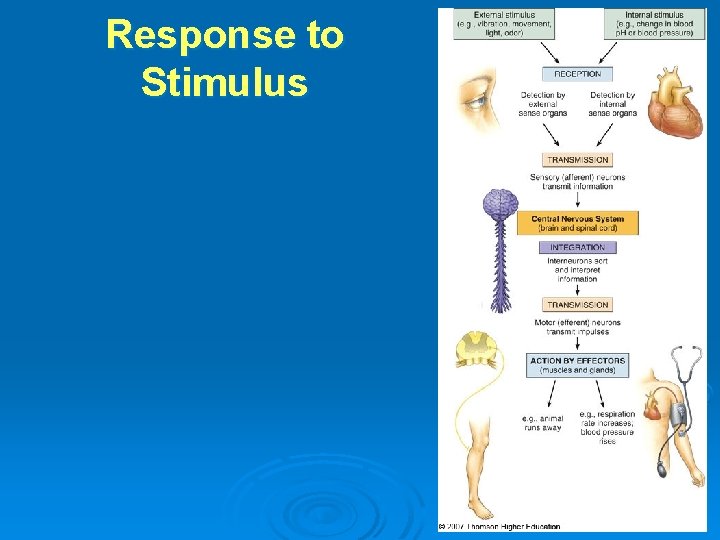
Neural Signaling 1 (1) Reception of information • by a sensory receptor (2) Transmission by an afferent neuron • to the central nervous system (CNS) (3) Integration by interneurons • in the central nervous system (CNS)
Neural Signaling 2 (4) Transmission by an efferent neuron • to other neurons or effector (5) Action by effectors • the muscles and glands
Peripheral Nervous System (PNS) • Made up of • • sensory receptors neurons outside the CNS
Response to Stimulus
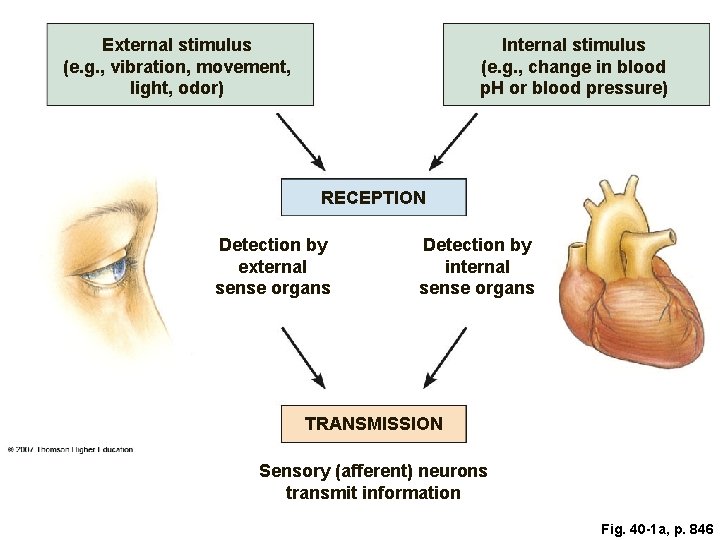
External stimulus (e. g. , vibration, movement, light, odor) Internal stimulus (e. g. , change in blood p. H or blood pressure) RECEPTION Detection by external sense organs Detection by internal sense organs TRANSMISSION Sensory (afferent) neurons transmit information Fig. 40 -1 a, p. 846
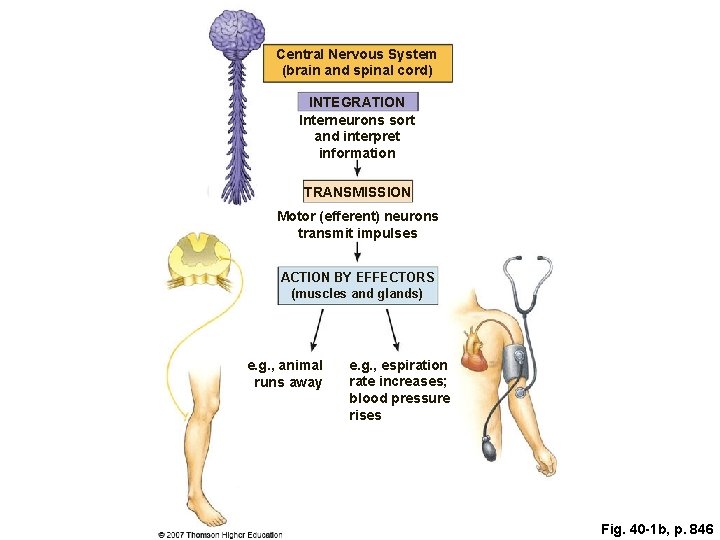
Central Nervous System (brain and spinal cord) INTEGRATION Interneurons sort and interpret information TRANSMISSION Motor (efferent) neurons transmit impulses ACTION BY EFFECTORS (muscles and glands) e. g. , animal runs away e. g. , espiration rate increases; blood pressure rises Fig. 40 -1 b, p. 846
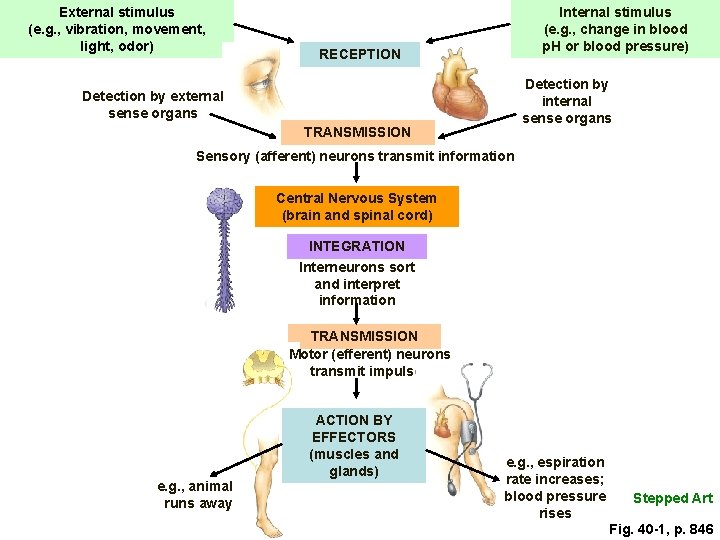
External stimulus (e. g. , vibration, movement, light, odor) Internal stimulus (e. g. , change in blood p. H or blood pressure) RECEPTION Detection by internal sense organs Detection by external sense organs TRANSMISSION Sensory (afferent) neurons transmit information Central Nervous System (brain and spinal cord) INTEGRATION Interneurons sort and interpret information TRANSMISSION Motor (efferent) neurons transmit impulses e. g. , animal runs away ACTION BY EFFECTORS (muscles and glands) e. g. , espiration rate increases; blood pressure rises Stepped Art Fig. 40 -1, p. 846
KEY CONCEPTS • Neural signaling involves reception, transmission, integration, and action by effectors
Learning Objective 2 • What is the structure of a typical neuron? • Give the function of each of its parts
Neurons • Specialized to • • • receive stimuli transmit electrical and chemical signals Cell body • contains nucleus and organelles
Dendrites • Many branched dendrites • • extend from cell body of neuron specialized to receive stimuli and send signals to the cell body
Axons 1 • A single long axon • • • extends from neuron cell body forms branches (axon collaterals) Transmits signals into terminal branches • which end in synaptic terminals
Axons 2 • Myelin sheath • • • surrounds many axons insulates Schwann cells • form the myelin sheath in the PNS
Axons 3 • In the CNS • • sheath is formed by other glial cells Nodes of Ranvier • gaps in sheath between successive Schwann cells
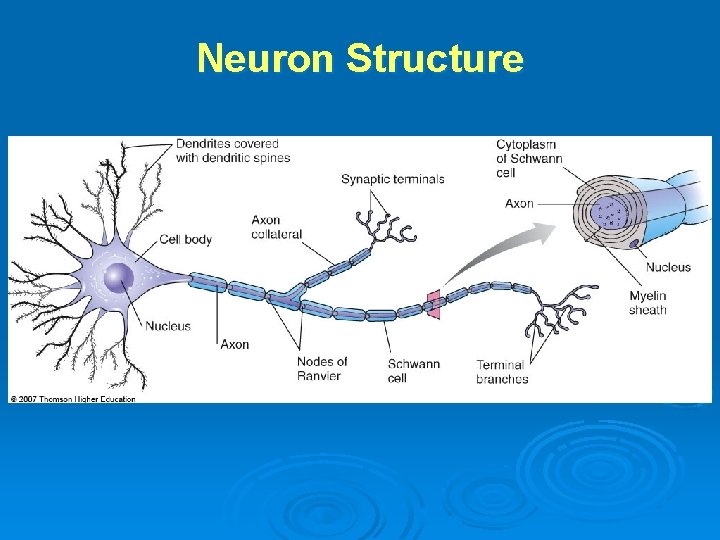
Neuron Structure
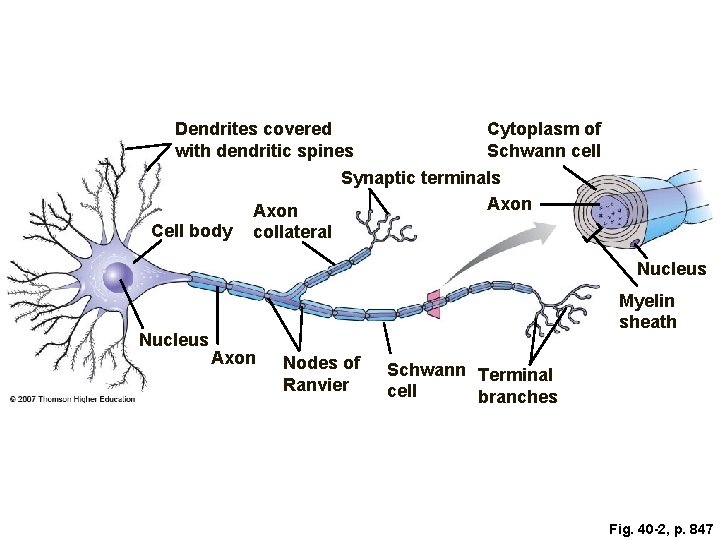
Dendrites covered with dendritic spines Cell body Axon collateral Cytoplasm of Schwann cell Synaptic terminals Axon Nucleus Myelin sheath Axon Nodes of Ranvier Schwann Terminal cell branches Fig. 40 -2, p. 847
Nerves and Ganglia • Nerve • • • several hundred axons wrapped in connective tissue Ganglion • mass of neuron cell bodies in the PNS
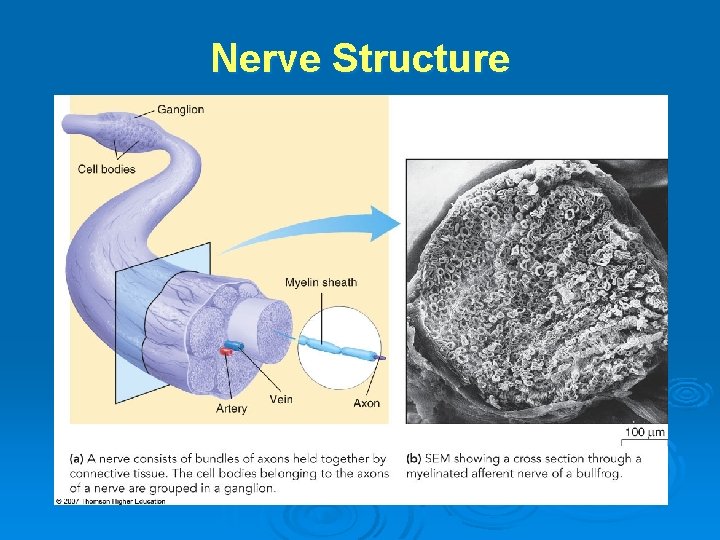
Nerve Structure
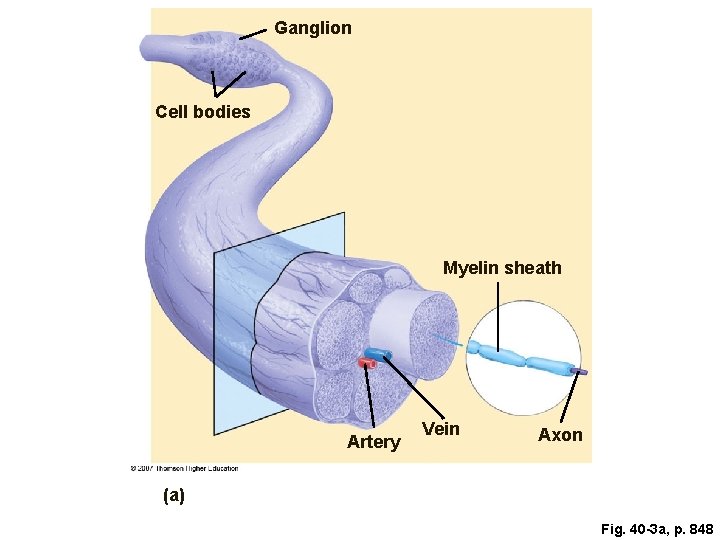
Ganglion Cell bodies Myelin sheath Artery Vein Axon (a) Fig. 40 -3 a, p. 848
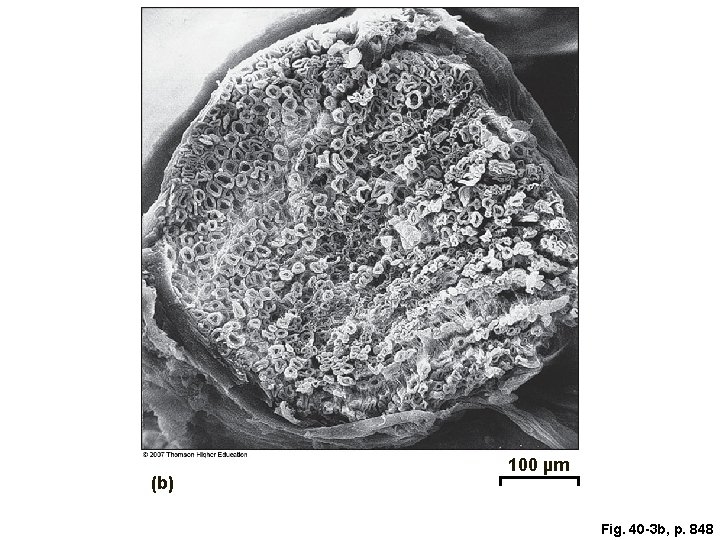
(b) 100 µm Fig. 40 -3 b, p. 848
Learn more about the structure of neurons and nerves by clicking on the figures in Thomson. NOW.
Learning Objective 3 • Name the main types of glial cells • Describe the functions of each
Glial Cells • Support and nourish neurons • Are important in neural communication
Glial Cell Types 1 • Astrocytes • • physically support neurons regulate extracellular fluid in CNS (by taking up excess potassium ions) communicate with one another (and with neurons) induce and stabilize synapses
Glial Cell Types 2 • Oligodendrocytes • • form myelin sheaths around axons in CNS Schwann cells • form sheaths around axons in PNS
Glial Cell Types 3 • Microglia • • Phagocytic cells Ependymal Cells • • • line cavities in the CNS contribute to formation of cerebrospinal fluid serve as neural stem cells
KEY CONCEPTS • Neurons are specialized to receive stimuli and transmit signals; glial cells are supporting cells that protect and nourish neurons and that can modify neural signals
Learning Objective 4 • How does the neuron develop and maintain a resting potential?
Neural Signals • Electrical signals transmit information • along axons • Plasma membrane of resting neuron (not transmitting an impulse) is polarized • Inner surface of plasma membrane is negatively charged • relative to extracellular fluid
Resting Potential • Potential difference of about -70 m. V • • across the membrane Magnitude of resting potential (1) differences in ion concentrations (Na+, K+) inside cell relative to extracellular fluid (2) selective permeability of plasma membrane to these ions
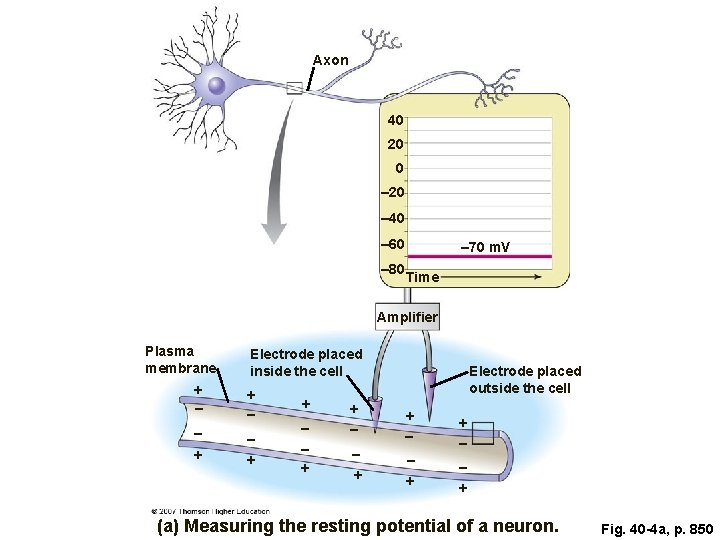
Axon 40 20 0 – 20 – 40 – 60 – 80 – 70 m. V Time Amplifier Plasma membrane + – – + Electrode placed inside the cell + – – + Electrode placed outside the cell + – – + (a) Measuring the resting potential of a neuron. Fig. 40 -4 a, p. 850
Ions • Pass through specific passive ion channels • • • K+ leak out faster than Na+ leak in Cl- accumulate at inner surface of plasma membrane Large anions (proteins) • • cannot cross plasma membrane contribute negative charges
Sodium–Potassium Pumps • Maintain gradients that determine resting potential • • transport 3 Na+ out for each 2 K+ in Require ATP
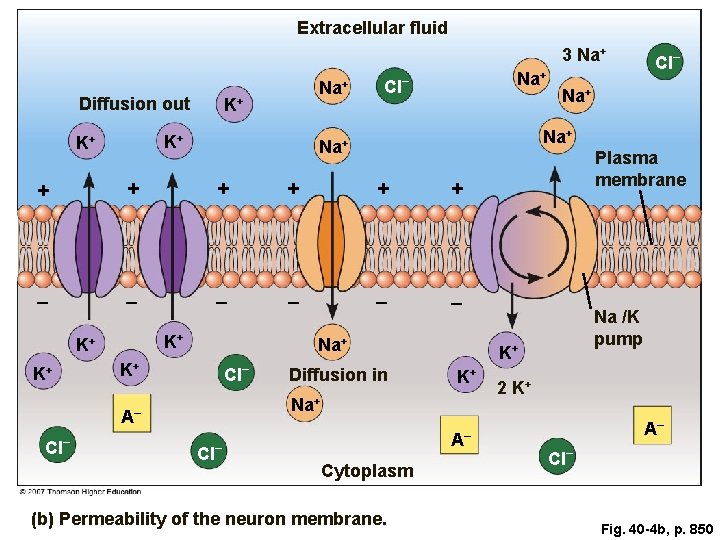
Extracellular fluid 3 Na+ Diffusion out Na+ K+ K+ K+ CI Na+ – + + + – – – K+ K+ A CI– Plasma membrane Na+ K+ CI– Diffusion in K+ CI A – Cytoplasm (b) Permeability of the neuron membrane. Na /K pump K+ Na+ _ Na+ Na+ + K+ CI– 2 K+ A _ _ CI– Fig. 40 -4 b, p. 850
KEY CONCEPTS • The resting potential of a neuron is maintained by differences in concentrations of specific ions inside the cell relative to the extracellular fluid and by selective permeability of the plasma membrane to these ions
Learning Objective 5 • Compare a graded potential with an action potential • Describe the production and transmission of each
Membrane Potential • Membrane is depolarized • • if stimulus causes membrane potential to become less negative Membrane is hyperpolarized • if membrane potential becomes more negative than resting potential
Graded Potential • A local response • Varies in magnitude • • depending on strength of applied stimulus Fades out • within a few millimeters of point of origin
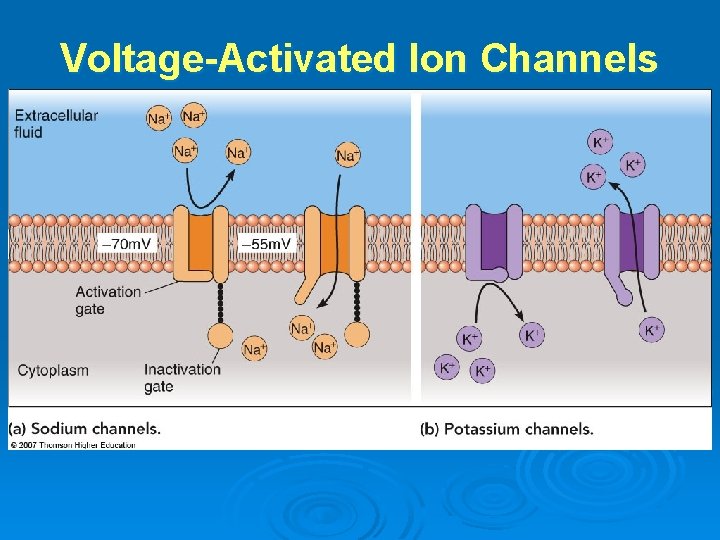
Action Potential 1 • Action potential is a wave of depolarization • • that moves down the axon Generated when • • • voltage across the membrane declines to a critical point (threshold level) voltage-activated ion channels open Na+ ions flow into the neuron
Voltage-Activated Ion Channels
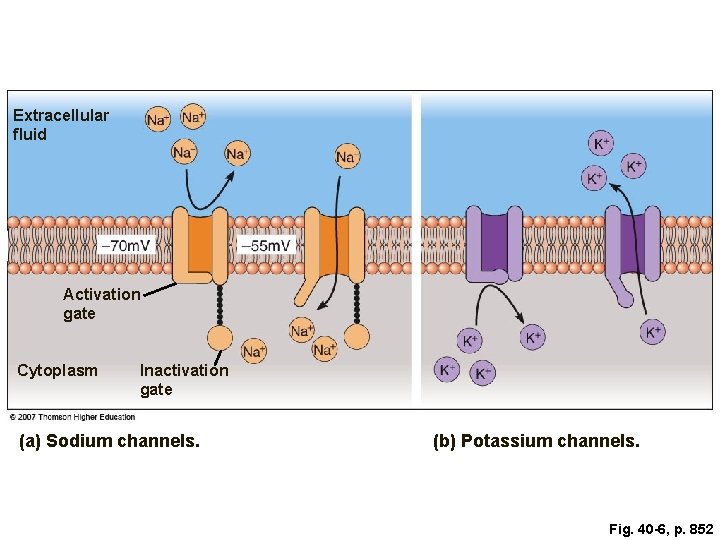
Extracellular fluid Activation gate Cytoplasm Inactivation gate (a) Sodium channels. (b) Potassium channels. Fig. 40 -6, p. 852
Voltage-Activated Ion Channels During an Action Potential
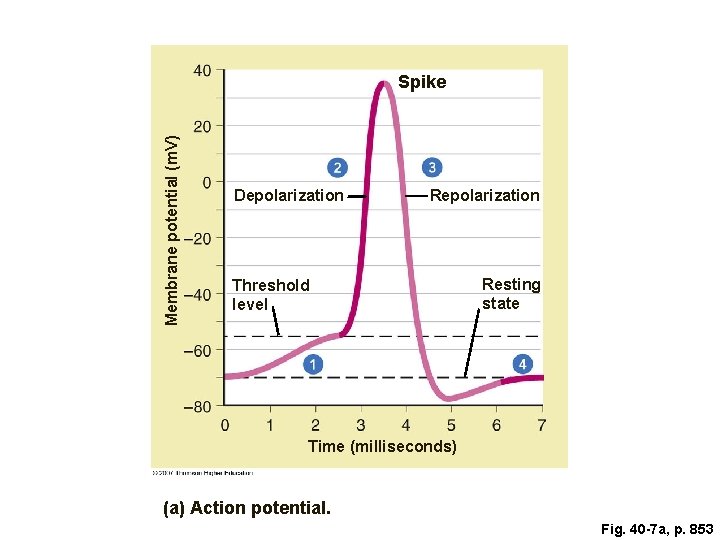
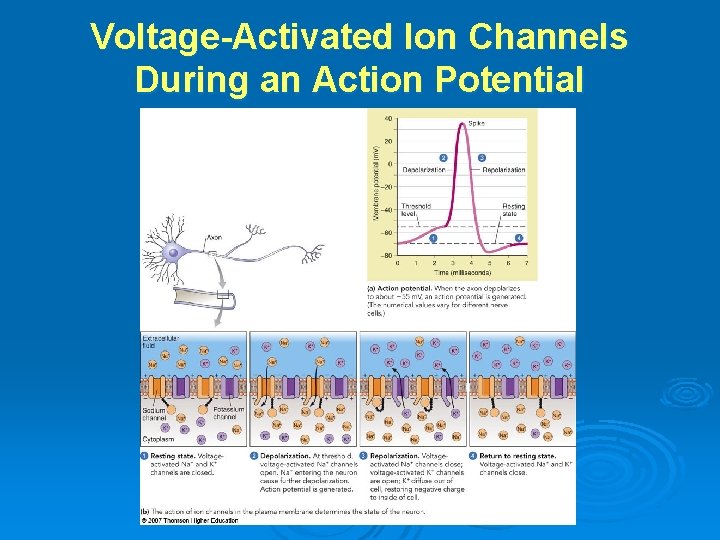
Membrane potential (m. V) Spike Depolarization Repolarization Threshold level Resting state Time (milliseconds) (a) Action potential. Fig. 40 -7 a, p. 853
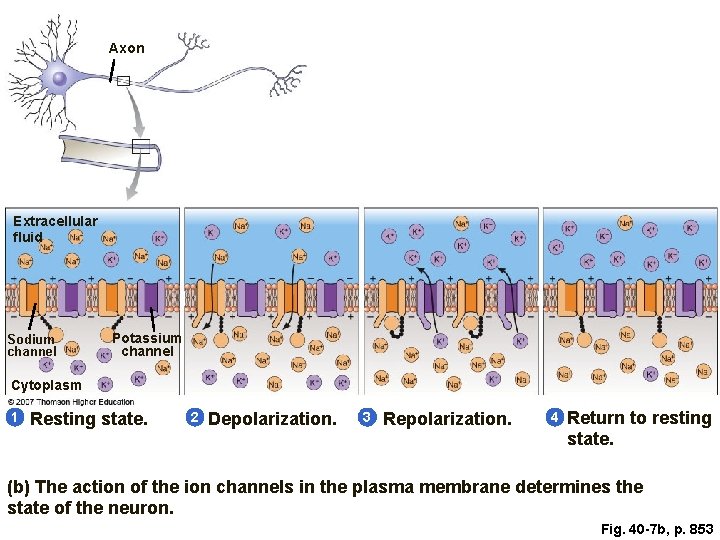
Axon Extracellular fluid Sodium channel Potassium channel Cytoplasm 1 Resting state. 2 Depolarization. 3 Repolarization. 4 Return to resting state. (b) The action of the ion channels in the plasma membrane determines the state of the neuron. Fig. 40 -7 b, p. 853
Action Potential 2 • An all-or-none response • • • no variation in strength of a single impulse either membrane potential exceeds threshold level or it does not Once begun, an action potential is selfpropagating
Repolarization • As an action potential moves down an axon, repolarization occurs behind it
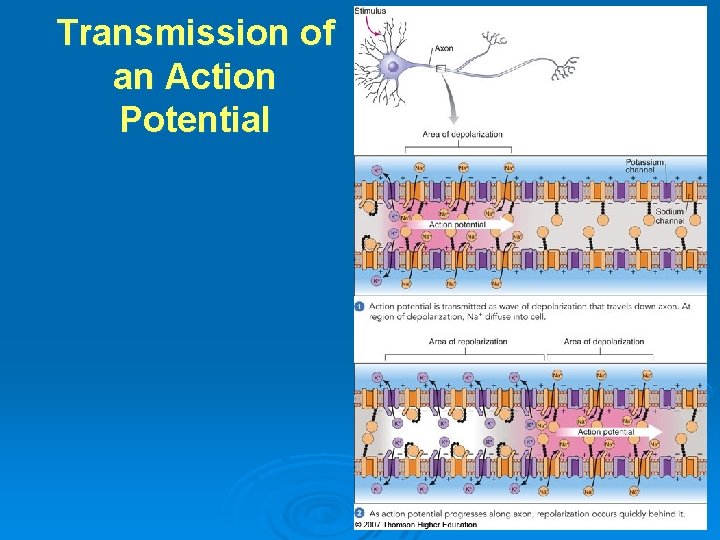
Transmission of an Action Potential
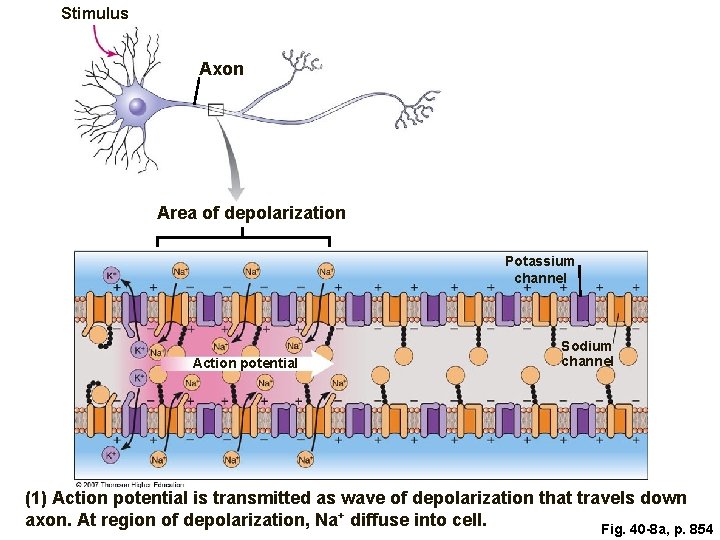
Stimulus Axon Area of depolarization Potassium channel Action potential Sodium channel (1) Action potential is transmitted as wave of depolarization that travels down axon. At region of depolarization, Na+ diffuse into cell. Fig. 40 -8 a, p. 854
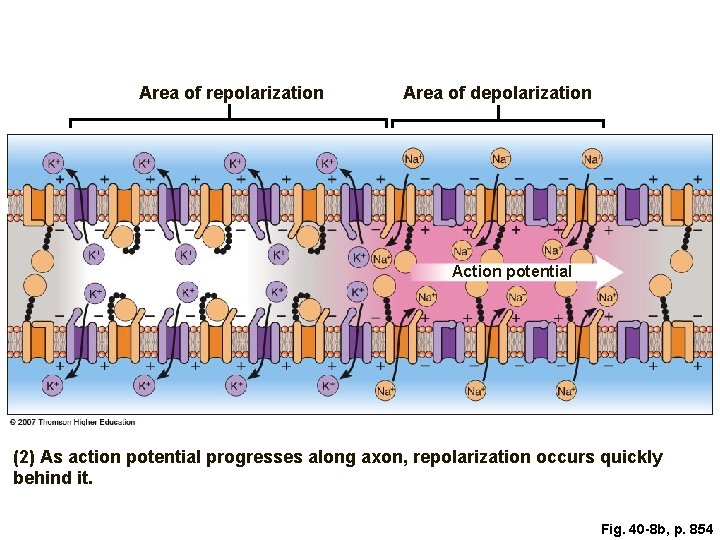
Area of repolarization Area of depolarization Action potential (2) As action potential progresses along axon, repolarization occurs quickly behind it. Fig. 40 -8 b, p. 854
Refractory Periods • During depolarization, the axon enters an absolute refractory period • • when it can’t transmit another action potential When enough gates controlling Na+ channels have been reset, the neuron enters a relative refractory period • when the threshold is higher
Learn more about ion channels and action potentials by clicking on the figures in Thomson. NOW.
KEY CONCEPTS • Depolarization of the neuron plasma membrane to threshold level generates an action potential, an electrical signal that travels as a wave of depolarization along the axon
Learning Objective 6 • Contrast continuous conduction with saltatory conduction
Continuous Conduction • Involves entire axon plasma membrane • Takes place in unmyelinated neurons
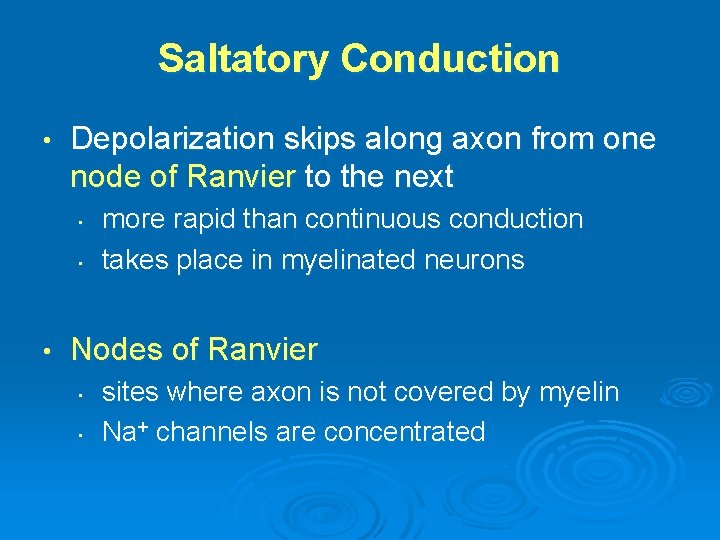
Saltatory Conduction • Depolarization skips along axon from one node of Ranvier to the next • • • more rapid than continuous conduction takes place in myelinated neurons Nodes of Ranvier • • sites where axon is not covered by myelin Na+ channels are concentrated
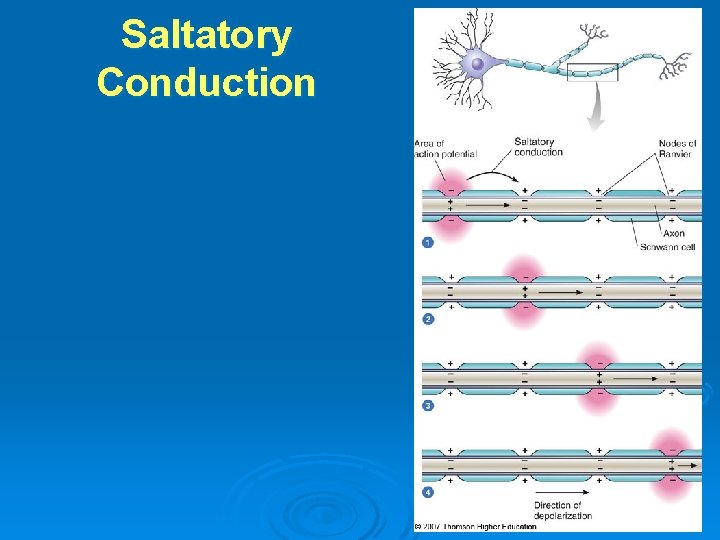
Saltatory Conduction
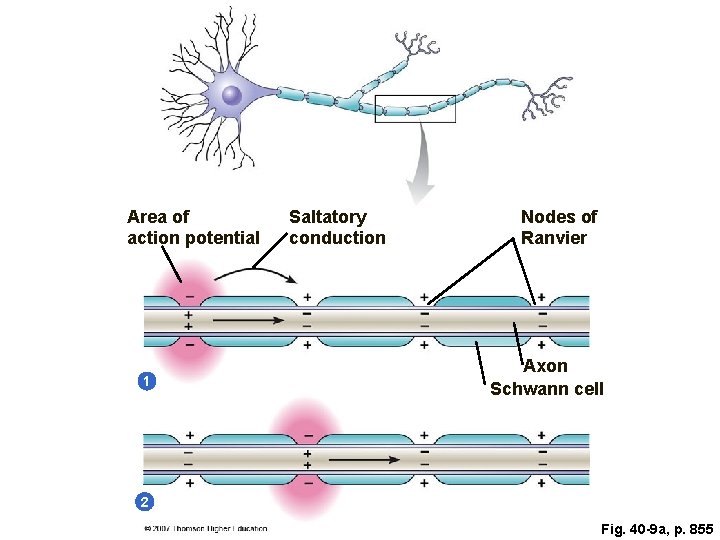
Area of action potential 1 Saltatory conduction Nodes of Ranvier Axon Schwann cell 2 Fig. 40 -9 a, p. 855
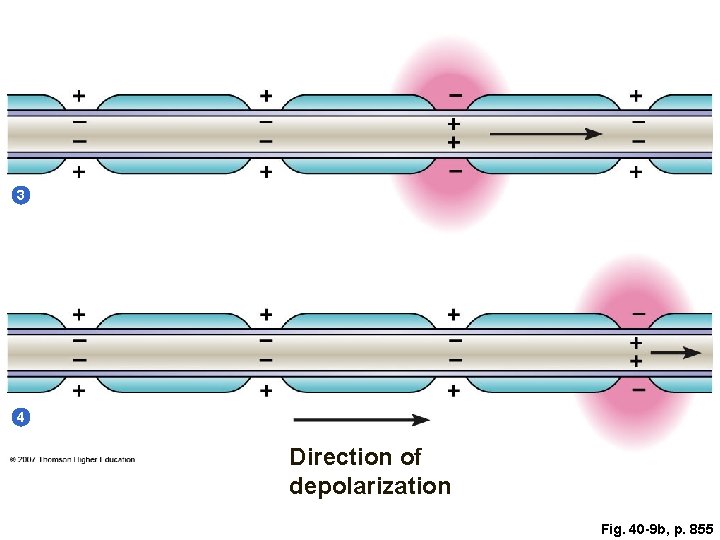
3 4 Direction of depolarization Fig. 40 -9 b, p. 855
Learning Objective 7 • Describe the actions of the neurotransmitters identified in the chapter
Synapses • Junctions between two neurons • • or between a neuron and effector Most synapses are chemical • some are electrical synapses
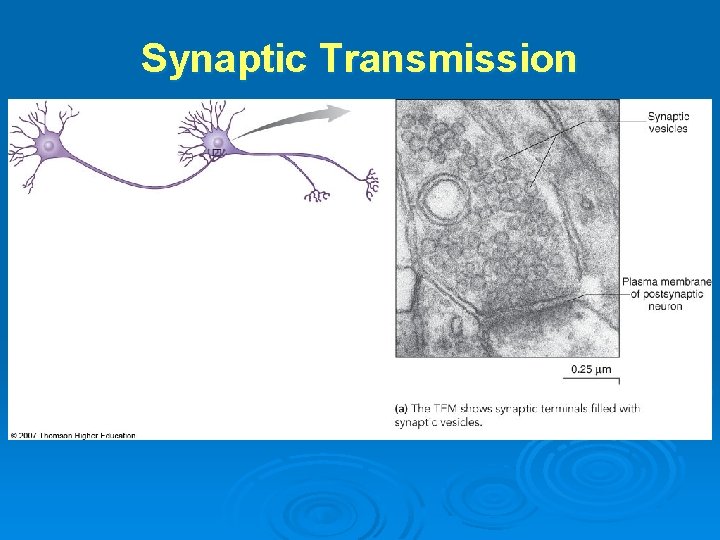
Synaptic Transmission • A presynaptic neuron releases neurotransmitter (chemical messenger) from its synaptic vesicles
Neurotransmitters 1 • Acetylcholine • • triggers contraction of skeletal muscle Biogenic amines • • • norepinephrine, serotonin, dopamine important in regulating mood dopamine is also important in motor function
Neurotransmitters 2 • Some amino acids • • • glutamate (excitatory neurotransmitter in brain) GABA (widespread inhibitory neurotransmitter) Neuropeptides (opioids) • • endorphins (e. g. beta-endorphin) enkephalins
Neurotransmitters 3 • Nitric oxide (NO) • • gaseous neurotransmitter transmits signals from postsynaptic neuron to presynaptic neuron (opposite direction from other neurotransmitters)
Learning Objective 8 • Trace the events that take place in synaptic transmission • Draw diagrams to support your description
Synaptic Transmission • Calcium ions cause synaptic vesicles to fuse with presynaptic membrane • • releases neurotransmitter into synaptic cleft Neurotransmitter diffuses across the synaptic cleft • combines with specific receptors on a postsynaptic neuron
Synaptic Transmission
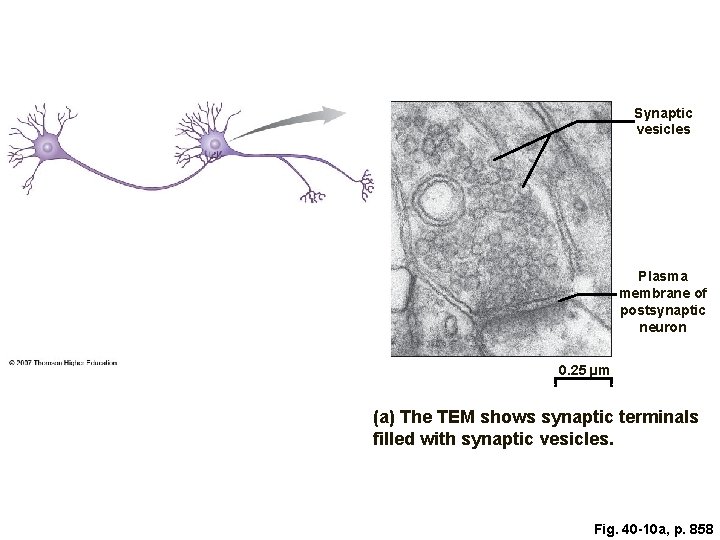
Synaptic vesicles Plasma membrane of postsynaptic neuron 0. 25 µm (a) The TEM shows synaptic terminals filled with synaptic vesicles. Fig. 40 -10 a, p. 858
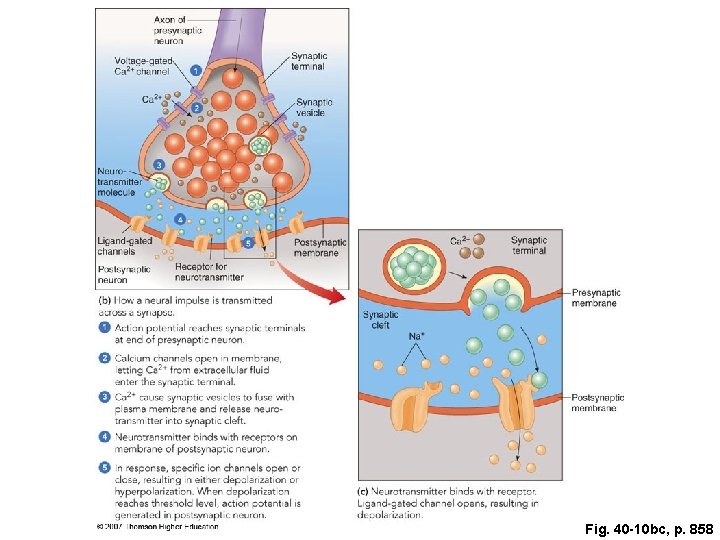
Fig. 40 -10 bc, p. 858
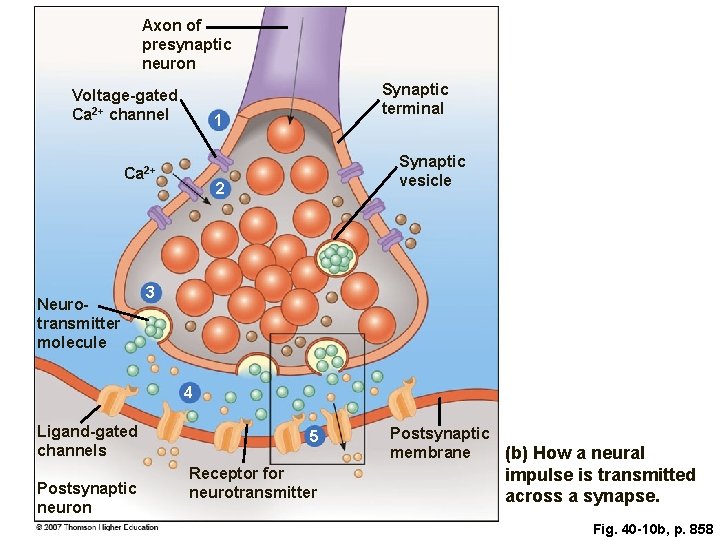
Axon of presynaptic neuron Voltage-gated Ca 2+ channel 1 Ca 2+ Neurotransmitter molecule Synaptic terminal Synaptic vesicle 2 3 4 Ligand-gated channels Postsynaptic neuron 5 Receptor for neurotransmitter Postsynaptic membrane (b) How a neural impulse is transmitted across a synapse. Fig. 40 -10 b, p. 858
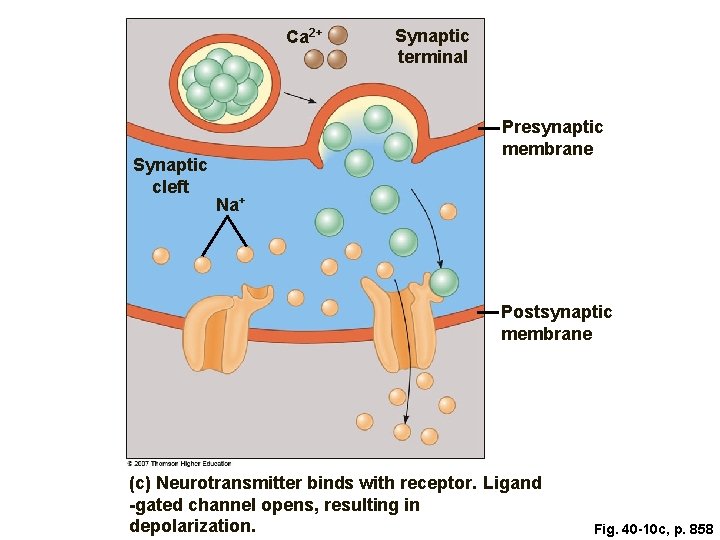
Ca 2+ Synaptic cleft Synaptic terminal Presynaptic membrane Na+ Postsynaptic membrane (c) Neurotransmitter binds with receptor. Ligand -gated channel opens, resulting in depolarization. Fig. 40 -10 c, p. 858
Neurotransmitter Receptors • Many are proteins that form ligand-gated ion channels • Others work through a second messenger such as c. AMP
Learn more about synaptic transmission by clicking on the figure in Thomson. NOW.
KEY CONCEPTS • Neurons signal other cells by releasing neurotransmitters at synapses
Learning Objective 9 • Compare excitatory and inhibitory signals and their effects
Binding of Neurotransmitter to a Receptor • Binding causes either • • • excitatory postsynaptic potential (EPSP) or inhibitory postsynaptic potential (IPSP) Depending on the type of receptor
EPSPs and IPSPs • EPSPs • • bring neuron closer to firing IPSPs • move neuron farther away from its firing level
Learning Objective 10 • Define neural integration • Describe how a postsynaptic neuron integrates incoming stimuli and “decides” whether or not to fire
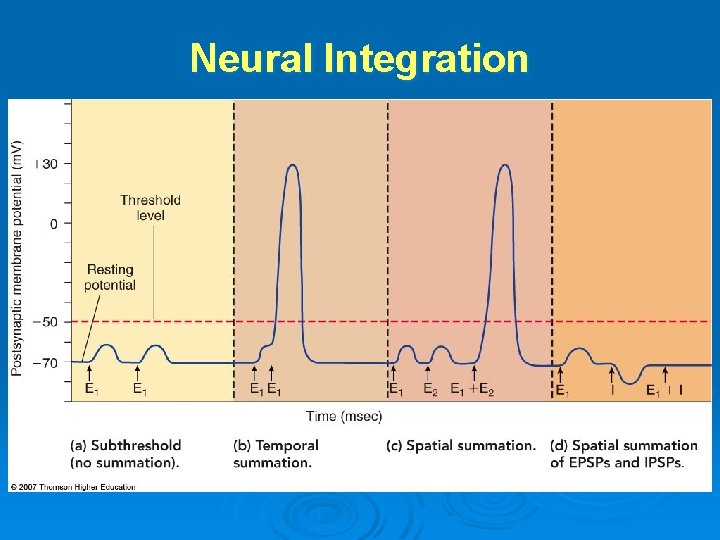
Neural Integration • Process of summing (integrating) incoming signals • Summation • process of adding and subtracting incoming signals
Summation • Each EPSP or IPSP is a graded potential • • • vary in magnitude depending on strength of stimulus applied Summation of several EPSPs • brings neuron to critical firing level
Temporal Summation • Occurs when repeated stimuli cause new EPSPs to develop before previous EPSPs have decayed
Spatial Summation • Occurs when several closely spaced synaptic terminals release neurotransmitter simultaneously • stimulating postsynaptic neuron at several different places
Neural Integration
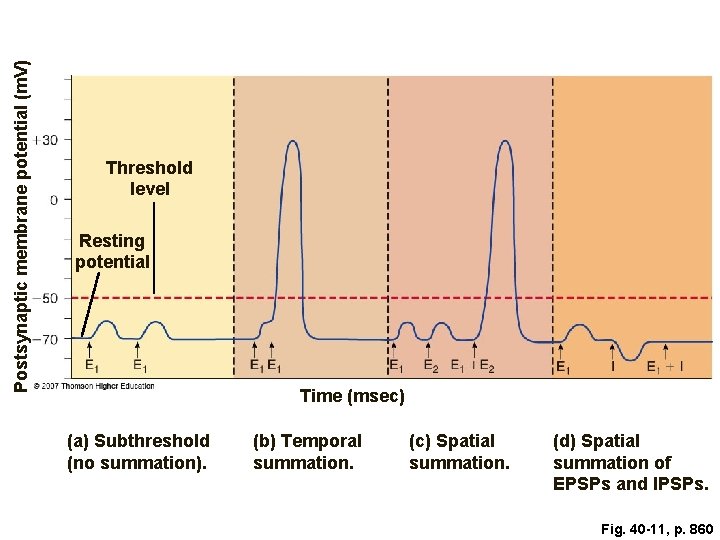
Postsynaptic membrane potential (m. V) Threshold level Resting potential Time (msec) (a) Subthreshold (no summation). (b) Temporal summation. (c) Spatial summation. (d) Spatial summation of EPSPs and IPSPs. Fig. 40 -11, p. 860
KEY CONCEPTS • During integration, incoming neural signals are summed; temporal and spatial summation can bring a neuron to threshold level
Learning Objective 11 • Distinguish among convergence, divergence, and reverberation • Explain why each is important
Neural Circuits • Complex neural circuits are possible because of associations such as convergence and divergence
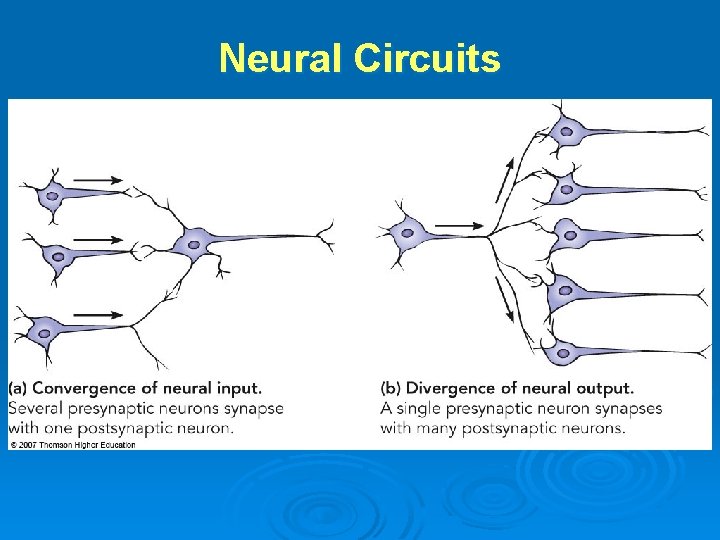
Convergence • A single neuron is affected by converging signals from two or more presynaptic neurons • Allows CNS to integrate incoming information from various sources
Divergence • A single presynaptic neuron stimulates many postsynaptic neurons • allowing widespread effect
Neural Circuits
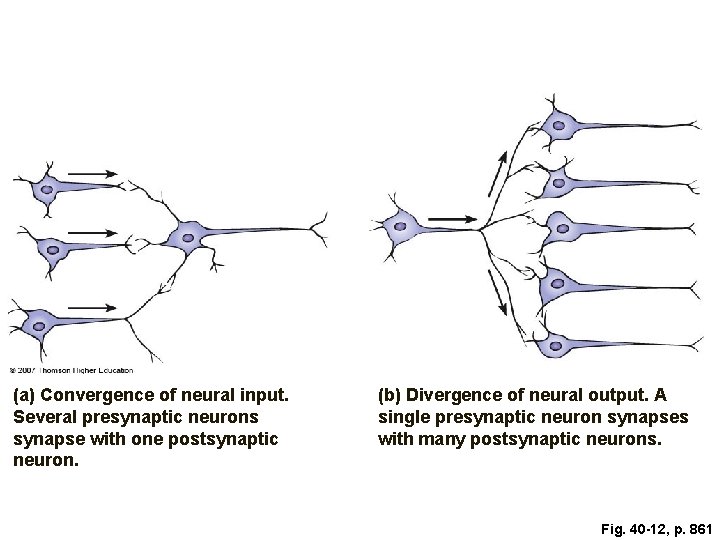
(a) Convergence of neural input. Several presynaptic neurons synapse with one postsynaptic neuron. (b) Divergence of neural output. A single presynaptic neuron synapses with many postsynaptic neurons. Fig. 40 -12, p. 861
Reverberating Circuits • Important in • • rhythmic breathing mental alertness short-term memory Depend on positive feedback • new impulses generated again and again until synapses fatigue
Reverberating Circuits
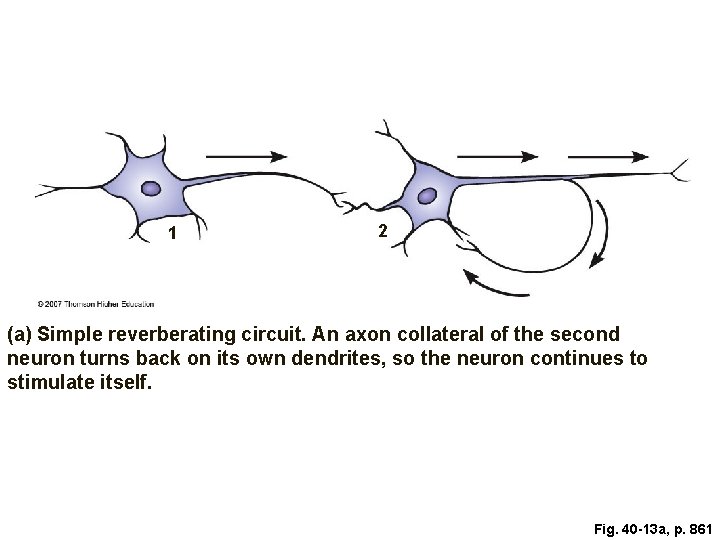
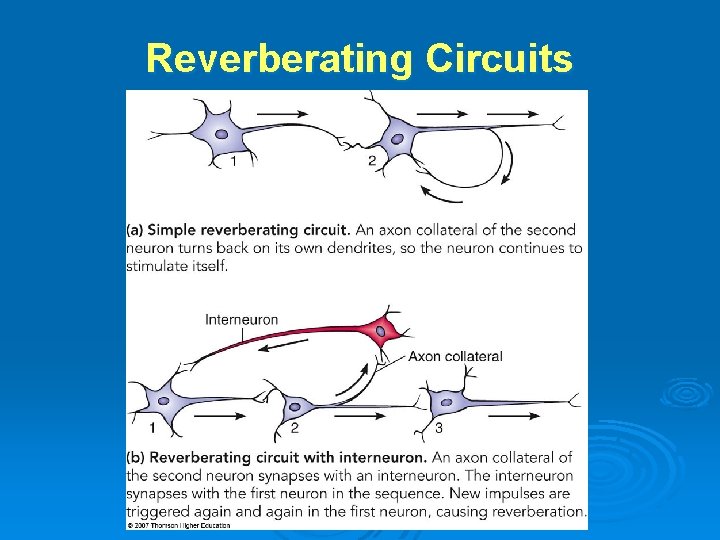
1 2 (a) Simple reverberating circuit. An axon collateral of the second neuron turns back on its own dendrites, so the neuron continues to stimulate itself. Fig. 40 -13 a, p. 861
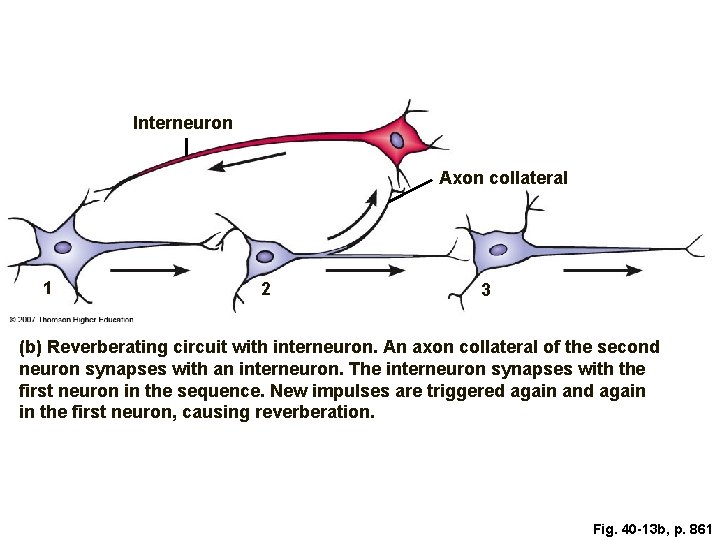
Interneuron Axon collateral 1 2 3 (b) Reverberating circuit with interneuron. An axon collateral of the second neuron synapses with an interneuron. The interneuron synapses with the first neuron in the sequence. New impulses are triggered again and again in the first neuron, causing reverberation. Fig. 40 -13 b, p. 861
- Slides: 97