
Neural Recording System By Ivana Duvnjak Stephen Kilpatrick
Neural Recording System By: Ivana Duvnjak Stephen Kilpatrick Dawit Fsiha
Outline p What is a Neural Network Recording System? p Why are they important? p How can they be improved? p Some possible solutions p Analysis of some solutions p Conclusions
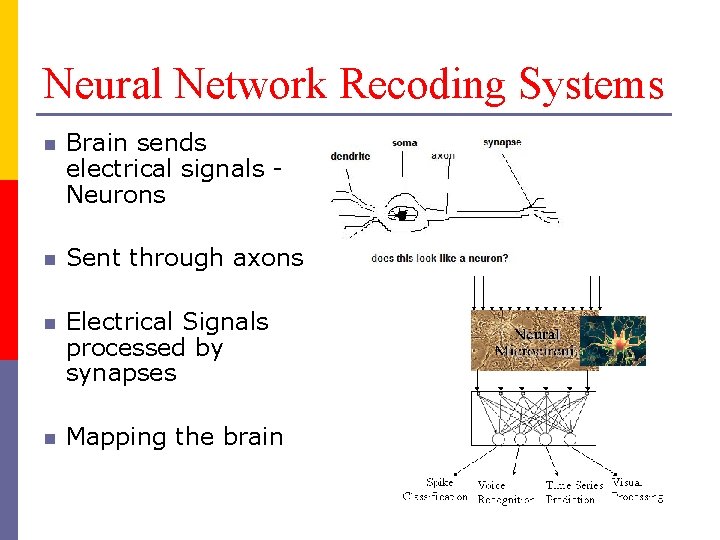
Neural Network Recoding Systems n Brain sends electrical signals Neurons n Sent through axons n Electrical Signals processed by synapses n Mapping the brain
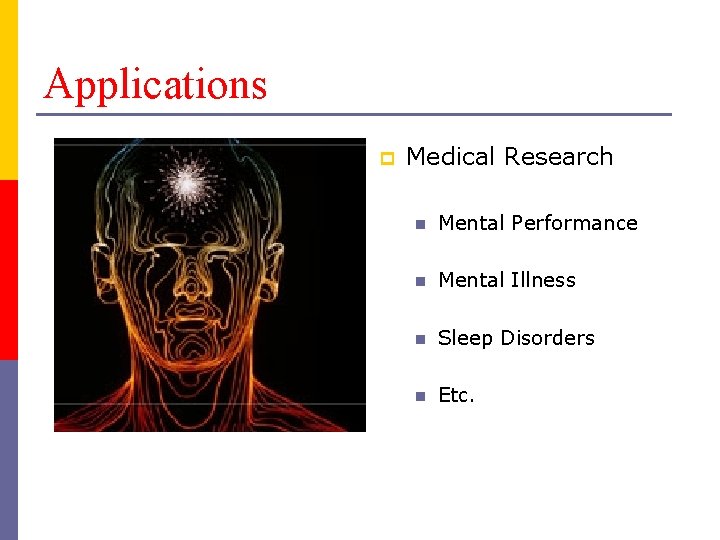
Applications p Medical Research n Mental Performance n Mental Illness n Sleep Disorders n Etc.
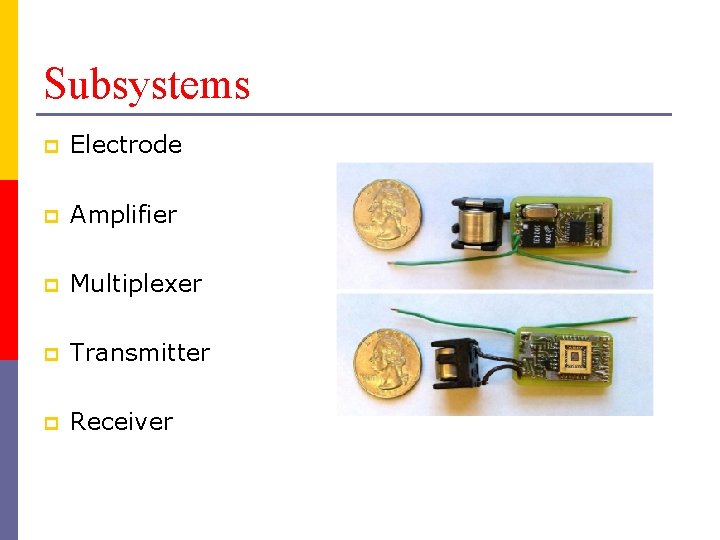
Subsystems p Electrode p Amplifier p Multiplexer p Transmitter p Receiver
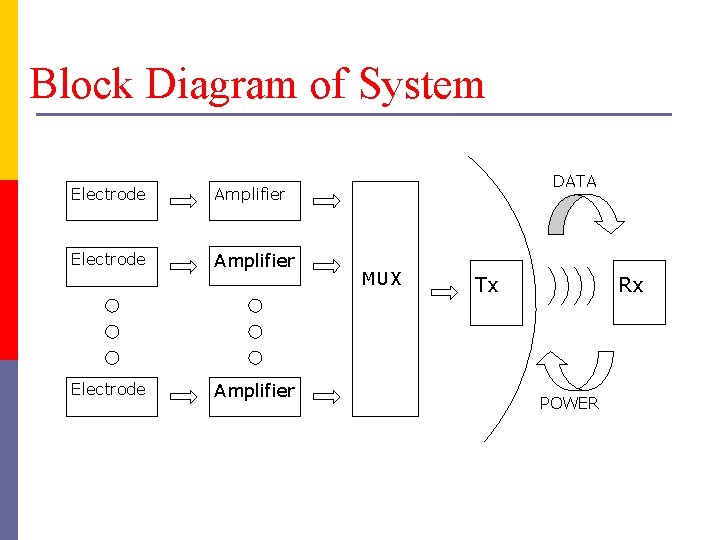
Block Diagram of System Electrode Amplifier DATA MUX Tx Rx POWER
Possible Improvements p Areas to improve in the neural recording system p Electrodes p Amplifier p Multiplexer p Transmitter p Receiver
Neural LNA Amplifier p Functions n Power dissipation must kept low n Must reject noise ( flicker noise) n Amplifying a weak signal received from the electrodes n Must reject the DC offset created at the electrodes-Tissue interface
Neural Amplifier Requirements p Power dissipation p Bandwidth requirement p Gain p Stability p Overall size
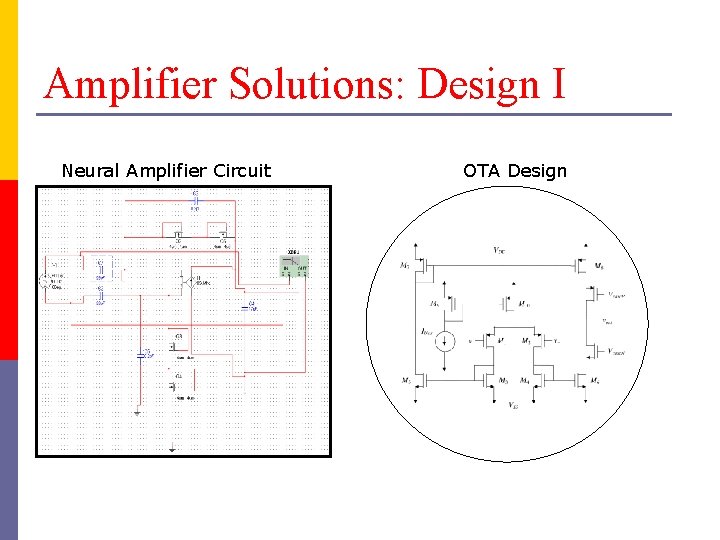
Amplifier Solutions: Design I Neural Amplifier Circuit OTA Design
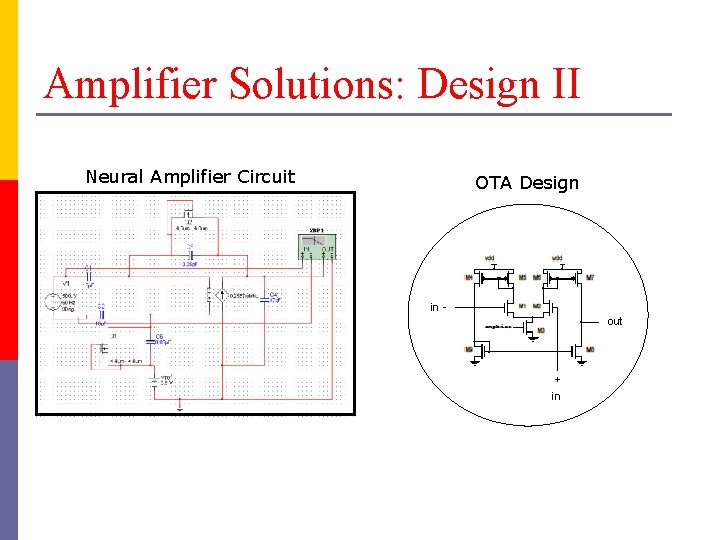
Amplifier Solutions: Design II Neural Amplifier Circuit OTA Design
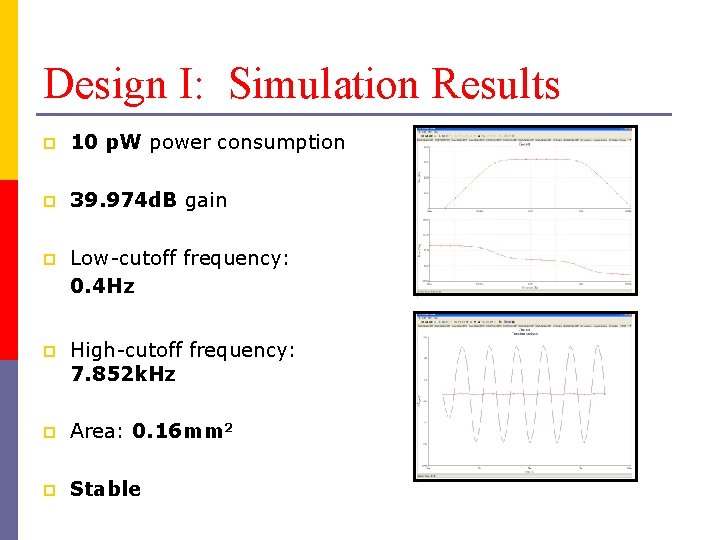
Design I: Simulation Results p 10 p. W power consumption p 39. 974 d. B gain p Low-cutoff frequency: 0. 4 Hz p High-cutoff frequency: 7. 852 k. Hz p Area: 0. 16 mm 2 p Stable
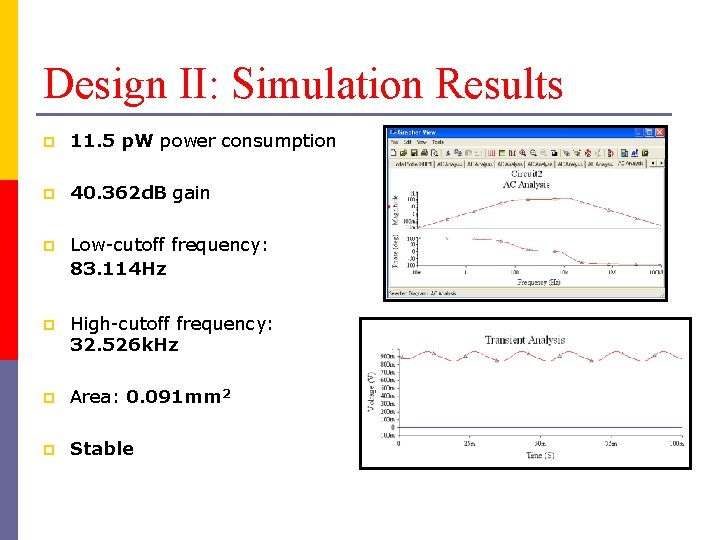
Design II: Simulation Results p 11. 5 p. W power consumption p 40. 362 d. B gain p Low-cutoff frequency: 83. 114 Hz p High-cutoff frequency: 32. 526 k. Hz p Area: 0. 091 mm 2 p Stable
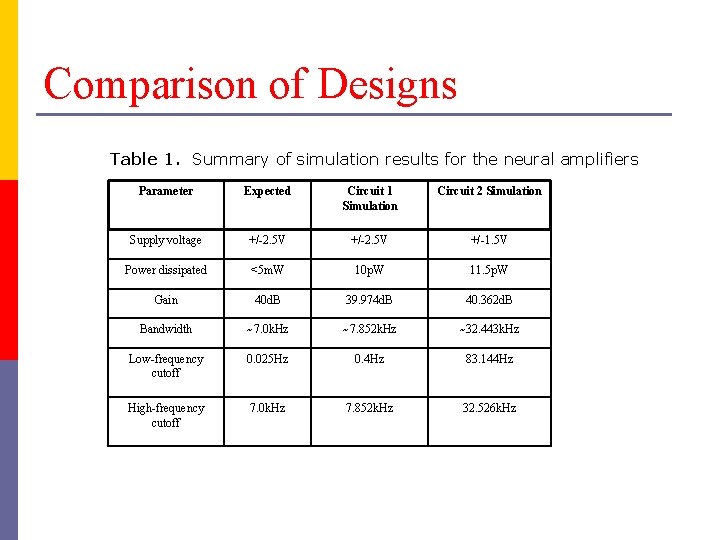
Comparison of Designs Table 1. Summary of simulation results for the neural amplifiers Parameter Expected Circuit 1 Simulation Circuit 2 Simulation Supply voltage +/-2. 5 V +/-1. 5 V Power dissipated <5 m. W 10 p. W 11. 5 p. W Gain 40 d. B 39. 974 d. B 40. 362 d. B Bandwidth ~7. 0 k. Hz ~7. 852 k. Hz ~32. 443 k. Hz Low-frequency cutoff 0. 025 Hz 0. 4 Hz 83. 144 Hz High-frequency cutoff 7. 0 k. Hz 7. 852 k. Hz 32. 526 k. Hz
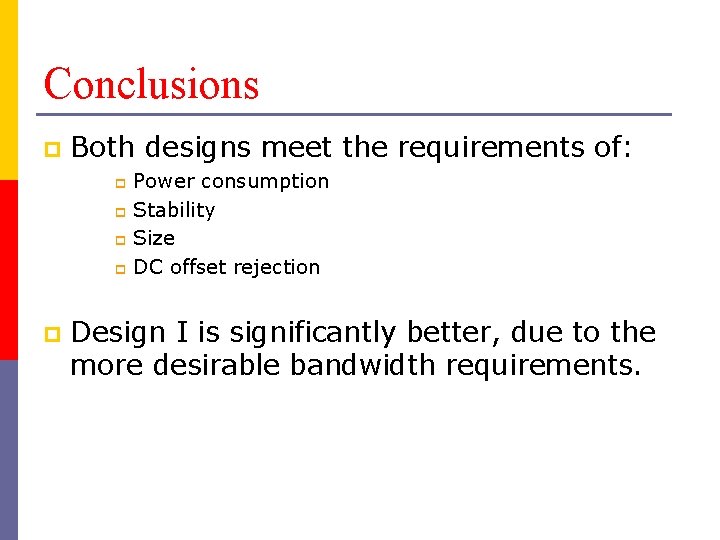
Conclusions p Both designs meet the requirements of: Power consumption p Stability p Size p DC offset rejection p p Design I is significantly better, due to the more desirable bandwidth requirements.

Implementation

References
Exit(0); Questions?
- Slides: 18