
Neural Networks History Pitts Mc Culloch 1943 First
- Slides: 8
Neural Networks History
Pitts & Mc. Culloch (1943) • First mathematical model of biological neurons • All Boolean operations can be implemented by these neuron-like nodes • Competitor to Von Neumann model for general purpose computing device • Origin of automata theory
Hebb (1949) • Hebbian rule of learning: increase connection strength between neurons i and j whenever both are activated • Or increase connection strength between nodes i and j whenever both are simultaneously ON or OFF 3
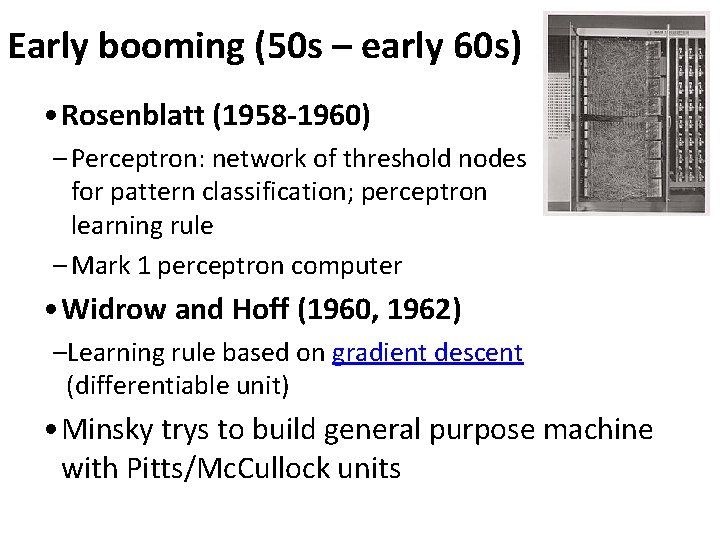
Early booming (50 s – early 60 s) • Rosenblatt (1958 -1960) – Perceptron: network of threshold nodes for pattern classification; perceptron learning rule – Mark 1 perceptron computer • Widrow and Hoff (1960, 1962) –Learning rule based on gradient descent (differentiable unit) • Minsky trys to build general purpose machine with Pitts/Mc. Cullock units
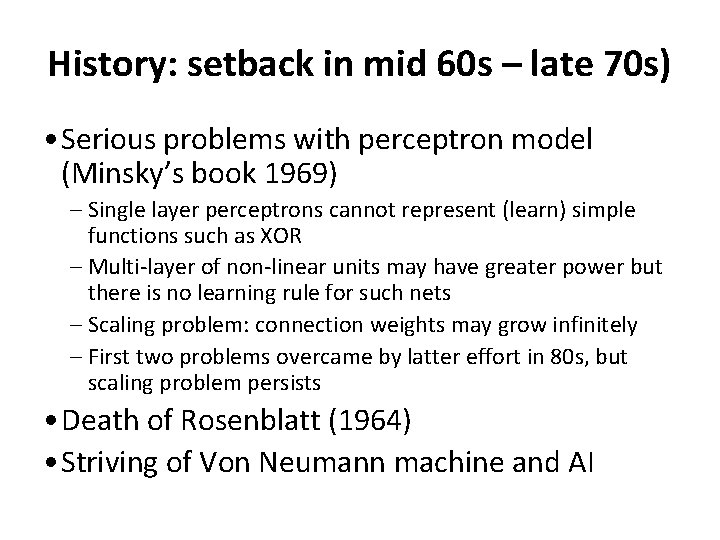
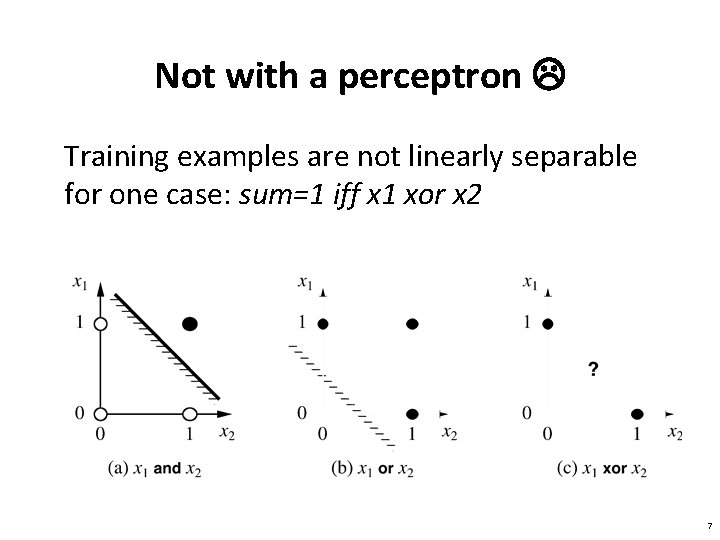
History: setback in mid 60 s – late 70 s) • Serious problems with perceptron model (Minsky’s book 1969) – Single layer perceptrons cannot represent (learn) simple functions such as XOR – Multi-layer of non-linear units may have greater power but there is no learning rule for such nets – Scaling problem: connection weights may grow infinitely – First two problems overcame by latter effort in 80 s, but scaling problem persists • Death of Rosenblatt (1964) • Striving of Von Neumann machine and AI
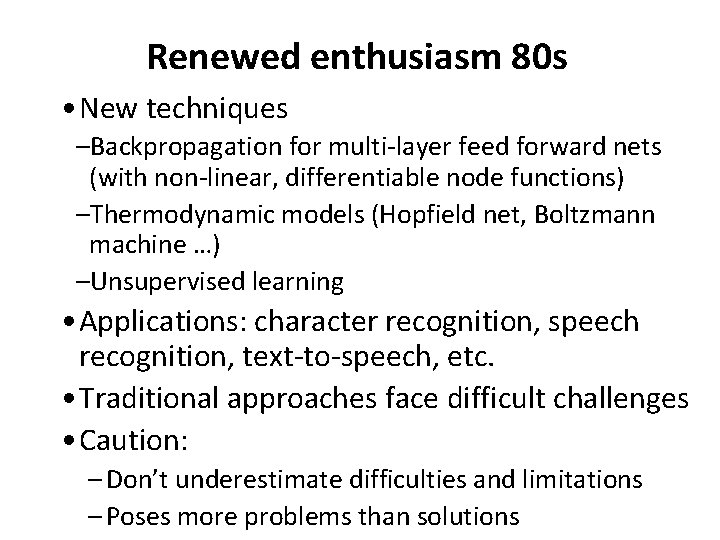
Renewed enthusiasm 80 s • New techniques –Backpropagation for multi-layer feed forward nets (with non-linear, differentiable node functions) –Thermodynamic models (Hopfield net, Boltzmann machine …) –Unsupervised learning • Applications: character recognition, speech recognition, text-to-speech, etc. • Traditional approaches face difficult challenges • Caution: – Don’t underestimate difficulties and limitations – Poses more problems than solutions
Not with a perceptron Training examples are not linearly separable for one case: sum=1 iff x 1 xor x 2 7
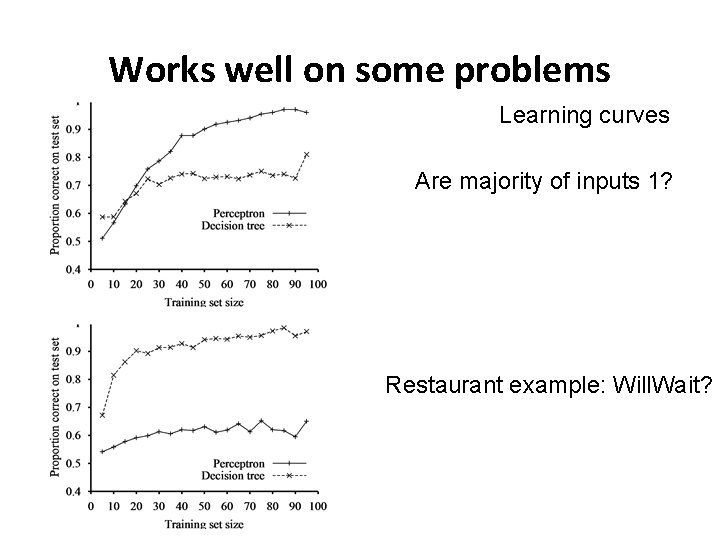
Works well on some problems Learning curves Are majority of inputs 1? Restaurant example: Will. Wait?