
Neural Networks for Machine Learning Lecture 11 a




- Slides: 37
Neural Networks for Machine Learning Lecture 11 a Hopfield Nets Geoffrey Hinton Nitish Srivastava, Kevin Swersky Tijmen Tieleman Abdel-rahman Mohamed
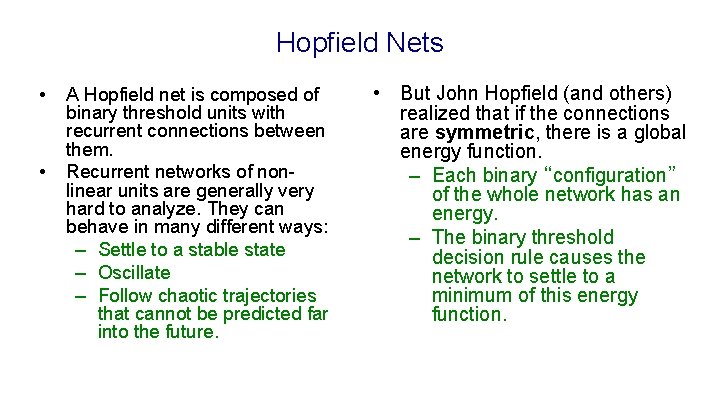
Hopfield Nets • • A Hopfield net is composed of binary threshold units with recurrent connections between them. Recurrent networks of nonlinear units are generally very hard to analyze. They can behave in many different ways: – Settle to a stable state – Oscillate – Follow chaotic trajectories that cannot be predicted far into the future. • But John Hopfield (and others) realized that if the connections are symmetric, there is a global energy function. – Each binary “configuration” of the whole network has an energy. – The binary threshold decision rule causes the network to settle to a minimum of this energy function.
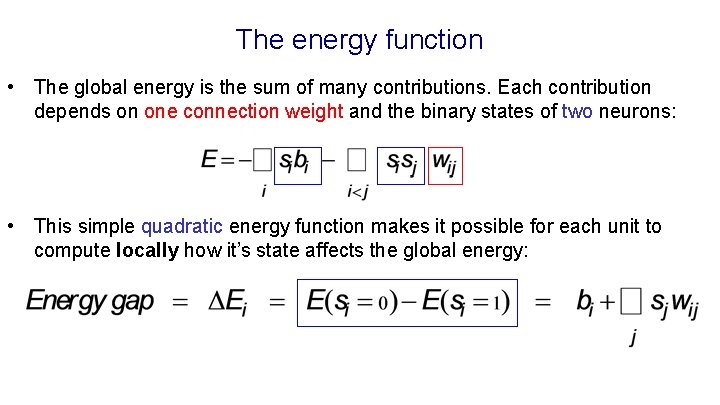
The energy function • The global energy is the sum of many contributions. Each contribution depends on one connection weight and the binary states of two neurons: • This simple quadratic energy function makes it possible for each unit to compute locally how it’s state affects the global energy:
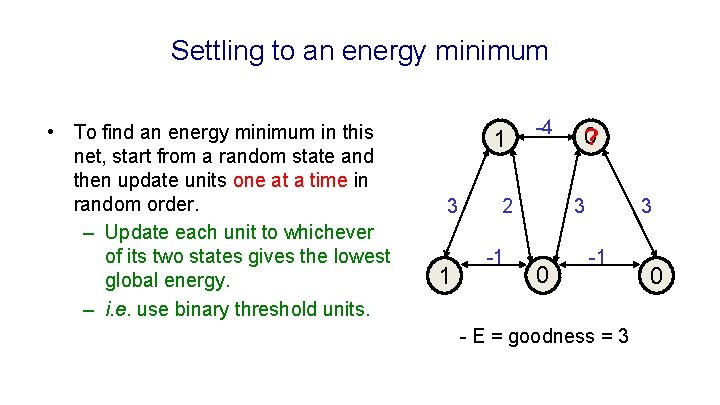
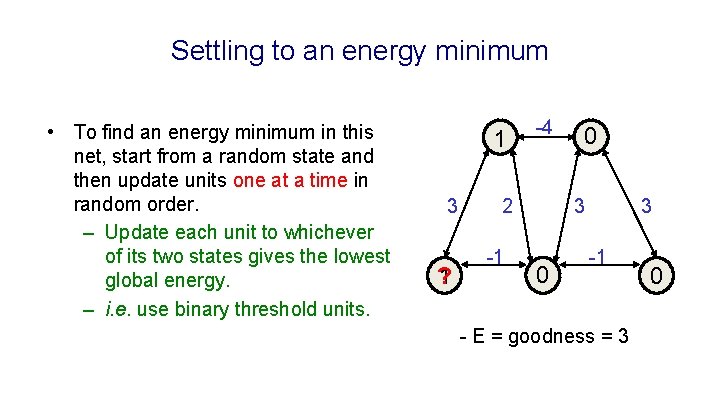
Settling to an energy minimum • To find an energy minimum in this net, start from a random state and then update units one at a time in random order. – Update each unit to whichever of its two states gives the lowest global energy. – i. e. use binary threshold units. 1 3 1 -4 2 -1 0 ? 3 0 3 -1 - E = goodness = 3 0
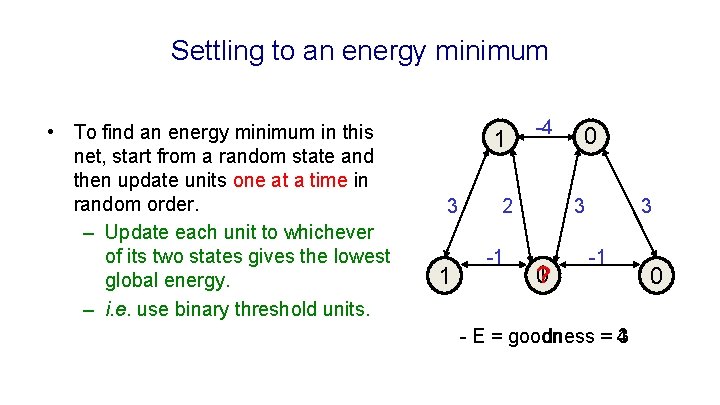
Settling to an energy minimum • To find an energy minimum in this net, start from a random state and then update units one at a time in random order. – Update each unit to whichever of its two states gives the lowest global energy. – i. e. use binary threshold units. 1 3 ? 1 -4 2 -1 0 3 -1 - E = goodness = 3 0
Settling to an energy minimum • To find an energy minimum in this net, start from a random state and then update units one at a time in random order. – Update each unit to whichever of its two states gives the lowest global energy. – i. e. use binary threshold units. 1 3 1 -4 2 -1 0 3 1 0 ? 3 -1 3 - E = goodness = 4 0
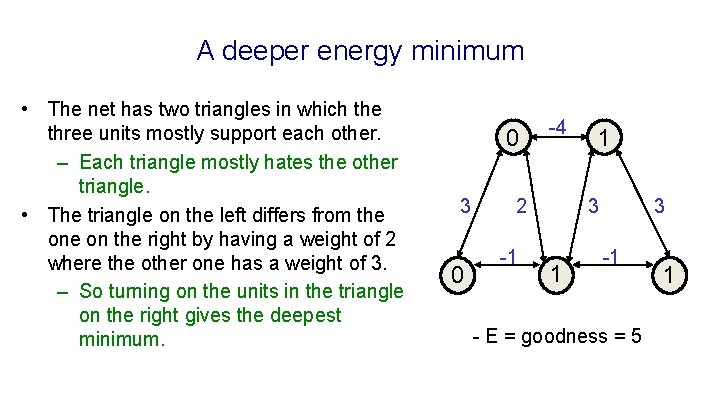
A deeper energy minimum • The net has two triangles in which the three units mostly support each other. – Each triangle mostly hates the other triangle. • The triangle on the left differs from the on the right by having a weight of 2 where the other one has a weight of 3. – So turning on the units in the triangle on the right gives the deepest minimum. 0 3 0 -4 2 -1 1 3 -1 - E = goodness = 5 1
Why do the decisions need to be sequential? • If units make simultaneous decisions the energy could go up. • With simultaneous parallel updating we can get oscillations. – They always have a period of 2. • If the updates occur in parallel but with random timing, the oscillations are usually destroyed. +5 0 -100 0 +5 At the next parallel step, both units will turn on. This has very high energy, so then they will both turn off again.
A neat way to make use of this type of computation • Hopfield (1982) proposed that • Using energy minima to memories could be energy represent memories gives a content-addressable memory: minima of a neural net. – An item can be accessed – The binary threshold decision by just knowing part of its rule can then be used to content. “clean up” incomplete or • This was really amazing corrupted memories. in the year 16 BG. – It is robust against • The idea of memories as energy hardware damage. minima was proposed by I. A. – It’s like reconstructing a Richards in 1924 in “Principles of dinosaur from a few bones. Literary Criticism”.
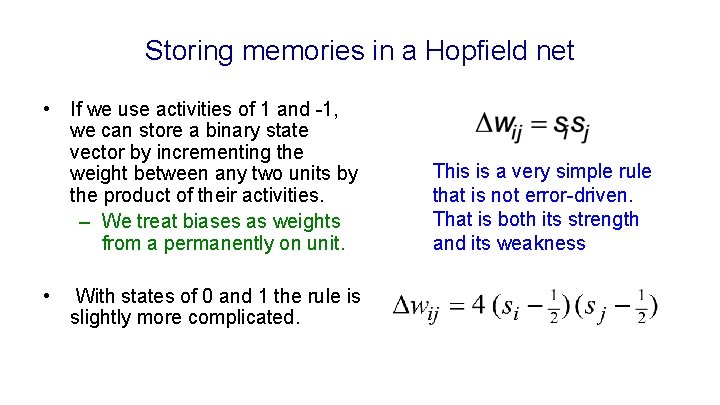
Storing memories in a Hopfield net • If we use activities of 1 and -1, we can store a binary state vector by incrementing the weight between any two units by the product of their activities. – We treat biases as weights from a permanently on unit. • With states of 0 and 1 the rule is slightly more complicated. This is a very simple rule that is not error-driven. That is both its strength and its weakness
Neural Networks for Machine Learning Lecture 11 b Dealing with spurious minima in Hopfield Nets Geoffrey Hinton Nitish Srivastava, Kevin Swersky Tijmen Tieleman Abdel-rahman Mohamed
The storage capacity of a Hopfield net • Using Hopfield’s storage rule the capacity of a totally connected net with N units is only about 0. 15 N memories. – At N bits per memory this is only bits. – This does not make efficient use of the bits required to store the weights. • The net has weights and biases. • After storing M memories, each connection weight has an integer value in the range [ –M, M]. • So the number of bits required to store the weights and biases is:
Spurious minima limit capacity • Each time we memorize a configuration, we hope to create a new energy minimum. – But what if two nearby minima merge to create a minimum at an intermediate location? – This limits the capacity of a Hopfield net. The state space is the corners of a hypercube. Showing it as a 1 -D continuous space is a misrepresentation.
Avoiding spurious minima by unlearning • Hopfield, Feinstein and Palmer suggested the following strategy: – Let the net settle from a random initial state and then do unlearning. – This will get rid of deep, spurious minima and increase memory capacity. • They showed that this worked. – But they had no analysis. • Crick and Mitchison proposed unlearning as a model of what dreams are for. – That’s why you don’t remember them (unless you wake up during the dream) • But how much unlearning should we do? – Can we derive unlearning as the right way to minimize some cost function?
Increasing the capacity of a Hopfield net • Physicists love the idea that the • math they already know might explain how the brain works. – Many papers were published in physics journals about Hopfield nets and their storage capacity. • Eventually, Elizabeth Gardiner figured out that there was a much better storage rule that uses the • full capacity of the weights. Instead of trying to store vectors in one shot, cycle through the training set many times. – Use the perceptron convergence procedure to train each unit to have the correct state given the states of all the other units in that vector. Statisticians call this technique “pseudo-likelihood”.
Neural Networks for Machine Learning Lecture 11 c Hopfield Nets with hidden units Geoffrey Hinton Nitish Srivastava, Kevin Swersky Tijmen Tieleman Abdel-rahman Mohamed
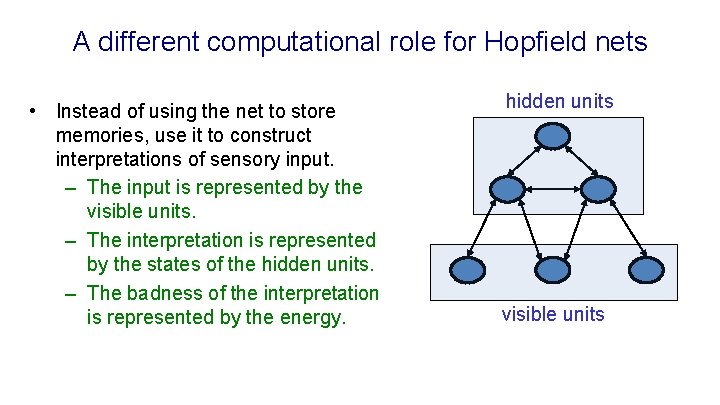
A different computational role for Hopfield nets • Instead of using the net to store memories, use it to construct interpretations of sensory input. – The input is represented by the visible units. – The interpretation is represented by the states of the hidden units. – The badness of the interpretation is represented by the energy. hidden units visible units
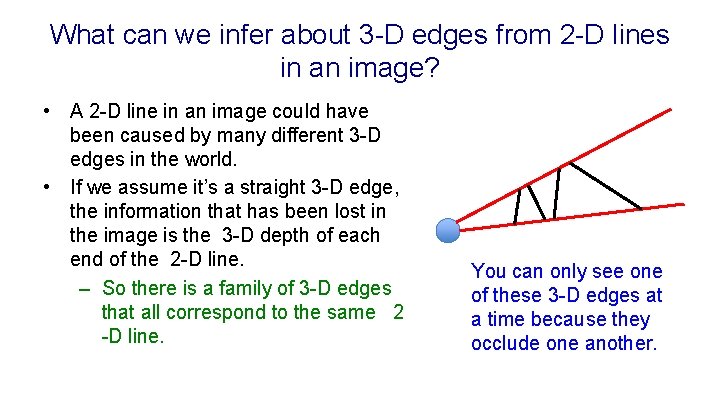
What can we infer about 3 -D edges from 2 -D lines in an image? • A 2 -D line in an image could have been caused by many different 3 -D edges in the world. • If we assume it’s a straight 3 -D edge, the information that has been lost in the image is the 3 -D depth of each end of the 2 -D line. – So there is a family of 3 -D edges that all correspond to the same 2 -D line. You can only see one of these 3 -D edges at a time because they occlude one another.
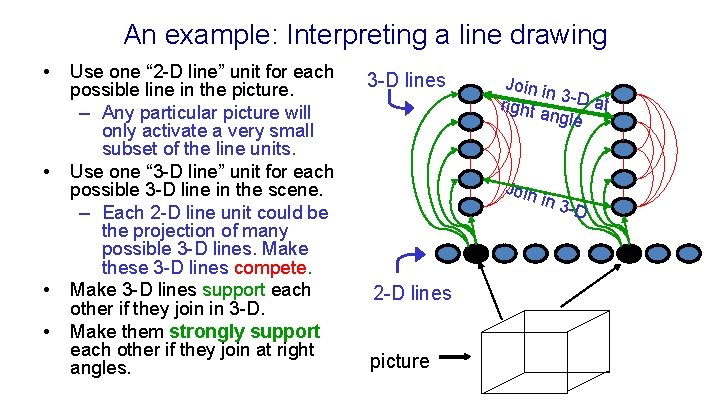
An example: Interpreting a line drawing • • Use one “ 2 -D line” unit for each possible line in the picture. – Any particular picture will only activate a very small subset of the line units. Use one “ 3 -D line” unit for each possible 3 -D line in the scene. – Each 2 -D line unit could be the projection of many possible 3 -D lines. Make these 3 -D lines compete. Make 3 -D lines support each other if they join in 3 -D. Make them strongly support each other if they join at right angles. 3 -D lines Join in 3 right a -D at ngle Join 2 -D lines picture in 3 - D
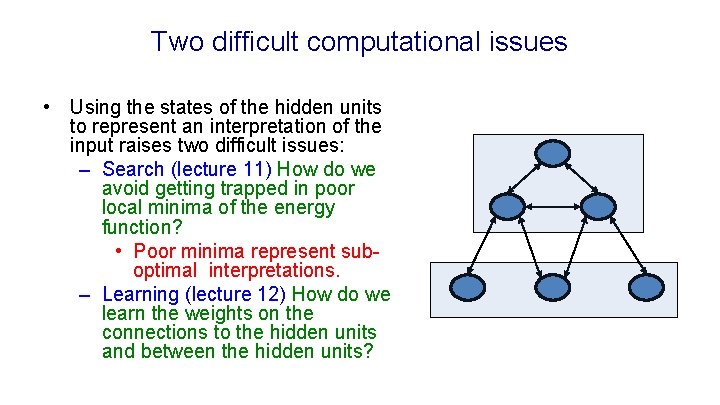
Two difficult computational issues • Using the states of the hidden units to represent an interpretation of the input raises two difficult issues: – Search (lecture 11) How do we avoid getting trapped in poor local minima of the energy function? • Poor minima represent suboptimal interpretations. – Learning (lecture 12) How do we learn the weights on the connections to the hidden units and between the hidden units?
Neural Networks for Machine Learning Lecture 11 d Using stochastic units to improve search Geoffrey Hinton Nitish Srivastava, Kevin Swersky Tijmen Tieleman Abdel-rahman Mohamed
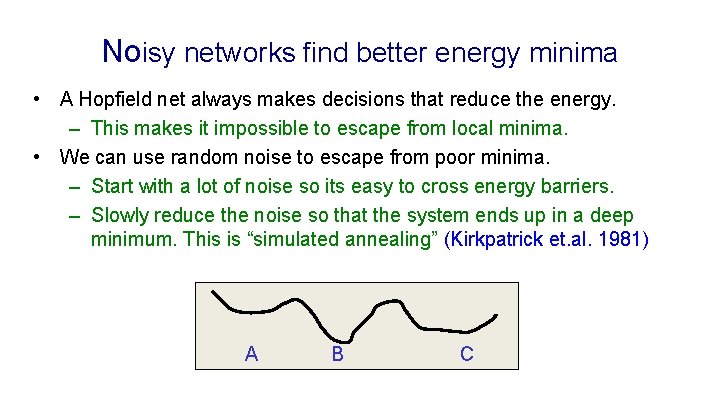
Noisy networks find better energy minima • A Hopfield net always makes decisions that reduce the energy. – This makes it impossible to escape from local minima. • We can use random noise to escape from poor minima. – Start with a lot of noise so its easy to cross energy barriers. – Slowly reduce the noise so that the system ends up in a deep minimum. This is “simulated annealing” (Kirkpatrick et. al. 1981) A B C
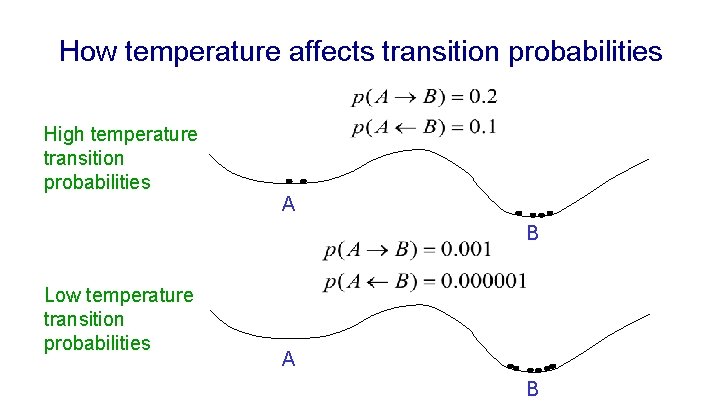
How temperature affects transition probabilities High temperature transition probabilities A B Low temperature transition probabilities A B
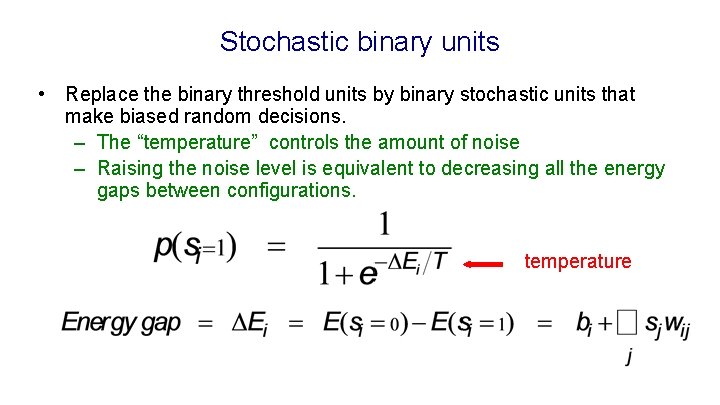
Stochastic binary units • Replace the binary threshold units by binary stochastic units that make biased random decisions. – The “temperature” controls the amount of noise – Raising the noise level is equivalent to decreasing all the energy gaps between configurations. temperature
Simulated annealing is a distraction • Simulated annealing is a powerful method for improving searches that get stuck in local optima. • It was one of the ideas that led to Boltzmann machines. • But it’s a big distraction from the main ideas behind Boltzmann machines. – So it will not be covered in this course. – From now on, we will use binary stochastic units that have a temperature of 1.
Thermal equilibrium at a temperature of 1 • Thermal equilibrium is a difficult • There is a nice intuitive way to concept! think about thermal equilibrium: – Reaching thermal equilibrium – Imagine a huge ensemble does not mean that the system of systems that all have has settled down into the exactly the same energy lowest energy configuration. function. – The thing that settles down is – The probability of a the probability distribution over configuration is just the configurations. fraction of the systems that have that configuration. – This settles to the stationary distribution.
Approaching thermal equilibrium • We start with any distribution we like over all the identical systems. – We could start with all the systems in the same configuration. – Or with an equal number of systems in each possible configuration. • Then we keep applying our stochastic update rule to pick the next configuration for each individual system. • After running the systems stochastically in the right way, we may eventually reach a situation where the fraction of systems in each configuration remains constant. – This is the stationary distribution that physicists call thermal equilibrium. – Any given system keeps changing its configuration, but the fraction of systems in each configuration does not change.
An analogy • Imagine a casino in Las Vegas that is full of card dealers (we need many more than 52! of them). • We start with all the card packs in standard order and then the dealers all start shuffling their packs. – After a few time steps, the king of spades still has a good chance of being next to the queen of spades. The packs have not yet forgotten where they started. – After prolonged shuffling, the packs will have forgotten where they started. There will be an equal number of packs in each of the 52! possible orders. – Once equilibrium has been reached, the number of packs that leave a configuration at each time step will be equal to the number that enter the configuration. • The only thing wrong with this analogy is that all the configurations have equal energy, so they all end up with the same probability.
Neural Networks for Machine Learning Lecture 11 e How a Boltzmann Machine models data Geoffrey Hinton Nitish Srivastava, Kevin Swersky Tijmen Tieleman Abdel-rahman Mohamed
Modeling binary data • Given a training set of binary vectors, fit a model that will assign a probability to every possible binary vector. – This is useful for deciding if other binary vectors come from the same distribution (e. g. documents represented by binary features that represents the occurrence of a particular word). – It can be used for monitoring complex systems to detect unusual behavior. – If we have models of several different distributions it can be used to compute the posterior probability that a particular distribution produced the observed data.
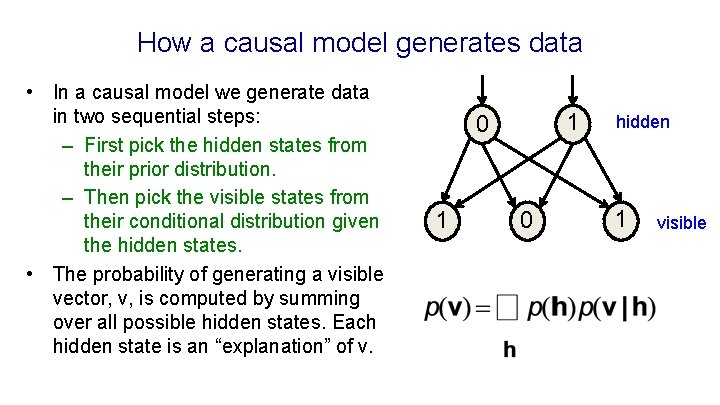
How a causal model generates data • In a causal model we generate data in two sequential steps: – First pick the hidden states from their prior distribution. – Then pick the visible states from their conditional distribution given the hidden states. • The probability of generating a visible vector, v, is computed by summing over all possible hidden states. Each hidden state is an “explanation” of v. 1 0 hidden 1 visible
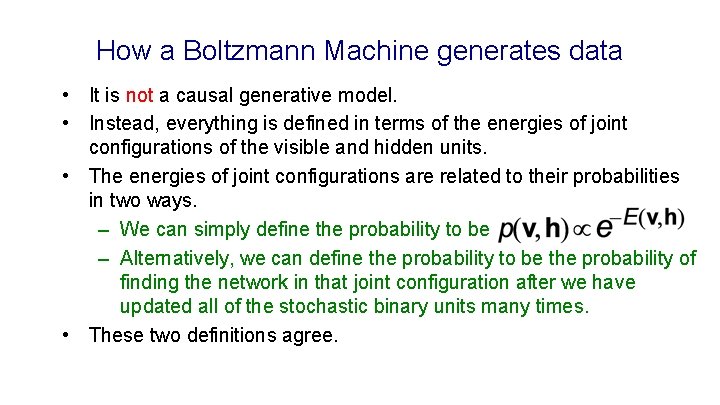
How a Boltzmann Machine generates data • It is not a causal generative model. • Instead, everything is defined in terms of the energies of joint configurations of the visible and hidden units. • The energies of joint configurations are related to their probabilities in two ways. – We can simply define the probability to be – Alternatively, we can define the probability to be the probability of finding the network in that joint configuration after we have updated all of the stochastic binary units many times. • These two definitions agree.
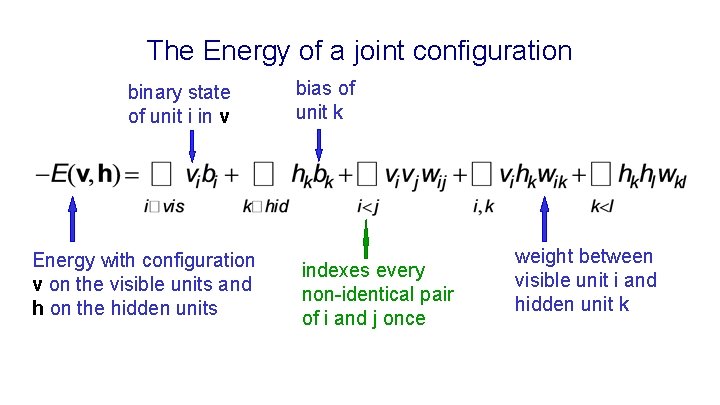
The Energy of a joint configuration binary state of unit i in v Energy with configuration v on the visible units and h on the hidden units bias of unit k indexes every non-identical pair of i and j once weight between visible unit i and hidden unit k
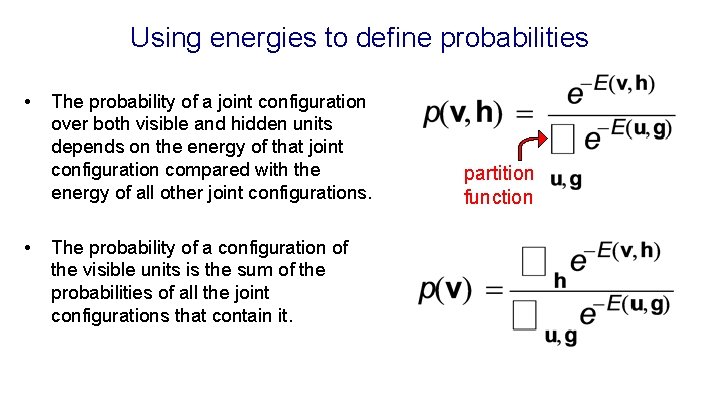
Using energies to define probabilities • • The probability of a joint configuration over both visible and hidden units depends on the energy of that joint configuration compared with the energy of all other joint configurations. The probability of a configuration of the visible units is the sum of the probabilities of all the joint configurations that contain it. partition function
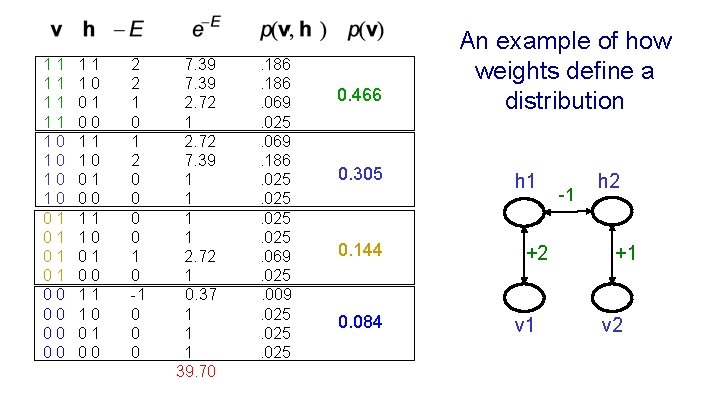
11 11 10 10 01 01 00 00 11 10 01 00 2 2 1 0 1 2 0 0 1 0 -1 0 0 0 7. 39 2. 72 1 2. 72 7. 39 1 1 2. 72 1 0. 37 1 1 1 39. 70 . 186. 069. 025. 069. 186. 025. 069. 025. 009. 025 0. 466 0. 305 0. 144 0. 084 An example of how weights define a distribution h 1 +2 v 1 -1 h 2 +1 v 2
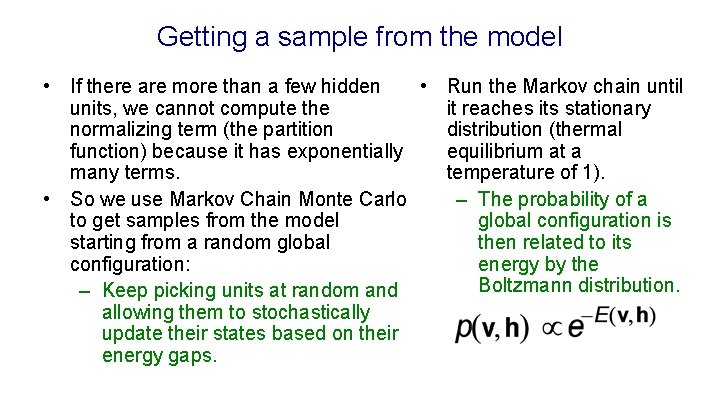
Getting a sample from the model • If there are more than a few hidden • Run the Markov chain until units, we cannot compute the it reaches its stationary normalizing term (the partition distribution (thermal function) because it has exponentially equilibrium at a many terms. temperature of 1). • So we use Markov Chain Monte Carlo – The probability of a to get samples from the model global configuration is starting from a random global then related to its configuration: energy by the Boltzmann distribution. – Keep picking units at random and allowing them to stochastically update their states based on their energy gaps.
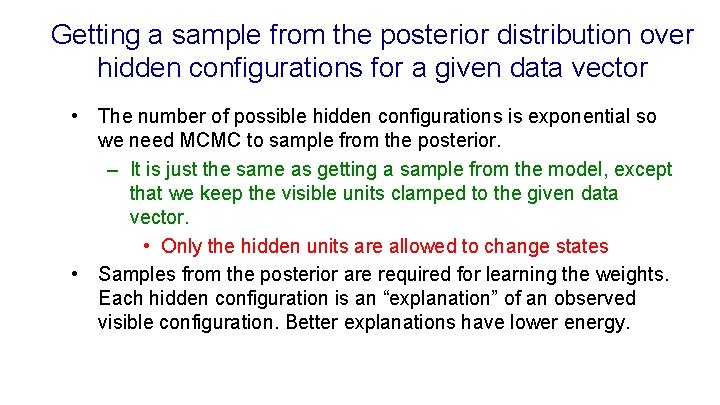
Getting a sample from the posterior distribution over hidden configurations for a given data vector • The number of possible hidden configurations is exponential so we need MCMC to sample from the posterior. – It is just the same as getting a sample from the model, except that we keep the visible units clamped to the given data vector. • Only the hidden units are allowed to change states • Samples from the posterior are required for learning the weights. Each hidden configuration is an “explanation” of an observed visible configuration. Better explanations have lower energy.