
Neural Networks and Deep Learning Dan Roth Lecture


- Slides: 87
Neural Networks and Deep Learning Dan Roth, Lecture by Nitish Gupta danroth@seas. upenn. edu|http: //www. cis. upenn. edu/~danroth/|461 C, 3401 Walnut Slides were created by Dan Roth (for CIS 519/419 at Penn or CS 446 at UIUC), Eric Eaton for CIS 519/419 at Penn, or from other authors who have made their CIS 419/519 Fall’ 19 ML slides available. 1
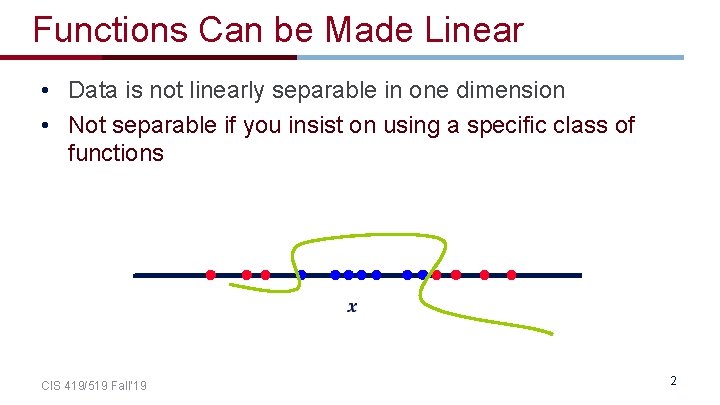
Functions Can be Made Linear • Data is not linearly separable in one dimension • Not separable if you insist on using a specific class of functions CIS 419/519 Fall’ 19 2
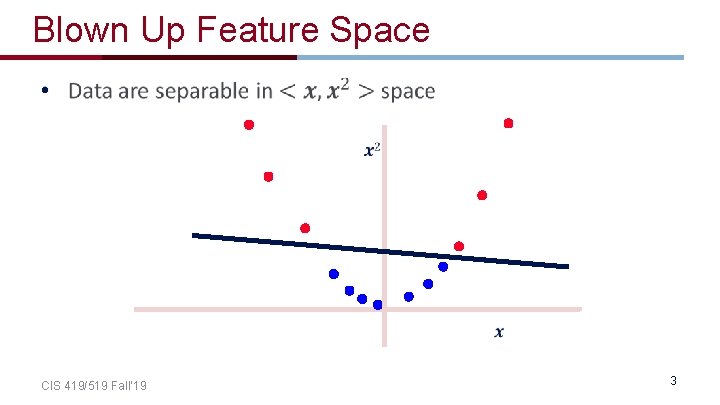
Blown Up Feature Space • CIS 419/519 Fall’ 19 3
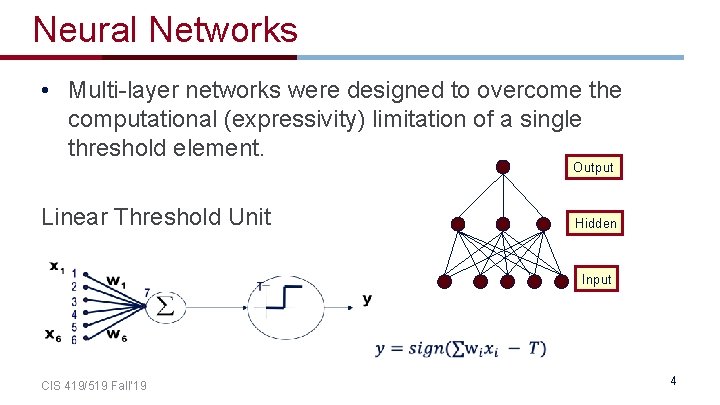
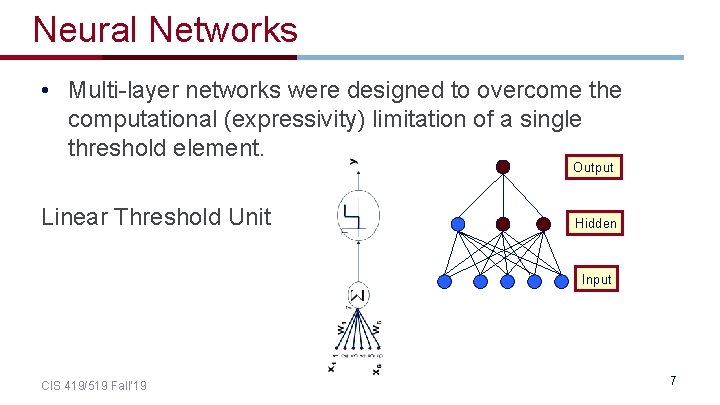
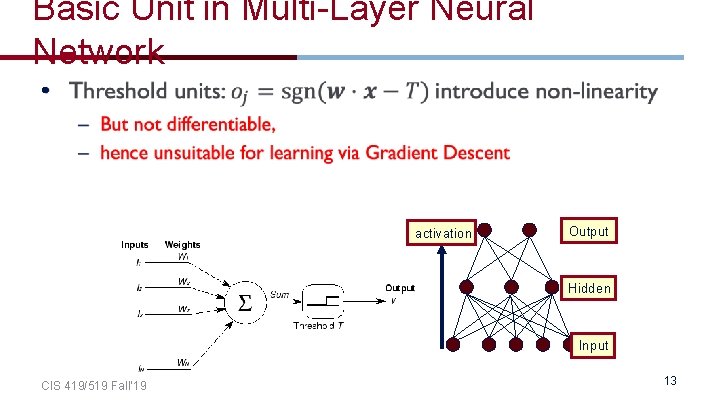
Neural Networks • Multi-layer networks were designed to overcome the computational (expressivity) limitation of a single threshold element. Output Linear Threshold Unit Hidden Input CIS 419/519 Fall’ 19 4
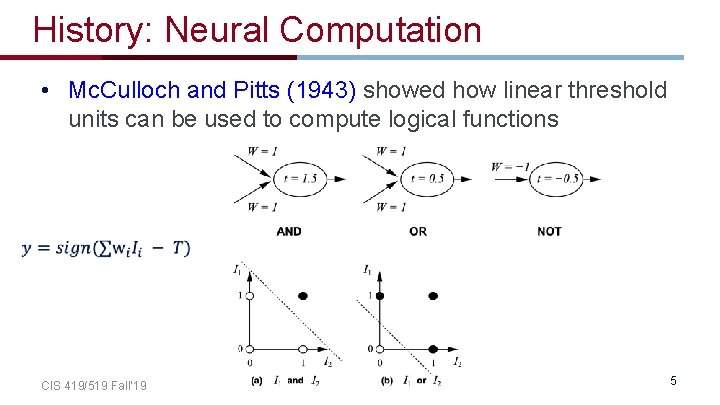
History: Neural Computation • Mc. Culloch and Pitts (1943) showed how linear threshold units can be used to compute logical functions CIS 419/519 Fall’ 19 5
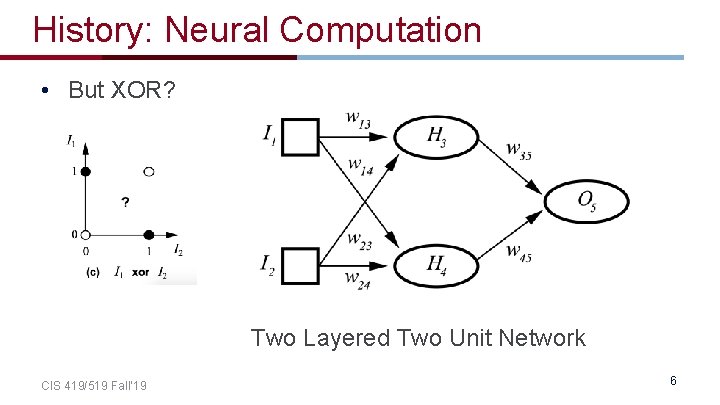
History: Neural Computation • But XOR? Two Layered Two Unit Network CIS 419/519 Fall’ 19 6
Neural Networks • Multi-layer networks were designed to overcome the computational (expressivity) limitation of a single threshold element. Output Linear Threshold Unit Hidden Input CIS 419/519 Fall’ 19 7
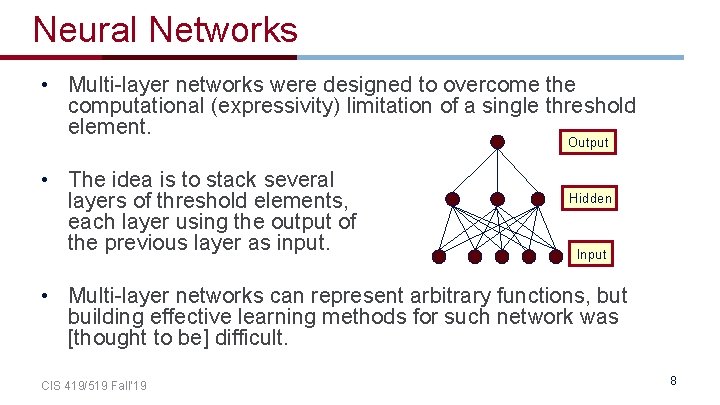
Neural Networks • Multi-layer networks were designed to overcome the computational (expressivity) limitation of a single threshold element. Output • The idea is to stack several layers of threshold elements, each layer using the output of the previous layer as input. Hidden Input • Multi-layer networks can represent arbitrary functions, but building effective learning methods for such network was [thought to be] difficult. CIS 419/519 Fall’ 19 8
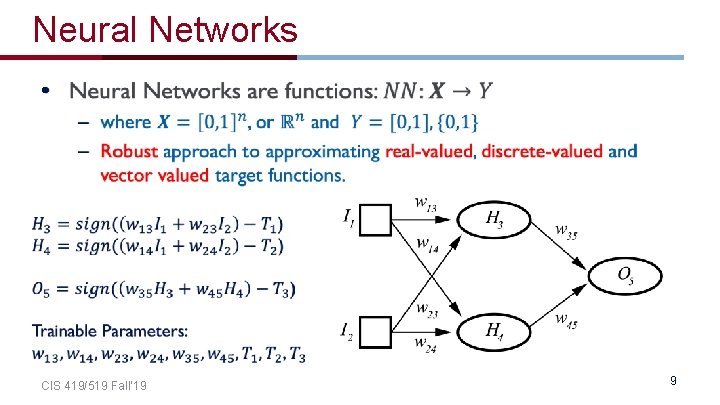
Neural Networks • CIS 419/519 Fall’ 19 9
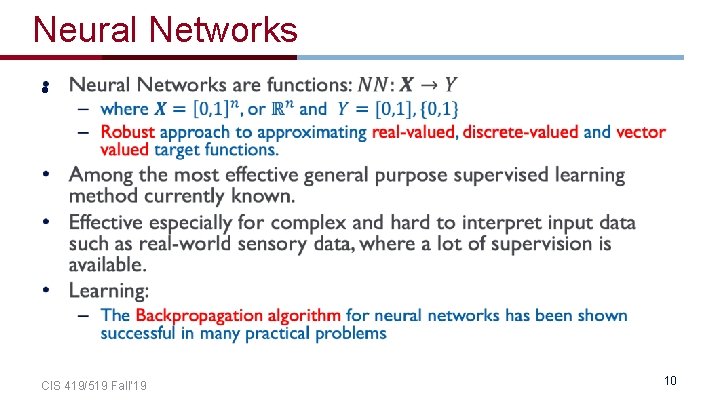
Neural Networks • CIS 419/519 Fall’ 19 10
Motivation for Neural Networks • Inspired by biological neural network systems – But are not identical to them • We are currently on rising part of a wave of interest in NN architectures, after a long downtime from the mid-90 ies. – Better computer architecture (parallelism on GPUs & TPUs) – A lot more data than before; in many domains, supervision is available. CIS 419/519 Fall’ 19 11
Motivation for Neural Networks • One potentially interesting perspective: – Before we looked at NN only as function approximators. – Geoffrey Hinton introduced RBMs in the mid 2000 s – method to learn high-level representations of input – Ideas are being developed on the value of these intermediate representations for transfer learning etc. • We will present in the next two lectures a few of the basic architectures and learning algorithms, and provide some examples for applications CIS 419/519 Fall’ 19 12
Basic Unit in Multi-Layer Neural Network • activation Output Hidden Input CIS 419/519 Fall’ 19 13
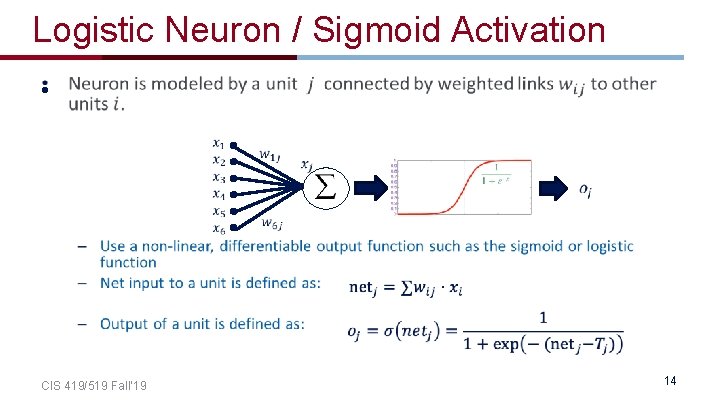
Logistic Neuron / Sigmoid Activation • CIS 419/519 Fall’ 19 14
Representational Power • Any Boolean function can be represented by a two layer network (simulate a two layer AND-OR network) • Any bounded continuous function can be approximated with arbitrary small error by a two layer network. • Sigmoid functions provide a set of basis functions from which arbitrary function can be composed. • Any function can be approximated to arbitrary accuracy by a three layer network. CIS 419/519 Fall’ 19 15
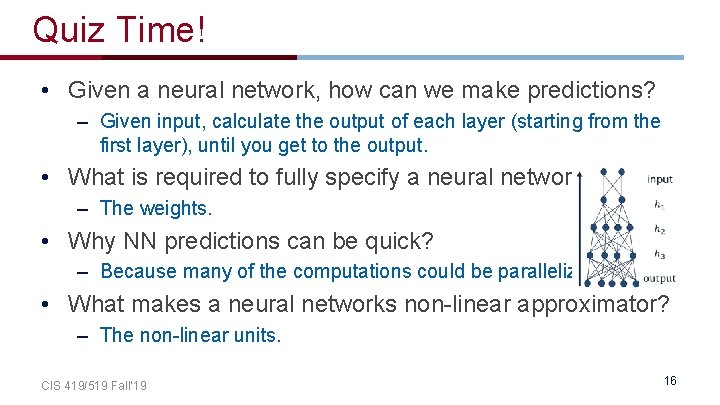
Quiz Time! • Given a neural network, how can we make predictions? – Given input, calculate the output of each layer (starting from the first layer), until you get to the output. • What is required to fully specify a neural network? – The weights. • Why NN predictions can be quick? – Because many of the computations could be parallelized. • What makes a neural networks non-linear approximator? – The non-linear units. CIS 419/519 Fall’ 19 16
Training a Neural Net CIS 419/519 Fall’ 19
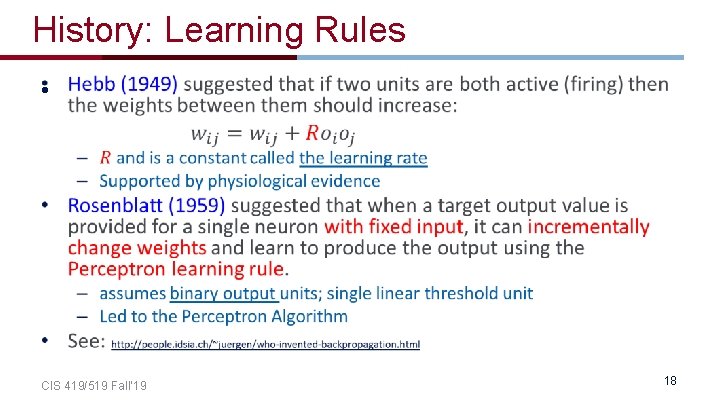
History: Learning Rules • CIS 419/519 Fall’ 19 18
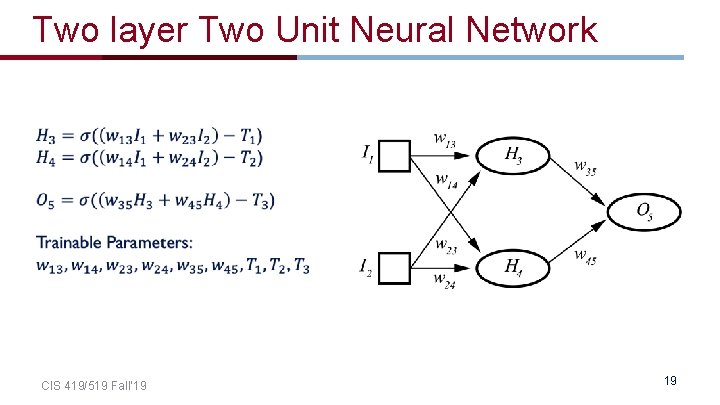
Two layer Two Unit Neural Network CIS 419/519 Fall’ 19 19
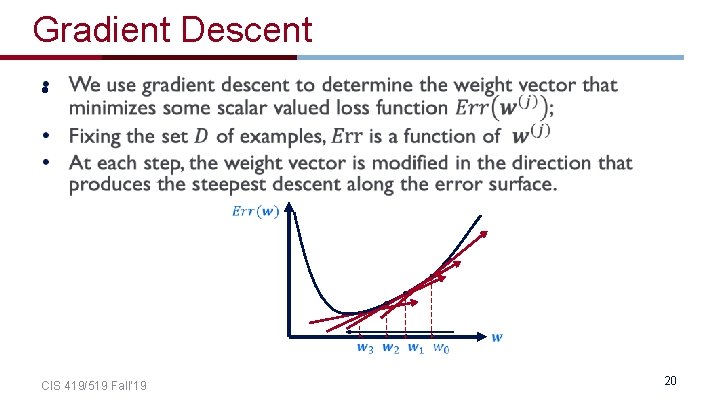
Gradient Descent • CIS 419/519 Fall’ 19 20
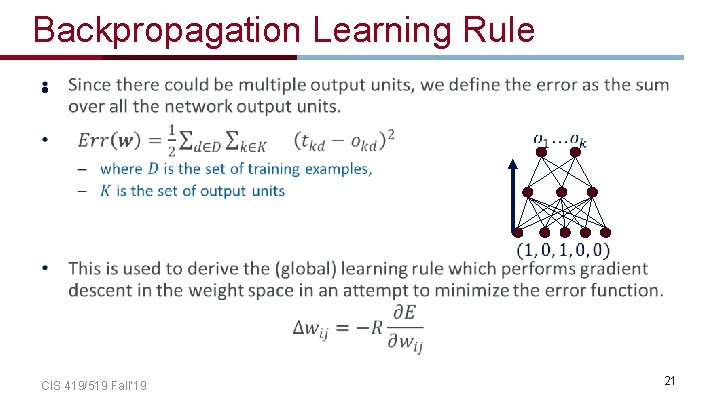
Backpropagation Learning Rule • CIS 419/519 Fall’ 19 21
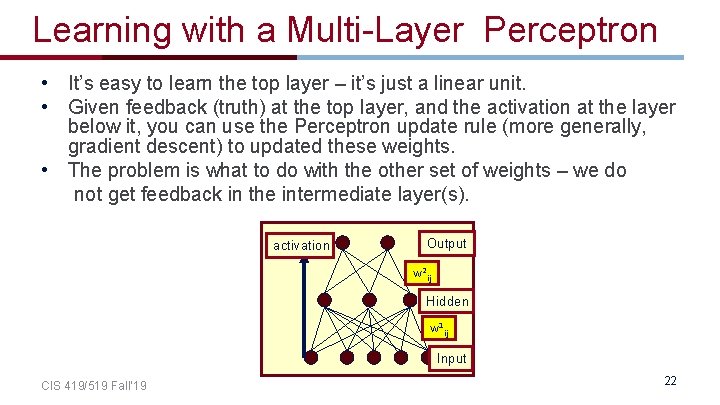
Learning with a Multi-Layer Perceptron • It’s easy to learn the top layer – it’s just a linear unit. • Given feedback (truth) at the top layer, and the activation at the layer below it, you can use the Perceptron update rule (more generally, gradient descent) to updated these weights. • The problem is what to do with the other set of weights – we do not get feedback in the intermediate layer(s). activation Output w 2 ij Hidden w 1 ij Input CIS 419/519 Fall’ 19 22
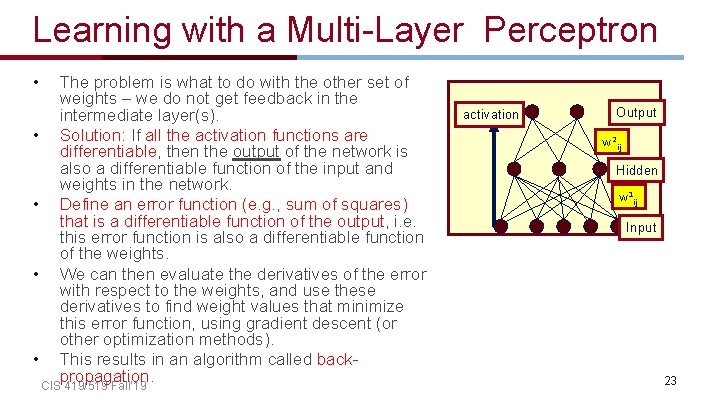
Learning with a Multi-Layer Perceptron • The problem is what to do with the other set of weights – we do not get feedback in the intermediate layer(s). • Solution: If all the activation functions are differentiable, then the output of the network is also a differentiable function of the input and weights in the network. • Define an error function (e. g. , sum of squares) that is a differentiable function of the output, i. e. this error function is also a differentiable function of the weights. • We can then evaluate the derivatives of the error with respect to the weights, and use these derivatives to find weight values that minimize this error function, using gradient descent (or other optimization methods). • This results in an algorithm called backpropagation. CIS 419/519 Fall’ 19 activation Output w 2 ij Hidden w 1 ij Input 23
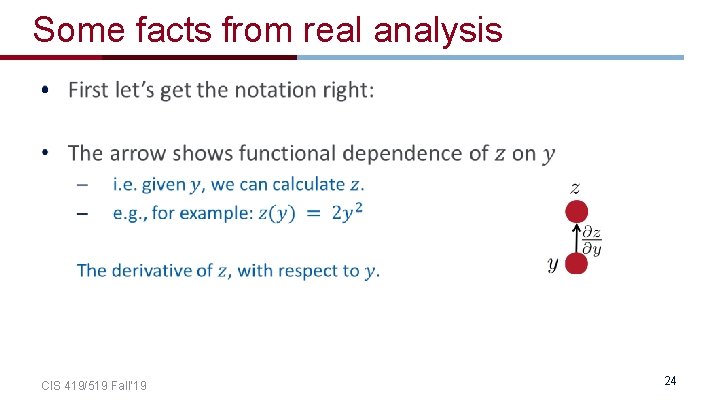
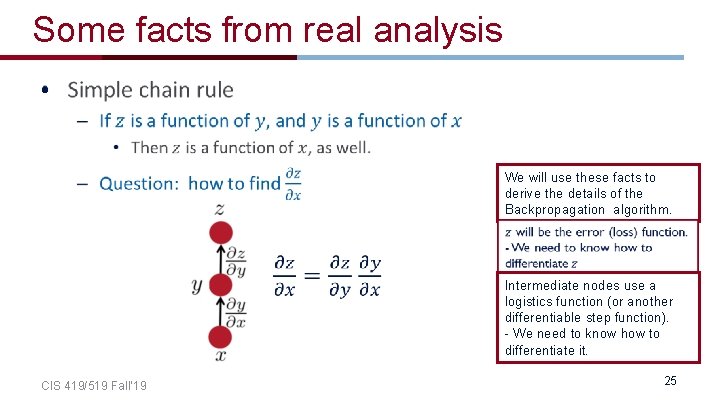
Some facts from real analysis • CIS 419/519 Fall’ 19 24
Some facts from real analysis • We will use these facts to derive the details of the Backpropagation algorithm. Intermediate nodes use a logistics function (or another differentiable step function). - We need to know how to differentiate it. CIS 419/519 Fall’ 19 25
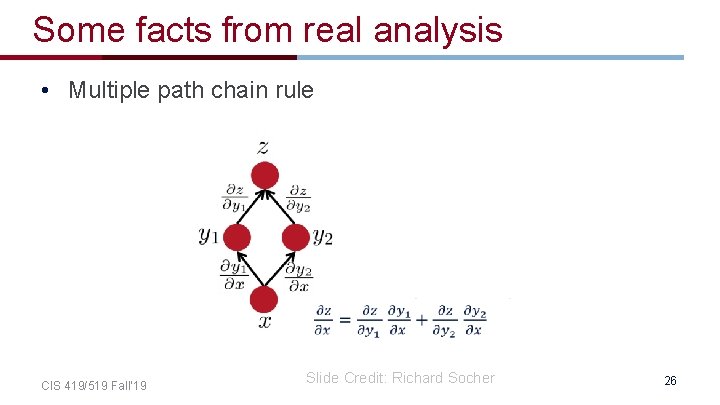
Some facts from real analysis • Multiple path chain rule CIS 419/519 Fall’ 19 Slide Credit: Richard Socher 26
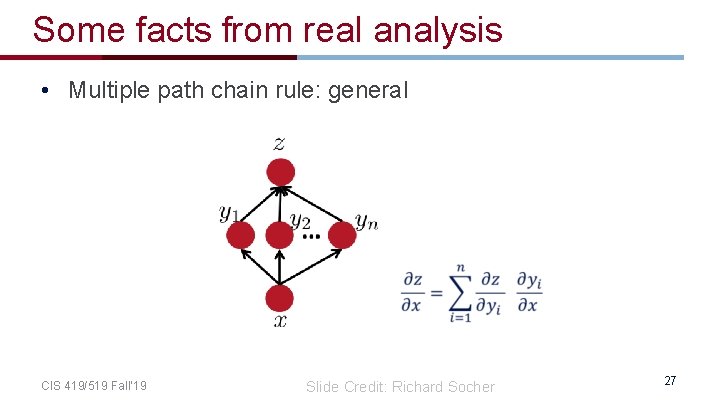
Some facts from real analysis • Multiple path chain rule: general CIS 419/519 Fall’ 19 Slide Credit: Richard Socher 27
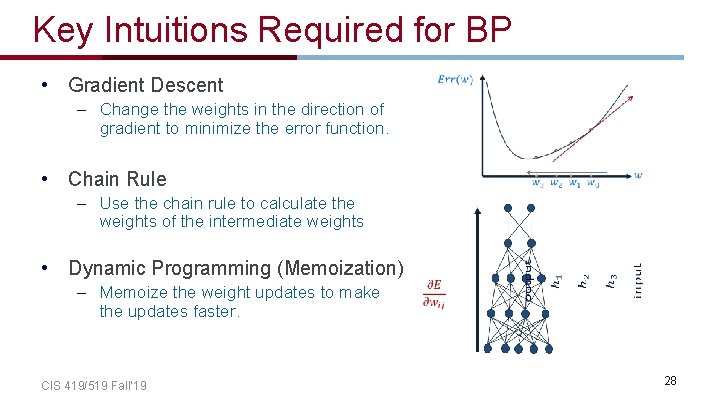
Key Intuitions Required for BP • Gradient Descent – Change the weights in the direction of gradient to minimize the error function. • Chain Rule – Use the chain rule to calculate the weights of the intermediate weights • Dynamic Programming (Memoization) – Memoize the weight updates to make the updates faster. CIS 419/519 Fall’ 19 28
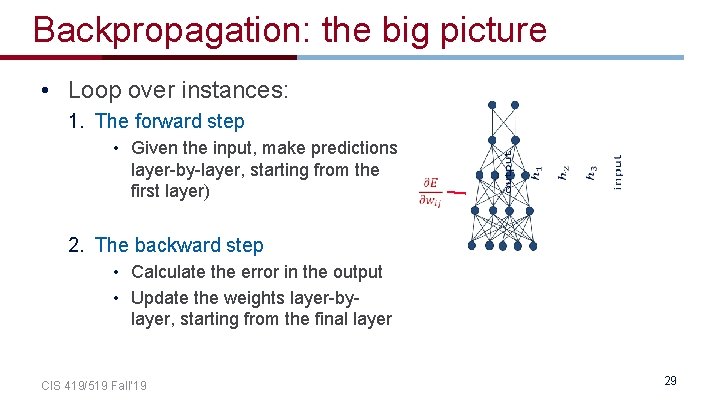
Backpropagation: the big picture • Loop over instances: 1. The forward step 2. The backward step • Given the input, make predictions layer-by-layer, starting from the first layer) • Calculate the error in the output • Update the weights layer-bylayer, starting from the final layer CIS 419/519 Fall’ 19 29
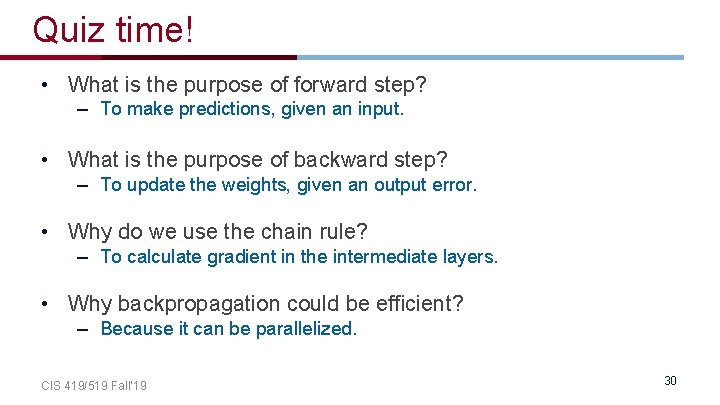
Quiz time! • What is the purpose of forward step? – To make predictions, given an input. • What is the purpose of backward step? – To update the weights, given an output error. • Why do we use the chain rule? – To calculate gradient in the intermediate layers. • Why backpropagation could be efficient? – Because it can be parallelized. CIS 419/519 Fall’ 19 30
Deriving the update rules CIS 419/519 Fall’ 19
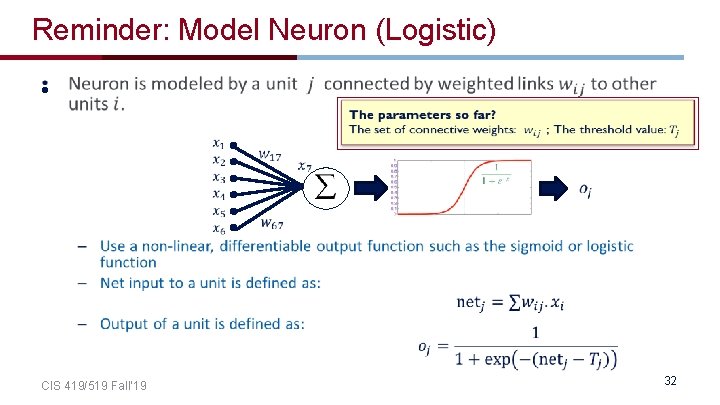
Reminder: Model Neuron (Logistic) • CIS 419/519 Fall’ 19 32
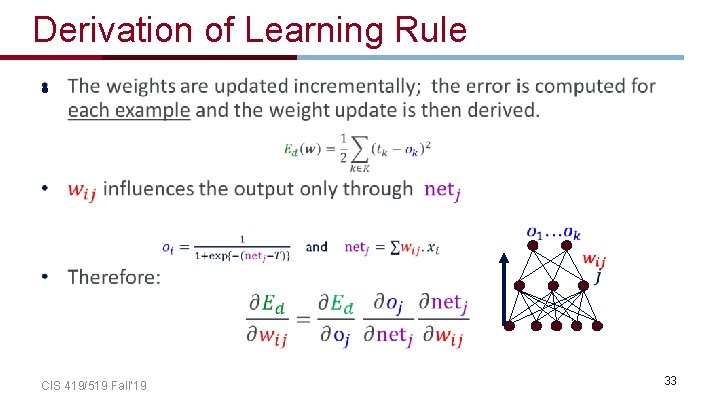
Derivation of Learning Rule • CIS 419/519 Fall’ 19 33
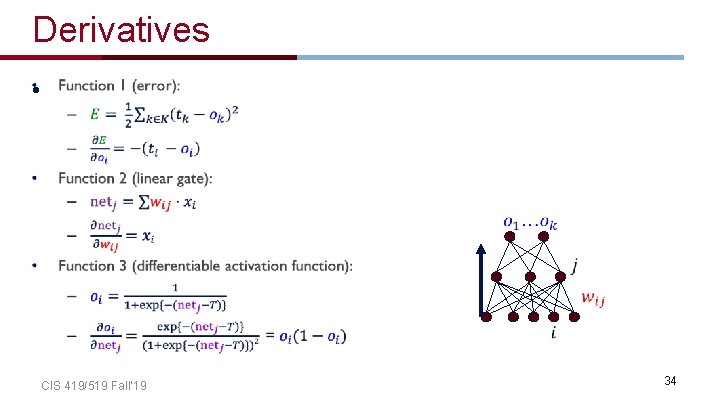
Derivatives • CIS 419/519 Fall’ 19 34
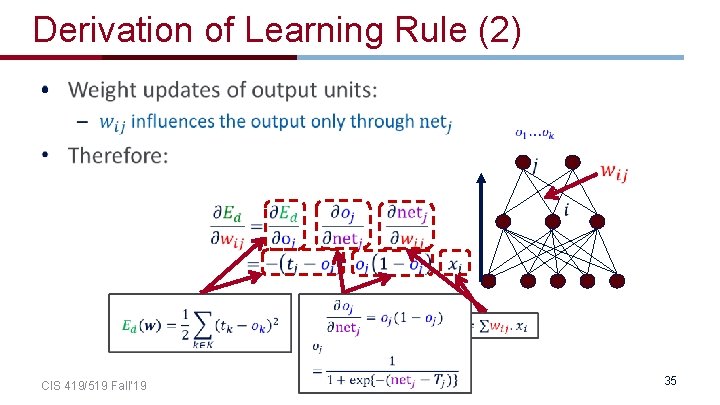
Derivation of Learning Rule (2) • CIS 419/519 Fall’ 19 35
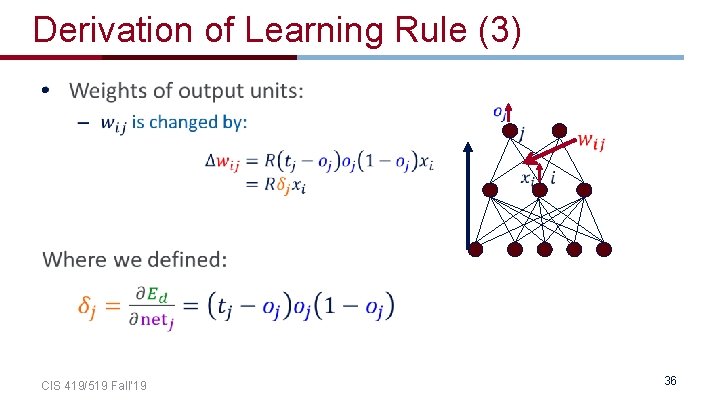
Derivation of Learning Rule (3) • CIS 419/519 Fall’ 19 36
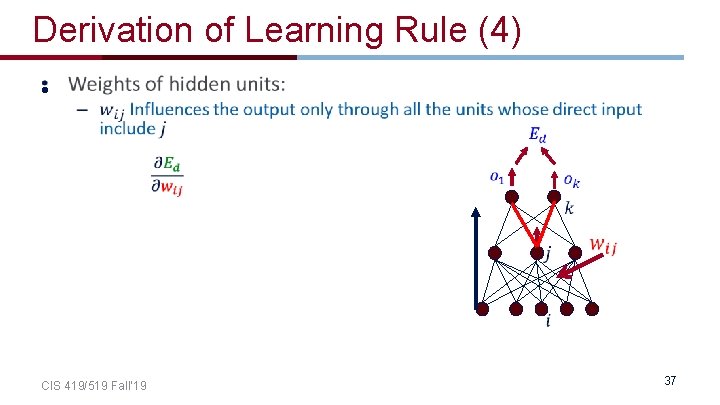
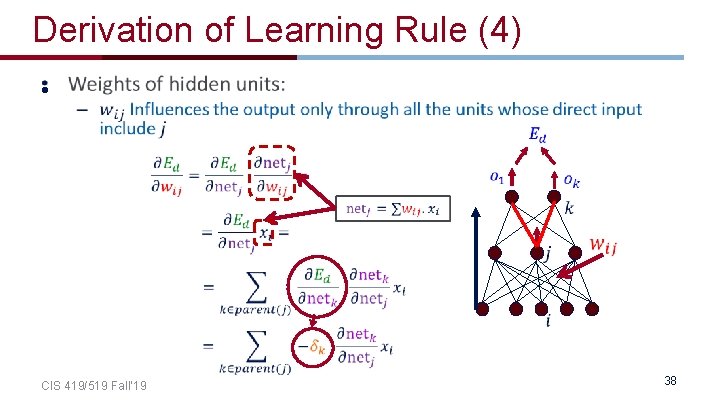
Derivation of Learning Rule (4) • CIS 419/519 Fall’ 19 37
Derivation of Learning Rule (4) • CIS 419/519 Fall’ 19 38
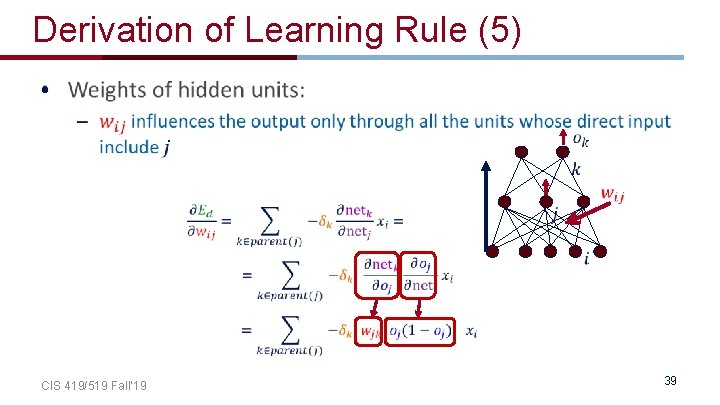
Derivation of Learning Rule (5) • CIS 419/519 Fall’ 19 39
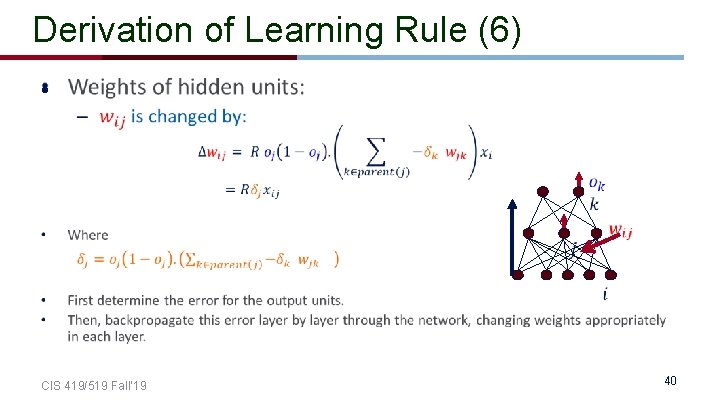
Derivation of Learning Rule (6) • CIS 419/519 Fall’ 19 40
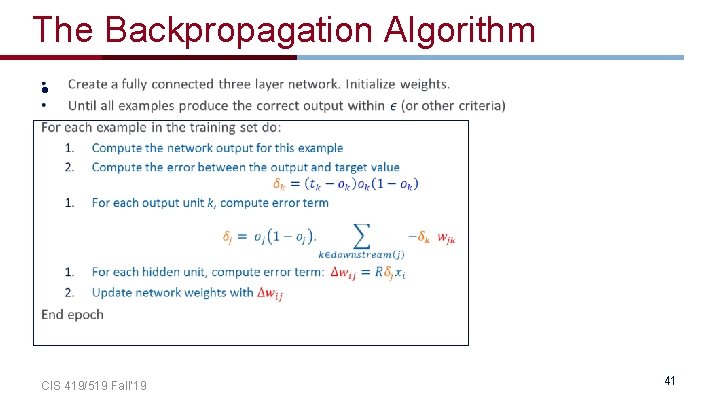
The Backpropagation Algorithm • CIS 419/519 Fall’ 19 41
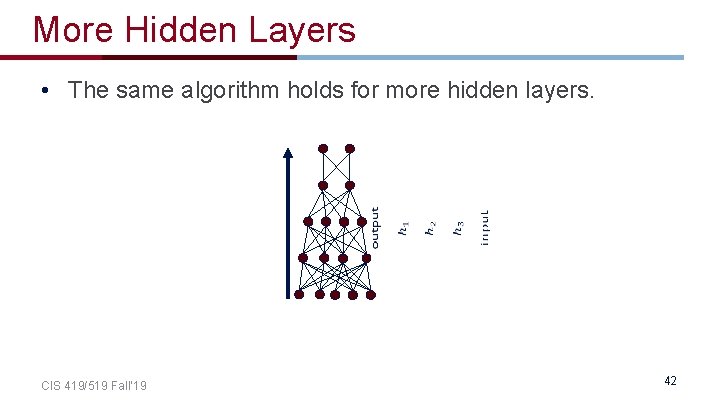
More Hidden Layers • The same algorithm holds for more hidden layers. CIS 419/519 Fall’ 19 42
Demo time! • Link: https: //playground. tensorflow. org/ CIS 419/519 Fall’ 19 43
Comments on Training • No guarantee of convergence; neural networks form nonconvex functions with multiple local minima • In practice, many large networks can be trained on large amounts of data for realistic problems. • Many epochs (tens of thousands) may be needed for adequate training. Large data sets may require many hours of CPU • Termination criteria: Number of epochs; Threshold on training set error; No decrease in error; Increased error on a validation set. • To avoid local minima: several trials with different random initial weights with majority or voting techniques 44 CIS 419/519 Fall’ 19
Over-training Prevention • Running too many epochs and/or a NN with many hidden layers may lead to an overfit network • Keep an held-out validation set and test accuracy after every epoch • Early stopping: maintain weights for best performing network on the validation set and return it when performance decreases significantly beyond that. • To avoid losing training data to validation: – Use 10 -fold cross-validation to determine the average number of epochs that optimizes validation performance – Train on the full data set using this many epochs to produce the final results CIS 419/519 Fall’ 19 45
Over-fitting prevention • Too few hidden units prevent the system from adequately fitting the data and learning the concept. • Using too many hidden units leads to over-fitting. • Similar cross-validation method can be used to determine an appropriate number of hidden units. (general) • Another approach to prevent over-fitting is weight-decay: all weights are multiplied by some fraction in (0, 1) after every epoch. – Encourages smaller weights and less complex hypothesis – Equivalently: change Error function to include a term for the sum of the squares of the weights in the network. (general) CIS 419/519 Fall’ 19 46
Neural Networks and Deep Learning Dan Roth, Lecture by Nitish Gupta danroth@seas. upenn. edu|http: //www. cis. upenn. edu/~danroth/|461 C, 3401 Walnut Slides were created by Dan Roth (for CIS 519/419 at Penn or CS 446 at UIUC), Eric Eaton for CIS 519/419 at Penn, or from other authors who have made their CIS 419/519 Fall’ 19 ML slides available. 47
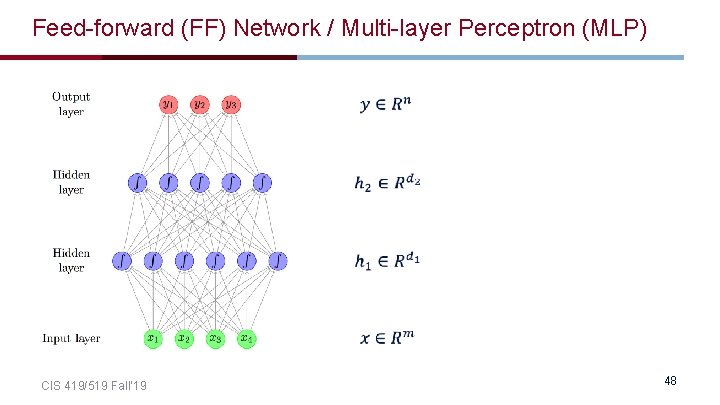
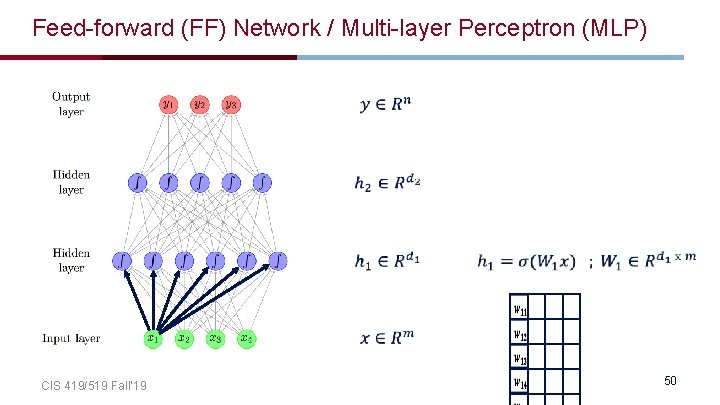
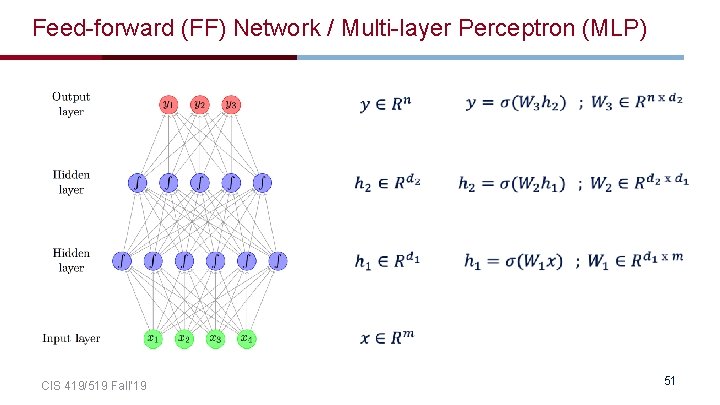
Feed-forward (FF) Network / Multi-layer Perceptron (MLP) CIS 419/519 Fall’ 19 48
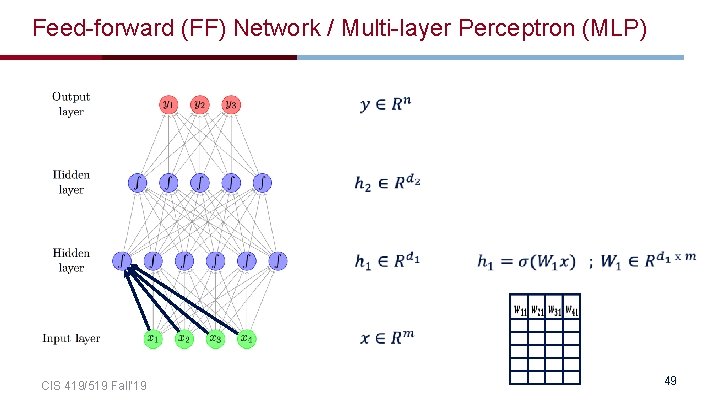
Feed-forward (FF) Network / Multi-layer Perceptron (MLP) CIS 419/519 Fall’ 19 49
Feed-forward (FF) Network / Multi-layer Perceptron (MLP) CIS 419/519 Fall’ 19 50
Feed-forward (FF) Network / Multi-layer Perceptron (MLP) CIS 419/519 Fall’ 19 51
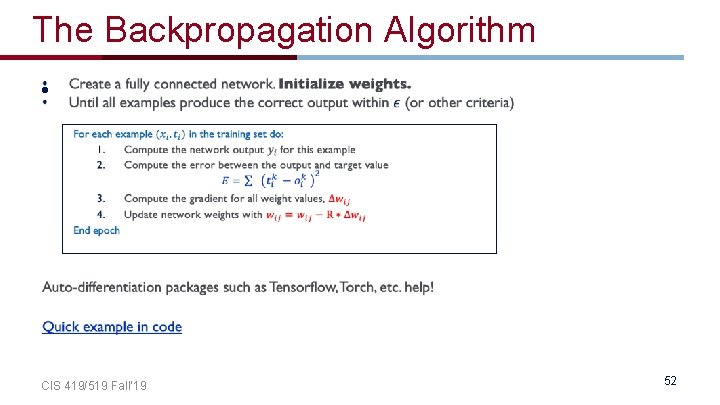
The Backpropagation Algorithm • CIS 419/519 Fall’ 19 52
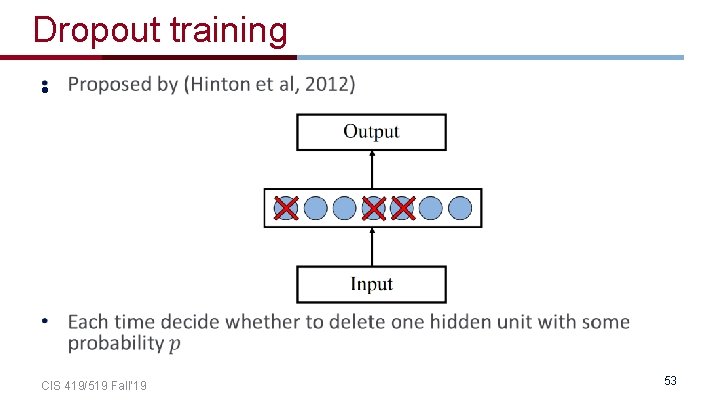
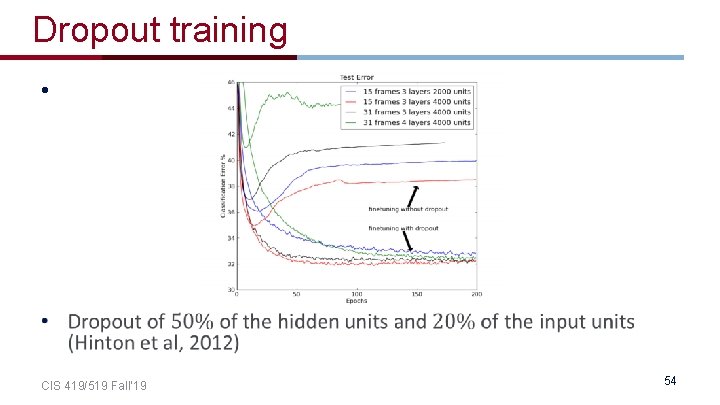
Dropout training • CIS 419/519 Fall’ 19 53
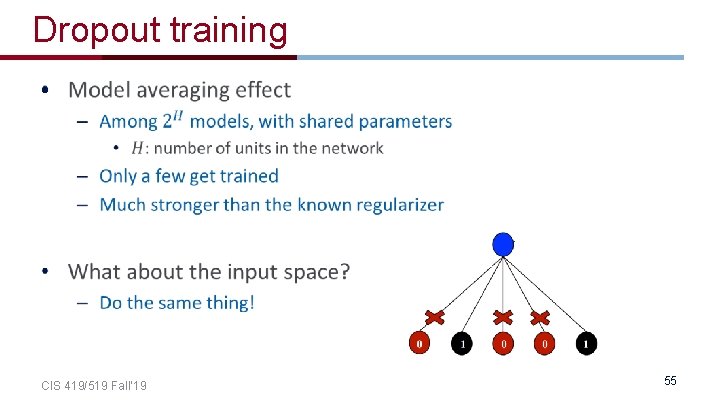
Dropout training • CIS 419/519 Fall’ 19 54
Dropout training • CIS 419/519 Fall’ 19 55
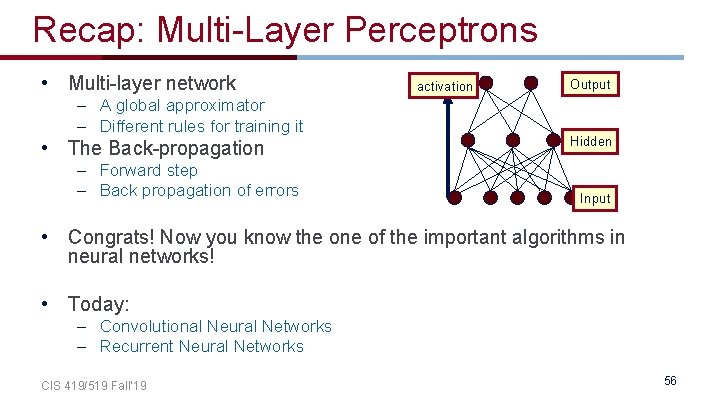
Recap: Multi-Layer Perceptrons • Multi-layer network – A global approximator – Different rules for training it • The Back-propagation – Forward step – Back propagation of errors activation Output Hidden Input • Congrats! Now you know the one of the important algorithms in neural networks! • Today: – Convolutional Neural Networks – Recurrent Neural Networks CIS 419/519 Fall’ 19 56
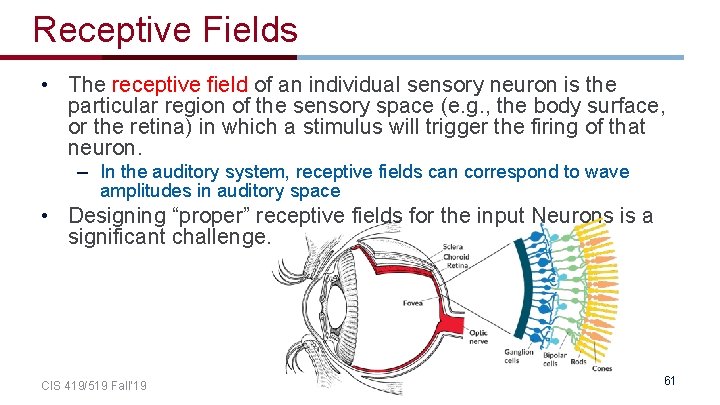
Receptive Fields • The receptive field of an individual sensory neuron is the particular region of the sensory space (e. g. , the body surface, or the retina) in which a stimulus will trigger the firing of that neuron. – In the auditory system, receptive fields can correspond to wave amplitudes in auditory space • Designing “proper” receptive fields for the input Neurons is a significant challenge. CIS 419/519 Fall’ 19 61
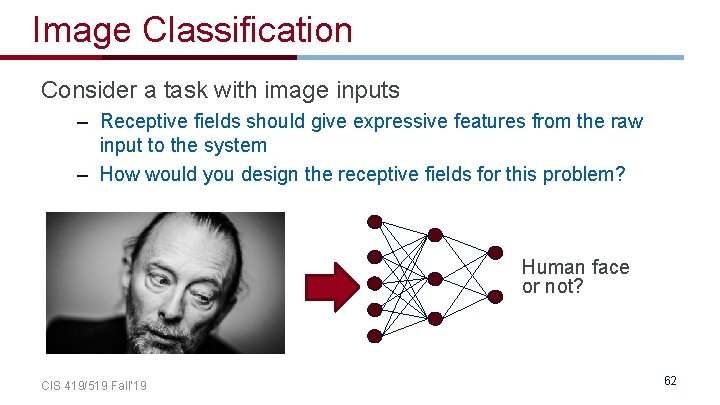
Image Classification Consider a task with image inputs – Receptive fields should give expressive features from the raw input to the system – How would you design the receptive fields for this problem? Human face or not? CIS 419/519 Fall’ 19 62
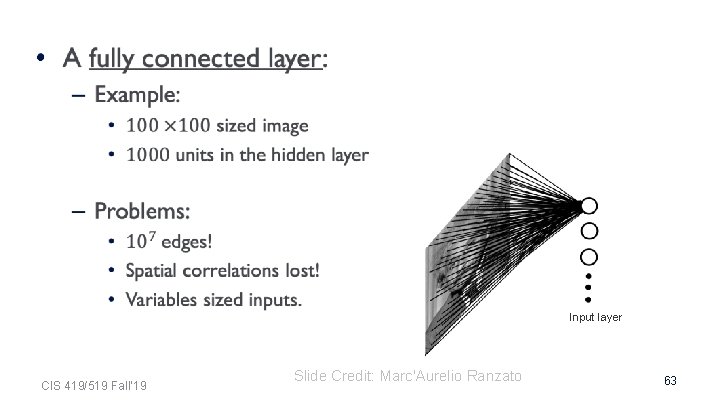
• Input layer CIS 419/519 Fall’ 19 Slide Credit: Marc'Aurelio Ranzato 63
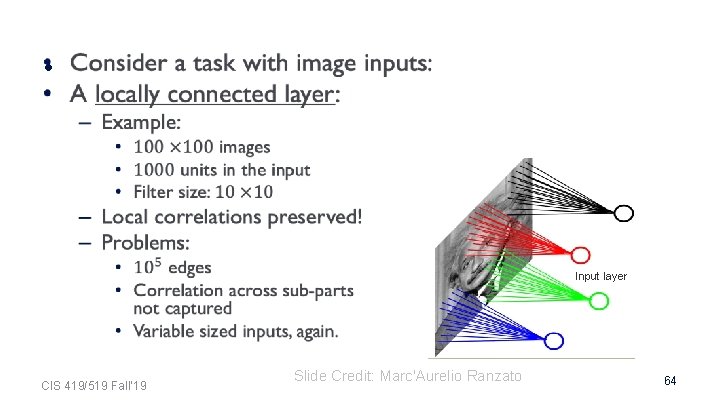
• Input layer CIS 419/519 Fall’ 19 Slide Credit: Marc'Aurelio Ranzato 64
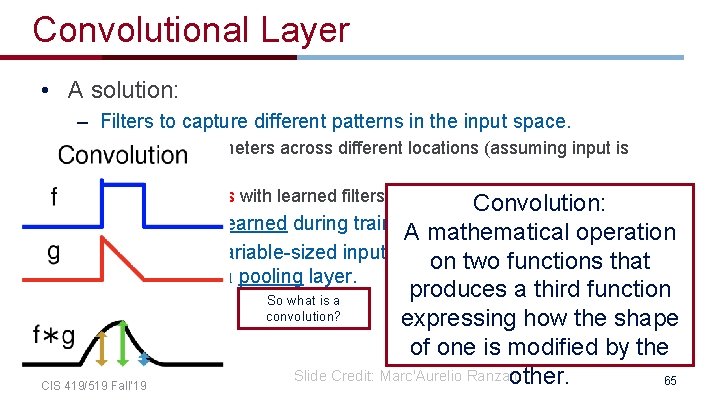
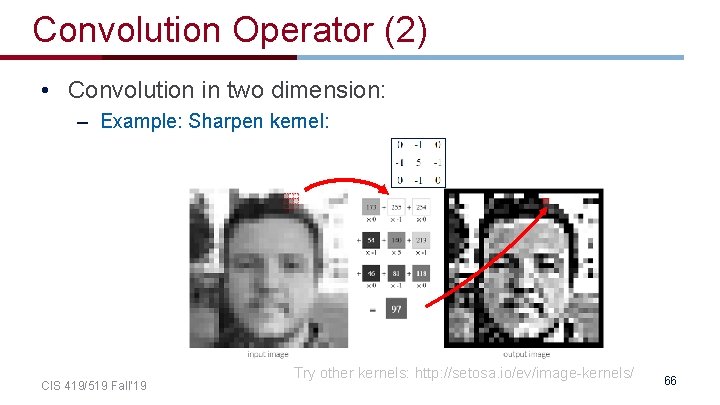
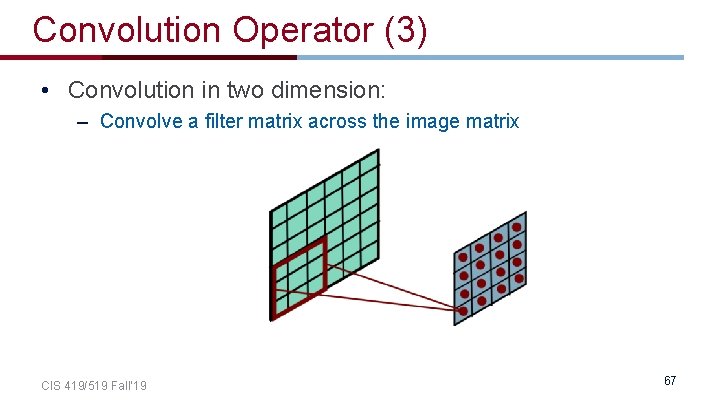
Convolutional Layer • A solution: – Filters to capture different patterns in the input space. • Share parameters across different locations (assuming input is stationary) • Convolutions with learned filters Convolution: – Filters will be learned during training. A mathematical operation – The issue of variable-sized inputs will be on two functions that resolved with a pooling layer. produces a third function So what is a Input layer convolution? expressing how the shape of one is modified by the Slide Credit: Marc'Aurelio Ranzato other. 65 CIS 419/519 Fall’ 19
Convolution Operator (2) • Convolution in two dimension: – Example: Sharpen kernel: CIS 419/519 Fall’ 19 Try other kernels: http: //setosa. io/ev/image-kernels/ 66
Convolution Operator (3) • Convolution in two dimension: – Convolve a filter matrix across the image matrix CIS 419/519 Fall’ 19 67
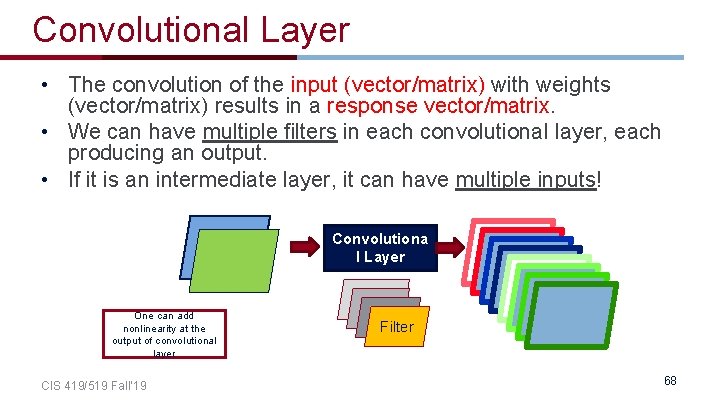
Convolutional Layer • The convolution of the input (vector/matrix) with weights (vector/matrix) results in a response vector/matrix. • We can have multiple filters in each convolutional layer, each producing an output. • If it is an intermediate layer, it can have multiple inputs! Convolutiona l Layer One can add nonlinearity at the output of convolutional layer CIS 419/519 Fall’ 19 Filter 68
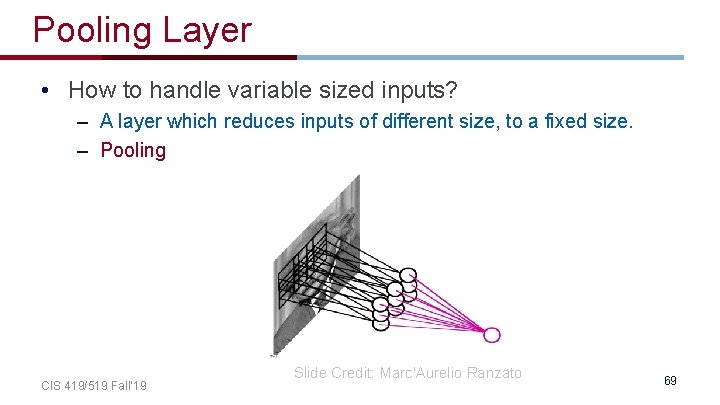
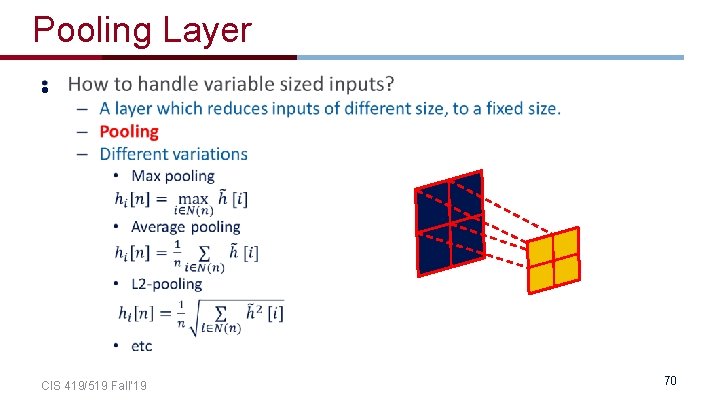
Pooling Layer • How to handle variable sized inputs? – A layer which reduces inputs of different size, to a fixed size. – Pooling CIS 419/519 Fall’ 19 Slide Credit: Marc'Aurelio Ranzato 69
Pooling Layer • CIS 419/519 Fall’ 19 70
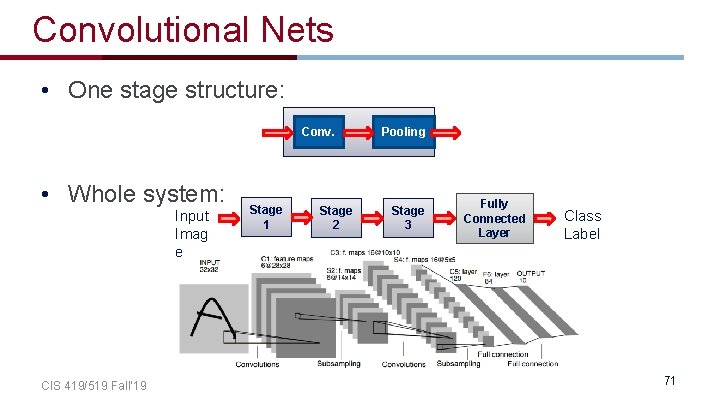
Convolutional Nets • One stage structure: Conv. • Whole system: Input Imag e CIS 419/519 Fall’ 19 Stage 1 Stage 2 Pooling Stage 3 Fully Connected Layer Class Label 71
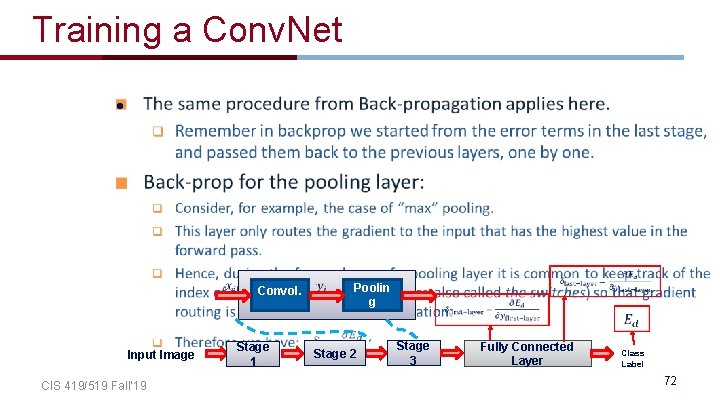
Training a Conv. Net • Input Image CIS 419/519 Fall’ 19 Convol. Stage 1 Poolin g Stage 2 Stage 3 Fully Connected Layer Class Label 72
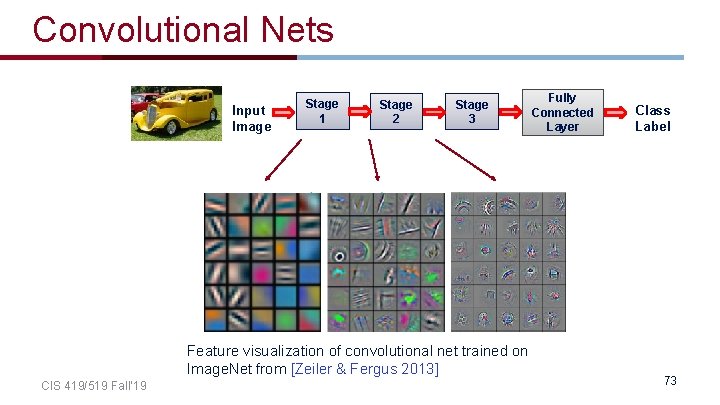
Convolutional Nets Input Image Stage 1 Stage 2 Stage 3 Fully Connected Layer Feature visualization of convolutional net trained on Image. Net from [Zeiler & Fergus 2013] CIS 419/519 Fall’ 19 Class Label 73
Demo (Teachable Machines) https: //teachablemachine. withgoogle. com/ CIS 419/519 Fall’ 19 74
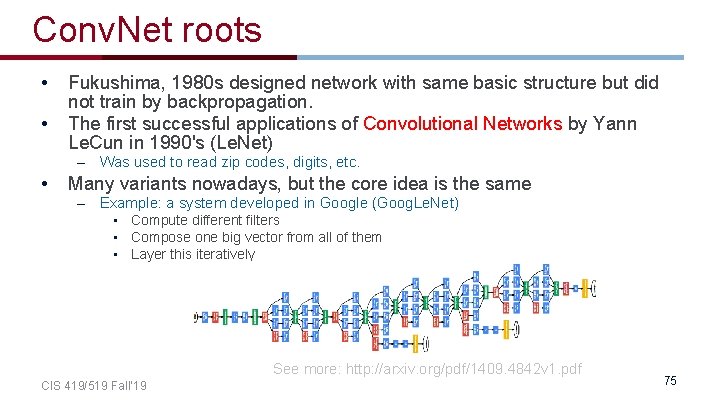
Conv. Net roots • • Fukushima, 1980 s designed network with same basic structure but did not train by backpropagation. The first successful applications of Convolutional Networks by Yann Le. Cun in 1990's (Le. Net) – Was used to read zip codes, digits, etc. • Many variants nowadays, but the core idea is the same – Example: a system developed in Google (Goog. Le. Net) • Compute different filters • Compose one big vector from all of them • Layer this iteratively See more: http: //arxiv. org/pdf/1409. 4842 v 1. pdf CIS 419/519 Fall’ 19 75
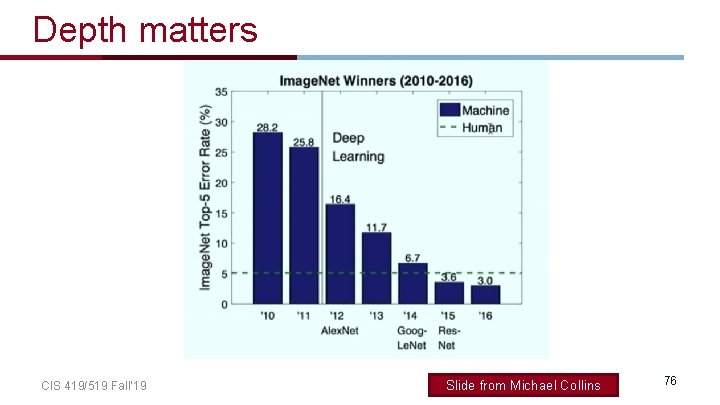
Depth matters CIS 419/519 Fall’ 19 Slide from Michael Collins 76
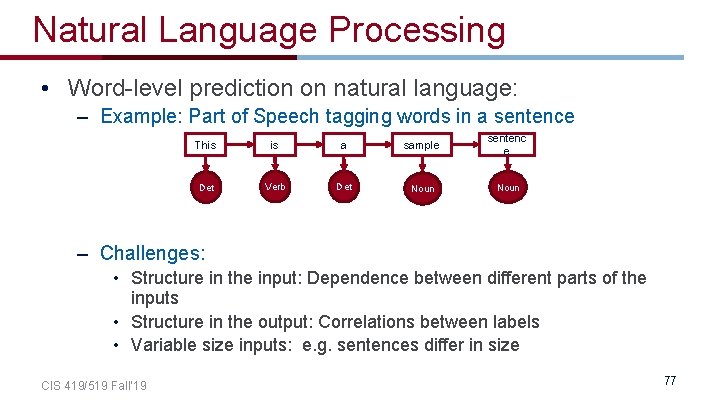
Natural Language Processing • Word-level prediction on natural language: – Example: Part of Speech tagging words in a sentence This is a sample sentenc e Det Verb Det Noun – Challenges: • Structure in the input: Dependence between different parts of the inputs • Structure in the output: Correlations between labels • Variable size inputs: e. g. sentences differ in size CIS 419/519 Fall’ 19 77
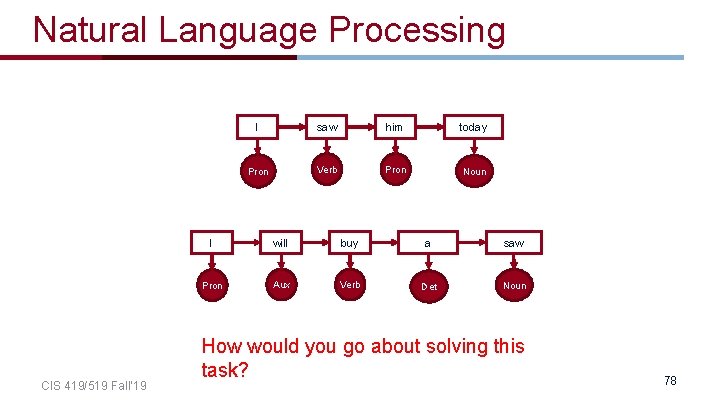
Natural Language Processing CIS 419/519 Fall’ 19 I saw him today Pron Verb Pron Noun I will buy a saw Pron Aux Verb Det Noun How would you go about solving this task? 78
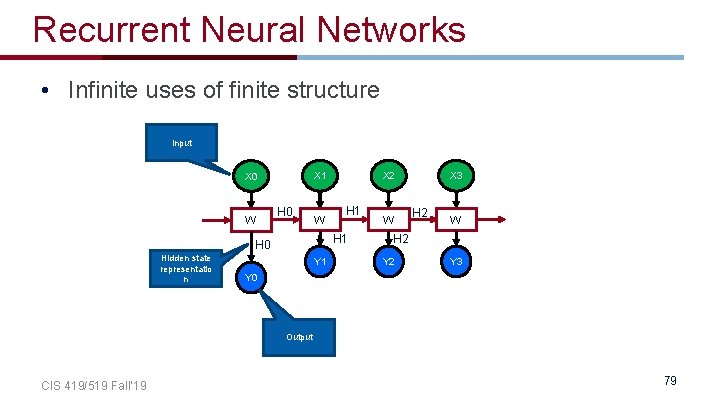
Recurrent Neural Networks • Infinite uses of finite structure Input X 1 X 0 W H 1 H 0 Hidden state representatio n X 2 Y 1 W X 3 H 2 W H 2 Y 3 Y 0 Output CIS 419/519 Fall’ 19 79
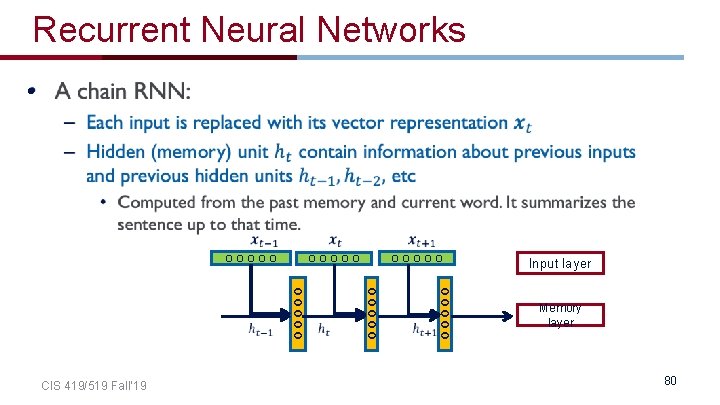
Recurrent Neural Networks • OOOOO CIS 419/519 Fall’ 19 OOOOO Input layer Memory layer 80
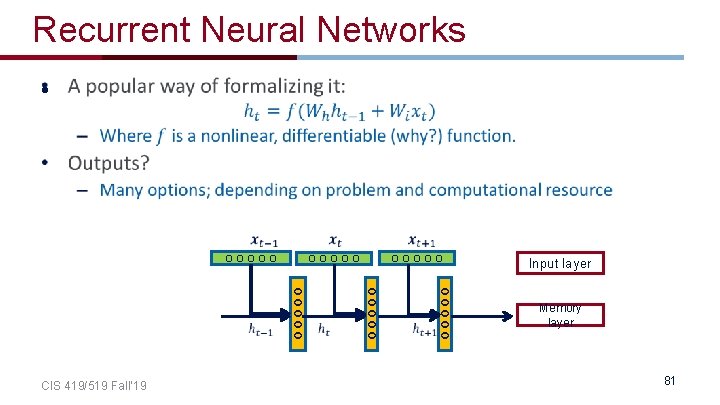
Recurrent Neural Networks • OOOOO CIS 419/519 Fall’ 19 OOOOO Input layer Memory layer 81
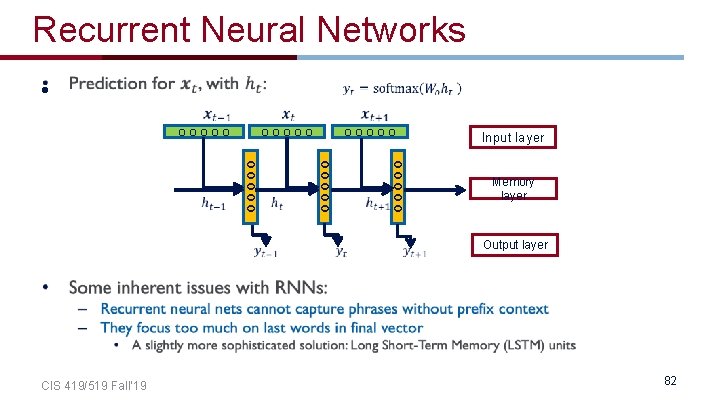
Recurrent Neural Networks • OOOOO CIS 419/519 Fall’ 19 OOOOO OOOOO Input layer Memory layer Output layer 82
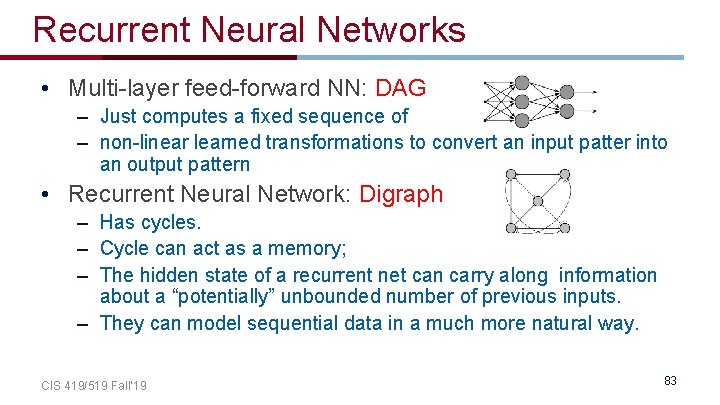
Recurrent Neural Networks • Multi-layer feed-forward NN: DAG – Just computes a fixed sequence of – non-linear learned transformations to convert an input patter into an output pattern • Recurrent Neural Network: Digraph – Has cycles. – Cycle can act as a memory; – The hidden state of a recurrent net can carry along information about a “potentially” unbounded number of previous inputs. – They can model sequential data in a much more natural way. CIS 419/519 Fall’ 19 83
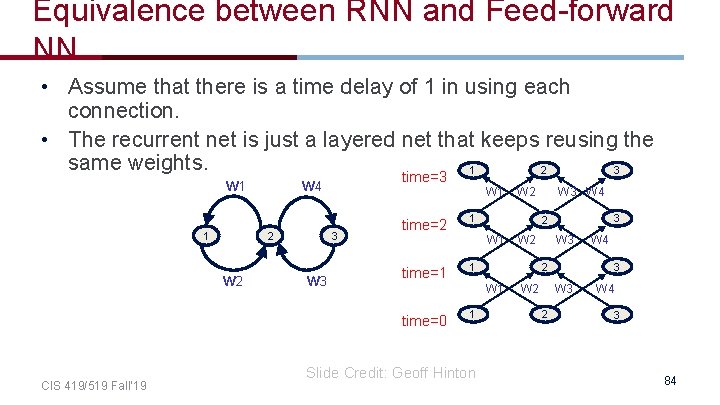
Equivalence between RNN and Feed-forward NN • Assume that there is a time delay of 1 in using each connection. • The recurrent net is just a layered net that keeps reusing the same weights. 1 2 3 time=3 w 1 w 4 1 2 3 w 2 w 3 time=2 1 2 3 W 1 W 2 W 3 W 4 time=1 1 2 3 W 1 W 2 W 3 W 4 time=0 CIS 419/519 Fall’ 19 W 1 W 2 W 3 W 4 1 Slide Credit: Geoff Hinton 2 3 84
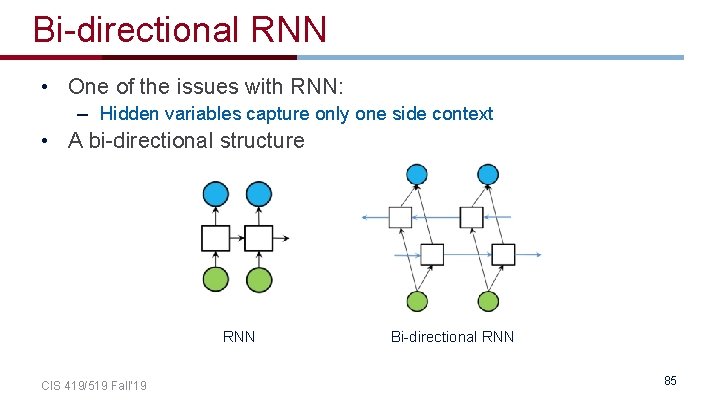
Bi-directional RNN • One of the issues with RNN: – Hidden variables capture only one side context • A bi-directional structure RNN CIS 419/519 Fall’ 19 Bi-directional RNN 85
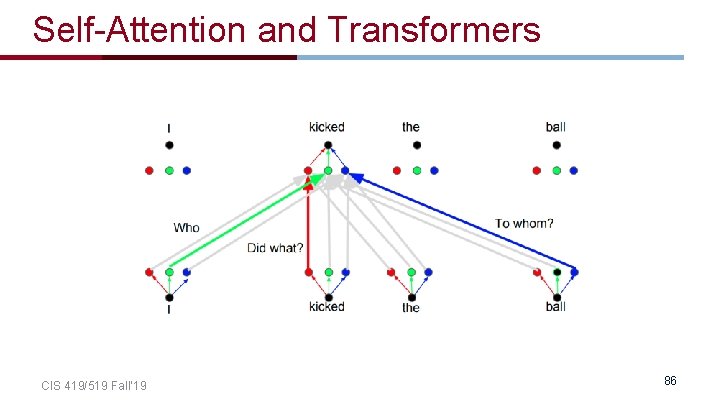
Self-Attention and Transformers CIS 419/519 Fall’ 19 86
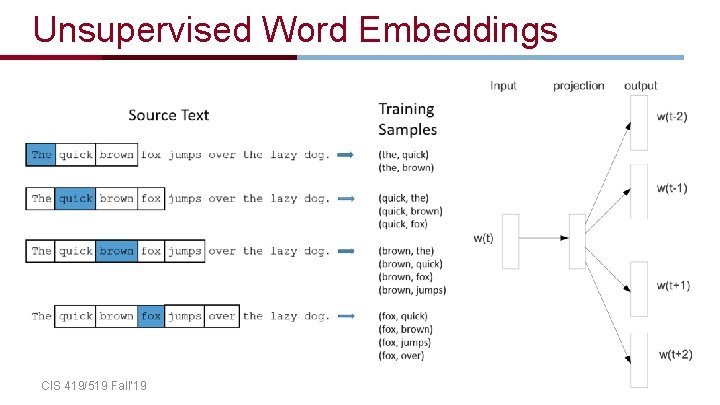
Unsupervised Word Embeddings CIS 419/519 Fall’ 19 87
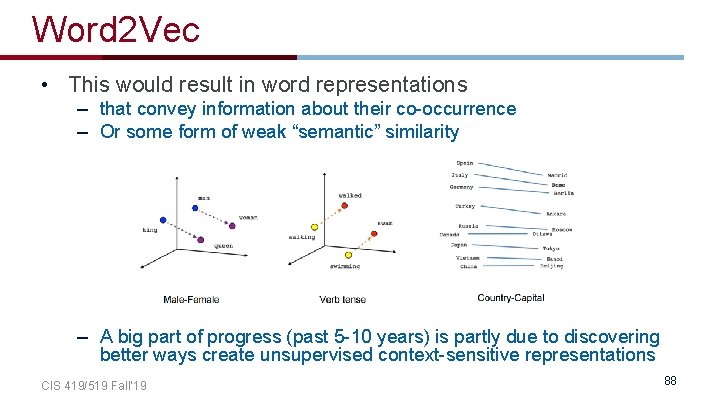
Word 2 Vec • This would result in word representations – that convey information about their co-occurrence – Or some form of weak “semantic” similarity – A big part of progress (past 5 -10 years) is partly due to discovering better ways create unsupervised context-sensitive representations CIS 419/519 Fall’ 19 88
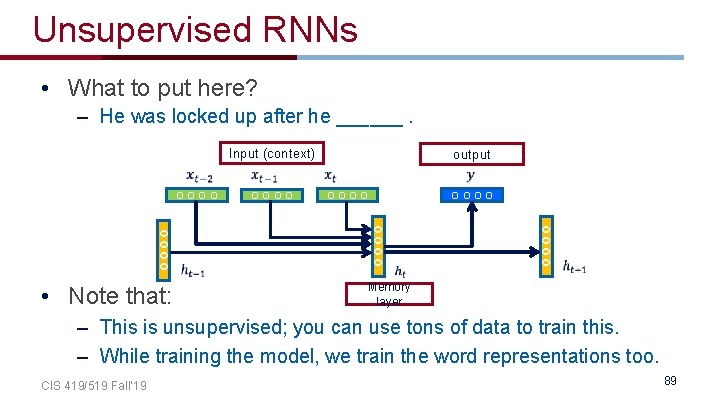
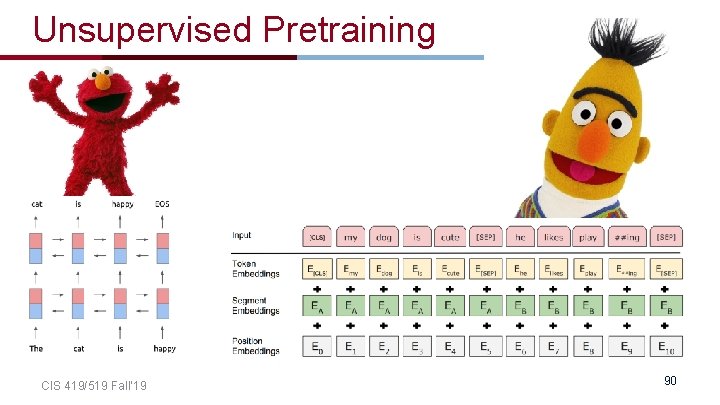
Unsupervised RNNs • What to put here? – He was locked up after he ______. Input (context) output OOOO OOOO • Note that: OOOO Memory layer – This is unsupervised; you can use tons of data to train this. – While training the model, we train the word representations too. CIS 419/519 Fall’ 19 89
Unsupervised Pretraining CIS 419/519 Fall’ 19 90
Any Questions? nitishg@seas. upenn. edu CIS 419/519 Fall’ 19 91