
NEURAL NETWORK BASED TEMPERATURE PREDICTION IN HYDEL GENERATING
NEURAL NETWORK BASED TEMPERATURE PREDICTION IN HYDEL GENERATING STATION MTech Power Systems 15 -09 -2021 1
CONTENTS � INTRODUCTION � PROBLEM � OBJECTIVE � LITERATURE REVIEW � WORK DONE � REFERENCES MTech Power Systems 15 -09 -2021 2
INTRODUCTION � Hydropower contributes around 20% of world electricity generation. � Most economical resource. � essential to obtain maximum capacity from existing plants minimizing down times. � Bearing temperature - vital role in continues operation of hydro power plants. MTech Power Systems 15 -09 -2021 3
PROBLEM � Frequent failure of old power plants-bearing temperature rise � This causes-frequent power failures, damages turbine generator system � Monitoring bearing temperature rise is an important task MTech Power Systems 15 -09 -2021 4
OBJECTIVE � To model and simulate dynamic variations of bearing temperature of an in-service hydro power unit. � prediction of generator transformer winding temperature. � Develop a control system with a graphical user interface. � The operator can get an idea of approximate temperature if the operating conditions are specified. MTech Power Systems 15 -09 -2021 5
Literature review � Stable bearing temperatures - essential for successful continuous operation. � Whenever the temperature exceeds the limits-machine looses stability. � In this project, from the measured temperature variations of bearings a model is created to predict bearing temperatures at various operating conditions. MTech Power Systems 15 -09 -2021 6
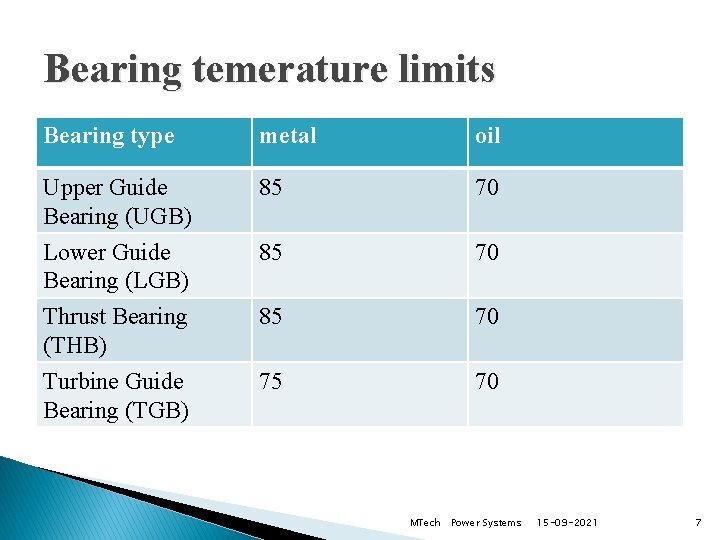
Bearing temerature limits Bearing type metal oil Upper Guide Bearing (UGB) 85 70 Lower Guide Bearing (LGB) 85 70 Thrust Bearing (THB) Turbine Guide Bearing (TGB) 85 70 75 70 MTech Power Systems 15 -09 -2021 7
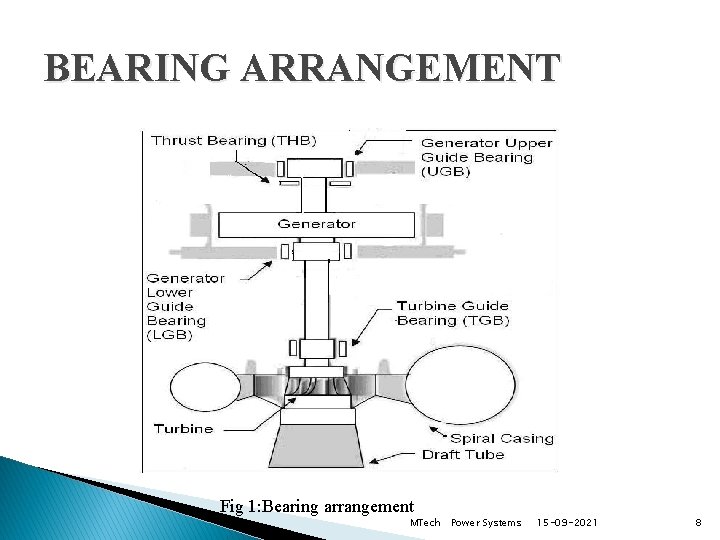
BEARING ARRANGEMENT Fig 1: Bearing arrangement MTech Power Systems 15 -09 -2021 8
Overview of modelling How should multi-physical interactions in a hydropower bearing-heat exchanger system be modelled, simulated, in order to predict the bearing temperature variation? MTech Power Systems 15 -09 -2021 9
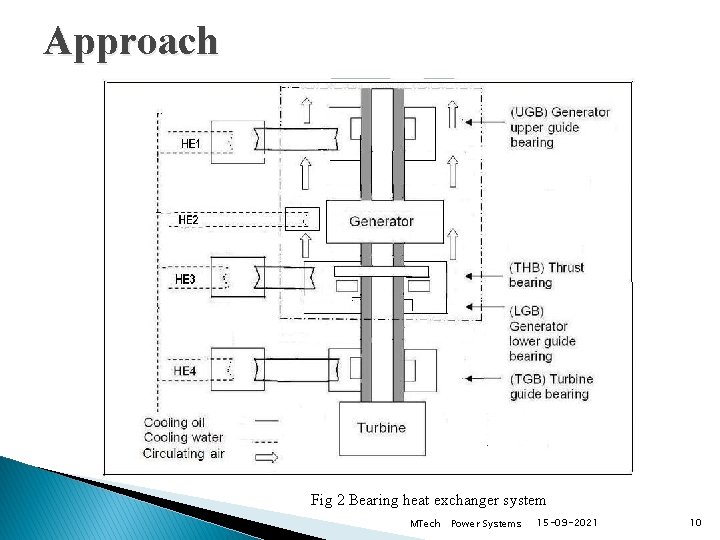
Approach Fig 2 Bearing heat exchanger system MTech Power Systems 15 -09 -2021 10
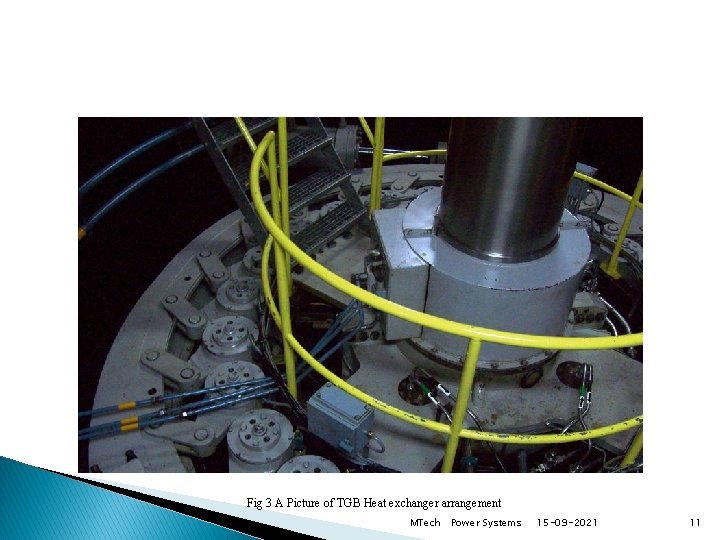
Fig 3 A Picture of TGB Heat exchanger arrangement MTech Power Systems 15 -09 -2021 11
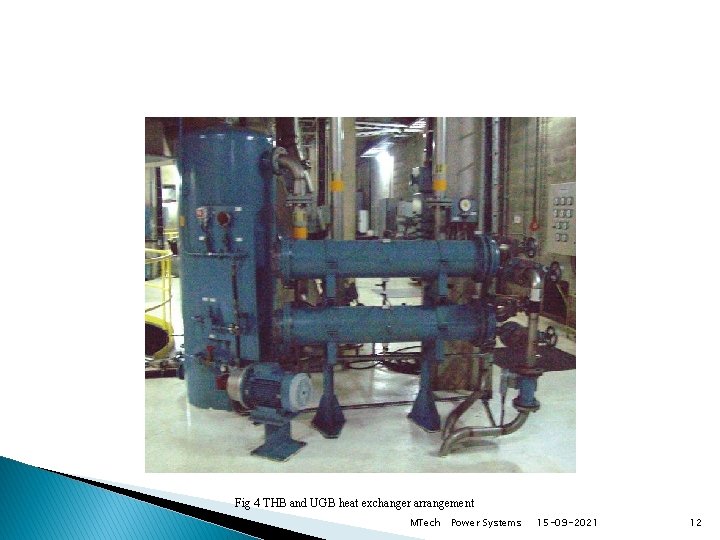
Fig 4 THB and UGB heat exchanger arrangement MTech Power Systems 15 -09 -2021 12
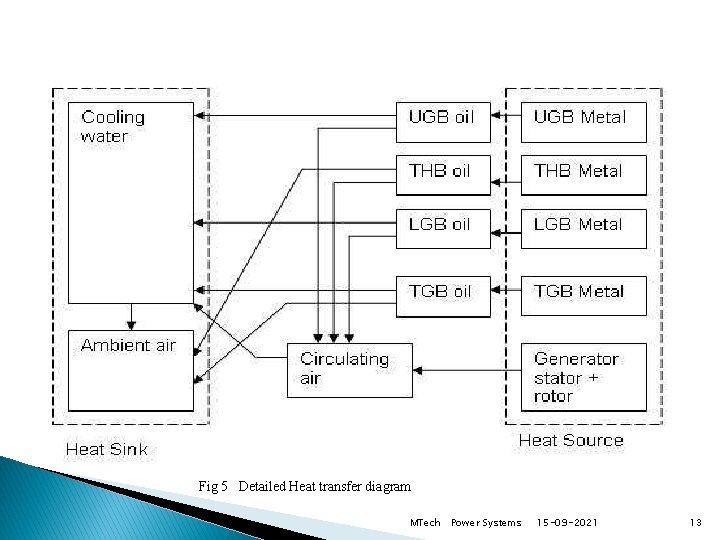
Fig 5 Detailed Heat transfer diagram MTech Power Systems 15 -09 -2021 13
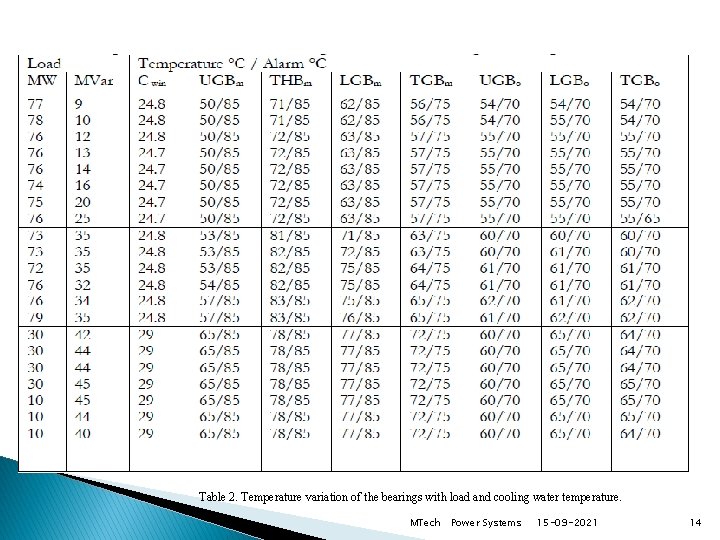
Table 2. Temperature variation of the bearings with load and cooling water temperature. MTech Power Systems 15 -09 -2021 14
� when the cooling water temperature is high the bearing temperatures are also at a higher value. � Bearing metal temperatures depend on: Initial conditions of the bearing, External conditions such as cooling water flow rate, Cooling water temperature Electrical load. § § MTech Power Systems 15 -09 -2021 15
System under investigation has multiple time dependent inputs and multiple outputs. � interaction within the system -complex , non linear. � Parallel processing needed to obtain the output. � Computation can not be implemented by using conventional modelling techniques. � MTech Power Systems 15 -09 -2021 16
Neural Netwok � Neural network (NN) approach - best to model systems which exhibits such characteristics. � Biologically motivated approach to machine learning. � NNs imitate the function of human brain. � Fundamental processing elements -neuron 1. Receives inputs from other source 2. Combines them in someway 3. Performs nonlinear operation on the result 4. Outputs the final result MTech Power Systems 15 -09 -2021 17
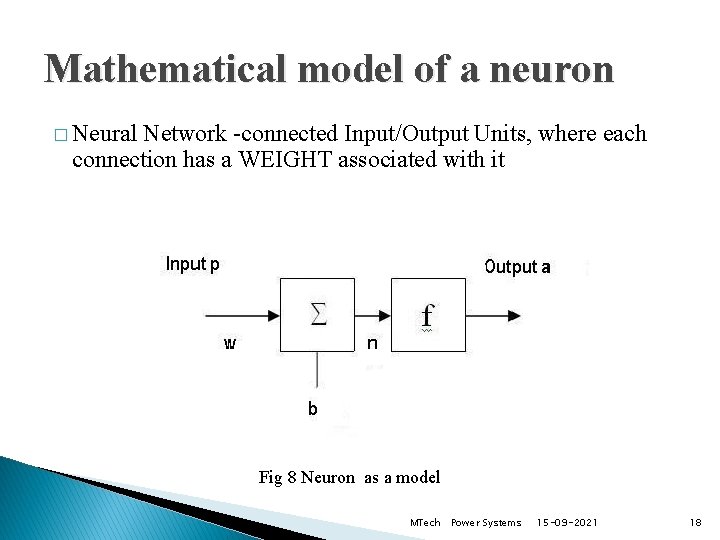
Mathematical model of a neuron � Neural Network -connected Input/Output Units, where each connection has a WEIGHT associated with it Fig 8 Neuron as a model MTech Power Systems 15 -09 -2021 18
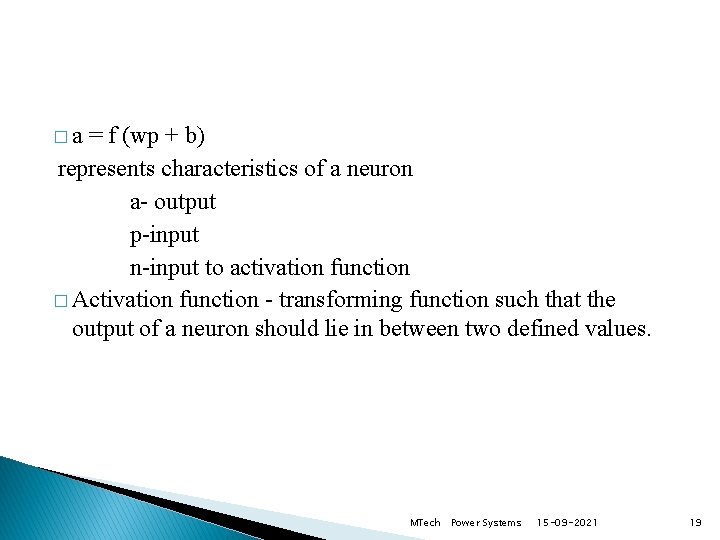
�a = f (wp + b) represents characteristics of a neuron a- output p-input n-input to activation function � Activation function - transforming function such that the output of a neuron should lie in between two defined values. MTech Power Systems 15 -09 -2021 19
Three types of activation functions: v Step function v piecewise linear function v Sigmoid function � MTech Power Systems 15 -09 -2021 20

Training a neural network � Neural Network learns by adjusting the weights � The training method: v Supervised learning v Un supervised learning MTech Power Systems 15 -09 -2021 21

Advantages of Neural Networks Capability to identify the patterns exist in a given data set. � Can map the input data to the output data in a nonlinear system. � Can process data in parallel- applied to MIMO system easily. � MTech Power Systems 15 -09 -2021 22
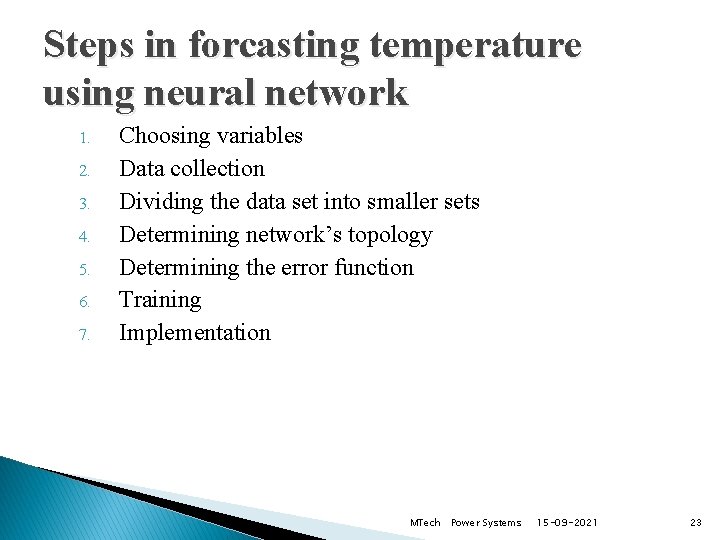
Steps in forcasting temperature using neural network 1. 2. 3. 4. 5. 6. 7. Choosing variables Data collection Dividing the data set into smaller sets Determining network’s topology Determining the error function Training Implementation MTech Power Systems 15 -09 -2021 23
Choosing variables and Data collection � Determining which variable is related directly or indirectly to the data that we need to forecast. • If the variable does not have any affect to the data that we need to forecast then we should wipe it out of consider. • Beside it, if the variable is concerned directly or indirectly then we should take it to consider. � Collecting data involved with the variables that are chosen MTech Power Systems 15 -09 -2021 24
Dividing patterns set � Divide the whole patterns set into the smaller sets: (1) Training set (2) Test set (3) Verification set. � The training set -the biggest set employed in training the network. �The test set, often includes 10% to 30% of training set. �verification set is set balance between the needs of enough patterns for verification, training, and testing. MTech Power Systems 15 -09 -2021 25
Determining network’s topology Determines links between neurons, number of hidden layers, number of neurons in each layer. � Trial and error method. � Determining the error function � To estimate the network’s performance before and after training process. Training Ø Tunes a neural network by adjusting the weights and biases to give the global minimum of performance index or error function. MTech Power Systems 15 -09 -2021 26
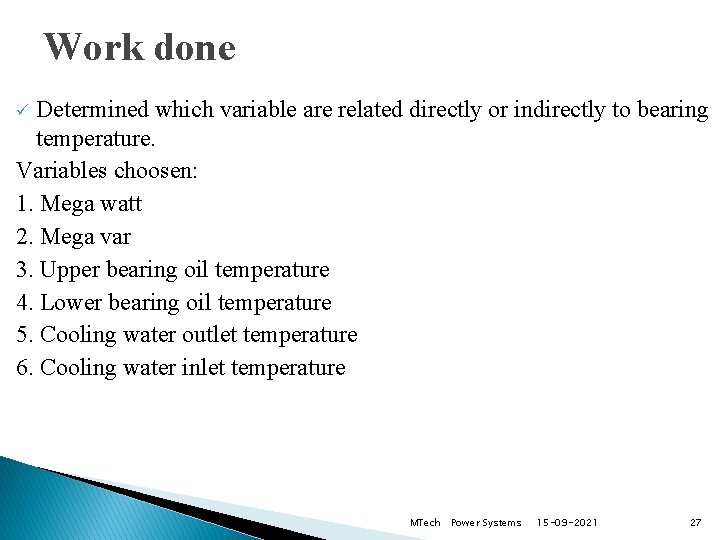
Work done Determined which variable are related directly or indirectly to bearing temperature. Variables choosen: 1. Mega watt 2. Mega var 3. Upper bearing oil temperature 4. Lower bearing oil temperature 5. Cooling water outlet temperature 6. Cooling water inlet temperature ü MTech Power Systems 15 -09 -2021 27
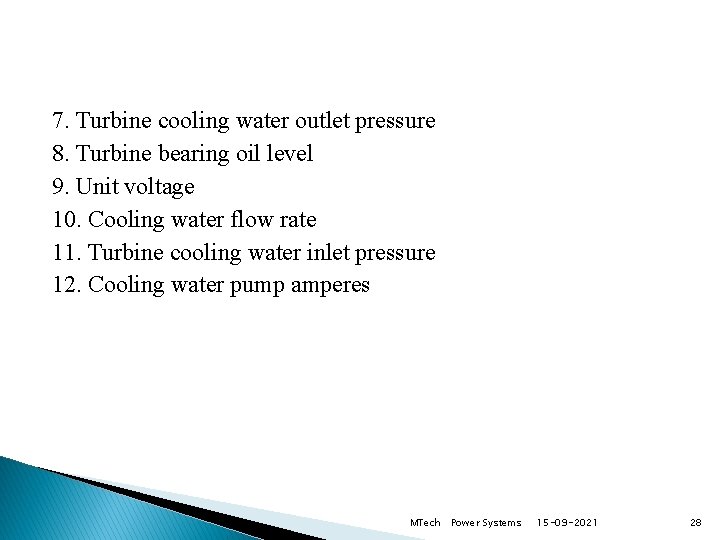
7. Turbine cooling water outlet pressure 8. Turbine bearing oil level 9. Unit voltage 10. Cooling water flow rate 11. Turbine cooling water inlet pressure 12. Cooling water pump amperes MTech Power Systems 15 -09 -2021 28
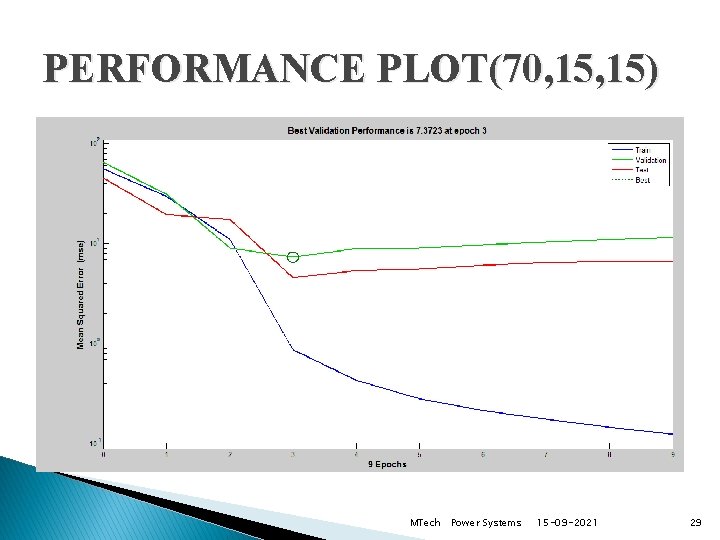
PERFORMANCE PLOT(70, 15) MTech Power Systems 15 -09 -2021 29
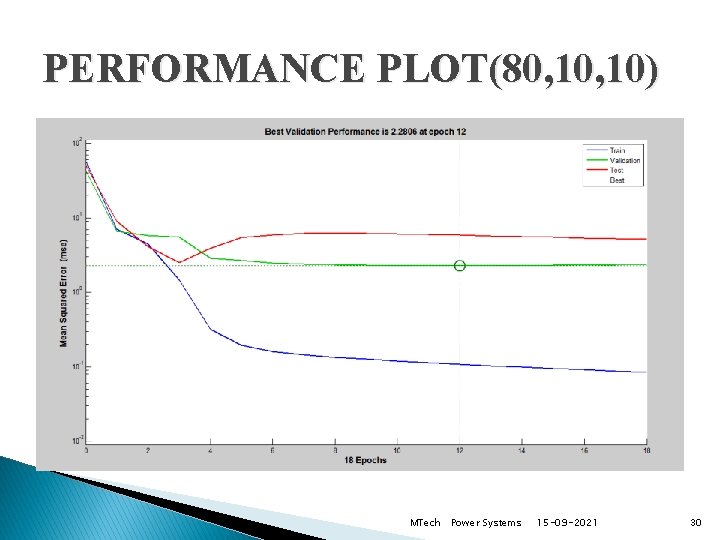
PERFORMANCE PLOT(80, 10) MTech Power Systems 15 -09 -2021 30
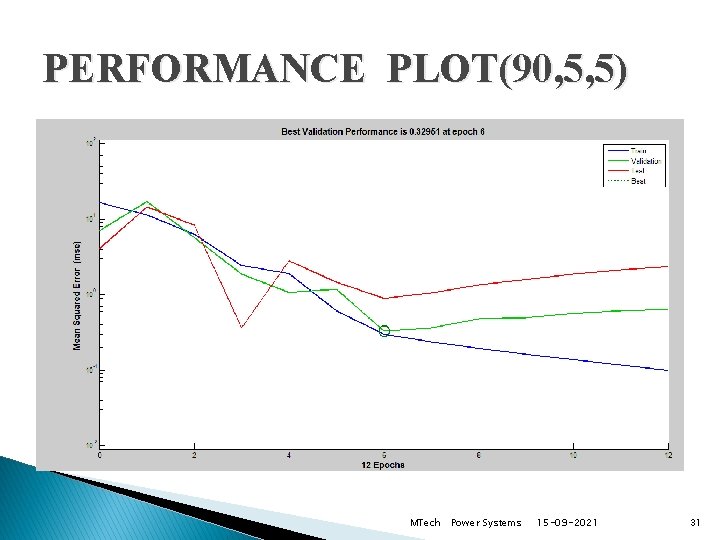
PERFORMANCE PLOT(90, 5, 5) MTech Power Systems 15 -09 -2021 31
� The set having more number of data's for training, provided the best result. � The performance plot with data set as 90, 5, 5 was best. MTech Power Systems 15 -09 -2021 32
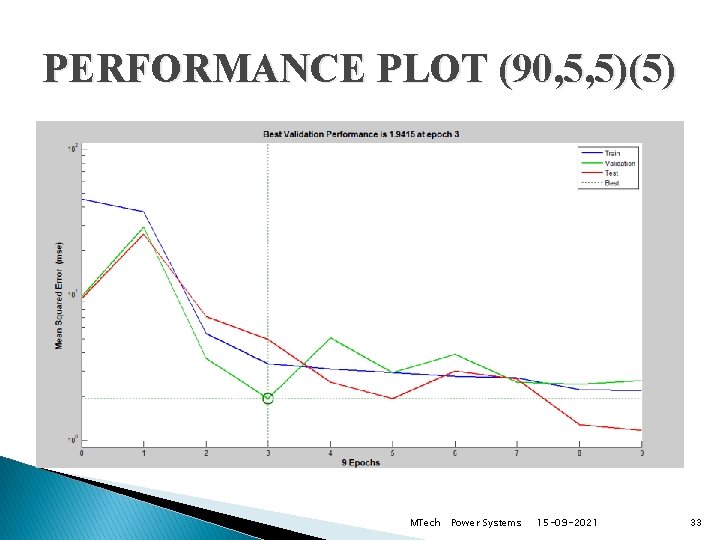
PERFORMANCE PLOT (90, 5, 5)(5) MTech Power Systems 15 -09 -2021 33
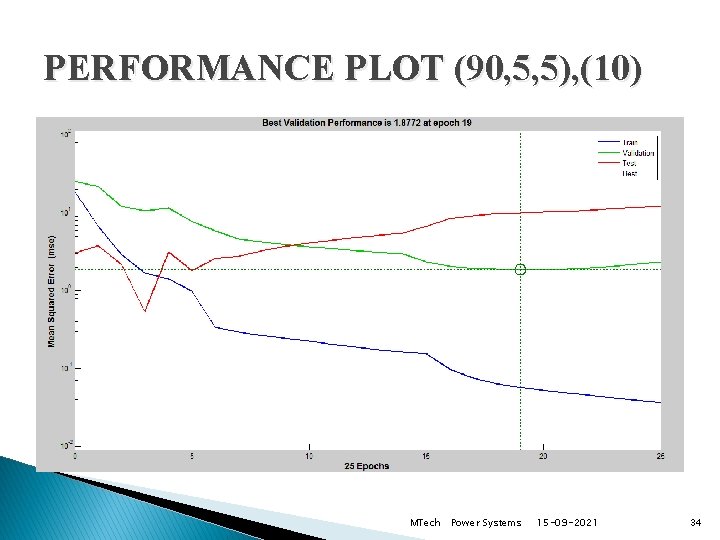
PERFORMANCE PLOT (90, 5, 5), (10) MTech Power Systems 15 -09 -2021 34
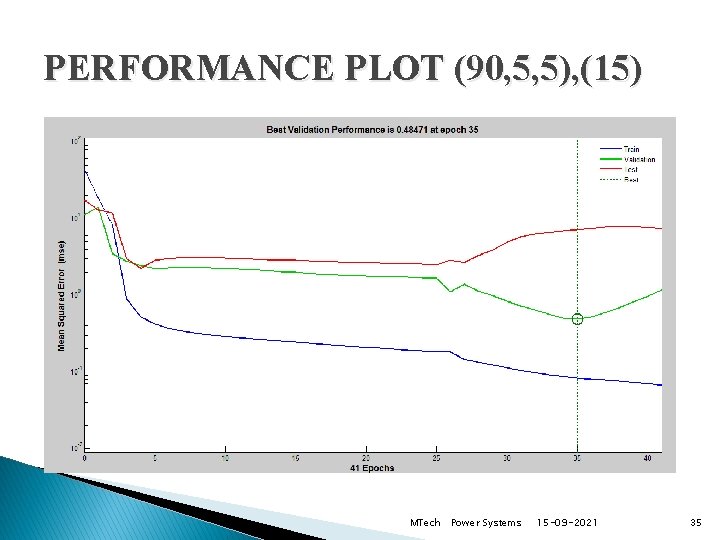
PERFORMANCE PLOT (90, 5, 5), (15) MTech Power Systems 15 -09 -2021 35
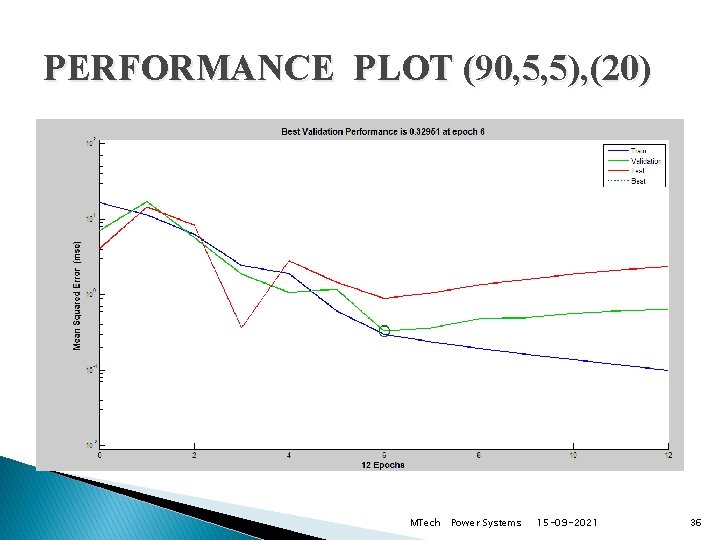
PERFORMANCE PLOT (90, 5, 5), (20) MTech Power Systems 15 -09 -2021 36
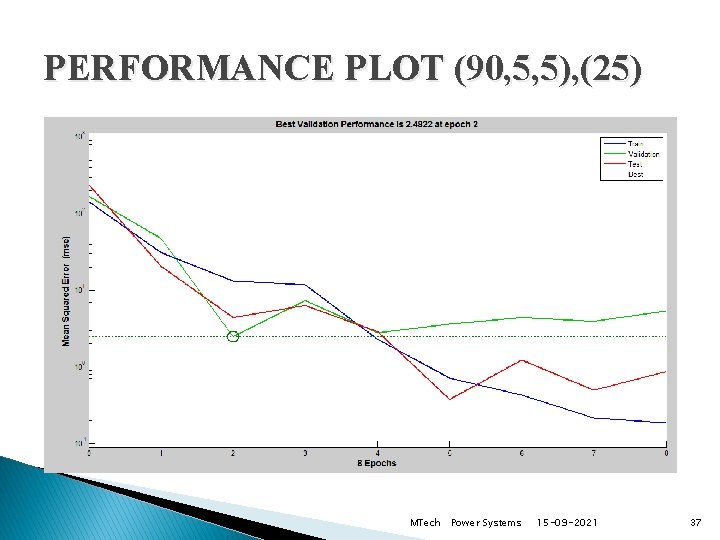
PERFORMANCE PLOT (90, 5, 5), (25) MTech Power Systems 15 -09 -2021 37
� The model provided best performance when the number of neurons in hidden layer was selected as 20. MTech Power Systems 15 -09 -2021 38
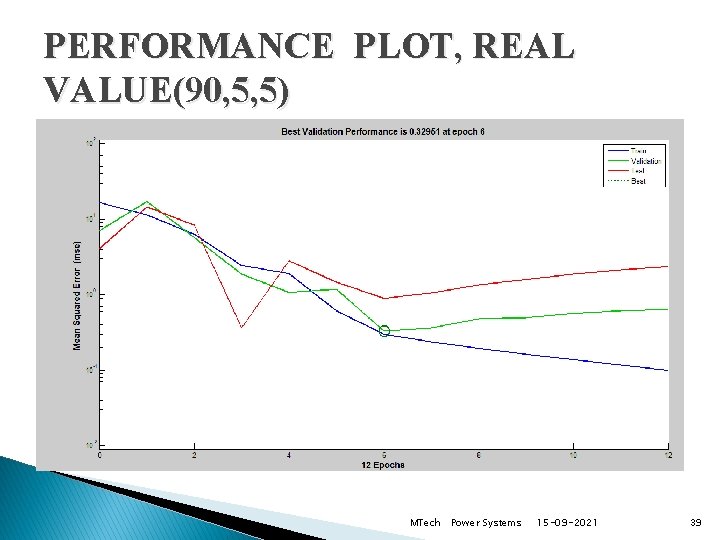
PERFORMANCE PLOT, REAL VALUE(90, 5, 5) MTech Power Systems 15 -09 -2021 39
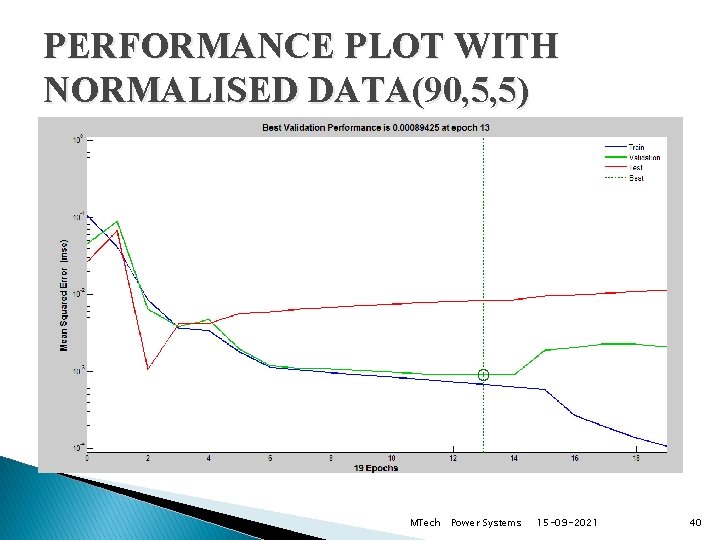
PERFORMANCE PLOT WITH NORMALISED DATA(90, 5, 5) MTech Power Systems 15 -09 -2021 40
� Better performance was obtained with normalised data. MTech Power Systems 15 -09 -2021 41
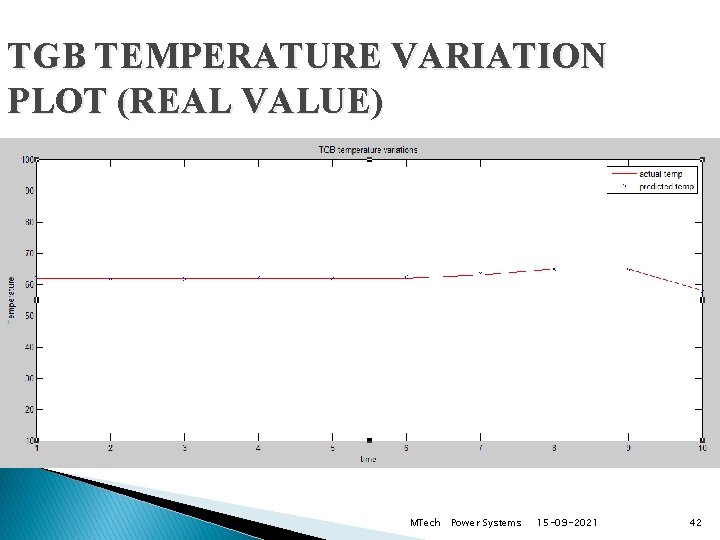
TGB TEMPERATURE VARIATION PLOT (REAL VALUE) MTech Power Systems 15 -09 -2021 42
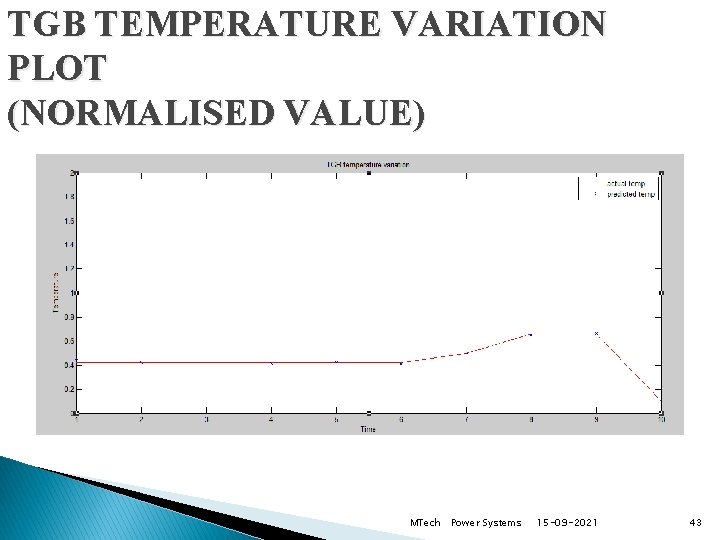
TGB TEMPERATURE VARIATION PLOT (NORMALISED VALUE) MTech Power Systems 15 -09 -2021 43
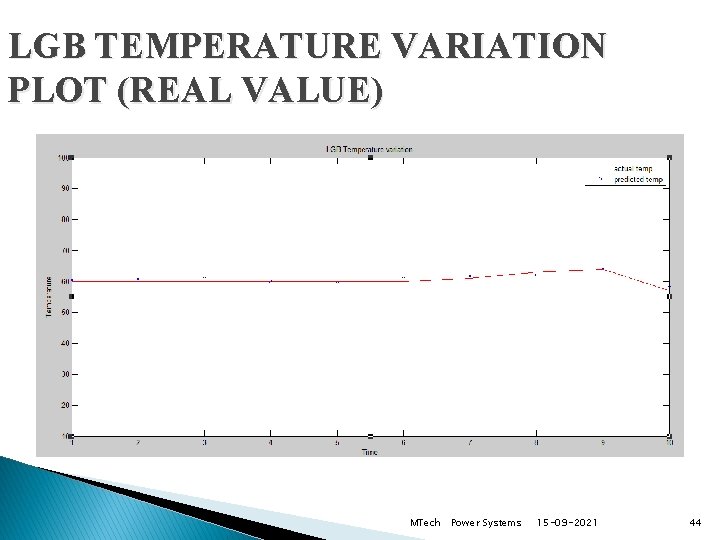
LGB TEMPERATURE VARIATION PLOT (REAL VALUE) MTech Power Systems 15 -09 -2021 44
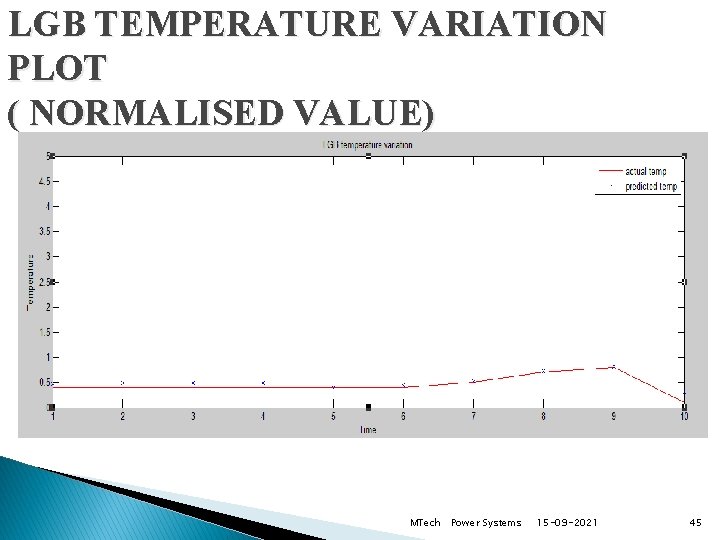
LGB TEMPERATURE VARIATION PLOT ( NORMALISED VALUE) MTech Power Systems 15 -09 -2021 45
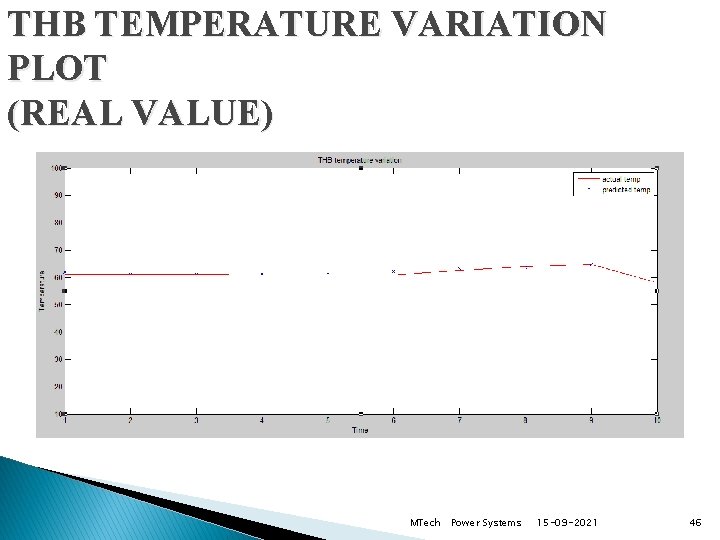
THB TEMPERATURE VARIATION PLOT (REAL VALUE) MTech Power Systems 15 -09 -2021 46
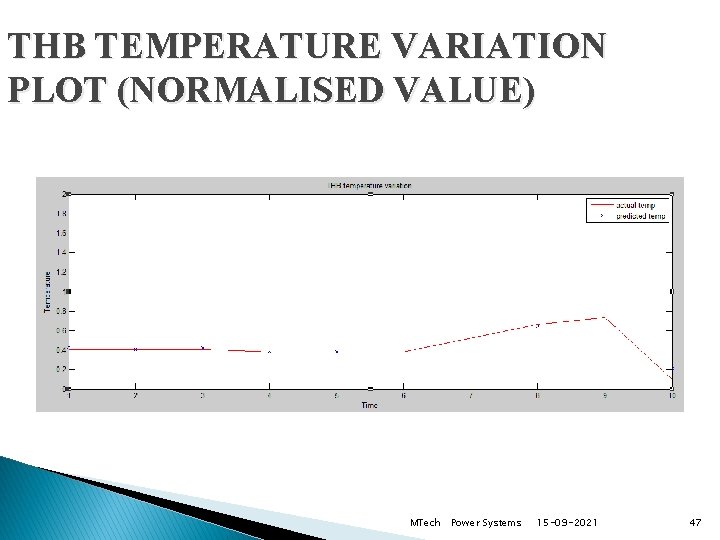
THB TEMPERATURE VARIATION PLOT (NORMALISED VALUE) MTech Power Systems 15 -09 -2021 47
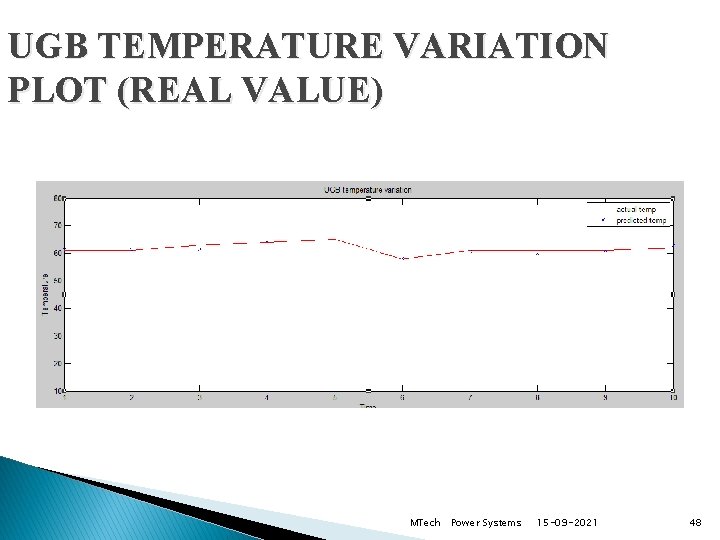
UGB TEMPERATURE VARIATION PLOT (REAL VALUE) MTech Power Systems 15 -09 -2021 48
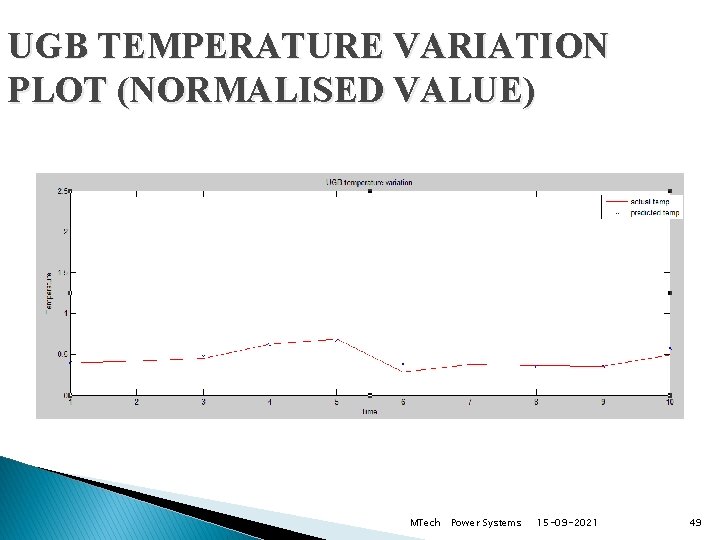
UGB TEMPERATURE VARIATION PLOT (NORMALISED VALUE) MTech Power Systems 15 -09 -2021 49
GENERATOR TRANSFORMER TEMPERATURE PREDICTION � In the similar way winding temperature of transformer was predicted. � Power transformers - most valuable assets in electrical power networks. � Hence requires great attention. � Their outages effect stability of network. � Thermal impacts not only causes insulation degradation but is a limiting factor of transformer operation. MTech Power Systems 15 -09 -2021 50
� knowledge of temperature is of great interest. � Basic criterion for loading is the winding temperature. It must not exceed the prescribed values. � The inputs chosen are: q active power q reactive power q current MTech Power Systems 15 -09 -2021 51
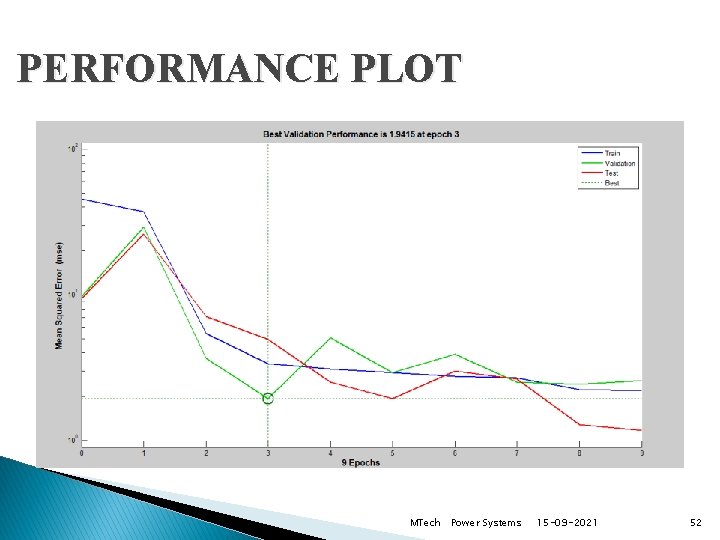
PERFORMANCE PLOT MTech Power Systems 15 -09 -2021 52
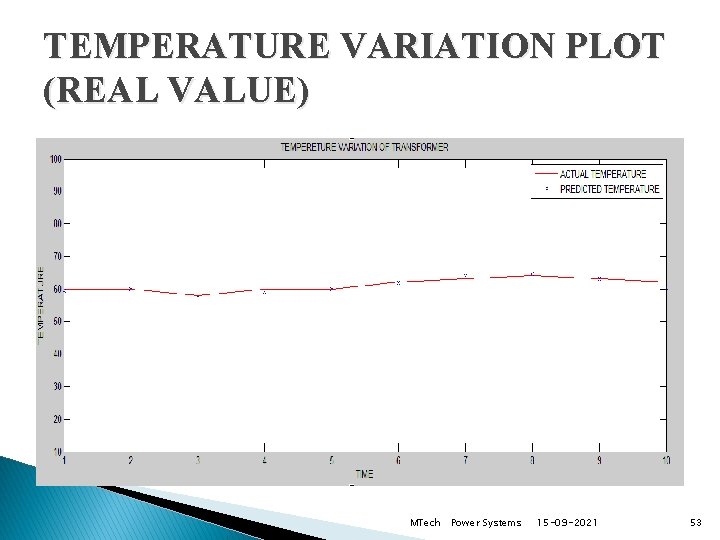
TEMPERATURE VARIATION PLOT (REAL VALUE) MTech Power Systems 15 -09 -2021 53
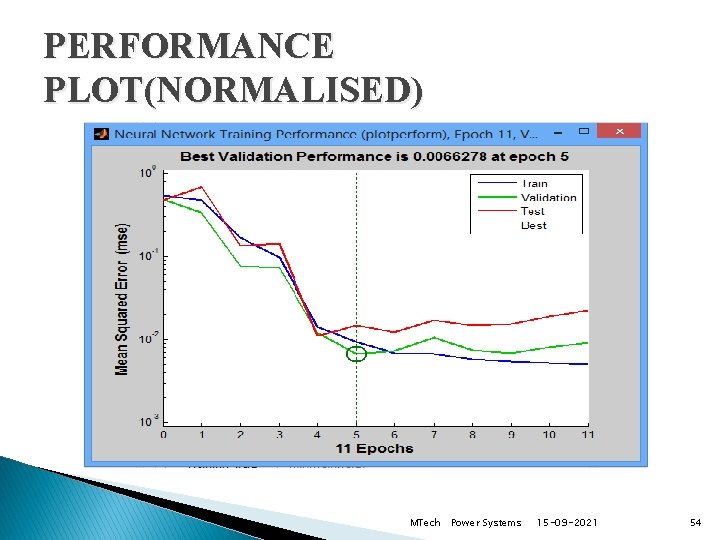
PERFORMANCE PLOT(NORMALISED) MTech Power Systems 15 -09 -2021 54
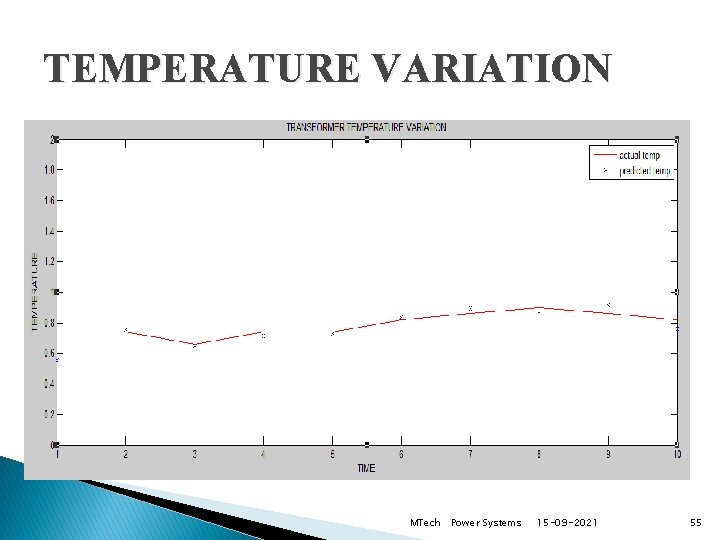
TEMPERATURE VARIATION MTech Power Systems 15 -09 -2021 55
CONCLUSION � Was able to predict both bearing temperature and transformer temperature with an accuracy of ± 1 °C. � Developed a GUI so that operator can easily predict temperature by specifying operating conditions. MTech Power Systems 15 -09 -2021 56
![REFERENCES [1]Modeling And Simulation Of Temperature Variation In Bearings Of Hydroelectric Power Generating Unit,](http://slidetodoc.com/presentation_image_h2/a53f15d88e862d4cb3da62d5fe7d99c6/image-57.jpg "REFERENCES [1]Modeling And Simulation Of Temperature Variation In Bearings Of Hydroelectric Power Generating Unit,")
REFERENCES [1]Modeling And Simulation Of Temperature Variation In Bearings Of Hydroelectric Power Generating Unit, icbse Kandy-2010 [2]One Hour Ahead Load Forcasting Using Neurel Network, IEE transactions, Feb 2008. [3]Girish kumar Jar, Artificial neural networks and it’s applications, IARI, New Delhi- 100 -012 [5]Predicting Transformer Temperature rise and loss of life in presence of harmonic load currents, ASEJ 2012 [4] Ral Rojas, Neural network a systematic introduction, Sprinter, Berlin, Heidelberg, Network, March 1996. [5] James A Freeman, David M Skapura, Neural networks Algorithms, Applications, and programming techniques, Pearson Inc, 1999 [6] Stuart Russel, Peter Norvig, Artificial Intelligence A Modern Approach Pearsons Inc, 1995, MTech Power Systems 15 -09 -2021 57
![[7] T. J. Molinski and G. W. Swift, “Reducing the life-cycle cost of powertransformers,](http://slidetodoc.com/presentation_image_h2/a53f15d88e862d4cb3da62d5fe7d99c6/image-58.jpg "[7] T. J. Molinski and G. W. Swift, “Reducing the life-cycle cost of powertransformers,")
[7] T. J. Molinski and G. W. Swift, “Reducing the life-cycle cost of powertransformers, ” in CEPSI 1 Proceedings, Kuala Lumpur, Malaysia, Oct. 21– 25, 1996. [8]Radakovic, Z. and Feser, K. A new method for the calculation of the hot-spot temperature in power transformer with ONAN cooling", IEEE Trans. Power Delivery, 18(4), pp. 1 -9 (Oct. 2003). [9]Pradhan, M. K. and Ramu, T. S. Prediction of hottest spot temperature (HST) in power and station transformers", IEEE Trans. Power Delivery, 18(4), pp. 1275 -1283 (Oct. 2003). MTech Power Systems 15 -09 -2021 58

THANK YOU MTech Power Systems 15 -09 -2021 59
- Slides: 59