
Neural mechanisms of pain MEDI 6100 Fremantle Broome
Neural mechanisms of pain MEDI 6100 Fremantle Broome Sydney 1
Prof Eric Visser Dr Natalie Morellini © Eric J. Visser 2017 UNDA. All rights reserved 2
Student learning outcomes o Describe 'pain pathways' in depth o Outline central nervous system [CNS] control over pain perception o See learning suggestions at the end of this slide show o Main reference to read Schug SA, et al. APM: SE Working Group of the Australian and New Zealand College of Anaesthetists and Faculty of Pain Medicine (2015), Acute Pain Management: Scientific Evidence (4 th edn) ANZCA & FPM, Melbourne, pages 1 -7 o http: //fpm. anzca. edu. au/documents/apmse 4_2015_final © EJ Visser and UNDA 2018 all rights reserved 3
What is pain? o ‘Pain is an unpleasant sensory & emotional experience associated with actual or potential tissue damage’ (IASP 2012) o Pain is generated by the conscious brain in response to perceived tissue damage o Pain is more than just a sensation o Pain is a subjective, multidimensional, whole-person experience o Pain is what the person-in-pain says it is o Pain always occurs in a ‘context’ -bio-medical-psycho-social-environmental © EJ Visser and UNDA 2018 all rights reserved 4
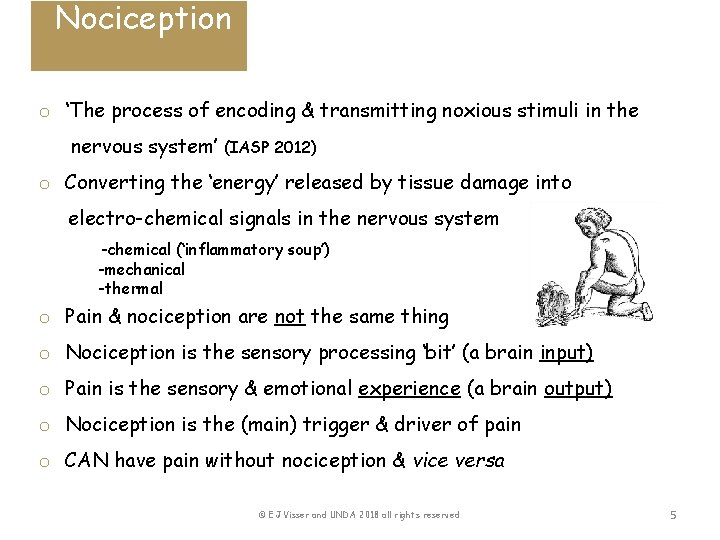
Nociception o ‘The process of encoding & transmitting noxious stimuli in the nervous system’ (IASP 2012) o Converting the ‘energy’ released by tissue damage into electro-chemical signals in the nervous system -chemical (‘inflammatory soup’) -mechanical -thermal o Pain & nociception are not the same thing o Nociception is the sensory processing ‘bit’ (a brain input) o Pain is the sensory & emotional experience (a brain output) o Nociception is the (main) trigger & driver of pain o CAN have pain without nociception & vice versa © EJ Visser and UNDA 2018 all rights reserved 5
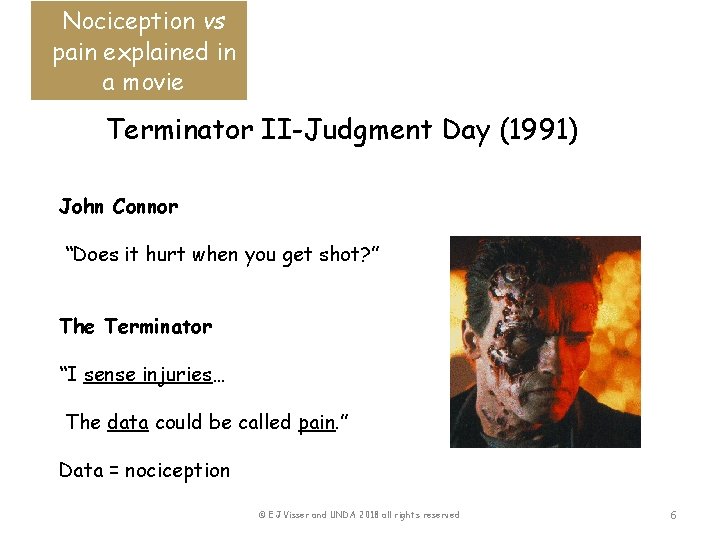
Nociception vs pain explained in a movie Terminator II-Judgment Day (1991) John Connor “Does it hurt when you get shot? ” The Terminator “I sense injuries… The data could be called pain. ” Data = nociception © EJ Visser and UNDA 2018 all rights reserved 6
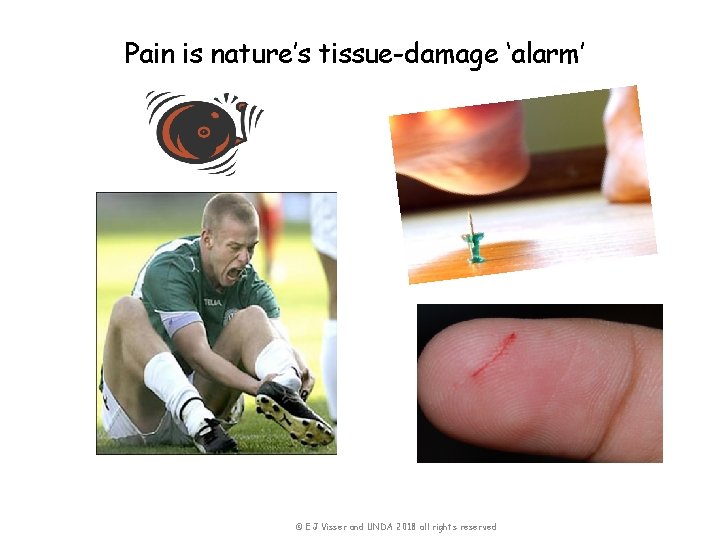
Pain is nature’s tissue-damage ‘alarm’ © EJ VISSER AND UNDA 2018 ALL RIGHTS RESERVED © EJ Visser and UNDA 2018 all rights reserved
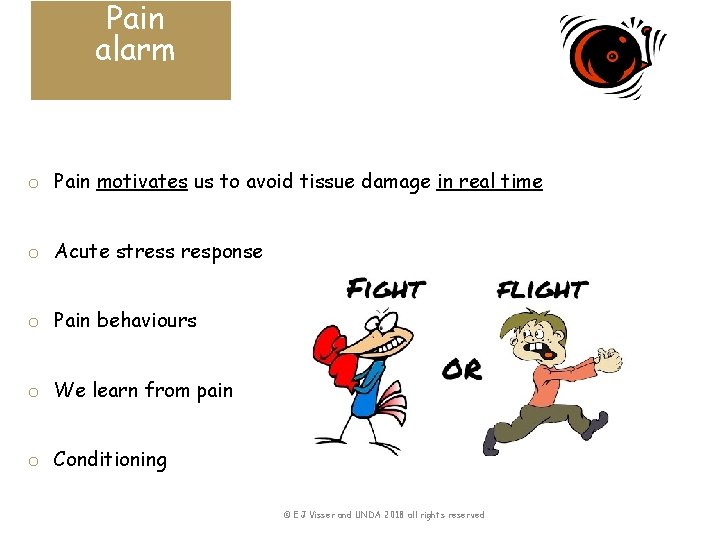
Pain alarm o Pain motivates us to avoid tissue damage in real time o Acute stress response o Pain behaviours o We learn from pain o Conditioning © EJ Visser and UNDA 2018 all rights reserved
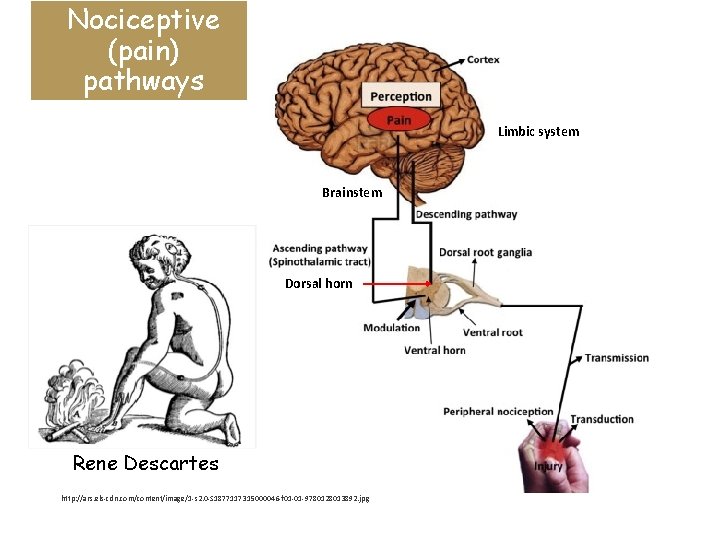
Nociceptive (pain) pathways Limbic system Brainstem Dorsal horn Rene Descartes http: //ars. els-cdn. com/content/image/1 -s 2. 0 -S 1877117315000046 -f 01 -01 -9780128013892. jpg
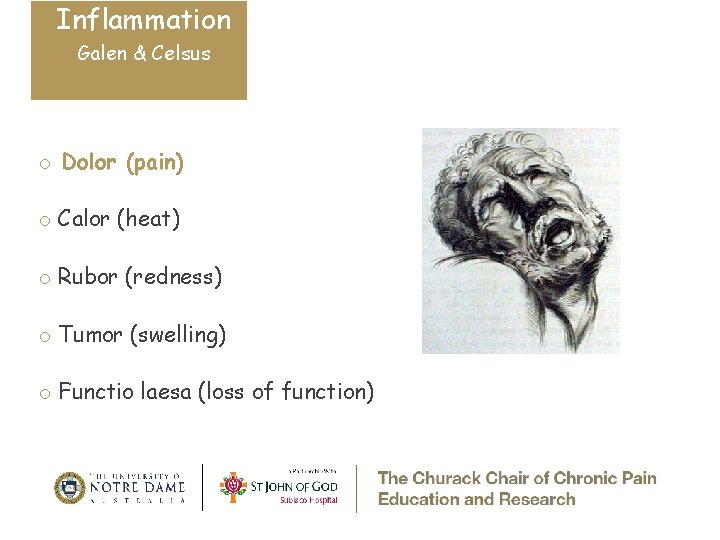
Inflammation Galen & Celsus o Dolor (pain) o Calor (heat) o Rubor (redness) o Tumor (swelling) o Functio laesa (loss of function)
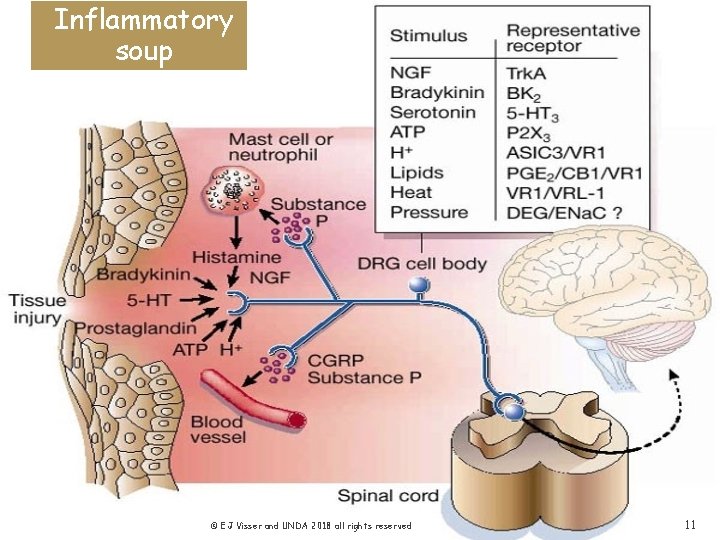
Inflammatory soup © EJ Visser and UNDA 2018 all rights reserved 11
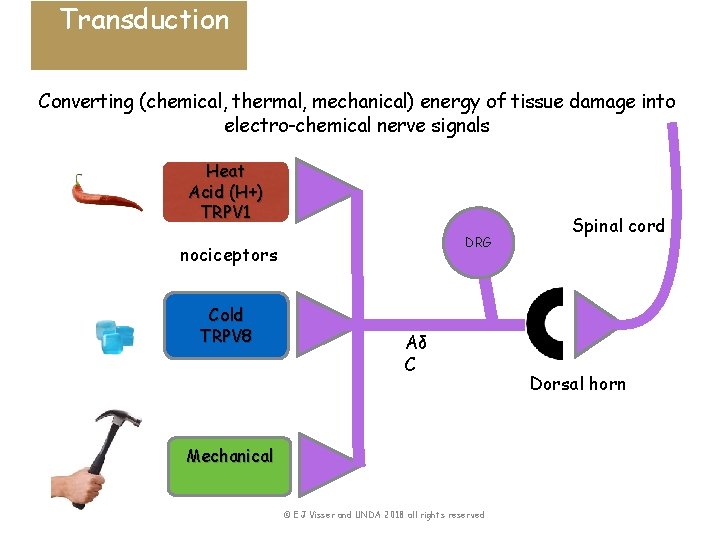
Transduction Converting (chemical, thermal, mechanical) energy of tissue damage into electro-chemical nerve signals Heat Acid (H+) TRPV 1 DRG nociceptors Cold TRPV 8 Aδ C Mechanical © EJ Visser and UNDA 2018 all rights reserved Spinal cord Dorsal horn
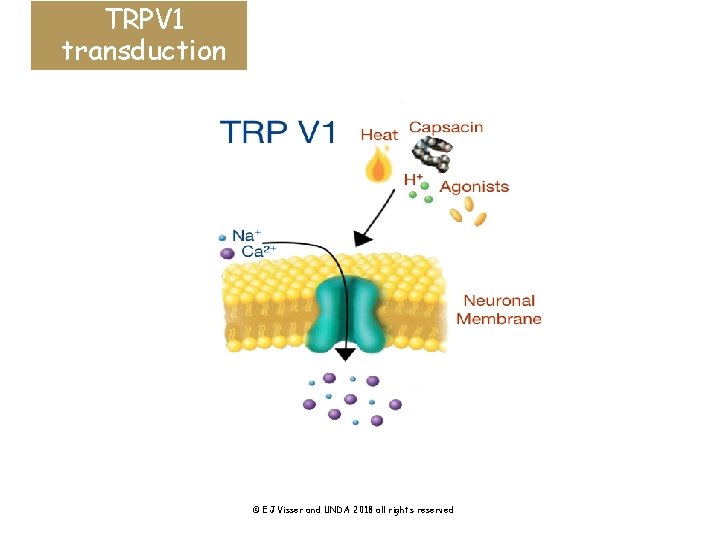
TRPV 1 transduction © EJ Visser and UNDA 2018 all rights reserved
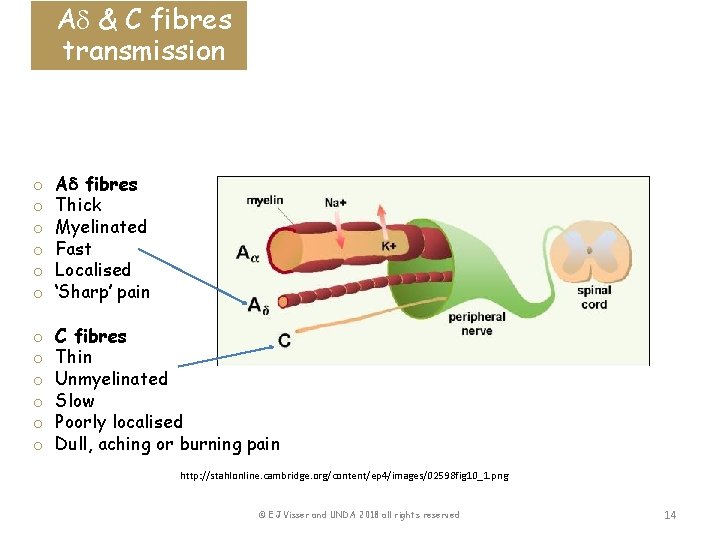
A & C fibres transmission o o o A fibres Thick Myelinated Fast Localised ‘Sharp’ pain o o o C fibres Thin Unmyelinated Slow Poorly localised Dull, aching or burning pain http: //stahlonline. cambridge. org/content/ep 4/images/02598 fig 10_1. png © EJ Visser and UNDA 2018 all rights reserved 14
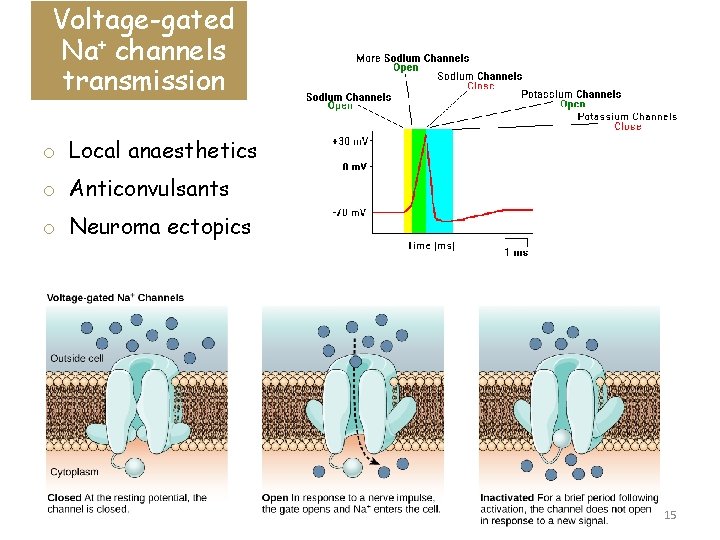
Voltage-gated Na+ channels transmission o Local anaesthetics o Anticonvulsants o Neuroma ectopics 15
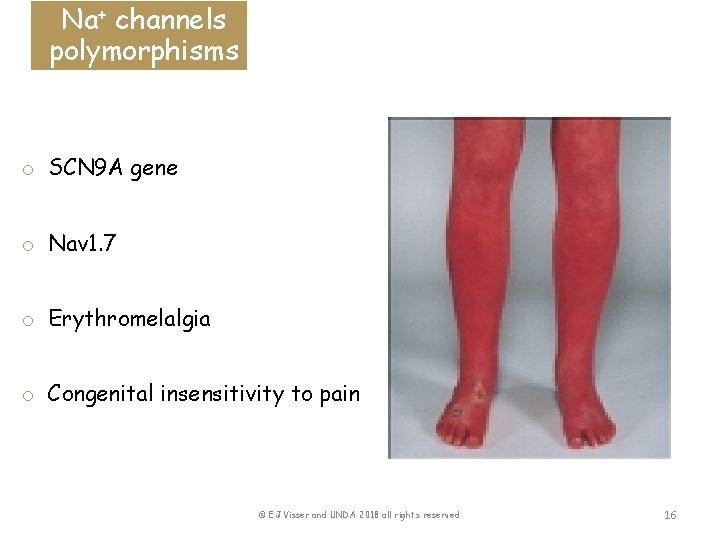
Na+ channels polymorphisms o SCN 9 A gene o Nav 1. 7 o Erythromelalgia o Congenital insensitivity to pain © EJ Visser and UNDA 2018 all rights reserved 16
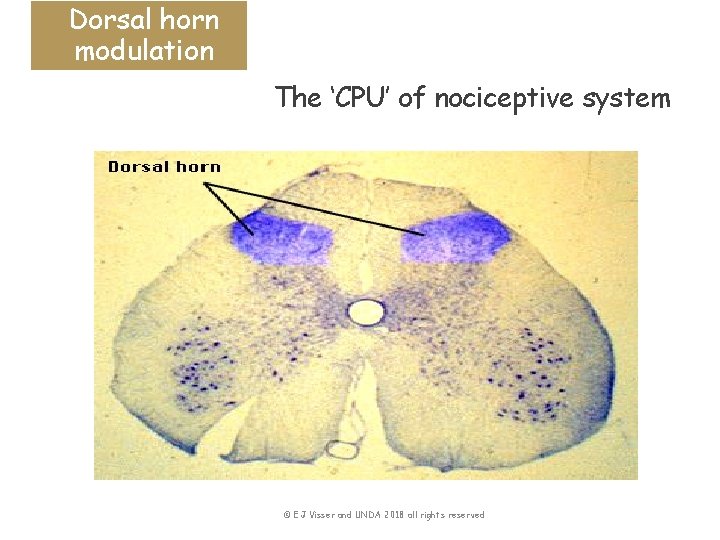
Dorsal horn modulation The ‘CPU’ of nociceptive system © EJ Visser and UNDA 2018 all rights reserved
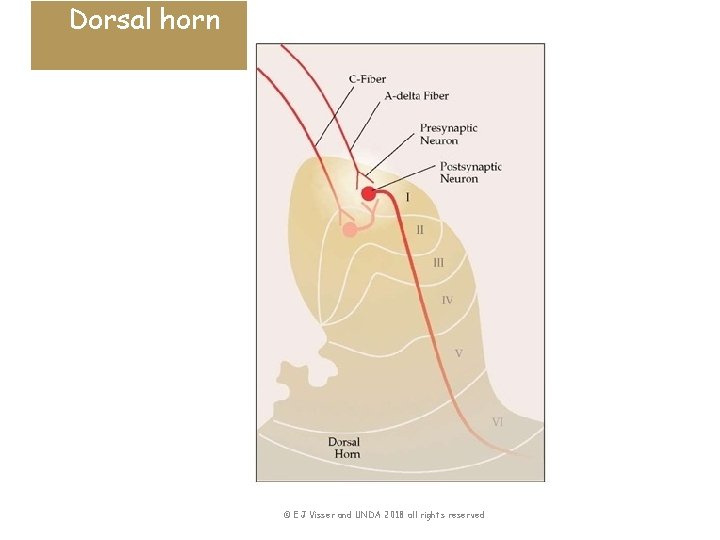
Dorsal horn © EJ Visser and UNDA 2018 all rights reserved
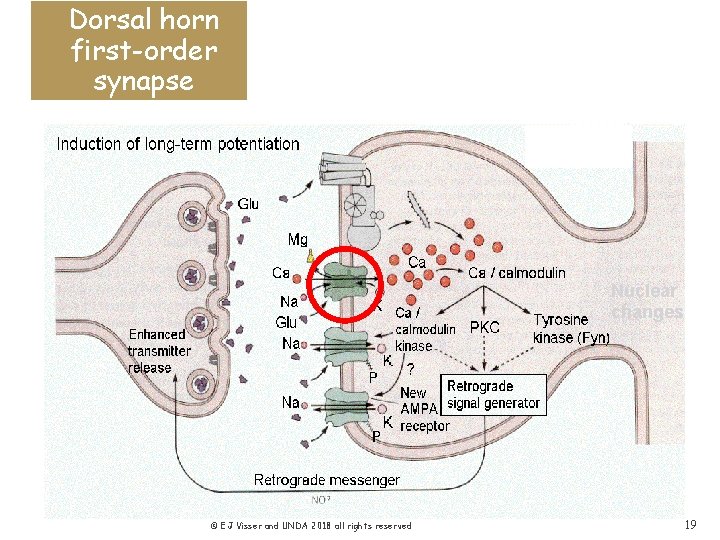
Dorsal horn first-order synapse Nuclear changes © EJ Visser and UNDA 2018 all rights reserved 19
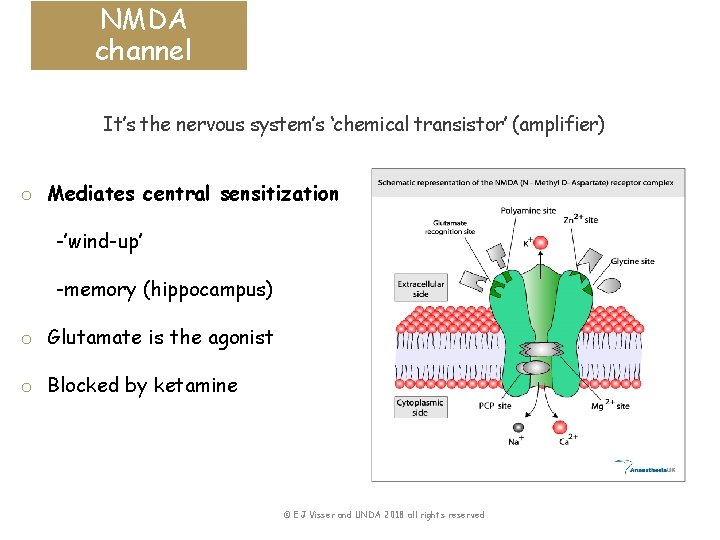
NMDA channel It’s the nervous system’s ‘chemical transistor’ (amplifier) o Mediates central sensitization -’wind-up’ -memory (hippocampus) o Glutamate is the agonist o Blocked by ketamine © EJ Visser and UNDA 2018 all rights reserved © ERIC J. VISSER 2017 UNDA. ALL RIGHTS RESERVED 20
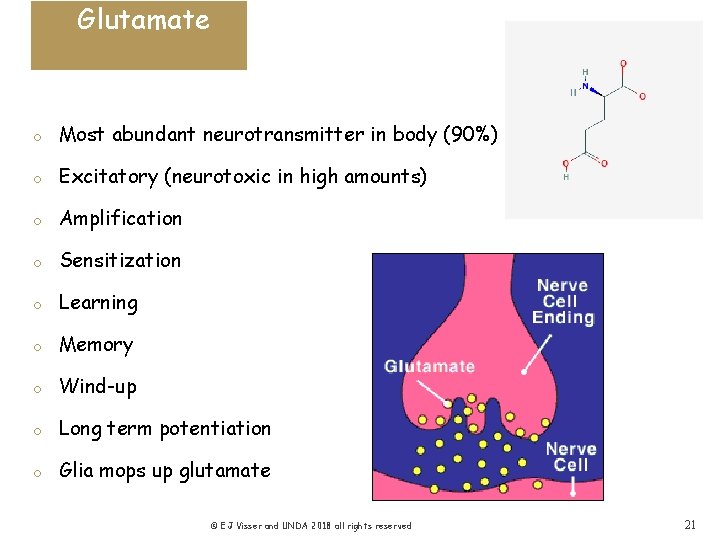
Glutamate o Most abundant neurotransmitter in body (90%) o Excitatory (neurotoxic in high amounts) o Amplification o Sensitization o Learning o Memory o Wind-up o Long term potentiation o Glia mops up glutamate © EJ Visser and UNDA 2018 all rights reserved 21
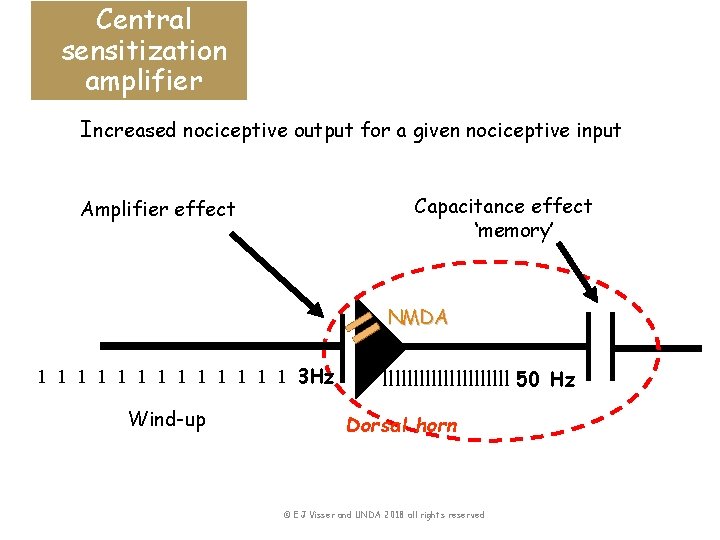
Central sensitization amplifier Increased nociceptive output for a given nociceptive input Capacitance effect ‘memory’ Amplifier effect NMDA 1 1 1 1 3 Hz Wind-up lllllllllll 50 Hz Dorsal horn © EJ Visser and UNDA 2018 all rights reserved © ERIC J. VISSER 2017 UNDA. ALL RIGHTS RESERVED 22
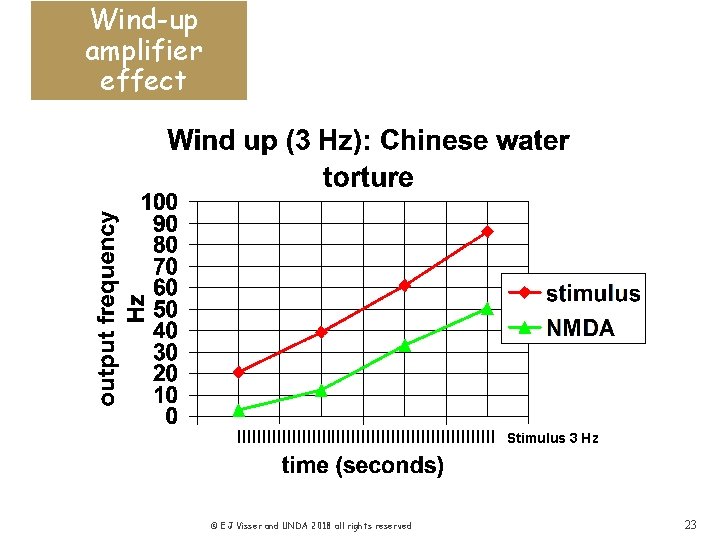
Wind-up amplifier effect IIIIIIIIIIIIIIIIIIIIIIIIII © EJ Visser and UNDA 2018 all rights reserved Stimulus 3 Hz 23
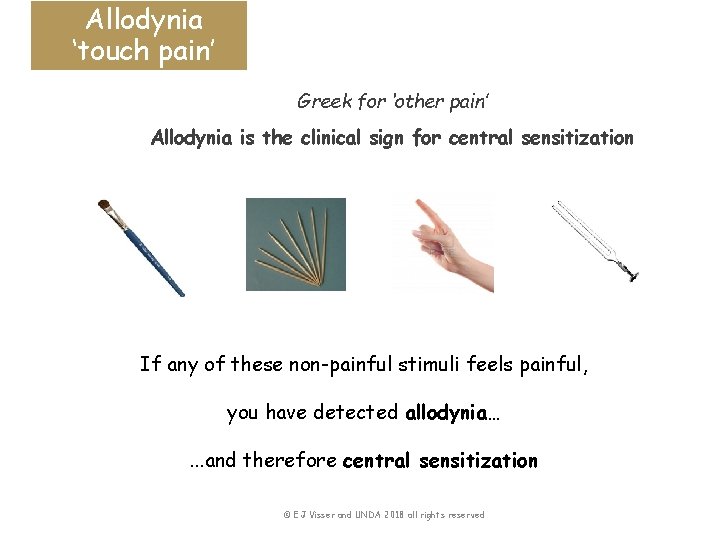
Allodynia ‘touch pain’ Greek for ‘other pain’ Allodynia is the clinical sign for central sensitization If any of these non-painful stimuli feels painful, you have detected allodynia…. . . and therefore central sensitization © EJ Visser and UNDA 2018 all rights reserved
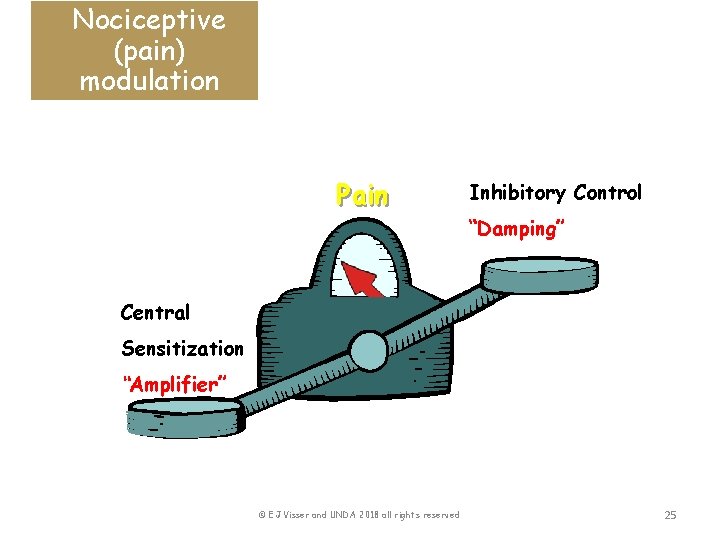
Nociceptive (pain) modulation Pain Inhibitory Control “Damping” Central Sensitization “Amplifier” © EJ Visser and UNDA 2018 all rights reserved 25
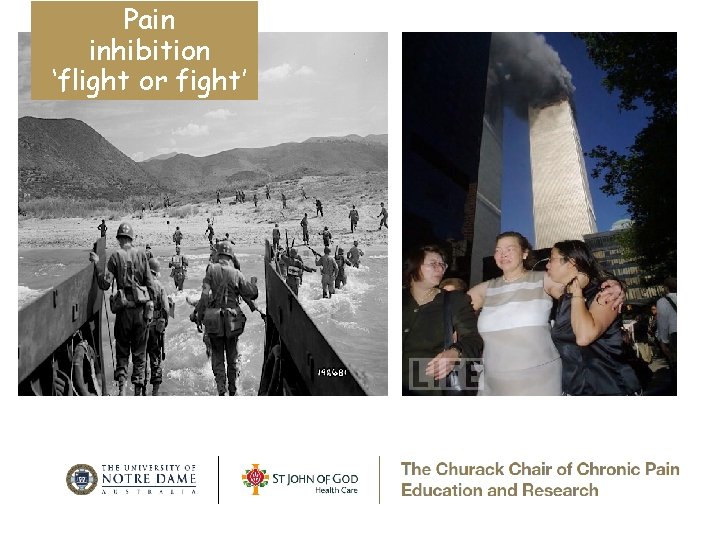
Pain inhibition ‘flight or fight’ © ERIC J. VISSER 2017 UNDA. ALL RIGHTS RESERVED 26
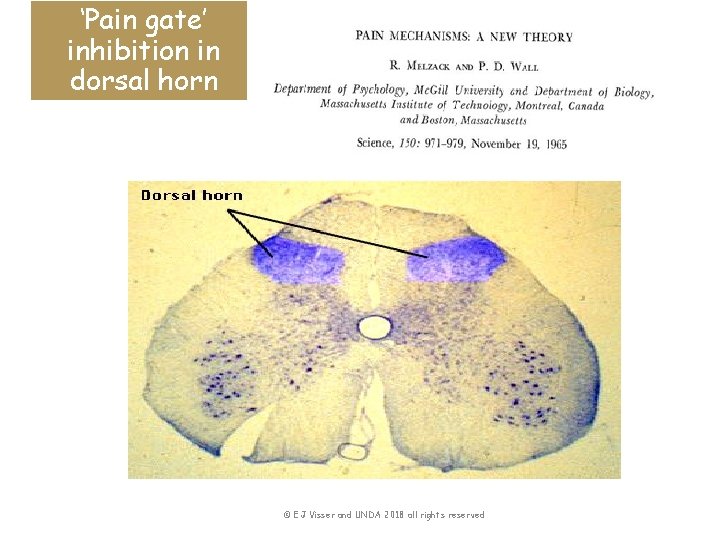
‘Pain gate’ inhibition in dorsal horn © EJ Visser and UNDA 2018 all rights reserved
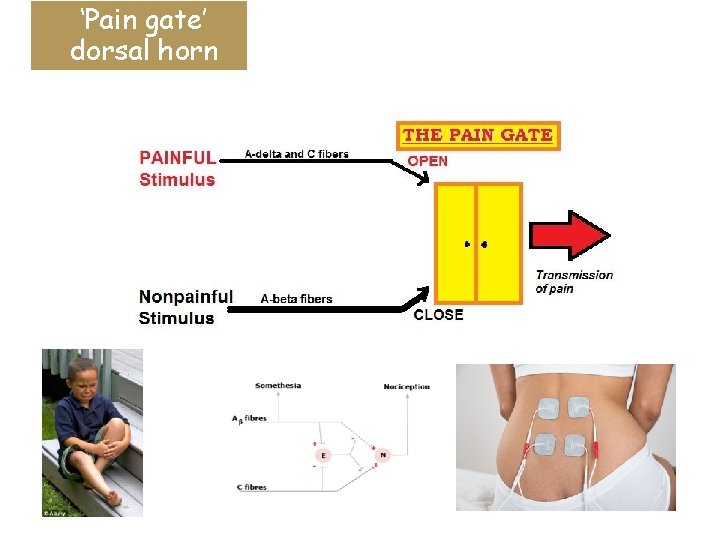
‘Pain gate’ dorsal horn
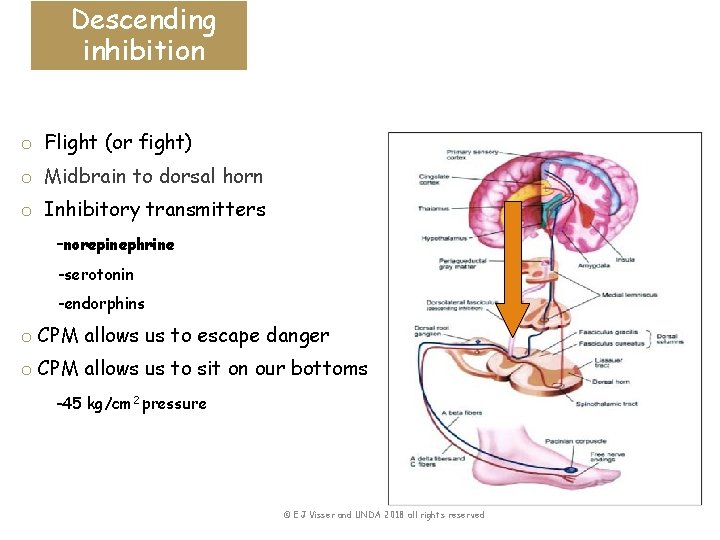
Descending inhibition o Flight (or fight) o Midbrain to dorsal horn o Inhibitory transmitters -norepinephrine -serotonin -endorphins o CPM allows us to escape danger o CPM allows us to sit on our bottoms -45 kg/cm 2 pressure © EJ Visser and UNDA 2018 all rights reserved © ERIC J. VISSER 2017 UNDA. ALL RIGHTS RESERVED 29
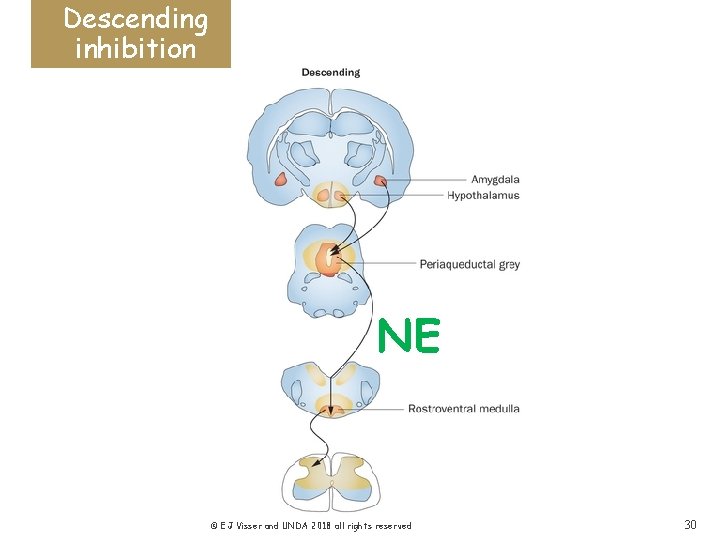
Descending inhibition NE © EJ Visser and UNDA 2018 all rights reserved 30
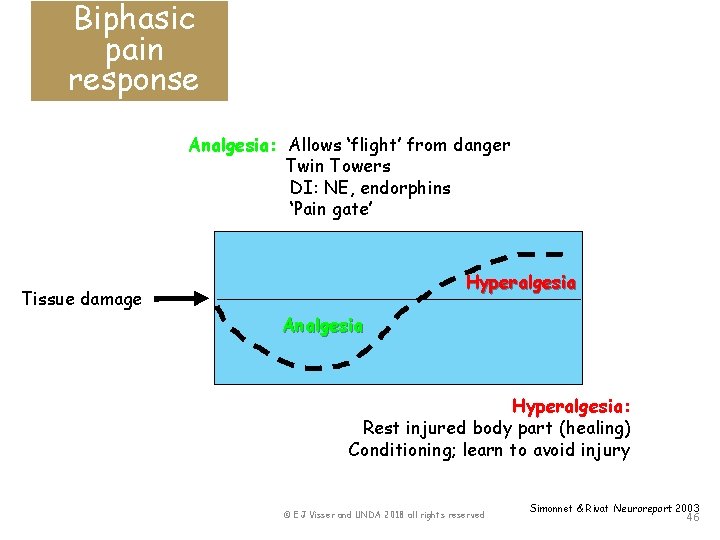
Biphasic pain response Analgesia: Allows ‘flight’ from danger Twin Towers DI: NE, endorphins ‘Pain gate’ Hyperalgesia Tissue damage Analgesia Hyperalgesia: Rest injured body part (healing) Conditioning; learn to avoid injury © EJ Visser and UNDA 2018 all rights reserved Simonnet & Rivat Neuroreport 2003 46
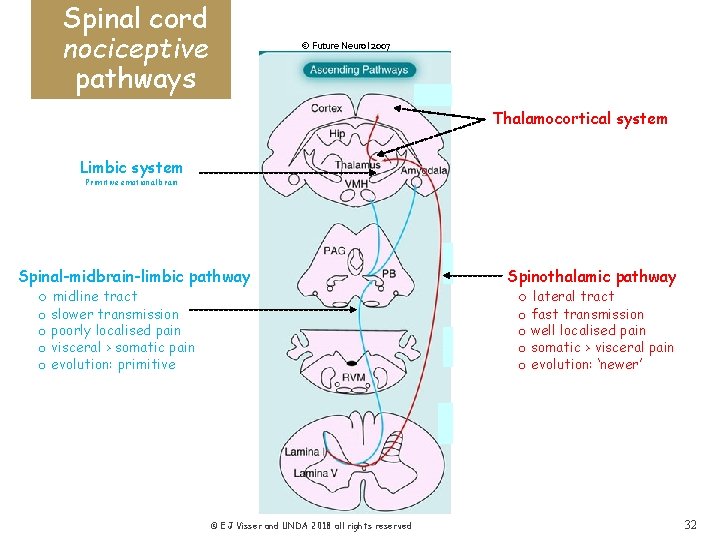
Spinal cord nociceptive pathways © Future Neurol 2007 Thalamocortical system Limbic system Primitive emotional brain Spinal-midbrain-limbic pathway o midline tract o slower transmission o poorly localised pain o visceral > somatic pain o evolution: primitive © EJ Visser and UNDA 2018 all rights reserved Spinothalamic pathway o lateral tract o fast transmission o well localised pain o somatic > visceral pain o evolution: ‘newer’ 32
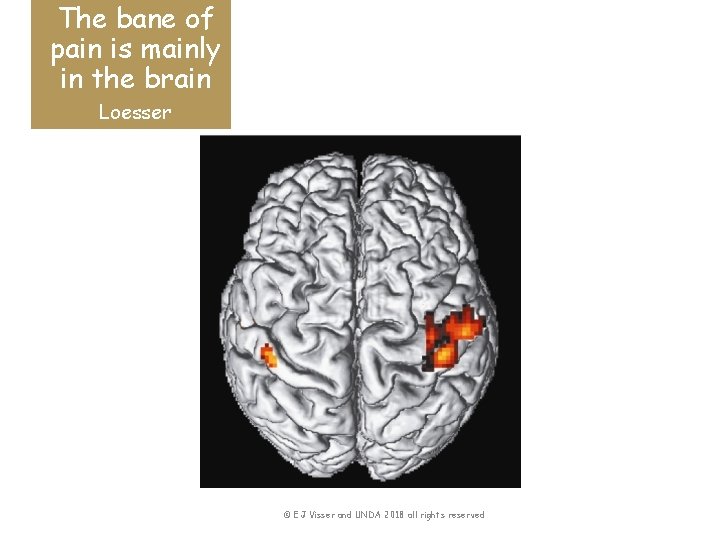
The bane of pain is mainly in the brain Loesser © EJ Visser and UNDA 2018 all rights reserved © ERIC J. VISSER 2017 UNDA. ALL RIGHTS RESERVED 33
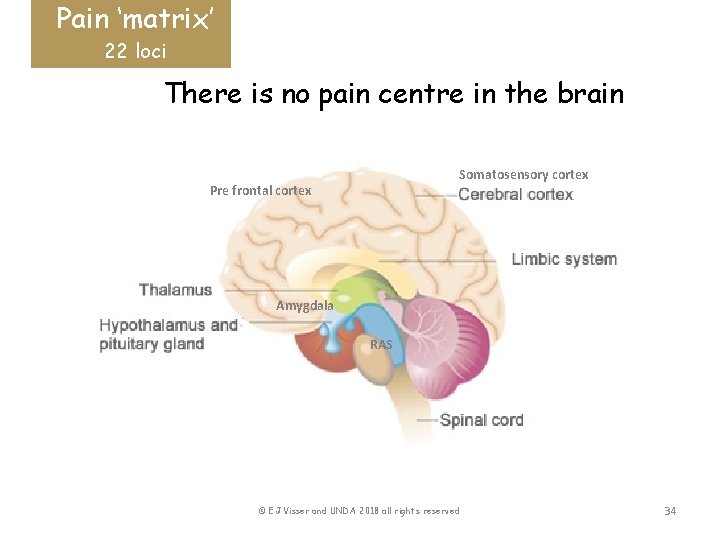
Pain ‘matrix’ 22 loci There is no pain centre in the brain Somatosensory cortex Pre frontal cortex Amygdala RAS © EJ Visser and UNDA 2018 all rights reserved 34
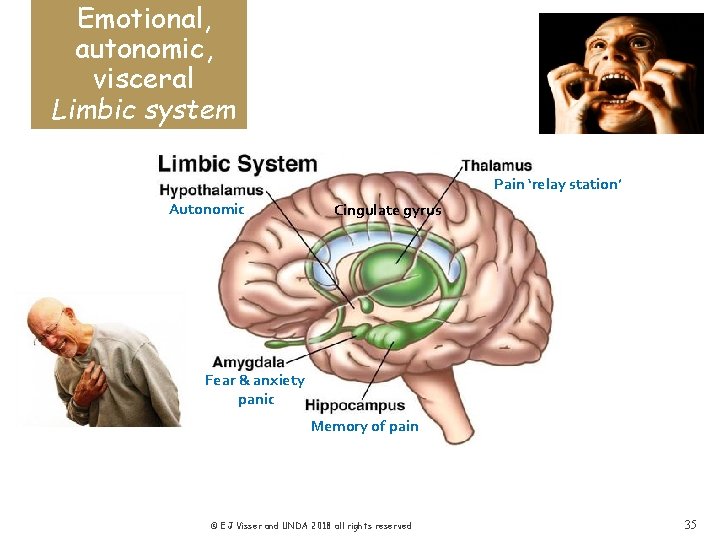
Emotional, autonomic, visceral Limbic system Pain ‘relay station’ Autonomic Cingulate gyrus Fear & anxiety panic Memory of pain © EJ Visser and UNDA 2018 all rights reserved 35
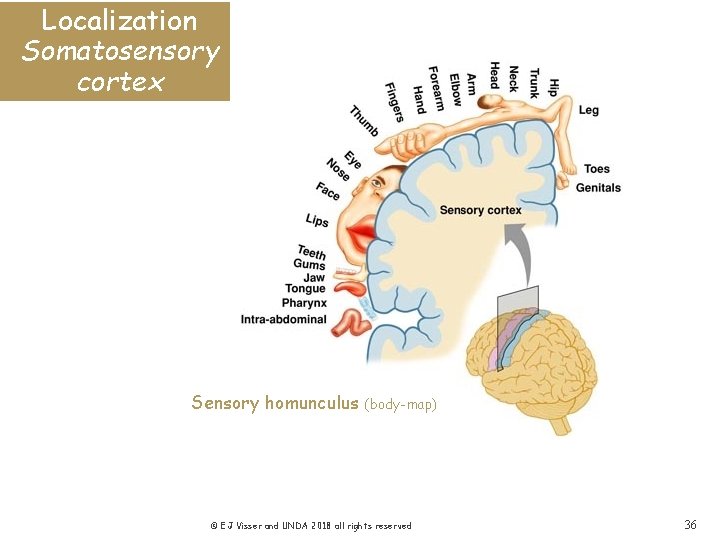
Localization Somatosensory cortex Sensory homunculus (body-map) © EJ Visser and UNDA 2018 all rights reserved 36
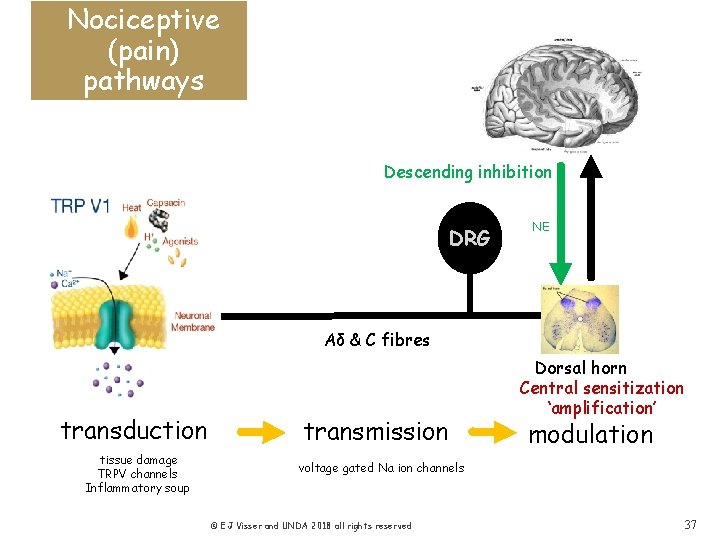
Nociceptive (pain) pathways Descending inhibition DRG NE Aδ & C fibres transduction tissue damage TRPV channels Inflammatory soup transmission Dorsal horn Central sensitization ‘amplification’ modulation voltage gated Na ion channels © EJ Visser and UNDA 2018 all rights reserved 37
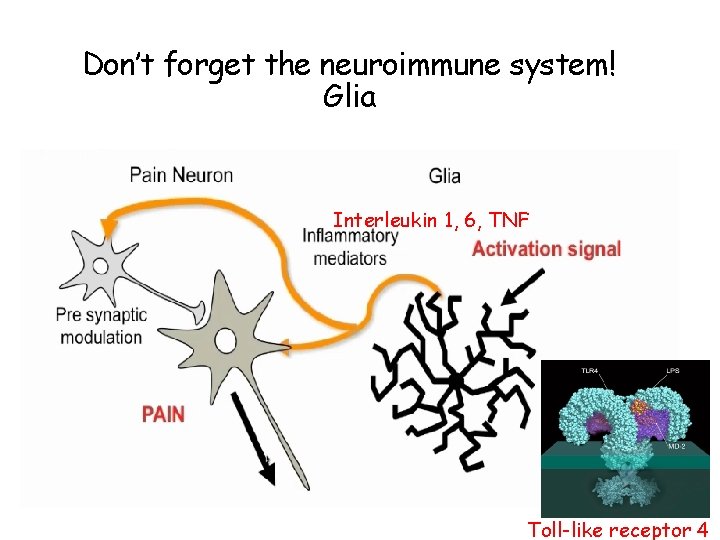
Don’t forget the neuroimmune system! Glia Interleukin 1, 6, TNF Toll-like receptor 4
Key learning objectives o Know the definitions of pain & nociception o Understand differences between them o Appreciate that pain is a complex, multi-dimensional experience generated by the conscious brain, and not just a sensation o Understand that pain is a tissue damage ‘alarm’ system o Know that a person can experience pain when there’s NO tissue damage o Understand the basic anatomy of nociceptive (‘pain’) pathways o Understand the transduction, transmission & modulation of nociceptive signals in the nervous system © EJ Visser and UNDA 2018 all rights reserved 39
Key learning objectives o Understand the concept of the ‘pain gate’ in the dorsal horn o Understand the concept of neuroplasticity & its role in pain o Understand that central sensitization (CS) ‘amplifies’ nociception o Understand that descending inhibition ‘dampens’ nociception o Understand the concept of pain ‘wind-up’ o Know that allodynia (touch pain) is the main clinical sign of CS o Understand that nociception activates the (emotional) limbic system o Understand that there is no specific ‘pain centre’ in the brain o Understand the roles of the neuroimmune (glia) & adrenergic systems in nociception & pain © EJ Visser and UNDA 2018 all rights reserved 40
Questions? © EJ Visser and UNDA 2018 all rights reserved 41
Extra slides and information © EJ Visser and UNDA 2018 all rights reserved 42
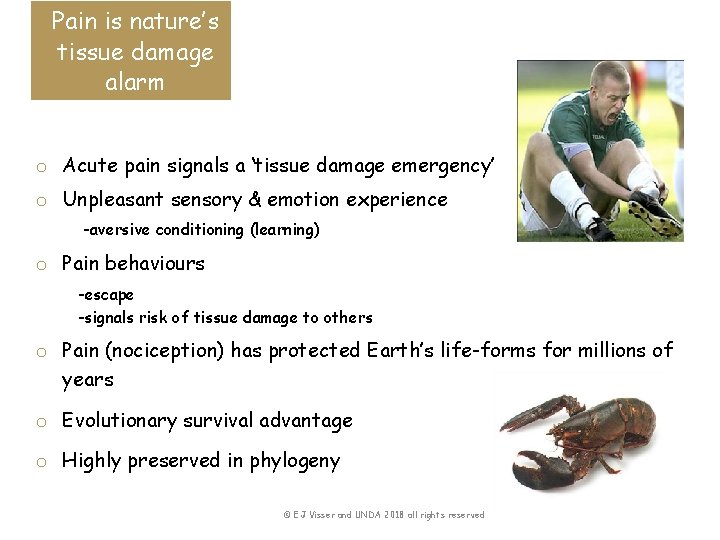
Pain is nature’s tissue damage alarm o Acute pain signals a ‘tissue damage emergency’ o Unpleasant sensory & emotion experience -aversive conditioning (learning) o Pain behaviours -escape -signals risk of tissue damage to others o Pain (nociception) has protected Earth’s life-forms for millions of years o Evolutionary survival advantage o Highly preserved in phylogeny © EJ Visser and UNDA 2018 all rights reserved
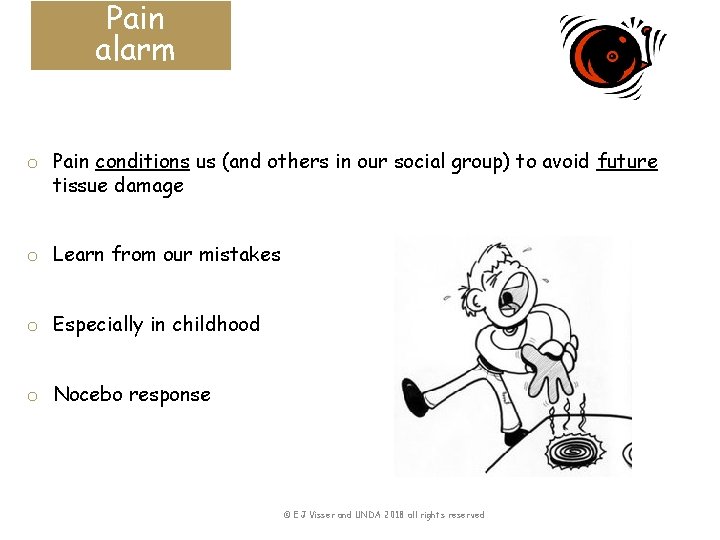
Pain alarm o Pain conditions us (and others in our social group) to avoid future tissue damage o Learn from our mistakes o Especially in childhood o Nocebo response © EJ Visser and UNDA 2018 all rights reserved
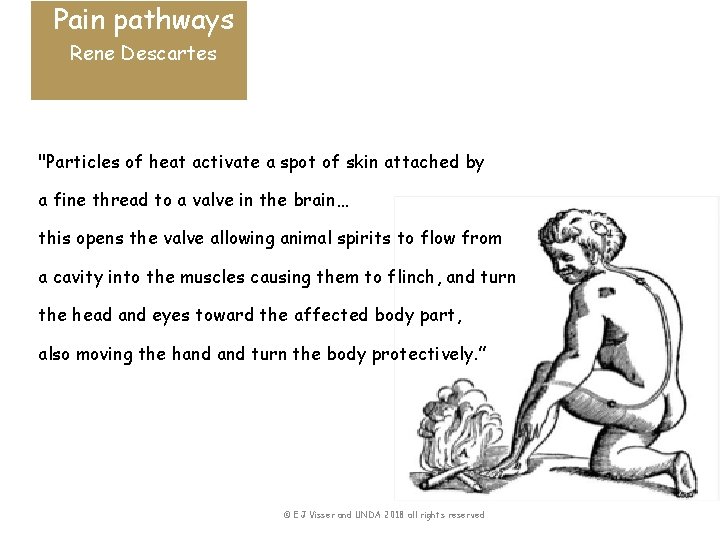
Pain pathways Rene Descartes "Particles of heat activate a spot of skin attached by a fine thread to a valve in the brain… this opens the valve allowing animal spirits to flow from a cavity into the muscles causing them to flinch, and turn the head and eyes toward the affected body part, also moving the hand turn the body protectively. ” © EJ Visser and UNDA 2018 all rights reserved
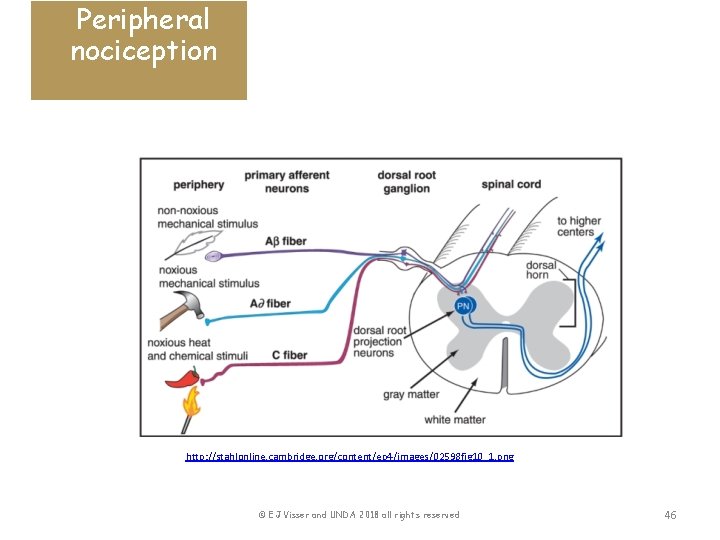
Peripheral nociception http: //stahlonline. cambridge. org/content/ep 4/images/02598 fig 10_1. png © EJ Visser and UNDA 2018 all rights reserved 46
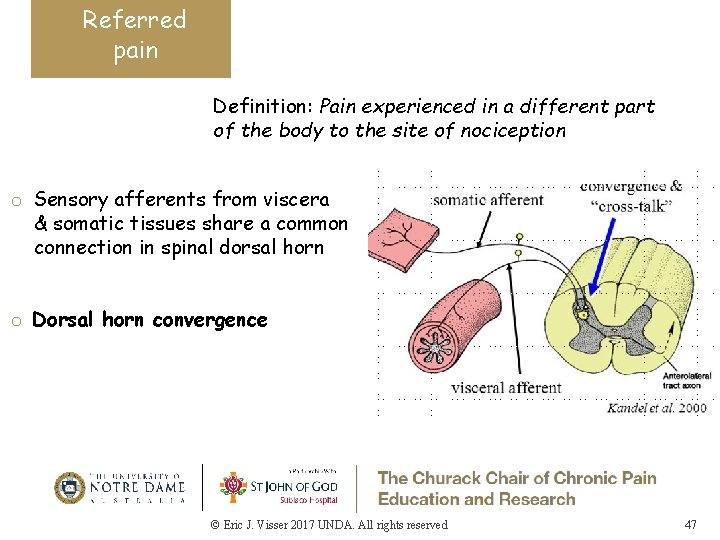
Referred pain Definition: Pain experienced in a different part of the body to the site of nociception o Sensory afferents from viscera & somatic tissues share a common connection in spinal dorsal horn o Dorsal horn convergence © Eric J. Visser 2017 UNDA. All rights reserved 47
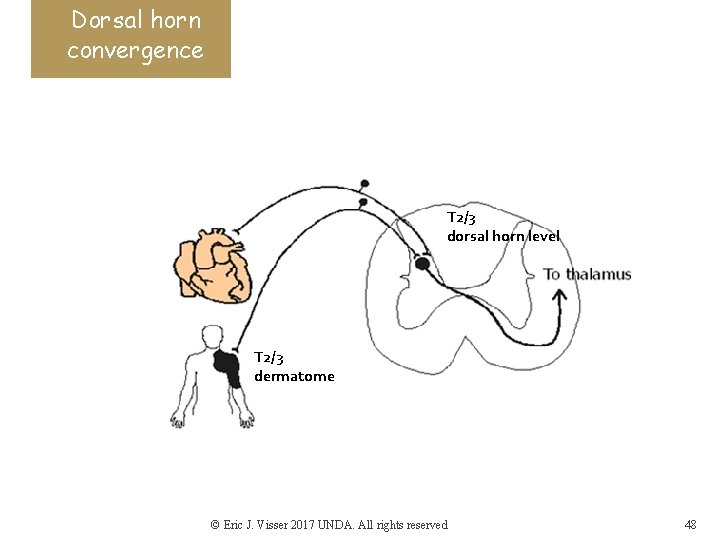
Dorsal horn convergence T 2/3 dorsal horn level T 2/3 dermatome © Eric J. Visser 2017 UNDA. All rights reserved 48
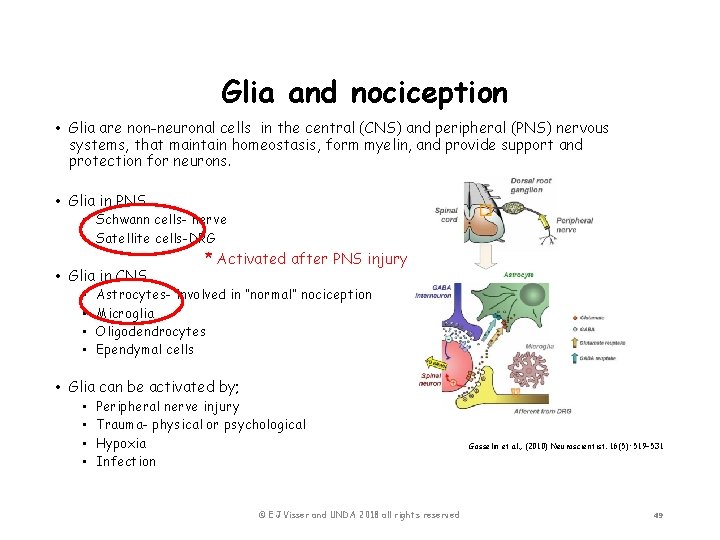
Glia and nociception • Glia are non-neuronal cells in the central (CNS) and peripheral (PNS) nervous systems, that maintain homeostasis, form myelin, and provide support and protection for neurons. • Glia in PNS • Schwann cells- nerve • Satellite cells-DRG • Glia in CNS • • * Activated after PNS injury Astrocytes- involved in “normal” nociception Microglia Oligodendrocytes Ependymal cells • Glia can be activated by; • • Peripheral nerve injury Trauma- physical or psychological Hypoxia Infection © EJ Visser and UNDA 2018 all rights reserved Gosselin et al. , (2010) Neuroscientist. 16(5): 519– 531 49
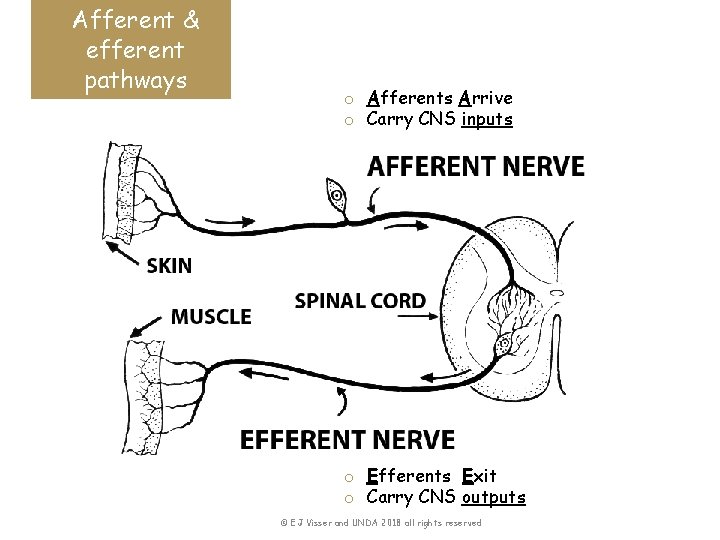
Afferent & efferent pathways o Afferents Arrive o Carry CNS inputs o Efferents Exit o Carry CNS outputs © ERIC J. VISSER 2017 ALL RIGHTS RESERVED © EJ Visser and. UNDA 2018 all rights reserved 50
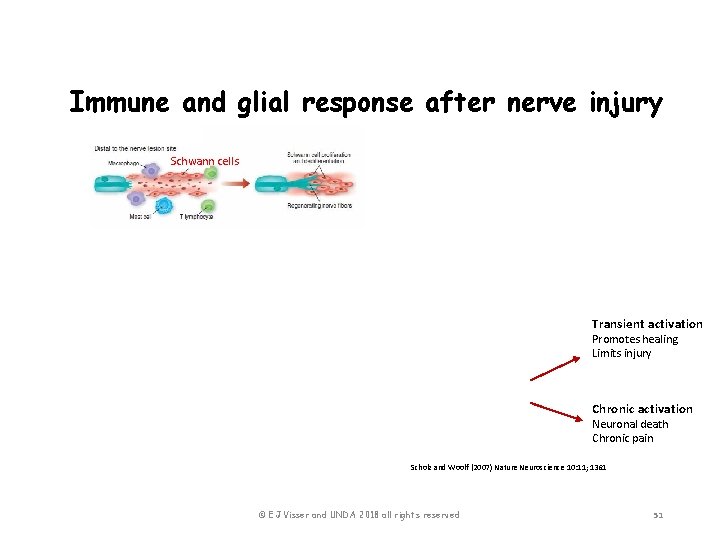
Immune and glial response after nerve injury Schwann cells Transient activation Satellite cells Resident Microglia and Astrocytes Promotes healing Limits injury Active Microglia and Astrocytes Pro-inflammatory events Chronic activation Neuronal death Chronic pain Scholz and Woolf (2007) Nature Neuroscience 10: 11; 1361 © EJ Visser and UNDA 2018 all rights reserved 51
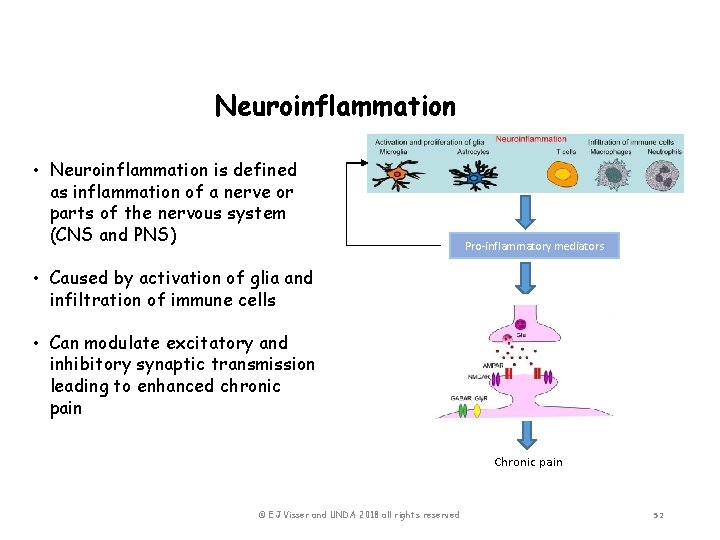
Neuroinflammation • Neuroinflammation is defined as inflammation of a nerve or parts of the nervous system (CNS and PNS) Pro-inflammatory mediators • Caused by activation of glia and infiltration of immune cells • Can modulate excitatory and inhibitory synaptic transmission leading to enhanced chronic pain Chronic pain © EJ Visser and UNDA 2018 all rights reserved 52
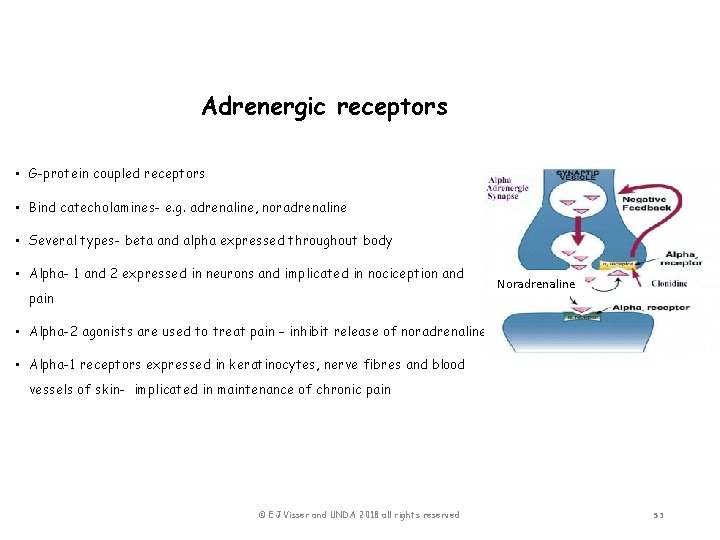
Adrenergic receptors • G-protein coupled receptors • Bind catecholamines- e. g. adrenaline, noradrenaline • Several types- beta and alpha expressed throughout body • Alpha- 1 and 2 expressed in neurons and implicated in nociception and pain Noradrenaline • Alpha-2 agonists are used to treat pain – inhibit release of noradrenaline • Alpha-1 receptors expressed in keratinocytes, nerve fibres and blood vessels of skin- implicated in maintenance of chronic pain © EJ Visser and UNDA 2018 all rights reserved 53
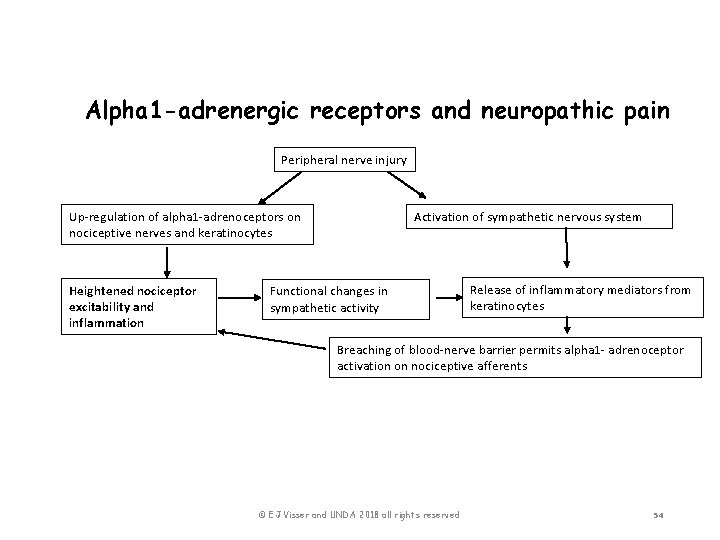
Alpha 1 -adrenergic receptors and neuropathic pain Peripheral nerve injury Activation of sympathetic nervous system Up-regulation of alpha 1 -adrenoceptors on nociceptive nerves and keratinocytes Heightened nociceptor excitability and inflammation Functional changes in sympathetic activity Release of inflammatory mediators from keratinocytes Breaching of blood-nerve barrier permits alpha 1 - adrenoceptor activation on nociceptive afferents © EJ Visser and UNDA 2018 all rights reserved 54
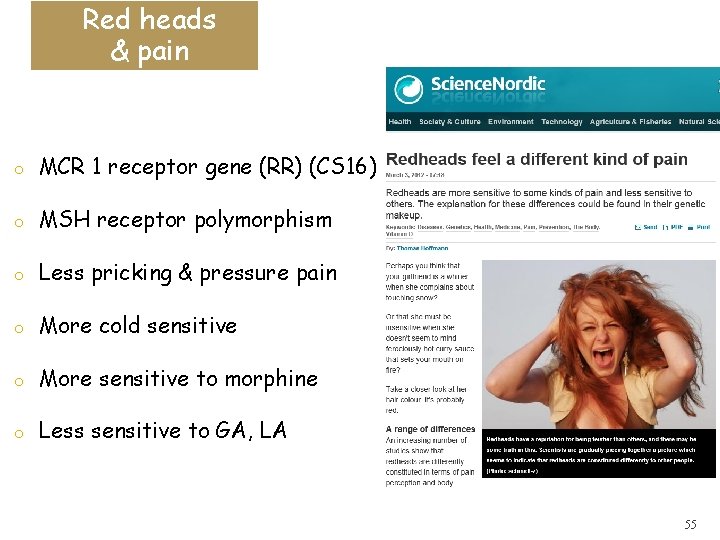
Red heads & pain o MCR 1 receptor gene (RR) (CS 16) o MSH receptor polymorphism o Less pricking & pressure pain o More cold sensitive o More sensitive to morphine o Less sensitive to GA, LA 55
- Slides: 55