
Neural Cell Physiology Resting potential Neural Cell Physiology
- Slides: 33
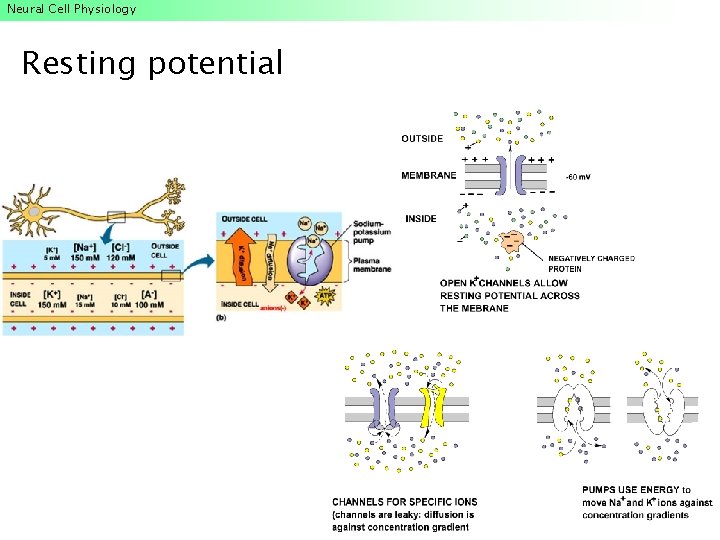
Neural Cell Physiology Resting potential
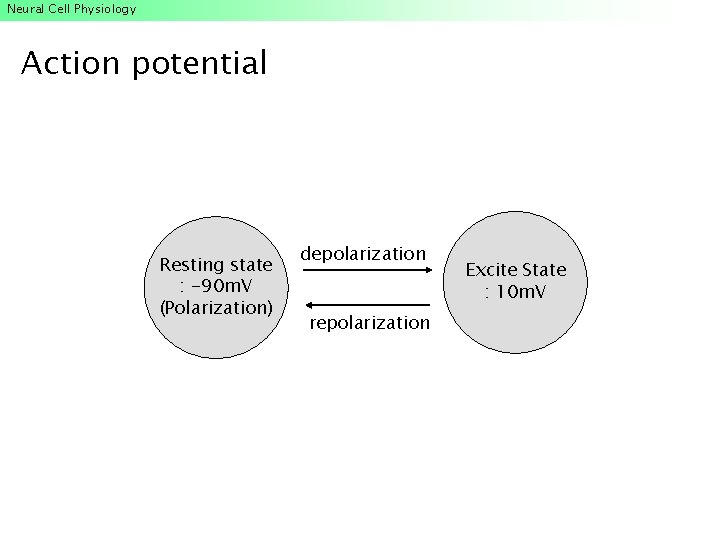
Neural Cell Physiology Action potential Resting state : -90 m. V (Polarization) depolarization repolarization Excite State : 10 m. V
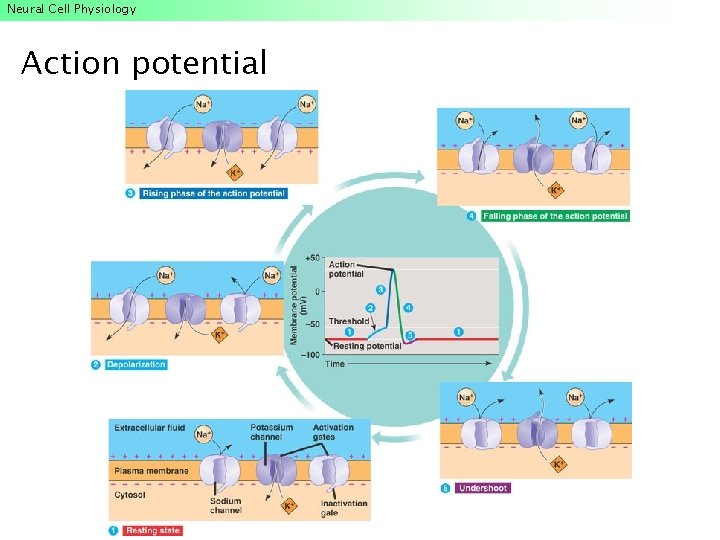
Neural Cell Physiology Action potential
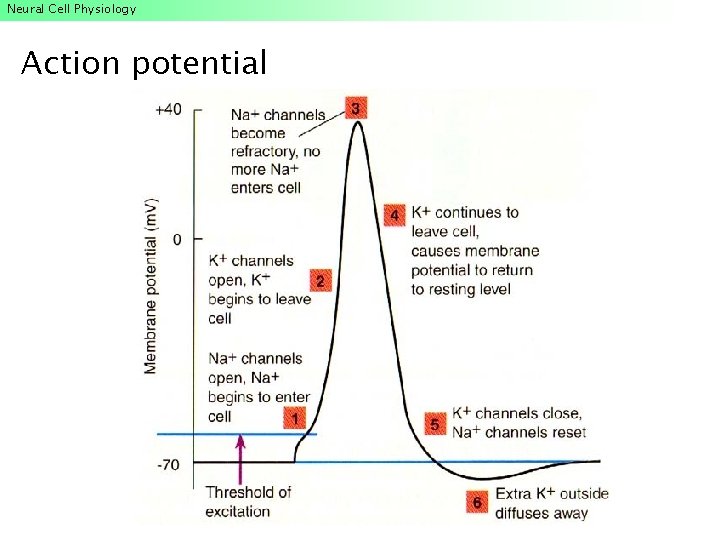
Neural Cell Physiology Action potential
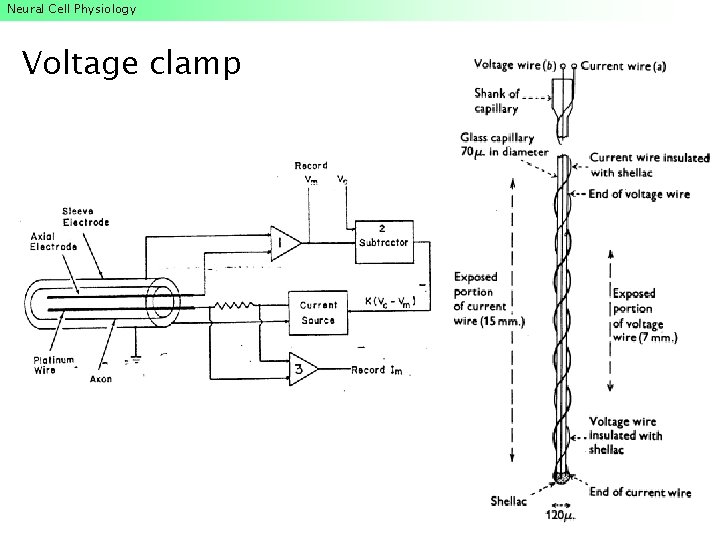
Neural Cell Physiology Voltage clamp
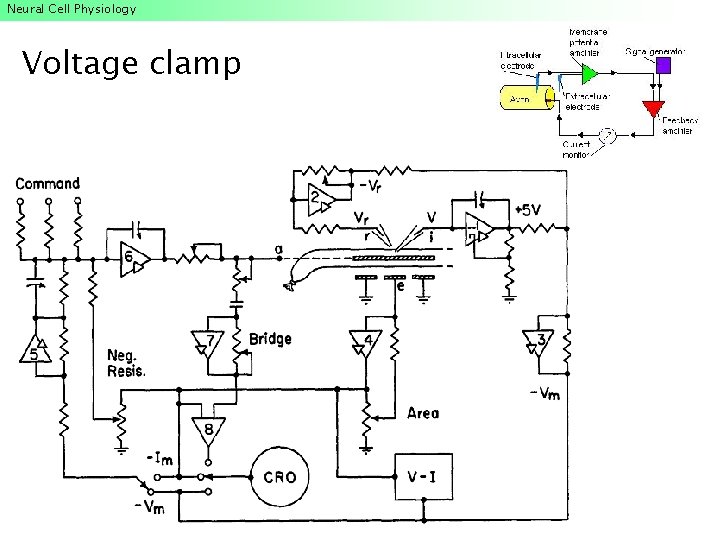
Neural Cell Physiology Voltage clamp
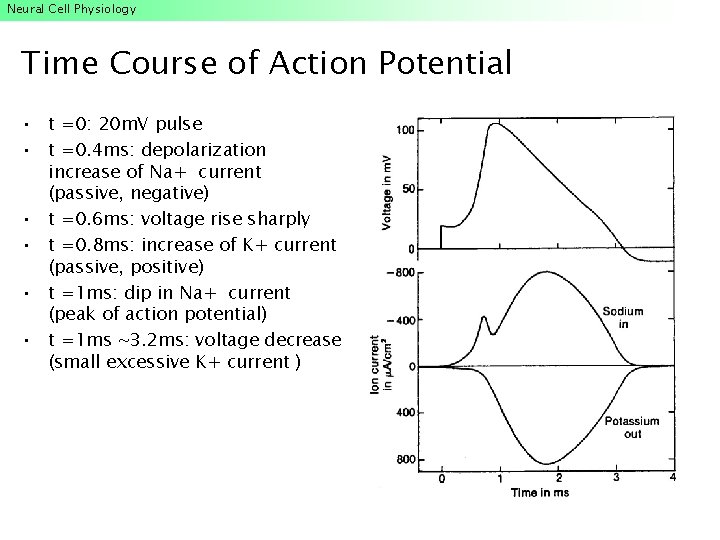
Neural Cell Physiology Time Course of Action Potential • t =0: 20 m. V pulse • t =0. 4 ms: depolarization increase of Na+ current (passive, negative) • t =0. 6 ms: voltage rise sharply • t =0. 8 ms: increase of K+ current (passive, positive) • t =1 ms: dip in Na+ current (peak of action potential) • t =1 ms ~3. 2 ms: voltage decrease (small excessive K+ current )
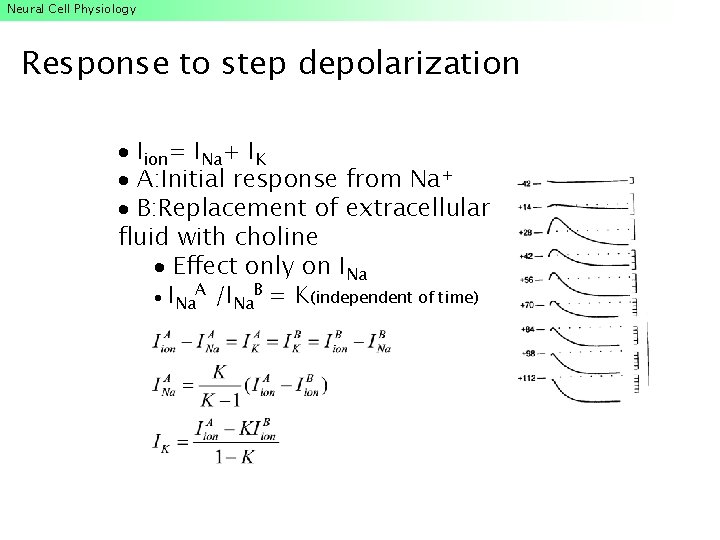
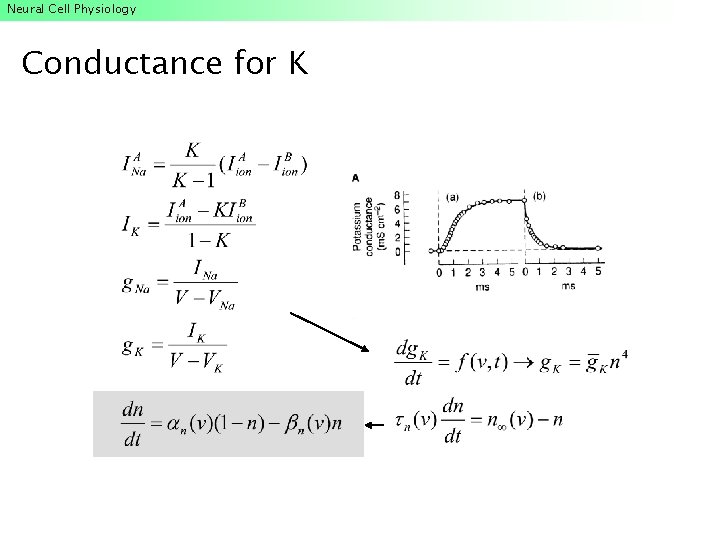
Neural Cell Physiology Response to step depolarization Iion= INa+ IK A: Initial response from Na+ B: Replacement of extracellular fluid with choline Effect only on INa. A /INa. B = K(independent of time)
Neural Cell Physiology Conductance for K
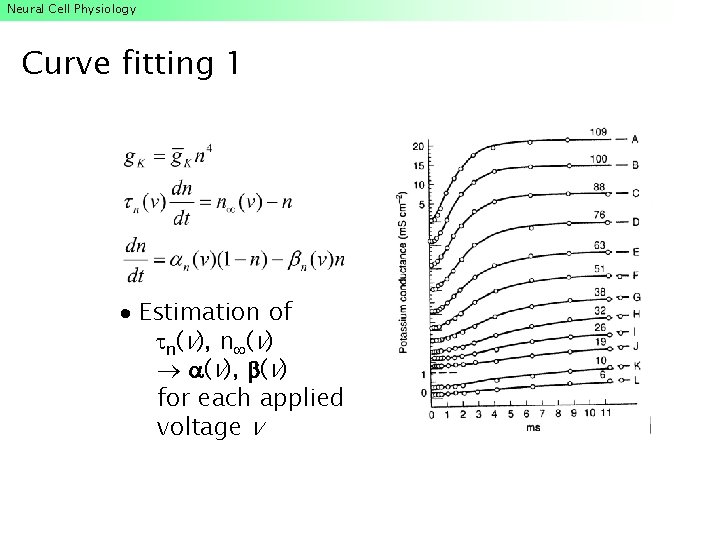
Neural Cell Physiology Curve fitting 1 Estimation of n(v), n (v), (v) for each applied voltage v
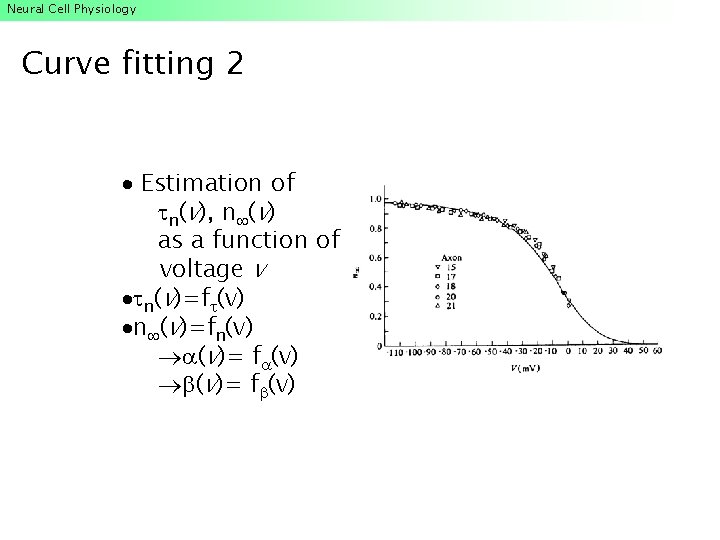
Neural Cell Physiology Curve fitting 2 Estimation of n(v), n (v) as a function of voltage v n(v)=f (v) n (v)=fn(v) (v)= f (v)
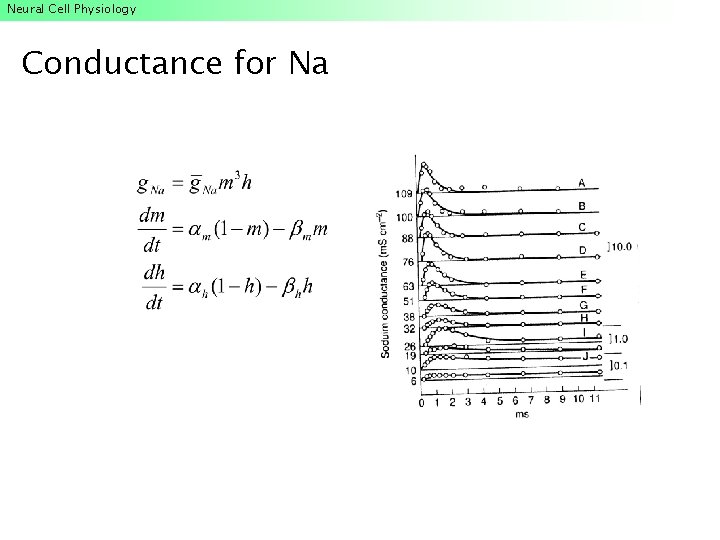
Neural Cell Physiology Conductance for Na
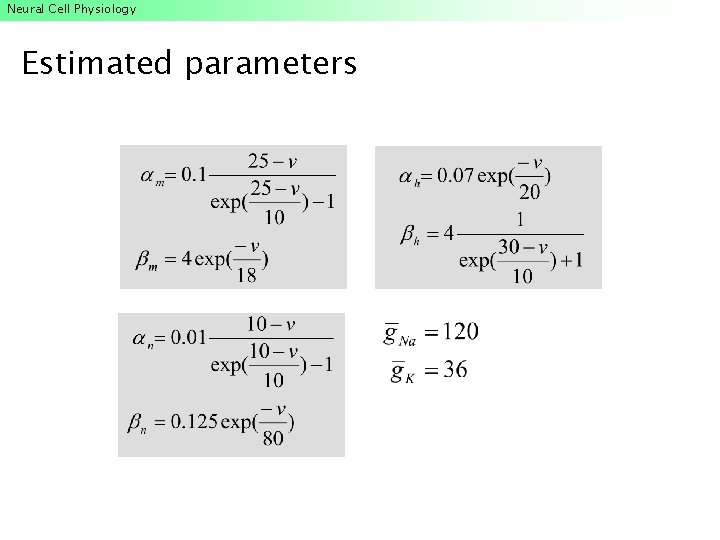
Neural Cell Physiology Estimated parameters
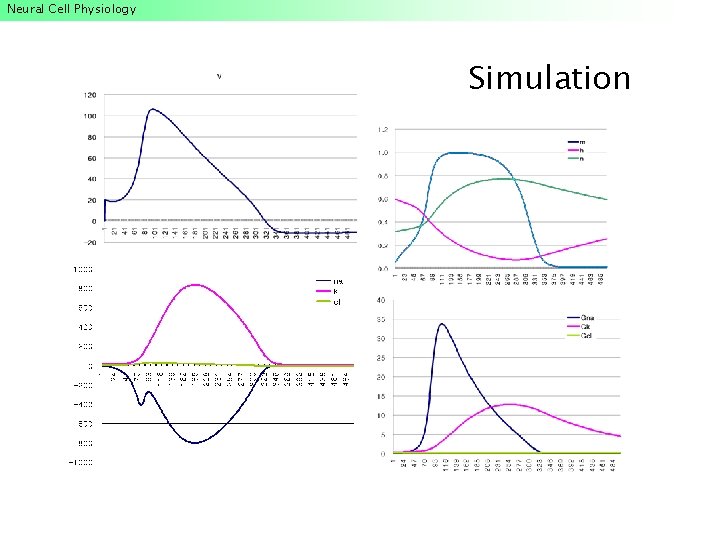
Neural Cell Physiology Simulation
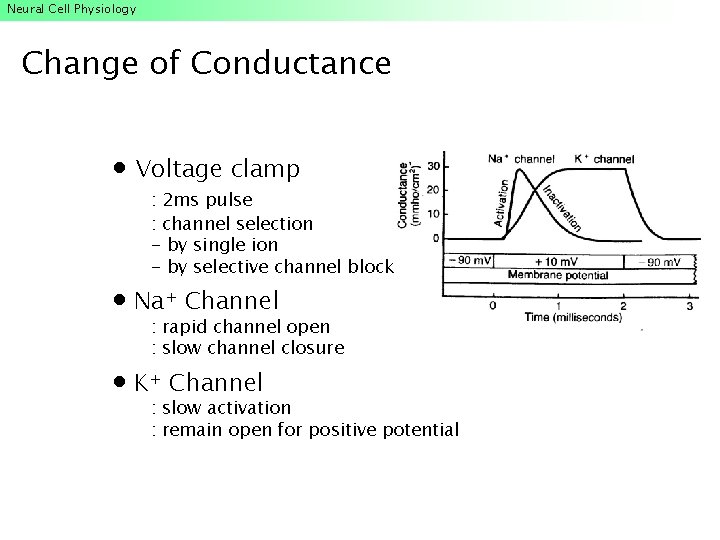
Neural Cell Physiology Change of Conductance Voltage clamp : 2 ms pulse : channel selection - by single ion - by selective channel block Na+ Channel : rapid channel open : slow channel closure K+ Channel : slow activation : remain open for positive potential
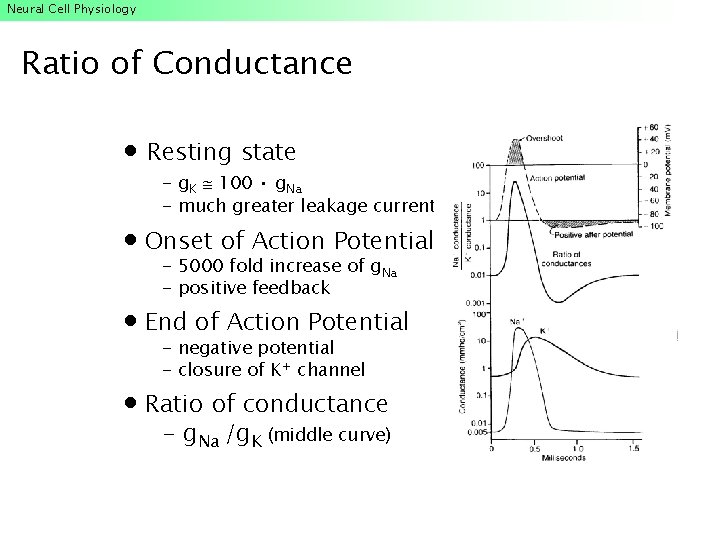
Neural Cell Physiology Ratio of Conductance Resting state - g. K 100 • g. Na - much greater leakage current Onset of Action Potential - 5000 fold increase of g. Na - positive feedback End of Action Potential - negative potential - closure of K+ channel Ratio of conductance - g. Na /g. K (middle curve)
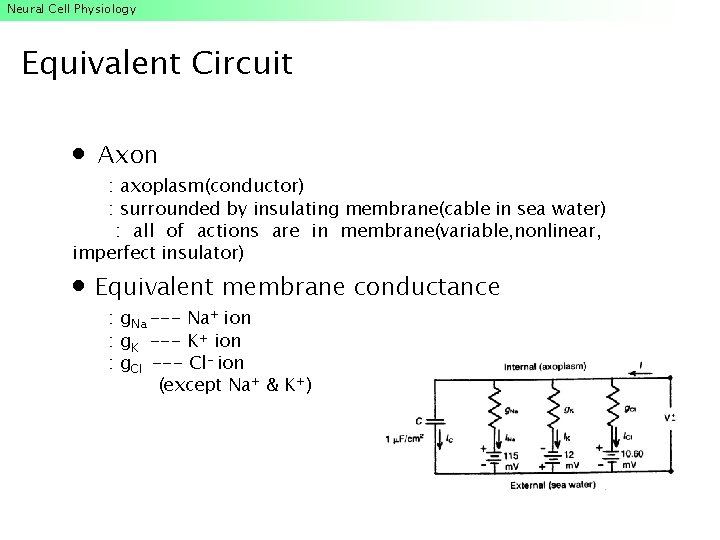
Neural Cell Physiology Equivalent Circuit Axon : axoplasm(conductor) : surrounded by insulating membrane(cable in sea water) : all of actions are in membrane(variable, nonlinear, imperfect insulator) Equivalent membrane conductance : g. Na --- Na+ ion : g. K --- K+ ion : g. Cl --- Cl- ion (except Na+ & K+) 그림 3 -7
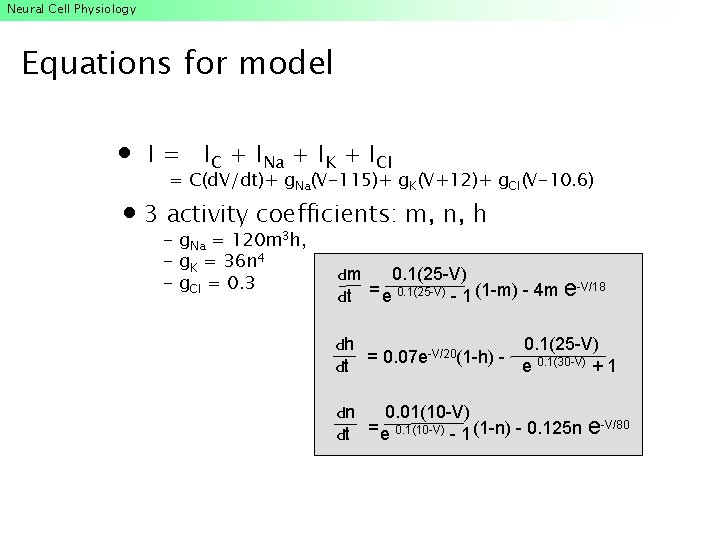
Neural Cell Physiology Equations for model I = IC + INa + IK + ICl = C(d. V/dt)+ g. Na(V-115)+ g. K(V+12)+ g. Cl(V-10. 6) 3 activity coefficients: m, n, h - g. Na = 120 m 3 h, - g. K = 36 n 4 - g. Cl = 0. 3 dm 0. 1(25 -V) -V/18 = dt e 0. 1(25 -V) - 1 (1 -m) - 4 m e dh 0. 1(25 -V) -V/20(1 -h) = 0. 07 e dt e 0. 1(30 -V) + 1 dn 0. 01(10 -V) -V/80 dt = e 0. 1(10 -V) - 1 (1 -n) - 0. 125 n e
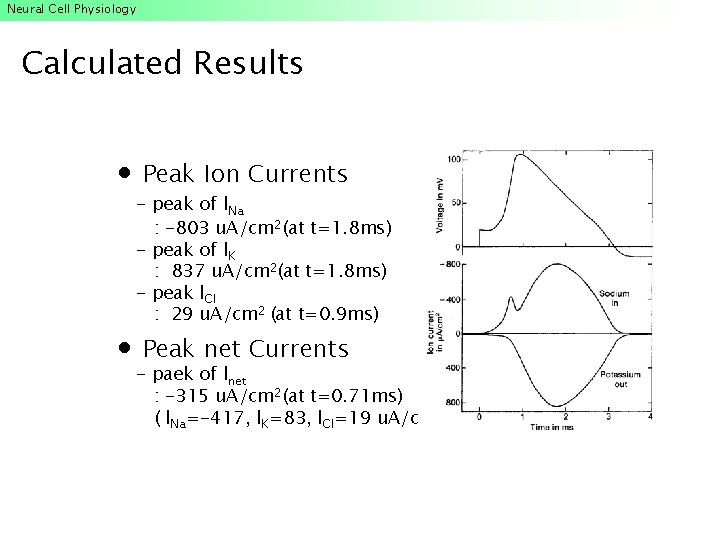
Neural Cell Physiology Calculated Results Peak Ion Currents - peak of l. Na : -803 u. A/cm 2(at t=1. 8 ms) - peak of l. K : 837 u. A/cm 2(at t=1. 8 ms) - peak l. Cl : 29 u. A/cm 2 (at t=0. 9 ms) Peak net Currents - paek of lnet : -315 u. A/cm 2(at t=0. 71 ms) ( l. Na=-417, l. K=83, l. Cl=19 u. A/cm 2 ) 그림 3 -6
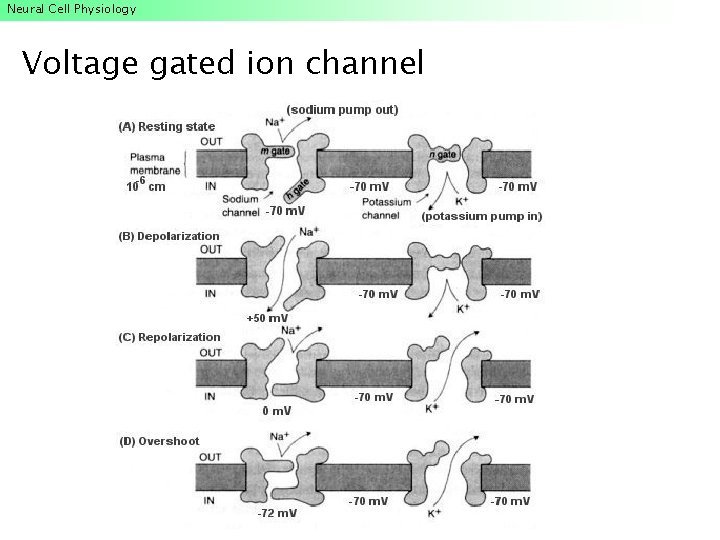
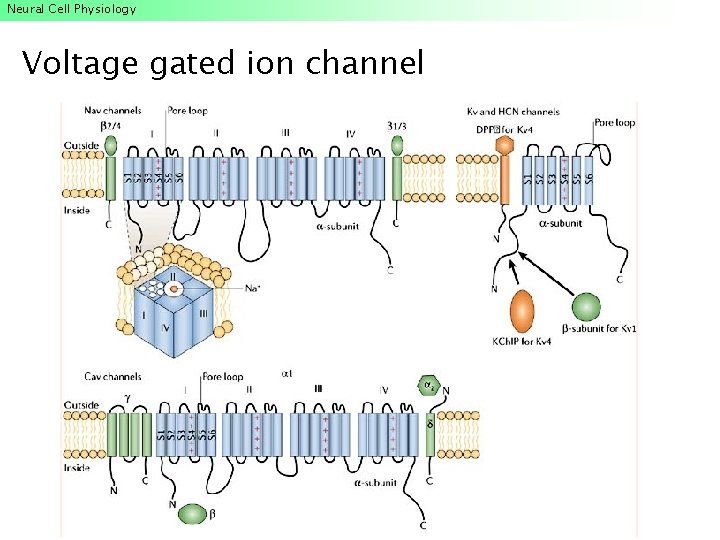
Neural Cell Physiology Voltage gated ion channel
Neural Cell Physiology Voltage gated ion channel
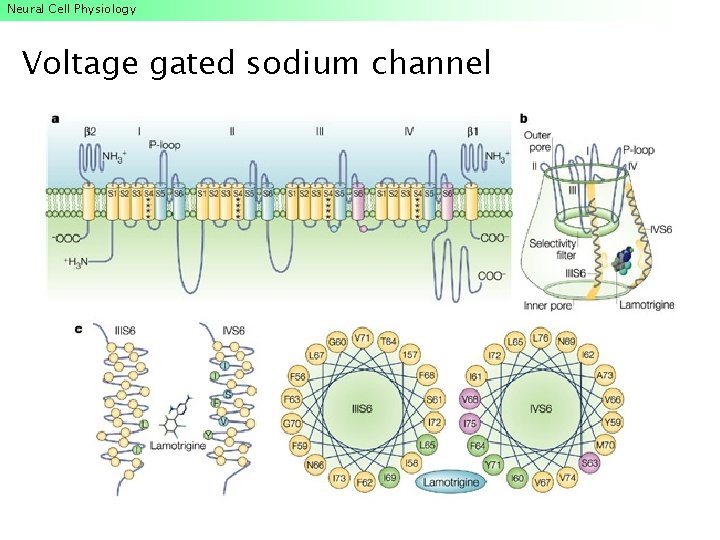
Neural Cell Physiology Voltage gated sodium channel
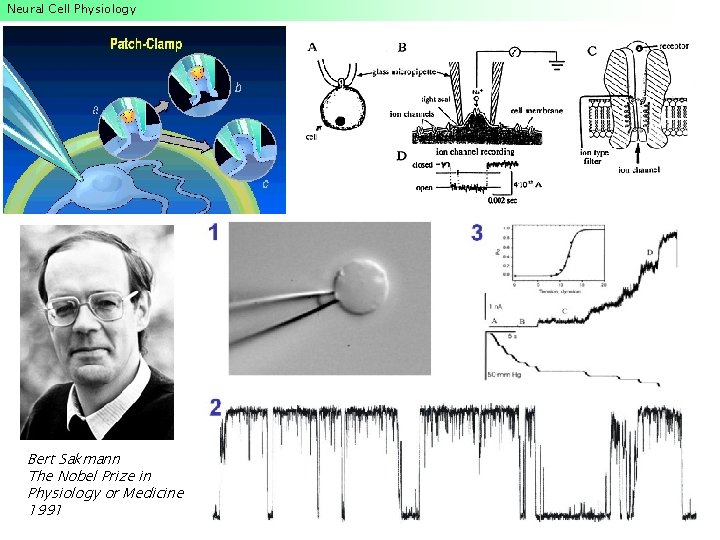
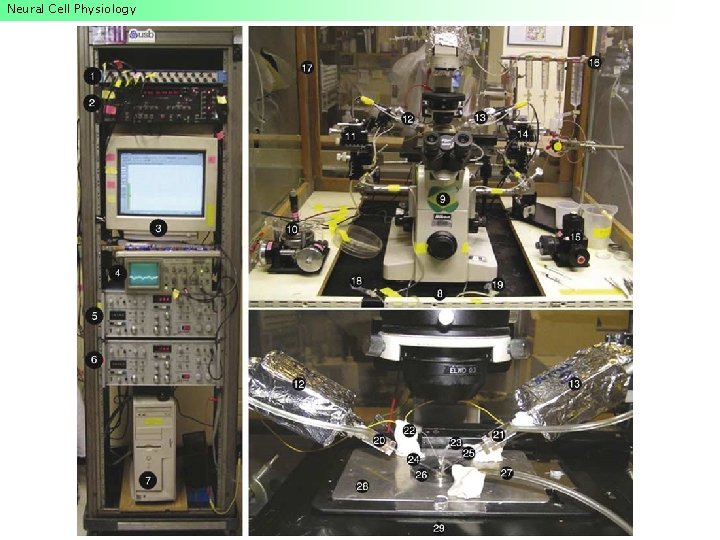
Neural Cell Physiology Bert Sakmann The Nobel Prize in Physiology or Medicine 1991
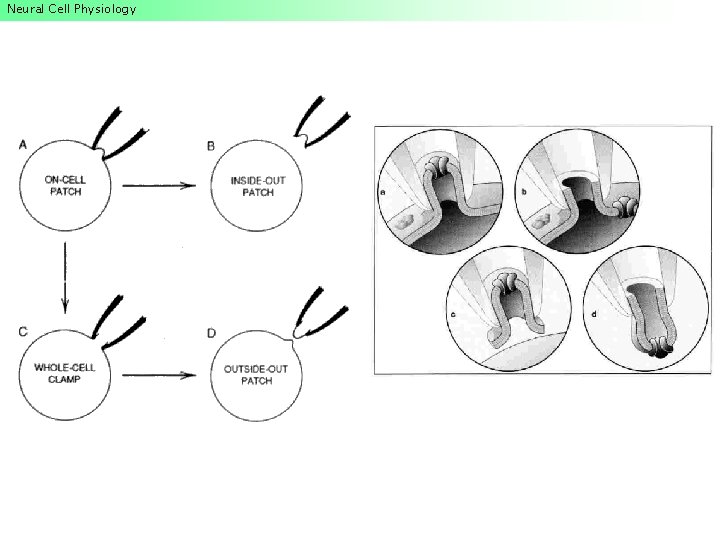
Neural Cell Physiology
Neural Cell Physiology
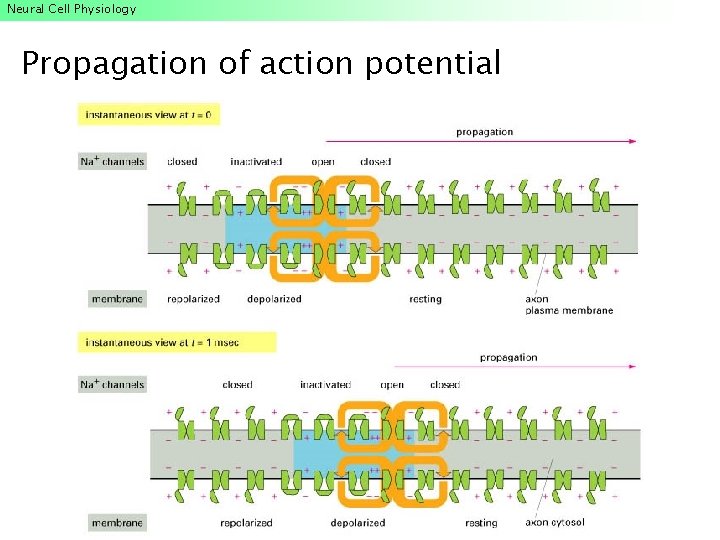
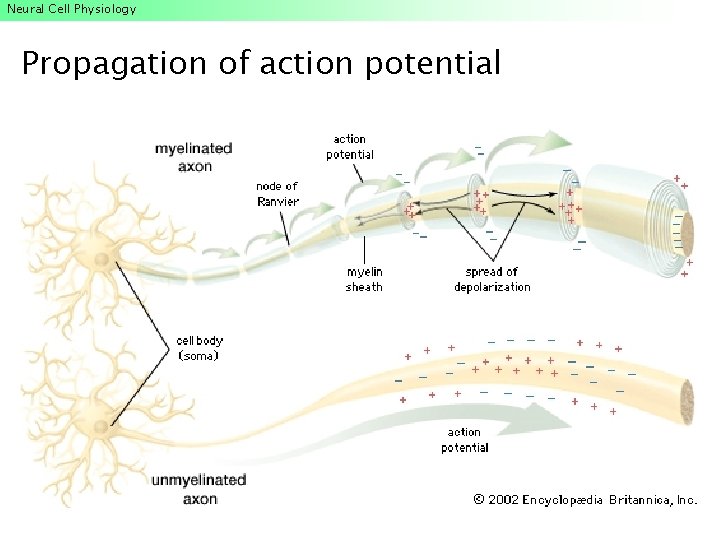
Neural Cell Physiology Propagation of action potential
Neural Cell Physiology Propagation of action potential
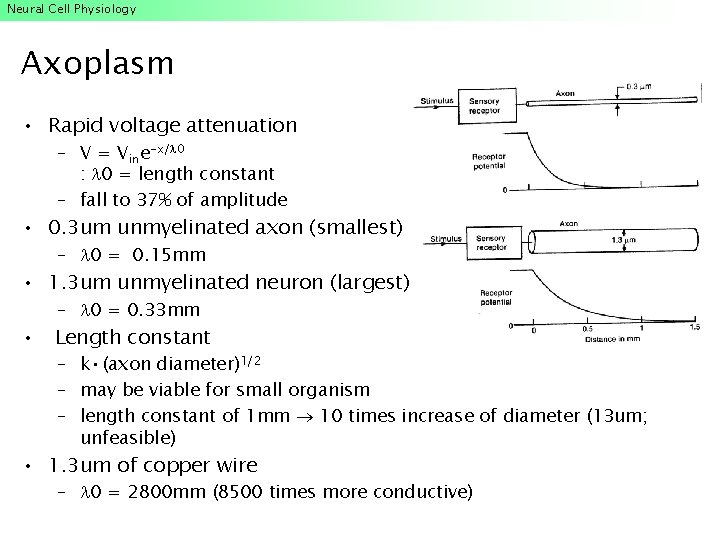
Neural Cell Physiology Axoplasm • Rapid voltage attenuation – V = Vine-x/ 0 : 0 = length constant – fall to 37% of amplitude • 0. 3 um unmyelinated axon (smallest) – 0 = 0. 15 mm • 1. 3 um unmyelinated neuron (largest) – 0 = 0. 33 mm • Length constant – k • (axon diameter)1/2 – may be viable for small organism – length constant of 1 mm 10 times increase of diameter (13 um; unfeasible) • 1. 3 um of copper wire – 0 = 2800 mm (8500 times more conductive)
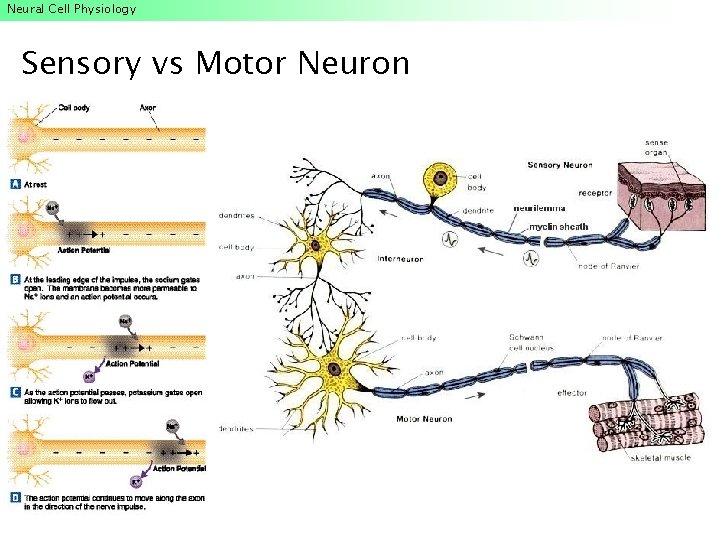
Neural Cell Physiology Sensory vs Motor Neuron
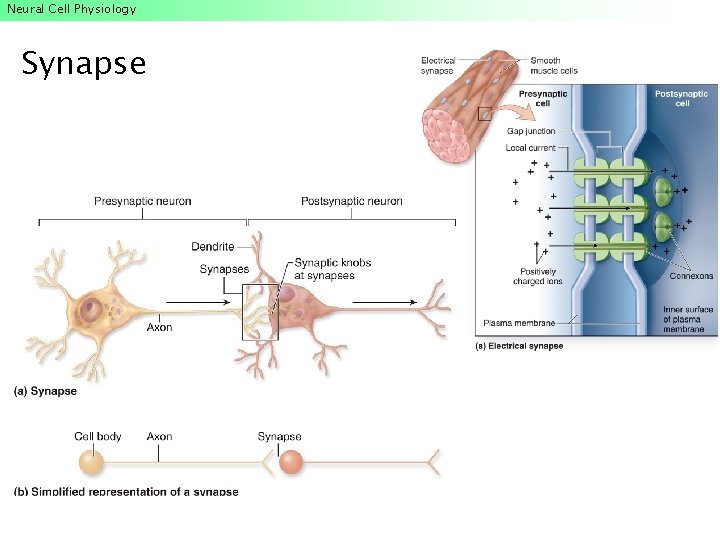
Neural Cell Physiology Synapse
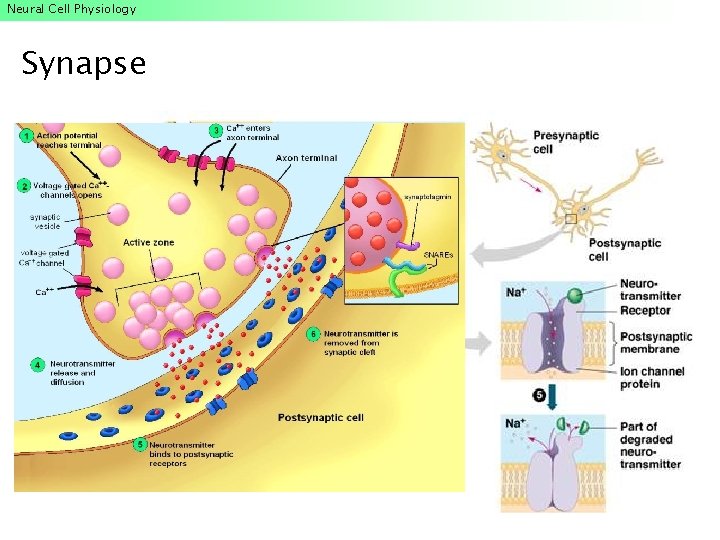
Neural Cell Physiology Synapse
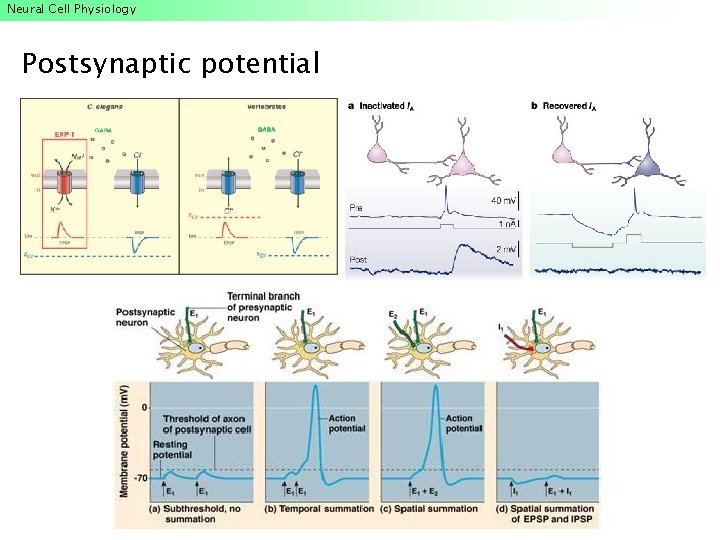
Neural Cell Physiology Postsynaptic potential
Neural Cell Physiology Take home message • Characteristics of action potential • Propagation mechanism