
Neural Bases of the Motor Theory of Speech
Neural Bases of the Motor Theory of Speech Perception Tyler Perrachione HST. 722 / 9. 044 J 11/1/2007 tkp@mit. edu
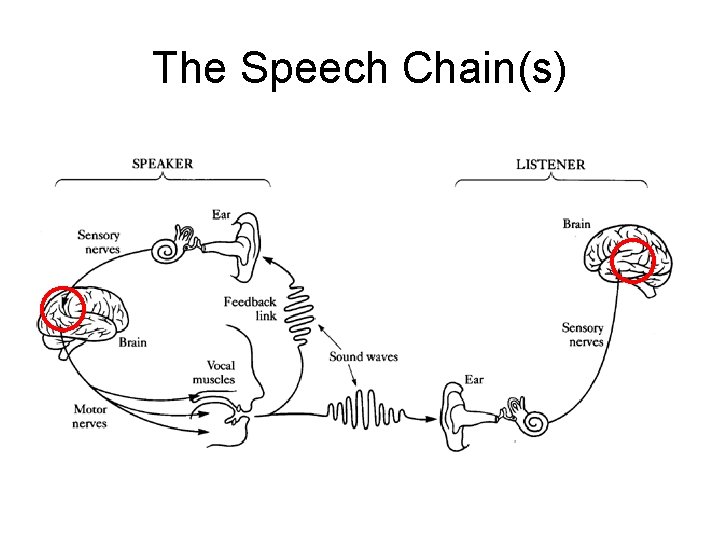
The Speech Chain(s)
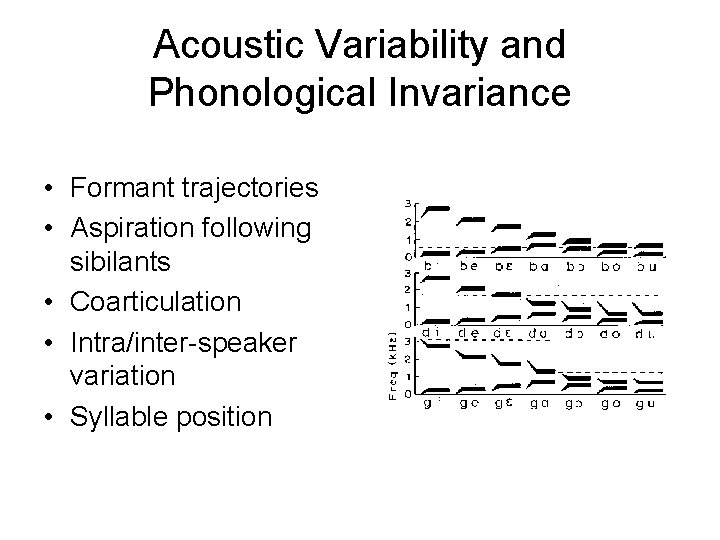
Acoustic Variability and Phonological Invariance • Formant trajectories • Aspiration following sibilants • Coarticulation • Intra/inter-speaker variation • Syllable position
Bonuses from Motor Theory • Parsimonious w/r/t a unified system for production and perception • Accounts for mapping between highly variable acoustic signal and invariant phonological percepts • Consistent with perception as internal representation of distal events
Why is the Motor Theory Always the Alternative Theory? • • • Lack of direct behavioral evidence Putatively less computationally efficient Less intuitive Skepticism about theories that are “too big” Haskins labs are a bunch of crackpots
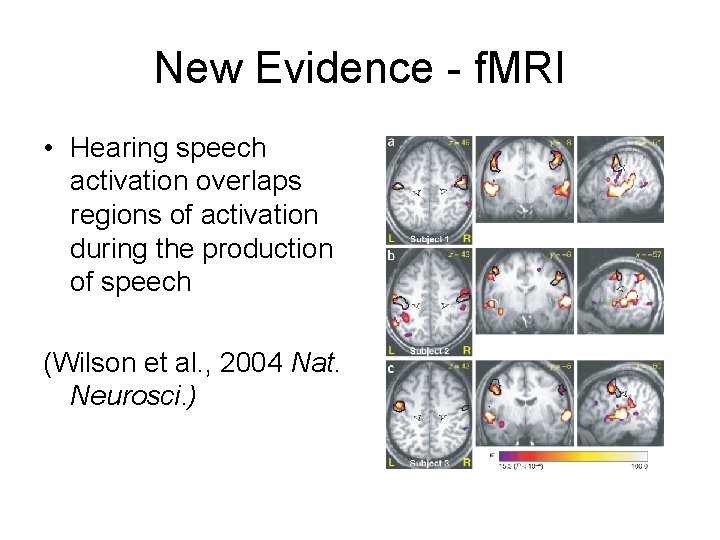
New Evidence - f. MRI • Hearing speech activation overlaps regions of activation during the production of speech (Wilson et al. , 2004 Nat. Neurosci. )
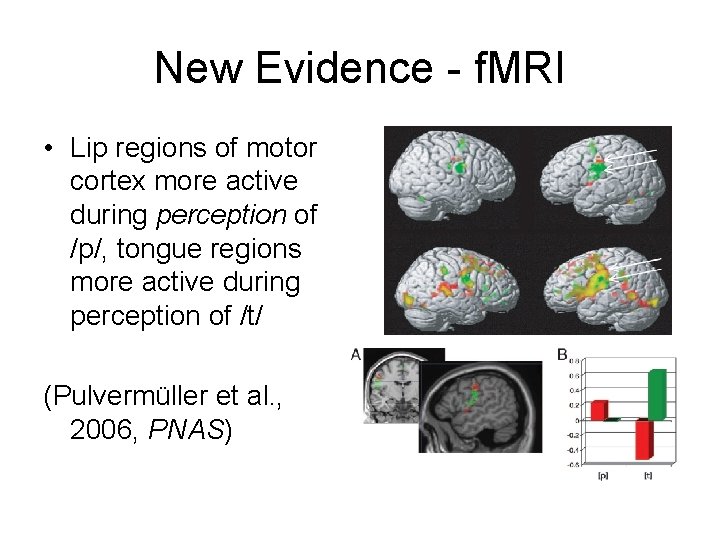
New Evidence - f. MRI • Lip regions of motor cortex more active during perception of /p/, tongue regions more active during perception of /t/ (Pulvermüller et al. , 2006, PNAS)
New Evidence - TMS • Stimulation of prefrontal cortex impairs speech, not nonspeech, perception (Meister et al. 2007, Current Biology) • Dissociable loci of phonological and semantic processing in IFG (Gough et al. 2005, J. Neurosci). • Combined PET and TMS to locate speech perception modulation in IFG (Watkins & Paus, 2004, J. Cog. Neuro) • Enhanced motor-evoked potential when listening to speech vs nonspeech (Watkins et al. 2003, Neuropsychologia)
Relation to Other Topics • Somatic & auditory integration in DCN for spatial location perception => sensory & motor integration in IFG for speech perception • Stuttering and production / perception feedback loop • Putative human mirror-neuron system • Lateralization of speech-language processes
Why Discuss Motor Theory? • Sensorimotor integration in perception has implications beyond speech: – Conspecific identification, theory of mind, internal world models / simulations • Implications for diagnosis and treatment of speech-sound disorders • Broader perspective on nature of speech / language integration and evolution
- Slides: 10