
Networking and Telecommunication Network Virtualization and the Mobile
Networking and Telecommunication: Network Virtualization and the Mobile Virtual Network Operation reality ICITD Southern University and A&M College Research Colloquium Networking and Telecommunication Femi Ekanoye Doctoral Candidate Department of Information Systems The ICT University Baton Rouge, Louisiana
Networking and Telecommunication Presentation Outline • • • Introduction Emergence of Network Virtualization Objectives of Network Virtualization Current trends of Network Virtualization Application scenarios of Network Virtualization • Advantages of Network Virtualization • Limitations of Network Virtualization
Networking and Telecommunication Presentation Outline • • • Introduction of Mobile Virtual Network Operation Importance of Study MVNO Business model Literature Assessment Research questions • Methodology • Conclusion • References
Networking and Telecommunication Introduction • Multiple Virtual Networks co-existing in a single physical network. • Networks isolated from each other but combined with the aid of programs. • Lease of Virtual Network as cloud computing service. • Logically Isolated Network Partitions (tech. gov, 2015).
Emergence of Network Virtualization • Enabling greater access to information • Providing new modes of communication among people and organization. • Fundamentally change the way we work, play and learn. • Overcoming limitations of size and scope of deploying new technologies. • Network technologies deployment shielded from the high cost of infrastructure (Buyya et al, 2008).
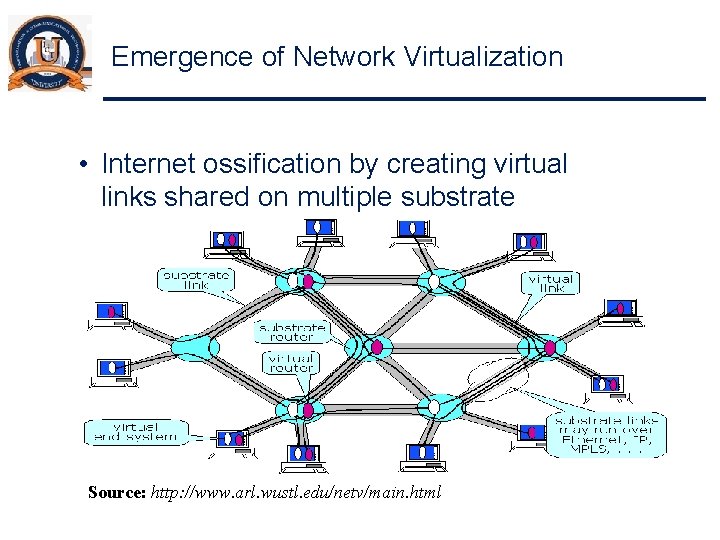
Emergence of Network Virtualization • Internet ossification by creating virtual links shared on multiple substrate Source: http: //www. arl. wustl. edu/netv/main. html
Objectives of Network Virtualization • Design and implement multiple concurrent, isolated and independent virtual infrastructure resource sharing. • Enable efficient provisioning of independent coexistent transport service. • Provisioning of abstraction of heterogeneous transport technologies and network element (ict-strauss. eu, 2017)
Current trends of Network Virtualization • Evolution of software defined networks(SDN) and network function virtualization(NFV). • Emergence of Containerization technology aptly changing industry landscape (pertino. com, 2017) • New disruptive technologies connecting workforce with workload and work apps that are needed.
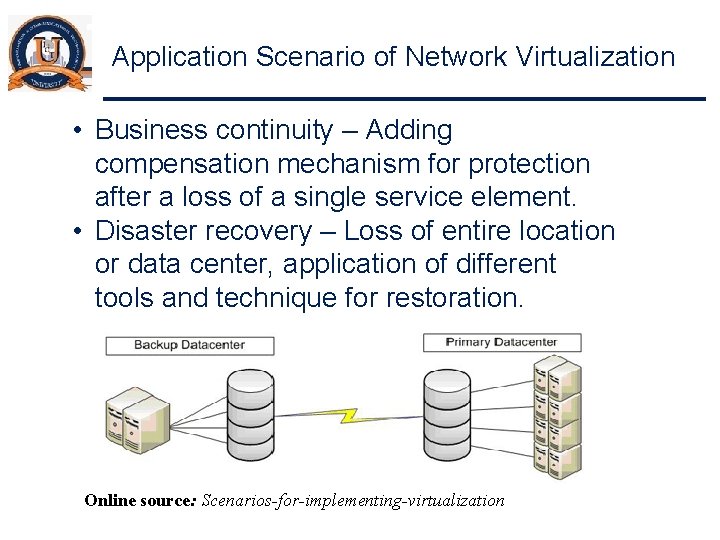
Application Scenario of Network Virtualization • Business continuity – Adding compensation mechanism for protection after a loss of a single service element. • Disaster recovery – Loss of entire location or data center, application of different tools and technique for restoration. Online source: Scenarios-for-implementing-virtualization
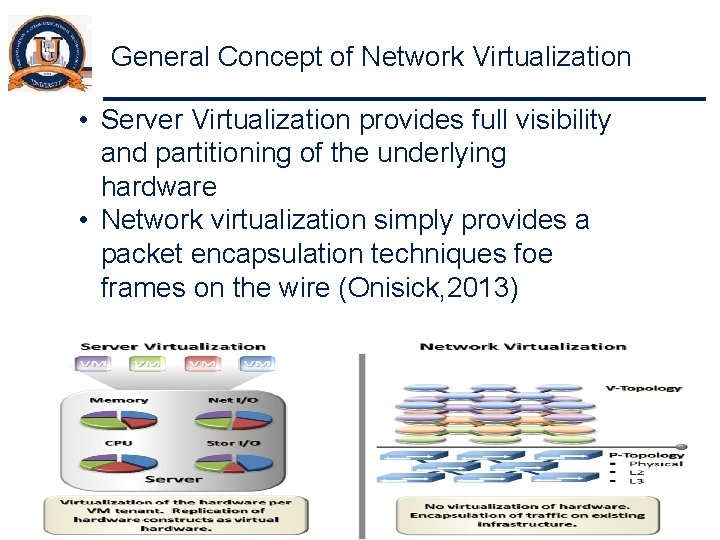
General Concept of Network Virtualization • Server Virtualization provides full visibility and partitioning of the underlying hardware • Network virtualization simply provides a packet encapsulation techniques foe frames on the wire (Onisick, 2013)
Advantages of Network Virtualization • Less time, money and efforts spent on hardware. • Eliminates the cost of maintenance and repairs. • Eliminates the need to have trained workers across brands and model of all hardware. • Less demand for lots of technical skills. • Makes development, testing and deployment of new apps a lot faster (Flukenetworks, 2016).
Limitations of Network Virtualization • Network virtualization integration does not comply with accepted Internationalization(I 18 N) conventions. • The network virtualization software may consume large amount of memory. • Network virtualization software integration is not supported for Linux platform.
Introduction of Mobile Virtual Network Operation research: A case of Nigeria and USA • MVNO operates virtually on host physical infrastructure • MVNO is a company that provides mobile communication services. • MVNO sell subscription and bill customer under their own brand but do not own spectrum license.
Introduction of Mobile Virtual Network Operation research: A case of Nigeria and USA • MVNO huge presence in United States and low presence in Africa. • Prompting in exploring possibilities of wide spread in Nigeria. • The concept of making bulk sales to brand names (Dahlen et al, 2002). • Innovation development of having full control of critical component of the chain. • Key resource area of the MVNO
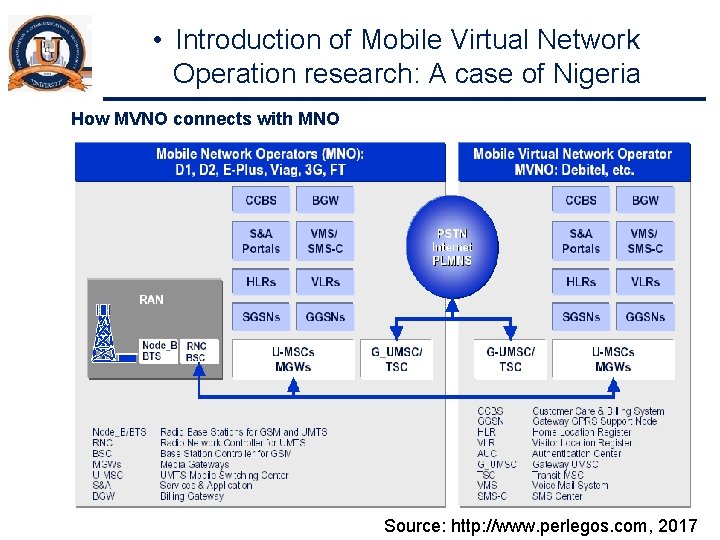
• Introduction of Mobile Virtual Network Operation research: A case of Nigeria How MVNO connects with MNO Source: http: //www. perlegos. com, 2017
MVNO Business Model • Company, networks and service types are under three(3) categories. • Resellers buy necessary services from MNO and sell them. Rely heavily on host back office support (Shin, 2015). • Service operator MVNO handles their back office operation management. They have their own SIM(Shin, 2015). • Full MVNO are fully independent. They develop their own business innovation and choose their host.
Importance of Study • MVNO initiative contributes to economic and National development by attracting local and foreign investor. • Brings prosperity that will have direct impact on the citizens by way of employment. • Provides grounds for MVNO framework to be developed by regulator. • Understanding Market segmentation for Business community.
Literature Assessment • Literature search focused on MVNO and MNO in developed countries • Used industry journals search, articles written by telecommunication students, dissertations and Google Scholar. • Contribution from general academic and practitioner literature on MVNO. • Only 3 full text peer reviewed journal papers found for MVNO development.
Literature Assessment • Combined growth of telecoms market in Africa in 2013 valued at $60 Billion (Market. Watch, 2014). • Nigeria accounted for $25 Billion of the entire value in 2013 (Vanguard. com, 2017) • Value expected to rise significantly to 234 Billion with CAGR 21. 21% by 2017(Market. Watch, 2014). • MVNO major problem is coverage and roaming which attracts extra cost(Harry, 2012).

Literature Assessment • MVNO focus on market-side success factor(Lee et al, 2008) • Bigger MNOs allow MVNOs to thrive and later absorb the one with best model(Seshu, 2012). • They aim at drastically reducing the resources that are required such as investment, headcount and rollout time(Lee et al, 2008)
Research questions RQ 1: What are the steps taken by the regulatory body to ensure a robust regulatory framework is put in place to support the emergence of MVNO in Nigeria? RQ 2: What are the bottlenecks experienced by the MNOs to begin this innovative telecommunication business idea? RQ 3: How well will consumers respond to these fresh players in the telecommunication environment, knowing fully well that they only operate virtually?
Methodology • Methodology adopted in this study is exploratory in nature • Based on secondary data collected from carious sources • Sources of data include articles, press releases of market research agencies, MVNO reports and interviews. • Exploratory approach was considered more suitable for the topic since MVNO is new in the study environment.
Methodology- Study design • Qualitative inquiry and analysis fits this purpose with stronger sensitivity, confirmability and dependability. • Data was collected through electronic focused group using two virtual communication tool. • Multiple case study of MVNO in Baton Rouge, LA, United States and MNO in Nigeria. • Participants selected through critical case sampling(Patton, 2011).
Methodology- Data Analysis • Review audio or video recording and transcribe in MS word. • Read and reflect over gathered data to get other idea on participants views. • Segment sentences into coded categories and form labels. • Emergence of logical findings through participants response. • Use NVIVO software to arrange the reports to bring perspective and accuracy of participants experience.
Conclusion • Network virtualization model and traditional model distinction • Proponents of Network virtualization refer it as a long term solution. • Proposed to be an integral part of next generation networking paradigm. • Provides flexibility, promotes diversity and promises security and increased manageability (Chowdhury and Boutaba, 2015).
References • Buyya et al. , (2008). Cloud computing and emerging IT platforms: Vision, hype, and reality for delivering computing as the 5 th utility. • Chowdhury, K. , and Boutaba, R. (2015). State of the Art and Research Challenges: University of Waterloo Network. • Dahlen et al. , (2002). Service Opportunities for Realistic MVNO Models: Telektronikk, PP. 26 -33 • Harry, D. (2012). Giagaom research: https: //gigaom. com/2012/06/25/why-aremvnos-so-hot-right-now-thank-the-carriers/ • Lee, S. , and Chan, H. (2008). The Emergence of Mobile Virtual Network Operators (MVNOs): An Examination of the Business Strategy in the Global MVNO Market, ” International Journal on Media Management, pp. 10 -21 • Market Watch. (2014). The MVNO market analysis: status update, emerging opportunities and outlook for Europe.
References • Onisick, J. (2013). Define. The. Cloud: What Network Virtualization Isn’t. • Patton, J. (2001). Purposeful sampling in qualitative synthesis: examining the adaptability of Patton's purposeful sampling strategies to qualitative research syntheses. • Requirements of Network Virtualization. (2015). http: //tech. gov. in; Network Virtualization explained. • Scalable and efficient orchestration of Ethernet services using software-defined and flexible optical networks: http: //www. ict-strauss. eu/en/project/objectives. html; Retrieved February 2017. • Seshu, B. (2012). Giagaom research, https: //gigaom. com/2012/06/25/why-are- mvnos-so-hot-right-now-thank-the-carriers/ • Shin, J. (2015). Understanding the three types of MVNO: the future of MVNO enablement. • Systems Announce Business Combination: www. flukenetworks. com; Published October, 2014.
References • Telecom Market Haven. (2013). Vanguard Newspaper: Nigerias-25 bn-telecom-market -haven-businessmen-toure/ • Top 3 Networking Trends for 2015: http: //pertino. com/blog/top-networking-trends-for 2015/Scenarios for implementing virtualization; Retrieved February, 2017.
- Slides: 28