
Networking and Health Information Exchange Unit 1 b
Networking and Health Information Exchange Unit 1 b ISO Open Systems Interconnection (OSI) Component 9/Unit 1 b Health IT Workforce Curriculum Version 1. 0/Fall 2010 1
Network Layer • Internet Protocol (IP) is used to assign IP addresses to network devices. – Connectionless – Best effort delivery – Relies on TCP for reliable, error free delivery Component 9/Unit 1 b Health IT Workforce Curriculum Version 1. 0/Fall 2010 2
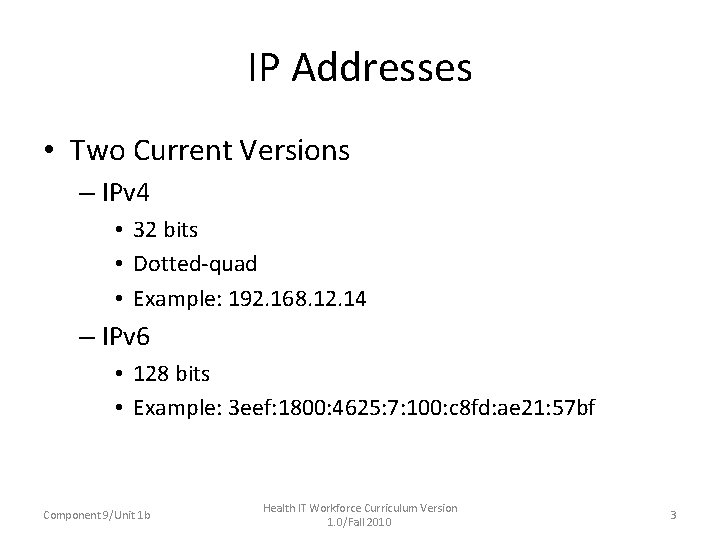
IP Addresses • Two Current Versions – IPv 4 • 32 bits • Dotted-quad • Example: 192. 168. 12. 14 – IPv 6 • 128 bits • Example: 3 eef: 1800: 4625: 7: 100: c 8 fd: ae 21: 57 bf Component 9/Unit 1 b Health IT Workforce Curriculum Version 1. 0/Fall 2010 3
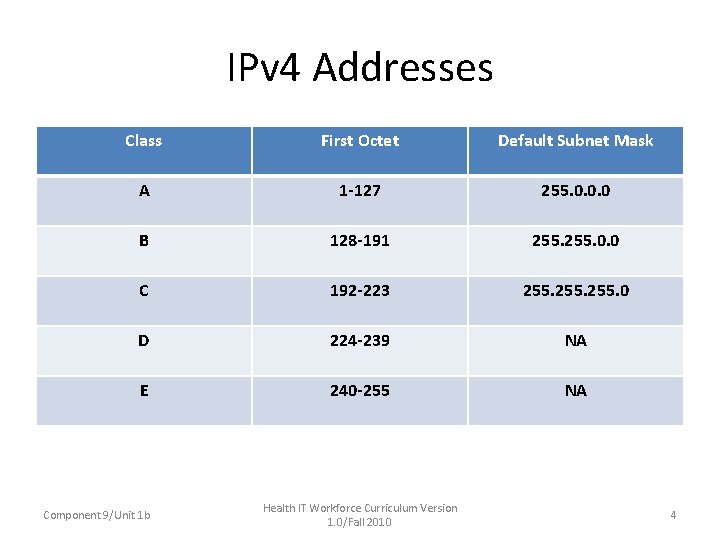
IPv 4 Addresses Class First Octet Default Subnet Mask A 1 -127 255. 0. 0. 0 B 128 -191 255. 0. 0 C 192 -223 255. 0 D 224 -239 NA E 240 -255 NA Component 9/Unit 1 b Health IT Workforce Curriculum Version 1. 0/Fall 2010 4
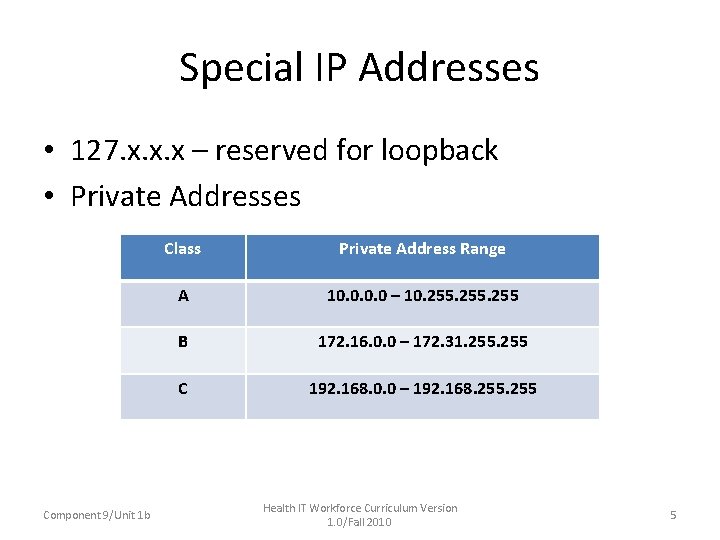
Special IP Addresses • 127. x. x. x – reserved for loopback • Private Addresses Component 9/Unit 1 b Class Private Address Range A 10. 0 – 10. 255 B 172. 16. 0. 0 – 172. 31. 255 C 192. 168. 0. 0 – 192. 168. 255 Health IT Workforce Curriculum Version 1. 0/Fall 2010 5
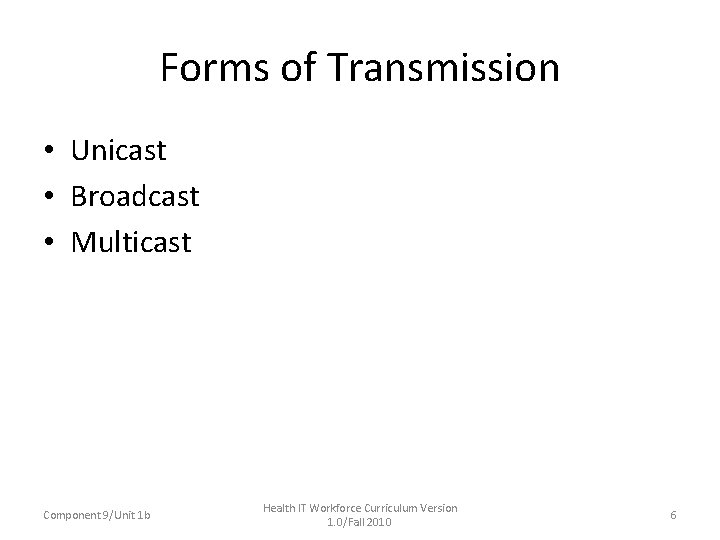
Forms of Transmission • Unicast • Broadcast • Multicast Component 9/Unit 1 b Health IT Workforce Curriculum Version 1. 0/Fall 2010 6
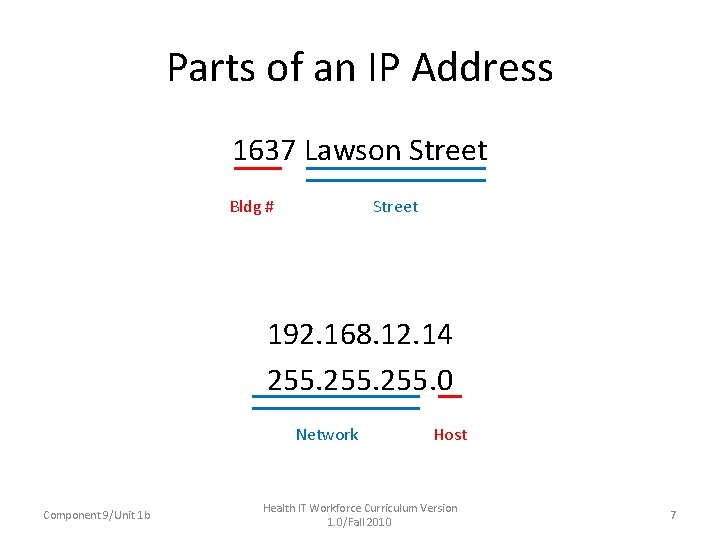
Parts of an IP Address 1637 Lawson Street Bldg # Street 192. 168. 12. 14 255. 0 Network Component 9/Unit 1 b Host Health IT Workforce Curriculum Version 1. 0/Fall 2010 7
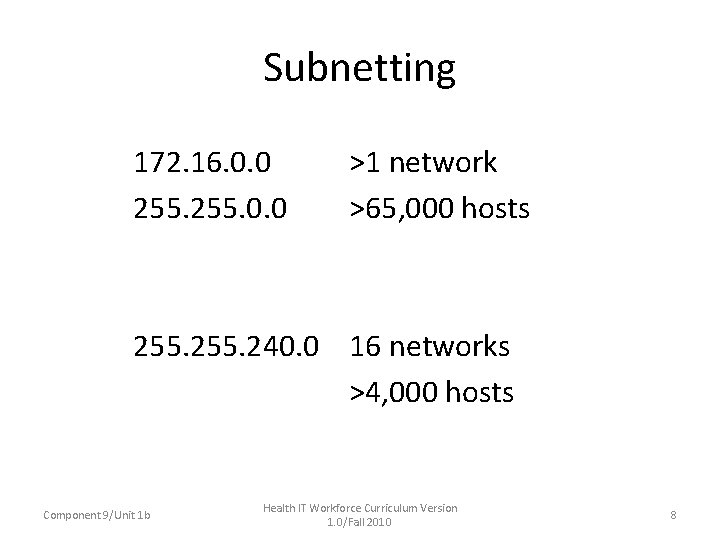
Subnetting 172. 16. 0. 0 255. 0. 0 >1 network >65, 000 hosts 255. 240. 0 16 networks >4, 000 hosts Component 9/Unit 1 b Health IT Workforce Curriculum Version 1. 0/Fall 2010 8
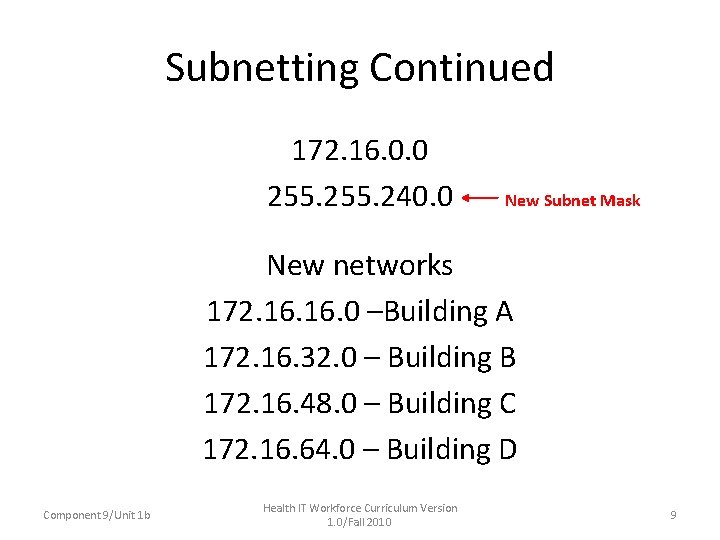
Subnetting Continued 172. 16. 0. 0 255. 240. 0 New Subnet Mask New networks 172. 16. 0 –Building A 172. 16. 32. 0 – Building B 172. 16. 48. 0 – Building C 172. 16. 64. 0 – Building D Component 9/Unit 1 b Health IT Workforce Curriculum Version 1. 0/Fall 2010 9
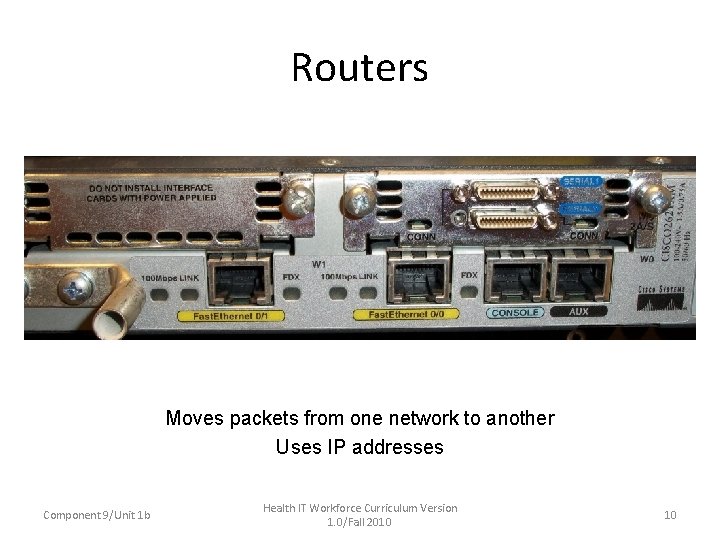
Routers Moves packets from one network to another Uses IP addresses Component 9/Unit 1 b Health IT Workforce Curriculum Version 1. 0/Fall 2010 10
Routing Protocols • Two types: – Static routing – Dynamic routing • Hop – Term used to describe the movement of data from one router to another • Time to Live (TTL) Component 9/Unit 1 b Health IT Workforce Curriculum Version 1. 0/Fall 2010 11
Internet Control Message Protocol (ICMP) • Used to send some messages back to sender in case there is an error in delivery • Common messages – Unreachable destination or service – Time exceeded – Route Redirection – Source Quench • Used with PING and TRACERT Component 9/Unit 1 b Health IT Workforce Curriculum Version 1. 0/Fall 2010 12
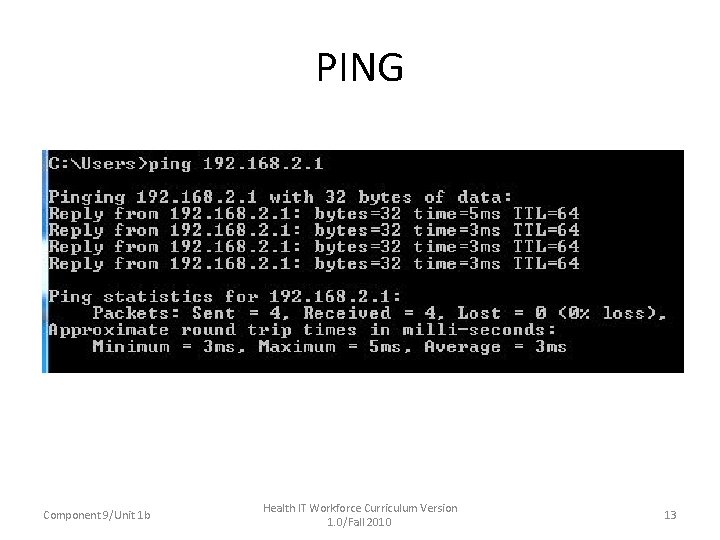
PING Component 9/Unit 1 b Health IT Workforce Curriculum Version 1. 0/Fall 2010 13
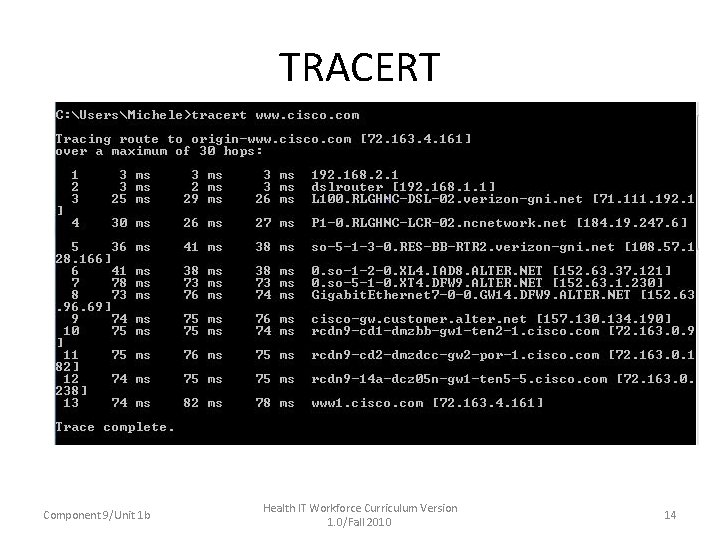
TRACERT Component 9/Unit 1 b Health IT Workforce Curriculum Version 1. 0/Fall 2010 14
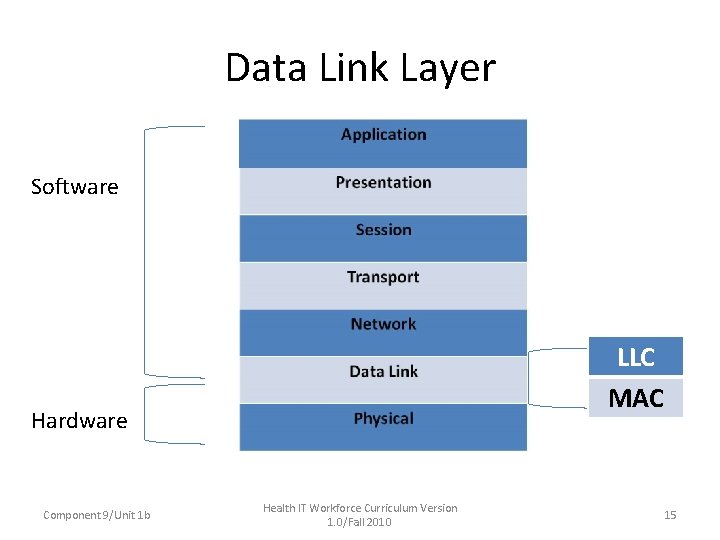
Data Link Layer Software LLC MAC Hardware Component 9/Unit 1 b Health IT Workforce Curriculum Version 1. 0/Fall 2010 15
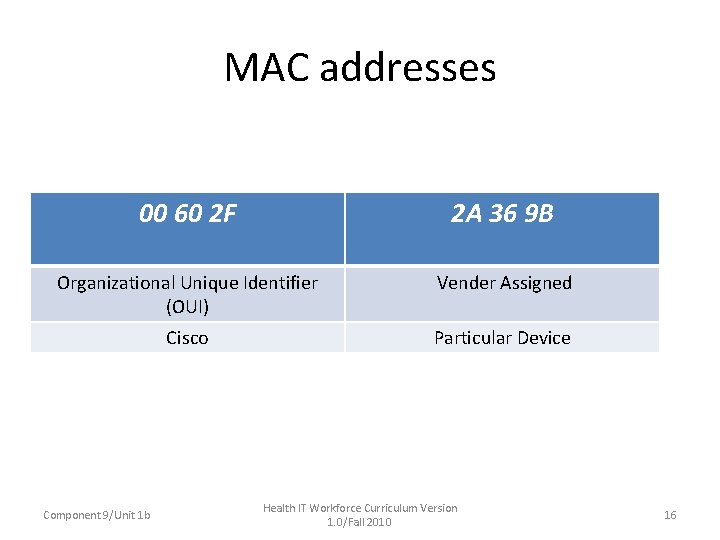
MAC addresses 00 60 2 F 2 A 36 9 B Organizational Unique Identifier (OUI) Vender Assigned Cisco Particular Device Component 9/Unit 1 b Health IT Workforce Curriculum Version 1. 0/Fall 2010 16
Media Access Control • Controlled – Also called deterministic – Every device has to wait their turn – Only 1 device can transmit data at a time – No collisions – Examples • Token Ring • Fiber Data Distributed Interface (FDDI) Component 9/Unit 1 b Health IT Workforce Curriculum Version 1. 0/Fall 2010 17
Media Access Control Continued • Contention-based – Also called non-deterministic – Devices can transmit at any time – Collisions can occur – Examples • Ethernet • Wireless Component 9/Unit 1 b Health IT Workforce Curriculum Version 1. 0/Fall 2010 18
Ethernet • Uses CSMA/CD – Carrier Sense Multiple Access (CSMA) • “Listens” to media to see if there any signals • If media is busy, it will wait and try again • If media isn’t busy, the device will transmit its data – Collision Detection (CD) • If another device transmitted at the same time there would be a collision • Data from both devices are corrupt and will need to be resent Component 9/Unit 1 b Health IT Workforce Curriculum Version 1. 0/Fall 2010 19
Wireless • Uses CSMA/CA – Carrier Sense Multiple Access (CSMA) • “Listens” to media to see if there any signals • If media is busy, it will wait and try again – Collision Avoidance (CA) • If the media is free the device will send out a signal letting other devices know that it is getting ready to use the media • The device then transmits data • Used by 802. 11 standards Component 9/Unit 1 b Health IT Workforce Curriculum Version 1. 0/Fall 2010 20
Other Data Link Protocols • Frame Relay • Point-to-Point Protocol (PPP) • Asynchronous Transfer Mode (ATM) Component 9/Unit 1 b Health IT Workforce Curriculum Version 1. 0/Fall 2010 21
Physical Layer • Hardware Specifications • Encoding – Non Return to Zero (NRZ) – Manchester • Transmits and Receives Data • Network Topology Component 9/Unit 1 b Health IT Workforce Curriculum Version 1. 0/Fall 2010 22
- Slides: 22