
Networking and Health Information Exchange Standards Developing Organizations
- Slides: 27
Networking and Health Information Exchange Standards Developing Organizations Lecture a This material (Comp 9 Unit 3) was developed by Duke University, funded by the Department of Health and Human Services, Office of the National Coordinator for Health Information Technology under Award Number IU 24 OC 000024. This material was updated by Normandale Community College, funded under Award Number 90 WT 0003. This work is licensed under the Creative Commons Attribution-Non. Commercial-Share. Alike 4. 0 International License. To view a copy of this license, visit http: //creativecommons. org/licenses/by-nc-sa/4. 0/
Standards Developing Organizations Learning Objectives • Explain why standards related to networking and health information exchange are important in the current environment • Standards development – How standards are developed – Who develops them – How standards are accredited – How standards are selected • Understand different kinds of standards being developed and for what purpose 2
Why Standards? • • Necessary part of everyday life Enables working together Avoid chaos Ubiquitous use 3
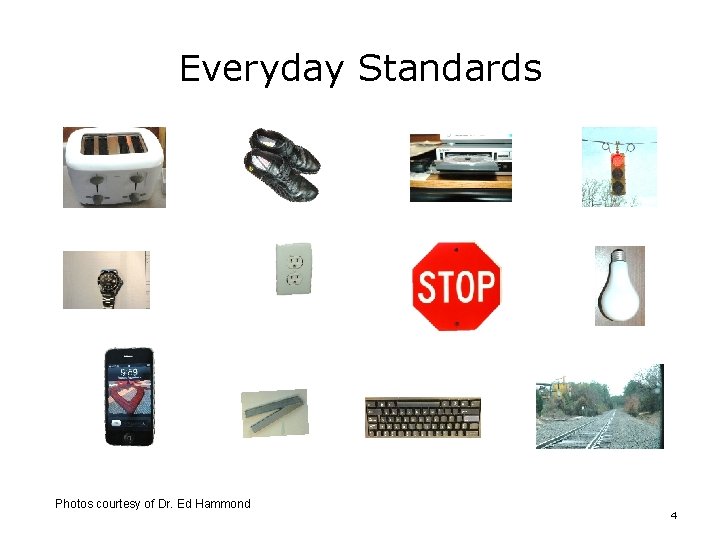
Everyday Standards Photos courtesy of Dr. Ed Hammond 4
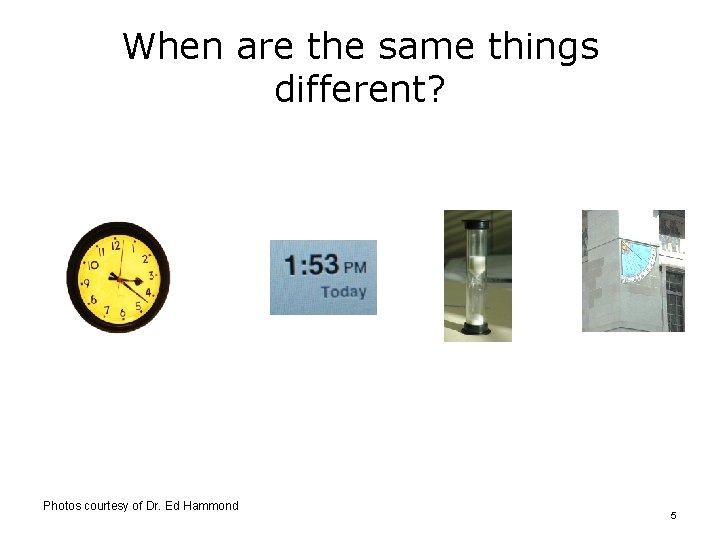
When are the same things different? Photos courtesy of Dr. Ed Hammond 5
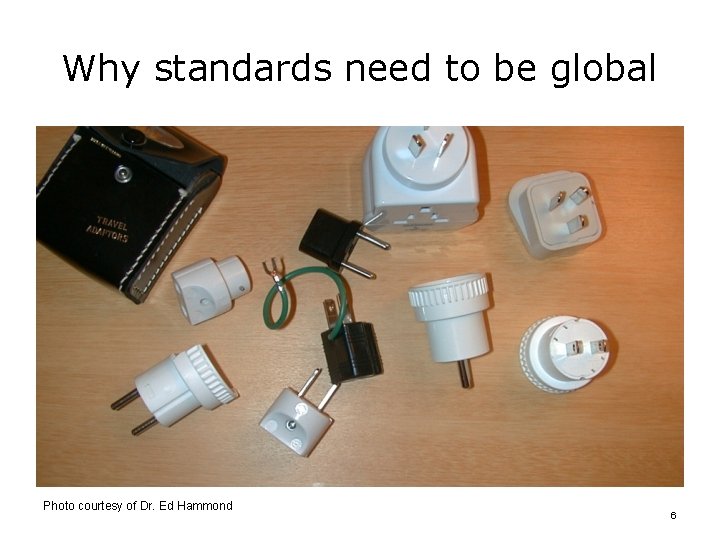
Why standards need to be global Photo courtesy of Dr. Ed Hammond 6
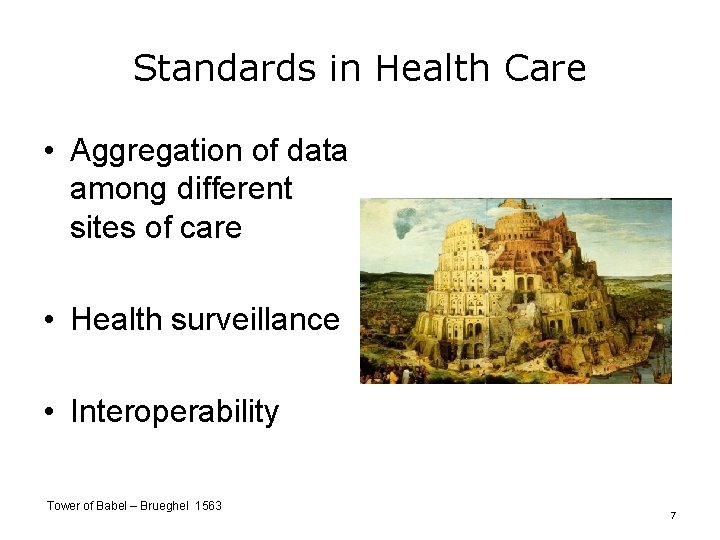
Standards in Health Care • Aggregation of data among different sites of care • Health surveillance • Interoperability Tower of Babel – Brueghel 1563 7
Interoperability Requires … • Connectivity infrastructure – Land lines – Cable – Wireless – Satellites – Other 8
Interoperability Requires … • Governance infrastructure – Decisions made and enforced o Data o Standards o Knowledge o Process – Ideally proper decisions made by experts and supported by governments. Interoperability is difficult without government involvement o Should be a partnership between public and o 9
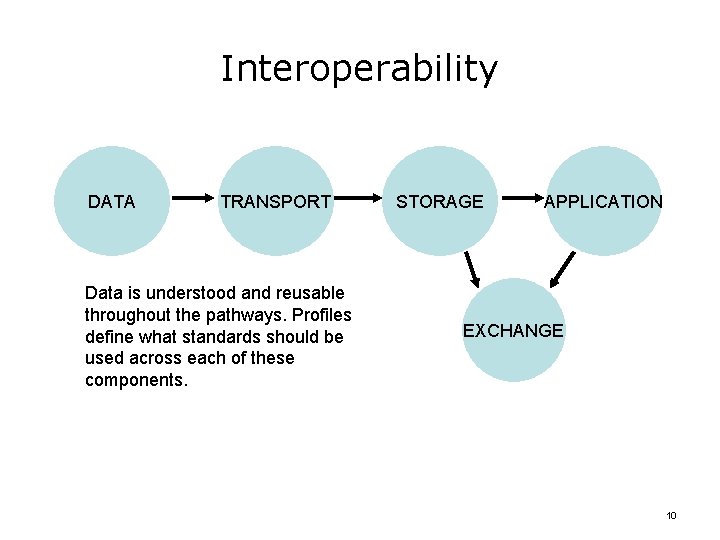
Interoperability DATA TRANSPORT Data is understood and reusable throughout the pathways. Profiles define what standards should be used across each of these components. STORAGE APPLICATION EXCHANGE 10
Comments About Standards • “What I like most about standards are that there are so many to choose from. ” • “There are no standards. ” • “We need standards, so let’s make some. ” 11
Government and Standards • Much of the activity for Health Information Technology for Economic and Clinical Health (HITECH) and the American Recovery and Reinvestment Act (ARRA) involves standards 12
Who Is Doing the Thinking About Standards? • The Office of the National Coordinator (ONC), supported by two committees: – Healthcare Information Technology Standards Committee (HITSC) – Healthcare Information Technology Policy Committee (HITPC) • Both are engaged in identifying appropriate standards for HIT 13
How Are Standards Made? • Government • De facto standards (proprietary) created by a vendor • Ad hoc standards created by industry groups • Consensus standards created by open groups of interested stake holders 14
Authority For Standards • • Government – mandate Single vendor – market share Ad hoc – vendor agreement Consensus – Balanced voting process among categories of participants – Requires over-whelming agreement – Vote by members or countries 15
Who Creates Standards? • Unfortunately, there are many groups that create standards. The result is competing, conflicting and overlapping standards. The result is inconsistency in what standards are chosen, defeating the purpose of standards. • We refer to a group that creates standards as a Standards Developing Organization (SDO). Some SDOs are international, others are US only. 16
International SDOs (1/2) • International Standards Organization (ISO) – ISO TC 215 – Healthcare Informatics • European Committee for Standardization (CEN) • Health Level 7 (HL 7) International • Digital Imaging and Communications in Medicine (DICOM) • Institute of Electrical and Electronic Engineers (IEEE) • Clinical Data Interchange Standards Consortium (CDISC) 17
International SDOs (2/2) • GS 1 • International Healthcare Terminology SDO (IHTSDO) • Joint Initiative Council (JIC) 18
Related Organizations • • • World Health Organization (WHO) Object Management Group (OMG) Integrating the Healthcare Enterprise (IHE) open. EHR World Wide Web Consortium (W 3 C) Organization for the Advancement of Structured Information Standards (OASIS) • Internet Engineering Task Force (IETF) 19
US HIT SDOs • ASTM • ASC X 12 N • National Council for Prescription Drug Programs (NCPDP) • Med. Biquitous • American Dental Association • International/US – CDISC, DICOM, HL 7, IEEE 20
Related US Groups • • • American National Standards Institute (ANSI) US Tag to ISO TC 215 National Institute of Standards (NIST) SDO Charter Organization (SCO) National Quality Forum (NQF) Office of the National Coordinator (ONC) – HIT Standards Committee (HITSC) – HIT Policy Committee (HITPC) • National Library of Medicine (NLM) 21
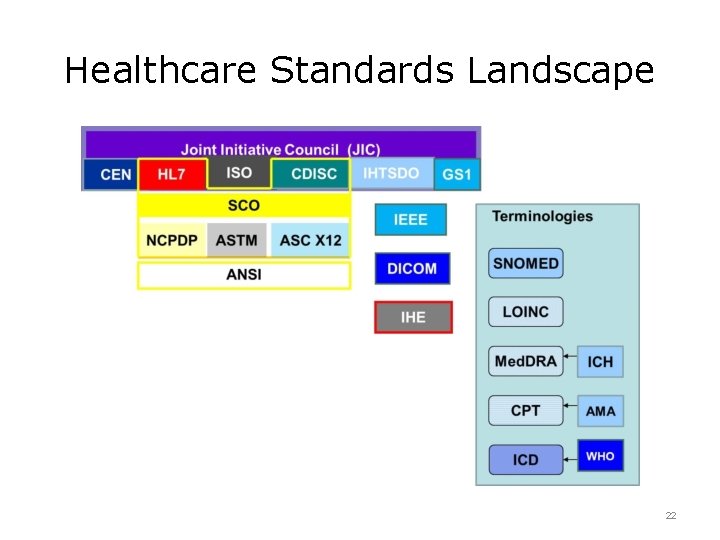
Healthcare Standards Landscape 22
Standards Developing Organizations Summary- Lecture a • Importance of standards • How standards are made • Who makes standards 23
Standards Developing Organizations References – Lecture a References American Dental Association. (n. d. ). Retrieved from American Dental Association website: www. ada. org ANSI - American National Standards Institute. (n. d. ). Retrieved from www. ansi. org ANSI Accredited U. S. Technical Advisory Groups (TAGs) to ISO. (n. d. ). Retrieved from www. ansi. org/standards_activities/iso_programs/tag_iso. aspx ASCX 12 - About ASC X 12. (n. d. ). Retrieved from ASC X 12 website: www. x 12. org ASTM International - Welcome to ASTM. org. (n. d. ). Retrieved from ASTM International website: www. astm. org CDISC Strength Through Collaboration. (n. d. ). Retrieved from Clinical Data Interchange Standards Consortium website: www. cdisc. org DICOM (Digital Imaging and Communications in Medicine). (n. d. ). Retrieved from Medical Imaging & Technology Alliance - a division of NEMA website: http: //medical. nema. org/ GS 1 The global language of business. (n. d. ). Retrieved from www. gs 1. org Health Level Seven International. (n. d. ). Retrieved from HL 7 website: www. hl 7. org IEEE Advancing Technology for Humanity. (n. d. ). Retrieved from IEEE website: www. IEEE. org IHE - Welcome to Integrating the Healthcare Enterprise. (n. d. ). Retrieved from IHE International website: www. ihe. net 24
References Standards Developing Organizations References – Lecture a Joint Initiative on SDO Global Health Informatics Standardization. (n. d. ). Retrieved from Health Level Seven International website: www. jointinitiativecouncil. org/ Med. Biquitous Advancing Healthcare Education Through Collaboration. (n. d. ). Retrieved from Med. Biquitous Consortium website: www. medbiq. org National Council for Prescription Drug Programs. (n. d. ). Retrieved from www. ncpdp. org National Institute of Standards and Technology. (n. d. ). Retrieved from U. S. Department of Commerce website: www. nist. gov National Quality Forum. (n. d. ). Retrieved from The National Quality Forum website: www. qualityforum. org OASIS - Advancing open standards for the information society. (n. d. ). Retrieved from OASIS website: www. oasis-open. org OMG. (n. d. ). Retrieved from Object Management Group, Inc. website: www. omg. org open. EHR - Welcome to open. EHR. (n. d. ). Retrieved from open. EHR website: www. openehr. org TC 215 Health Informatics. (n. d. ). Retrieved from ISO (International Organization for Standardization) website: www. iso. org/iso_technical_committee? commid=54960 Technical Committees, Workshops and other bodies. (n. d. ). Retrieved from CEN (Comité Européen de Normalisation) website: www. cen. eu/cen/Sectors/Technical. Committees. Workshops/CENTechnical. Committees/Pages/defa ult. aspx? param=6232&title=CEN/TC%20251 25
References Standards Developing Organizations References – Lecture a The Internet Engineering Task Force (IETF). (n. d. ). Retrieved from Internet Society website: www. ietf. org U. S. National Library of Medicine - National Institutes of Health. (n. d. ). Retrieved from U. S. National Library of Medicine website: www. nlm. nih. gov W 3 C. (n. d. ). Retrieved, from W 3 C website: http: //www. w 3. org/ Welcome to IHTSDO. (n. d. ). Retrieved from International Health Terminology Standards Development Organisation website: www. ihtsdo. org World Health Organization. (n. d. ). Retrieved from WHO website: www. who. int Images Slide 4 – Photos courtesy of Dr. Ed Hammond Slide 5 – Photos courtesy of Dr. Ed Hammond Slide 6 – Photos courtesy of Dr. Ed Hammond Slide 7 – File: Brueghel-tower-of-babel. jpg. (n. d. ). Retrieved January 10, 2012, from Wikipedia, the free encyclopedia website: http: //en. wikipedia. org/wiki/File: Brueghel-tower-of-babel. jpg 26
Standards Developing Organizations Lecture a This material was developed by Duke University, funded by the Department of Health and Human Services, Office of the National Coordinator for Health Information Technology under Award Number IU 24 OC 000024. This material was updated by Normandale Community College, funded under Award Number 90 WT 0003. 27