
NETWORKED INDIVIDUALISM Dott ssa Francesca Moretti moretti francescaphdgmail
- Slides: 43
NETWORKED INDIVIDUALISM Dott. ssa Francesca Moretti moretti. francescaphd@gmail. com 17/03/2021 NETWORKED INDIVIDUALISM 1
INDEX 1. KEYWORDS 2. IDENTITY IN A POSTMODERN WORLD 3. COMMUNITY 4. COMMUNITY vs NETWORK 5. THE ROLE OF NEW TECHNOLOGIES 6. LET’S TALK ABOUT IT 7. SOCIAL NETWORK SITE 8. NETWORKED INDIVIDUALISM 17/03/2021 NETWORKED INDIVIDUALISM 2
KEYWORDS COMMUNITY IDENTITY POSTMODERNITY SOCIAL CAPITAL 17/03/2021 NETWORKED INDIVIDUALISM NETWORK 3
IDENTITY IN A POSTMODERN WORLD Zygmunt Bauman argues that the idea of identity stemmed from the need for a sense of belonging and security, and that the existence of identity is only applicable to the modern society that is ‘liquid’ – constantly changing and transforming. Identity became a new problem and task because it wasn’t one before mankind entered “modernity”. Bauman states that “the thought of ‘having an identity’ will not occur to people as long as ‘belonging’ remains their fate, a condition with no alternative. They will begin to entertain such a thought only in the form of a task to be performed, and to be performed over and over again rather than in a one-off fashion. 17/03/2021 NETWORKED INDIVIDUALISM 4
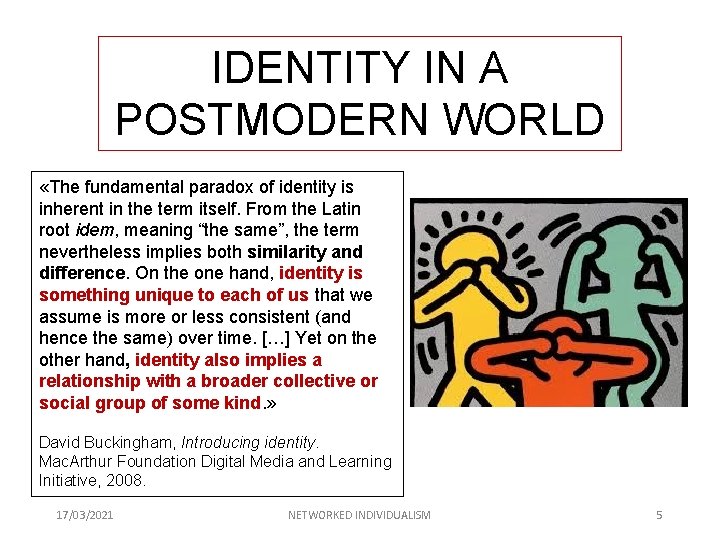
IDENTITY IN A POSTMODERN WORLD «The fundamental paradox of identity is inherent in the term itself. From the Latin root idem, meaning “the same”, the term nevertheless implies both similarity and difference. On the one hand, identity is something unique to each of us that we assume is more or less consistent (and hence the same) over time. […] Yet on the other hand, identity also implies a relationship with a broader collective or social group of some kind. » David Buckingham, Introducing identity. Mac. Arthur Foundation Digital Media and Learning Initiative, 2008. 17/03/2021 NETWORKED INDIVIDUALISM 5
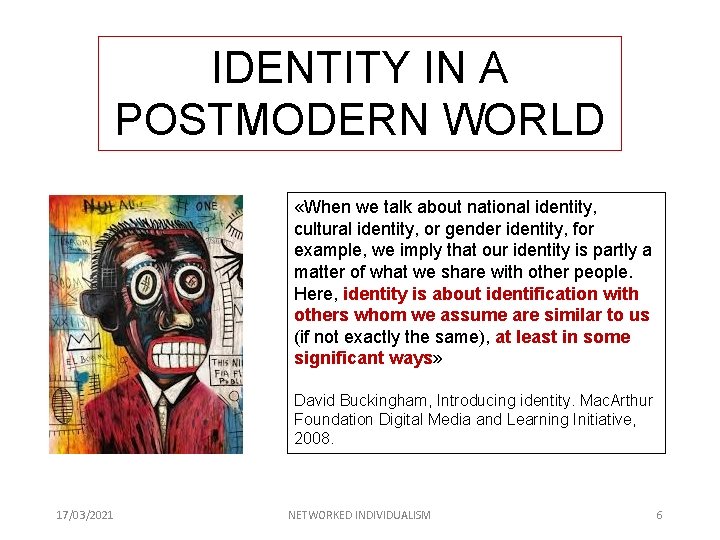
IDENTITY IN A POSTMODERN WORLD «When we talk about national identity, cultural identity, or gender identity, for example, we imply that our identity is partly a matter of what we share with other people. Here, identity is about identification with others whom we assume are similar to us (if not exactly the same), at least in some significant ways» David Buckingham, Introducing identity. Mac. Arthur Foundation Digital Media and Learning Initiative, 2008. 17/03/2021 NETWORKED INDIVIDUALISM 6
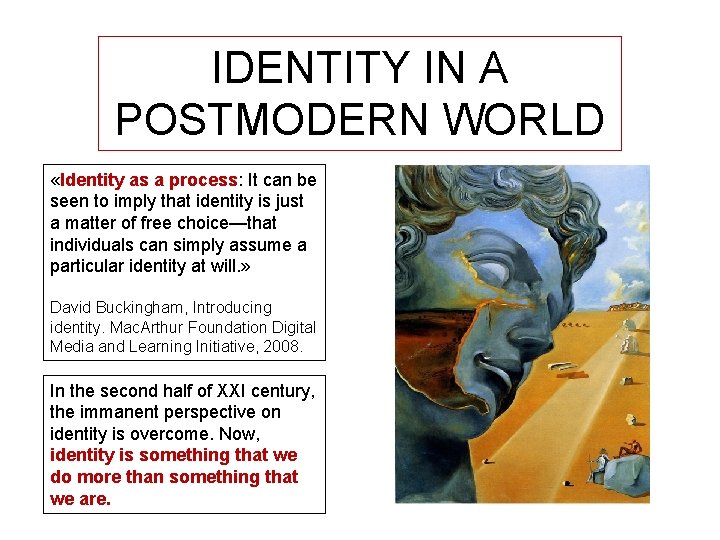
IDENTITY IN A POSTMODERN WORLD «Identity as a process: It can be seen to imply that identity is just a matter of free choice—that individuals can simply assume a particular identity at will. » David Buckingham, Introducing identity. Mac. Arthur Foundation Digital Media and Learning Initiative, 2008. In the second half of XXI century, the immanent perspective on identity is overcome. Now, identity is something that we do more than something that we are.
IDENTITY IN A POSTMODERN WORLD Self as a symbolic project (Thompson) which the individual must actively construct out of the available symbolic materials, materials which "the individual weaves into a coherent account of who he or she is, a narrative of self-identity. Identity is not something fixed, nor is it something that is provided to the individual by an external entity. Rather, it is continuously and actively re-worked by the individual who has the responsibility for its constant redefinition. (Comunello) 17/03/2021 NETWORKED INDIVIDUALISM 8
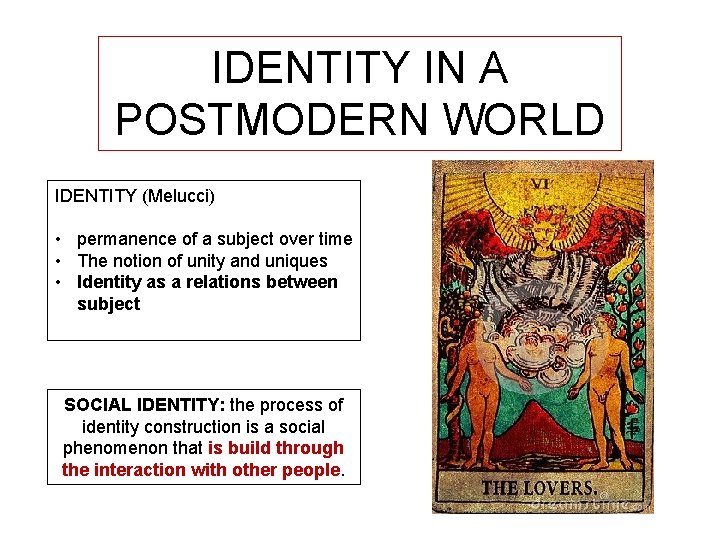
IDENTITY IN A POSTMODERN WORLD IDENTITY (Melucci) • permanence of a subject over time • The notion of unity and uniques • Identity as a relations between subject SOCIAL IDENTITY: the process of identity construction is a social phenomenon that is build through the interaction with other people.
COMMUNITY Ferdinand Tönnies (1887) implementing a critique of modernity, already at the end of the Nineteenth century had decreed the decline of the community (Gemeinschaft), sacrificed in favor of society (Gesellschaft), an artificial and homologating entity. According to the German sociologist, the processes of industrialization, bureaucratization and urbanization had the responsibility of having initiated changes that inexorably extinguished the deep bond of man with nature. 17/03/2021 NETWORKED INDIVIDUALISM 10
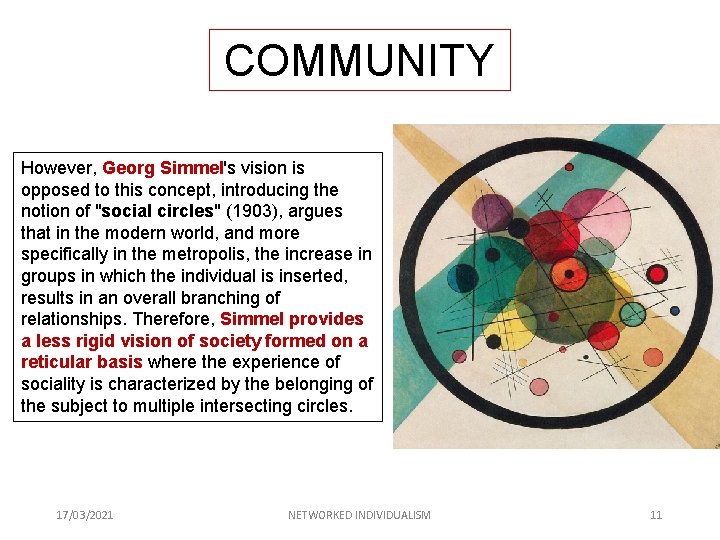
COMMUNITY However, Georg Simmel's vision is opposed to this concept, introducing the notion of "social circles" (1903), argues that in the modern world, and more specifically in the metropolis, the increase in groups in which the individual is inserted, results in an overall branching of relationships. Therefore, Simmel provides a less rigid vision of society formed on a reticular basis where the experience of sociality is characterized by the belonging of the subject to multiple intersecting circles. 17/03/2021 NETWORKED INDIVIDUALISM 11
COMMUNITY The thesis of the German scholar anticipates, therefore, what became more evident in the 1950 s and 1960 s, when the logic of the network began to predominate in the study of social bonds. In fact, through studies conducted on urbanization processes it was possible to demonstrate the emergence of more fluid social structures than in the past. 17/03/2021 NETWORKED INDIVIDUALISM 12
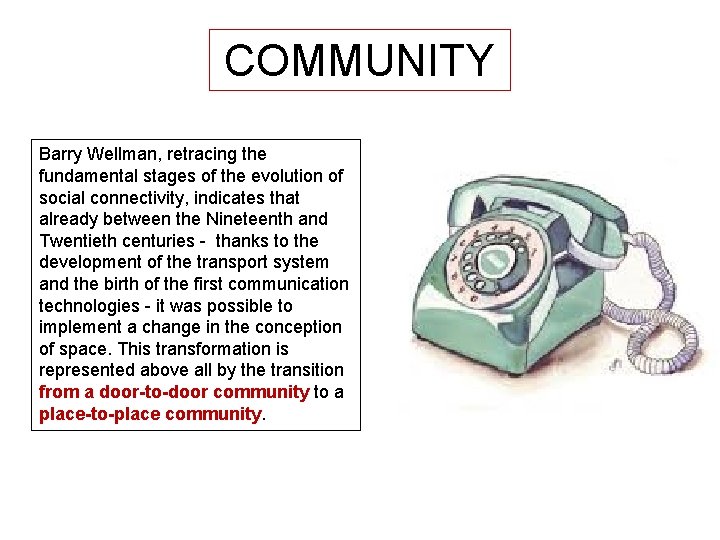
COMMUNITY Barry Wellman, retracing the fundamental stages of the evolution of social connectivity, indicates that already between the Nineteenth and Twentieth centuries - thanks to the development of the transport system and the birth of the first communication technologies - it was possible to implement a change in the conception of space. This transformation is represented above all by the transition from a door-to-door community to a place-to-place community.
COMMUNITY In fact, by going beyond the limits imposed by the neighborhood, individuals had the possibility of structuring relationships that are no longer based exclusively on the sharing of a physical space. The opportunities for people to implement a continuous and despatialized type of relationality (Thompson, 1998) are increasing and this has inevitably led to a restructuring of the sociological concept of community, now concentrated exclusively on the exchange of social resources. 17/03/2021 NETWORKED INDIVIDUALISM 14
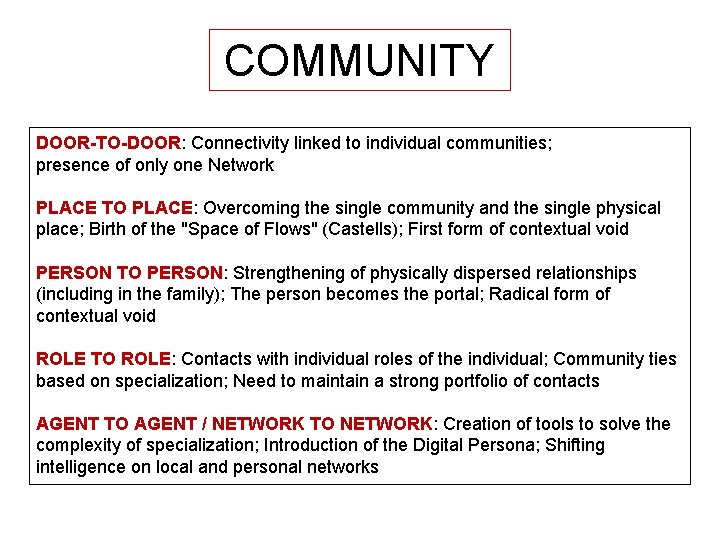
COMMUNITY DOOR-TO-DOOR: Connectivity linked to individual communities; presence of only one Network PLACE TO PLACE: Overcoming the single community and the single physical place; Birth of the "Space of Flows" (Castells); First form of contextual void PERSON TO PERSON: Strengthening of physically dispersed relationships (including in the family); The person becomes the portal; Radical form of contextual void ROLE TO ROLE: Contacts with individual roles of the individual; Community ties based on specialization; Need to maintain a strong portfolio of contacts AGENT TO AGENT / NETWORK TO NETWORK: Creation of tools to solve the complexity of specialization; Introduction of the Digital Persona; Shifting intelligence on local and personal networks
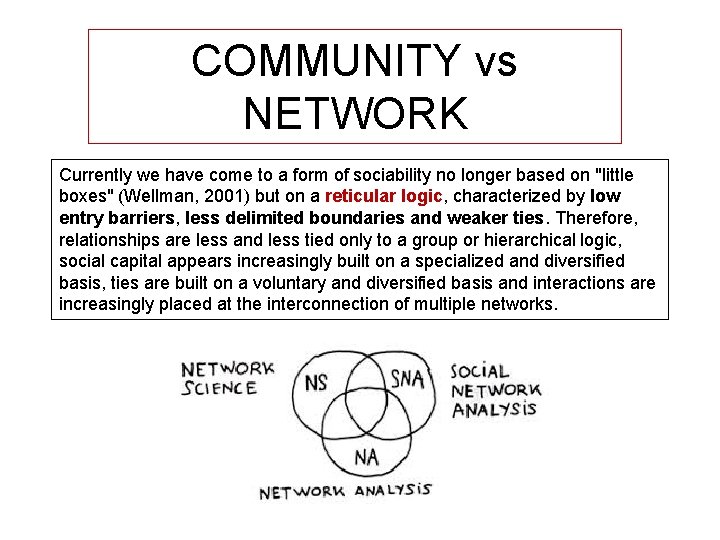
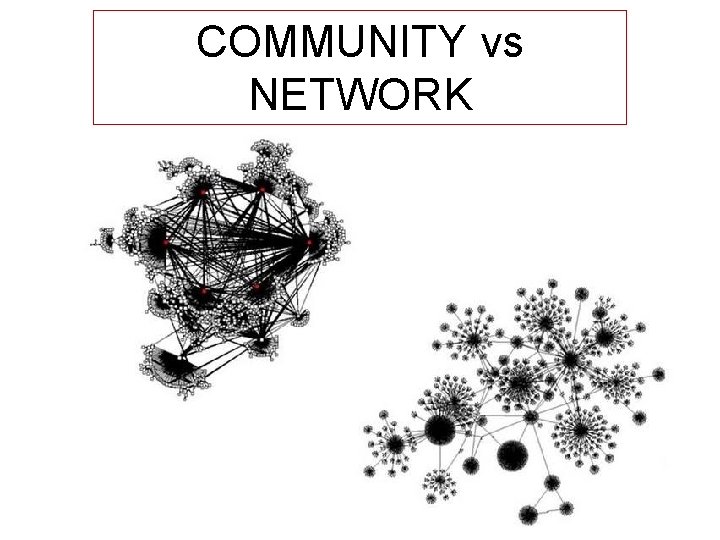
COMMUNITY vs NETWORK Currently we have come to a form of sociability no longer based on "little boxes" (Wellman, 2001) but on a reticular logic, characterized by low entry barriers, less delimited boundaries and weaker ties. Therefore, relationships are less and less tied only to a group or hierarchical logic, social capital appears increasingly built on a specialized and diversified basis, ties are built on a voluntary and diversified basis and interactions are increasingly placed at the interconnection of multiple networks.
COMMUNITY vs NETWORK Therefore, Wellman indicates that a rethinking of the very concept of community is necessary, to be understood now as networks of personal bonds that provide sociality, information support, a sense of belonging and social identity.
COMMUNITY vs NETWORK «Communities, at least in the tradition of sociological research, were based on the sharing of values and social organization. Networks are built by the choices and strategies of social actors, be it individuals, families or social groups. Thus, the major trasformation of sociability in complex societies took place with the substitution of communities as a major form of sociability. » Manuel Castells, The Internet galaxy: Reflections on the Internet, business, and society. Oxford University Press on Demand, 2002 17/03/2021 NETWORKED INDIVIDUALISM 18
COMMUNITY vs NETWORK A form of sociability that is inside and outside thecnological enviroment. There is no contrapposition between virtual and reality (Lévy, 1995) «The social outcome of these networks is a double one. On the one hand, from the point of view of each individual, his/her social world is formed around his/her networks, and evolves with the composition of the network. On the other hand, from the point of view of the network, its configuration operates as the point of reference of each one of the participants in the network» Castells, Manuel, et al. Mobile communication and society: A global perspective. Mit Press, 2009 17/03/2021 NETWORKED INDIVIDUALISM 19
COMMUNITY vs NETWORK Relational networks: sociology has resorted to the metaphor of the rhizome (Deleuze, Guattari) according to which any point of the rhizome can be connected to any other and must be. In order to describe the digital network the conceptualization of the rhizome can be translated in terms of graphs where all the nodes are interconnected with the others with less denser ties. 17/03/2021 NETWORKED INDIVIDUALISM 20
COMMUNITY vs NETWORK 17/03/2021 NETWORKED INDIVIDUALISM 21
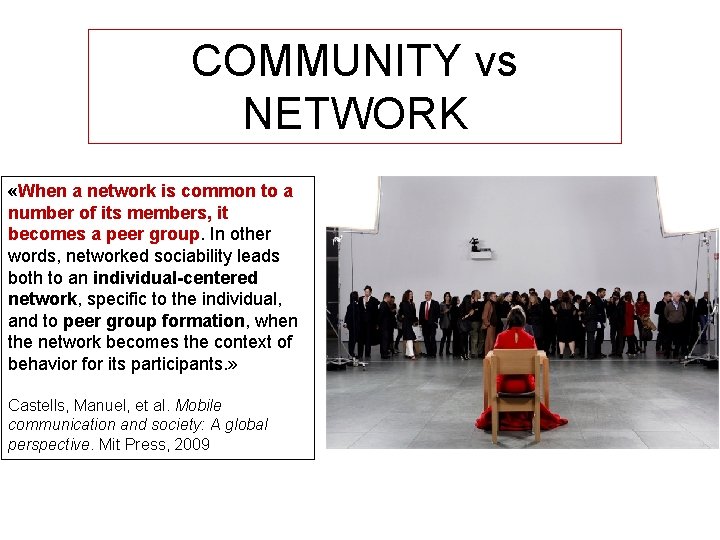
COMMUNITY vs NETWORK «When a network is common to a number of its members, it becomes a peer group. In other words, networked sociability leads both to an individual-centered network, specific to the individual, and to peer group formation, when the network becomes the context of behavior for its participants. » Castells, Manuel, et al. Mobile communication and society: A global perspective. Mit Press, 2009
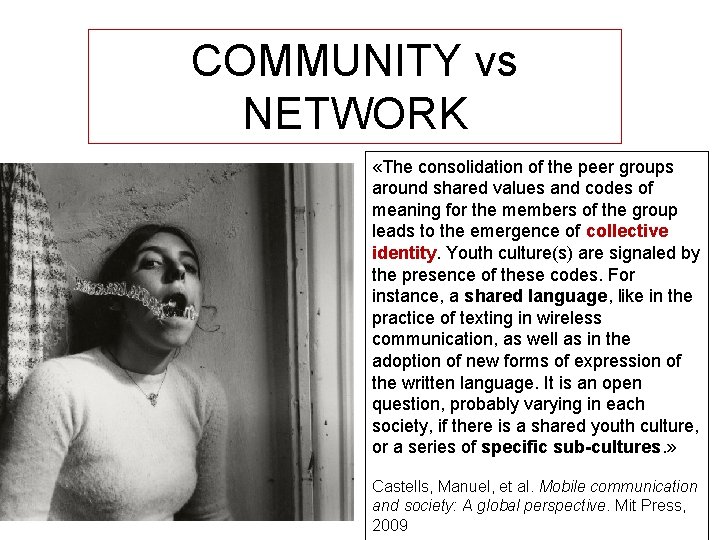
COMMUNITY vs NETWORK «The consolidation of the peer groups around shared values and codes of meaning for the members of the group leads to the emergence of collective identity. Youth culture(s) are signaled by the presence of these codes. For instance, a shared language, like in the practice of texting in wireless communication, as well as in the adoption of new forms of expression of the written language. It is an open question, probably varying in each society, if there is a shared youth culture, or a series of specific sub-cultures. » Castells, Manuel, et al. Mobile communication and society: A global perspective. Mit Press, 2009
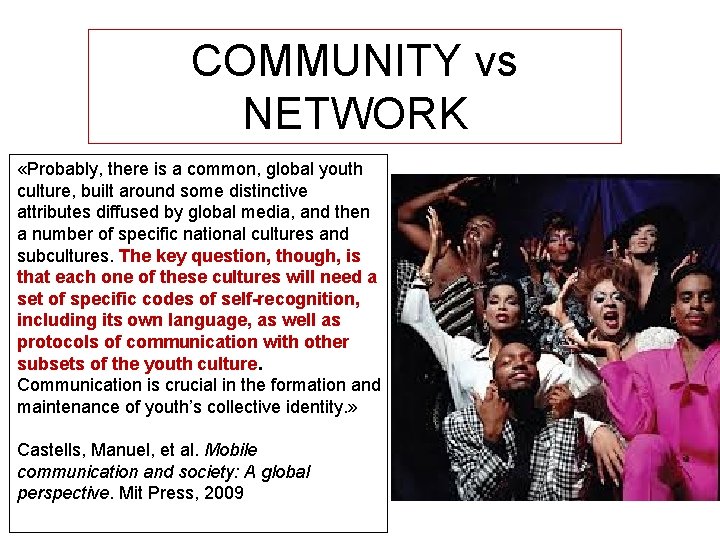
COMMUNITY vs NETWORK «Probably, there is a common, global youth culture, built around some distinctive attributes diffused by global media, and then a number of specific national cultures and subcultures. The key question, though, is that each one of these cultures will need a set of specific codes of self-recognition, including its own language, as well as protocols of communication with other subsets of the youth culture. Communication is crucial in the formation and maintenance of youth’s collective identity. » Castells, Manuel, et al. Mobile communication and society: A global perspective. Mit Press, 2009
COMMUNITY vs NETWORK «There is also an observed trend to personalize behavior within the youth culture. In other words, in parallel to the affirmation of a collective identity, there is also the strengthening of individual identity as a distinctive attribute of this collective youth identity. What is distinctive to contemporary youth culture is the affirmation of each individual that shares the culture: it is a community of individuals. Thus, there will be signs of individualism in each process of communication. Each person in communication will personalize his/her message and sender/receiver position. » Castells, Manuel, et al. Mobile communication and society: A global perspective. Mit Press, 2009
THE ROLE OF NEW TECHNOLOGIES It seems undeniable that the internet and new technologies are, therefore, putting into action a new form of sociality characterized by a continuous dissociation between space and time (Giddens, 1994), creating what Manuel Castells (2002) defines as a space of flows. Still Castells (2002) to describe the current reality speaks, in fact, of the network society, a society that has been characterized by the development of three processes: the flexibility and globalization of capital, the increase of individual freedoms connected to a more open communication. and finally the technological advancement.
THE ROLE OF NEW TECHNOLOGIES In this reality, so enhanced by network technologies increasingly ubiquitous and pervasive - people are therefore immersed in a network of contacts that are characterized by being fragmented and discontinuous. However, it is erroneous to think that these changes were determined by the advent of the technologies themselves, which, in the words of Comunello: «they undoubtedly have the role of powerful enablers, but we certainly cannot identify in them the prime mover of such transformations. » The role played by technologies is, on the one hand, that of making similar social processes visible, observable; on the other hand, that of supporting some qualitative shifts in the phenomenon which, although significant, certainly do not have the strength to distort it, to modify its essential features.
THE ROLE OF NEW TECHNOLOGIES Technologies are therefore simply accompanying a more general social transformation: we now live in a liquid society (Baumann, 2000), governed by uncontrolled and global changes where the search for identity, both collective and individual, is which has become the primary source for building meaning (Castells, 2002). In this reality, so highly digitized, physical barriers are progressively demolished, but also information barriers which, according to Meyrowitz (1985), had the ability to define a social situation. Our self is ego-centric and the individual, comparable to a control panel, is continually intent on "updating or virtualizing" (Marinelli, 2004) parts of his network of contacts. 17/03/2021 NETWORKED INDIVIDUALISM 28
LET’S TALK ABOUT IT How technologies are defining your idea of community? You have 30 minutes to write a small essay (max 6 lines) about your personal experiences in the light of theories just illustrated. Then we will share our thoughs. 17/03/2021 NETWORKED INDIVIDUALISM 29
SOCIAL NETWORK SITE Whereas the advent of postmodernity has unquestionably driven individuals towards some unceasing processes of differentiation and individualism, coincidentally we are now developing a different form of sociability centered on the individual, or more specifically, on the roles that he has to play from time to time (Castells; 2006). Yet, in almost paradoxical way, these tendencies have produced an environment directed by partial systems. 17/03/2021 NETWORKED INDIVIDUALISM 30
SOCIAL NETWORK SITE To refer to this reality, sociologists affirm that we live in a complex society, highly differentiated and led by principles of autonomy, freedom and pluralism. If those ideals represent the main focus of the contemporary conscience, complex societies have ended up to satisfy the instances of partial systems, neglecting the human ones. Essentially people are not the raison d'e tre of society itself (Luhmann; 1986). 17/03/2021 NETWORKED INDIVIDUALISM 31
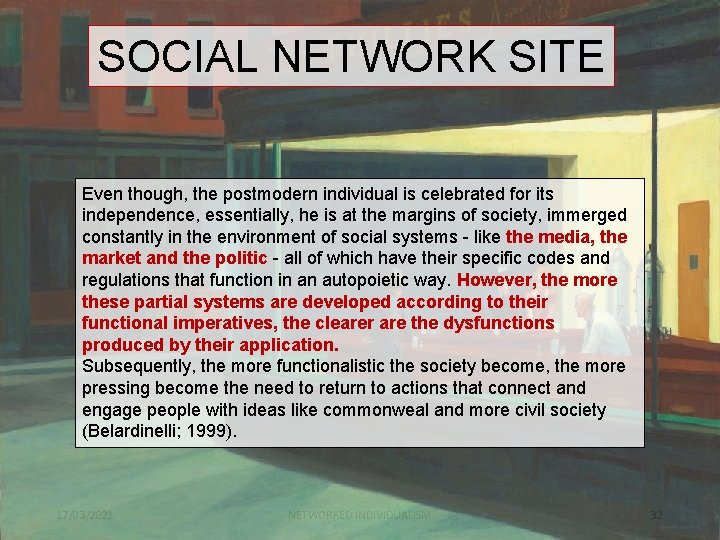
SOCIAL NETWORK SITE Even though, the postmodern individual is celebrated for its independence, essentially, he is at the margins of society, immerged constantly in the environment of social systems - like the media, the market and the politic - all of which have their specific codes and regulations that function in an autopoietic way. However, the more these partial systems are developed according to their functional imperatives, the clearer are the dysfunctions produced by their application. Subsequently, the more functionalistic the society become, the more pressing become the need to return to actions that connect and engage people with ideas like commonweal and more civil society (Belardinelli; 1999). 17/03/2021 NETWORKED INDIVIDUALISM 32
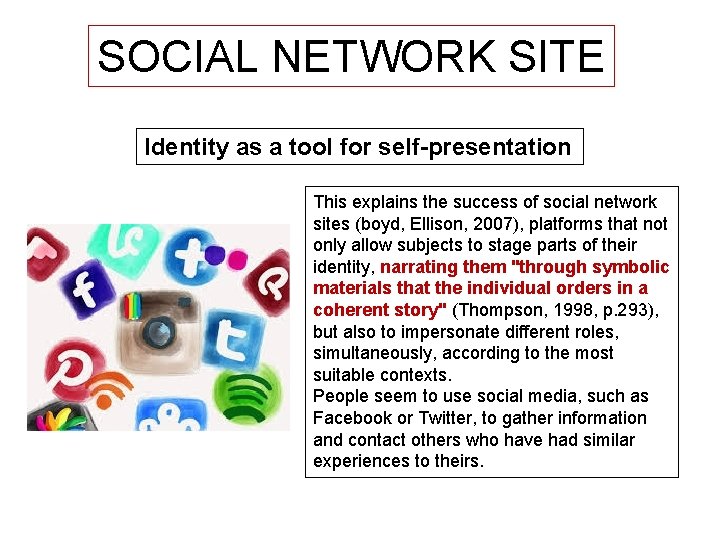
SOCIAL NETWORK SITE Identity as a tool for self-presentation This explains the success of social network sites (boyd, Ellison, 2007), platforms that not only allow subjects to stage parts of their identity, narrating them "through symbolic materials that the individual orders in a coherent story" (Thompson, 1998, p. 293), but also to impersonate different roles, simultaneously, according to the most suitable contexts. People seem to use social media, such as Facebook or Twitter, to gather information and contact others who have had similar experiences to theirs.
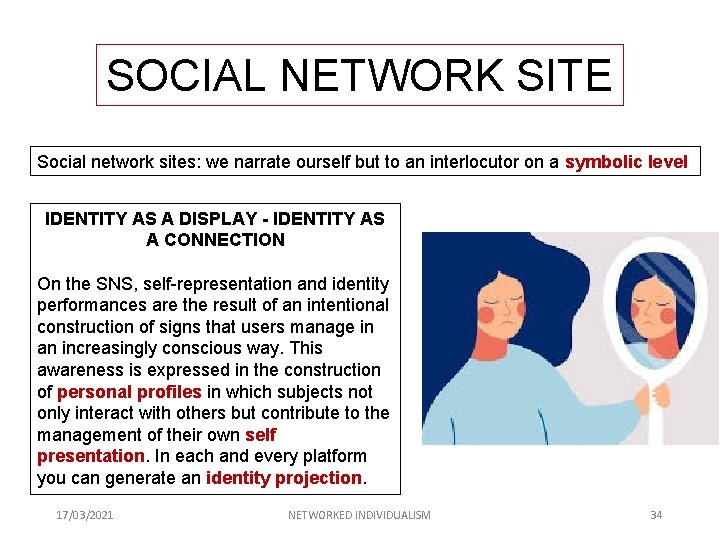
SOCIAL NETWORK SITE Social network sites: we narrate ourself but to an interlocutor on a symbolic level IDENTITY AS A DISPLAY - IDENTITY AS A CONNECTION On the SNS, self-representation and identity performances are the result of an intentional construction of signs that users manage in an increasingly conscious way. This awareness is expressed in the construction of personal profiles in which subjects not only interact with others but contribute to the management of their own self presentation. In each and every platform you can generate an identity projection. 17/03/2021 NETWORKED INDIVIDUALISM 34
SOCIAL NETWORK SITE «We define social network sites as web-based services that allow individuals to construct a public or semi-public profile within a bounded system, articulate a list of other users with whom they share a connection, and view and traverse their list of connections and those made by others within the system. The nature and nomenclature of these connections may vary from site to site» danah m. boyd, Social Network Sites: Definition, History, and Scholarship, Journal of computer‐mediated Communication 13. 1 (2007) 17/03/2021 NETWORKED INDIVIDUALISM 35
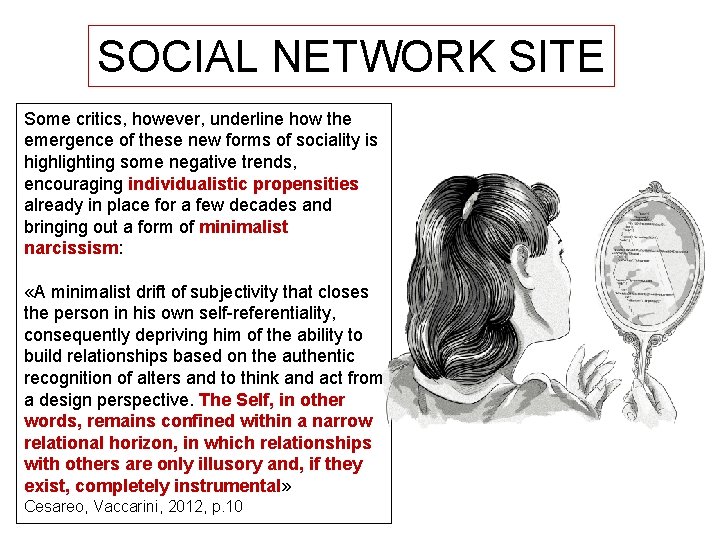
SOCIAL NETWORK SITE Some critics, however, underline how the emergence of these new forms of sociality is highlighting some negative trends, encouraging individualistic propensities already in place for a few decades and bringing out a form of minimalist narcissism: «A minimalist drift of subjectivity that closes the person in his own self-referentiality, consequently depriving him of the ability to build relationships based on the authentic recognition of alters and to think and act from a design perspective. The Self, in other words, remains confined within a narrow relational horizon, in which relationships with others are only illusory and, if they exist, completely instrumental» Cesareo, Vaccarini, 2012, p. 10
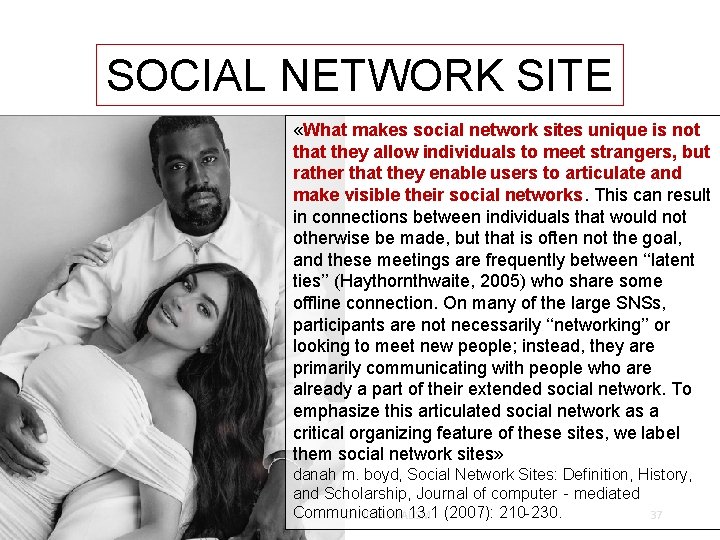
SOCIAL NETWORK SITE «What makes social network sites unique is not that they allow individuals to meet strangers, but rather that they enable users to articulate and make visible their social networks. This can result in connections between individuals that would not otherwise be made, but that is often not the goal, and these meetings are frequently between ‘‘latent ties’’ (Haythornthwaite, 2005) who share some offline connection. On many of the large SNSs, participants are not necessarily ‘‘networking’’ or looking to meet new people; instead, they are primarily communicating with people who are already a part of their extended social network. To emphasize this articulated social network as a critical organizing feature of these sites, we label them social network sites» 17/03/2021 danah m. boyd, Social Network Sites: Definition, History, and Scholarship, Journal of computer‐mediated Communication 13. 1 (2007): 210 -230. NETWORKED INDIVIDUALISM 37
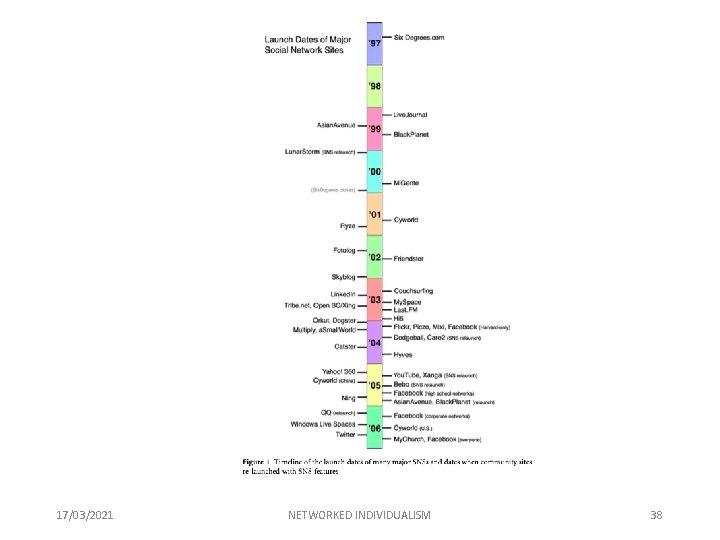
17/03/2021 NETWORKED INDIVIDUALISM 38
SOCIAL NETWORK SITE Rainie and Wellman (2012) contrast this critical vision with the concept of networked individualism, i. e. individualism on the net, not to be understood as a collection of isolated subjects, but rather as individuals who interact with an extended network of contacts, offline and on. line, chosen on the basis of their interests, values, affinities and projects. The new media become "the new neighborhood" (Rainie, Wellman, 2012), have a participatory role and therefore do not affect the activation of relationships in presence, but rather broaden our possibilities of interaction. 17/03/2021 NETWORKED INDIVIDUALISM 39
NETWORKED INDIVIDUALISM The culture of individualism does not lead to isolation, but it changes de patterns of sociability in terms of increasingly selective, and self-directed contacts. Thus, the new trend is the emergence of networked sociability. The medium of this sociability may vary. It includes, naturally, the Internet and mobile phones, but it can also be face to face. The critical matter is not the technology, but the development of networks of sociability based on choice and affinity, breaking the organizational and spatial boundaries of relationship. Castells, Manuel, et al. Mobile communication and society: A global perspective. Mit Press, 2009
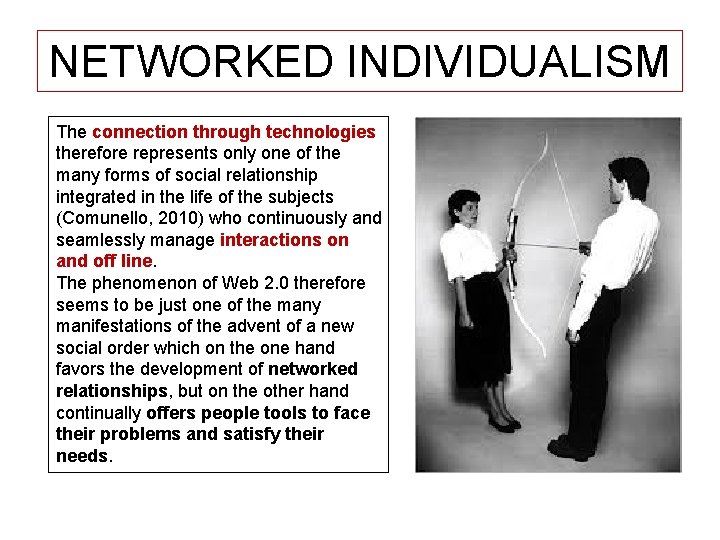
NETWORKED INDIVIDUALISM The connection through technologies therefore represents only one of the many forms of social relationship integrated in the life of the subjects (Comunello, 2010) who continuously and seamlessly manage interactions on and off line. The phenomenon of Web 2. 0 therefore seems to be just one of the many manifestations of the advent of a new social order which on the one hand favors the development of networked relationships, but on the other hand continually offers people tools to face their problems and satisfy their needs.
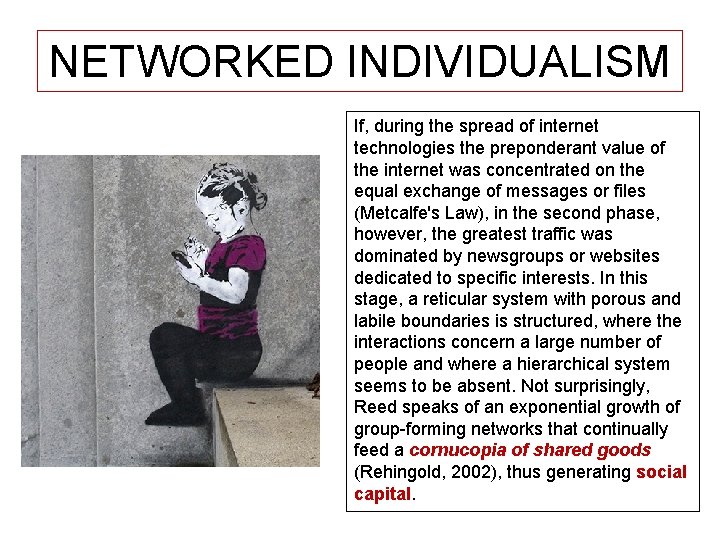
NETWORKED INDIVIDUALISM If, during the spread of internet technologies the preponderant value of the internet was concentrated on the equal exchange of messages or files (Metcalfe's Law), in the second phase, however, the greatest traffic was dominated by newsgroups or websites dedicated to specific interests. In this stage, a reticular system with porous and labile boundaries is structured, where the interactions concern a large number of people and where a hierarchical system seems to be absent. Not surprisingly, Reed speaks of an exponential growth of group-forming networks that continually feed a cornucopia of shared goods (Rehingold, 2002), thus generating social capital.
THANK YOU FOR YOUR ATTENTION Dott. ssa Francesca Moretti moretti. francescaphd@gmail. com 17/03/2021 NETWORKED INDIVIDUALISM 43