
Network Virtualization issues from a telecom operator perspective
- Slides: 19
Network Virtualization issues from a telecom operator perspective. Outcomes from IST 4 WARD Project TELEFÓNICA I+D Version 1. 0. Date: June, 9 th 2009 TELEFÓNICA I+D © 2008 2007 Telefónica Investigación y Desarrollo, S. A. Unipersonal
Index 01 IST WARD Project 02 Network Virtualization from an operator’s perspective 03 Challenges for Core Network Virtualization 04 Conclusions TELEFÓNICA I+D © 2007 Telefónica Investigación y Desarrollo, S. A. Unipersonal 2
Index 01 IST WARD Project 02 Network Virtualization from an operator’s perspective 03 Challenges for Core Network Virtualization 04 Conclusions TELEFÓNICA I+D © 2007 Telefónica Investigación y Desarrollo, S. A. Unipersonal 3
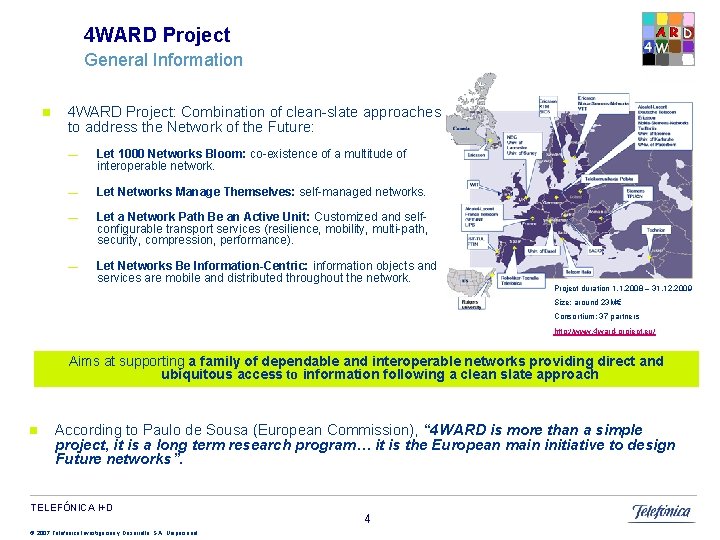
4 WARD Project General Information n 4 WARD Project: Combination of clean-slate approaches to address the Network of the Future: — Let 1000 Networks Bloom: co-existence of a multitude of interoperable network. — Let Networks Manage Themselves: self-managed networks. — Let a Network Path Be an Active Unit: Customized and selfconfigurable transport services (resilience, mobility, multi-path, security, compression, performance). — Let Networks Be Information-Centric: information objects and services are mobile and distributed throughout the network. Project duration 1. 1. 2008 – 31. 12. 2009 Size: around 23 M€ Consortium: 37 partners http: //www. 4 ward-project. eu/ Aims at supporting a family of dependable and interoperable networks providing direct and ubiquitous access to information following a clean slate approach n According to Paulo de Sousa (European Commission), “ 4 WARD is more than a simple project, it is a long term research program… it is the European main initiative to design Future networks”. TELEFÓNICA I+D © 2007 Telefónica Investigación y Desarrollo, S. A. Unipersonal 4
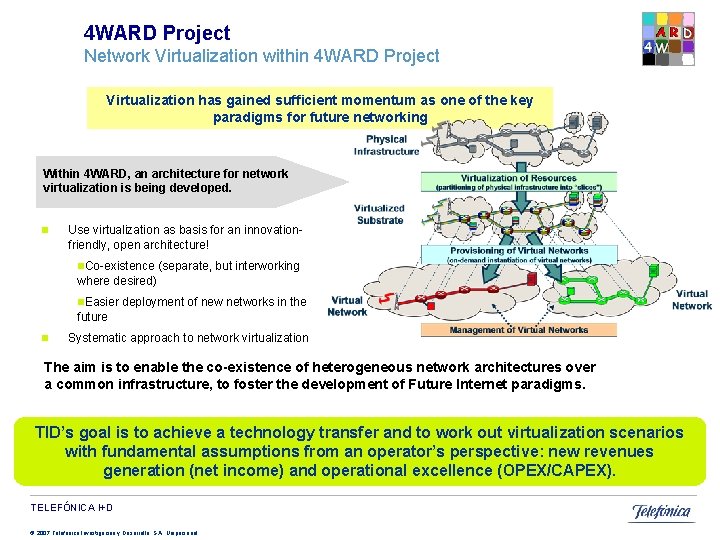
4 WARD Project Network Virtualization within 4 WARD Project Virtualization has gained sufficient momentum as one of the key paradigms for future networking Within 4 WARD, an architecture for network virtualization is being developed. n Use virtualization as basis for an innovationfriendly, open architecture! n. Co-existence (separate, but interworking where desired) n. Easier deployment of new networks in the future n Systematic approach to network virtualization The aim is to enable the co-existence of heterogeneous network architectures over a common infrastructure, to foster the development of Future Internet paradigms. TID’s goal is to achieve a technology transfer and to work out virtualization scenarios with fundamental assumptions from antransfer operator’s new revenues TID’s goal is to achieve a technology andperspective: to work out virtualization generation income) and operational excellence (OPEX/CAPEX). scenarios with(net fundamental assumptions from an operator’s perspective. TELEFÓNICA I+D © 2007 Telefónica Investigación y Desarrollo, S. A. Unipersonal
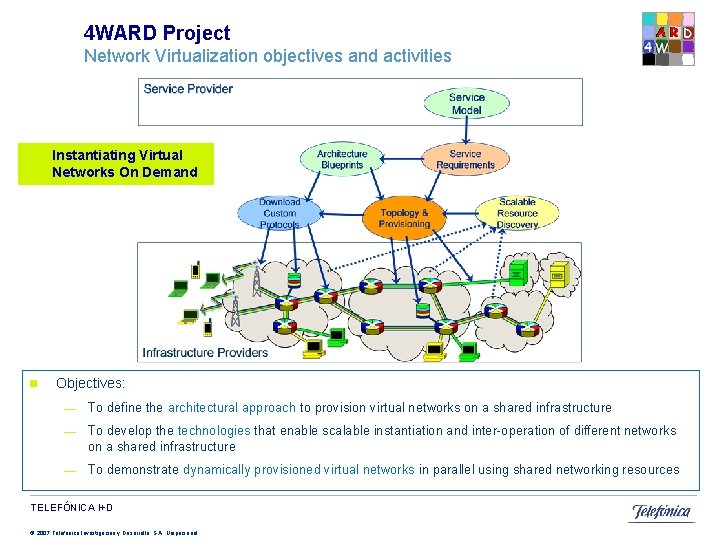
4 WARD Project Network Virtualization objectives and activities Instantiating Virtual Networks On Demand n Objectives: — To define the architectural approach to provision virtual networks on a shared infrastructure — To develop the technologies that enable scalable instantiation and inter-operation of different networks on a shared infrastructure — To demonstrate dynamically provisioned virtual networks in parallel using shared networking resources TELEFÓNICA I+D © 2007 Telefónica Investigación y Desarrollo, S. A. Unipersonal
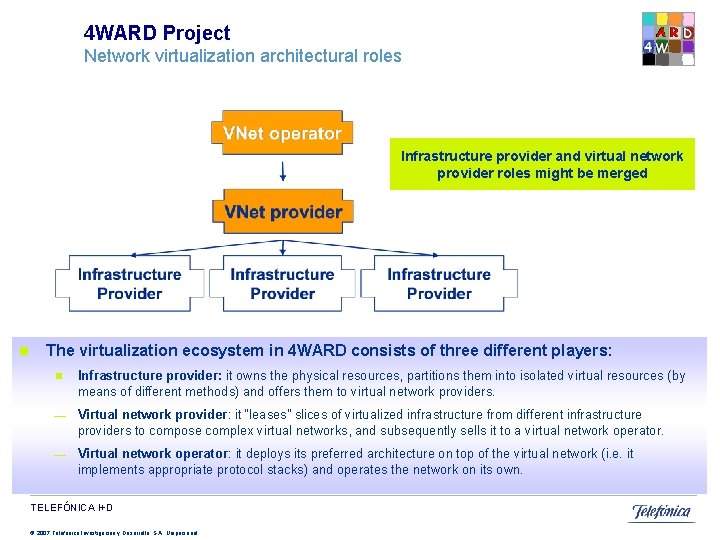
4 WARD Project Network virtualization architectural roles Infrastructure provider and virtual network provider roles might be merged n The virtualization ecosystem in 4 WARD consists of three different players: n Infrastructure provider: it owns the physical resources, partitions them into isolated virtual resources (by means of different methods) and offers them to virtual network providers. — Virtual network provider: it “leases” slices of virtualized infrastructure from different infrastructure providers to compose complex virtual networks, and subsequently sells it to a virtual network operator. — Virtual network operator: it deploys its preferred architecture on top of the virtual network (i. e. it implements appropriate protocol stacks) and operates the network on its own. TELEFÓNICA I+D © 2007 Telefónica Investigación y Desarrollo, S. A. Unipersonal
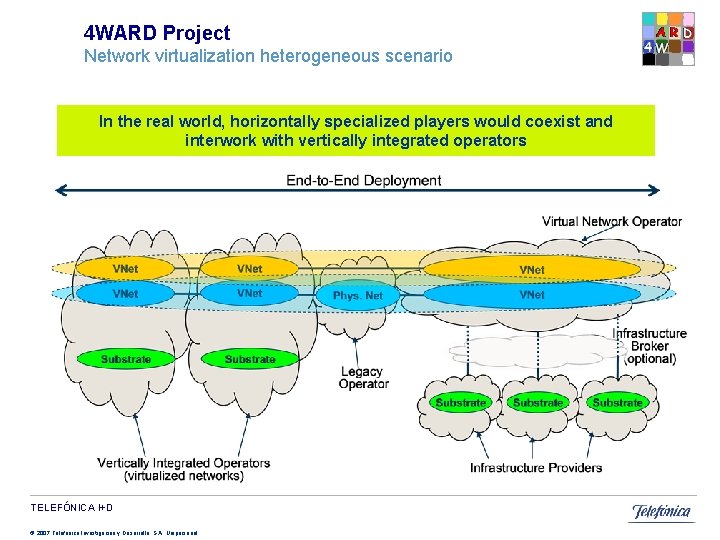
4 WARD Project Network virtualization heterogeneous scenario In the real world, horizontally specialized players would coexist and interwork with vertically integrated operators TELEFÓNICA I+D © 2007 Telefónica Investigación y Desarrollo, S. A. Unipersonal
Index 01 IST WARD Project 02 Network Virtualization from an operator’s perspective 03 Challenges for Core Network Virtualization 04 Conclusions TELEFÓNICA I+D © 2007 Telefónica Investigación y Desarrollo, S. A. Unipersonal 9
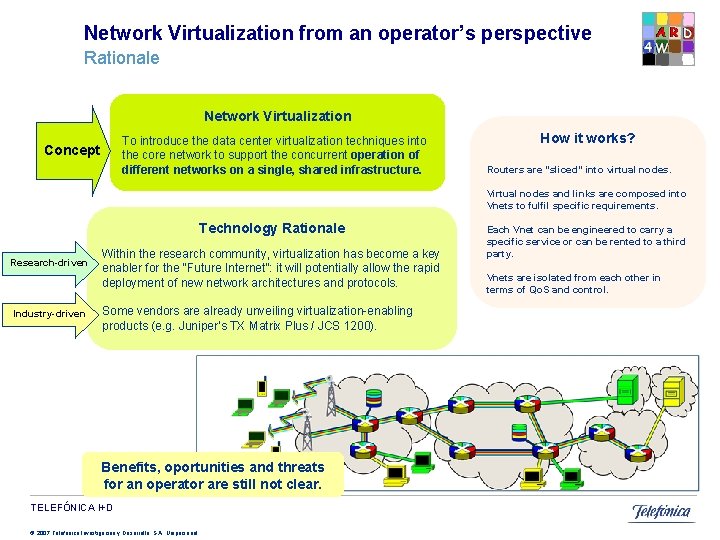
Network Virtualization from an operator’s perspective Rationale Network Virtualization To introduce the data center virtualization techniques into the core network to support the concurrent operation of different networks on a single, shared infrastructure. Concept How it works? Routers are “sliced” into virtual nodes. Virtual nodes and links are composed into Vnets to fulfil specific requirements. Technology Rationale Research-driven Industry-driven Within the research community, virtualization has become a key enabler for the “Future Internet”: it will potentially allow the rapid deployment of new network architectures and protocols. Some vendors are already unveiling virtualization-enabling products (e. g. Juniper’s TX Matrix Plus / JCS 1200). Benefits, oportunities and threats for an operator are still not clear. TELEFÓNICA I+D © 2007 Telefónica Investigación y Desarrollo, S. A. Unipersonal Each Vnet can be engineered to carry a specific service or can be rented to a third party. Vnets are isolated from each other in terms of Qo. S and control.
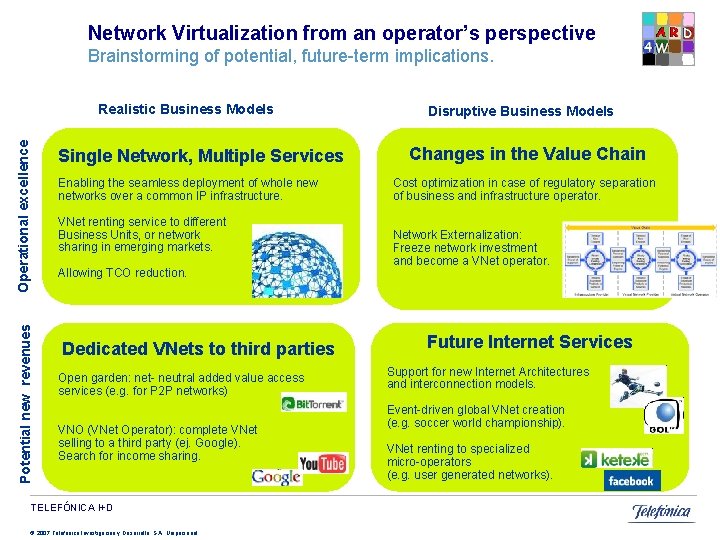
Network Virtualization from an operator’s perspective Brainstorming of potential, future-term implications. Operational excellence Realistic Business Models Single Network, Multiple Services Enabling the seamless deployment of whole new networks over a common IP infrastructure. VNet renting service to different Business Units, or network sharing in emerging markets. Potential new revenues Allowing TCO reduction. Dedicated VNets to third parties Open garden: net- neutral added value access services (e. g. for P 2 P networks) VNO (VNet Operator): complete VNet selling to a third party (ej. Google). Search for income sharing. TELEFÓNICA I+D © 2007 Telefónica Investigación y Desarrollo, S. A. Unipersonal Disruptive Business Models Changes in the Value Chain Cost optimization in case of regulatory separation of business and infrastructure operator. Network Externalization: Freeze network investment and become a VNet operator. Future Internet Services Support for new Internet Architectures and interconnection models. Event-driven global VNet creation (e. g. soccer world championship). VNet renting to specialized micro-operators (e. g. user generated networks).
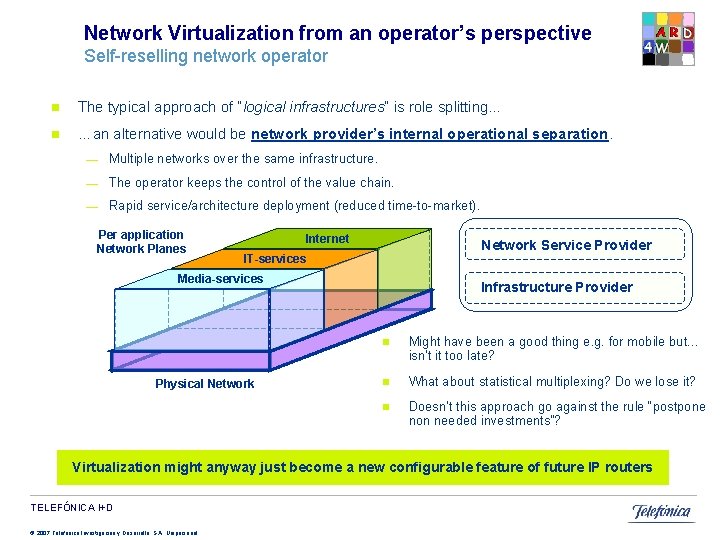
Network Virtualization from an operator’s perspective Self-reselling network operator n The typical approach of “logical infrastructures” is role splitting… n …an alternative would be network provider’s internal operational separation. — Multiple networks over the same infrastructure. — The operator keeps the control of the value chain. — Rapid service/architecture deployment (reduced time-to-market). Per application Network Planes Internet Network Service Provider IT-services Media-services Physical Network Infrastructure Provider n Might have been a good thing e. g. for mobile but… isn’t it too late? n What about statistical multiplexing? Do we lose it? n Doesn’t this approach go against the rule “postpone non needed investments”? Virtualization might anyway just become a new configurable feature of future IP routers TELEFÓNICA I+D © 2007 Telefónica Investigación y Desarrollo, S. A. Unipersonal
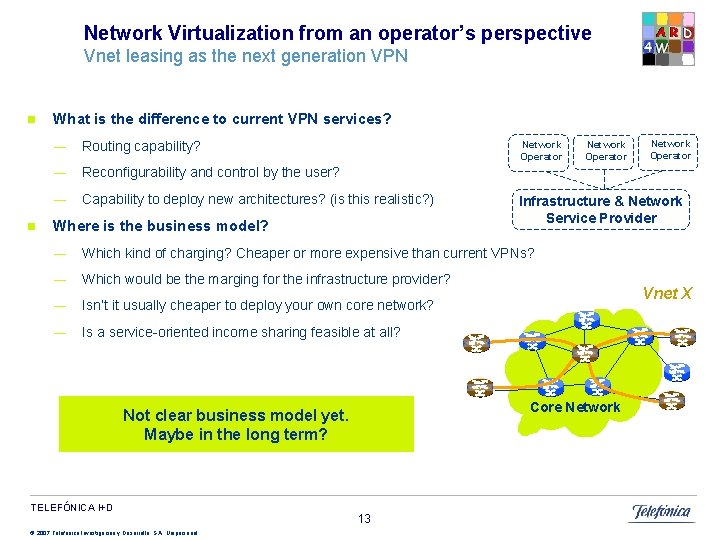
Network Virtualization from an operator’s perspective Vnet leasing as the next generation VPN n n What is the difference to current VPN services? — Routing capability? — Reconfigurability and control by the user? — Capability to deploy new architectures? (is this realistic? ) Network Operator Where is the business model? Which kind of charging? Cheaper or more expensive than current VPNs? — Which would be the marging for the infrastructure provider? — Isn’t it usually cheaper to deploy your own core network? — Is a service-oriented income sharing feasible at all? © 2007 Telefónica Investigación y Desarrollo, S. A. Unipersonal Vnet X Core Network Not clear business model yet. Maybe in the long term? 13 Network Operator Infrastructure & Network Service Provider — TELEFÓNICA I+D Network Operator
Index 01 IST WARD Project 02 Network Virtualization from an operator’s perspective 03 Challenges for Core Network Virtualization 04 Conclusions TELEFÓNICA I+D © 2007 Telefónica Investigación y Desarrollo, S. A. Unipersonal 14
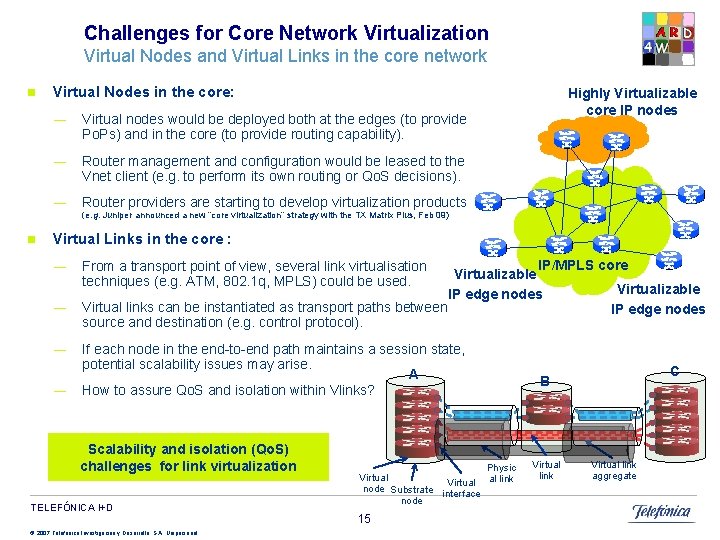
Challenges for Core Network Virtualization Virtual Nodes and Virtual Links in the core network n Virtual Nodes in the core: — Virtual nodes would be deployed both at the edges (to provide Po. Ps) and in the core (to provide routing capability). — Router management and configuration would be leased to the Vnet client (e. g. to perform its own routing or Qo. S decisions). — Router providers are starting to develop virtualization products Highly Virtualizable core IP nodes (e. g. Juniper announced a new “core virtualization” strategy with the TX Matrix Plus, Feb 09) n Virtual Links in the core : — — IP/MPLS core Virtualizable IP edge nodes Virtual links can be instantiated as transport paths between IP edge nodes source and destination (e. g. control protocol). From a transport point of view, several link virtualisation techniques (e. g. ATM, 802. 1 q, MPLS) could be used. If each node in the end-to-end path maintains a session state, potential scalability issues may arise. A How to assure Qo. S and isolation within Vlinks? Scalability and isolation (Qo. S) challenges for link virtualization TELEFÓNICA I+D © 2007 Telefónica Investigación y Desarrollo, S. A. Unipersonal Physic Virtual al link node Substrate interface node 15 C B Virtual link aggregate
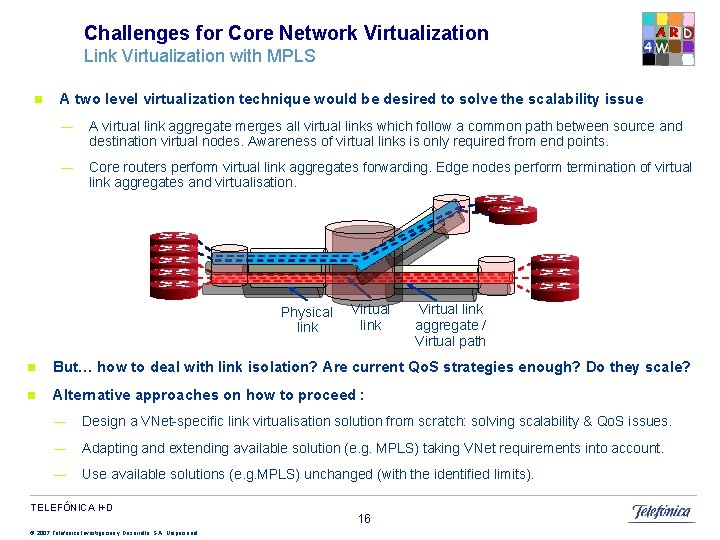
Challenges for Core Network Virtualization Link Virtualization with MPLS n A two level virtualization technique would be desired to solve the scalability issue — A virtual link aggregate merges all virtual links which follow a common path between source and destination virtual nodes. Awareness of virtual links is only required from end points. — Core routers perform virtual link aggregates forwarding. Edge nodes perform termination of virtual link aggregates and virtualisation. Physical link Virtual link aggregate / Virtual path n But… how to deal with link isolation? Are current Qo. S strategies enough? Do they scale? n Alternative approaches on how to proceed : — Design a VNet-specific link virtualisation solution from scratch: solving scalability & Qo. S issues. — Adapting and extending available solution (e. g. MPLS) taking VNet requirements into account. — Use available solutions (e. g. MPLS) unchanged (with the identified limits). TELEFÓNICA I+D © 2007 Telefónica Investigación y Desarrollo, S. A. Unipersonal 16
Index 01 IST WARD Project 02 Network Virtualization from an operator’s perspective 03 Challenges for Core Network Virtualization 04 Conclusions TELEFÓNICA I+D © 2007 Telefónica Investigación y Desarrollo, S. A. Unipersonal 17
Conclusion n Virtualization has a strong potential (at least to move research forces) to play a key role in the Future Internet. n Key messages from an operator’s perspective: n — Business use cases for a telecom operator are far from being clear. — There are potential scalability and Qo. S challenges in the deployment of Virtual Networks in current core networks. 4 WARD aims at providing both demonstration facilities and developing realistic business cases for network virtualization from an industrial perspective. TELEFÓNICA I+D © 2007 Telefónica Investigación y Desarrollo, S. A. Unipersonal 18
TELEFÓNICA I+D © 2008 2007 Telefónica Investigación y Desarrollo, S. A. Unipersonal