
Network Theorems By Ms Darshana Dongre Superposition Theorem
Network Theorems By- Ms. Darshana Dongre
Superposition Theorem Total current through or voltage across a resistor or branch Determine by adding effects due to each source acting independently Replace a voltage source with a short 2
Superposition Theorem Replace a current source with an open Find results of branches using each source independently Algebraically combine results 3
Superposition Theorem Power Not a linear quantity Found by squaring voltage or current Theorem does not apply to power To find power using superposition Determine voltage or current Calculate power 4
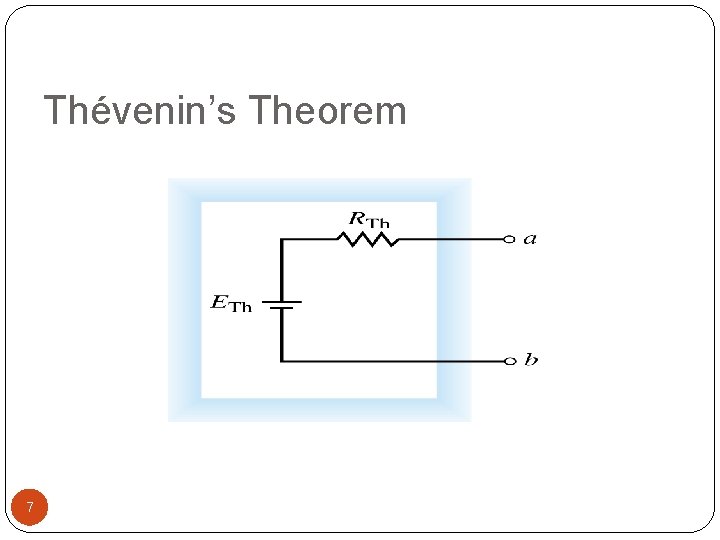
Thévenin’s Theorem Lumped linear bilateral network May be reduced to a simplified two-terminal circuit Consists of a single voltage source and series resistance 5
Thévenin’s Theorem Voltage source Thévenin equivalent voltage, ETh. Series resistance is Thévenin equivalent resistance, RTh 6
Thévenin’s Theorem 7
Thévenin’s Theorem To convert to a Thévenin circuit First identify and remove load from circuit Label resulting open terminals 8
Thévenin’s Theorem Set all sources to zero Replace voltage sources with shorts, current sources with opens Determine Thévenin equivalent resistance as seen by open circuit 9
Thévenin’s Theorem Replace sources and calculate voltage across open If there is more than one source Superposition theorem could be used 10
Thévenin’s Theorem Resulting open-circuit voltage is Thévenin equivalent voltage Draw Thévenin equivalent circuit, including load 11
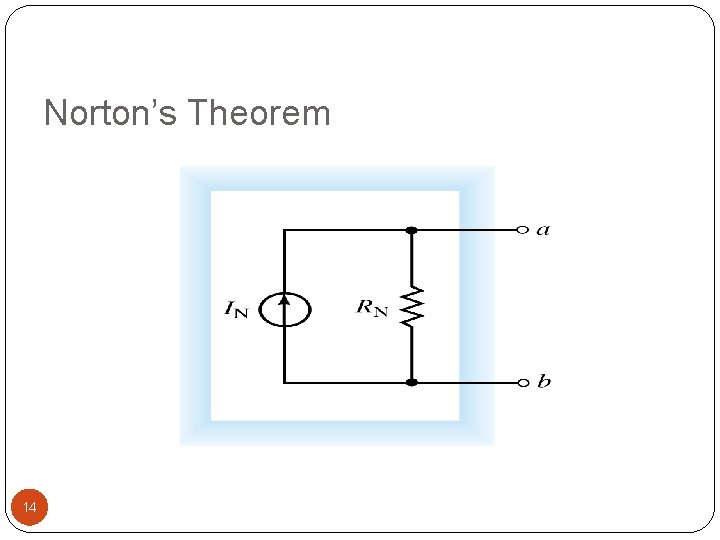
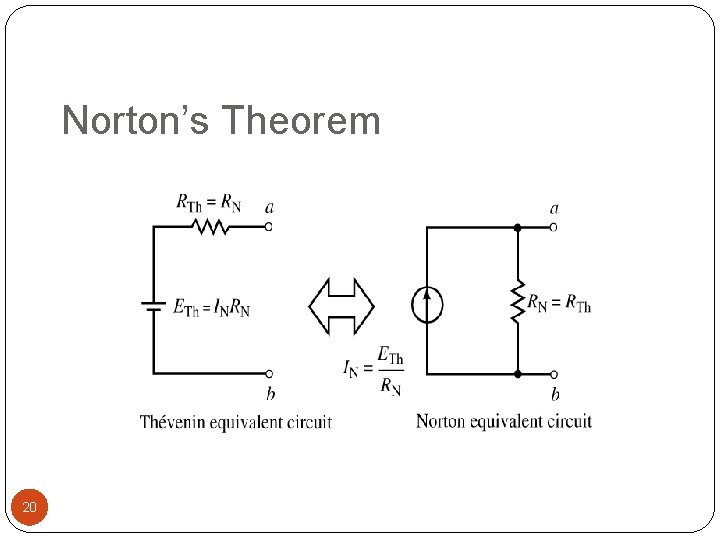
Norton’s Theorem Similar to Thévenin circuit Any lumped linear bilateral network May be reduced to a two-terminal circuit Single current source and single shunt resistor 12
Norton’s Theorem RN = RTh IN is Norton equivalent current 13
Norton’s Theorem 14
Norton’s Theorem To convert to a Norton circuit Identify and remove load from circuit Label resulting two open terminals Set all sources to zero 15
Norton’s Theorem Determine open circuit resistance This is Norton equivalent resistance Note This is accomplished in the same manner as Thévenin equivalent resistance 16
Norton’s Theorem Replace sources and determine current that would flow through a short place between two terminals This current is the Norton equivalent current 17
Norton’s Theorem For multiple sources Superposition theorem could be used Draw the Norton equivalent circuit Including the load 18
Norton’s Theorem Norton equivalent circuit May be determined directly from a Thévenin circuit (or vice- versa) by using source transformation theorem 19
Norton’s Theorem 20
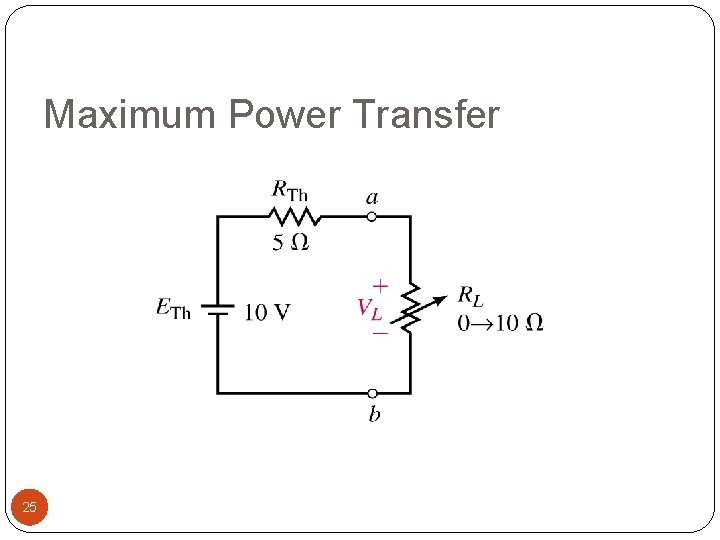
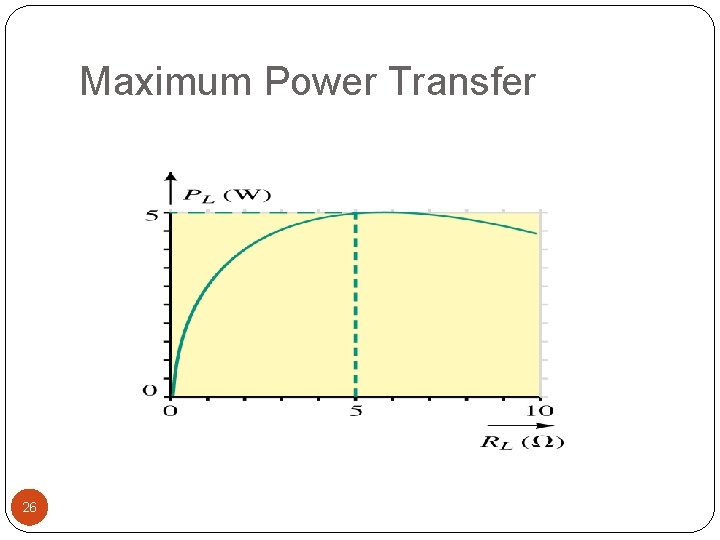
Maximum Power Transfer Load should receive maximum amount of power from source Maximum power transfer theorem states Load will receive maximum power from a circuit when resistance of the load is exactly the same as Thévenin (or Norton) equivalent resistance of the circuit 21
Maximum Power Transfer To calculate maximum power delivered by source to load Use P = V 2/R Voltage across load is one half of Thévenin equivalent voltage 22
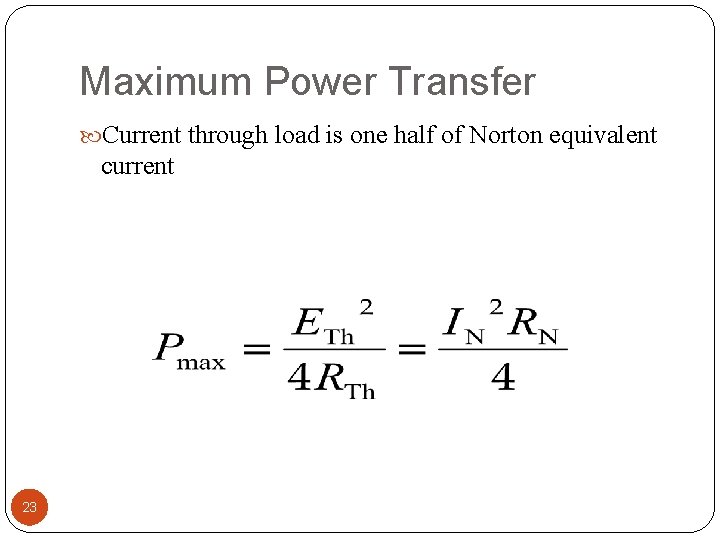
Maximum Power Transfer Current through load is one half of Norton equivalent current 23
Maximum Power Transfer Power across a load changes as load changes by using a variable resistance as the load 24
Maximum Power Transfer 25
Maximum Power Transfer 26
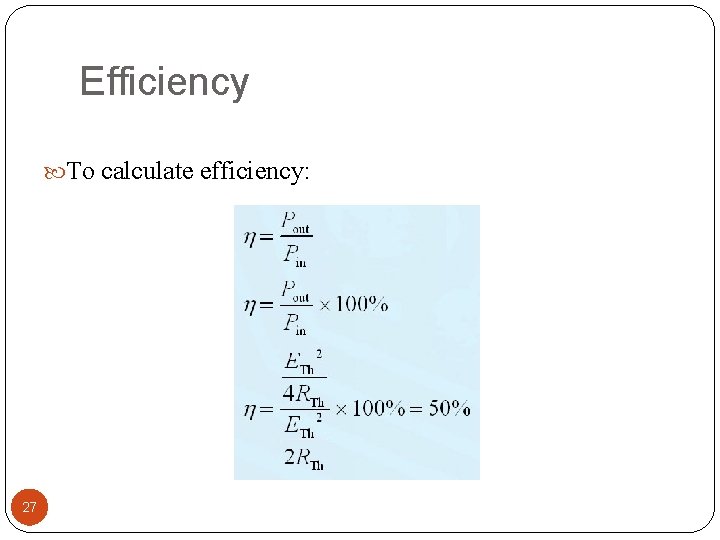
Efficiency To calculate efficiency: 27
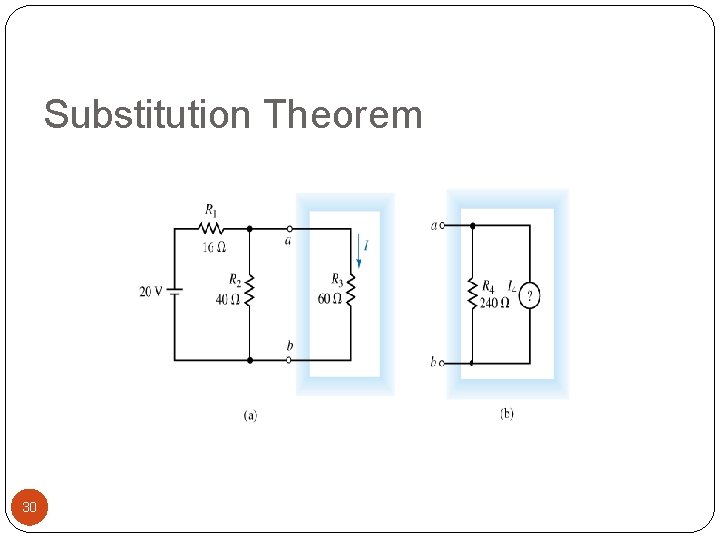
Substitution Theorem Any branch within a circuit may be replaced by an equivalent branch Provided the replacement branch has same current voltage Theorem can replace any branch with an equivalent branch Simplify analysis of remaining circuit 28
Substitution Theorem Part of the circuit shown is to be replaced with a current source and a 240 shunt resistor Determine value of the current source 29
Substitution Theorem 30
Millman’s Theorem Used to simplify circuits that have Several parallel-connected branches containing a voltage source and series resistance Current source and parallel resistance Combination of both 31
Millman’s Theorem Other theorems may work, but Millman’s theorem provides a much simpler and more direct equivalent 32
Millman’s Theorem Voltage sources May be converted into an equivalent current source and parallel resistance using source transformation theorem Parallel resistances may now be converted into a single equivalent resistance 33
Millman’s Theorem First, convert voltage sources into current sources Equivalent current, Ieq, is just the algebraic sum of all the parallel currents 34
Millman’s Theorem Next, determine equivalent resistance, Req, the parallel resistance of all the resistors Voltage across entire circuit may now be calculated by: Eeq = Ieq. Req 35
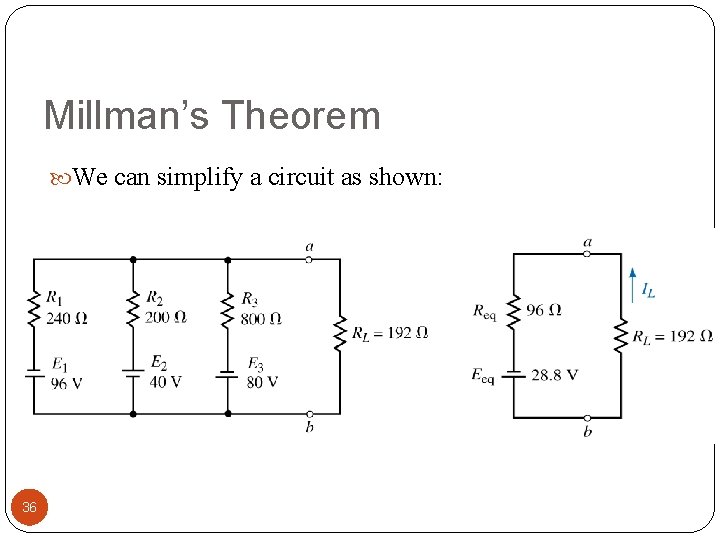
Millman’s Theorem We can simplify a circuit as shown: 36
Reciprocity Theorem A voltage source causing a current I in any branch May be removed from original location and placed into that branch 37
Reciprocity Theorem Voltage source in new location will produce a current in original source location Equal to the original I 38
Reciprocity Theorem Voltage source is replaced by a short circuit in original location Direction of current must not change 39
Reciprocity Theorem A current source causing a voltage V at any node May be removed from original location and connected to that node Current source in the new location Will produce a voltage in original location equal to V 40
Reciprocity Theorem Current source is replaced by an open circuit in original location Voltage polarity cannot change 41
- Slides: 41