
NETWORK TECHNIQUES PERT CPM Program Evaluation and Review
- Slides: 27
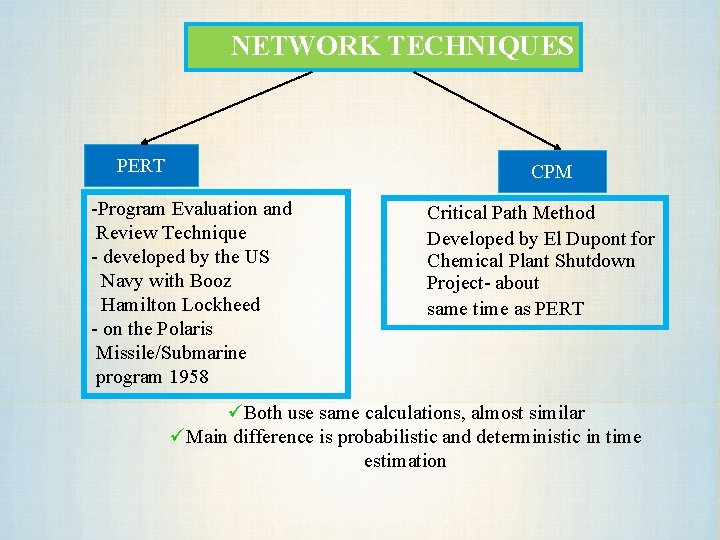
NETWORK TECHNIQUES PERT CPM -Program Evaluation and Review Technique - developed by the US Navy with Booz Hamilton Lockheed - on the Polaris Missile/Submarine program 1958 Critical Path Method Developed by El Dupont for Chemical Plant Shutdown Project- about same time as PERT üBoth use same calculations, almost similar üMain difference is probabilistic and deterministic in time estimation
1)Helpful in Planning. 2)Inter-Relationship of various activities. 3)Cost Control. 4)Minimization of Maintenance. 5)Reduction of time. 6)Control on Idle Resources. 7)Avoiding Delays , interruptions.
1)Helpful in planning : Network analysis is powerful tool for planning , scheduling and controlling. 2)Inter-Relationship of various activities: Network analysis creates inter-relationship and inter dependence of various activities of project or a programme. 3)Cost Control : In certain cases we can measure cost of delay in the completion of the project. This cost can be compared to the cost of the resources required to carry out various activities at various speed. continue
Continue…. 4)Minimization of Maintenance: Network analysis helps the management to minimize the total maintenance time. 5)Reduction of time: Sometime we have to arrange existing resources with a view to reducing the total time for the project , rather than reducing cost. 6)Control on Idle Resources: Network analysis also helps to control the idle resources. We should not allow large fluctuation in the use of limited resources. We adhere to our scheduled cost and time.
* 7)Avoiding Delays , interruptions : Network Continue… analysis develops discipline and systematic approach in planning scheduling etc. this not the case in traditional methods. It helps managers to avoid delays.
• It forms the basis for all planning and predicting. • It provides management with the ability to plan for the best possible. • It provides visibility and enables management to controls “one-of a-kind” programs as opposed to repetitive situations. • It provides the basic structure for reporting information.
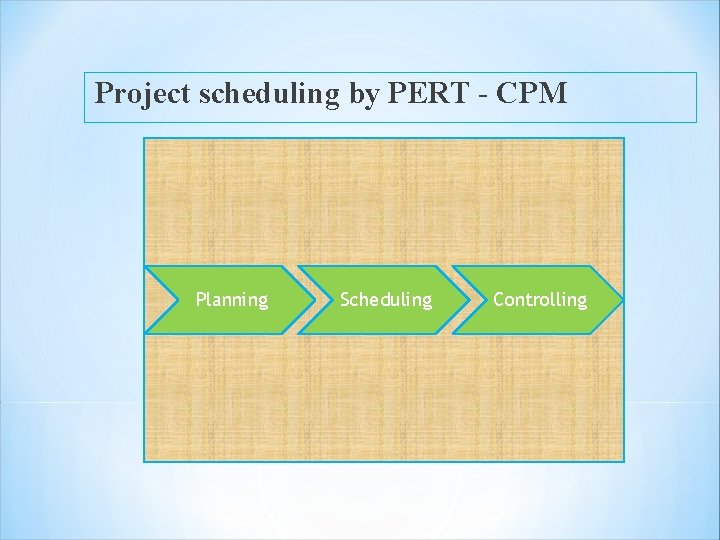
Project scheduling by PERT - CPM Planning Scheduling Controlling
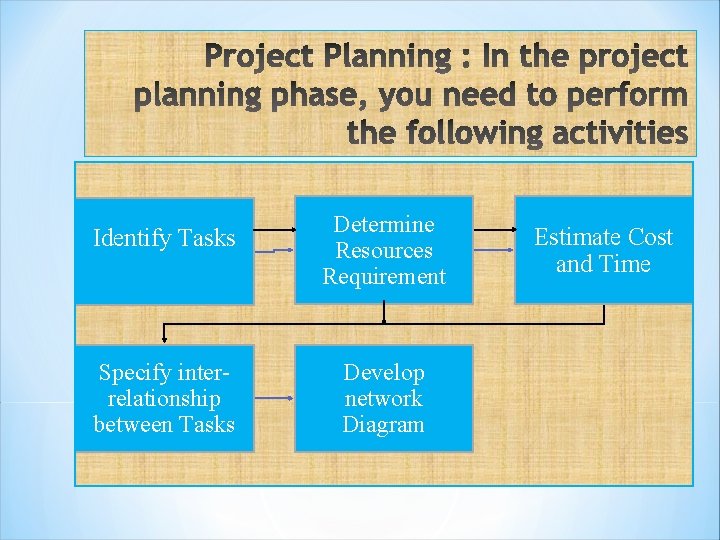
Identify Tasks Determine Resources Requirement Specify interrelationship between Tasks Develop network Diagram Estimate Cost and Time
Identify various tasks or work elements to be performed in the project. Determine requirement of resources , such as men , material, and machines , for carrying out activities listed above. . Estimate costs and time for various activities. Specify the inter – relationship among various activities.
*Once the planning phase , scheduling of the project is when each of the activities requried to be performed , taken up. *Estimate the durations of activities. *To calculate the total project duration by applying network analysis techniques. *
* *Project control refers to comparing the actual progress against the estimated schedule. If significant difference are observed then you need to re-schedule the project to update or revise the uncompleted part of the project.
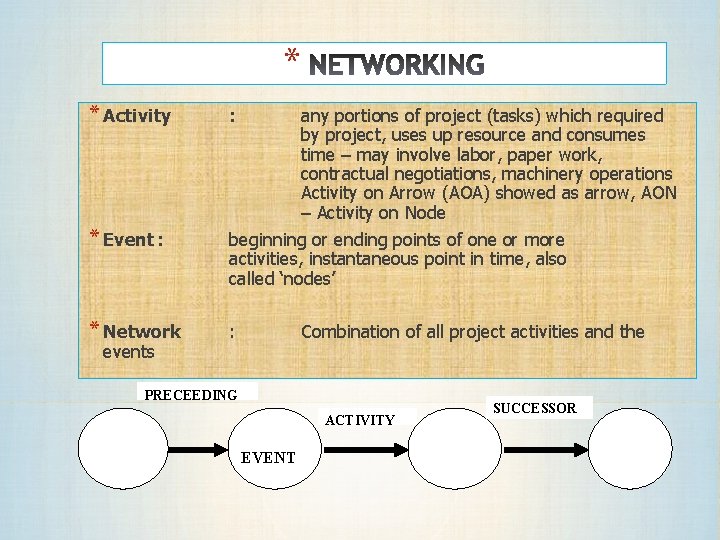
* * Activity * Event : * Network events : any portions of project (tasks) which required by project, uses up resource and consumes time – may involve labor, paper work, contractual negotiations, machinery operations Activity on Arrow (AOA) showed as arrow, AON – Activity on Node beginning or ending points of one or more activities, instantaneous point in time, also called ‘nodes’ : Combination of all project activities and the PRECEEDING ACTIVITY EVENT SUCCESSOR
Definition: In CPM activities are shown as a network of precedence relationships using activity-on-node network construction Single estimate of activity time Deterministic activity times USED IN : Production management - for the jobs of repetitive in nature where the activity time estimates can be predicted with considerable certainty due to the existence of past experience. *
A critical path is a sequence of connected activities that lead from beginning of the project to the end of the project. The longest path in the network is called the CRITICAL PATH.
Steps in CPM Project Planning 1)Specify the Individual Activities 2)Determine the Sequence of the Activities. 3)Draw the Network Diagram. 4)Estimate Activity Completion Time. 5)Identify the Critical Path. Continue…
1)Specify the Individual Activities : From the work break down structure , a listing can be made of all the activities in the project. This listing can be used as the basis for adding sequence and duration information in later steps. 2)Determine the Sequence of the Activities: Some activities are dependent on the completion of others. 3)Draw the Network Diagram: Once the activities and their sequencing have been defined , the CPM diagram can be drawn. Continue…. .
* Continu e… 4)Estimate Activity Completion Time : The time required to complete each activity can be estimated using past experience or the estimates of knowledgeable persons. 5)Identify the Critical Path : The critical path is longest duration path through the network. ES earliest start time. EF earliest finish time. LS latest start time.
ØHelpful for scheduling , monitoring and controlling projects. ØThe activities and their outcomes can be shown as a network. ØDisplays dependencies to help scheduling. ØEvaluates which activities can run parallel to each other. ØWidely used in industry. ØCan define multiple, equally critical paths.
Disadvantages of CPM *CPM’s can be complicated , and complexity increases for larger projects. *Does not handle the scheduling of personnel or the allocation of resources. *The critical path is not always clear and needs to be calculated carefully. *Estimating activity completion times can be difficult.
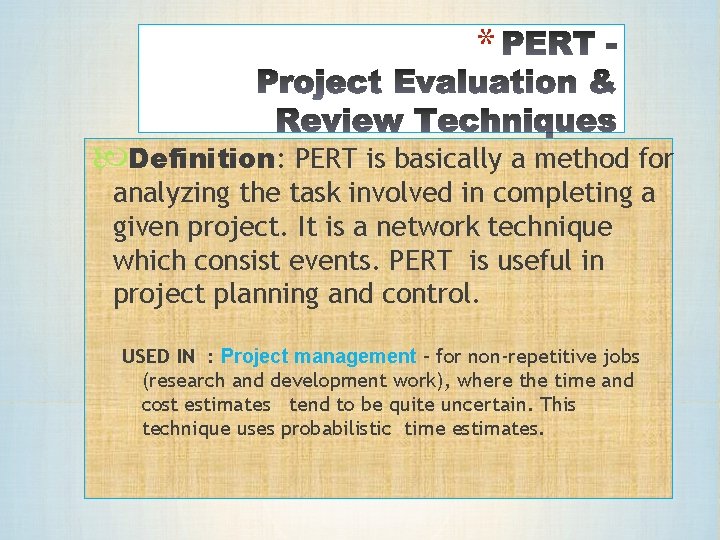
* Definition: PERT is basically a method for analyzing the task involved in completing a given project. It is a network technique which consist events. PERT is useful in project planning and control. USED IN : Project management - for non-repetitive jobs (research and development work), where the time and cost estimates tend to be quite uncertain. This technique uses probabilistic time estimates.
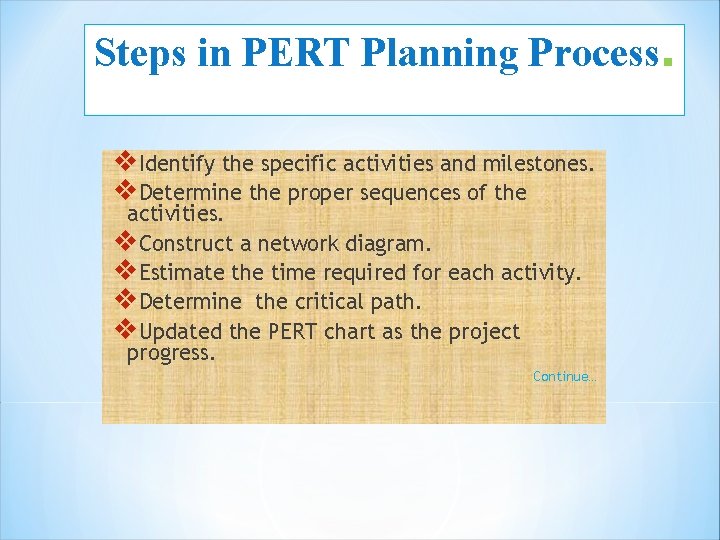
Steps in PERT Planning Process. v. Identify the specific activities and milestones. v. Determine the proper sequences of the activities. v. Construct a network diagram. v. Estimate the time required for each activity. v. Determine the critical path. v. Updated the PERT chart as the project progress. Continue…
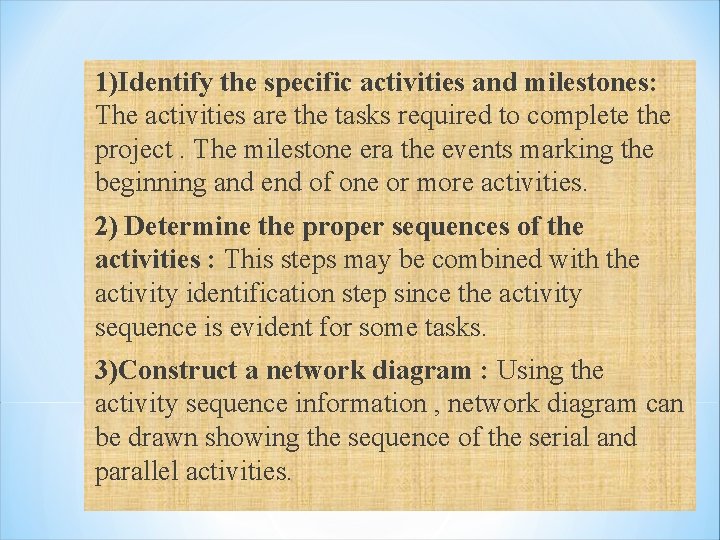
1)Identify the specific activities and milestones: The activities are the tasks required to complete the project. The milestone era the events marking the beginning and end of one or more activities. 2) Determine the proper sequences of the activities : This steps may be combined with the activity identification step since the activity sequence is evident for some tasks. 3)Construct a network diagram : Using the activity sequence information , network diagram can be drawn showing the sequence of the serial and parallel activities. Continue…
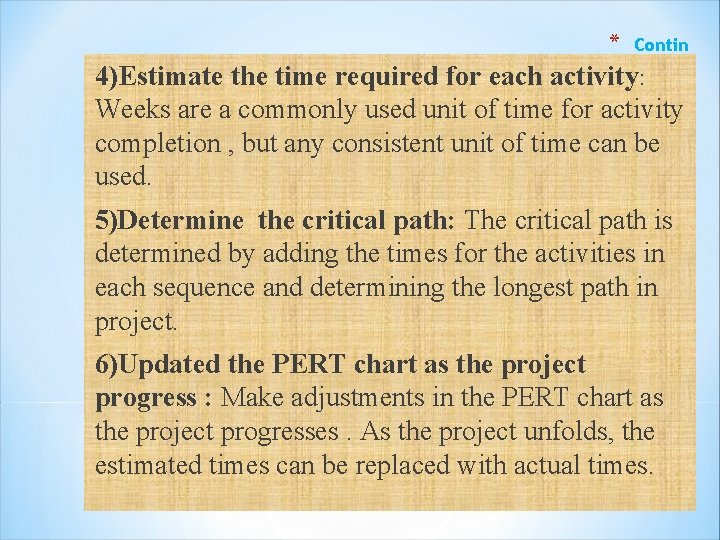
* Contin ue 4)Estimate the time required for each activity: Weeks are a commonly used unit of time for activity completion , but any consistent unit of time can be used. 5)Determine the critical path: The critical path is determined by adding the times for the activities in each sequence and determining the longest path in project. 6)Updated the PERT chart as the project progress : Make adjustments in the PERT chart as the project progresses. As the project unfolds, the estimated times can be replaced with actual times.
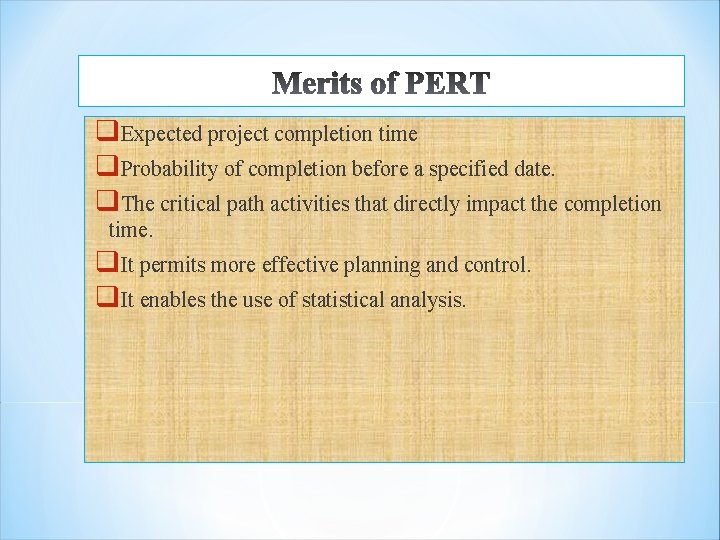
q. Expected project completion time q. Probability of completion before a specified date. q. The critical path activities that directly impact the completion time. q. It permits more effective planning and control. q. It enables the use of statistical analysis.
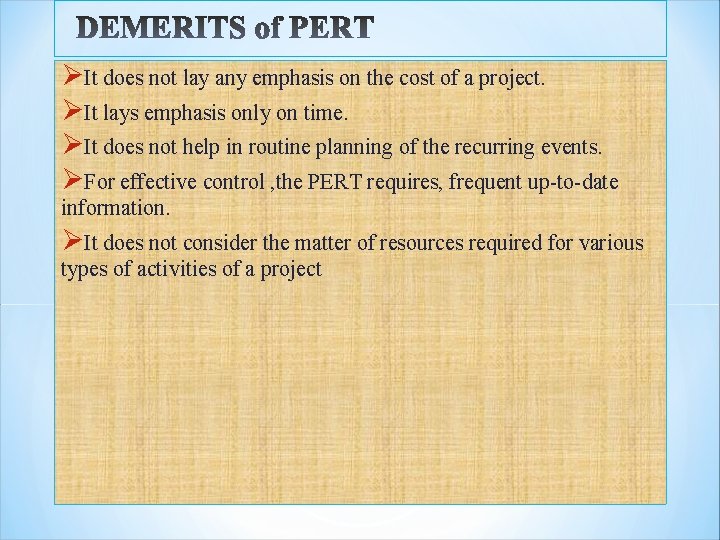
ØIt does not lay any emphasis on the cost of a project. ØIt lays emphasis only on time. ØIt does not help in routine planning of the recurring events. ØFor effective control , the PERT requires, frequent up-to-date information. ØIt does not consider the matter of resources required for various types of activities of a project
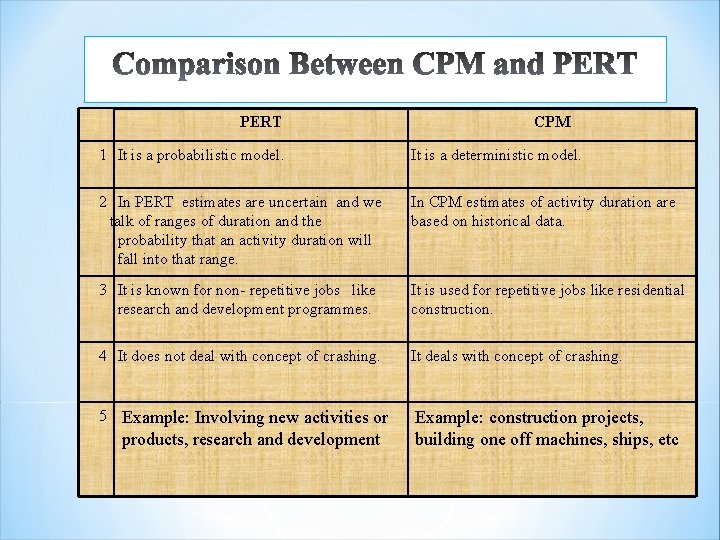
PERT CPM 1 It is a probabilistic model. It is a deterministic model. 2 In PERT estimates are uncertain and we talk of ranges of duration and the probability that an activity duration will fall into that range. In CPM estimates of activity duration are based on historical data. 3 It is known for non- repetitive jobs like research and development programmes. It is used for repetitive jobs like residential construction. 4 It does not deal with concept of crashing. It deals with concept of crashing. 5 Example: Involving new activities or Example: construction projects, building one off machines, ships, etc products, research and development