
Network Simulators Emulators and Testbeds By George Nychis
Network Simulators, Emulators and Testbeds By: George Nychis Gaurang Sardesai
Outline n n Motivation for Research ¨ Different Techniques Simulators ¨ Assumptions/Axioms ¨ Methods and Results Testbeds ¨ Architecture ¨ Different Testbeds Emulators ¨ Architecture ¨ Parameters and Results Introduction Simulators Testbeds Emulation Questions
The need for research n n n Why do we need to research the modeling of Wireless Networks? Wireless Access Modeling increasingly important in years to come Techniques used for wired networks no longer work ¨ Links not constant, reliable or physically isolated from each other ¨ Single medium shared by many devices, including external uncontrollable sources Few readily available tools for modeling and prototyping ¨ So current work relies on formal separation of radio and Networking Layers Need for cross-layer protocol research Introduction Simulators Testbeds Emulation Questions
The Need for Research (contd) n Need a technique which satisfies following criteria ¨ ¨ ¨ ¨ n Repeatability Experimental control Realism (w. r. t lower layers) Configurability and behavior modification Automation and remote management Isolation (from collocated networks) Scalability Integration with wired testbeds and networks Three techniques currently available ¨ Simulators, Testbeds and Emulators Introduction Simulators Testbeds Emulation Questions
Introduction to Simulators n NS-2 n OPNET Modeler n Glo. Mo. Sim n SWAN Introduction Simulators Testbeds Emulation Questions
Benefits of Simulators Control n Configurability n Repeatability n Manageability n Integration n Isolation n Scale n Introduction Simulators Testbeds Emulation Questions
Do Simulators Match Reality? n Often use simplified MAC layer Modeled in detail, but miss layer interaction Often lagging behind current technology n What about signal propagation? n n Introduction Simulators Testbeds Emulation Questions
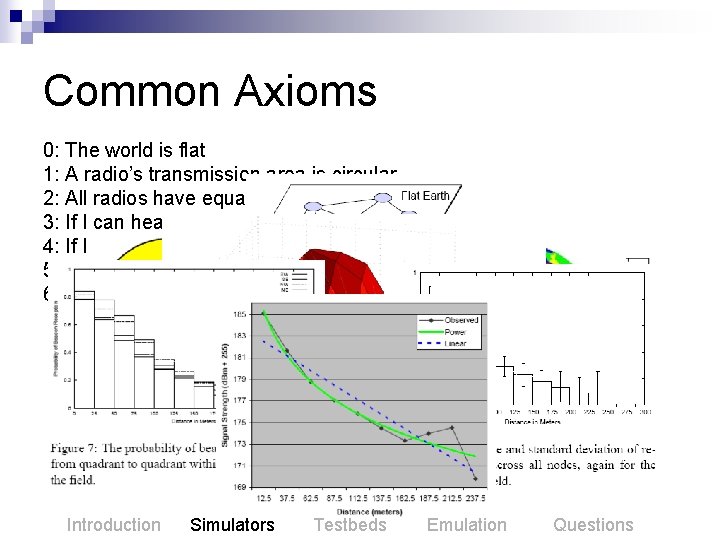
Common Axioms 0: The world is flat 1: A radio’s transmission area is circular 2: All radios have equal range 3: If I can hear you, you can hear me 4: If I can hear you at all, I can hear you perfectly 5: Signal strength is a simple function of distance 6: Each packet is transmitted at the same bit-rate Introduction Simulators Testbeds Emulation Questions
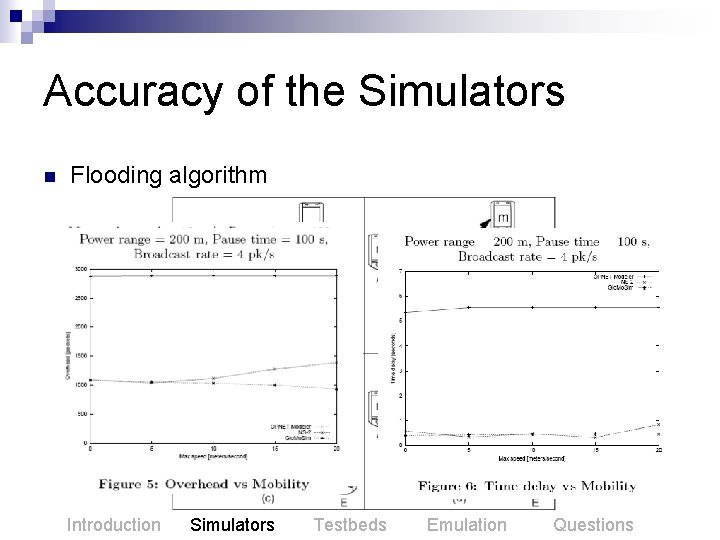
Accuracy of the Simulators n Flooding algorithm Introduction Simulators Testbeds Emulation Questions
Introduction to Testbeds n Emulab / Netbed n ORBIT n WHYNET n APE Introduction Simulators Testbeds Emulation Questions
Benefits of Testbeds Allow a level of control over real world n Use of real devices n Real layer interaction with the OS n Some provide a level of scaling n Remote management n Ability to run real applications n Introduction Simulators Testbeds Emulation Questions
Disadvantages of Testbeds n Repeatability n Scaling n Mobility of nodes n Dependant on location Introduction Simulators Testbeds Emulation Questions
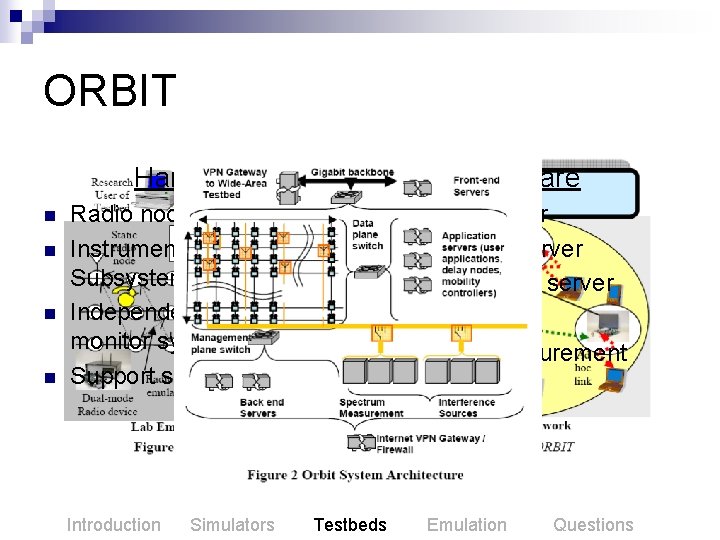
ORBIT Hardware n n Radio nodes Instrumentation Subsystem Independent WLAN monitor system Support servers Software n n n Introduction Simulators Testbeds Node Handler Collection Server Disk-Loading server Node Agent ORBIT Measurement Library Libmac Emulation Questions
Other Testbeds n Netbed ¨ n APE (Ad hoc Protocol Evaluation) ¨ n 5 Motes, 5 Stargates on 5 robots, 25 static Motes, 23 wireless PCs “Virtual Mobility” metric, scenarios included WHYNET ¨ CDMA 2000 cellular IP, Ultra Wideband, MIMO, Software Defined Radios Introduction Simulators Testbeds Emulation Questions
Emulators n n n Emulators are a middle ground between pure simulation and wireless testbeds Combine the repeatability, configurability, isolation and manageability of simulations and the realism of testbeds Utilize a real MAC layer, provide a realistic physical layer Avoid adopting a uncontrollable or locale-specific architecture High degree of control and fidelity ¨ ¨ ¨ n Can use statistical models of signal propagation Can replay traces of observed signal propagation Can analyze behavior in artificial situations that would be hard to create in the real world. PROPSim, Tas 4500 flex 5 (Spirent Communications), CMU Emulator Introduction Simulators Testbeds Emulation Questions
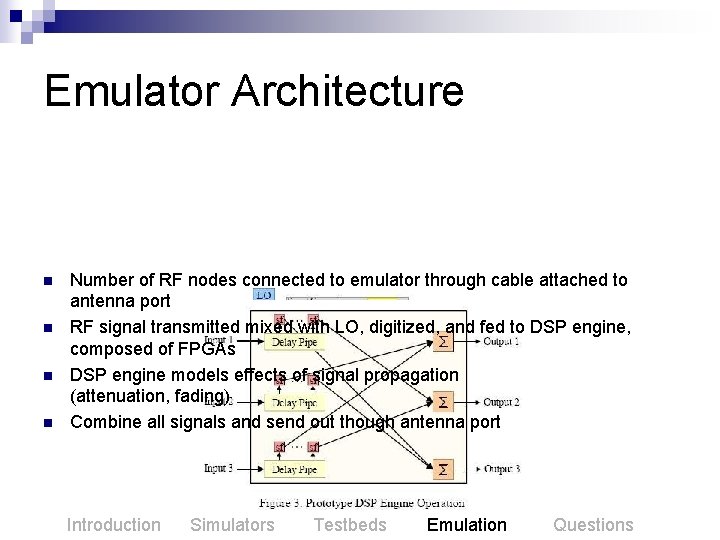
Emulator Architecture n n Number of RF nodes connected to emulator through cable attached to antenna port RF signal transmitted mixed with LO, digitized, and fed to DSP engine, composed of FPGAs DSP engine models effects of signal propagation (attenuation, fading) Combine all signals and send out though antenna port Introduction Simulators Testbeds Emulation Questions
![Implementation n Proof of Concept Prototype Hardware [Laptops, A/D and D/A Boards, Wireless Cards]](http://slidetodoc.com/presentation_image_h/dd4a23cf761de844b876928df7102b86/image-17.jpg "Implementation n Proof of Concept Prototype Hardware [Laptops, A/D and D/A Boards, Wireless Cards]")
Implementation n Proof of Concept Prototype Hardware [Laptops, A/D and D/A Boards, Wireless Cards] ¨ DSP Engine [FPGA with delay pipes] ¨ Emulation Controller [Script mode and Manual Mode] ¨ n Validation ¨ Fidelity n Physical Layer ¨ n Transport Layer ¨ ¨ EVM for signal vectors TCP throughput comparisons Isolation Introduction Simulators Testbeds Emulation Questions
Signal Propagation Modeling n n n Large Scale Path Loss Small Scale Fading Ray Tracing Capturing and Replaying Signal Behavior Channel Sounding Capabilities & Limitations of the model Better at time granularity and fidelity than simulators ¨ Easily expandable to support emerging technologies [MIMO, steerable antennas, time reversal] ¨ Uses discrete elements to model, vis-à-vis continuous wireless phenomena ¨ Multipliers in FPGA limits scale as complexity for interaction -> n 2 ¨ Introduction Simulators Testbeds Emulation Questions
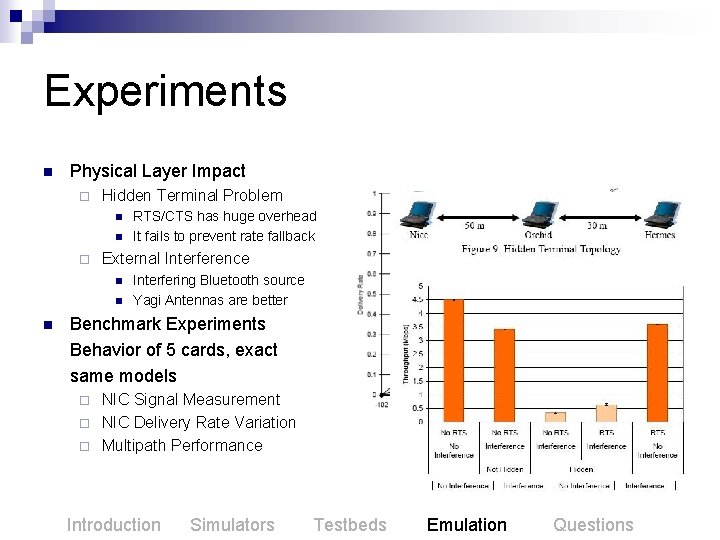
Experiments n Physical Layer Impact ¨ Hidden Terminal Problem n n ¨ External Interference n n n RTS/CTS has huge overhead It fails to prevent rate fallback Interfering Bluetooth source Yagi Antennas are better Benchmark Experiments Behavior of 5 cards, exact same models NIC Signal Measurement ¨ NIC Delivery Rate Variation ¨ Multipath Performance ¨ Introduction Simulators Testbeds Emulation Questions
Rate Selection Algorithms n n Wireless Protocols have to tradeoff between throughput and range Three Techniques ¨ ARF (Automatic Rate Fallback) n n ¨ SNR n n ¨ Uses in-band probing with 802. 11’s ACK mechanism, more than necessary Sets thresholds to increase and decrease transmission rates Select optimal Transmission rate for a given SNR; adv is speed Ignore multipath interference and measure SNR only at the receiver ERF (Estimated Rate Fallback) n n n Hybrid Algorithm which combines best of both ARF and SNR Run both in Parallel, then select apt estimate. Run SNR until multipath is detected or SNR is near decision threshold. Very important at full capacity Introduction Simulators Testbeds Emulation Questions
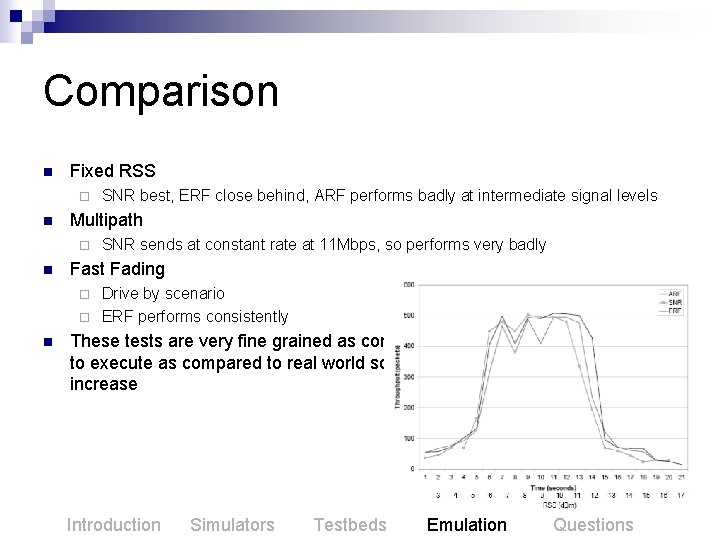
Comparison n Fixed RSS ¨ n Multipath ¨ n SNR best, ERF close behind, ARF performs badly at intermediate signal levels SNR sends at constant rate at 11 Mbps, so performs very badly Fast Fading Drive by scenario ¨ ERF performs consistently ¨ n These tests are very fine grained as compared to simulators and very easy to execute as compared to real world scenario where number of nodes increase Introduction Simulators Testbeds Emulation Questions
Final Thoughts / Questions n n n Simulations lack environment details which vary results Simulators could provide tools to include environment details Simulator comparisons, but no accuracy comparisons Emulators are not a complete replacement Simulation required for large scale experiments Real world experiments required for fidelity or verification Introduction Simulators Testbeds Emulation Questions
References n n n Using Emulation to understand improve wireless networks and applications – Judd and Steenkiste Overview of ORBIT radio grid testbed for evaluation of next generation wireless network protocols – Raychaudhari et al On the Accuracy of MANET simulators – Cavin, Sasson & Schiper Experimental Evaluation of wireless simulation assumptions – Kotz et al Lowering the barrier to wireless and mobile experimentation – White et al
- Slides: 23