
NETWORK SECURITY LAB Lab 23 AES RSA Encryption
NETWORK SECURITY LAB Lab 2&3. AES & RSA Encryption
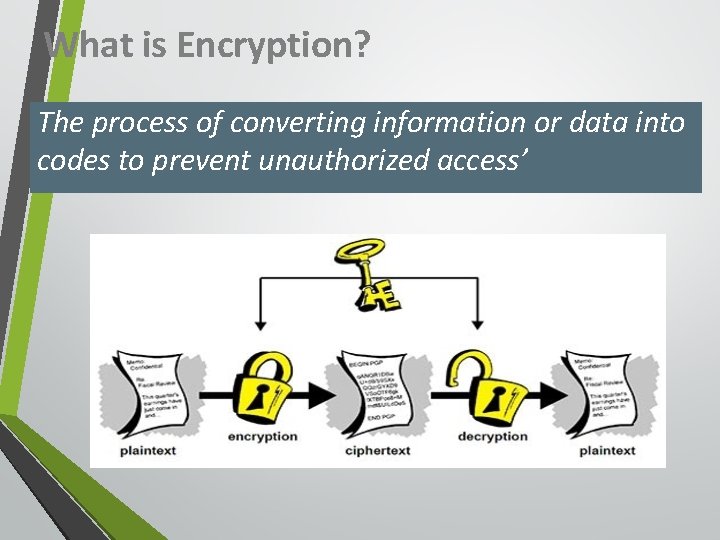
What is Encryption? The process of converting information or data into codes to prevent unauthorized access’
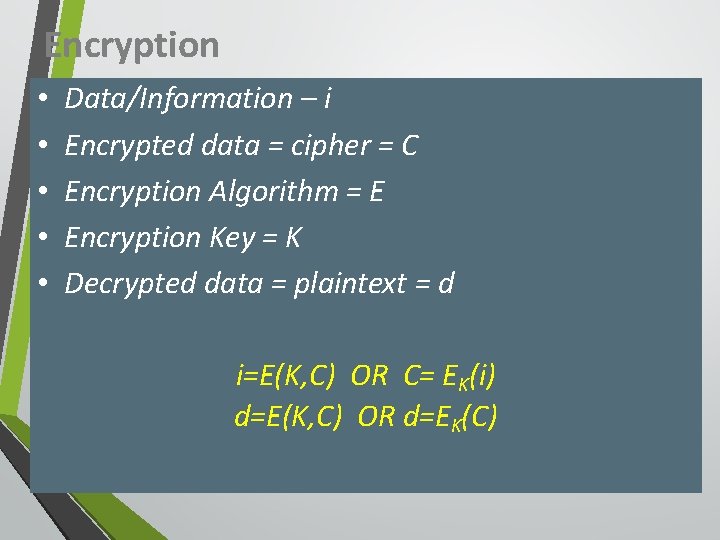
Encryption • • • Data/Information – i Encrypted data = cipher = C Encryption Algorithm = E Encryption Key = K Decrypted data = plaintext = d i=E(K, C) OR C= EK(i) d=E(K, C) OR d=EK(C)
Encryption - Terminology • Encryption or Enciphering: Process of converting plain text to cipher text. • Encryption Algorithm: Performs encryption – Inputs needed: plain text and secret key • Deciphering or Decryption: Process of recovering plain text from cipher • Secret Key: used for encryption or decryption
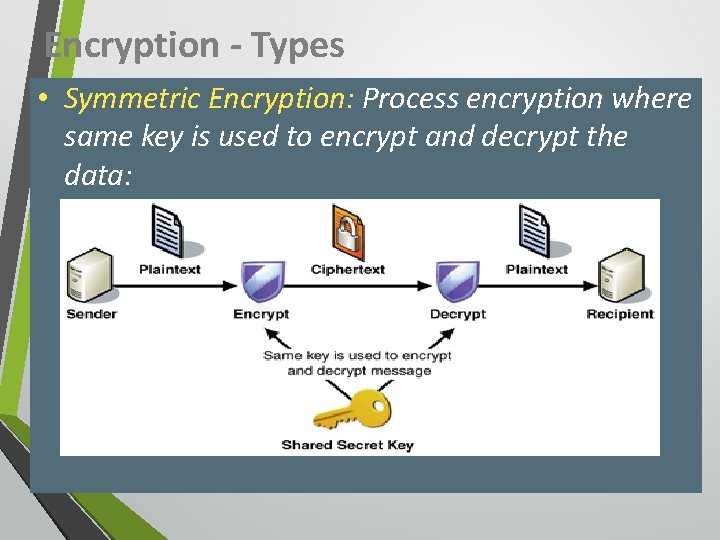
Encryption - Types • Symmetric Encryption: Process encryption where same key is used to encrypt and decrypt the data:
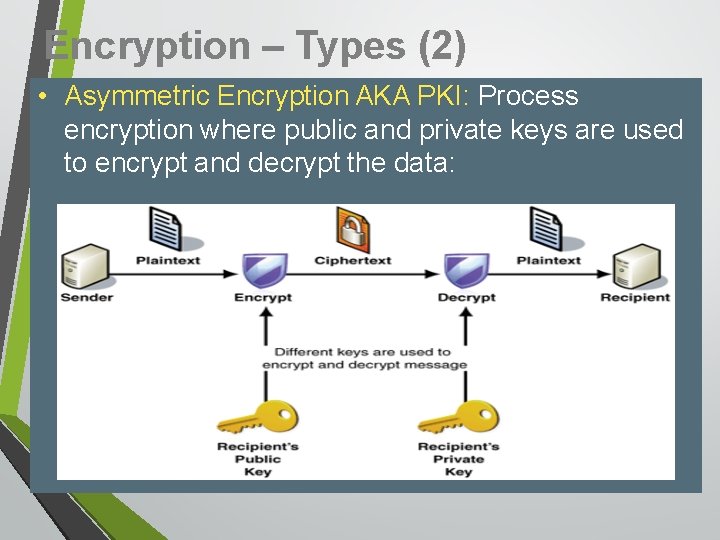
Encryption – Types (2) • Asymmetric Encryption AKA PKI: Process encryption where public and private keys are used to encrypt and decrypt the data:
Symmetric Encryption- Uses • Commonly used in database as there are no two separate end points to send and receive data. • Widely used due to its speed factor compared to PKI. • Often used in encrypting backup tapes for offline storage and digital streaming. • Used to securely store private information, credit card information, etc. ,
Symmetric Encryption- Deep Dive • Symmetric encryption uses a number of algorithms: – Two Fish (Open source) – Blow Fish – 3 DES – AES • In late 1990’s the National Institute for Standards and Technology (NIST) felt the need for new standard for cryptography.
Symmetric Encryption- Deep Dive (2) • Belgian Cryptographers : Vincent Rijmen and Joan Daemen developed the AES. • Acquired by Federal Government and named as FIPS 197. • Widely accepted by the private sector. • Testing protocols for AES
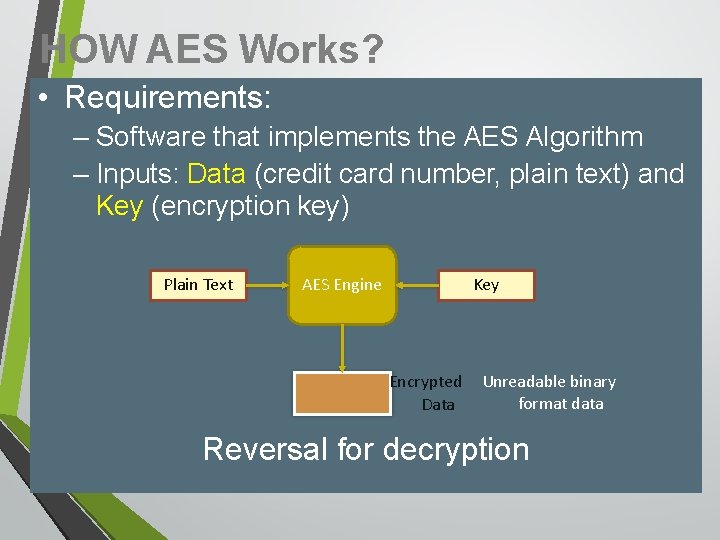
HOW AES Works? • Requirements: – Software that implements the AES Algorithm – Inputs: Data (credit card number, plain text) and Key (encryption key) Plain Text AES Engine ryp Key Encrypted Data Unreadable binary format data Reversal for decryption
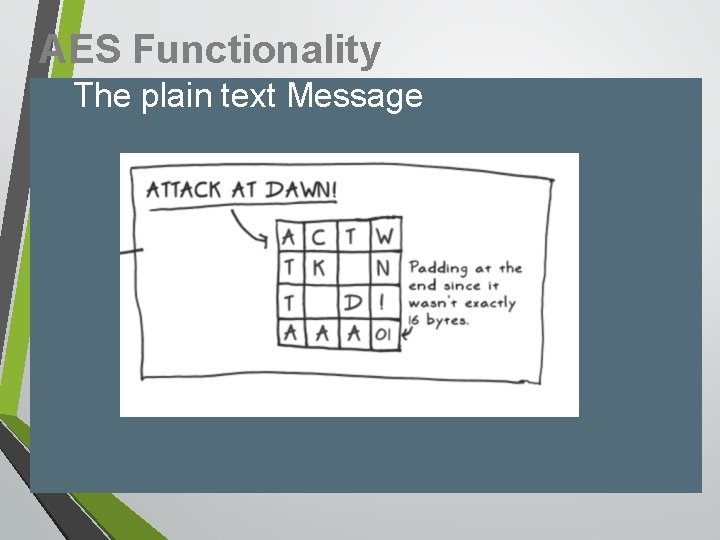
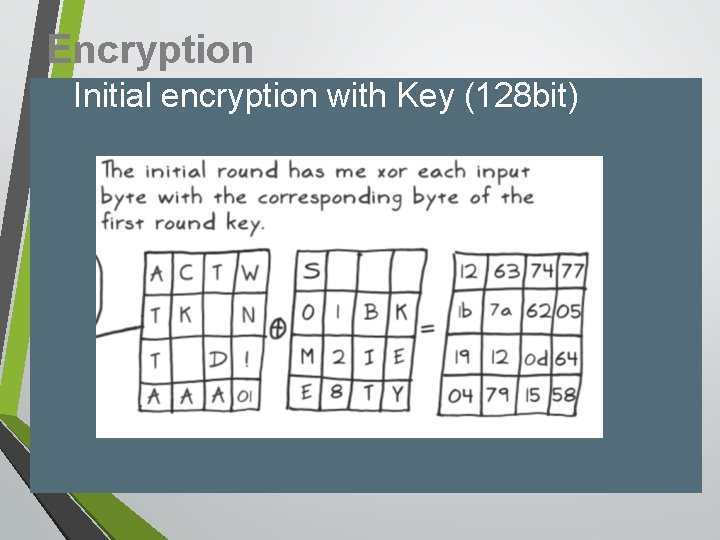
AES- Behind the Scene • AES is a block cipher • Has an Initialization Vector (IV) for rounds of encryption for the data in the block. • Size of the block is 16 bytes • Encryption Key Sizes: – 128 bit (16 Bytes) – 192 bit (24 Bytes) – 256 bit (32 Bytes)
AES- Strong Encryption Key • Encryption Key – A passphrase • Should be complex and not a easy guess • Use combination of letters, numbers, cases and special characters. Ex: Player. R@g 3!$$ • How keys are generated? – Random Number Generated (RNG) – Password Based Encryption (PBE) = Password + Software for encryption and hashing. – Split Passwords = Passwords entered by 2 or more users.
Where can I find AES? • Software Vendors: – Microsoft – IBM – SUN • Products with Encryption – Third party vendors • Free subscriptions – Online applications – Free web applications
AES Functionality The plain text Message
Encryption Initial encryption with Key (128 bit)
Encryption Substitution technique for other keys
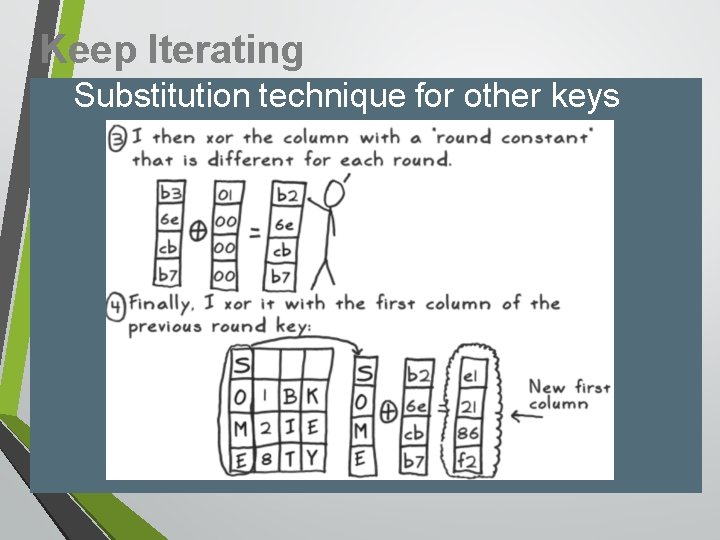
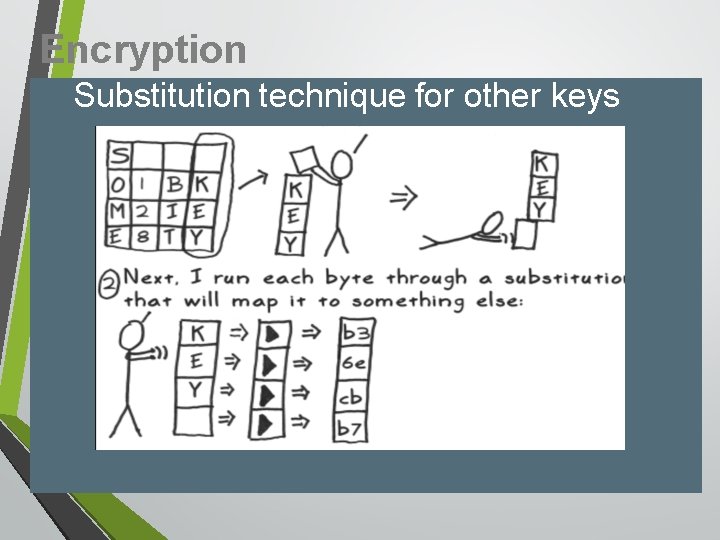
Keep Iterating Substitution technique for other keys
Application Hands on Application for AES Encryption http: //aes. online-domain-tools. com/
Asymmetric Encryption- RSA • Public-Private Key encryption AKA PKI • Developed by Ron, Shamir and Adleman in 1997. • Using Public Key and Private key to encrypt and decrypt the messages • Encrypts using public key and decrypt using private key

RSA Algorithm • • Choose 2 different prime numbers P, Q Calculate Modulus N = P*Q Calculate Totient X(N) = (P-1) (Q-1) Choose an integer E (Public Key) – Should be between 1 and X(N) – The GCD (E and X(N) = 1 • Calculate D (Private Key)= 1 + K * X(N) / E
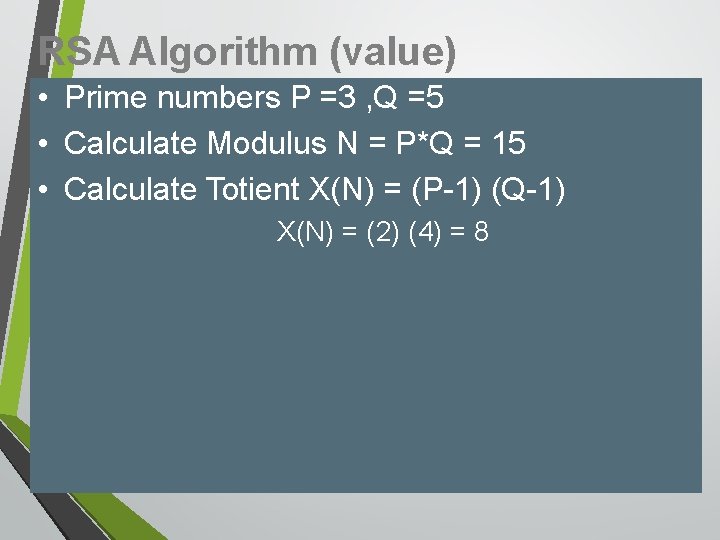
RSA Algorithm (value) • Prime numbers P =3 , Q =5 • Calculate Modulus N = P*Q = 15 • Calculate Totient X(N) = (P-1) (Q-1) X(N) = (2) (4) = 8
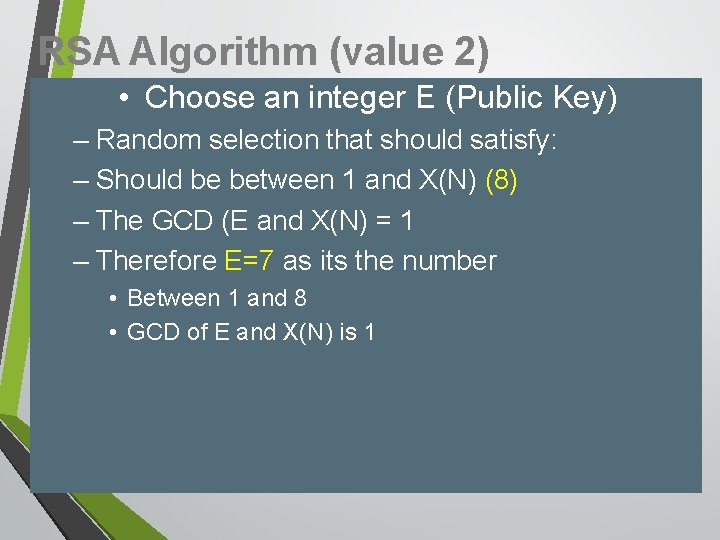
RSA Algorithm (value 2) • Choose an integer E (Public Key) – Random selection that should satisfy: – Should be between 1 and X(N) (8) – The GCD (E and X(N) = 1 – Therefore E=7 as its the number • Between 1 and 8 • GCD of E and X(N) is 1

RSA Algorithm (value 3) • Calculate D (Private Key) – Formula D = 1 + K * X(N) / E – K will be a random value starting from 0, 1, 2… – Value of K should be less than the value of E=7 – The value of k will be changed until the value of equation is an integer and not a fraction – Assume K =1 • 1+1*8/7 = 1+8/7= 9/7 = 1. 24 • 1+2*8/7 = 1+16/7= 17/7 = 2. 42 • 1+6*8/7 = 1+48/7= 49/7 = 7 – Therefore the value of D = 7
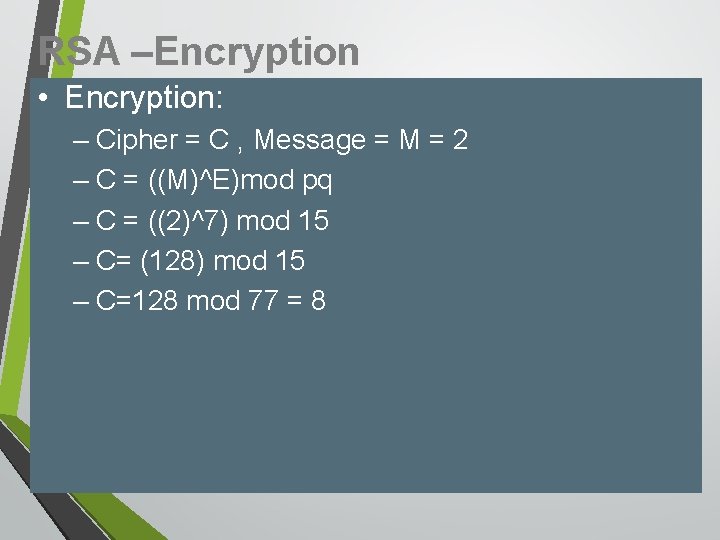
RSA –Encryption • Encryption: – Cipher = C , Message = M = 2 – C = ((M)^E)mod pq – C = ((2)^7) mod 15 – C= (128) mod 15 – C=128 mod 77 = 8
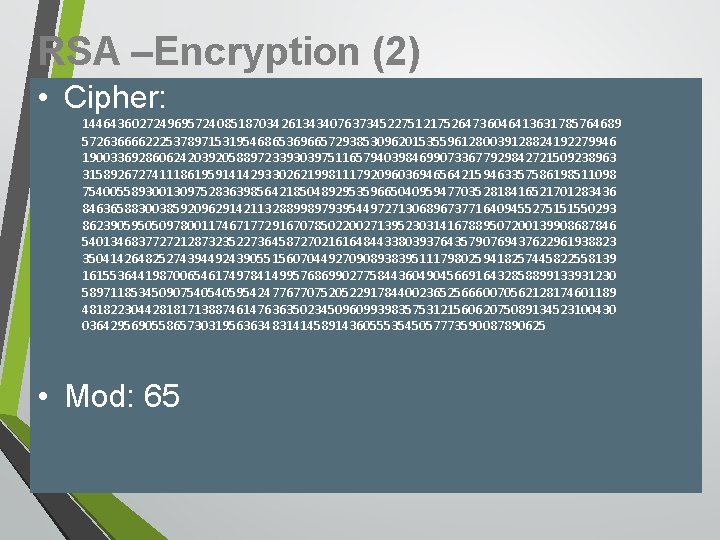
RSA –Encryption (2) • Cipher: 1446436027249695724085187034261343407637345227512175264736046413631785764689 5726366662225378971531954686536966572938530962015355961280039128824192279946 1900336928606242039205889723393039751165794039846990733677929842721509238963 3158926727411186195914142933026219981117920960369465642159463357586198511098 7540055893001309752836398564218504892953596650409594770352818416521701283436 8463658830038592096291421132889989793954497271306896737716409455275151550293 8623905950509780011746717729167078502200271395230314167889507200139908687846 5401346837727212873235227364587270216164844338039376435790769437622961938823 3504142648252743944924390551560704492709089383951117980259418257445822558139 1615536441987006546174978414995768699027758443604904566916432858899133931230 5897118534509075405405954247767707520522917844002365256660070562128174601189 4818223044281817138874614763635023450960993983575312156062075089134523100430 036429569055865730319563634831414589143605553545057773590087890625 • Mod: 65
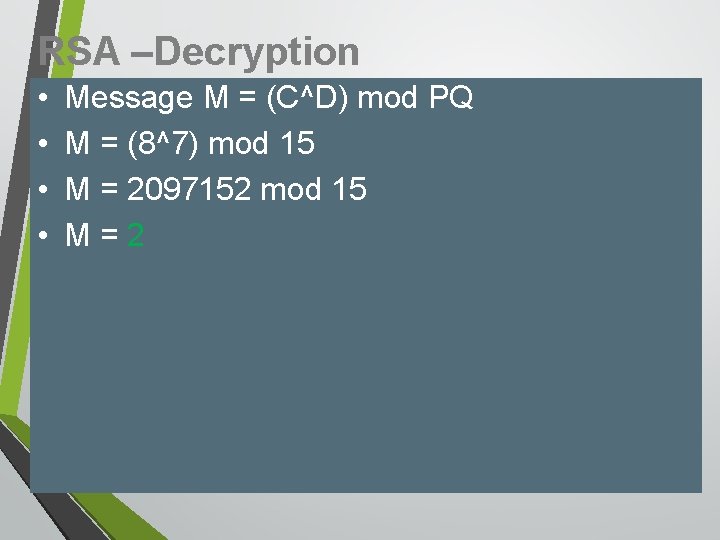
RSA –Decryption • • Message M = (C^D) mod PQ M = (8^7) mod 15 M = 2097152 mod 15 M=2
REPORT WORK • Prepare a brief write up on the different components of the AES Encryption. • Explain in short the process of encryption in AES.
- Slides: 27