
Network Security KeyOriented PKIs TLSSSL Tuomas Aura Outline
- Slides: 50
Network Security: Key-Oriented PKIs, TLS/SSL Tuomas Aura
Outline 1. 2. 3. 4. 5. 6. 7. 8. 9. Key-oriented PKIs More building blocks Authenticated key exchange Diffie-Hellman Key exchange using public-key encryption TLS/SSL TLS handshake TLS record protocol TLS trust model 2
Key-oriented PKIs 3
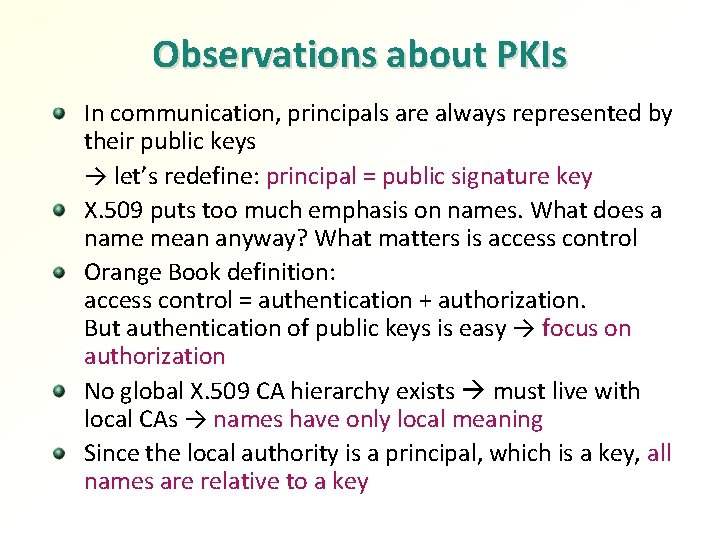
Observations about PKIs In communication, principals are always represented by their public keys → let’s redefine: principal = public signature key X. 509 puts too much emphasis on names. What does a name mean anyway? What matters is access control Orange Book definition: access control = authentication + authorization. But authentication of public keys is easy → focus on authorization No global X. 509 CA hierarchy exists must live with local CAs → names have only local meaning Since the local authority is a principal, which is a key, all names are relative to a key
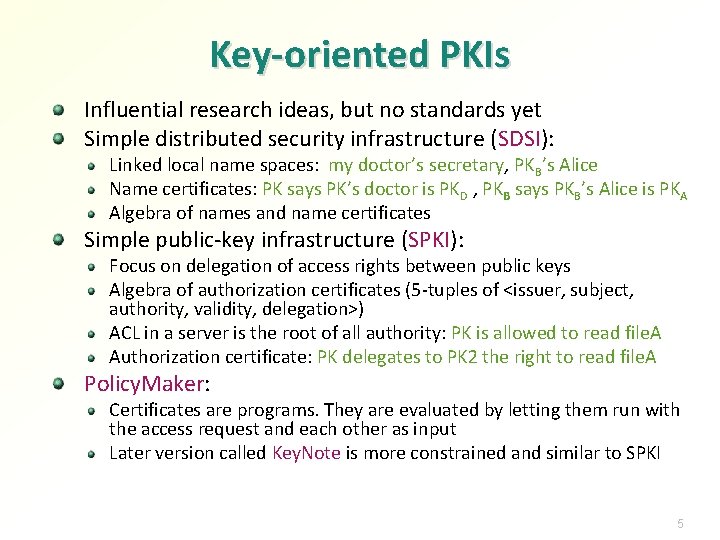
Key-oriented PKIs Influential research ideas, but no standards yet Simple distributed security infrastructure (SDSI): Linked local name spaces: my doctor’s secretary, PKB’s Alice Name certificates: PK says PK’s doctor is PKD , PKB says PKB’s Alice is PKA Algebra of names and name certificates Simple public-key infrastructure (SPKI): Focus on delegation of access rights between public keys Algebra of authorization certificates (5 -tuples of <issuer, subject, authority, validity, delegation>) ACL in a server is the root of all authority: PK is allowed to read file. A Authorization certificate: PK delegates to PK 2 the right to read file. A Policy. Maker: Certificates are programs. They are evaluated by letting them run with the access request and each other as input Later version called Key. Note is more constrained and similar to SPKI 5
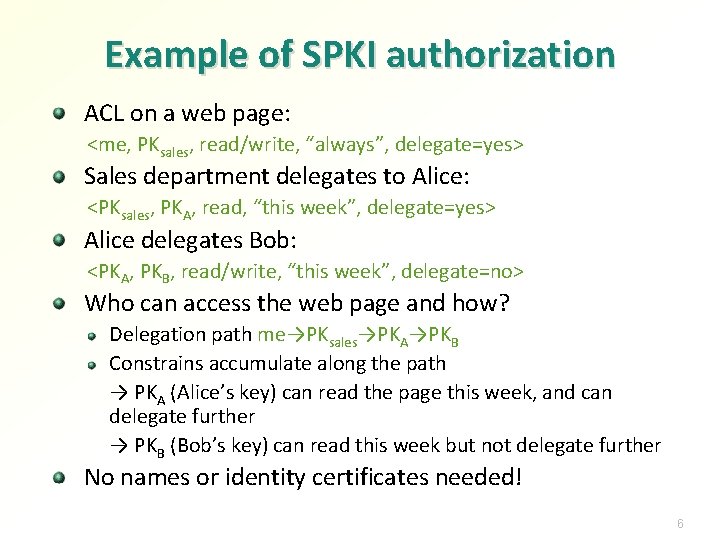
Example of SPKI authorization ACL on a web page: <me, PKsales, read/write, “always”, delegate=yes> Sales department delegates to Alice: <PKsales, PKA, read, “this week”, delegate=yes> Alice delegates Bob: <PKA, PKB, read/write, “this week”, delegate=no> Who can access the web page and how? Delegation path me→PKsales→PKA→PKB Constrains accumulate along the path → PKA (Alice’s key) can read the page this week, and can delegate further → PKB (Bob’s key) can read this week but not delegate further No names or identity certificates needed! 6
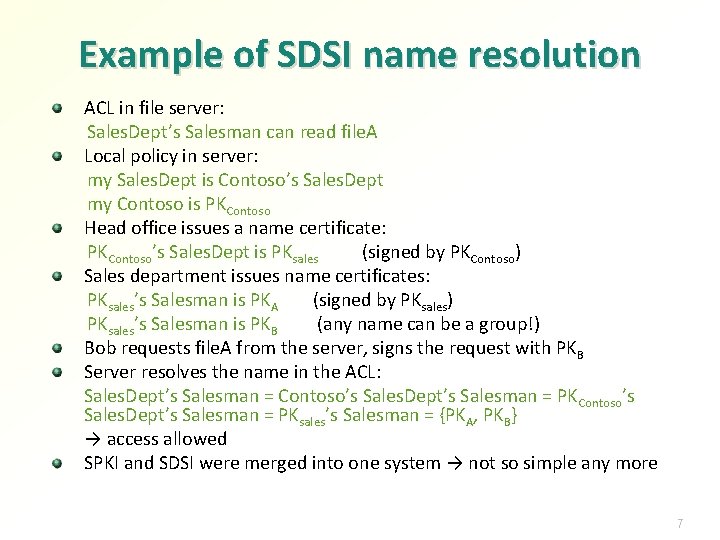
Example of SDSI name resolution ACL in file server: Sales. Dept’s Salesman can read file. A Local policy in server: my Sales. Dept is Contoso’s Sales. Dept my Contoso is PKContoso Head office issues a name certificate: PKContoso’s Sales. Dept is PKsales (signed by PKContoso) Sales department issues name certificates: PKsales’s Salesman is PKA (signed by PKsales) PKsales’s Salesman is PKB (any name can be a group!) Bob requests file. A from the server, signs the request with PKB Server resolves the name in the ACL: Sales. Dept’s Salesman = Contoso’s Sales. Dept’s Salesman = PKsales’s Salesman = {PKA, PKB} → access allowed SPKI and SDSI were merged into one system → not so simple any more 7
More building blocks
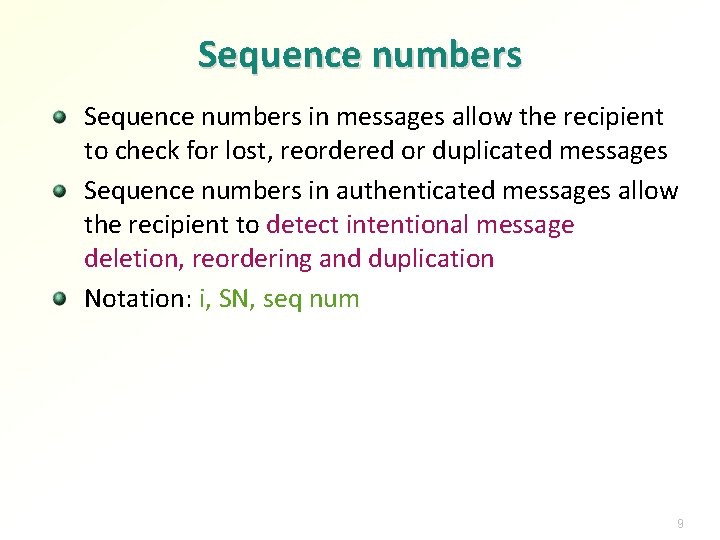
Sequence numbers in messages allow the recipient to check for lost, reordered or duplicated messages Sequence numbers in authenticated messages allow the recipient to detect intentional message deletion, reordering and duplication Notation: i, SN, seq num 9
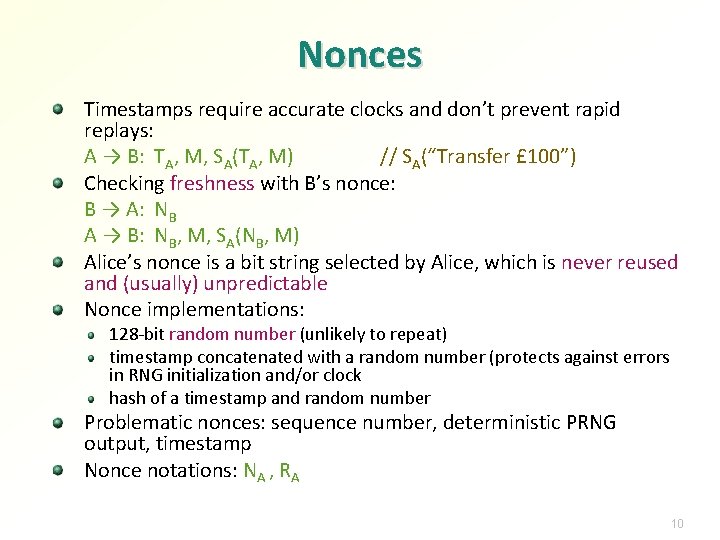
Nonces Timestamps require accurate clocks and don’t prevent rapid replays: A → B: TA, M, SA(TA, M) // SA(“Transfer £ 100”) Checking freshness with B’s nonce: B → A: NB A → B: NB, M, SA(NB, M) Alice’s nonce is a bit string selected by Alice, which is never reused and (usually) unpredictable Nonce implementations: 128 -bit random number (unlikely to repeat) timestamp concatenated with a random number (protects against errors in RNG initialization and/or clock hash of a timestamp and random number Problematic nonces: sequence number, deterministic PRNG output, timestamp Nonce notations: NA , RA 10
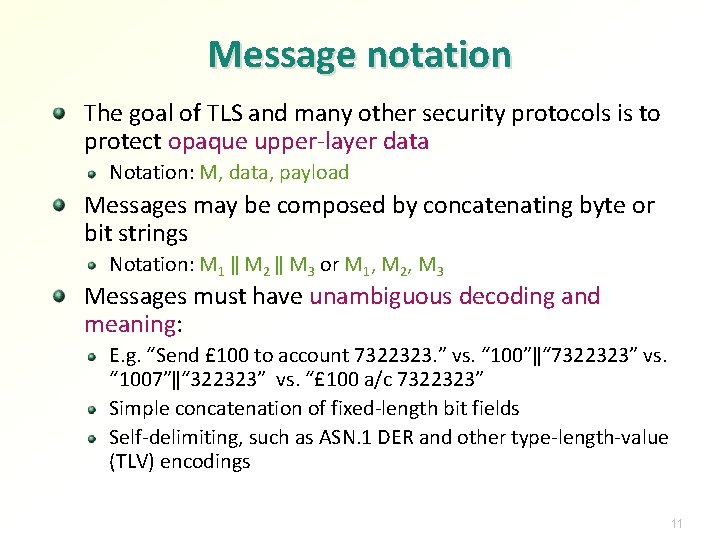
Message notation The goal of TLS and many other security protocols is to protect opaque upper-layer data Notation: M, data, payload Messages may be composed by concatenating byte or bit strings Notation: M 1 ‖ M 2 ‖ M 3 or M 1, M 2, M 3 Messages must have unambiguous decoding and meaning: E. g. “Send £ 100 to account 7322323. ” vs. “ 100”‖“ 7322323” vs. “ 1007”‖“ 322323” vs. “£ 100 a/c 7322323” Simple concatenation of fixed-length bit fields Self-delimiting, such as ASN. 1 DER and other type-length-value (TLV) encodings 11
Authenticated key exchange
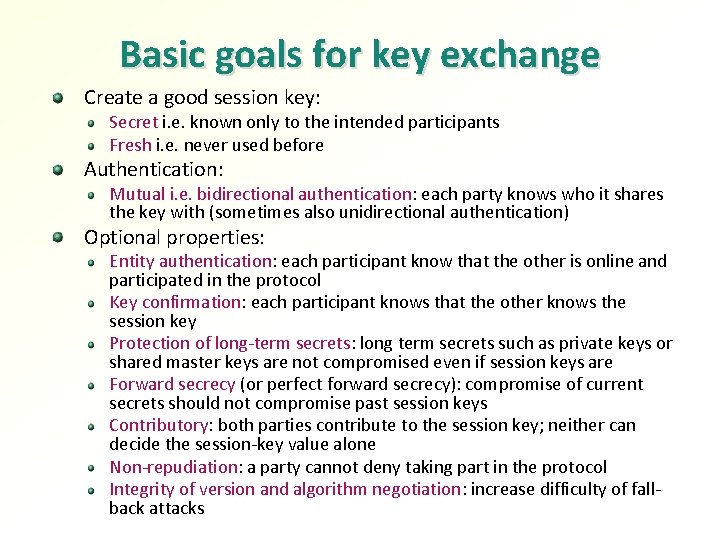
Basic goals for key exchange Create a good session key: Secret i. e. known only to the intended participants Fresh i. e. never used before Authentication: Mutual i. e. bidirectional authentication: each party knows who it shares the key with (sometimes also unidirectional authentication) Optional properties: Entity authentication: each participant know that the other is online and participated in the protocol Key confirmation: each participant knows that the other knows the session key Protection of long-term secrets: long term secrets such as private keys or shared master keys are not compromised even if session keys are Forward secrecy (or perfect forward secrecy): compromise of current secrets should not compromise past session keys Contributory: both parties contribute to the session key; neither can decide the session-key value alone Non-repudiation: a party cannot deny taking part in the protocol Integrity of version and algorithm negotiation: increase difficulty of fallback attacks
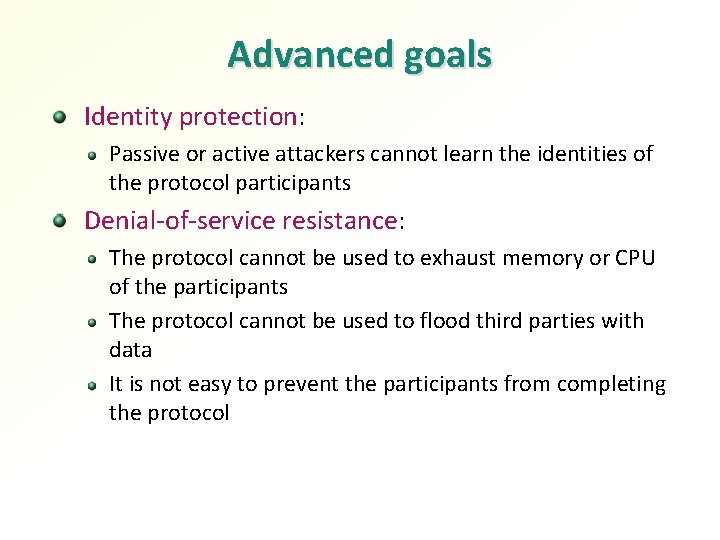
Advanced goals Identity protection: Passive or active attackers cannot learn the identities of the protocol participants Denial-of-service resistance: The protocol cannot be used to exhaust memory or CPU of the participants The protocol cannot be used to flood third parties with data It is not easy to prevent the participants from completing the protocol
Diffie-Hellman 15
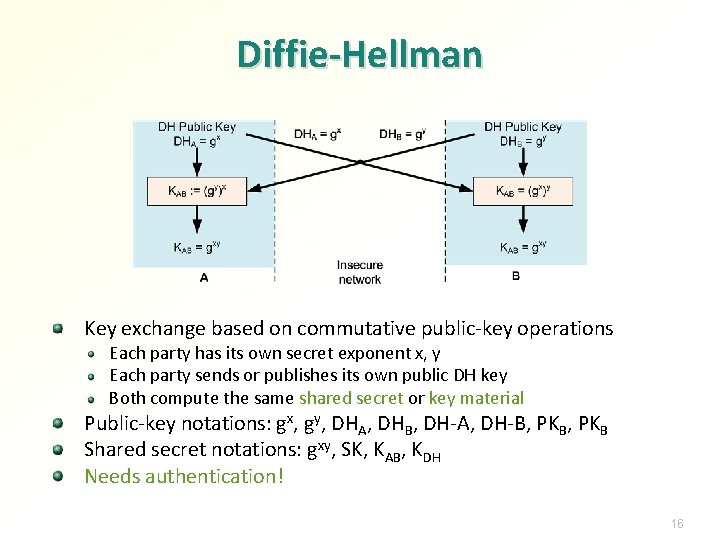
Diffie-Hellman Key exchange based on commutative public-key operations Each party has its own secret exponent x, y Each party sends or publishes its own public DH key Both compute the same shared secret or key material Public-key notations: gx, gy, DHA, DHB, DH-A, DH-B, PKB Shared secret notations: gxy, SK, KAB, KDH Needs authentication! 16
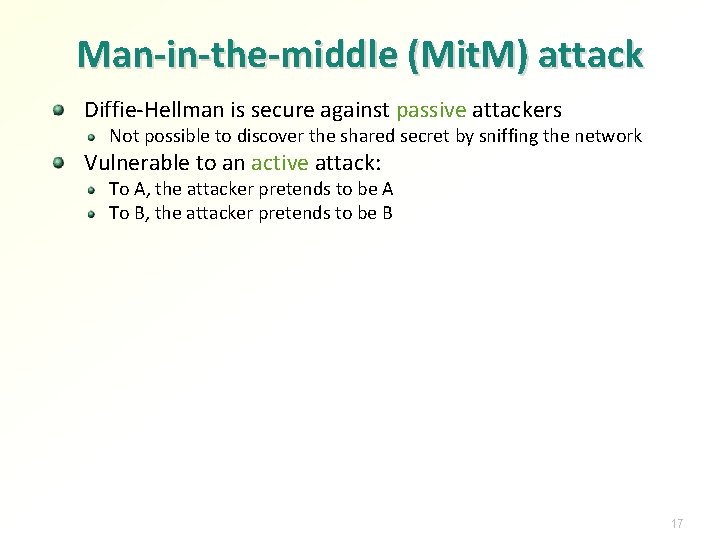
Man-in-the-middle (Mit. M) attack Diffie-Hellman is secure against passive attackers Not possible to discover the shared secret by sniffing the network Vulnerable to an active attack: To A, the attacker pretends to be A To B, the attacker pretends to be B 17
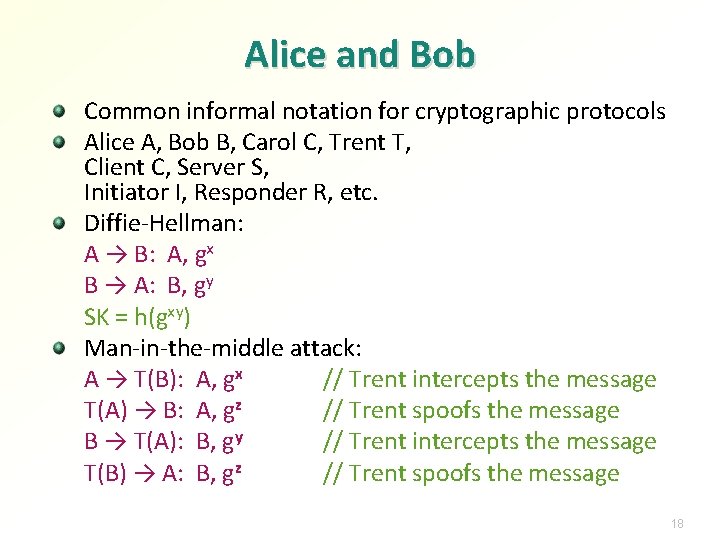
Alice and Bob Common informal notation for cryptographic protocols Alice A, Bob B, Carol C, Trent T, Client C, Server S, Initiator I, Responder R, etc. Diffie-Hellman: A → B: A, gx B → A: B, gy SK = h(gxy) Man-in-the-middle attack: A → T(B): A, gx // Trent intercepts the message T(A) → B: A, gz // Trent spoofs the message B → T(A): B, gy // Trent intercepts the message T(B) → A: B, gz // Trent spoofs the message 18
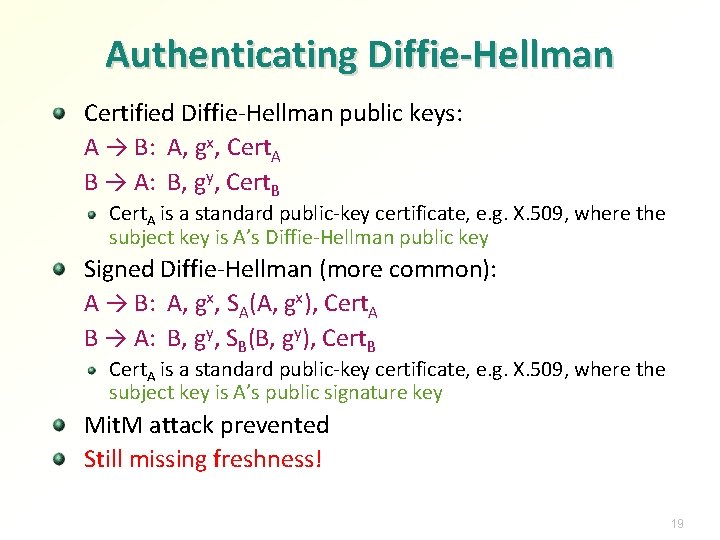
Authenticating Diffie-Hellman Certified Diffie-Hellman public keys: A → B: A, gx, Cert. A B → A: B, gy, Cert. B Cert. A is a standard public-key certificate, e. g. X. 509, where the subject key is A’s Diffie-Hellman public key Signed Diffie-Hellman (more common): A → B: A, gx, SA(A, gx), Cert. A B → A: B, gy, SB(B, gy), Cert. B Cert. A is a standard public-key certificate, e. g. X. 509, where the subject key is A’s public signature key Mit. M attack prevented Still missing freshness! 19
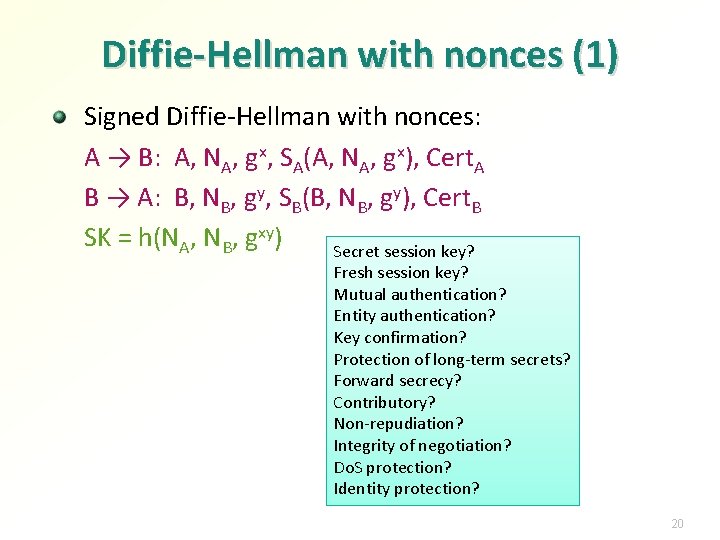
Diffie-Hellman with nonces (1) Signed Diffie-Hellman with nonces: A → B: A, NA, gx, SA(A, NA, gx), Cert. A B → A: B, NB, gy, SB(B, NB, gy), Cert. B SK = h(NA, NB, gxy) Secret session key? Fresh session key? Mutual authentication? Entity authentication? Key confirmation? Protection of long-term secrets? Forward secrecy? Contributory? Non-repudiation? Integrity of negotiation? Do. S protection? Identity protection? 20
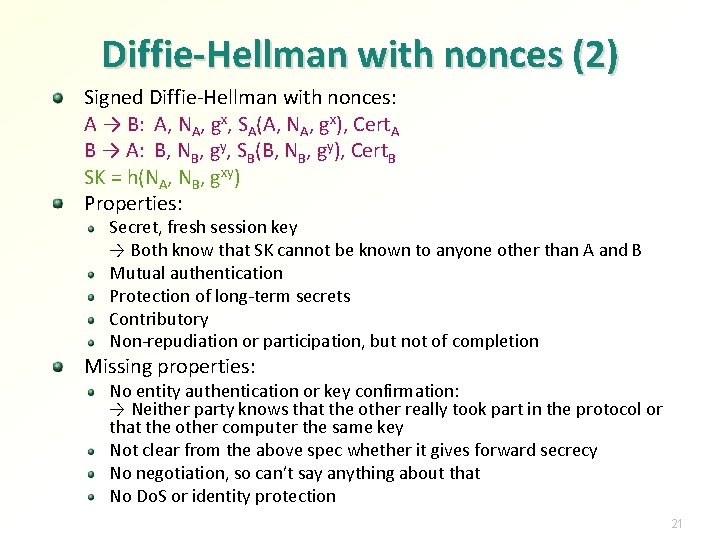
Diffie-Hellman with nonces (2) Signed Diffie-Hellman with nonces: A → B: A, NA, gx, SA(A, NA, gx), Cert. A B → A: B, NB, gy, SB(B, NB, gy), Cert. B SK = h(NA, NB, gxy) Properties: Secret, fresh session key → Both know that SK cannot be known to anyone other than A and B Mutual authentication Protection of long-term secrets Contributory Non-repudiation or participation, but not of completion Missing properties: No entity authentication or key confirmation: → Neither party knows that the other really took part in the protocol or that the other computer the same key Not clear from the above spec whether it gives forward secrecy No negotiation, so can’t say anything about that No Do. S or identity protection 21
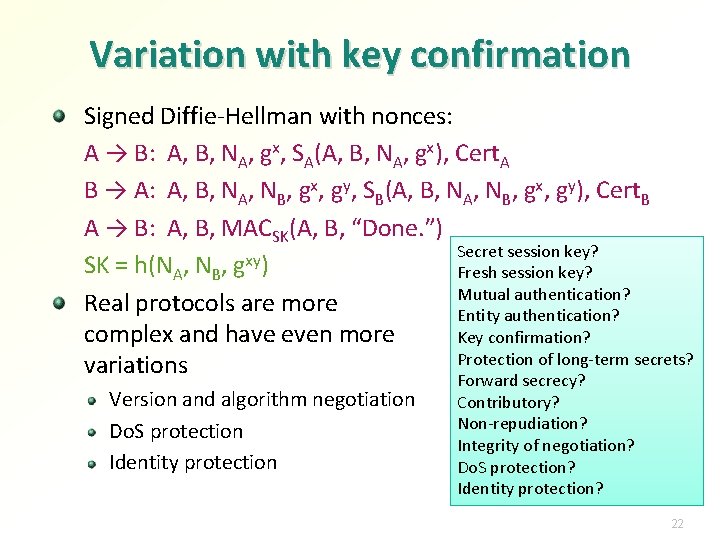
Variation with key confirmation Signed Diffie-Hellman with nonces: A → B: A, B, NA, gx, SA(A, B, NA, gx), Cert. A B → A: A, B, NA, NB, gx, gy, SB(A, B, NA, NB, gx, gy), Cert. B A → B: A, B, MACSK(A, B, “Done. ”) Secret session key? xy SK = h(NA, NB, g ) Fresh session key? Mutual authentication? Real protocols are more Entity authentication? complex and have even more Key confirmation? Protection of long-term secrets? variations Version and algorithm negotiation Do. S protection Identity protection Forward secrecy? Contributory? Non-repudiation? Integrity of negotiation? Do. S protection? Identity protection? 22
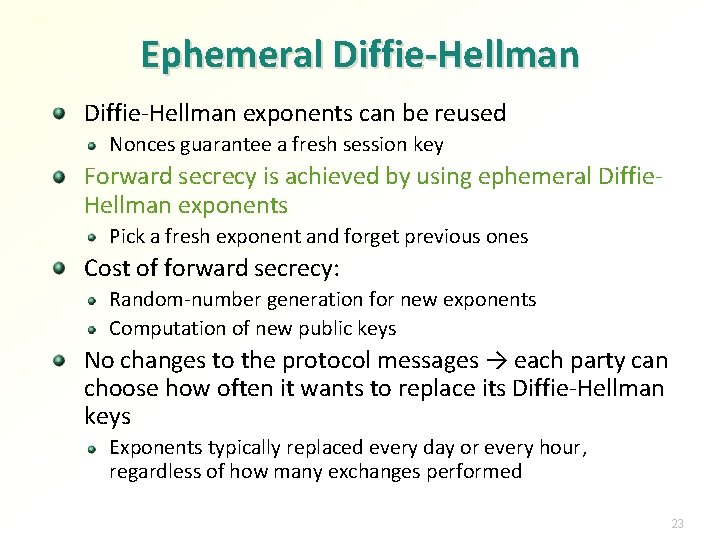
Ephemeral Diffie-Hellman exponents can be reused Nonces guarantee a fresh session key Forward secrecy is achieved by using ephemeral Diffie. Hellman exponents Pick a fresh exponent and forget previous ones Cost of forward secrecy: Random-number generation for new exponents Computation of new public keys No changes to the protocol messages → each party can choose how often it wants to replace its Diffie-Hellman keys Exponents typically replaced every day or every hour, regardless of how many exchanges performed 23
Key exchange using public-key encryption
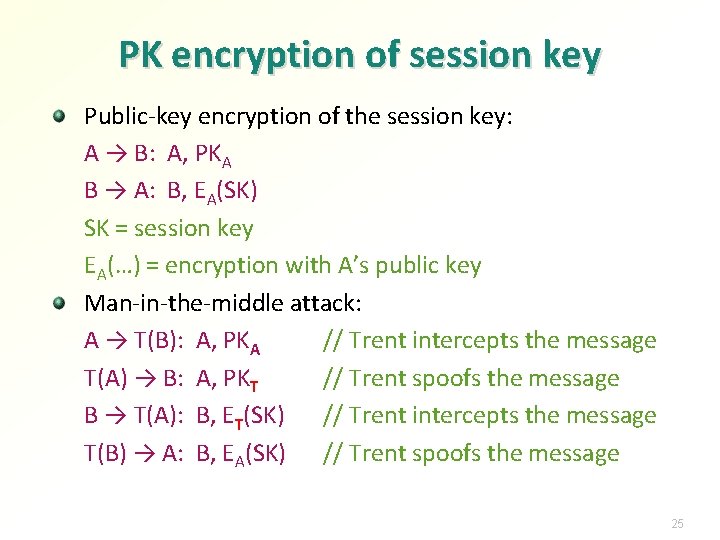
PK encryption of session key Public-key encryption of the session key: A → B: A, PKA B → A: B, EA(SK) SK = session key EA(…) = encryption with A’s public key Man-in-the-middle attack: A → T(B): A, PKA // Trent intercepts the message T(A) → B: A, PKT // Trent spoofs the message B → T(A): B, ET(SK) // Trent intercepts the message T(B) → A: B, EA(SK) // Trent spoofs the message 25
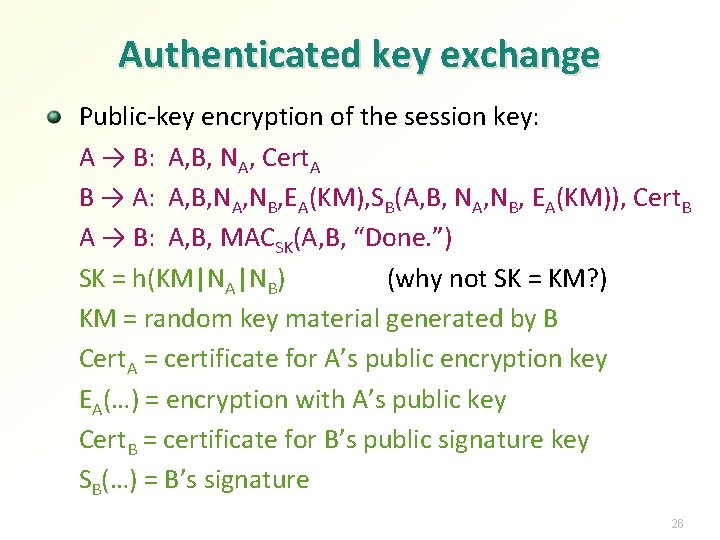
Authenticated key exchange Public-key encryption of the session key: A → B: A, B, NA, Cert. A B → A: A, B, NA, NB, EA(KM), SB(A, B, NA, NB, EA(KM)), Cert. B A → B: A, B, MACSK(A, B, “Done. ”) SK = h(KM|NA|NB) (why not SK = KM? ) KM = random key material generated by B Cert. A = certificate for A’s public encryption key EA(…) = encryption with A’s public key Cert. B = certificate for B’s public signature key SB(…) = B’s signature 26
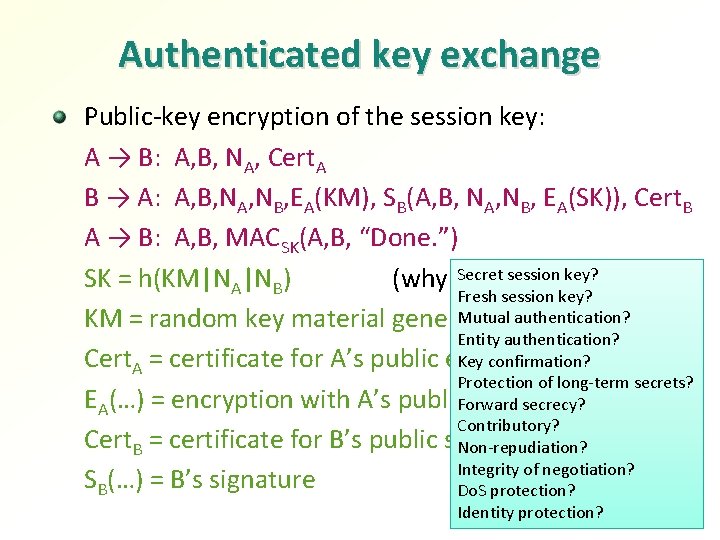
Authenticated key exchange Public-key encryption of the session key: A → B: A, B, NA, Cert. A B → A: A, B, NA, NB, EA(KM), SB(A, B, NA, NB, EA(SK)), Cert. B A → B: A, B, MACSK(A, B, “Done. ”) Secret. SK session key? SK = h(KM|NA|NB) (why not = KM? ) Fresh session key? Mutual authentication? KM = random key material generated by B Entity authentication? Key confirmation? Cert. A = certificate for A’s public encryption key Protection of long-term secrets? EA(…) = encryption with A’s public. Forward key secrecy? Contributory? Cert. B = certificate for B’s public signature key Non-repudiation? Integrity of negotiation? SB(…) = B’s signature Do. S protection? Identity protection? 27
TLS/SSL
TLS/SSL Originally Secure Sockets Layer (SSLv 3) by Netscape in 1995 Originally intended to facilitate web commerce: Fast adoption because built into web browsers Encrypt credit card numbers and passwords on the web Early attitudes, especially in the IETF: IPSec will eventually replace TLS/SSL is bad because it slows the adoption of IPSec Now SSL/TLS is the dominant encryption standard Standardized as Transport-Layer Security (TLSv 1) by IETF [RFC 2246] Minimal changes to SSLv 3 implementations but not interoperable 29
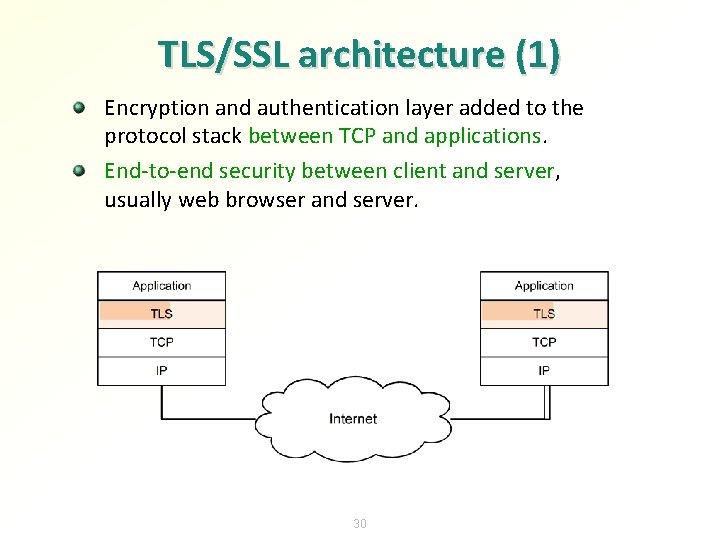
TLS/SSL architecture (1) Encryption and authentication layer added to the protocol stack between TCP and applications. End-to-end security between client and server, usually web browser and server. 30
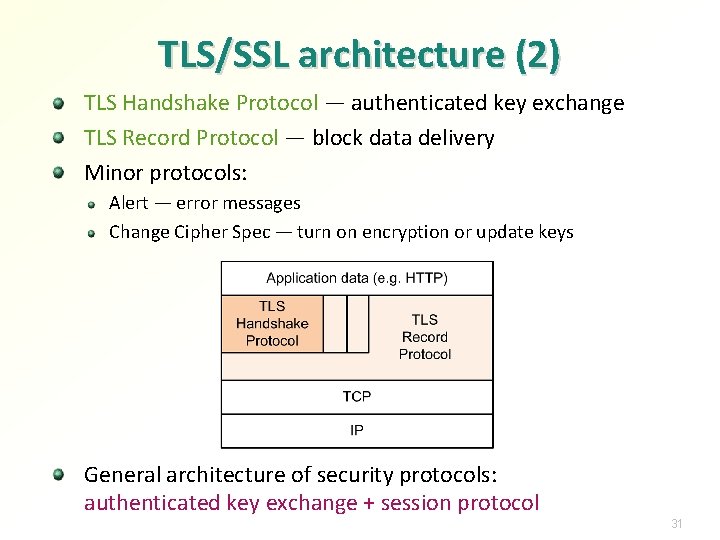
TLS/SSL architecture (2) TLS Handshake Protocol — authenticated key exchange TLS Record Protocol — block data delivery Minor protocols: Alert — error messages Change Cipher Spec — turn on encryption or update keys General architecture of security protocols: authenticated key exchange + session protocol 31
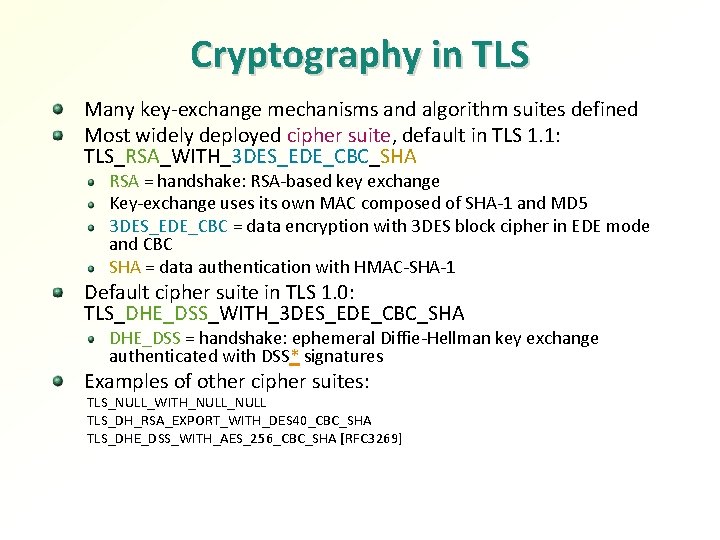
Cryptography in TLS Many key-exchange mechanisms and algorithm suites defined Most widely deployed cipher suite, default in TLS 1. 1: TLS_RSA_WITH_3 DES_EDE_CBC_SHA RSA = handshake: RSA-based key exchange Key-exchange uses its own MAC composed of SHA-1 and MD 5 3 DES_EDE_CBC = data encryption with 3 DES block cipher in EDE mode and CBC SHA = data authentication with HMAC-SHA-1 Default cipher suite in TLS 1. 0: TLS_DHE_DSS_WITH_3 DES_EDE_CBC_SHA DHE_DSS = handshake: ephemeral Diffie-Hellman key exchange authenticated with DSS* signatures Examples of other cipher suites: TLS_NULL_WITH_NULL TLS_DH_RSA_EXPORT_WITH_DES 40_CBC_SHA TLS_DHE_DSS_WITH_AES_256_CBC_SHA [RFC 3269]
TLS handshake 33
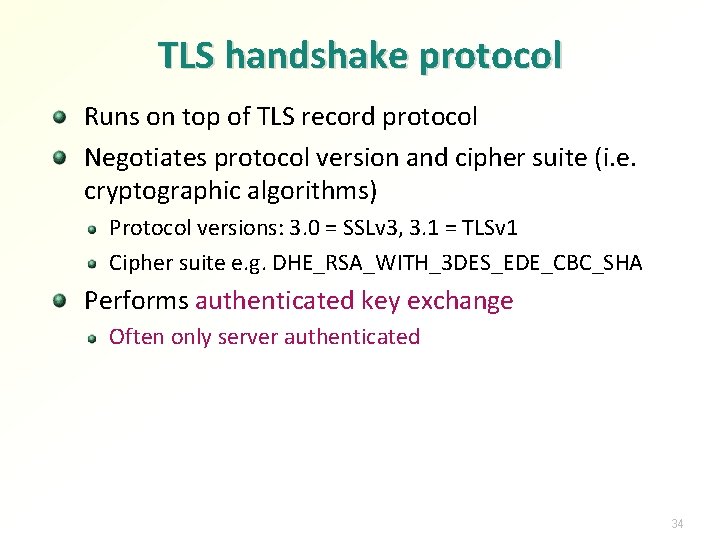
TLS handshake protocol Runs on top of TLS record protocol Negotiates protocol version and cipher suite (i. e. cryptographic algorithms) Protocol versions: 3. 0 = SSLv 3, 3. 1 = TLSv 1 Cipher suite e. g. DHE_RSA_WITH_3 DES_EDE_CBC_SHA Performs authenticated key exchange Often only server authenticated 34
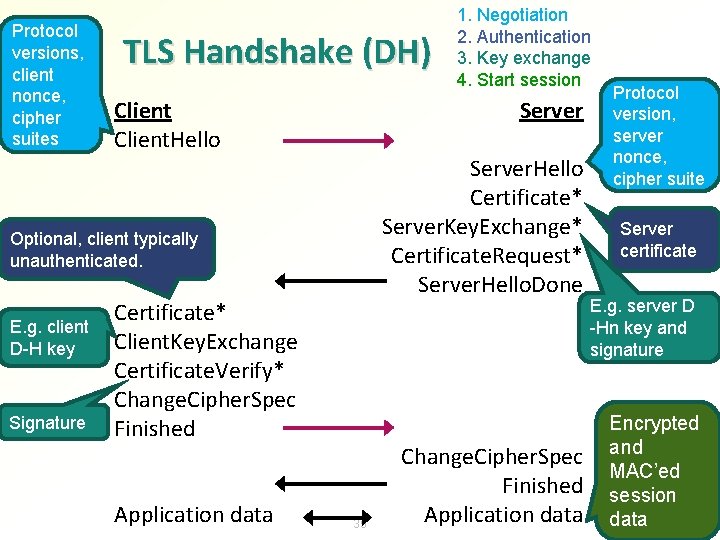
Protocol versions, client nonce, cipher suites TLS Handshake (DH) Client. Hello Server. Hello Certificate* Server. Key. Exchange* Certificate. Request* Server. Hello. Done Optional, client typically unauthenticated. E. g. client D-H key Signature Certificate* Client. Key. Exchange Certificate. Verify* Change. Cipher. Spec Finished Application data 1. Negotiation 2. Authentication 3. Key exchange 4. Start session 35 Change. Cipher. Spec Finished Application data Protocol version, server nonce, cipher suite Server certificate E. g. server D -Hn key and signature Encrypted and MAC’ed session data
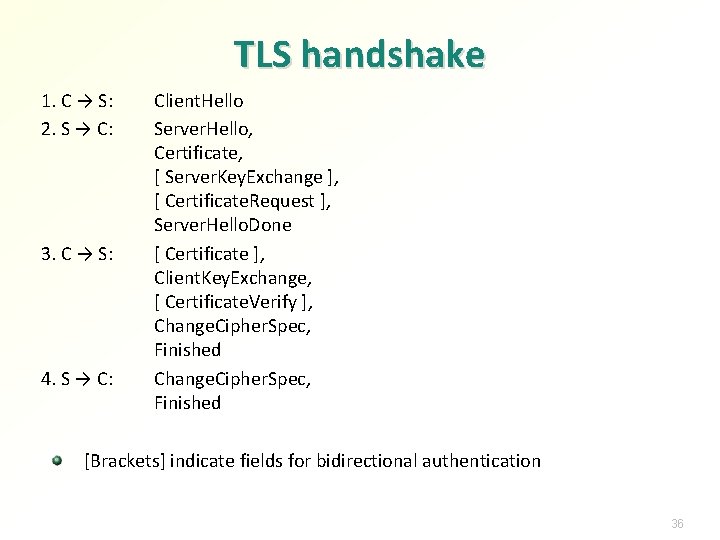
TLS handshake 1. C → S: 2. S → C: 3. C → S: 4. S → C: Client. Hello Server. Hello, Certificate, [ Server. Key. Exchange ], [ Certificate. Request ], Server. Hello. Done [ Certificate ], Client. Key. Exchange, [ Certificate. Verify ], Change. Cipher. Spec, Finished [Brackets] indicate fields for bidirectional authentication 36
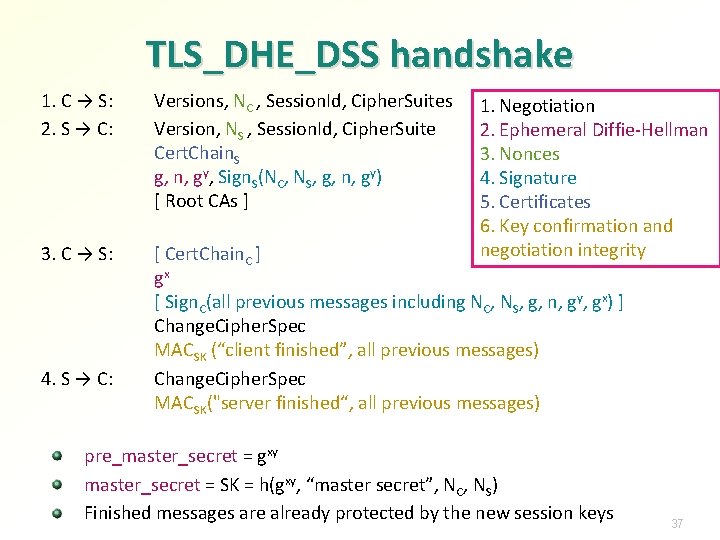
TLS_DHE_DSS handshake 1. C → S: 2. S → C: Versions, NC , Session. Id, Cipher. Suites Version, NS , Session. Id, Cipher. Suite Cert. Chain. S g, n, gy, Sign. S(NC, NS, g, n, gy) [ Root CAs ] 3. C → S: [ Cert. Chain. C ] gx [ Sign. C(all previous messages including NC, NS, g, n, gy, gx) ] Change. Cipher. Spec MACSK (“client finished”, all previous messages) Change. Cipher. Spec MACSK("server finished“, all previous messages) 4. S → C: 1. Negotiation 2. Ephemeral Diffie-Hellman 3. Nonces 4. Signature 5. Certificates 6. Key confirmation and negotiation integrity pre_master_secret = gxy master_secret = SK = h(gxy, “master secret”, NC, NS) Finished messages are already protected by the new session keys 37
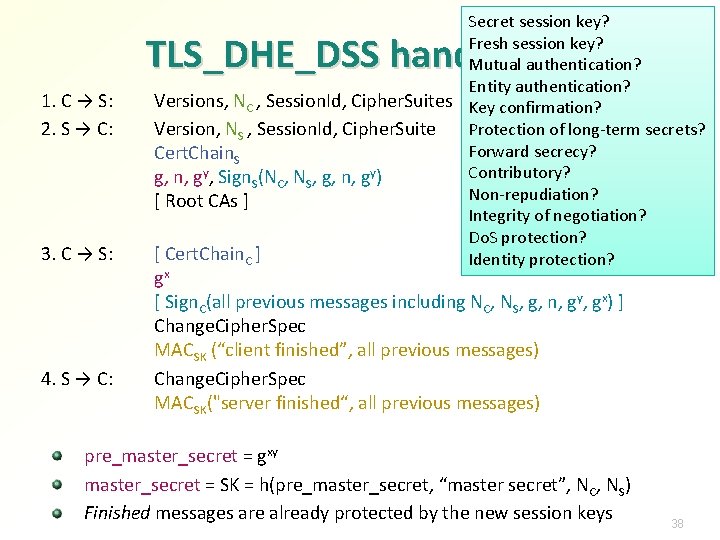
Secret session key? Fresh session key? Mutual authentication? Entity authentication? Versions, NC , Session. Id, Cipher. Suites Key confirmation? Protection of long-term secrets? Version, NS , Session. Id, Cipher. Suite Forward secrecy? Cert. Chain. S Contributory? g, n, gy, Sign. S(NC, NS, g, n, gy) Non-repudiation? [ Root CAs ] Integrity of negotiation? Do. S protection? [ Cert. Chain. C ] Identity protection? TLS_DHE_DSS handshake 1. C → S: 2. S → C: 3. C → S: 4. S → C: gx [ Sign. C(all previous messages including NC, NS, g, n, gy, gx) ] Change. Cipher. Spec MACSK (“client finished”, all previous messages) Change. Cipher. Spec MACSK("server finished“, all previous messages) pre_master_secret = gxy master_secret = SK = h(pre_master_secret, “master secret”, NC, NS) Finished messages are already protected by the new session keys 38
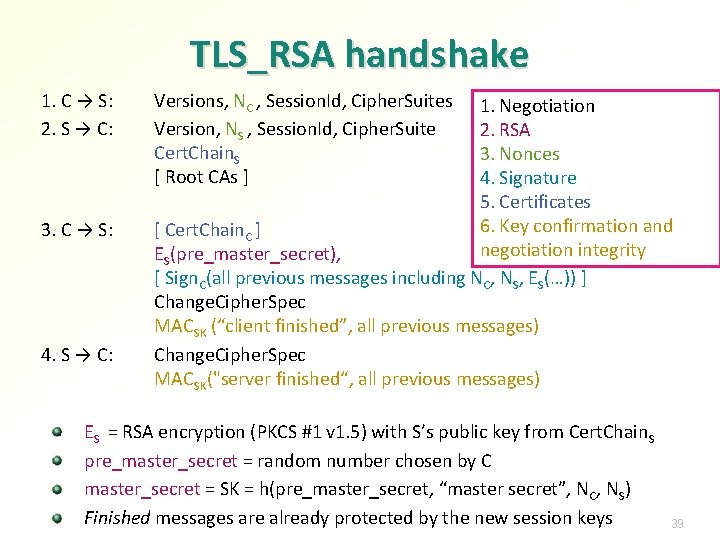
TLS_RSA handshake 1. C → S: 2. S → C: 3. C → S: 4. S → C: Versions, NC , Session. Id, Cipher. Suites Version, NS , Session. Id, Cipher. Suite Cert. Chain. S [ Root CAs ] 1. Negotiation 2. RSA 3. Nonces 4. Signature 5. Certificates 6. Key confirmation and [ Cert. Chain. C ] negotiation integrity ES(pre_master_secret), [ Sign. C(all previous messages including NC, NS, ES(…)) ] Change. Cipher. Spec MACSK (“client finished”, all previous messages) Change. Cipher. Spec MACSK("server finished“, all previous messages) ES = RSA encryption (PKCS #1 v 1. 5) with S’s public key from Cert. Chain. S pre_master_secret = random number chosen by C master_secret = SK = h(pre_master_secret, “master secret”, NC, NS) Finished messages are already protected by the new session keys 39
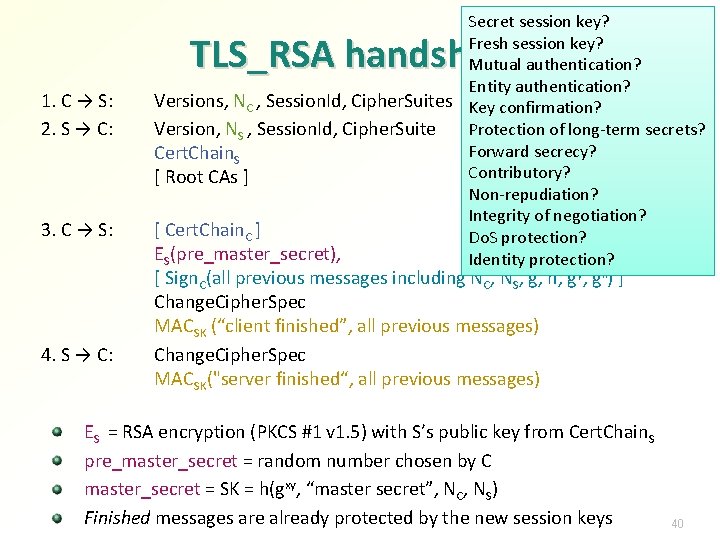
Secret session key? Fresh session key? Mutual authentication? Entity authentication? Versions, NC , Session. Id, Cipher. Suites Key confirmation? Protection of long-term secrets? Version, NS , Session. Id, Cipher. Suite Forward secrecy? Cert. Chain. S Contributory? [ Root CAs ] Non-repudiation? Integrity of negotiation? [ Cert. Chain. C ] Do. S protection? ES(pre_master_secret), Identity protection? TLS_RSA handshake 1. C → S: 2. S → C: 3. C → S: 4. S → C: [ Sign. C(all previous messages including NC, NS, g, n, gy, gx) ] Change. Cipher. Spec MACSK (“client finished”, all previous messages) Change. Cipher. Spec MACSK("server finished“, all previous messages) ES = RSA encryption (PKCS #1 v 1. 5) with S’s public key from Cert. Chain. S pre_master_secret = random number chosen by C master_secret = SK = h(gxy, “master secret”, NC, NS) Finished messages are already protected by the new session keys 40
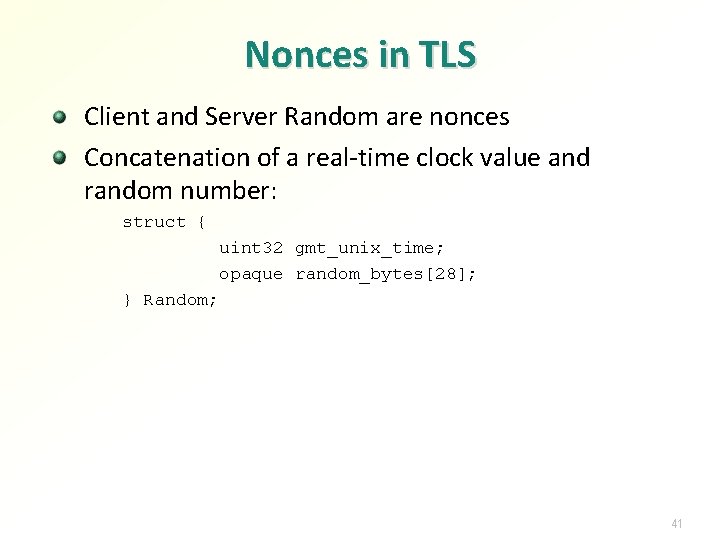
Nonces in TLS Client and Server Random are nonces Concatenation of a real-time clock value and random number: struct { uint 32 gmt_unix_time; opaque random_bytes[28]; } Random; 41
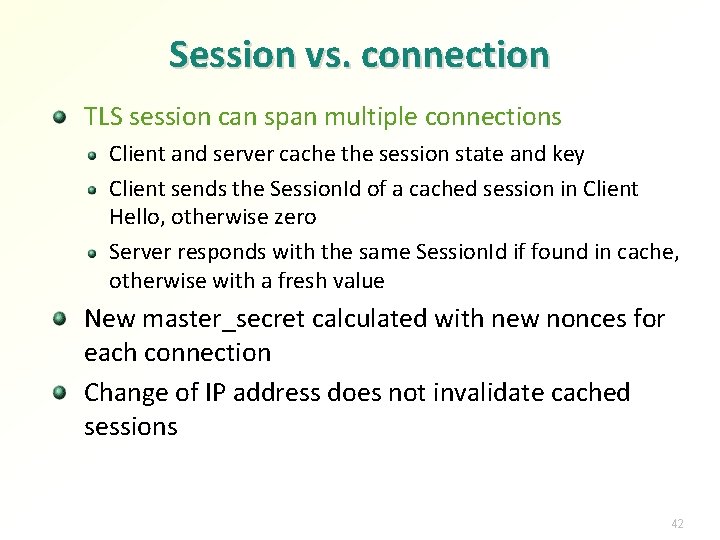
Session vs. connection TLS session can span multiple connections Client and server cache the session state and key Client sends the Session. Id of a cached session in Client Hello, otherwise zero Server responds with the same Session. Id if found in cache, otherwise with a fresh value New master_secret calculated with new nonces for each connection Change of IP address does not invalidate cached sessions 42
TLS record protocol
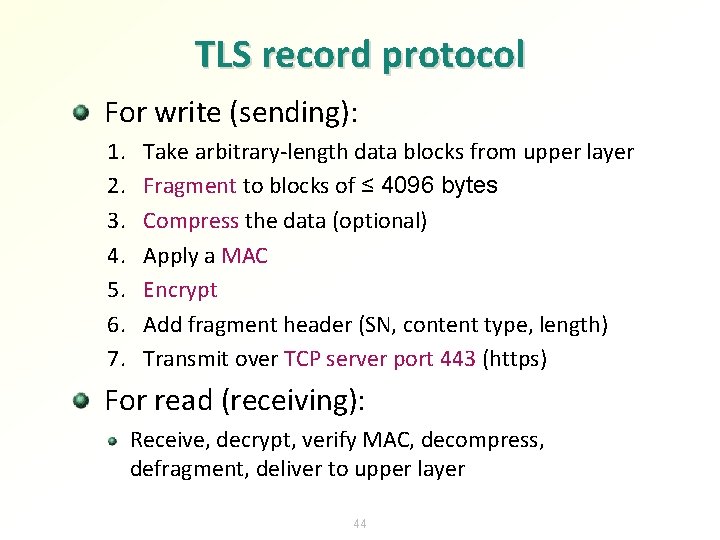
TLS record protocol For write (sending): 1. 2. 3. 4. 5. 6. 7. Take arbitrary-length data blocks from upper layer Fragment to blocks of ≤ 4096 bytes Compress the data (optional) Apply a MAC Encrypt Add fragment header (SN, content type, length) Transmit over TCP server port 443 (https) For read (receiving): Receive, decrypt, verify MAC, decompress, defragment, deliver to upper layer 44
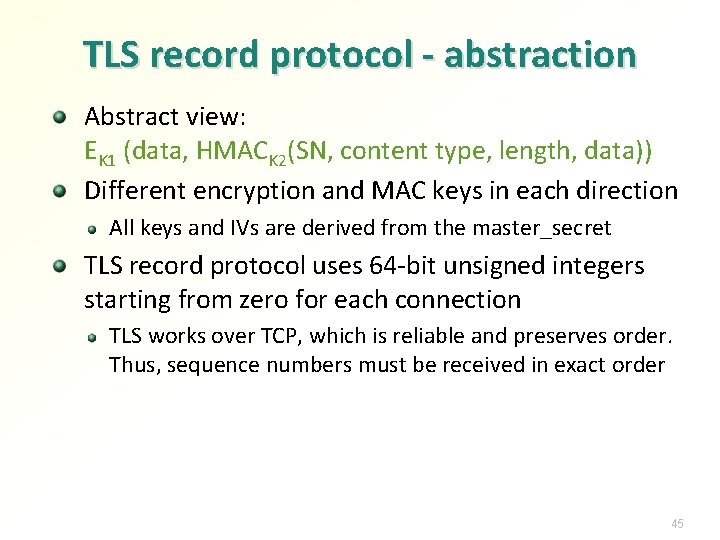
TLS record protocol - abstraction Abstract view: EK 1 (data, HMACK 2(SN, content type, length, data)) Different encryption and MAC keys in each direction All keys and IVs are derived from the master_secret TLS record protocol uses 64 -bit unsigned integers starting from zero for each connection TLS works over TCP, which is reliable and preserves order. Thus, sequence numbers must be received in exact order 45
TSL trust model 46
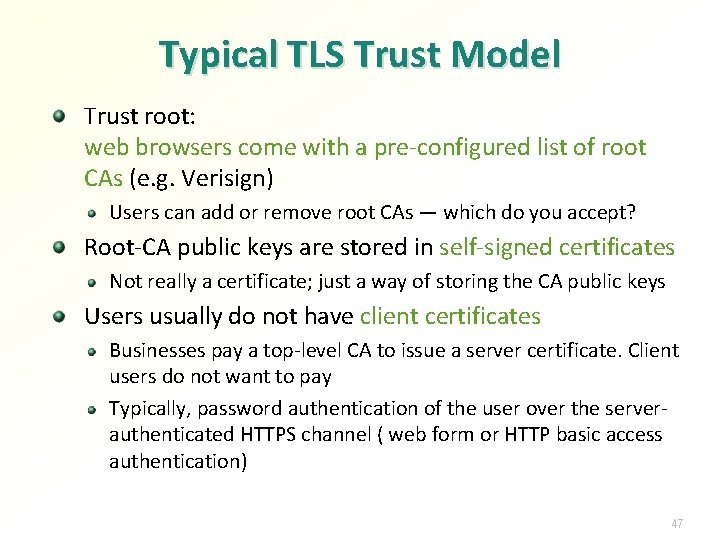
Typical TLS Trust Model Trust root: web browsers come with a pre-configured list of root CAs (e. g. Verisign) Users can add or remove root CAs — which do you accept? Root-CA public keys are stored in self-signed certificates Not really a certificate; just a way of storing the CA public keys Users usually do not have client certificates Businesses pay a top-level CA to issue a server certificate. Client users do not want to pay Typically, password authentication of the user over the serverauthenticated HTTPS channel ( web form or HTTP basic access authentication) 47
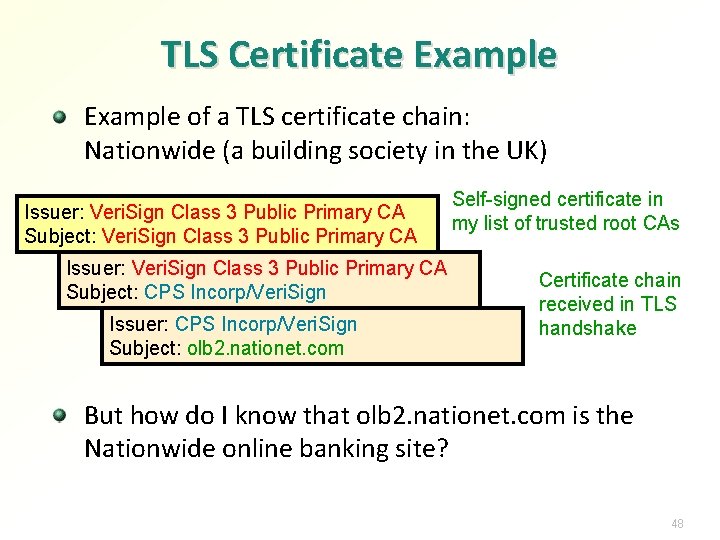
TLS Certificate Example of a TLS certificate chain: Nationwide (a building society in the UK) Issuer: Veri. Sign Class 3 Public Primary CA Subject: Veri. Sign Class 3 Public Primary CA Issuer: Veri. Sign Class 3 Public Primary CA Subject: CPS Incorp/Veri. Sign Issuer: CPS Incorp/Veri. Sign Subject: olb 2. nationet. com Self-signed certificate in my list of trusted root CAs Certificate chain received in TLS handshake But how do I know that olb 2. nationet. com is the Nationwide online banking site? 48
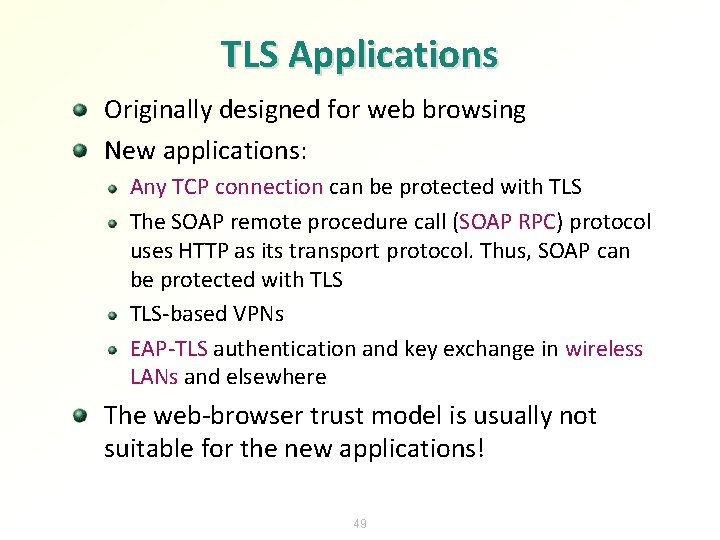
TLS Applications Originally designed for web browsing New applications: Any TCP connection can be protected with TLS The SOAP remote procedure call (SOAP RPC) protocol uses HTTP as its transport protocol. Thus, SOAP can be protected with TLS-based VPNs EAP-TLS authentication and key exchange in wireless LANs and elsewhere The web-browser trust model is usually not suitable for the new applications! 49
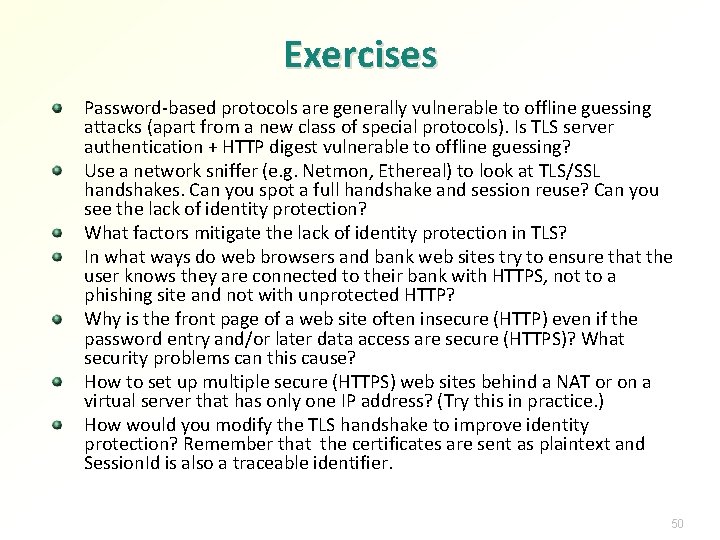
Exercises Password-based protocols are generally vulnerable to offline guessing attacks (apart from a new class of special protocols). Is TLS server authentication + HTTP digest vulnerable to offline guessing? Use a network sniffer (e. g. Netmon, Ethereal) to look at TLS/SSL handshakes. Can you spot a full handshake and session reuse? Can you see the lack of identity protection? What factors mitigate the lack of identity protection in TLS? In what ways do web browsers and bank web sites try to ensure that the user knows they are connected to their bank with HTTPS, not to a phishing site and not with unprotected HTTP? Why is the front page of a web site often insecure (HTTP) even if the password entry and/or later data access are secure (HTTPS)? What security problems can this cause? How to set up multiple secure (HTTPS) web sites behind a NAT or on a virtual server that has only one IP address? (Try this in practice. ) How would you modify the TLS handshake to improve identity protection? Remember that the certificates are sent as plaintext and Session. Id is also a traceable identifier. 50