
Network Security GSM and 3 G Security Tuomas
- Slides: 37
Network Security: GSM and 3 G Security Tuomas Aura
Outline Cellular networks GSM security architecture and protocols Counters UMTS AKA and session protocols 2
Cellular networks
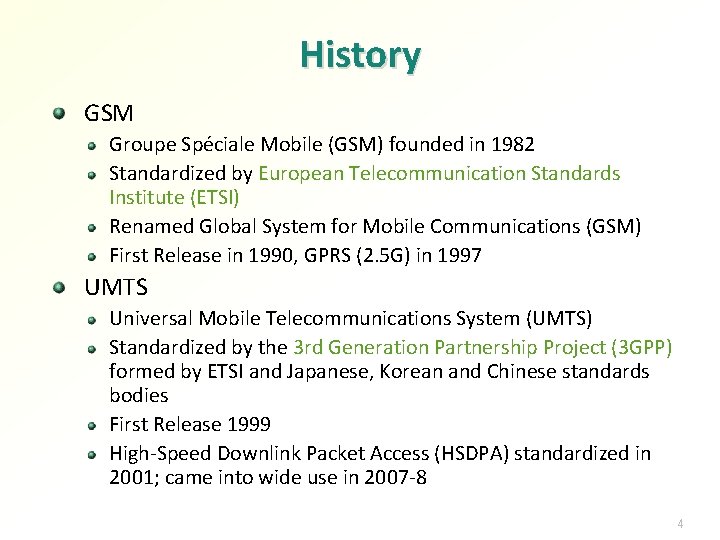
History GSM Groupe Spéciale Mobile (GSM) founded in 1982 Standardized by European Telecommunication Standards Institute (ETSI) Renamed Global System for Mobile Communications (GSM) First Release in 1990, GPRS (2. 5 G) in 1997 UMTS Universal Mobile Telecommunications System (UMTS) Standardized by the 3 rd Generation Partnership Project (3 GPP) formed by ETSI and Japanese, Korean and Chinese standards bodies First Release 1999 High-Speed Downlink Packet Access (HSDPA) standardized in 2001; came into wide use in 2007 -8 4
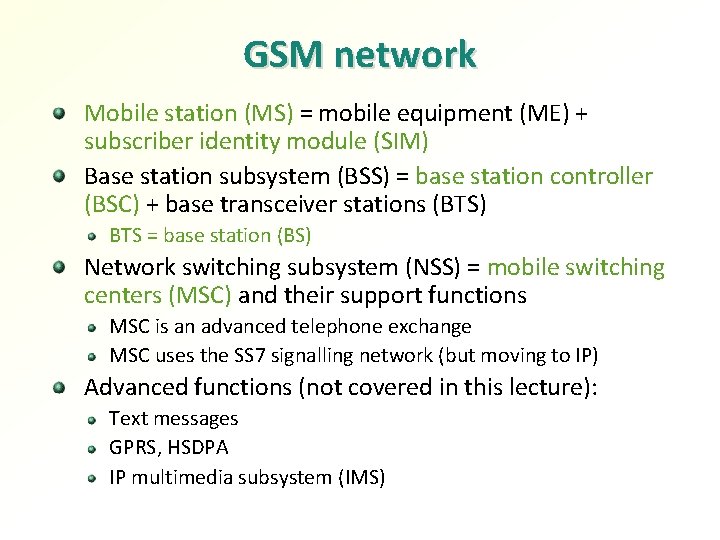
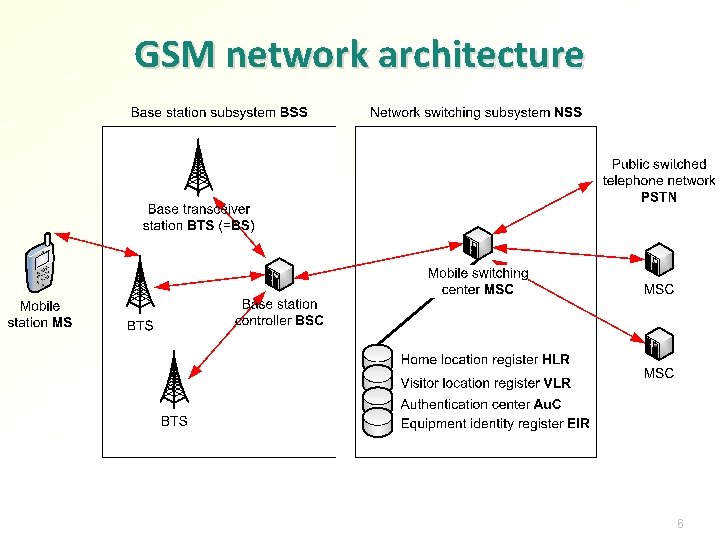
GSM network Mobile station (MS) = mobile equipment (ME) + subscriber identity module (SIM) Base station subsystem (BSS) = base station controller (BSC) + base transceiver stations (BTS) BTS = base station (BS) Network switching subsystem (NSS) = mobile switching centers (MSC) and their support functions MSC is an advanced telephone exchange MSC uses the SS 7 signalling network (but moving to IP) Advanced functions (not covered in this lecture): Text messages GPRS, HSDPA IP multimedia subsystem (IMS)
GSM network architecture 6
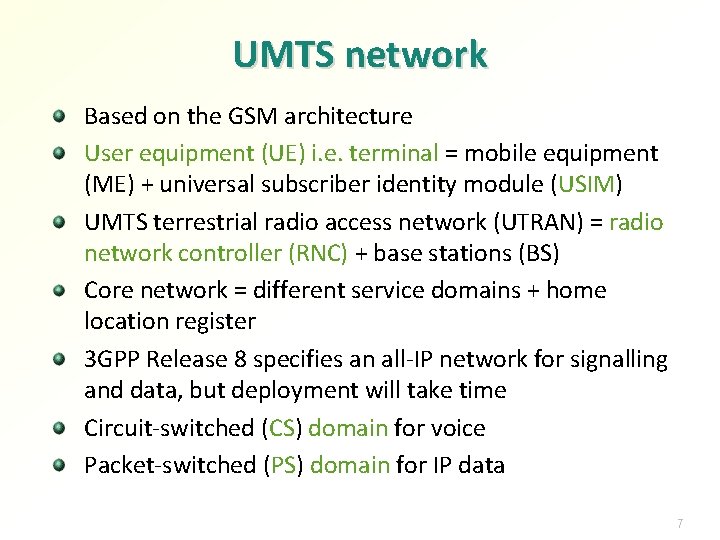
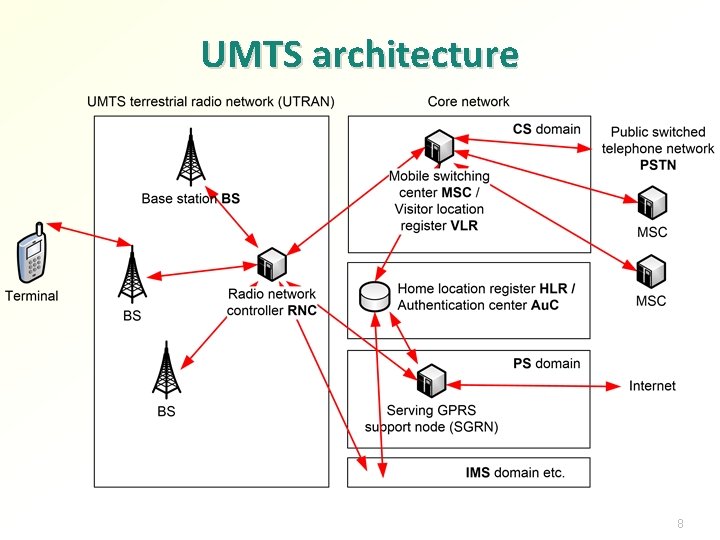
UMTS network Based on the GSM architecture User equipment (UE) i. e. terminal = mobile equipment (ME) + universal subscriber identity module (USIM) UMTS terrestrial radio access network (UTRAN) = radio network controller (RNC) + base stations (BS) Core network = different service domains + home location register 3 GPP Release 8 specifies an all-IP network for signalling and data, but deployment will take time Circuit-switched (CS) domain for voice Packet-switched (PS) domain for IP data 7
UMTS architecture 8
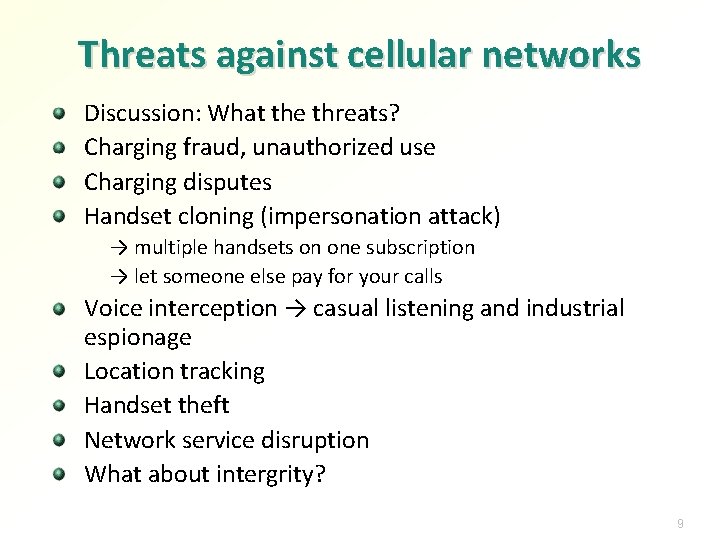
Threats against cellular networks Discussion: What the threats? Charging fraud, unauthorized use Charging disputes Handset cloning (impersonation attack) → multiple handsets on one subscription → let someone else pay for your calls Voice interception → casual listening and industrial espionage Location tracking Handset theft Network service disruption What about intergrity? 9
GSM security
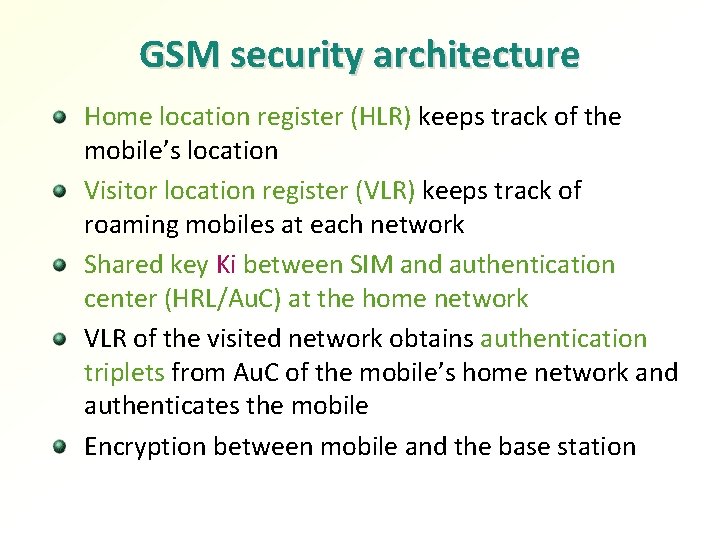
GSM security architecture Home location register (HLR) keeps track of the mobile’s location Visitor location register (VLR) keeps track of roaming mobiles at each network Shared key Ki between SIM and authentication center (HRL/Au. C) at the home network VLR of the visited network obtains authentication triplets from Au. C of the mobile’s home network and authenticates the mobile Encryption between mobile and the base station
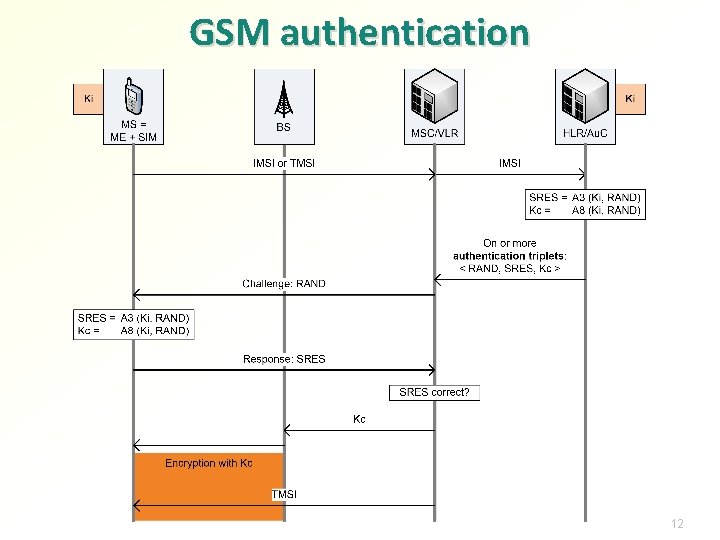
GSM authentication 12
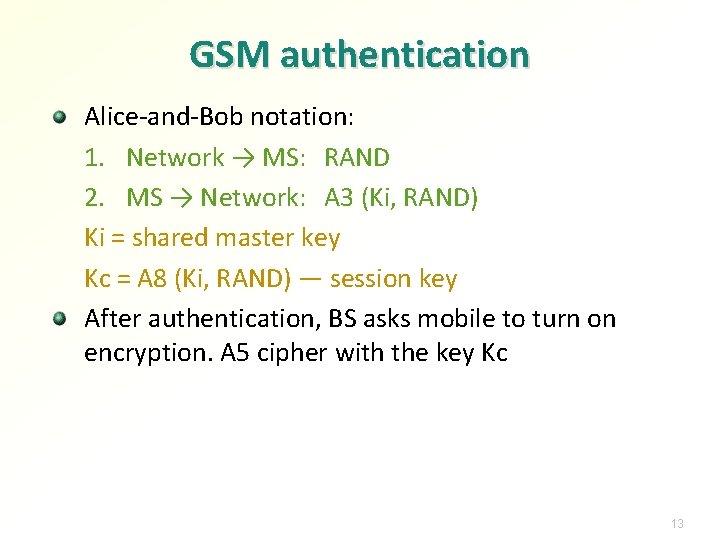
GSM authentication Alice-and-Bob notation: 1. Network → MS: RAND 2. MS → Network: A 3 (Ki, RAND) Ki = shared master key Kc = A 8 (Ki, RAND) — session key After authentication, BS asks mobile to turn on encryption. A 5 cipher with the key Kc 13
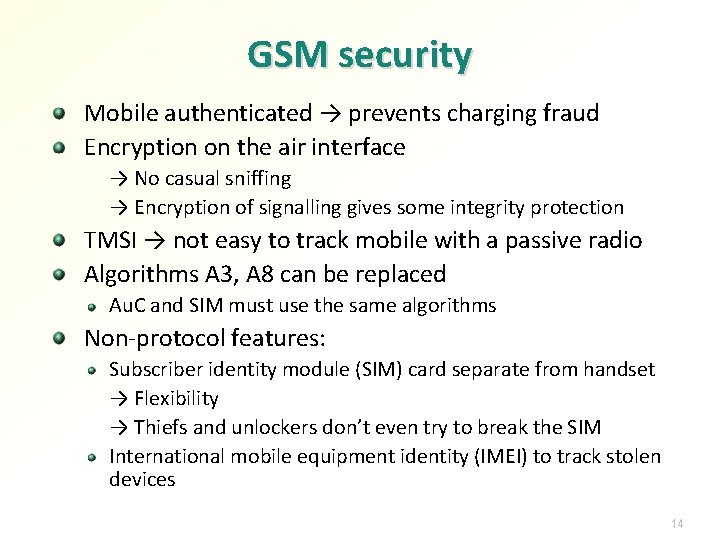
GSM security Mobile authenticated → prevents charging fraud Encryption on the air interface → No casual sniffing → Encryption of signalling gives some integrity protection TMSI → not easy to track mobile with a passive radio Algorithms A 3, A 8 can be replaced Au. C and SIM must use the same algorithms Non-protocol features: Subscriber identity module (SIM) card separate from handset → Flexibility → Thiefs and unlockers don’t even try to break the SIM International mobile equipment identity (IMEI) to track stolen devices 14
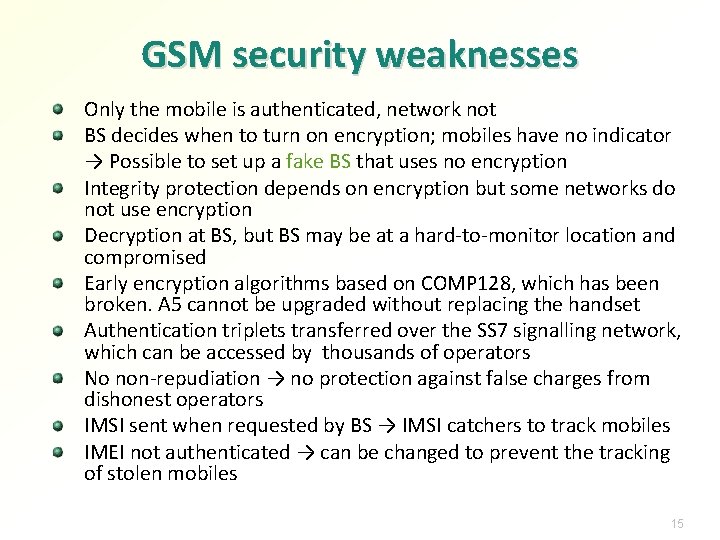
GSM security weaknesses Only the mobile is authenticated, network not BS decides when to turn on encryption; mobiles have no indicator → Possible to set up a fake BS that uses no encryption Integrity protection depends on encryption but some networks do not use encryption Decryption at BS, but BS may be at a hard-to-monitor location and compromised Early encryption algorithms based on COMP 128, which has been broken. A 5 cannot be upgraded without replacing the handset Authentication triplets transferred over the SS 7 signalling network, which can be accessed by thousands of operators No non-repudiation → no protection against false charges from dishonest operators IMSI sent when requested by BS → IMSI catchers to track mobiles IMEI not authenticated → can be changed to prevent the tracking of stolen mobiles 15
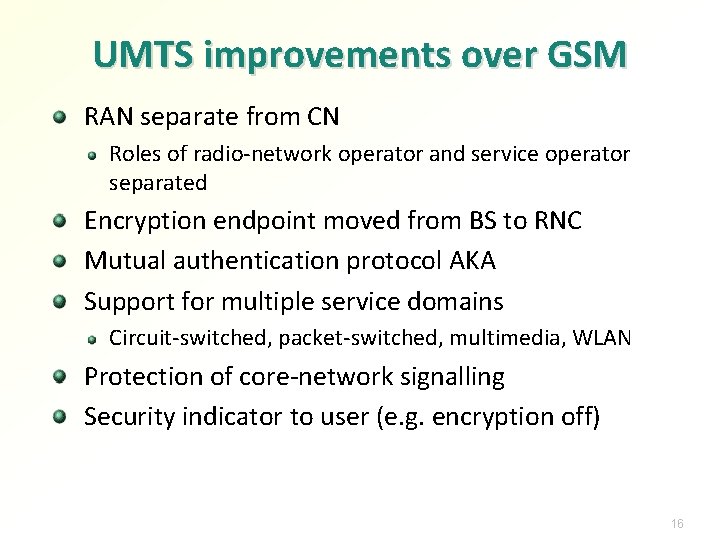
UMTS improvements over GSM RAN separate from CN Roles of radio-network operator and service operator separated Encryption endpoint moved from BS to RNC Mutual authentication protocol AKA Support for multiple service domains Circuit-switched, packet-switched, multimedia, WLAN Protection of core-network signalling Security indicator to user (e. g. encryption off) 16
Counters
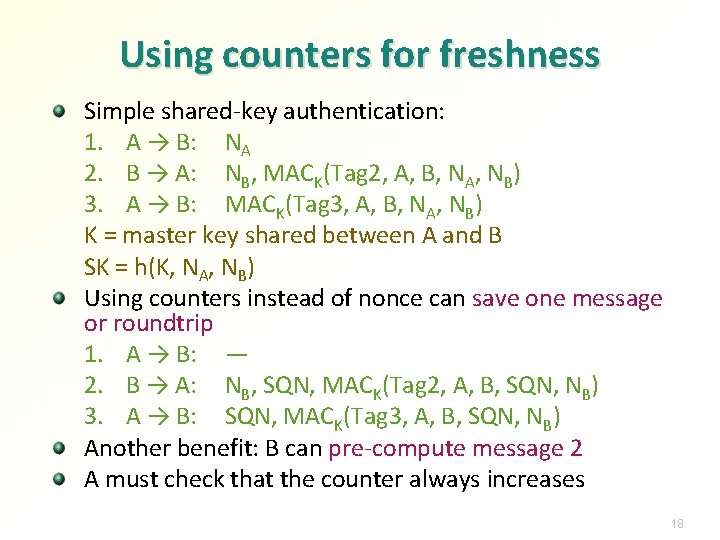
Using counters for freshness Simple shared-key authentication: 1. A → B: NA 2. B → A: NB, MACK(Tag 2, A, B, NA, NB) 3. A → B: MACK(Tag 3, A, B, NA, NB) K = master key shared between A and B SK = h(K, NA, NB) Using counters instead of nonce can save one message or roundtrip 1. A → B: — 2. B → A: NB, SQN, MACK(Tag 2, A, B, SQN, NB) 3. A → B: SQN, MACK(Tag 3, A, B, SQN, NB) Another benefit: B can pre-compute message 2 A must check that the counter always increases 18
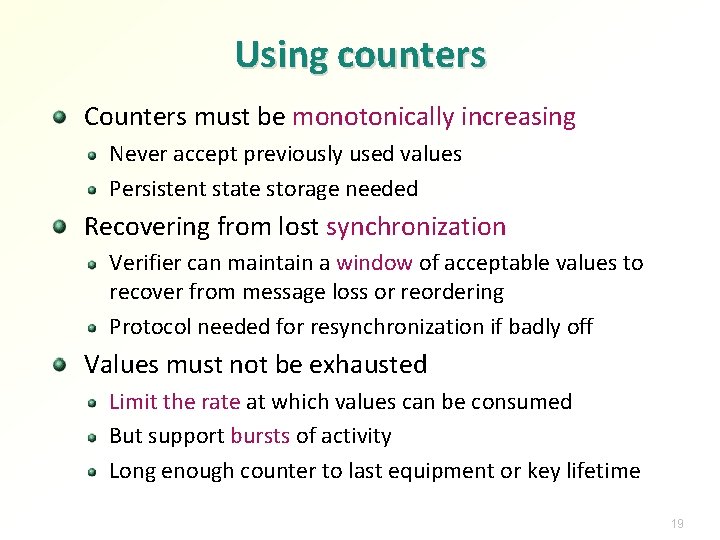
Using counters Counters must be monotonically increasing Never accept previously used values Persistent state storage needed Recovering from lost synchronization Verifier can maintain a window of acceptable values to recover from message loss or reordering Protocol needed for resynchronization if badly off Values must not be exhausted Limit the rate at which values can be consumed But support bursts of activity Long enough counter to last equipment or key lifetime 19
UMTS authentication and key agreement (AKA)
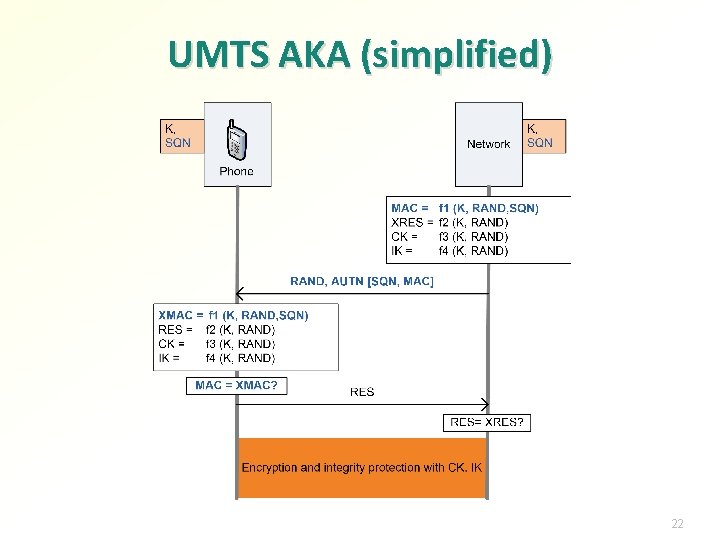
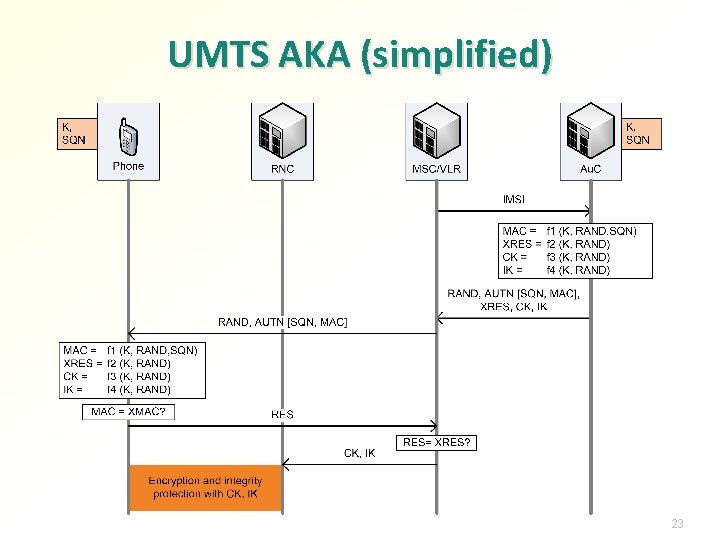
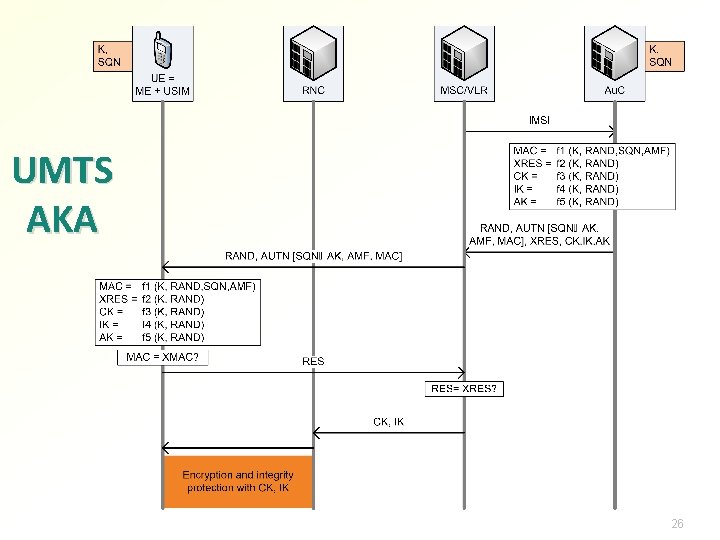
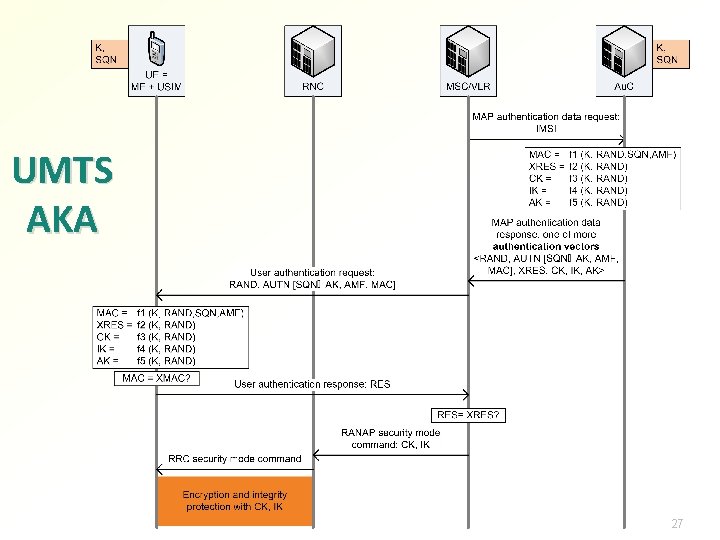
UMTS AKA = authentication and key agreement Based on GSM authentication Mutual authentication Sequence number for freshness to mobile → saves one roundtrip to Au. C → authentication vectors can be retrieved early, several at a time Why is this so important? Why not just use a client nonce? 21
UMTS AKA (simplified) 22
UMTS AKA (simplified) 23
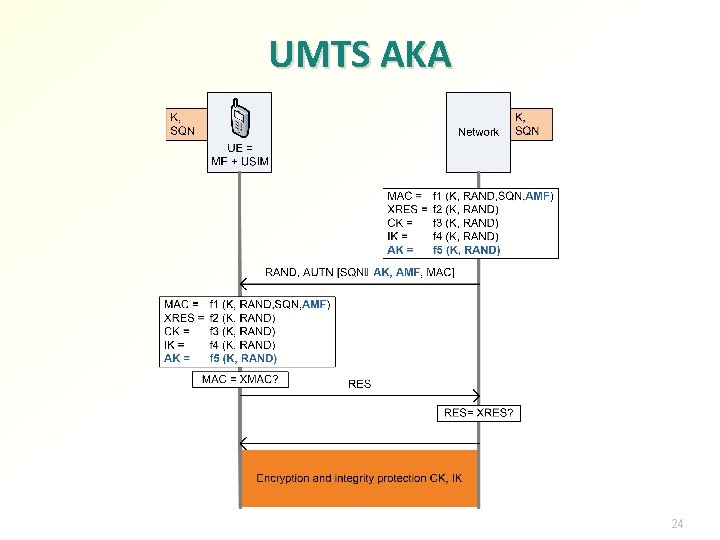
UMTS AKA 24
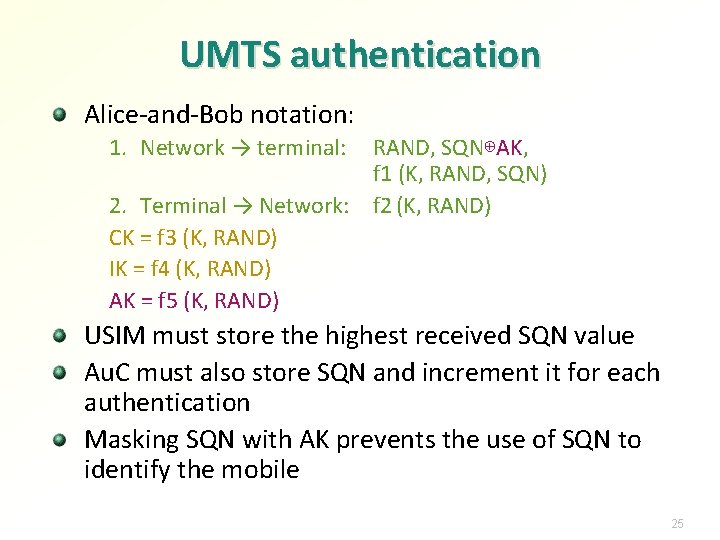
UMTS authentication Alice-and-Bob notation: 1. Network → terminal: RAND, SQN⊕AK, f 1 (K, RAND, SQN) 2. Terminal → Network: f 2 (K, RAND) CK = f 3 (K, RAND) IK = f 4 (K, RAND) AK = f 5 (K, RAND) USIM must store the highest received SQN value Au. C must also store SQN and increment it for each authentication Masking SQN with AK prevents the use of SQN to identify the mobile 25
UMTS AKA 26
UMTS AKA 27
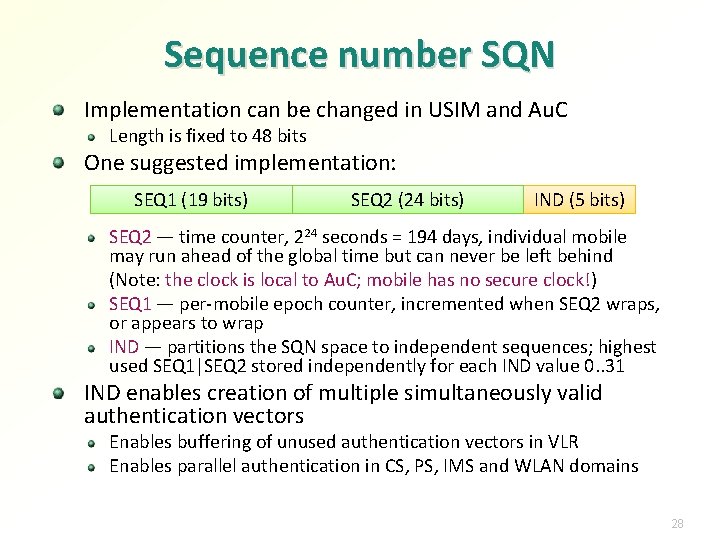
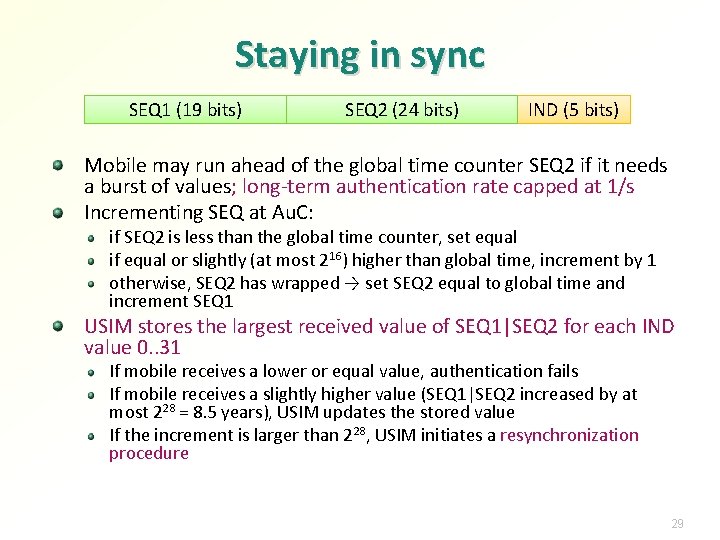
Sequence number SQN Implementation can be changed in USIM and Au. C Length is fixed to 48 bits One suggested implementation: SEQ 1 (19 bits) SEQ 2 (24 bits) IND (5 bits) SEQ 2 — time counter, 224 seconds = 194 days, individual mobile may run ahead of the global time but can never be left behind (Note: the clock is local to Au. C; mobile has no secure clock!) SEQ 1 — per-mobile epoch counter, incremented when SEQ 2 wraps, or appears to wrap IND — partitions the SQN space to independent sequences; highest used SEQ 1|SEQ 2 stored independently for each IND value 0. . 31 IND enables creation of multiple simultaneously valid authentication vectors Enables buffering of unused authentication vectors in VLR Enables parallel authentication in CS, PS, IMS and WLAN domains 28
Staying in sync SEQ 1 (19 bits) SEQ 2 (24 bits) IND (5 bits) Mobile may run ahead of the global time counter SEQ 2 if it needs a burst of values; long-term authentication rate capped at 1/s Incrementing SEQ at Au. C: if SEQ 2 is less than the global time counter, set equal if equal or slightly (at most 216) higher than global time, increment by 1 otherwise, SEQ 2 has wrapped → set SEQ 2 equal to global time and increment SEQ 1 USIM stores the largest received value of SEQ 1|SEQ 2 for each IND value 0. . 31 If mobile receives a lower or equal value, authentication fails If mobile receives a slightly higher value (SEQ 1|SEQ 2 increased by at most 228 = 8. 5 years), USIM updates the stored value If the increment is larger than 228, USIM initiates a resynchronization procedure 29
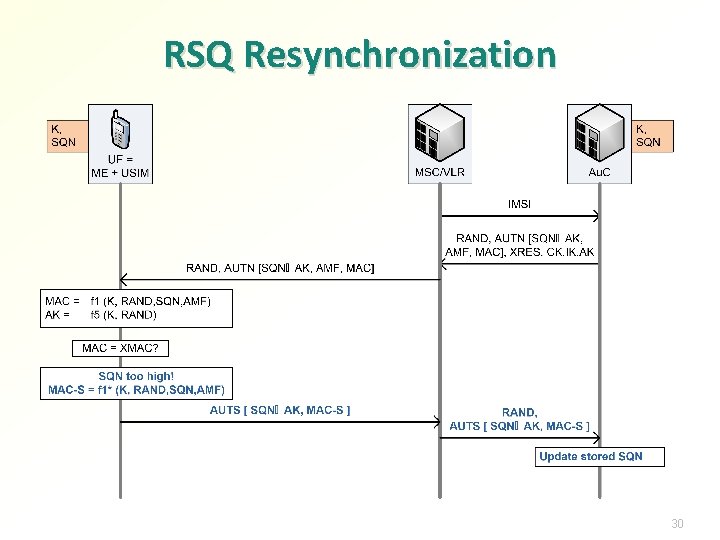
RSQ Resynchronization 30
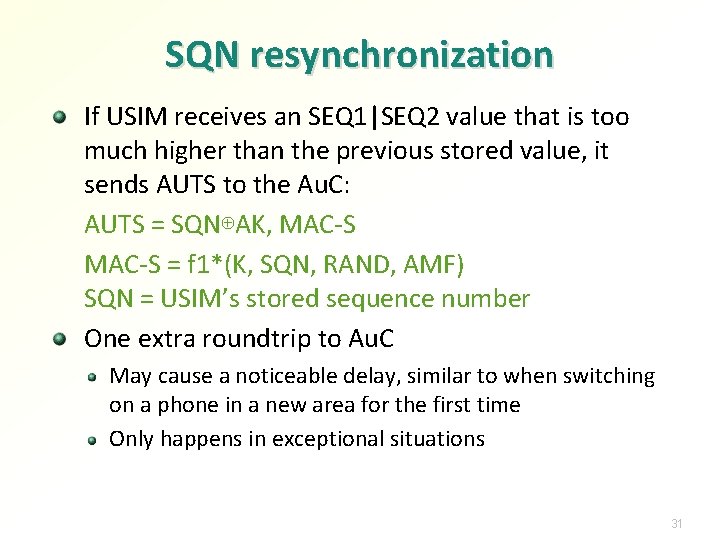
SQN resynchronization If USIM receives an SEQ 1|SEQ 2 value that is too much higher than the previous stored value, it sends AUTS to the Au. C: AUTS = SQN⊕AK, MAC-S = f 1*(K, SQN, RAND, AMF) SQN = USIM’s stored sequence number One extra roundtrip to Au. C May cause a noticeable delay, similar to when switching on a phone in a new area for the first time Only happens in exceptional situations 31
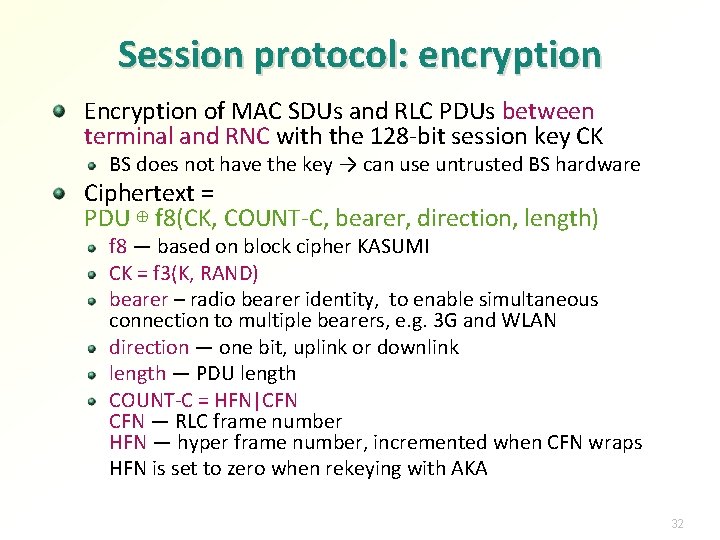
Session protocol: encryption Encryption of MAC SDUs and RLC PDUs between terminal and RNC with the 128 -bit session key CK BS does not have the key → can use untrusted BS hardware Ciphertext = PDU ⊕ f 8(CK, COUNT-C, bearer, direction, length) f 8 — based on block cipher KASUMI CK = f 3(K, RAND) bearer – radio bearer identity, to enable simultaneous connection to multiple bearers, e. g. 3 G and WLAN direction — one bit, uplink or downlink length — PDU length COUNT-C = HFN|CFN — RLC frame number HFN — hyper frame number, incremented when CFN wraps HFN is set to zero when rekeying with AKA 32
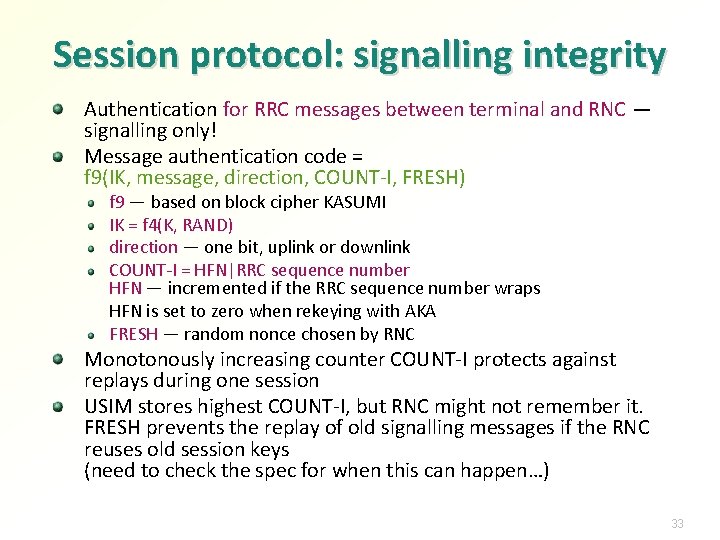
Session protocol: signalling integrity Authentication for RRC messages between terminal and RNC — signalling only! Message authentication code = f 9(IK, message, direction, COUNT-I, FRESH) f 9 — based on block cipher KASUMI IK = f 4(K, RAND) direction — one bit, uplink or downlink COUNT-I = HFN|RRC sequence number HFN — incremented if the RRC sequence number wraps HFN is set to zero when rekeying with AKA FRESH — random nonce chosen by RNC Monotonously increasing counter COUNT-I protects against replays during one session USIM stores highest COUNT-I, but RNC might not remember it. FRESH prevents the replay of old signalling messages if the RNC reuses old session keys (need to check the spec for when this can happen…) 33
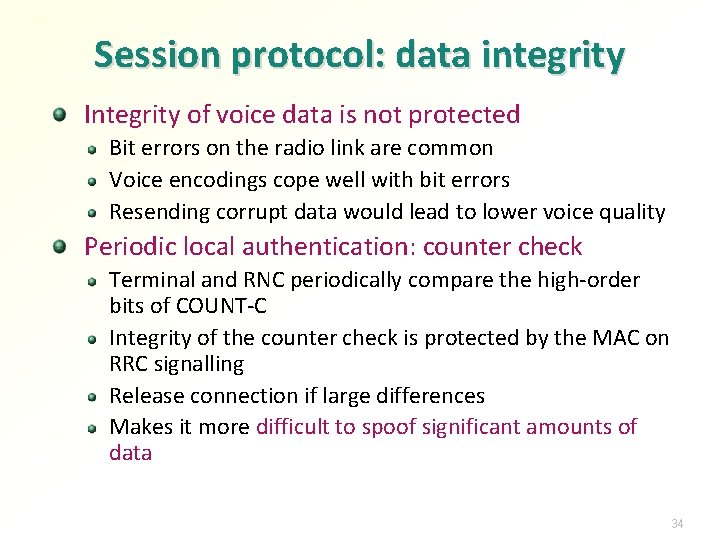
Session protocol: data integrity Integrity of voice data is not protected Bit errors on the radio link are common Voice encodings cope well with bit errors Resending corrupt data would lead to lower voice quality Periodic local authentication: counter check Terminal and RNC periodically compare the high-order bits of COUNT-C Integrity of the counter check is protected by the MAC on RRC signalling Release connection if large differences Makes it more difficult to spoof significant amounts of data 34
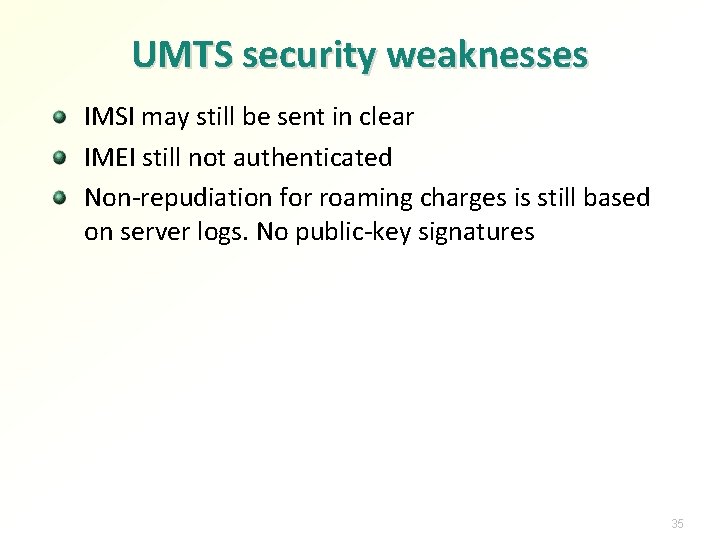
UMTS security weaknesses IMSI may still be sent in clear IMEI still not authenticated Non-repudiation for roaming charges is still based on server logs. No public-key signatures 35
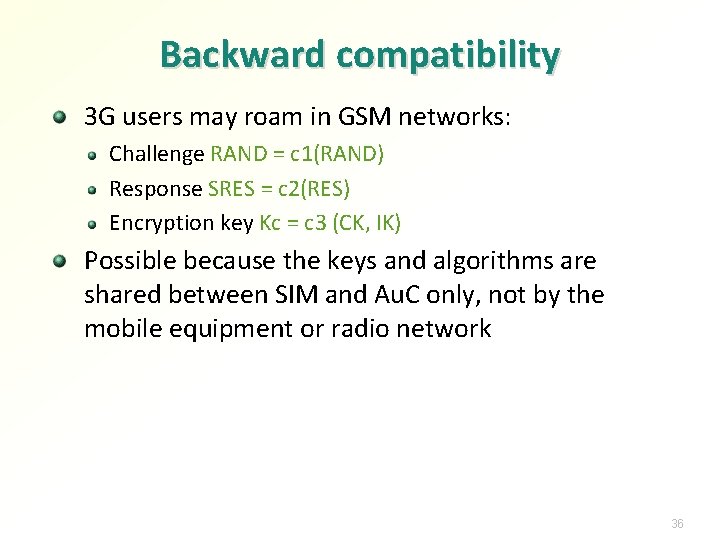
Backward compatibility 3 G users may roam in GSM networks: Challenge RAND = c 1(RAND) Response SRES = c 2(RES) Encryption key Kc = c 3 (CK, IK) Possible because the keys and algorithms are shared between SIM and Au. C only, not by the mobile equipment or radio network 36
Exercises Who could create false location traces in the GSM HLR and how? Is this possible in UMTS? Consider replacing the counter with a client nonce in AKA. What would you lose? Try to design a protocol where the IMSI is never sent over the air interface, i. e. the subscriber identity is never sent in clear. Remember that the terminal may have just landed from an intercontinental flight, and the terminal doesn’t know whether it has or not 37