
Network Science Focus on structural Discovery What do





- Slides: 28
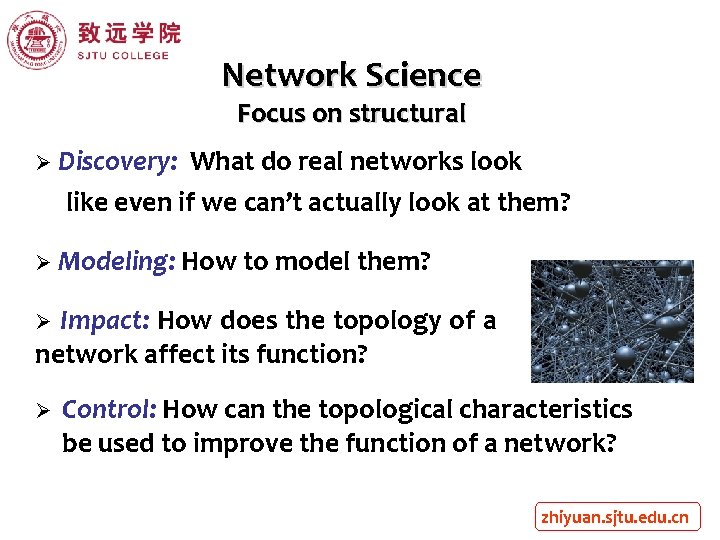
Network Science Focus on structural Ø Discovery: What do real networks look like even if we can’t actually look at them? Ø Modeling: How to model them? Impact: How does the topology of a network affect its function? Ø Ø Control: How can the topological characteristics be used to improve the function of a network? zhiyuan. sjtu. edu. cn
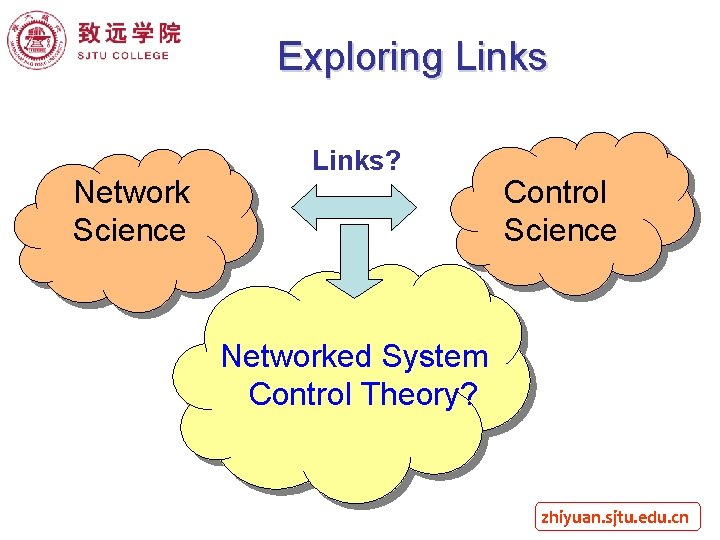
Exploring Links Network Science Links? Control Science Networked System Control Theory? zhiyuan. sjtu. edu. cn
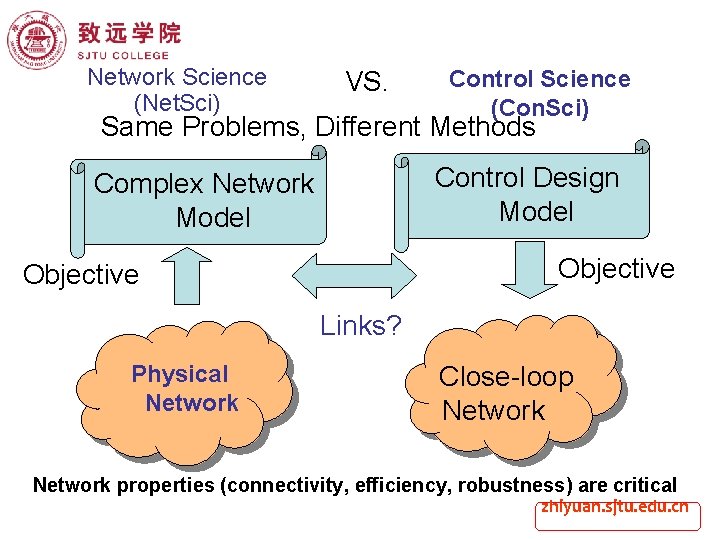
Network Science (Net. Sci) VS. Control Science (Con. Sci) Same Problems, Different Methods Control Design Model Complex Network Model Objective Links? Physical Network Close-loop Network properties (connectivity, efficiency, robustness) are critical zhiyuan. sjtu. edu. cn
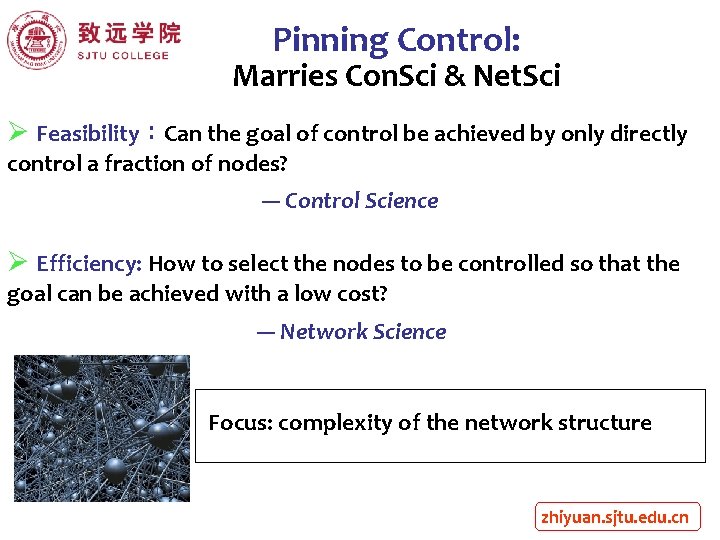
Pinning Control: Marries Con. Sci & Net. Sci Ø Feasibility:Can the goal of control be achieved by only directly control a fraction of nodes? --- Control Science Ø Efficiency: How to select the nodes to be controlled so that the goal can be achieved with a low cost? --- Network Science Focus: complexity of the network structure zhiyuan. sjtu. edu. cn
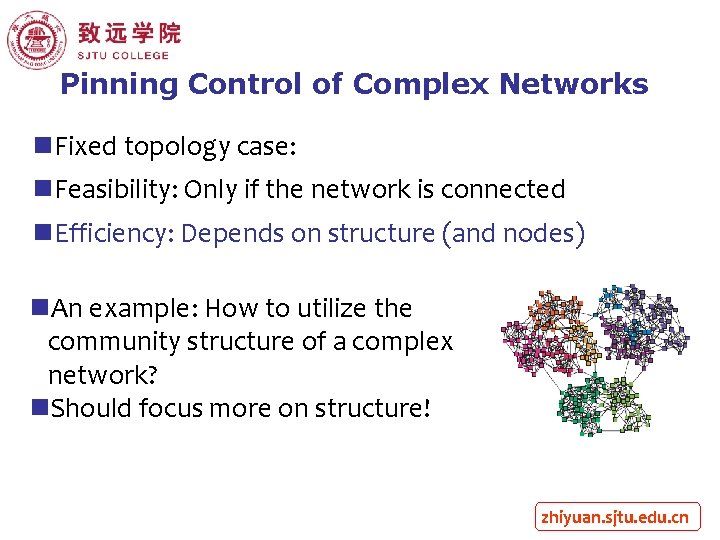
Pinning Control of Complex Networks n. Fixed topology case: n. Feasibility: Only if the network is connected n. Efficiency: Depends on structure (and nodes) n. An example: How to utilize the community structure of a complex network? n. Should focus more on structure! zhiyuan. sjtu. edu. cn
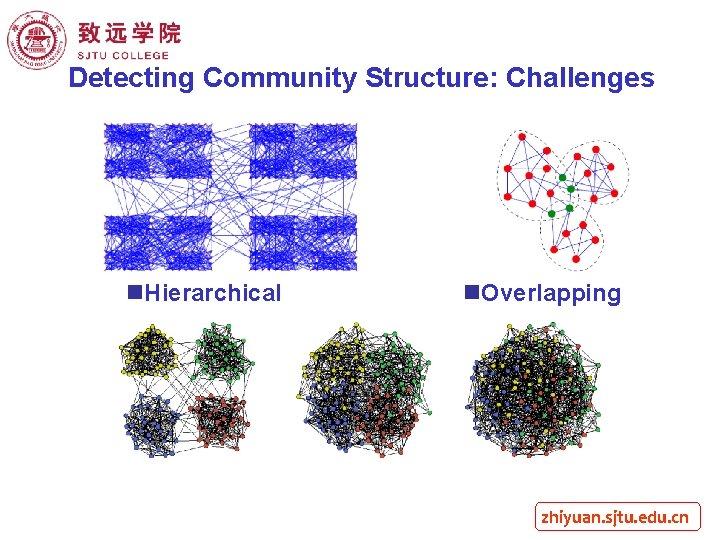
Detecting Community Structure: Challenges n. Hierarchical n. Overlapping zhiyuan. sjtu. edu. cn
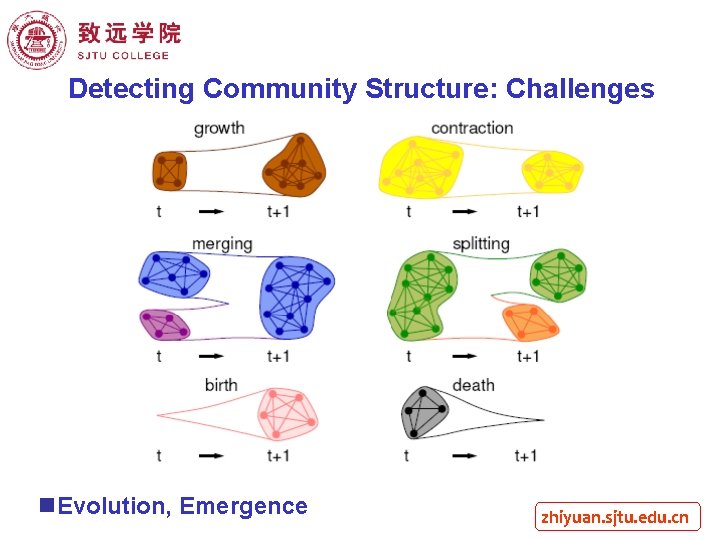
Detecting Community Structure: Challenges n. Evolution, Emergence zhiyuan. sjtu. edu. cn
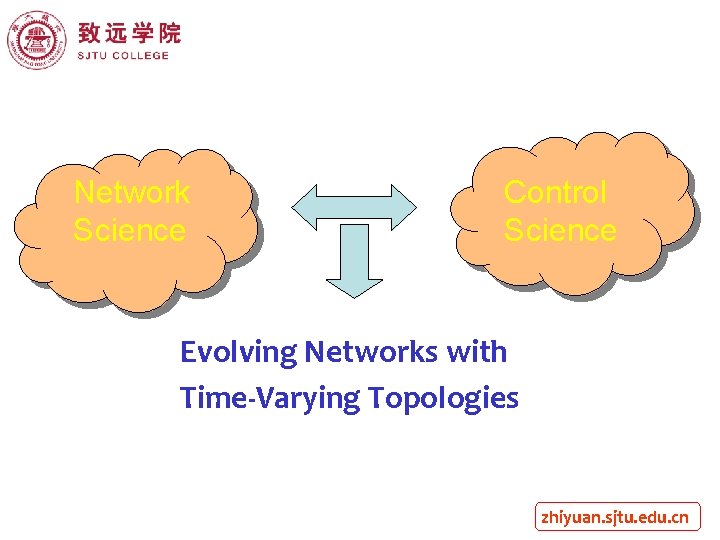
Network Science Control Science Evolving Networks with Time-Varying Topologies zhiyuan. sjtu. edu. cn
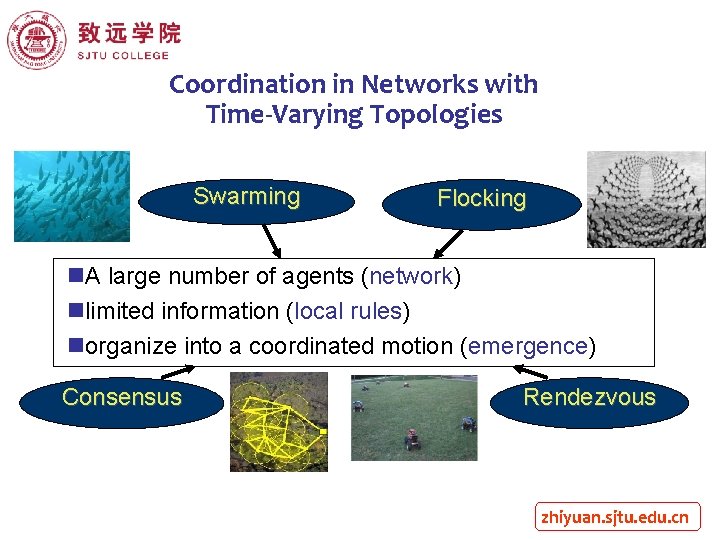
Coordination in Networks with Time-Varying Topologies Swarming Flocking n. A large number of agents (network) nlimited information (local rules) norganize into a coordinated motion (emergence) Consensus Rendezvous zhiyuan. sjtu. edu. cn
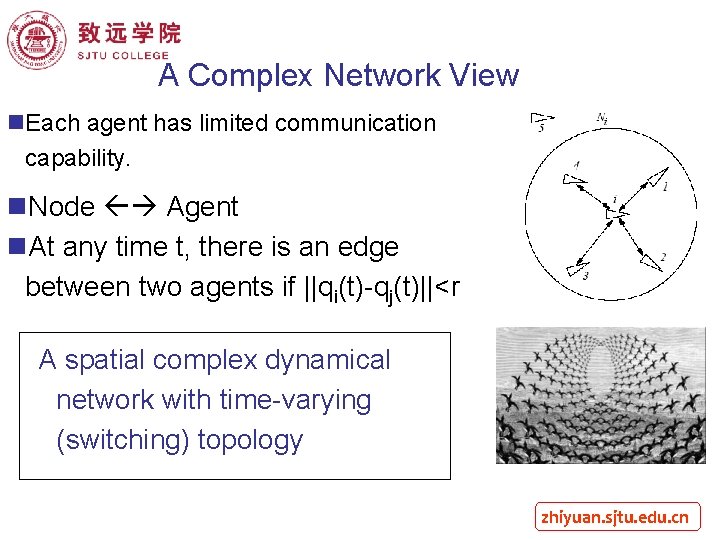
A Complex Network View n. Each agent has limited communication capability. n. Node Agent n. At any time t, there is an edge between two agents if ||qi(t)-qj(t)||<r A spatial complex dynamical network with time-varying (switching) topology zhiyuan. sjtu. edu. cn
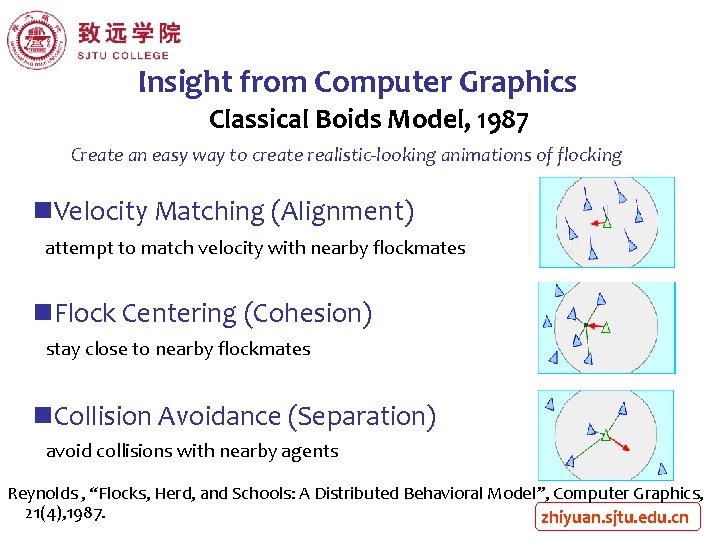
Insight from Computer Graphics Classical Boids Model, 1987 Create an easy way to create realistic-looking animations of flocking n. Velocity Matching (Alignment) attempt to match velocity with nearby flockmates n. Flock Centering (Cohesion) stay close to nearby flockmates n. Collision Avoidance (Separation) avoid collisions with nearby agents Reynolds , “Flocks, Herd, and Schools: A Distributed Behavioral Model”, Computer Graphics, 21(4), 1987. zhiyuan. sjtu. edu. cn
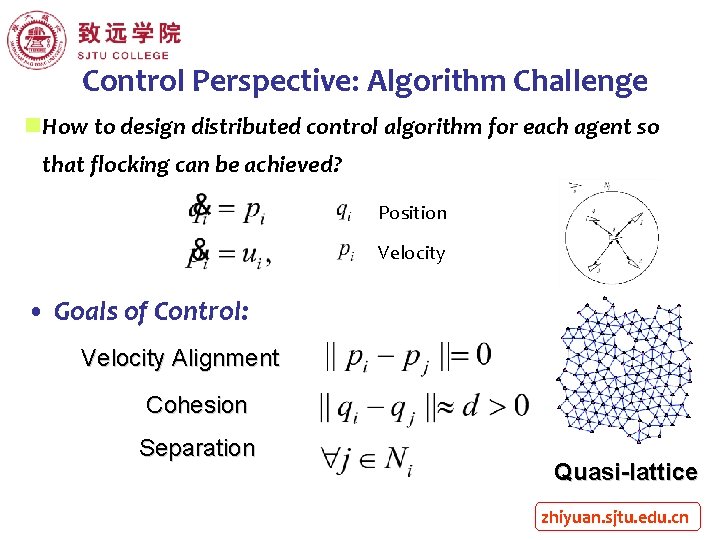
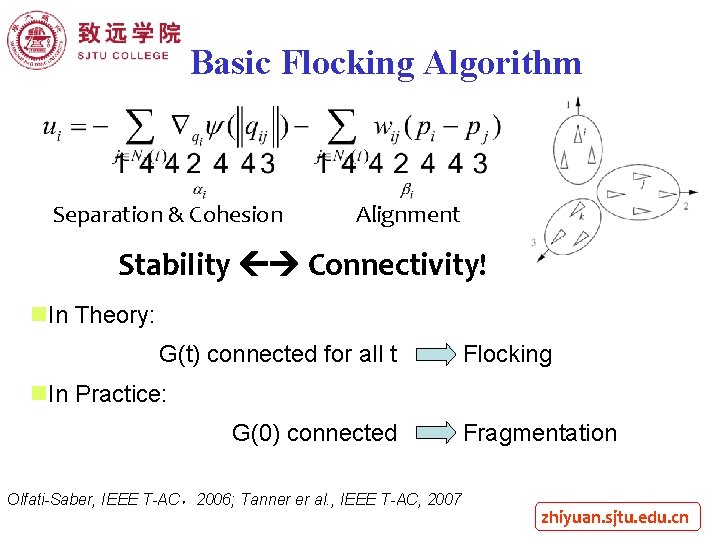
Control Perspective: Algorithm Challenge n. How to design distributed control algorithm for each agent so that flocking can be achieved? Position Velocity • Goals of Control: Velocity Alignment Cohesion Separation Quasi-lattice zhiyuan. sjtu. edu. cn
Basic Flocking Algorithm Separation & Cohesion Alignment Stability Connectivity! n. In Theory: G(t) connected for all t Flocking n. In Practice: G(0) connected Olfati-Saber, IEEE T-AC,2006; Tanner er al. , IEEE T-AC, 2007 Fragmentation zhiyuan. sjtu. edu. cn
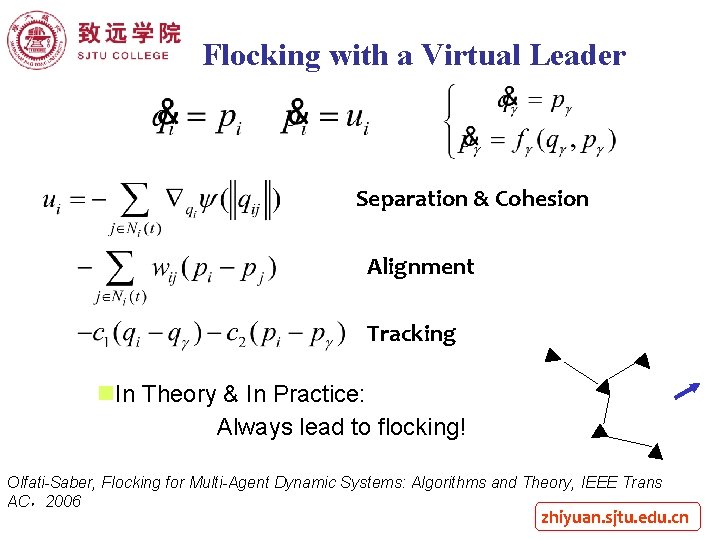
Flocking with a Virtual Leader Separation & Cohesion Alignment Tracking n. In Theory & In Practice: Always lead to flocking! Olfati-Saber, Flocking for Multi-Agent Dynamic Systems: Algorithms and Theory, IEEE Trans AC,2006 zhiyuan. sjtu. edu. cn
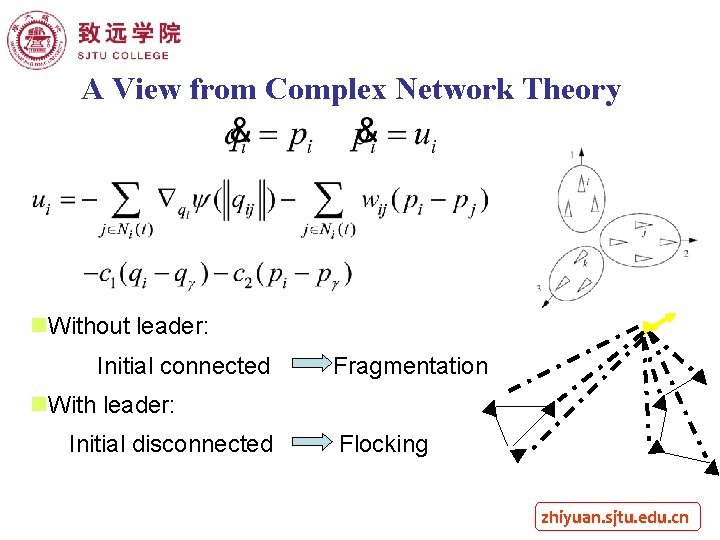
A View from Complex Network Theory n. Without leader: Initial connected Fragmentation n. With leader: Initial disconnected Flocking zhiyuan. sjtu. edu. cn
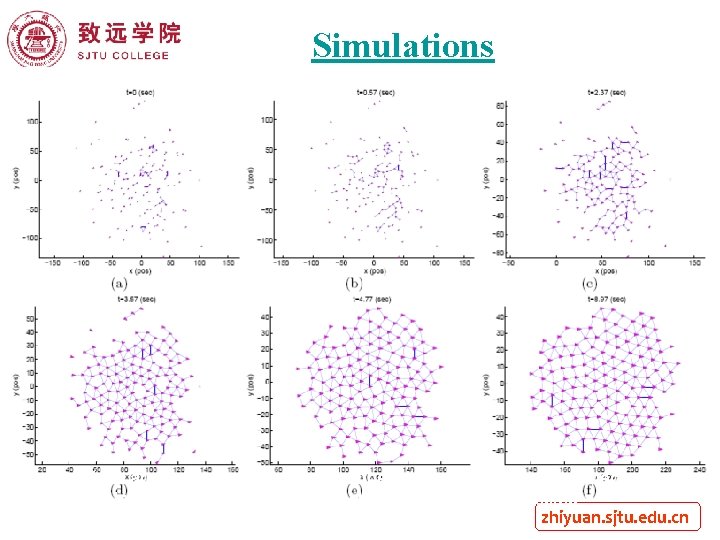
Simulations Initial positions are chosen randomly so that the initial net is highly disconnected. No. of edges increases and has a tendency to render the net connected. zhiyuan. sjtu. edu. cn
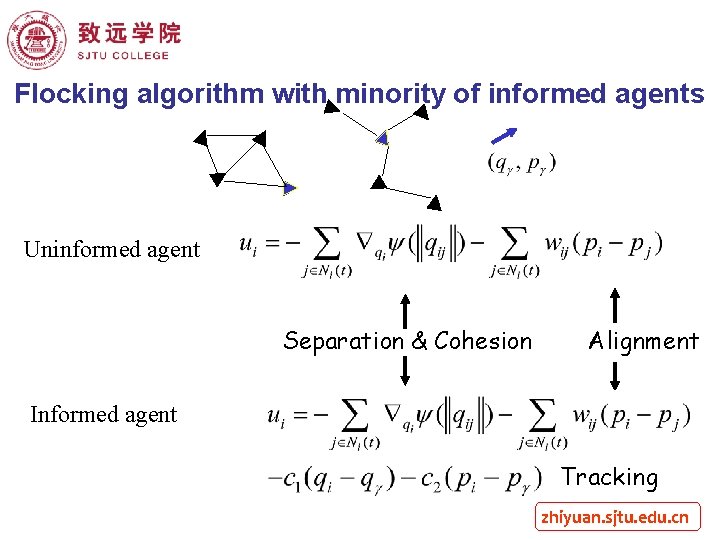
Flocking algorithm with minority of informed agents Uninformed agent Separation & Cohesion Alignment Informed agent Tracking zhiyuan. sjtu. edu. cn
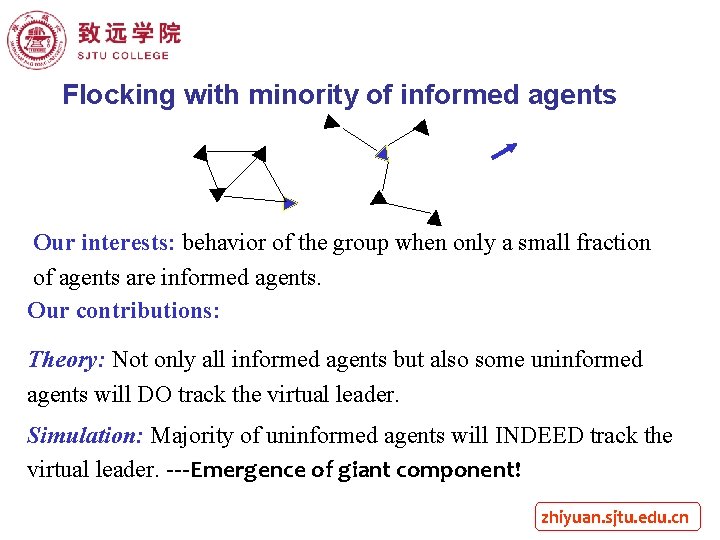
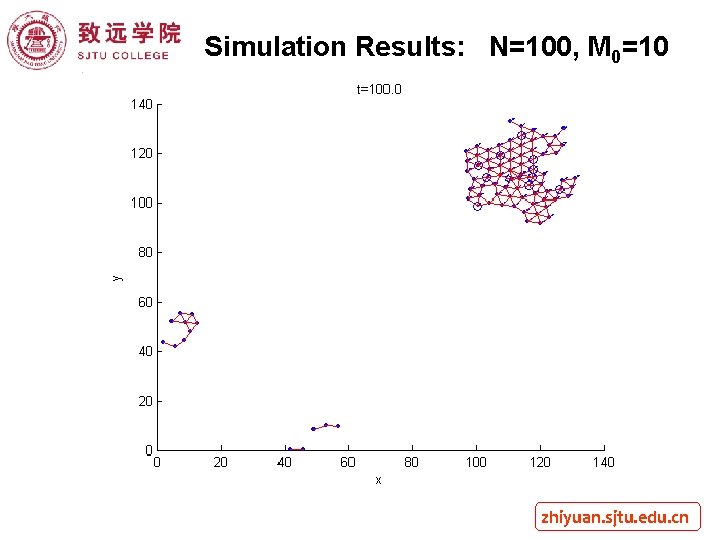
Flocking with minority of informed agents Our interests: behavior of the group when only a small fraction of agents are informed agents. Our contributions: Theory: Not only all informed agents but also some uninformed agents will DO track the virtual leader. Simulation: Majority of uninformed agents will INDEED track the virtual leader. ---Emergence of giant component! zhiyuan. sjtu. edu. cn
Simulation Results: N=100, M 0=10 zhiyuan. sjtu. edu. cn
Network Science Focus on structural Ø Discovery: What do real networks look like even if we can’t actually look at them? Ø Modeling: How to model them? Impact: How does the topology of a network affect its function? Ø Ø Control: How can the topological characteristics be used to improve the function of a network? zhiyuan. sjtu. edu. cn
xfwang@sjtu. edu. cn zhiyuan. sjtu. edu. cn