
Network Protocols and Vulnerabilities John Mitchell Outline u
Network Protocols and Vulnerabilities John Mitchell
Outline u. Basic Networking (FMU) u. Network attacks • Attack host networking protocols – SYN flooding, TCP Spoofing, … • Attack network infrastructure – Routing – Domain Name System This lecture is about the way things work now and how they are not perfect. Next lecture – some security improvements (still not perfect).
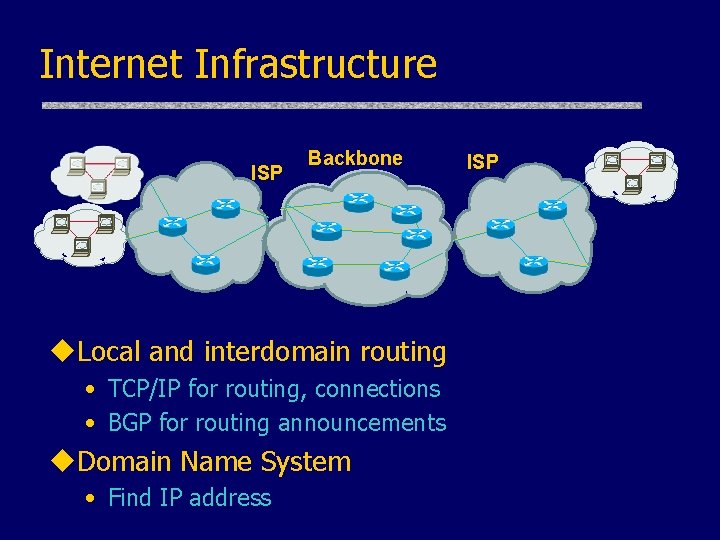
Internet Infrastructure ISP Backbone u. Local and interdomain routing • TCP/IP for routing, connections • BGP for routing announcements u. Domain Name System • Find IP address ISP
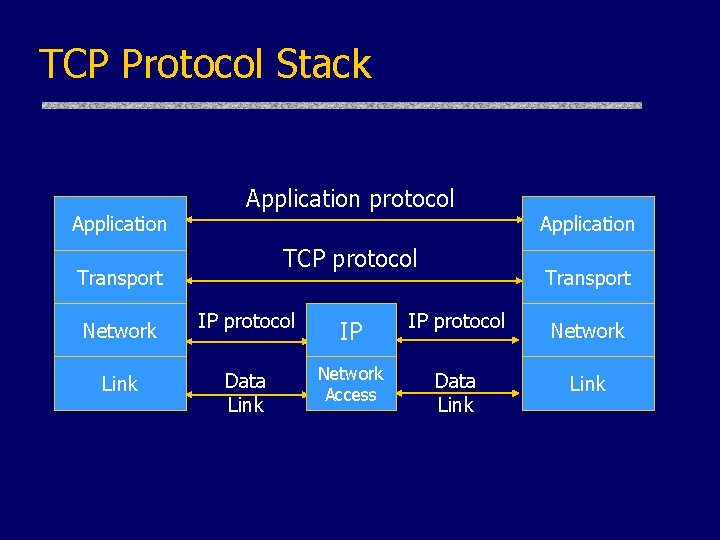
TCP Protocol Stack Application protocol TCP protocol Transport Application Transport Network IP protocol IP IP protocol Network Link Data Link Network Access Data Link
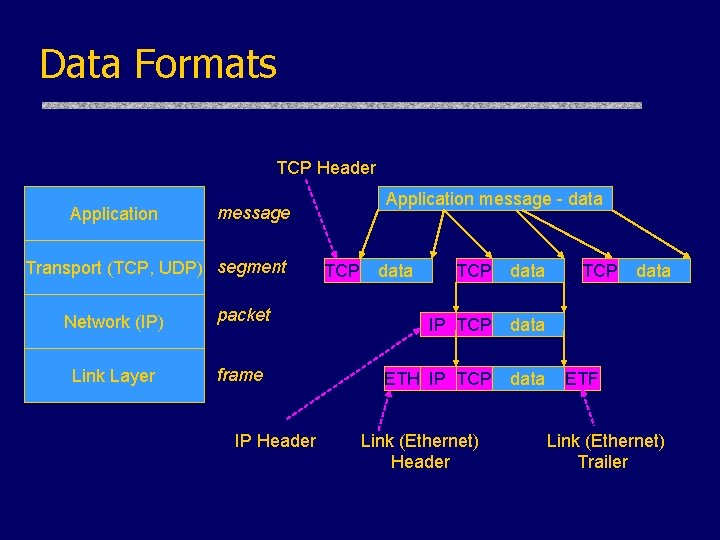
Data Formats TCP Header Application message - data message Transport (TCP, UDP) segment Network (IP) packet Link Layer frame IP Header TCP data IP TCP data ETH IP TCP data Link (Ethernet) Header TCP data ETF Link (Ethernet) Trailer
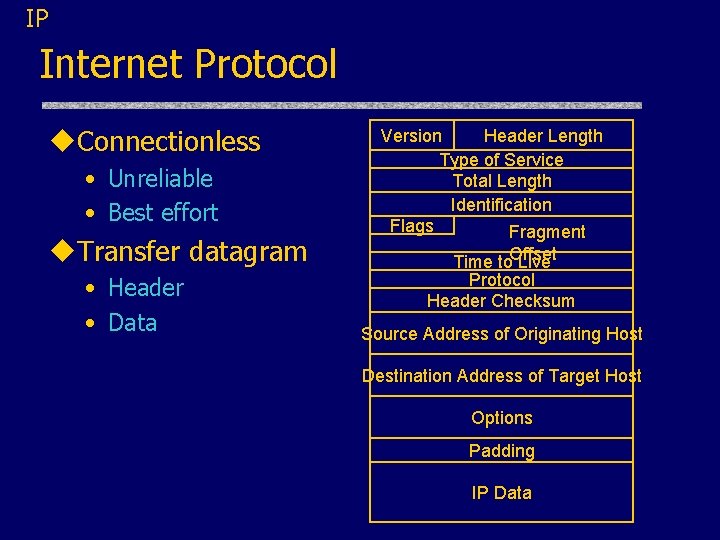
IP Internet Protocol u. Connectionless • Unreliable • Best effort u. Transfer datagram • Header • Data Version Header Length Type of Service Total Length Identification Flags Fragment Time to. Offset Live Protocol Header Checksum Source Address of Originating Host Destination Address of Target Host Options Padding IP Data
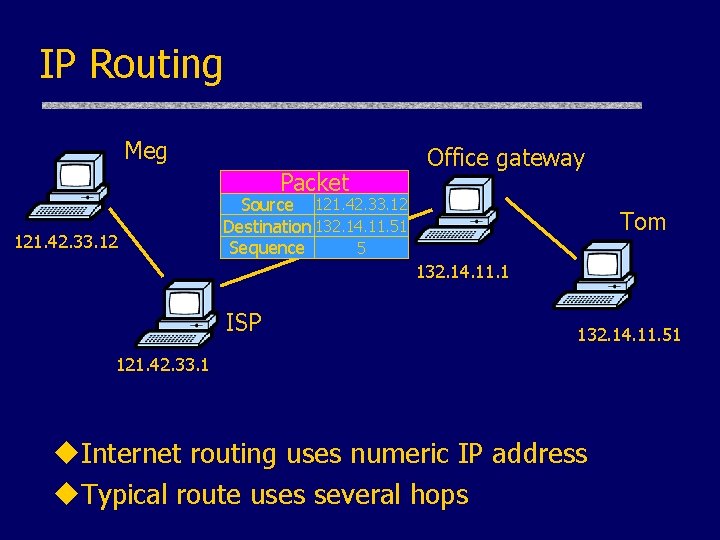
IP Routing Meg Packet 121. 42. 33. 12 Office gateway Source 121. 42. 33. 12 Destination 132. 14. 11. 51 5 Sequence Tom 132. 14. 11. 1 ISP 132. 14. 11. 51 121. 42. 33. 1 u. Internet routing uses numeric IP address u. Typical route uses several hops
IP Protocol Functions (Summary) u. Routing • IP host knows location of router (gateway) • IP gateway must know route to other networks u. Error reporting • IP reports discards to source u. Fragmentation and reassembly • If packets smaller than the user data
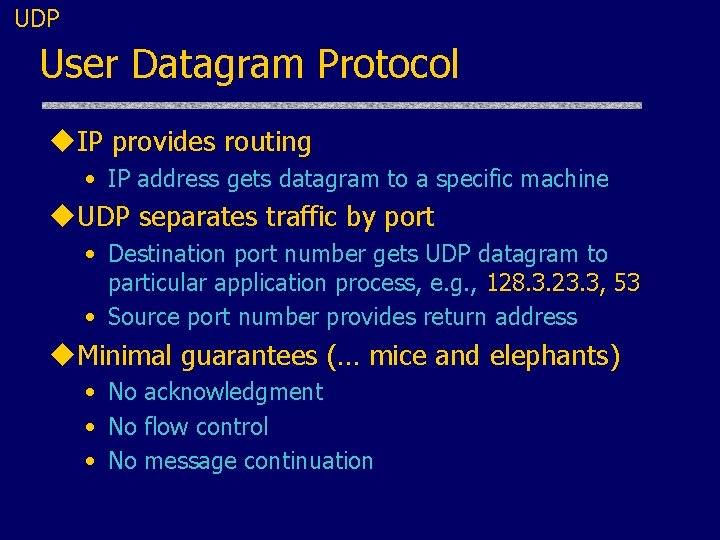
UDP User Datagram Protocol u. IP provides routing • IP address gets datagram to a specific machine u. UDP separates traffic by port • Destination port number gets UDP datagram to particular application process, e. g. , 128. 3. 23. 3, 53 • Source port number provides return address u. Minimal guarantees (… mice and elephants) • No acknowledgment • No flow control • No message continuation
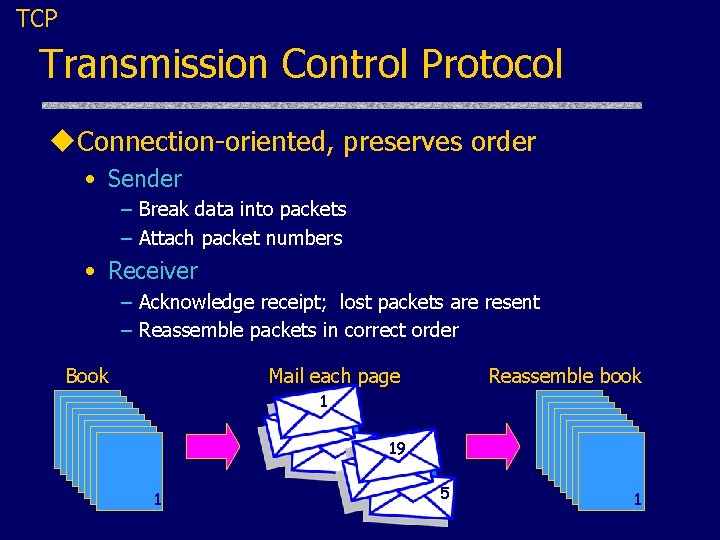
TCP Transmission Control Protocol u. Connection-oriented, preserves order • Sender – Break data into packets – Attach packet numbers • Receiver – Acknowledge receipt; lost packets are resent – Reassemble packets in correct order Book Mail each page Reassemble book 1 19 1 5 1
ICMP Internet Control Message Protocol u. Provides feedback about network operation • Error reporting • Reachability testing • Congestion Control u. Example message types • • • Destination unreachable Time exceeded Parameter problem Redirect to better gateway Echo/echo reply - reachability test Timestamp request/reply - measure transit delay
Basic Security Problems u. Network packets pass by untrusted hosts • Eavesdropping, packet sniffing u. IP addresses are public • Smurf u. TCP connection requires state • SYN flooding attack u. TCP state easy to guess • TCP spoofing attack
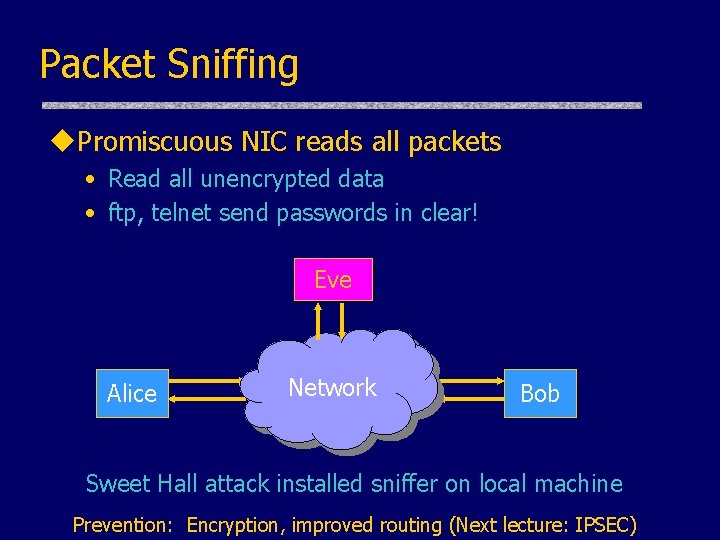
Packet Sniffing u. Promiscuous NIC reads all packets • Read all unencrypted data • ftp, telnet send passwords in clear! Eve Alice Network Bob Sweet Hall attack installed sniffer on local machine Prevention: Encryption, improved routing (Next lecture: IPSEC)
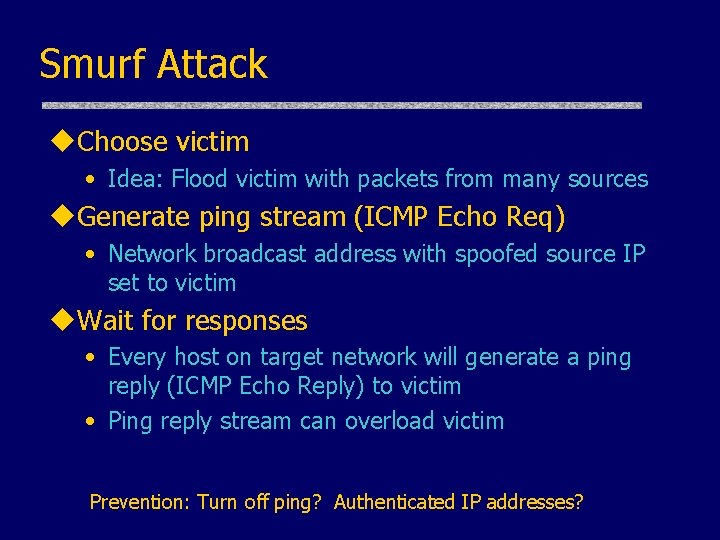
Smurf Attack u. Choose victim • Idea: Flood victim with packets from many sources u. Generate ping stream (ICMP Echo Req) • Network broadcast address with spoofed source IP set to victim u. Wait for responses • Every host on target network will generate a ping reply (ICMP Echo Reply) to victim • Ping reply stream can overload victim Prevention: Turn off ping? Authenticated IP addresses?
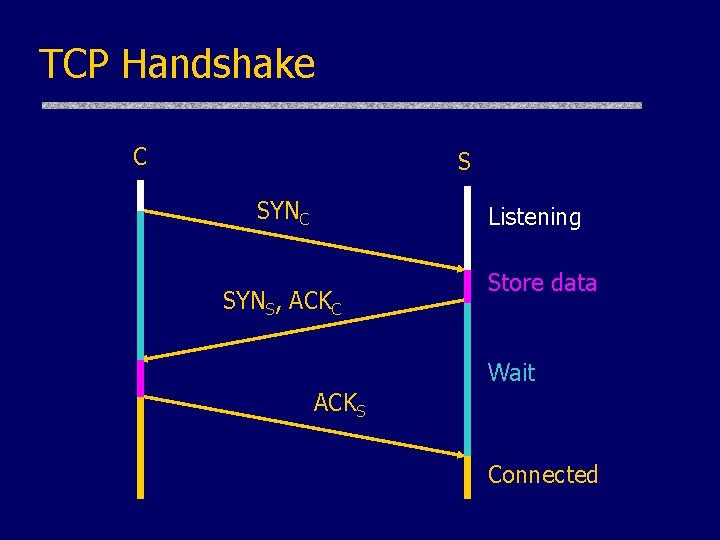
TCP Handshake C S SYNC Listening SYNS, ACKC Store data Wait ACKS Connected
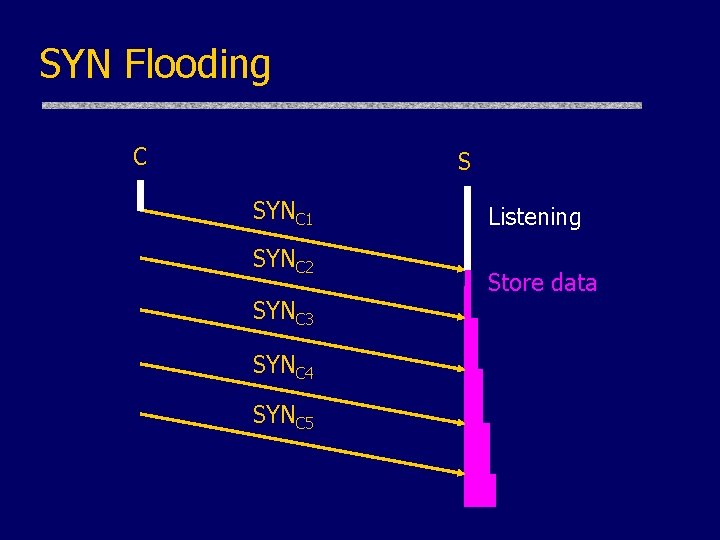
SYN Flooding C S SYNC 1 SYNC 2 SYNC 3 SYNC 4 SYNC 5 Listening Store data
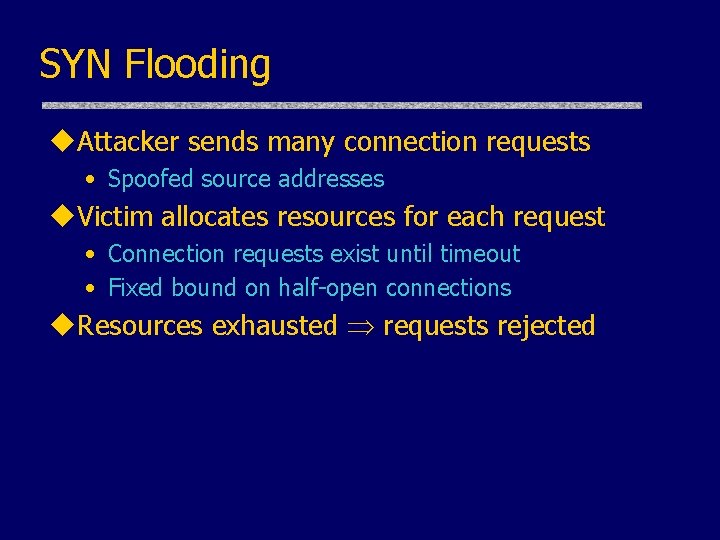
SYN Flooding u. Attacker sends many connection requests • Spoofed source addresses u. Victim allocates resources for each request • Connection requests exist until timeout • Fixed bound on half-open connections u. Resources exhausted requests rejected
![Protection against SYN Attacks [Bernstein, Schenk] u. Client sends SYN u. Server responds to](http://slidetodoc.com/presentation_image_h2/7967ba03a4c8fa20eb8863b6e423dd28/image-18.jpg "Protection against SYN Attacks [Bernstein, Schenk] u. Client sends SYN u. Server responds to")
Protection against SYN Attacks [Bernstein, Schenk] u. Client sends SYN u. Server responds to Client with SYN-ACK cookie • sqn = f(src addr, src port, dest addr, dest port, rand) • Server does not save state u. Honest client responds with ACK(sqn) u. Server checks response • If matches SYN-ACK, establishes connection See http: //cr. yp. to/syncookies. html
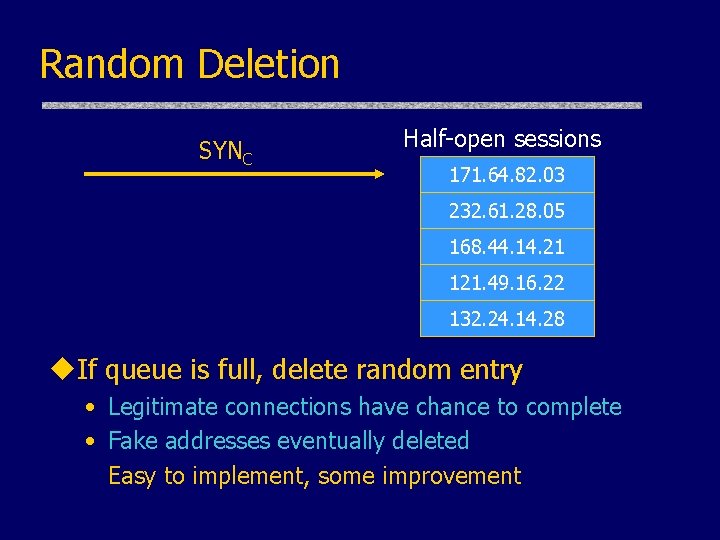
Random Deletion SYNC Half-open sessions 171. 64. 82. 03 232. 61. 28. 05 168. 44. 14. 21 121. 49. 16. 22 132. 24. 14. 28 u. If queue is full, delete random entry • Legitimate connections have chance to complete • Fake addresses eventually deleted Easy to implement, some improvement
TCP Connection Spoofing u. Each TCP connection has an associated state • Sequence number, port number u. Problem • Easy to guess state – Port numbers are standard – Sequence numbers often chosen in predictable way
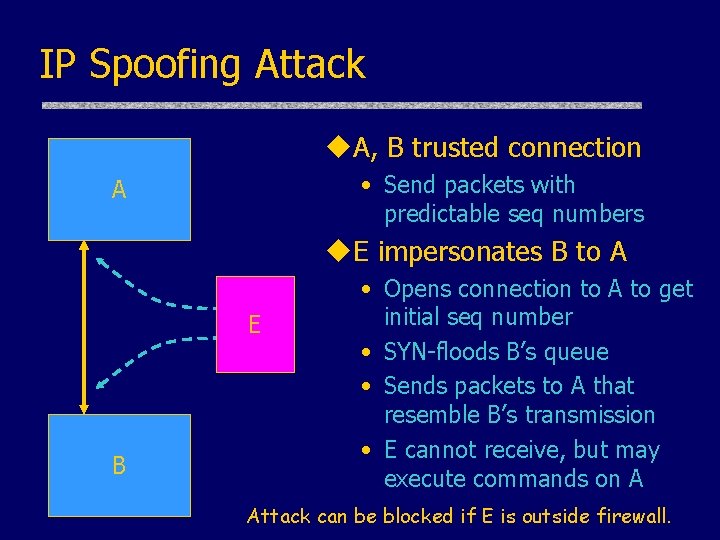
IP Spoofing Attack u. A, B trusted connection • Send packets with predictable seq numbers A u. E impersonates B to A E B • Opens connection to A to get initial seq number • SYN-floods B’s queue • Sends packets to A that resemble B’s transmission • E cannot receive, but may execute commands on A Attack can be blocked if E is outside firewall.
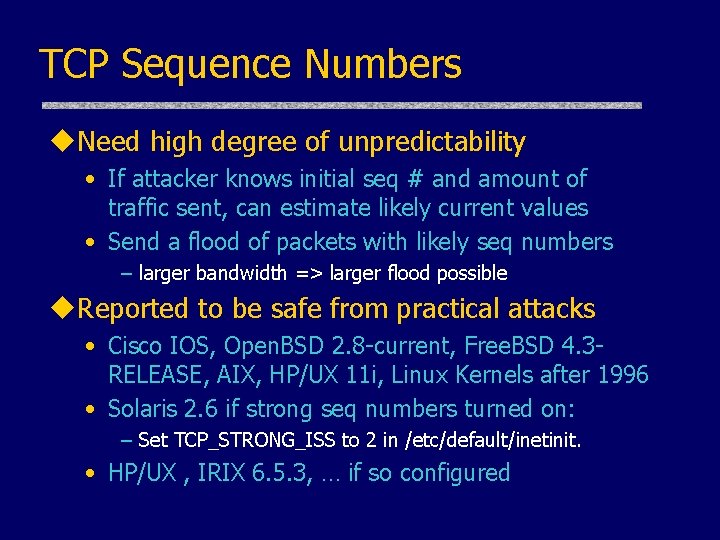
TCP Sequence Numbers u. Need high degree of unpredictability • If attacker knows initial seq # and amount of traffic sent, can estimate likely current values • Send a flood of packets with likely seq numbers – larger bandwidth => larger flood possible u. Reported to be safe from practical attacks • Cisco IOS, Open. BSD 2. 8 -current, Free. BSD 4. 3 RELEASE, AIX, HP/UX 11 i, Linux Kernels after 1996 • Solaris 2. 6 if strong seq numbers turned on: – Set TCP_STRONG_ISS to 2 in /etc/default/inetinit. • HP/UX , IRIX 6. 5. 3, … if so configured
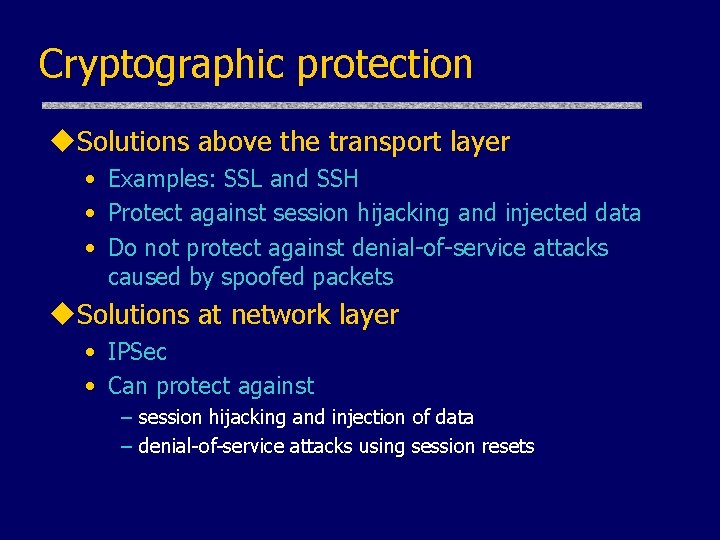
Cryptographic protection u. Solutions above the transport layer • Examples: SSL and SSH • Protect against session hijacking and injected data • Do not protect against denial-of-service attacks caused by spoofed packets u. Solutions at network layer • IPSec • Can protect against – session hijacking and injection of data – denial-of-service attacks using session resets
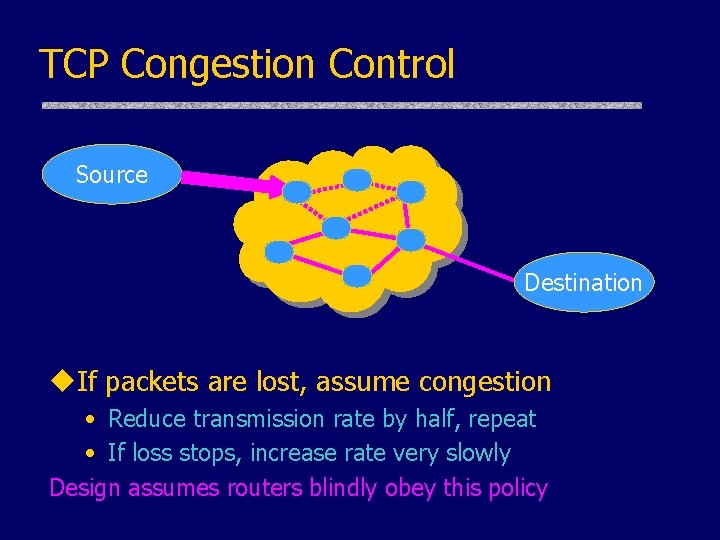
TCP Congestion Control Source Destination u. If packets are lost, assume congestion • Reduce transmission rate by half, repeat • If loss stops, increase rate very slowly Design assumes routers blindly obey this policy
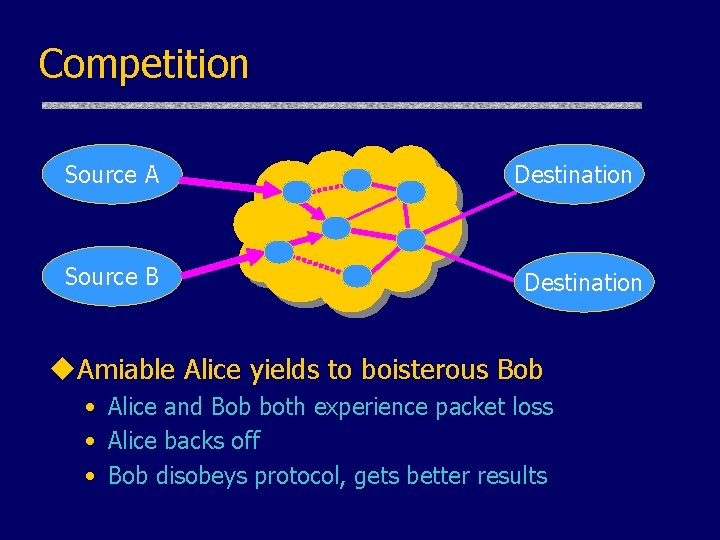
Competition Source A Source B Destination u. Amiable Alice yields to boisterous Bob • Alice and Bob both experience packet loss • Alice backs off • Bob disobeys protocol, gets better results
TCP Attack on Congestion Control u. Misbehaving receiver can trick sender into ignoring congestion control • Receiver: duplicate ACK indicates gap – Packets within seq number range assumed lost – Sender executes fast retransmit algorithm • Malicious receiver can – Send duplicate ACK – ACK before data is received • needs some application level retransmission – e. g. HTTP 1. 1 range requests … See RFC 2581 • Solutions – Add nonces – ACKs return nonce to prove reception See: Savage et al. , TCP Congestion Control with a Misbehaving Receiver
Routing Vulnerabilities u. Source routing attack • Can direct response through compromised host u. Routing Information Protocol (RIP) • Direct client traffic through compromised host u. Exterior gateway protocols • Advertise false routes • Send traffic through compromised hosts
Source Routing Attacks u. Attack • Destination host may use reverse of source route provided in TCP open request to return traffic – Modify the source address of a packet – Route traffic through machine controlled by attacker u. Defenses • Gateway rejects external packets claiming to be local • Reject pre-authorized connections if source routing info present • Only accept source route if trusted gateways listed in source routing info
Routing Table Update Protocols u. Interior Gateway Protocols: IGPs • distance vector type - each gateway keeps track of its distance to all destinations – Gateway-to-Gateway: GGP – Routing Information Protocol: RIP u. Exterior Gateway Protocol: EGP • used for communication between different autonomous systems
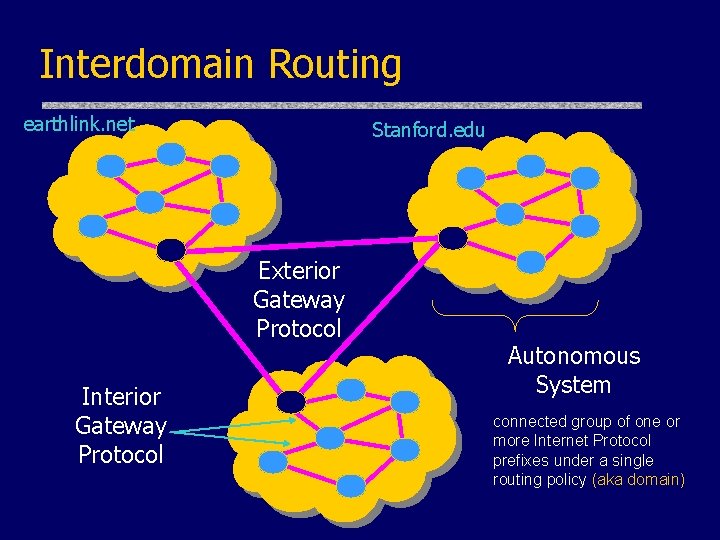
Interdomain Routing earthlink. net Stanford. edu Exterior Gateway Protocol Interior Gateway Protocol Autonomous System connected group of one or more Internet Protocol prefixes under a single routing policy (aka domain)
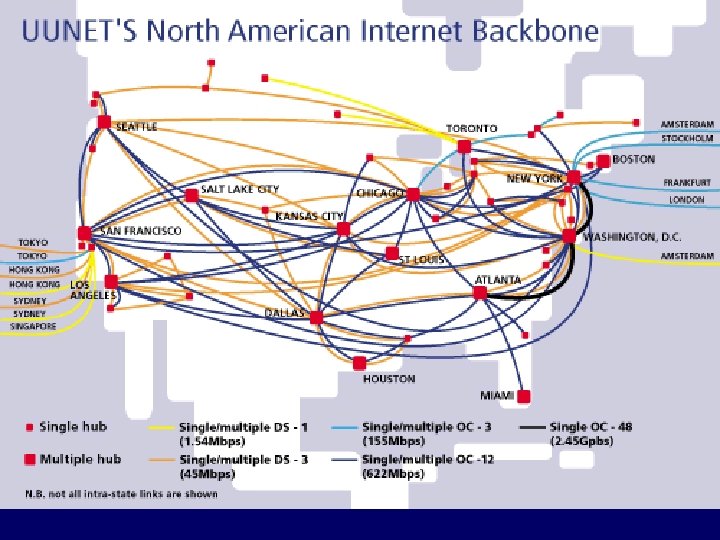
BGP overview u. Iterative path announcement • Path announcements grow from destination to source • Subject to policy (transit, peering) • Packets flow in reverse direction u. Protocol specification • Announcements can be shortest path • Nodes allowed to use other policies – E. g. , “cold-potato routing” by smaller peer • Not obligated to use path you announce
![BGP example 1 234 8 7265 7 7234 7 [D. Wetherall] 27 34 265](http://slidetodoc.com/presentation_image_h2/7967ba03a4c8fa20eb8863b6e423dd28/image-33.jpg "BGP example 1 234 8 7265 7 7234 7 [D. Wetherall] 27 34 265")
BGP example 1 234 8 7265 7 7234 7 [D. Wetherall] 27 34 265 2 3 u Transit: 2 provides transit for 7 • 7 reaches and is reached via 2 • exchange customer traffic 4 265 4 3265 27 7 265 234 u Peering: 4 and 5 peer 327 65 27 6 5 5 4 627 6234 5
Issues u. BGP convergence problems • Protocol allows policy flexibility • Some legal policies prevent convergence • Even shortest-path policy converges slowly u. Incentive for dishonesty • ISP pays for some routes, others free u. Security problems • Potential for disruptive attacks
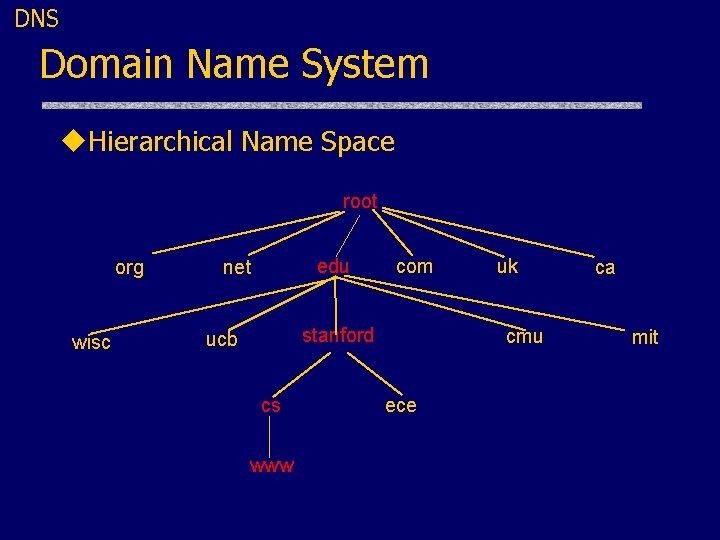
DNS Domain Name System u. Hierarchical Name Space root org wisc edu net com stanford ucb cs www uk cmu ece ca mit
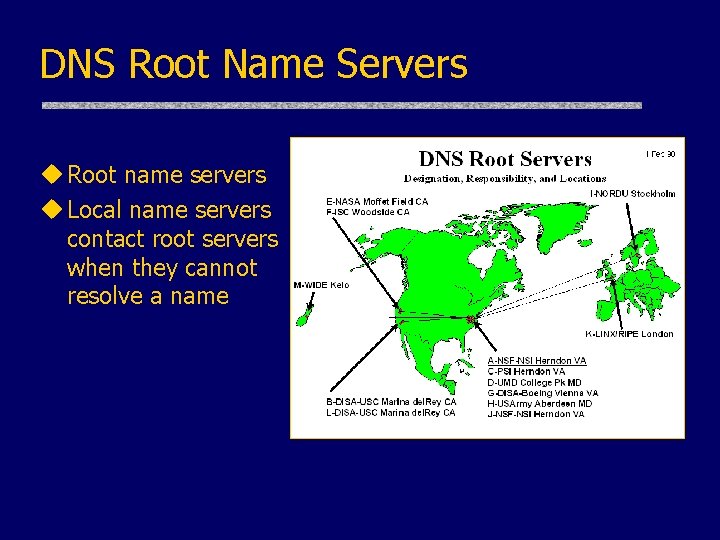
DNS Root Name Servers u Root name servers u Local name servers contact root servers when they cannot resolve a name
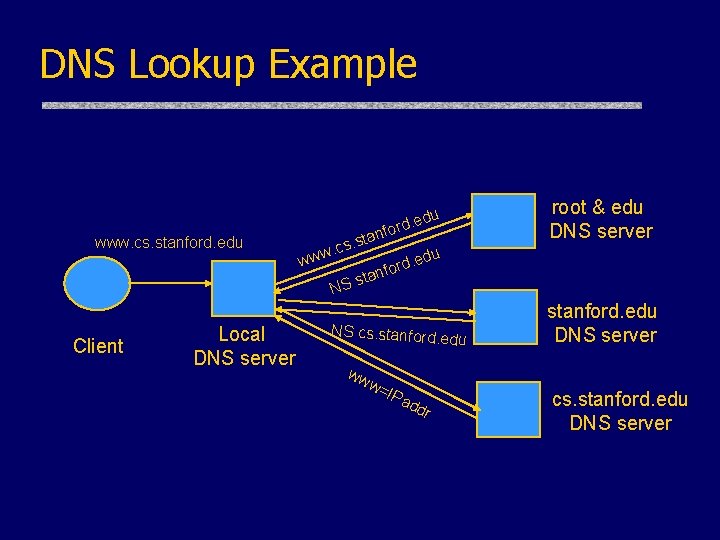
DNS Lookup Example www. cs. stanford. edu anfo . st w. cs ww NS Client Local DNS server root & edu DNS server du rd. e du d. e nfor sta NS cs. stanford. e ww w= IPa dd r du stanford. edu DNS server cs. stanford. edu DNS server
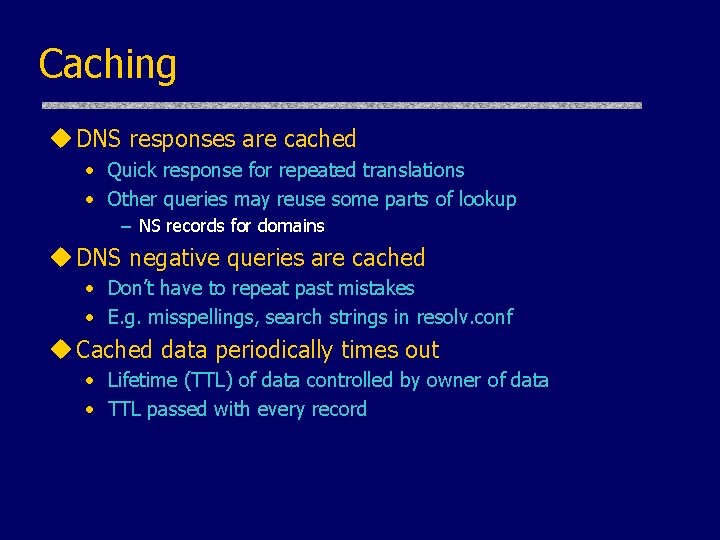
Caching u DNS responses are cached • Quick response for repeated translations • Other queries may reuse some parts of lookup – NS records for domains u DNS negative queries are cached • Don’t have to repeat past mistakes • E. g. misspellings, search strings in resolv. conf u Cached data periodically times out • Lifetime (TTL) of data controlled by owner of data • TTL passed with every record
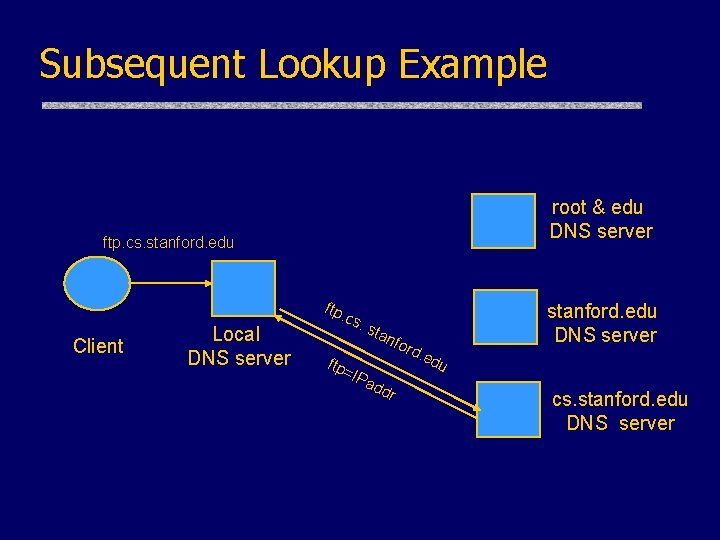
Subsequent Lookup Example root & edu DNS server ftp. cs. stanford. edu Client Local DNS server ftp cs. =IP sta nfo rd. ad d r stanford. edu DNS server ed u cs. stanford. edu DNS server
DNS Implementation Vulnerabilities u. Reverse query buffer overrun in BIND Releases 4. 9 (4. 9. 7 prior) and Releases 8 (8. 1. 2 prior) • gain root access • abort DNS service u. MS DNS for NT 4. 0 (service pack 3 and prior) • crashes on chargen stream • telnet ntbox 19 | telnet ntbox 53
Inherent DNS Vulnerabilities u. Users/hosts typically trust the host-address mapping provided by DNS u. Problems • Zone transfers can provide useful list of target hosts • Interception of requests or compromise of DNS servers can result in bogus responses • Solution – authenticated requests/responses
Bellovin/Mockapetris Attack u. Trust relationships use symbolic addresses • /etc/hosts. equiv contains friend. stanford. edu u. Requests come with numeric source address • Use reverse DNS to find symbolic name • Decide access based on /etc/hosts. equiv, … u. Attack • Spoof reverse DNS to make host trust attacker
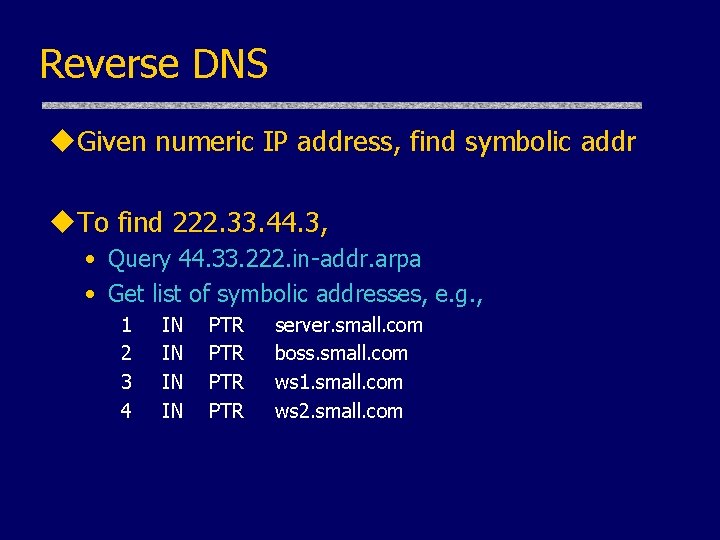
Reverse DNS u. Given numeric IP address, find symbolic addr u. To find 222. 33. 44. 3, • Query 44. 33. 222. in-addr. arpa • Get list of symbolic addresses, e. g. , 1 2 3 4 IN IN PTR PTR server. small. com boss. small. com ws 1. small. com ws 2. small. com
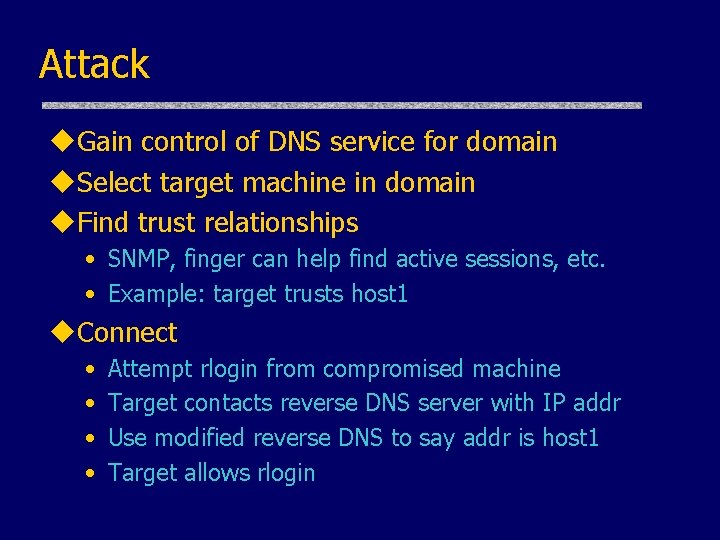
Attack u. Gain control of DNS service for domain u. Select target machine in domain u. Find trust relationships • SNMP, finger can help find active sessions, etc. • Example: target trusts host 1 u. Connect • • Attempt rlogin from compromised machine Target contacts reverse DNS server with IP addr Use modified reverse DNS to say addr is host 1 Target allows rlogin
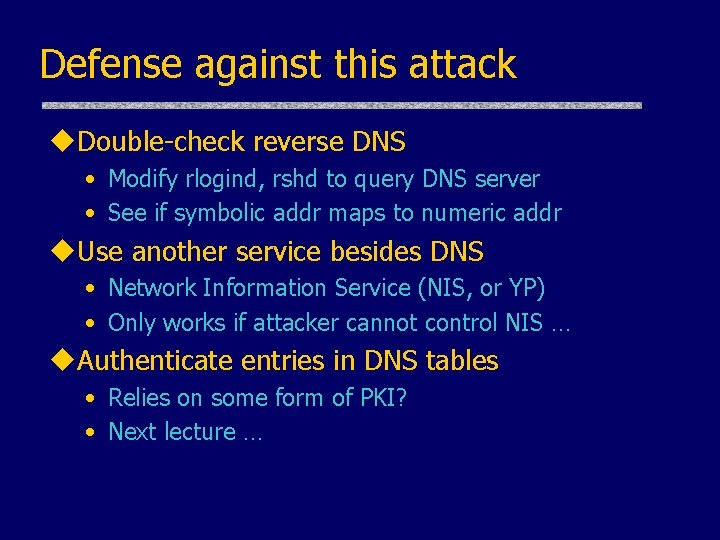
Defense against this attack u. Double-check reverse DNS • Modify rlogind, rshd to query DNS server • See if symbolic addr maps to numeric addr u. Use another service besides DNS • Network Information Service (NIS, or YP) • Only works if attacker cannot control NIS … u. Authenticate entries in DNS tables • Relies on some form of PKI? • Next lecture …
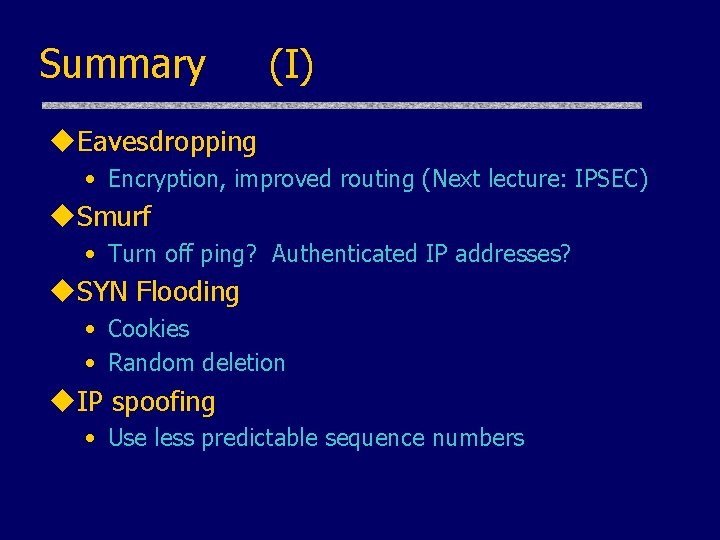
Summary (I) u. Eavesdropping • Encryption, improved routing (Next lecture: IPSEC) u. Smurf • Turn off ping? Authenticated IP addresses? u. SYN Flooding • Cookies • Random deletion u. IP spoofing • Use less predictable sequence numbers
Summary (II) u. Source routing attacks • Additional info in packets, tighter control over routing u. Interdomain routing • Authenticated routing announcements • Other issues u. DNS attack • Double-check reverse DNS • Use another service besides DNS • Authenticate entries in DNS tables

- Slides: 48