
Network Protocol Simulation A look at Discrete Event
- Slides: 26
Network Protocol Simulation: A look at Discrete Event Simulation Grant D. Lanterman 5/21/2004
Overview § Network Protocol Example § Simulation § Overview § Why? § Discrete Event Simulation § Why? § Example § Software
Example: TCP/IP § Driving force of the internet § Layered protocol
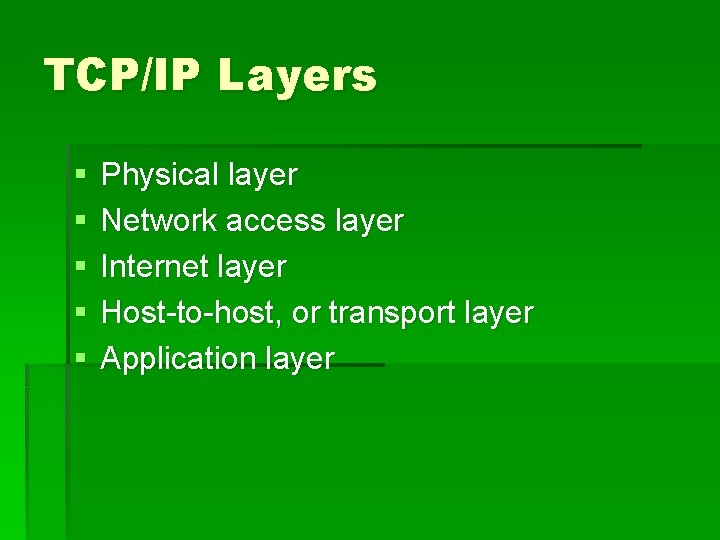
TCP/IP Layers § § § Physical layer Network access layer Internet layer Host-to-host, or transport layer Application layer
Network Protocols § Difficult to simulate activity with small test networks § Dynamic
The Answer! § § § Simulation Imitating real-world situations Two types § Analytical modeling § Computer simulation
Analytical Modeling § Use of mathematical equations to represent a network § May lead to oversimplification § Can’t effectively model the dynamic nature of a network § Less Practical
Computer Simulation § § § Preferred simulation type for networks Can adapt to dynamic nature of networks Use of a computer to simulate what will happen in real-world events § Discrete Event Simulation usually used § Example: § What would be the effect of adding an extra cashier to a bank
Simulation Terminology § § § § Simulation Model Attributes Entities Activities Delays States Events
Simulation Model § Set of assumptions about the system being simulated § Includes assumptions based on: § Algorithms § Mathematical equations § Conditions imposed by the system § Simplified § Replace real parts of the system by concepts
Entities § Objects that will participate in the simulation § Part of the model § Examples from a Bank Simulation: § Customers § Employees § Managers
Attributes § Properties of entities within the system § Examples from Bank Simulation: § Gender of a customer § Name of an employee
Activities and Delays § § Activity is a duration of known time A delay is a length of unknown time Can change state of system Activity Example: § A customer checking their account balance § Delay Example: § Time it takes for n customers to enter the bank
States § The current configuration of the system § Sate variables represent the current system § Example: § The length of the line of customers in the bank
Events § § § Instantaneous in time Often change the state of the system Example: § A customer enters the bank
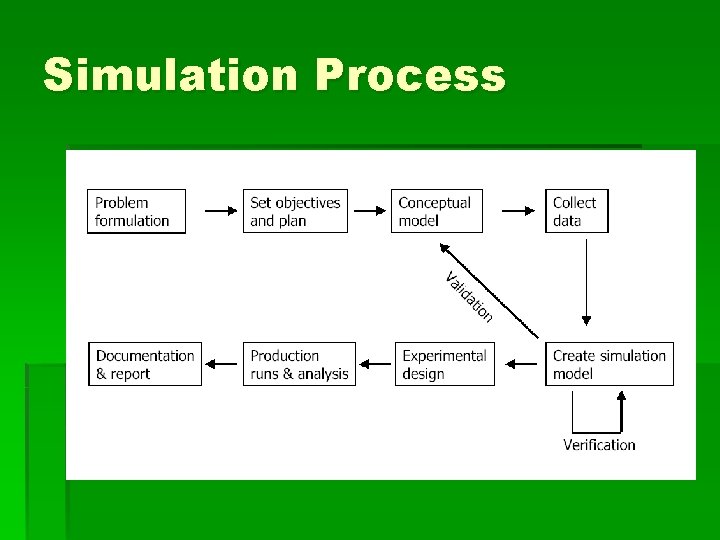
Simulation Process
Discrete Event Simulation (DES) § Asks the questions: § What events are possible and do they change the state? § What activities and what are their duration? § What events begin/end each activity? § How are delays defined? § How do we start the simulation?
DES § Models a system as it evolves § Represents changes as separate discrete events § Simulation executive § Next event § Time slicing
DES Approaches § Event § Commonly used § Describes an instantaneous change § Activity § Examines as a duration of time § Easy to understand but not efficient § Process § Groups activities to describe the life cycle of an entity § Most efficient and effective but difficult to impliment
Event Types § Primary § Scheduled at a specific time § New cashier comes to work § Conditional § Triggered by a condition § Customer moving from the line to a cashier
Event List § § § Often called the FEL or future event list Main data structure of a DES Ordered in increasing time of event notice Contains only primary events Contains all information needed to execute the events in it § Efficiency of simulator depends on efficiency of FEL
DES Algorithm § § § Remove first event(l, E) from FEL Advance simulation to time t Update sate variables according to E Insert new events into FEL according to E Compute statistics
Bank Queuing Example § Owner asks: What would the effects of adding another cashier to the bank have? § Customer wait time § Bank congestion
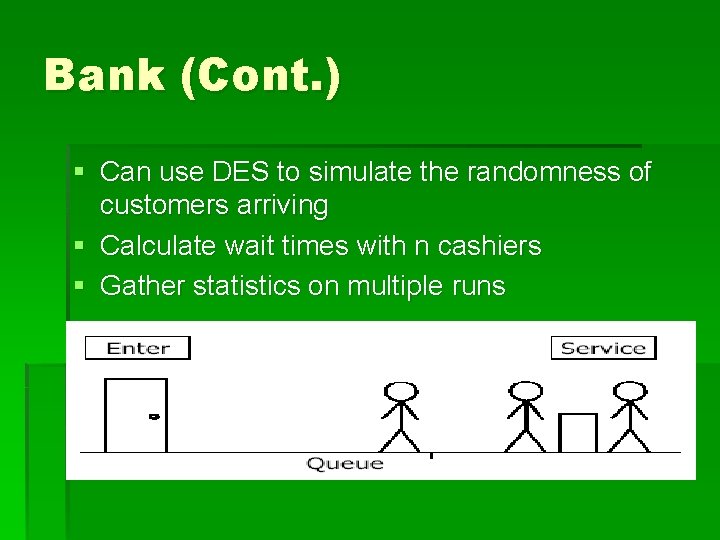
Bank (Cont. ) § Can use DES to simulate the randomness of customers arriving § Calculate wait times with n cashiers § Gather statistics on multiple runs
Network Simulators § Many software packages available § Example: § OPNET § Assist in building simulation model § Run simulation and collect results
Questions? § Comments? § Hearing None…