
Network Programming Part I Bryant and OHallaron Computer
Network Programming: Part I Bryant and O’Hallaron, Computer Systems: A Programmer’s Perspective, Third Edition 1
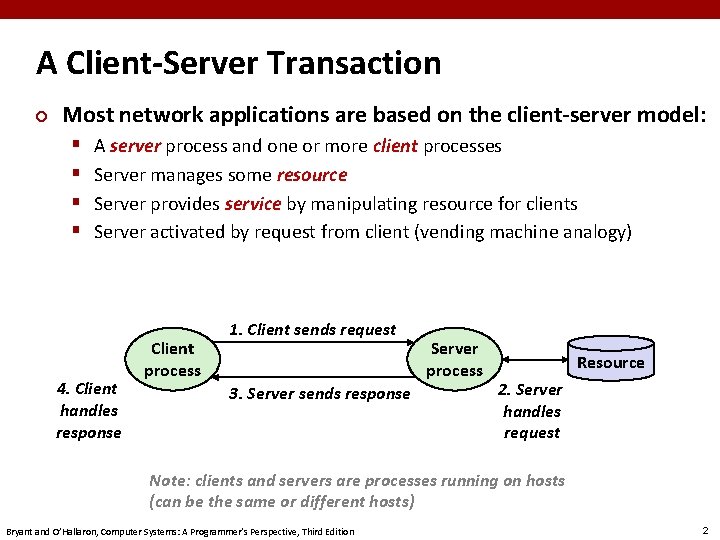
A Client-Server Transaction ¢ Most network applications are based on the client-server model: § § A server process and one or more client processes Server manages some resource Server provides service by manipulating resource for clients Server activated by request from client (vending machine analogy) 4. Client handles response Client process 1. Client sends request 3. Server sends response Server process Resource 2. Server handles request Note: clients and servers are processes running on hosts (can be the same or different hosts) Bryant and O’Hallaron, Computer Systems: A Programmer’s Perspective, Third Edition 2
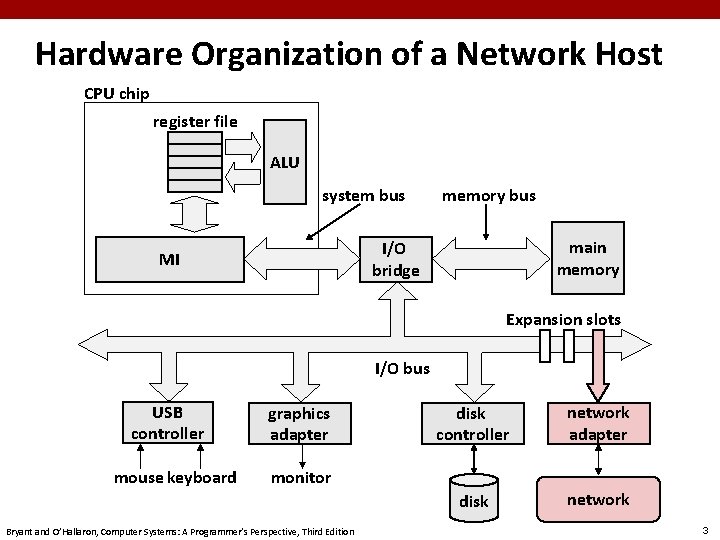
Hardware Organization of a Network Host CPU chip register file ALU system bus memory bus main memory I/O bridge MI Expansion slots I/O bus USB controller mouse keyboard graphics adapter disk controller network adapter disk network monitor Bryant and O’Hallaron, Computer Systems: A Programmer’s Perspective, Third Edition 3
Computer Networks ¢ A network is a hierarchical system of boxes and wires organized by geographical proximity § SAN (System Area Network) spans cluster or machine room Switched Ethernet, Quadrics QSW, … § LAN (Local Area Network) spans a building or campus § Ethernet is most prominent example § WAN (Wide Area Network) spans country or world § Typically high-speed point-to-point phone lines § ¢ An internetwork (internet) is an interconnected set of networks § The Global IP Internet (uppercase “I”) is the most famous example of an internet (lowercase “i”) ¢ Let’s see how an internet is built from the ground up Bryant and O’Hallaron, Computer Systems: A Programmer’s Perspective, Third Edition 4
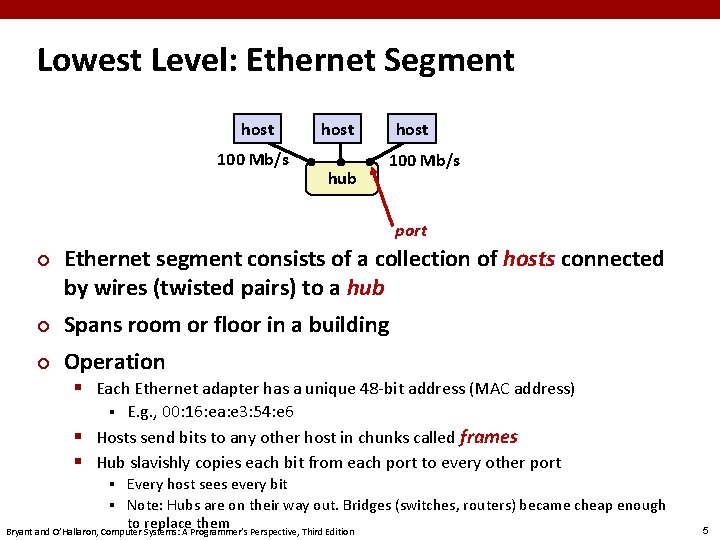
Lowest Level: Ethernet Segment host 100 Mb/s host hub host 100 Mb/s port ¢ Ethernet segment consists of a collection of hosts connected by wires (twisted pairs) to a hub ¢ Spans room or floor in a building ¢ Operation § Each Ethernet adapter has a unique 48 -bit address (MAC address) E. g. , 00: 16: ea: e 3: 54: e 6 § Hosts send bits to any other host in chunks called frames § Hub slavishly copies each bit from each port to every other port § Every host sees every bit § Note: Hubs are on their way out. Bridges (switches, routers) became cheap enough to replace them Bryant and O’Hallaron, Computer Systems: A Programmer’s Perspective, Third Edition § 5
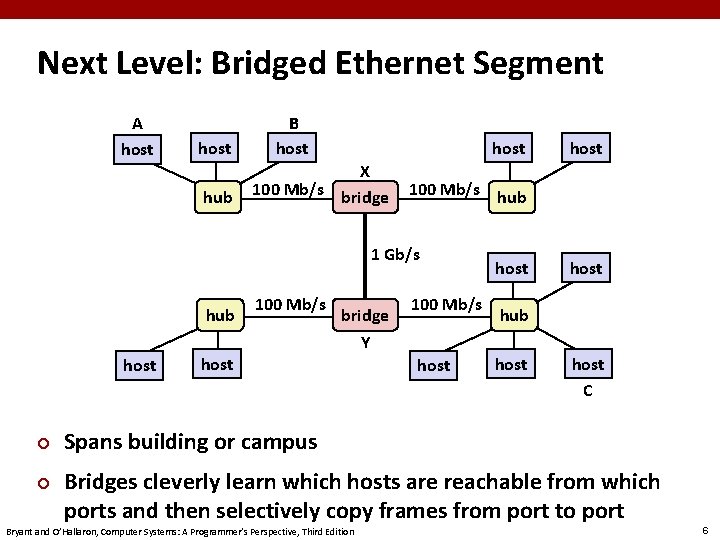
Next Level: Bridged Ethernet Segment A host hub B host X 100 Mb/s bridge 100 Mb/s hub 1 Gb/s hub host ¢ ¢ 100 Mb/s bridge host 100 Mb/s Y host hub host C Spans building or campus Bridges cleverly learn which hosts are reachable from which ports and then selectively copy frames from port to port Bryant and O’Hallaron, Computer Systems: A Programmer’s Perspective, Third Edition 6
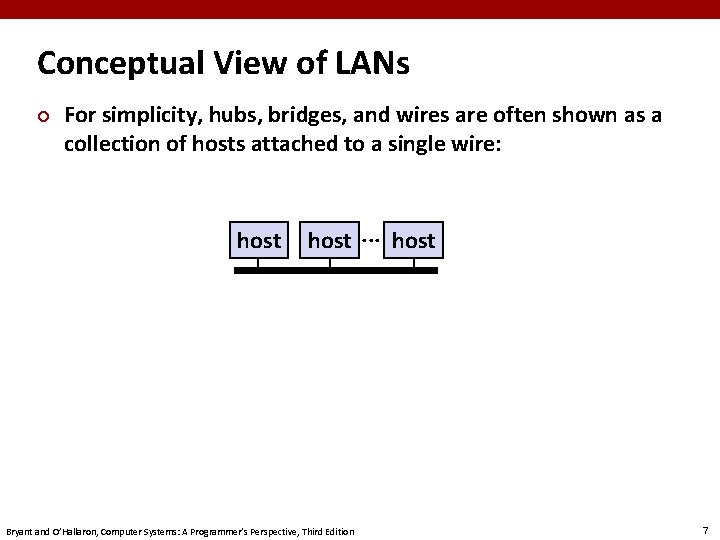
Conceptual View of LANs ¢ For simplicity, hubs, bridges, and wires are often shown as a collection of hosts attached to a single wire: host. . . host Bryant and O’Hallaron, Computer Systems: A Programmer’s Perspective, Third Edition 7
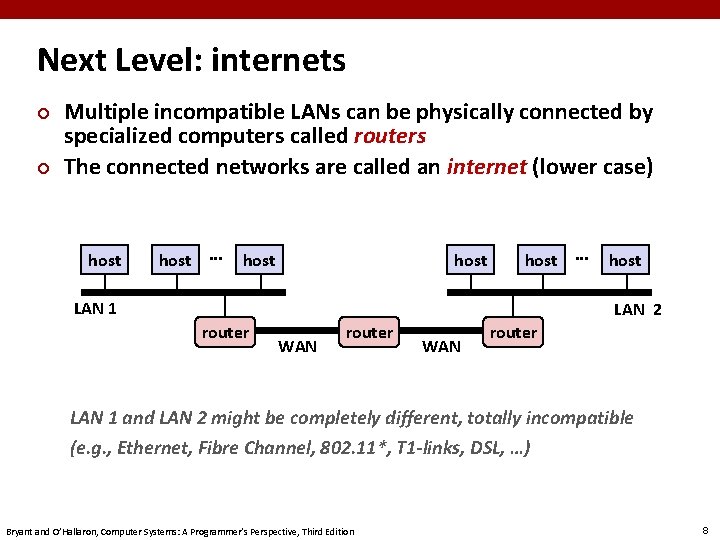
Next Level: internets ¢ ¢ Multiple incompatible LANs can be physically connected by specialized computers called routers The connected networks are called an internet (lower case) host. . . host. . . LAN 1 host LAN 2 router WAN router LAN 1 and LAN 2 might be completely different, totally incompatible (e. g. , Ethernet, Fibre Channel, 802. 11*, T 1 -links, DSL, …) Bryant and O’Hallaron, Computer Systems: A Programmer’s Perspective, Third Edition 8
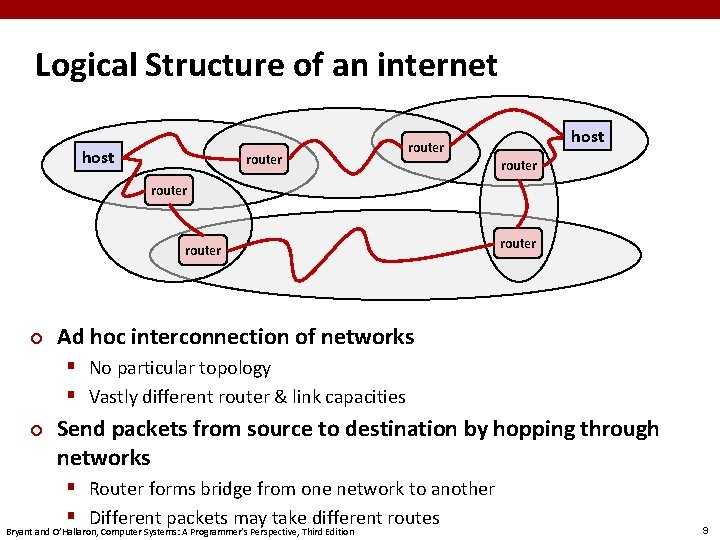
Logical Structure of an internet host router router ¢ router Ad hoc interconnection of networks § No particular topology § Vastly different router & link capacities ¢ Send packets from source to destination by hopping through networks § Router forms bridge from one network to another § Different packets may take different routes Bryant and O’Hallaron, Computer Systems: A Programmer’s Perspective, Third Edition 9
The Notion of an internet Protocol ¢ ¢ How is it possible to send bits across incompatible LANs and WANs? Solution: protocol software running on each host and router § Protocol is a set of rules that governs how hosts and routers should cooperate when they transfer data from network to network. § Smooths out the differences between the different networks Bryant and O’Hallaron, Computer Systems: A Programmer’s Perspective, Third Edition 10
What Does an internet Protocol Do? ¢ Provides a naming scheme § An internet protocol defines a uniformat for host addresses § Each host (and router) is assigned at least one of these internet addresses that uniquely identifies it ¢ Provides a delivery mechanism § An internet protocol defines a standard transfer unit (packet) § Packet consists of header and payload Header: contains info such as packet size, source and destination addresses § Payload: contains data bits sent from source host § Bryant and O’Hallaron, Computer Systems: A Programmer’s Perspective, Third Edition 11
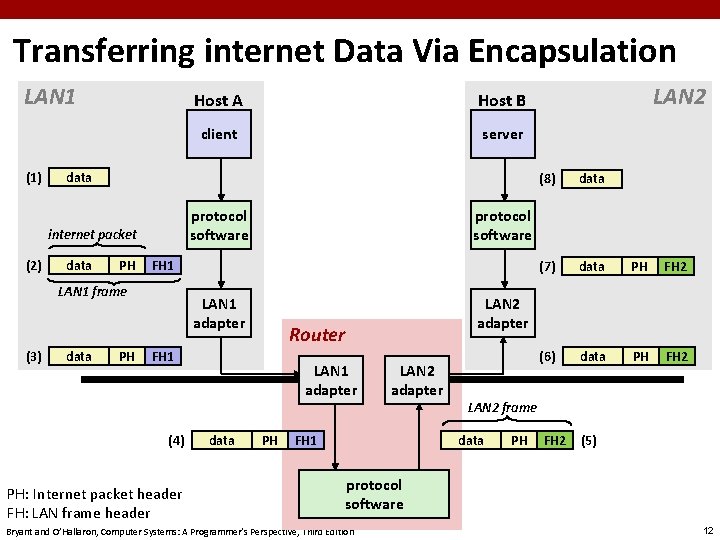
Transferring internet Data Via Encapsulation LAN 1 (1) client server protocol software data PH LAN 1 adapter PH: Internet packet header FH: LAN frame header LAN 1 adapter data (8) data (7) data PH FH 2 (6) data PH FH 2 LAN 2 adapter Router FH 1 (4) LAN 2 protocol software FH 1 LAN 1 frame (3) Host B data internet packet (2) Host A PH LAN 2 adapter FH 1 LAN 2 frame data PH FH 2 (5) protocol software Bryant and O’Hallaron, Computer Systems: A Programmer’s Perspective, Third Edition 12
Other Issues ¢ We are glossing over a number of important questions: § What if different networks have different maximum frame sizes? (segmentation) § How do routers know where to forward frames? § How are routers informed when the network topology changes? § What if packets get lost? ¢ These (and other) questions are addressed by the area of systems known as computer networking Bryant and O’Hallaron, Computer Systems: A Programmer’s Perspective, Third Edition 13
Global IP Internet (upper case) ¢ Most famous example of an internet ¢ Based on the TCP/IP protocol family § IP (Internet Protocol) : Provides basic naming scheme and unreliable delivery capability of packets (datagrams) from host-to-host § UDP (Unreliable Datagram Protocol) § Uses IP to provide unreliable datagram delivery from process-to-process § TCP (Transmission Control Protocol) § Uses IP to provide reliable byte streams from process-to-process over connections § ¢ Accessed via a mix of Unix file I/O and functions from the sockets interface Bryant and O’Hallaron, Computer Systems: A Programmer’s Perspective, Third Edition 14

Hardware and Software Organization of an Internet Application Internet client host Internet server host Client User code Server TCP/IP Kernel code TCP/IP Sockets interface (system calls) Hardware interface (interrupts) Network adapter Hardware and firmware Network adapter Global IP Internet Bryant and O’Hallaron, Computer Systems: A Programmer’s Perspective, Third Edition 15
A Programmer’s View of the Internet 1. Hosts are mapped to a set of 32 -bit IP addresses § 128. 2. 203. 179 2. The set of IP addresses is mapped to a set of identifiers called Internet domain names § 128. 2. 203. 179 is mapped to www. cs. cmu. edu 3. A process on one Internet host can communicate with a process on another Internet host over a connection Bryant and O’Hallaron, Computer Systems: A Programmer’s Perspective, Third Edition 16
Aside: IPv 4 and IPv 6 ¢ ¢ The original Internet Protocol, with its 32 -bit addresses, is known as Internet Protocol Version 4 (IPv 4) 1996: Internet Engineering Task Force (IETF) introduced Internet Protocol Version 6 (IPv 6) with 128 -bit addresses § Intended as the successor to IPv 4 ¢ As of 2015, vast majority of Internet traffic still carried by IPv 4 § Only 4% of users access Google services using IPv 6. ¢ We will focus on IPv 4, but will show you how to write networking code that is protocol-independent. Bryant and O’Hallaron, Computer Systems: A Programmer’s Perspective, Third Edition 17
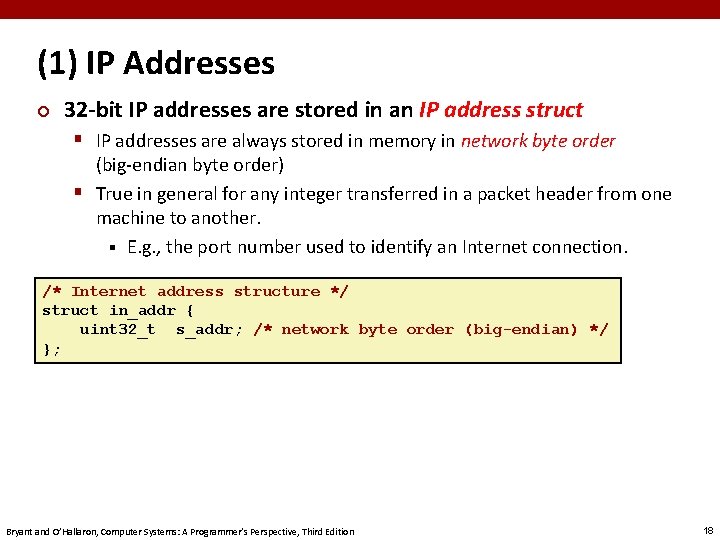
(1) IP Addresses ¢ 32 -bit IP addresses are stored in an IP address struct § IP addresses are always stored in memory in network byte order (big-endian byte order) § True in general for any integer transferred in a packet header from one machine to another. § E. g. , the port number used to identify an Internet connection. /* Internet address structure */ struct in_addr { uint 32_t s_addr; /* network byte order (big-endian) */ }; Bryant and O’Hallaron, Computer Systems: A Programmer’s Perspective, Third Edition 18
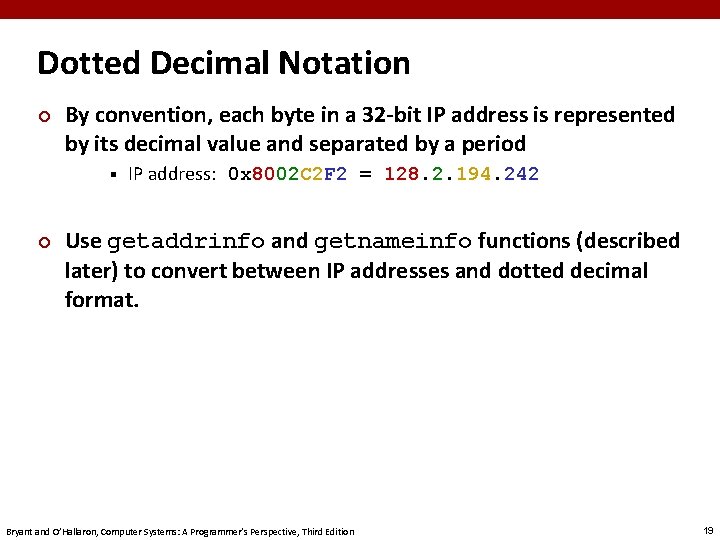
Dotted Decimal Notation ¢ By convention, each byte in a 32 -bit IP address is represented by its decimal value and separated by a period § ¢ IP address: 0 x 8002 C 2 F 2 = 128. 2. 194. 242 Use getaddrinfo and getnameinfo functions (described later) to convert between IP addresses and dotted decimal format. Bryant and O’Hallaron, Computer Systems: A Programmer’s Perspective, Third Edition 19
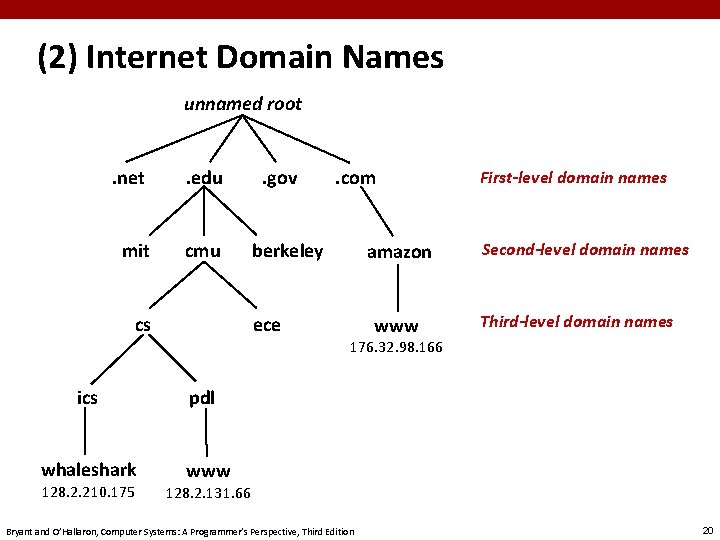
(2) Internet Domain Names unnamed root . net . edu mit cmu cs . gov . com berkeley amazon ece www First-level domain names Second-level domain names Third-level domain names 176. 32. 98. 166 ics whaleshark 128. 2. 210. 175 pdl www 128. 2. 131. 66 Bryant and O’Hallaron, Computer Systems: A Programmer’s Perspective, Third Edition 20
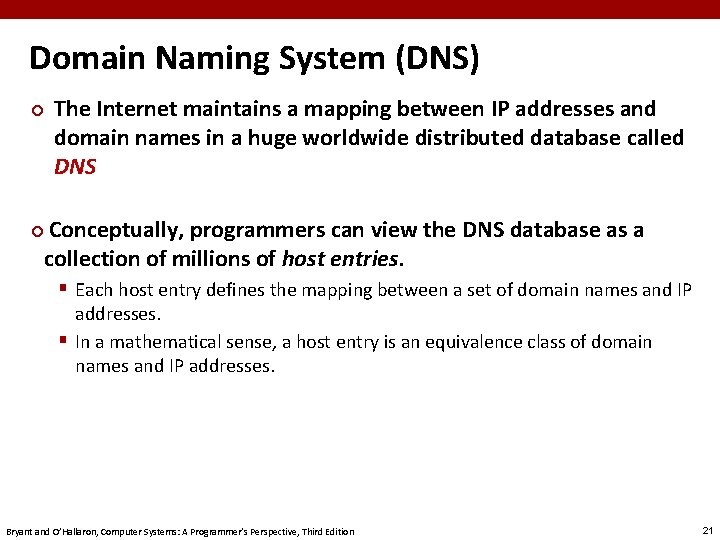
Domain Naming System (DNS) ¢ The Internet maintains a mapping between IP addresses and domain names in a huge worldwide distributed database called DNS Conceptually, programmers can view the DNS database as a collection of millions of host entries. ¢ § Each host entry defines the mapping between a set of domain names and IP addresses. § In a mathematical sense, a host entry is an equivalence class of domain names and IP addresses. Bryant and O’Hallaron, Computer Systems: A Programmer’s Perspective, Third Edition 21
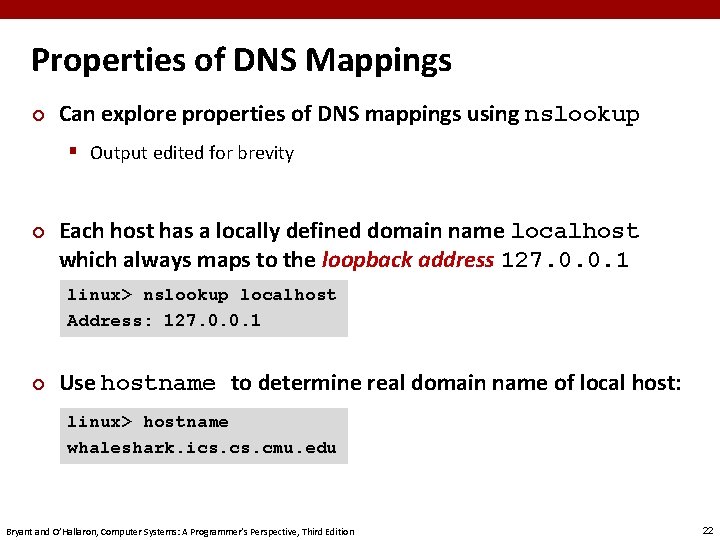
Properties of DNS Mappings ¢ Can explore properties of DNS mappings using nslookup § Output edited for brevity ¢ Each host has a locally defined domain name localhost which always maps to the loopback address 127. 0. 0. 1 linux> nslookup localhost Address: 127. 0. 0. 1 ¢ Use hostname to determine real domain name of local host: linux> hostname whaleshark. ics. cmu. edu Bryant and O’Hallaron, Computer Systems: A Programmer’s Perspective, Third Edition 22
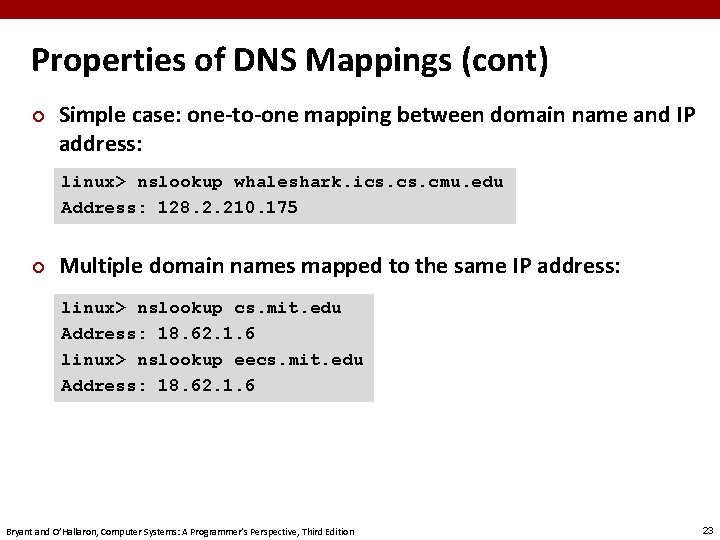
Properties of DNS Mappings (cont) ¢ Simple case: one-to-one mapping between domain name and IP address: linux> nslookup whaleshark. ics. cmu. edu Address: 128. 2. 210. 175 ¢ Multiple domain names mapped to the same IP address: linux> nslookup cs. mit. edu Address: 18. 62. 1. 6 linux> nslookup eecs. mit. edu Address: 18. 62. 1. 6 Bryant and O’Hallaron, Computer Systems: A Programmer’s Perspective, Third Edition 23
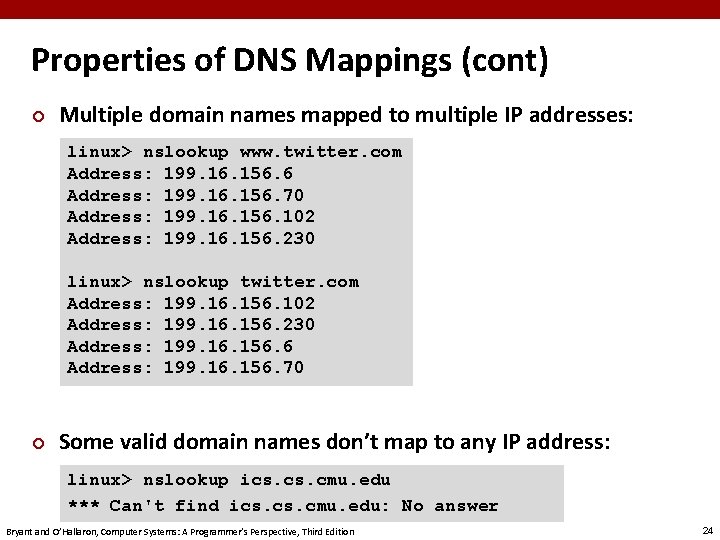
Properties of DNS Mappings (cont) ¢ Multiple domain names mapped to multiple IP addresses: linux> nslookup www. twitter. com Address: 199. 16. 156. 6 Address: 199. 16. 156. 70 Address: 199. 16. 156. 102 Address: 199. 16. 156. 230 linux> nslookup twitter. com Address: 199. 16. 156. 102 Address: 199. 16. 156. 230 Address: 199. 16. 156. 6 Address: 199. 16. 156. 70 ¢ Some valid domain names don’t map to any IP address: linux> nslookup ics. cmu. edu *** Can't find ics. cmu. edu: No answer Bryant and O’Hallaron, Computer Systems: A Programmer’s Perspective, Third Edition 24
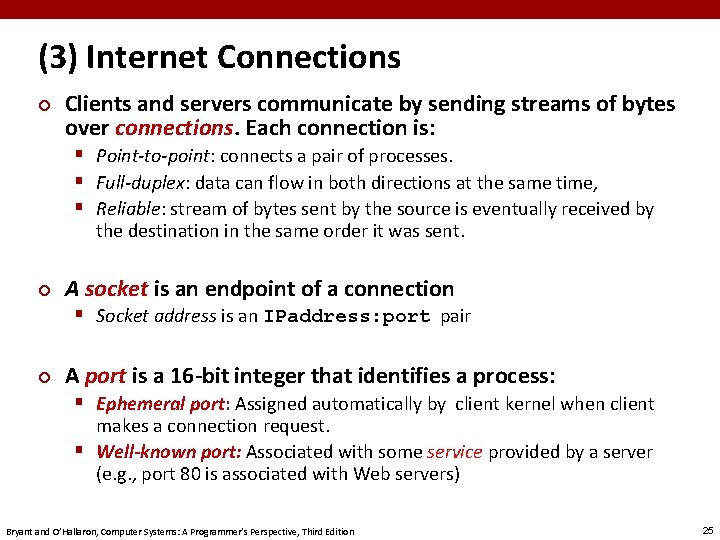
(3) Internet Connections ¢ Clients and servers communicate by sending streams of bytes over connections. Each connection is: § Point-to-point: connects a pair of processes. § Full-duplex: data can flow in both directions at the same time, § Reliable: stream of bytes sent by the source is eventually received by the destination in the same order it was sent. ¢ A socket is an endpoint of a connection § Socket address is an IPaddress: port pair ¢ A port is a 16 -bit integer that identifies a process: § Ephemeral port: Assigned automatically by client kernel when client makes a connection request. § Well-known port: Associated with some service provided by a server (e. g. , port 80 is associated with Web servers) Bryant and O’Hallaron, Computer Systems: A Programmer’s Perspective, Third Edition 25
Well-known Ports and Service Names ¢ Popular services have permanently assigned well-known ports and corresponding well-known service names: § § ¢ echo server: 7/echo ssh servers: 22/ssh email server: 25/smtp Web servers: 80/http Mappings between well-known ports and service names is contained in the file /etc/services on each Linux machine. Bryant and O’Hallaron, Computer Systems: A Programmer’s Perspective, Third Edition 26
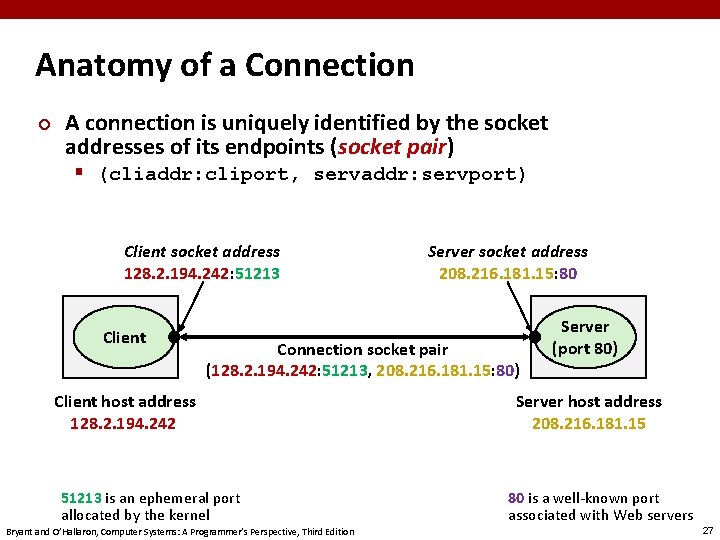
Anatomy of a Connection ¢ A connection is uniquely identified by the socket addresses of its endpoints (socket pair) § (cliaddr: cliport, servaddr: servport) Client socket address 128. 2. 194. 242: 51213 Client Server socket address 208. 216. 181. 15: 80 Connection socket pair (128. 2. 194. 242: 51213, 208. 216. 181. 15: 80) Client host address 128. 2. 194. 242 51213 is an ephemeral port allocated by the kernel Bryant and O’Hallaron, Computer Systems: A Programmer’s Perspective, Third Edition Server (port 80) Server host address 208. 216. 181. 15 80 is a well-known port associated with Web servers 27
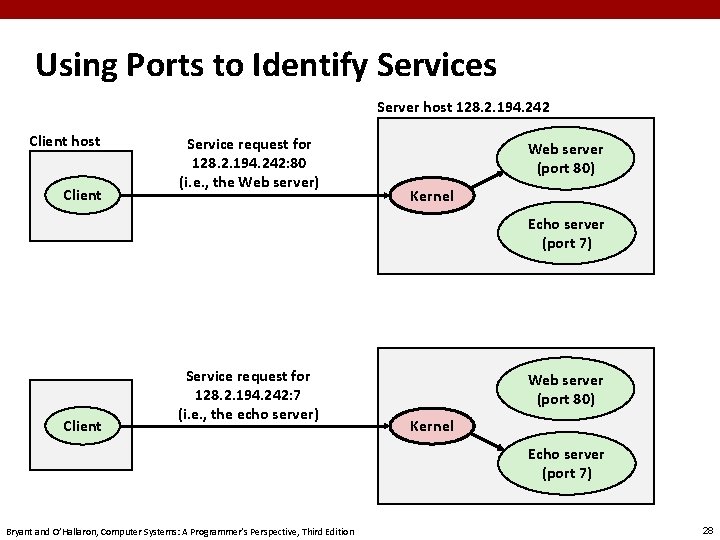
Using Ports to Identify Services Server host 128. 2. 194. 242 Client host Client Service request for 128. 2. 194. 242: 80 (i. e. , the Web server) Web server (port 80) Kernel Echo server (port 7) Client Service request for 128. 2. 194. 242: 7 (i. e. , the echo server) Web server (port 80) Kernel Echo server (port 7) Bryant and O’Hallaron, Computer Systems: A Programmer’s Perspective, Third Edition 28
Sockets Interface ¢ ¢ ¢ Set of system-level functions used in conjunction with Unix I/O to build network applications. Created in the early 80’s as part of the original Berkeley distribution of Unix that contained an early version of the Internet protocols. Available on all modern systems § Unix variants, Windows, OS X, IOS, Android, ARM Bryant and O’Hallaron, Computer Systems: A Programmer’s Perspective, Third Edition 29
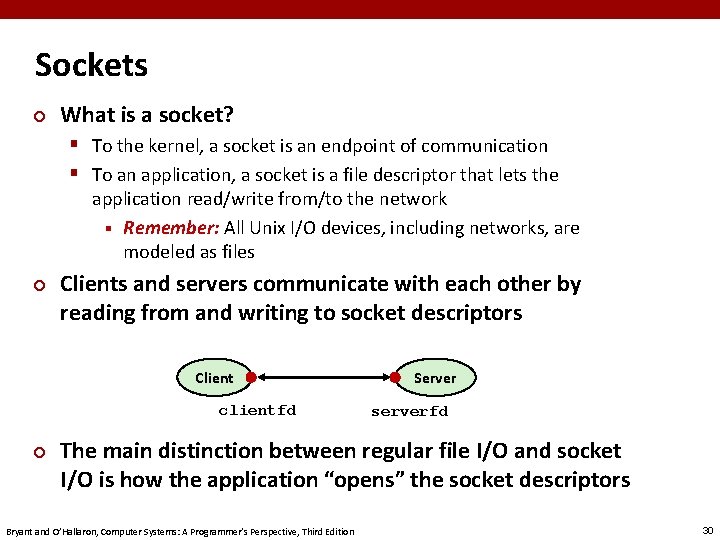
Sockets ¢ What is a socket? § To the kernel, a socket is an endpoint of communication § To an application, a socket is a file descriptor that lets the application read/write from/to the network § Remember: All Unix I/O devices, including networks, are modeled as files ¢ Clients and servers communicate with each other by reading from and writing to socket descriptors Client clientfd ¢ Server serverfd The main distinction between regular file I/O and socket I/O is how the application “opens” the socket descriptors Bryant and O’Hallaron, Computer Systems: A Programmer’s Perspective, Third Edition 30
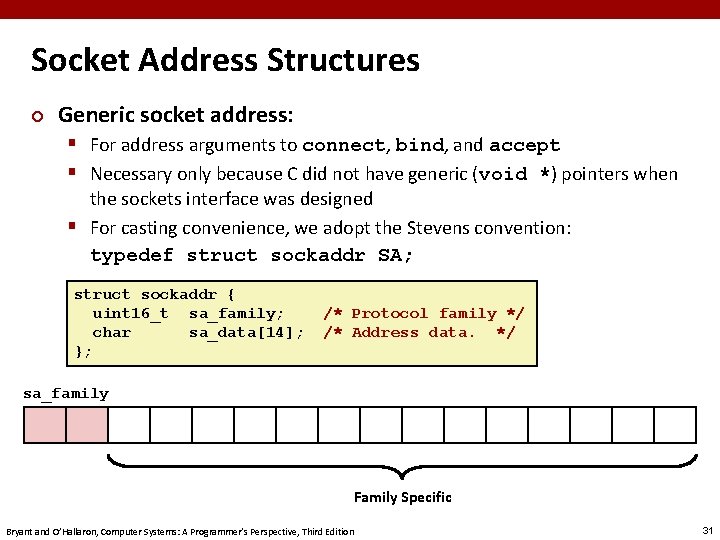
Socket Address Structures ¢ Generic socket address: § For address arguments to connect, bind, and accept § Necessary only because C did not have generic (void *) pointers when the sockets interface was designed § For casting convenience, we adopt the Stevens convention: typedef struct sockaddr SA; struct sockaddr { uint 16_t sa_family; char sa_data[14]; }; /* Protocol family */ /* Address data. */ sa_family Family Specific Bryant and O’Hallaron, Computer Systems: A Programmer’s Perspective, Third Edition 31
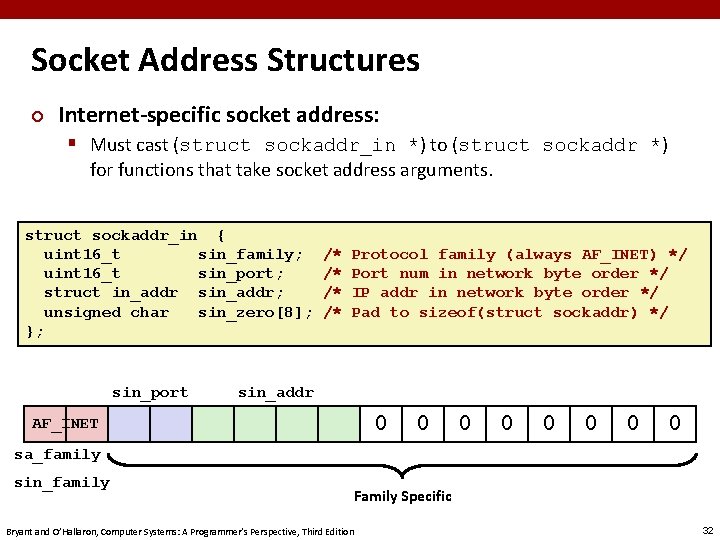
Socket Address Structures ¢ Internet-specific socket address: § Must cast (struct sockaddr_in *) to (struct sockaddr *) for functions that take socket address arguments. struct sockaddr_in { uint 16_t sin_family; uint 16_t sin_port; struct in_addr sin_addr; unsigned char sin_zero[8]; }; sin_port /* /* Protocol family (always AF_INET) */ Port num in network byte order */ IP addr in network byte order */ Pad to sizeof(struct sockaddr) */ sin_addr 0 AF_INET 0 0 0 0 sa_family sin_family Family Specific Bryant and O’Hallaron, Computer Systems: A Programmer’s Perspective, Third Edition 32
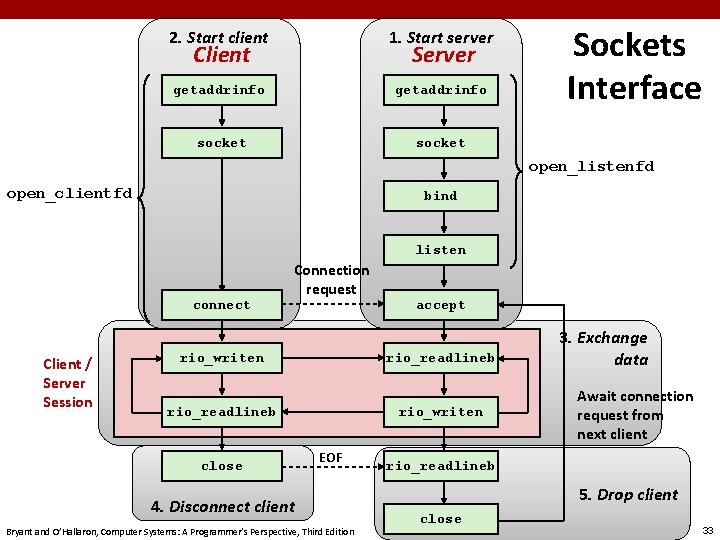
2. Start client 1. Start server getaddrinfo socket Client Server Sockets Interface open_listenfd open_clientfd bind listen connect Client / Server Session Connection request accept rio_writen rio_readlineb rio_writen close EOF 4. Disconnect client Bryant and O’Hallaron, Computer Systems: A Programmer’s Perspective, Third Edition 3. Exchange data Await connection request from next client rio_readlineb 5. Drop client close 33
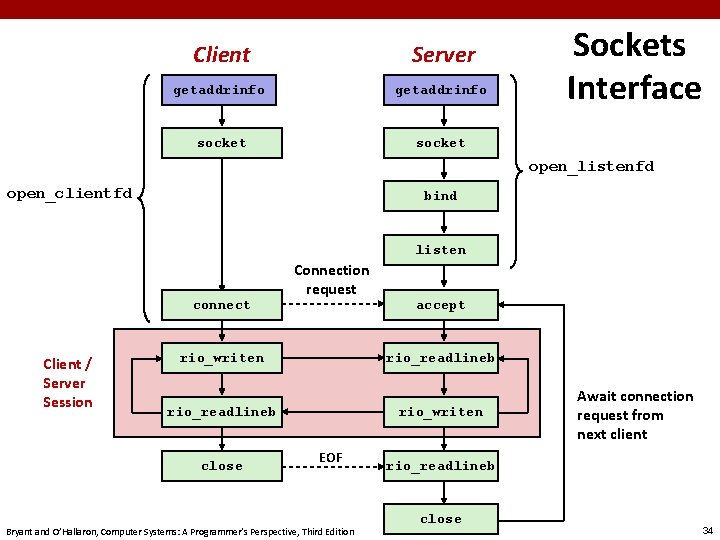
Client Server getaddrinfo socket Sockets Interface open_listenfd open_clientfd bind listen connect Client / Server Session Connection request accept rio_writen rio_readlineb rio_writen close EOF Bryant and O’Hallaron, Computer Systems: A Programmer’s Perspective, Third Edition Await connection request from next client rio_readlineb close 34
Host and Service Conversion: getaddrinfo ¢ getaddrinfo is the modern way to convert string representations of hostnames, host addresses, ports, and service names to socket address structures. § Replaces obsolete gethostbyname and getservbyname funcs. ¢ Advantages: § Reentrant (can be safely used by threaded programs). § Allows us to write portable protocol-independent code § ¢ Works with both IPv 4 and IPv 6 Disadvantages § Somewhat complex § Fortunately, a small number of usage patterns suffice in most cases. Bryant and O’Hallaron, Computer Systems: A Programmer’s Perspective, Third Edition 35
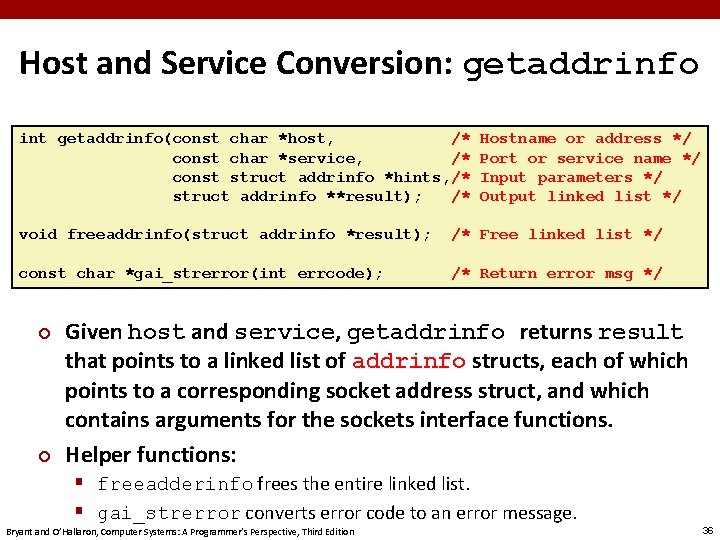
Host and Service Conversion: getaddrinfo int getaddrinfo(const char *host, /* const char *service, /* const struct addrinfo *hints, /* struct addrinfo **result); /* Hostname or address */ Port or service name */ Input parameters */ Output linked list */ void freeaddrinfo(struct addrinfo *result); /* Free linked list */ const char *gai_strerror(int errcode); /* Return error msg */ ¢ ¢ Given host and service, getaddrinfo returns result that points to a linked list of addrinfo structs, each of which points to a corresponding socket address struct, and which contains arguments for the sockets interface functions. Helper functions: § freeadderinfo frees the entire linked list. § gai_strerror converts error code to an error message. Bryant and O’Hallaron, Computer Systems: A Programmer’s Perspective, Third Edition 36
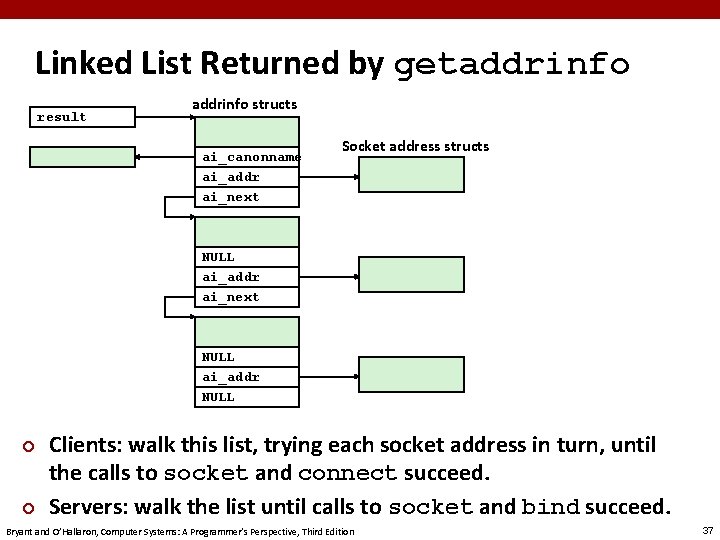
Linked List Returned by getaddrinfo result addrinfo structs ai_canonname ai_addr ai_next Socket address structs NULL ai_addr ai_next NULL ai_addr NULL ¢ ¢ Clients: walk this list, trying each socket address in turn, until the calls to socket and connect succeed. Servers: walk the list until calls to socket and bind succeed. Bryant and O’Hallaron, Computer Systems: A Programmer’s Perspective, Third Edition 37
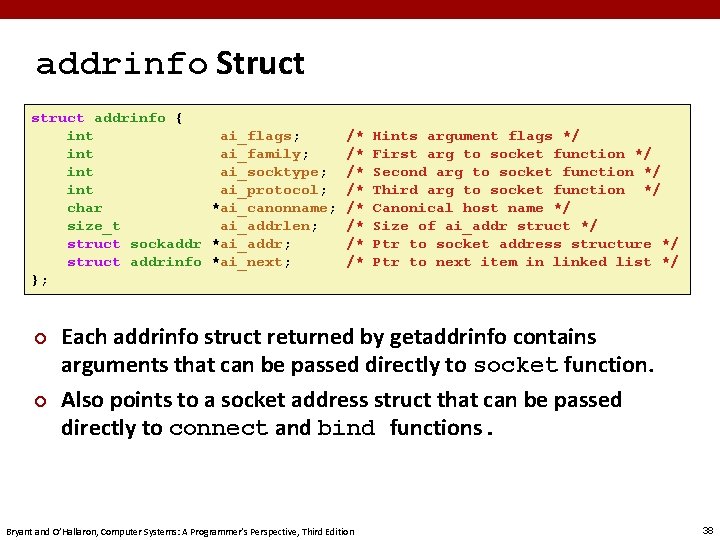
addrinfo Struct struct addrinfo { int ai_flags; /* Hints argument flags */ int ai_family; /* First arg to socket function */ int ai_socktype; /* Second arg to socket function */ int ai_protocol; /* Third arg to socket function */ char *ai_canonname; /* Canonical host name */ size_t ai_addrlen; /* Size of ai_addr struct */ struct sockaddr *ai_addr; /* Ptr to socket address structure */ struct addrinfo *ai_next; /* Ptr to next item in linked list */ }; ¢ ¢ Each addrinfo struct returned by getaddrinfo contains arguments that can be passed directly to socket function. Also points to a socket address struct that can be passed directly to connect and bind functions. Bryant and O’Hallaron, Computer Systems: A Programmer’s Perspective, Third Edition 38
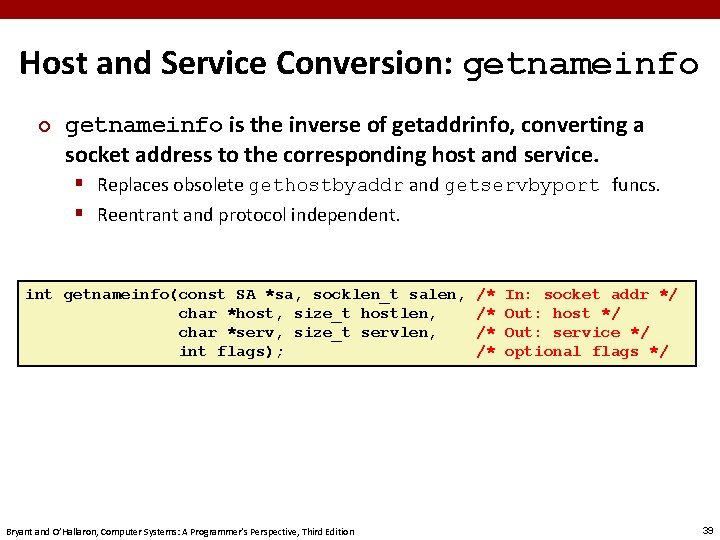
Host and Service Conversion: getnameinfo ¢ getnameinfo is the inverse of getaddrinfo, converting a socket address to the corresponding host and service. § Replaces obsolete gethostbyaddr and getservbyport funcs. § Reentrant and protocol independent. int getnameinfo(const SA *sa, socklen_t salen, char *host, size_t hostlen, char *serv, size_t servlen, int flags); Bryant and O’Hallaron, Computer Systems: A Programmer’s Perspective, Third Edition /* /* In: socket addr */ Out: host */ Out: service */ optional flags */ 39
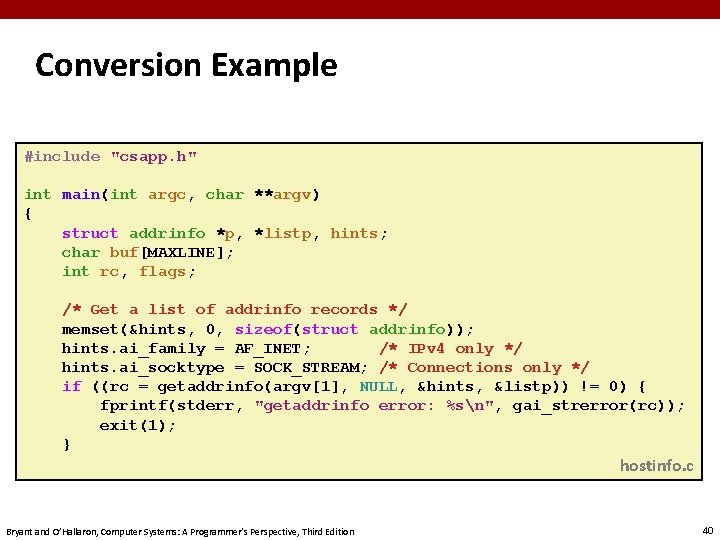
Conversion Example #include "csapp. h" int main(int argc, char **argv) { struct addrinfo *p, *listp, hints; char buf[MAXLINE]; int rc, flags; /* Get a list of addrinfo records */ memset(&hints, 0, sizeof(struct addrinfo)); hints. ai_family = AF_INET; /* IPv 4 only */ hints. ai_socktype = SOCK_STREAM; /* Connections only */ if ((rc = getaddrinfo(argv[1], NULL, &hints, &listp)) != 0) { fprintf(stderr, "getaddrinfo error: %sn", gai_strerror(rc)); exit(1); } hostinfo. c Bryant and O’Hallaron, Computer Systems: A Programmer’s Perspective, Third Edition 40
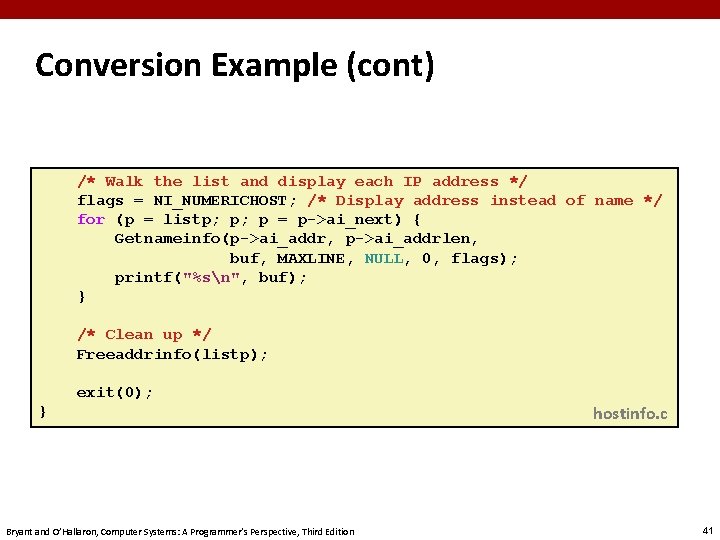
Conversion Example (cont) /* Walk the list and display each IP address */ flags = NI_NUMERICHOST; /* Display address instead of name */ for (p = listp; p; p = p->ai_next) { Getnameinfo(p->ai_addr, p->ai_addrlen, buf, MAXLINE, NULL, 0, flags); printf("%sn", buf); } /* Clean up */ Freeaddrinfo(listp); exit(0); } Bryant and O’Hallaron, Computer Systems: A Programmer’s Perspective, Third Edition hostinfo. c 41
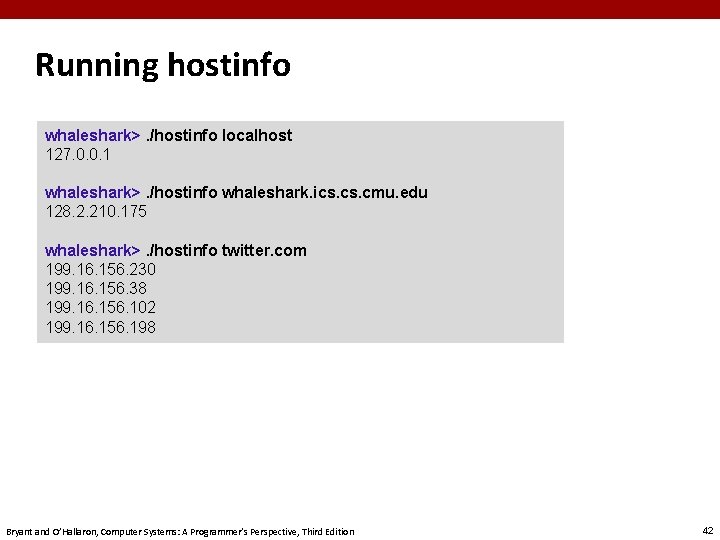
Running hostinfo whaleshark>. /hostinfo localhost 127. 0. 0. 1 whaleshark>. /hostinfo whaleshark. ics. cmu. edu 128. 2. 210. 175 whaleshark>. /hostinfo twitter. com 199. 16. 156. 230 199. 16. 156. 38 199. 16. 156. 102 199. 16. 156. 198 Bryant and O’Hallaron, Computer Systems: A Programmer’s Perspective, Third Edition 42

Additional slides Bryant and O’Hallaron, Computer Systems: A Programmer’s Perspective, Third Edition 43
Basic Internet Components ¢ Internet backbone: § collection of routers (nationwide or worldwide) connected by high-speed point-to-point networks ¢ Internet Exchange Points (IXP): § router that connects multiple backbones (often referred to as peers) § Also called Network Access Points (NAP) ¢ Regional networks: § smaller backbones that cover smaller geographical areas (e. g. , cities or states) ¢ Point of presence (POP): § machine that is connected to the Internet ¢ Internet Service Providers (ISPs): § provide dial-up or direct access to POPs Bryant and O’Hallaron, Computer Systems: A Programmer’s Perspective, Third Edition 44
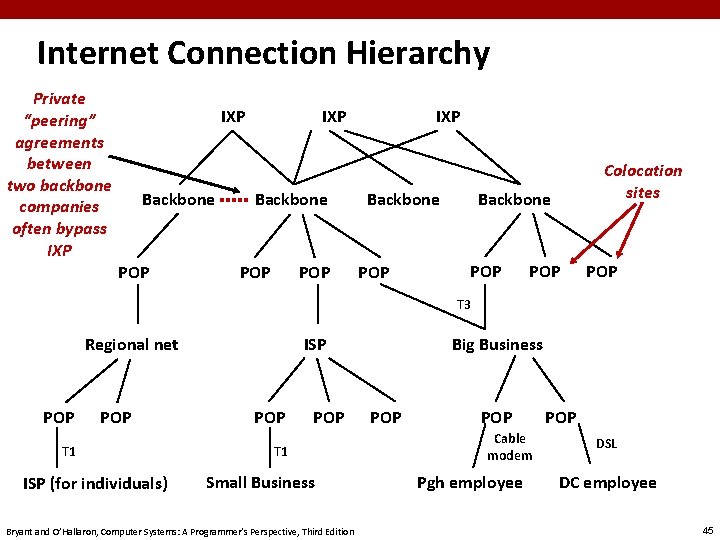
Internet Connection Hierarchy Private “peering” agreements between two backbone companies often bypass IXP Backbone POP Colocation sites Backbone POP POP T 3 Regional net POP T 1 ISP (for individuals) ISP POP T 1 Small Business Bryant and O’Hallaron, Computer Systems: A Programmer’s Perspective, Third Edition Big Business POP Cable modem Pgh employee POP DSL DC employee 45
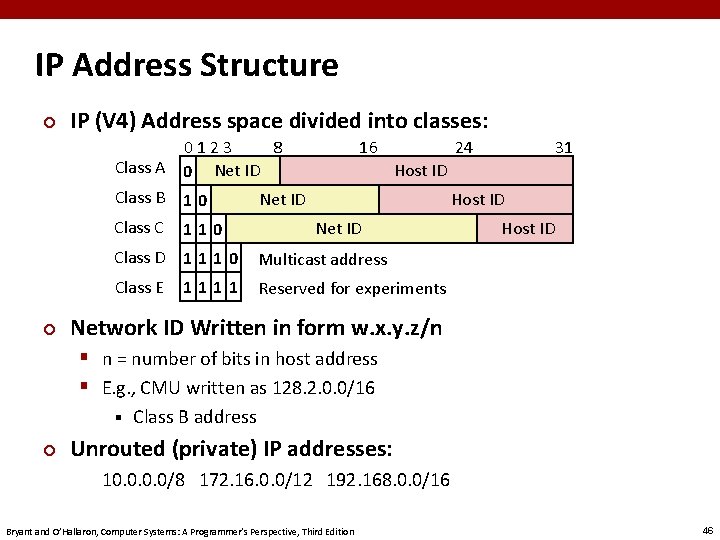
IP Address Structure ¢ IP (V 4) Address space divided into classes: 0123 8 Class A 0 Net ID Class B 1 0 Net ID Class C ¢ 110 16 24 Host ID Net ID Class D 1 1 1 0 Multicast address Class E Reserved for experiments 1111 31 Host ID Network ID Written in form w. x. y. z/n § n = number of bits in host address § E. g. , CMU written as 128. 2. 0. 0/16 § ¢ Class B address Unrouted (private) IP addresses: 10. 0/8 172. 16. 0. 0/12 192. 168. 0. 0/16 Bryant and O’Hallaron, Computer Systems: A Programmer’s Perspective, Third Edition 46
Evolution of Internet ¢ Original Idea § Every node on Internet would have unique IP address Everyone would be able to talk directly to everyone § No secrecy or authentication § Messages visible to routers and hosts on same LAN § Possible to forge source field in packet header § ¢ Shortcomings § There aren't enough IP addresses available § Don't want everyone to have access or knowledge of all other hosts § Security issues mandate secrecy & authentication Bryant and O’Hallaron, Computer Systems: A Programmer’s Perspective, Third Edition 47
Evolution of Internet: Naming ¢ Dynamic address assignment § Most hosts don't need to have known address Only those functioning as servers § DHCP (Dynamic Host Configuration Protocol) § Local ISP assigns address for temporary use § ¢ Example: § Laptop at CMU (wired connection) IP address 128. 2. 213. 29 (bryant-tp 4. cs. cmu. edu) § Assigned statically § Laptop at home § IP address 192. 168. 1. 5 § Only valid within home network § Bryant and O’Hallaron, Computer Systems: A Programmer’s Perspective, Third Edition 48
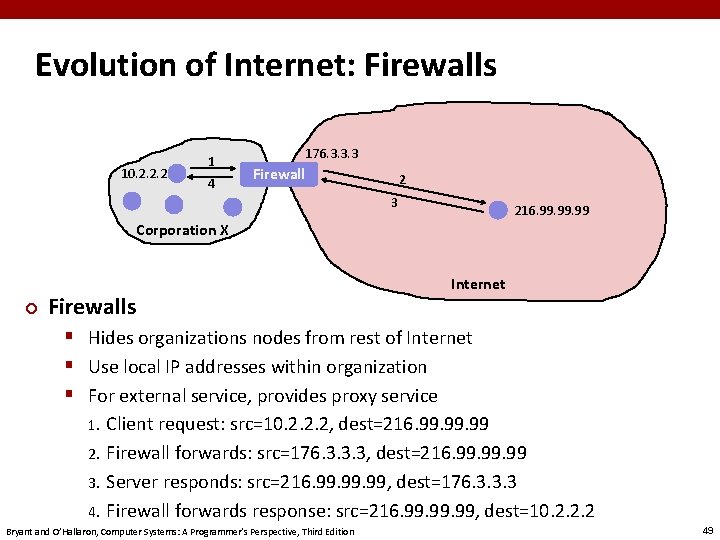
Evolution of Internet: Firewalls 10. 2. 2. 2 1 4 176. 3. 3. 3 Firewall 2 3 216. 99. 99 Corporation X ¢ Firewalls Internet § Hides organizations nodes from rest of Internet § Use local IP addresses within organization § For external service, provides proxy service Client request: src=10. 2. 2. 2, dest=216. 99. 99 2. Firewall forwards: src=176. 3. 3. 3, dest=216. 99. 99 3. Server responds: src=216. 99. 99, dest=176. 3. 3. 3 4. Firewall forwards response: src=216. 99. 99, dest=10. 2. 2. 2 1. Bryant and O’Hallaron, Computer Systems: A Programmer’s Perspective, Third Edition 49
- Slides: 49