
Network Performance IPOptical IPOptical Performance Management Tobey Trygar

Network Performance (IP/Optical) IP/Optical Performance Management Tobey Trygar Prepared For: ttrygar@telcordia. com ITU-T Workshop On +1 732 758 -5399 IP/Optical Chitose, Japan, 9 -11 July An SAIC Company The views expressed in this presentation are the presenter’s and do not necessarily represent the views and policies of Telcordia Technologies, Inc. 2002
Outline Definitions and Classifications Networks and Technologies Optical Transport Network (OTN), Layers and Interfaces OTN Performance Parameters OTN Client Signals Automatic Switched Optical Network (ASON) ASON Signalling IP As ASON Client IP/OTN Performance Session 11 - IP/Optical PM – 2
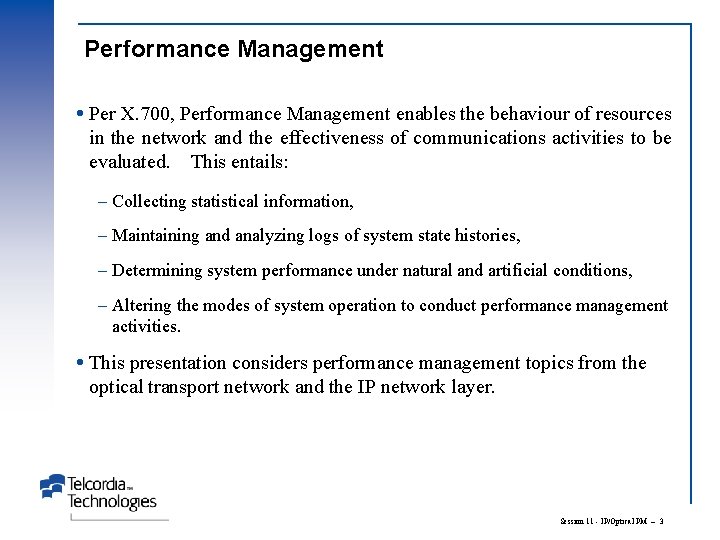
Performance Management Per X. 700, Performance Management enables the behaviour of resources in the network and the effectiveness of communications activities to be evaluated. This entails: – Collecting statistical information, – Maintaining and analyzing logs of system state histories, – Determining system performance under natural and artificial conditions, – Altering the modes of system operation to conduct performance management activities. This presentation considers performance management topics from the optical transport network and the IP network layer. Session 11 - IP/Optical PM – 3
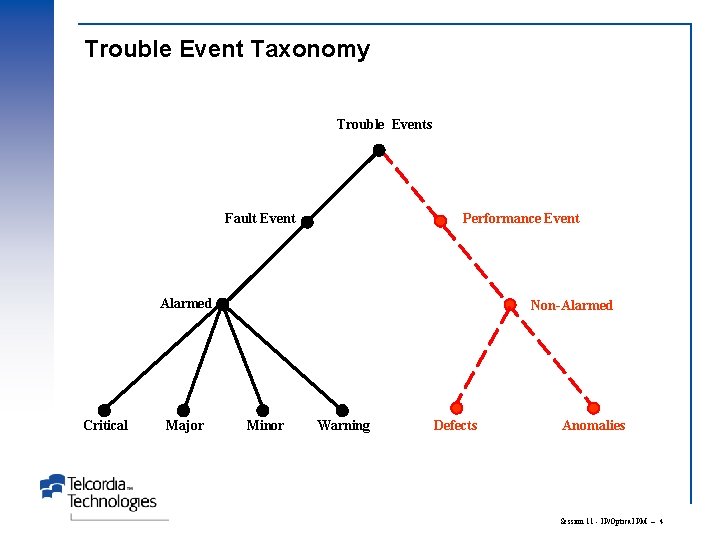
Trouble Event Taxonomy Trouble Events Fault Event Performance Event Alarmed Critical Major Non-Alarmed Minor Warning Defects Anomalies Session 11 - IP/Optical PM – 4
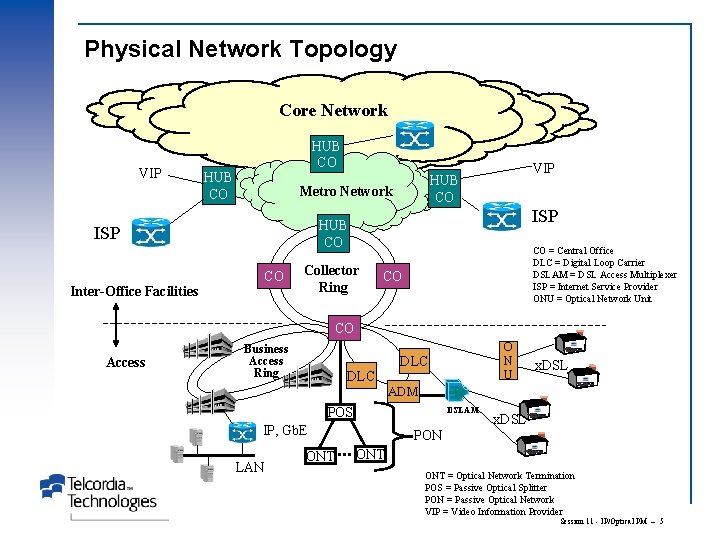
Physical Network Topology Core Network VIP HUB CO Metro Network ISP HUB CO ISP Inter-Office Facilities VIP HUB CO CO Collector Ring CO = Central Office DLC = Digital Loop Carrier DSLAM = DSL Access Multiplexer ISP = Internet Service Provider ONU = Optical Network Unit CO CO Access Business Access Ring DLC O N U DLC x. DSL ADM POS IP, Gb. E LAN DSLAM x. DSL PON ONT • • • ONT = Optical Network Termination POS = Passive Optical Splitter PON = Passive Optical Network VIP = Video Information Provider Session 11 - IP/Optical PM – 5
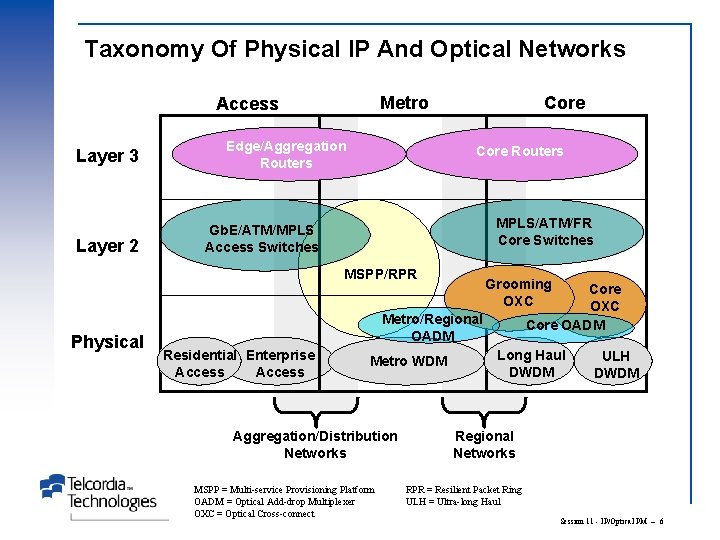
Taxonomy Of Physical IP And Optical Networks Metro Access Layer 3 Layer 2 Edge/Aggregation Routers Core Routers MPLS/ATM/FR Core Switches Gb. E/ATM/MPLS Access Switches MSPP/RPR Physical Grooming OXC Core OADM Metro/Regional OADM Residential Enterprise Access Metro WDM Aggregation/Distribution Networks MSPP = Multi-service Provisioning Platform OADM = Optical Add-drop Multiplexer OXC = Optical Cross-connect Long Haul DWDM ULH DWDM Regional Networks RPR = Resilient Packet Ring ULH = Ultra-long Haul Session 11 - IP/Optical PM – 6
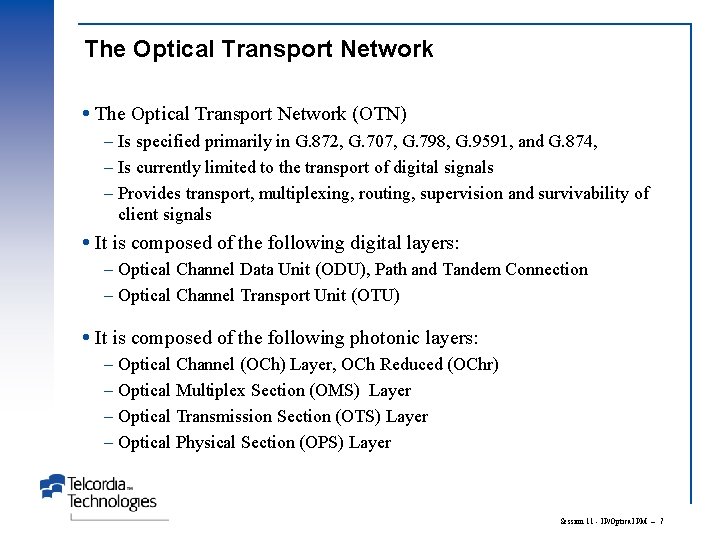
The Optical Transport Network (OTN) – Is specified primarily in G. 872, G. 707, G. 798, G. 9591, and G. 874, – Is currently limited to the transport of digital signals – Provides transport, multiplexing, routing, supervision and survivability of client signals It is composed of the following digital layers: – Optical Channel Data Unit (ODU), Path and Tandem Connection – Optical Channel Transport Unit (OTU) It is composed of the following photonic layers: – Optical Channel (OCh) Layer, OCh Reduced (OChr) – Optical Multiplex Section (OMS) Layer – Optical Transmission Section (OTS) Layer – Optical Physical Section (OPS) Layer Session 11 - IP/Optical PM – 7
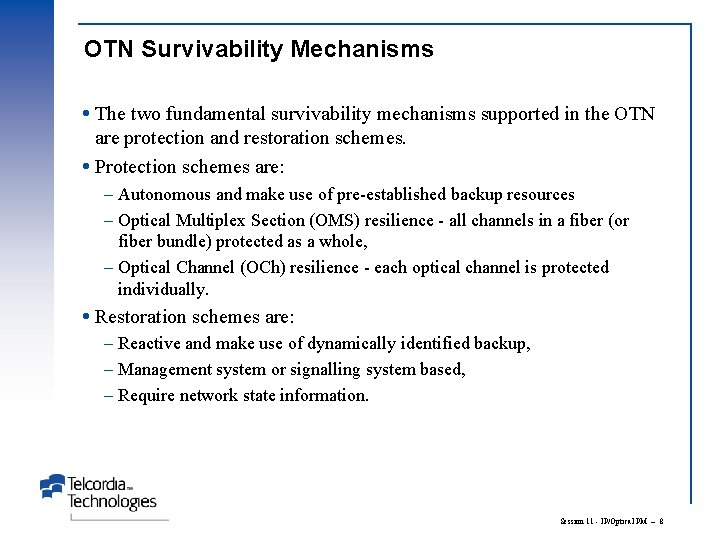
OTN Survivability Mechanisms The two fundamental survivability mechanisms supported in the OTN are protection and restoration schemes. Protection schemes are: – Autonomous and make use of pre-established backup resources – Optical Multiplex Section (OMS) resilience - all channels in a fiber (or fiber bundle) protected as a whole, – Optical Channel (OCh) resilience - each optical channel is protected individually. Restoration schemes are: – Reactive and make use of dynamically identified backup, – Management system or signalling system based, – Require network state information. Session 11 - IP/Optical PM – 8
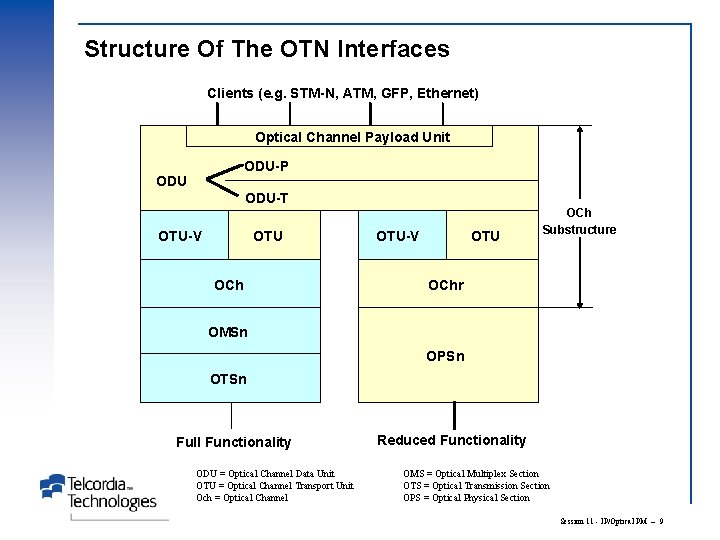
Structure Of The OTN Interfaces Clients (e. g. STM-N, ATM, GFP, Ethernet) Optical Channel Payload Unit ODU-P ODU-T OTU OTU-V OCh Substructure OChr OMSn OPSn OTSn Full Functionality ODU = Optical Channel Data Unit OTU = Optical Channel Transport Unit Och = Optical Channel Reduced Functionality OMS = Optical Multiplex Section OTS = Optical Transmission Section OPS = Optical Physical Section Session 11 - IP/Optical PM – 9
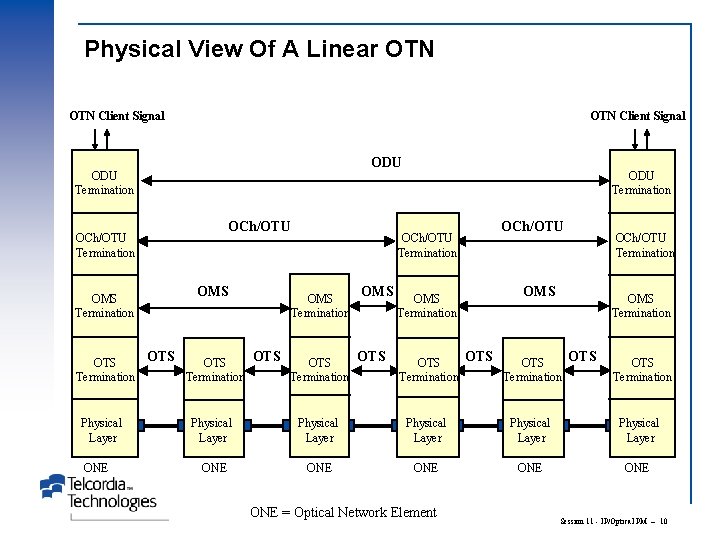
Physical View Of A Linear OTN Client Signal ODU Termination OCh/OTU Termination OMS Termination OTS Termination Physical Layer ONE OTS Termination OCh/OTU Termination OMS Termination OTS ODU Termination OTS Termination OMS OTS OMS Termination OTS Termination OCh/OTU Termination OTS OMS Termination OTS OTS Termination Physical Layer Physical Layer ONE ONE ONE = Optical Network Element Session 11 - IP/Optical PM – 10
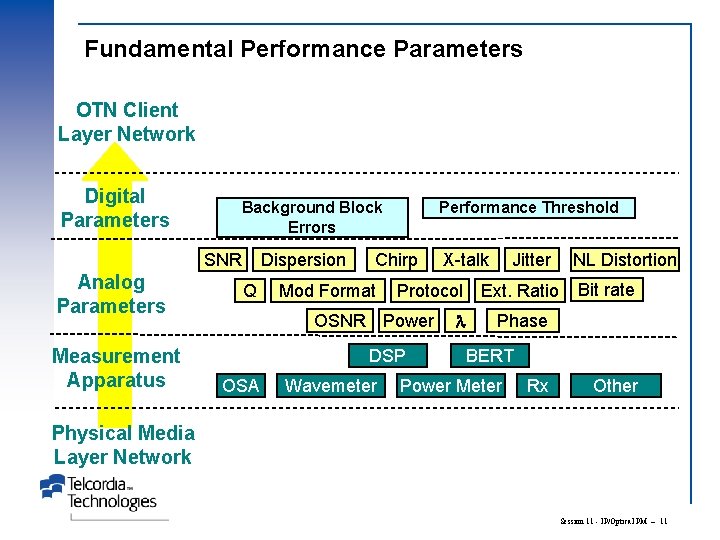
Fundamental Performance Parameters OTN Client Layer Network Digital Parameters Background Block Errors SNR Analog Parameters Measurement Apparatus Dispersion Q Performance Threshold Chirp Mod Format Protocol OSNR Power DSP OSA Wavemeter X-talk l Jitter Ext. Ratio NL Distortion Bit rate Phase BERT Power Meter Rx Other Physical Media Layer Network Session 11 - IP/Optical PM – 11
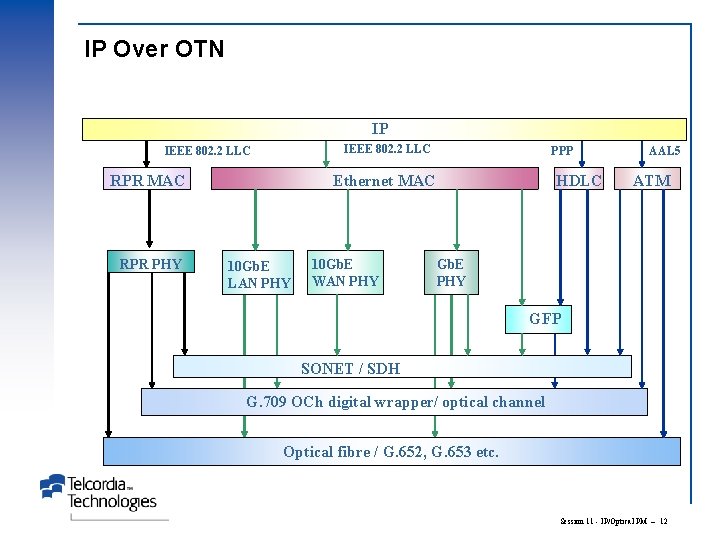
IP Over OTN IP IEEE 802. 2 LLC RPR MAC RPR PHY PPP Ethernet MAC 10 Gb. E LAN PHY 10 Gb. E WAN PHY HDLC AAL 5 ATM Gb. E PHY GFP SONET / SDH G. 709 OCh digital wrapper/ optical channel Optical fibre / G. 652, G. 653 etc. Session 11 - IP/Optical PM – 12
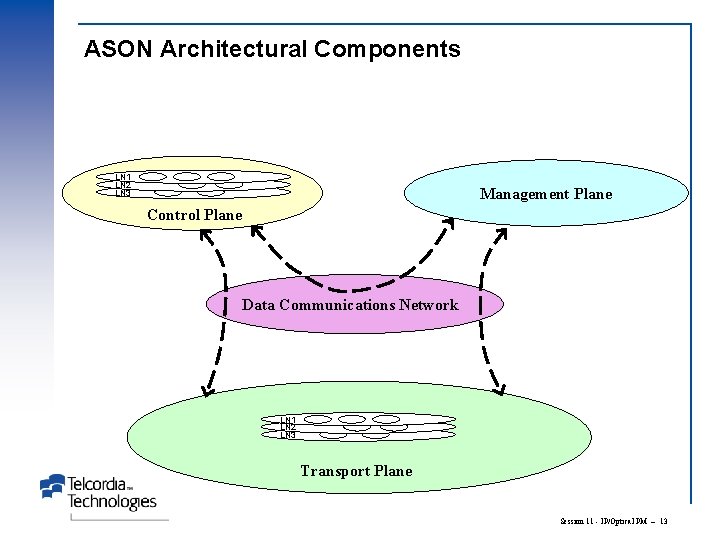
ASON Architectural Components LN 1 LN 2 LN 3 Management Plane Control Plane Data Communications Network LN 1 LN 2 LN 3 Transport Plane Session 11 - IP/Optical PM – 13
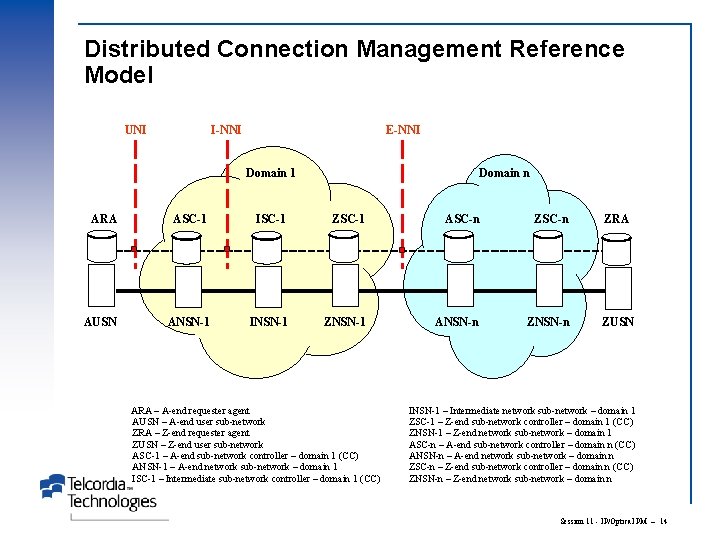
Distributed Connection Management Reference Model UNI I-NNI E-NNI Domain 1 Domain n ARA ASC-1 ISC-1 ZSC-1 ASC-n ZRA AUSN ANSN-1 INSN-1 ZNSN-1 ANSN-n ZUSN ARA – A-end requester agent AUSN – A-end user sub-network ZRA – Z-end requester agent ZUSN – Z-end user sub-network ASC-1 – A-end sub-network controller – domain 1 (CC) ANSN-1 – A-end network sub-network – domain 1 ISC-1 – Intermediate sub-network controller – domain 1 (CC) INSN-1 – Intermediate network sub-network – domain 1 ZSC-1 – Z-end sub-network controller – domain 1 (CC) ZNSN-1 – Z-end network sub-network – domain 1 ASC-n – A-end sub-network controller – domain n (CC) ANSN-n – A-end network sub-network – domain n ZSC-n – Z-end sub-network controller – domain n (CC) ZNSN-n – Z-end network sub-network – domain n Session 11 - IP/Optical PM – 14
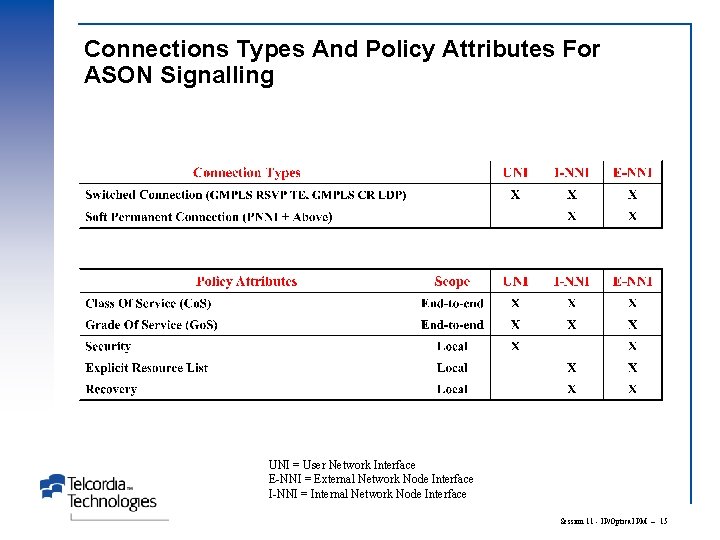
Connections Types And Policy Attributes For ASON Signalling UNI = User Network Interface E-NNI = External Network Node Interface I-NNI = Internal Network Node Interface Session 11 - IP/Optical PM – 15
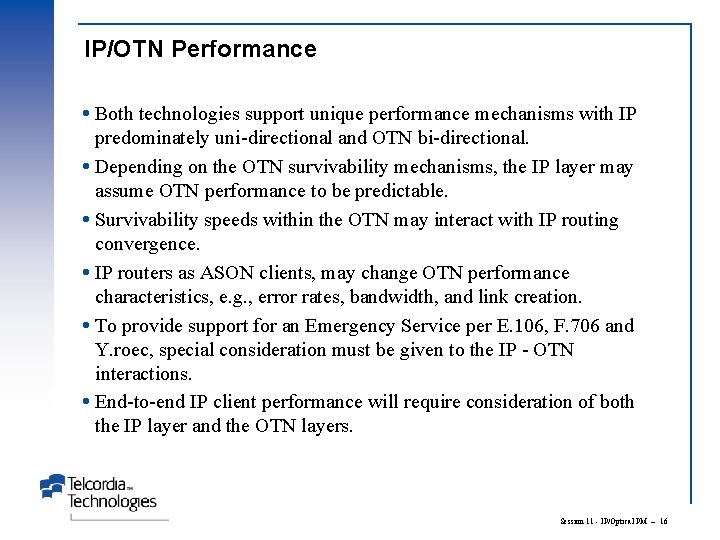
IP/OTN Performance Both technologies support unique performance mechanisms with IP predominately uni-directional and OTN bi-directional. Depending on the OTN survivability mechanisms, the IP layer may assume OTN performance to be predictable. Survivability speeds within the OTN may interact with IP routing convergence. IP routers as ASON clients, may change OTN performance characteristics, e. g. , error rates, bandwidth, and link creation. To provide support for an Emergency Service per E. 106, F. 706 and Y. roec, special consideration must be given to the IP - OTN interactions. End-to-end IP client performance will require consideration of both the IP layer and the OTN layers. Session 11 - IP/Optical PM – 16
References E. 106, Description of an International Emergency Preference Scheme (IEPS) F. 706, (Draft), International Emergency Multimedia Service G. 709, Network Node Interface For The Optical Transport Network (OTN) G. 798, Characteristics of Optical Transport Network Hierarchy Equipment Functional Blocks G. 805, Generic Functional Architecture Of Transport Networks G. 806, Characteristics of Transport Equipment - Description Methodology and Generic Functionality G. 872, Architecture Of Optical Transport Networks G. 874, Management Aspects Of Optical Transport Network Elements G. 959. 1, Optical Transport Network Physical Layer Interfaces G. 7041, Generic Framing Procedure G. 7710, Common Equipment Management Function Requirements G. 7712, Architecture And Specification Of Data Communication Network Session 11 - IP/Optical PM – 17
References G. 7713, Distributed Call and Connection Management G. 7713. 1 (Draft), Distributed Call and Connection Management (DCM) Based on PNNI G. 7713. 2 (Draft), DCM Signalling Mechanism Using GMPLS RSVP-TE G. 7713. 3 (Draft), Distributed Call and Connection Management Signalling Using GMPLS CR-LDP G. 8080, Architecture for the Automatic Switched Optical Network (ASON) M. 20, Maintenance Philosophy for Telecommunications Networks M. 3010, Principles For A Telecommunications Management Network X. 700, Management Framework for Open Systems Interconnection (OSI) for CCITT Applications Y. roec, (Draft), Framework(s) on Network Requirements and Capabilities to Support Emergency Communications Over Evolving Circuit Switched and Packet Switched Networks Session 11 - IP/Optical PM – 18
- Slides: 18