
Network Overview Contents Jones network basics and topology
Network Overview
Contents • Jones network basics and topology • Current network technologies – LAN and Ethernet – Circuit based WAN – ATM and Frame Relay • The future – GBN, GTS, etc.
Jones Network History • 'The Flat' – LAN, layer 2 based network – Layer 2 – Ethernet level switching – Limited expandability – Single-vendor: Cabletron • Also provided management solution, Cabletron Spectrum
LAN/Layer 2 • Local Area Networks – “Layer 2” of the seven-layer OSI model – Computer-to-computer, hardware level – Hubs and switches – Collision and broadcast domains – Controlled by the Spanning Tree Protocol – Reconvergence problems – Broadcast storms
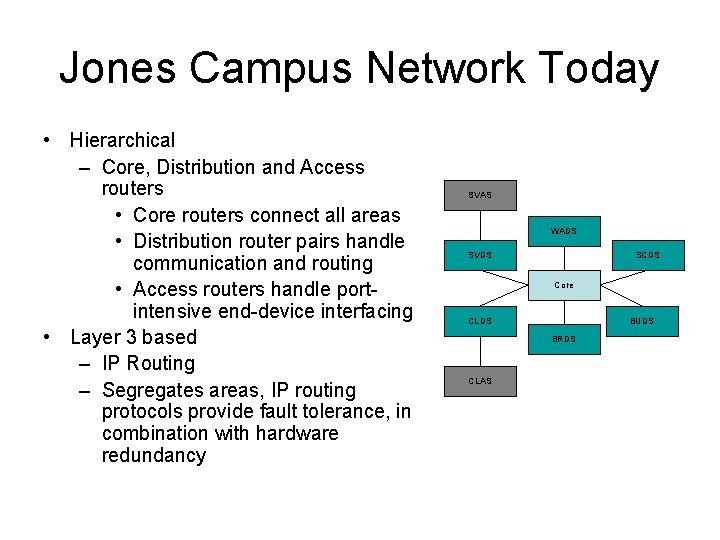
Jones Campus Network Today • Hierarchical – Core, Distribution and Access routers • Core routers connect all areas • Distribution router pairs handle communication and routing • Access routers handle portintensive end-device interfacing • Layer 3 based – IP Routing – Segregates areas, IP routing protocols provide fault tolerance, in combination with hardware redundancy SVAS WADS SVDS SCDS Core CLDS BUDS BRDS CLAS
Layer 3/IP • ISO Model, layer 3 – Network layer • • Protocols: IP, IPX, XNS, etc. Higher level addressing and routing functions Provides isolation and routing between LANs IP: Hierarchical addressing, a. b. c. d style – Subnetting and Subnet Masks • Today: Layer 3=IP – Routing protocols • BGP, IGRP • Provide similar function to STP on the IP level • Similar problems, but less widespread

Jones Campus Details • Distribution routers in pairs – Connect to access switches – Closet Distribution • Connects to pairs of Closet Access switches • Where (most) desktops connect – Server Distribution – Wide-Area Distribution • And WAN ATM – Branch Distribution – Backup Distribution – SOC Distribution • An ‘Island’ for the SOC, with SCAS swtich
Jones WAN Technologies • Fiber-optic connections to all areas – Fiber ring connects all three St. Louis campuses – Fiber links to Tempe (now Gigabit Ethernet), UK, Canada • Direct from ATM area to cores – Used as an access path for other circuits – Breaks out into individual links • Serial links pass through matrix switches, DSU • May go to SNA/Mainframe network directly or to IP WAN – – IBM 3745, SNA links IP WAN Tier 1: Standard vendor links Tier 2: Jones terminals at remote sites Tier 3: Trusted networks, Boone, Frame-Relay WAH
Circuit-based WAN Protocols • PVC concept – Permanent Virtual Circuit – Divide one connection into many concurrent ones • ATM • Frame Relay
ATM • Asyncronous Transfer Mode – The “Network of the Future” - in the ‘ 90’s – Typically used for high-capacity WAN circuits – Small packets (cells) of 64 bytes each – Provides Quality of Service • Time-sensitive data/PVC gets priority • Voice, video and data can be carried together – Out of style for many duties • Ethernet now provides speed and Qo. S
Frame-Relay • ATM’s lower-tech counterpart – Used as a sort of layer 2 Internet – Each end of a PVC gets an identifying number • DLCI - Data Link Connection Identifier – Links have two bandwidth numbers • CIR - Committed Information Rate • Full link rate – Commonly used for low-bandwidth connections • Point-to-multipoint • HQ to branch-style connections • To be replaced (maybe) by MPLS • Used for vendor, WAH, UK Branch connections
GBN Network Design • Large point-to-multipoint network – Evolving Design • MPLS to varied branch access circuits – ADSL, SDSL, T 1… – Any technology that can be attached to the MPLS cloud – Provides one link and redundency at lower cost than Frame • Head-end routers – St. Louis and Tempe – Using DS 3 (45 mbit serial) for now • Branch components – Router, local switch, and UPS monitored at this time – Final configuration to be determined.
GBN Logical Network • Uses MPLS VPN Technology – MPLS - Multiprotocol Label Switching • “Layer 2. 5” add-on tunneling protocol • Can be encapsulated and deencapsulated (pushed and popped) multiple times for security or design flexibility • Is designed to be more flexible than Frame-Relay with larger packet sizes and less total overhead than ATM – VPN (Virtual Private Network) • • Typically refers to encrypted encapsulation Carries IP traffic (IPSec VPN) or can be used with MPLS Provides secure traffic transmission Allows for use of a cheaper, provider-run ‘insecure’ network
- Slides: 13