
Network Management r introduction to network management m
- Slides: 28
Network Management r introduction to network management m motivation m major components r Internet network management framework m MIB: management information base m SMI: data definition language m SNMP: protocol for network management m security and administration r presentation services: ASN. 1 r firewalls 8: Network Management 1
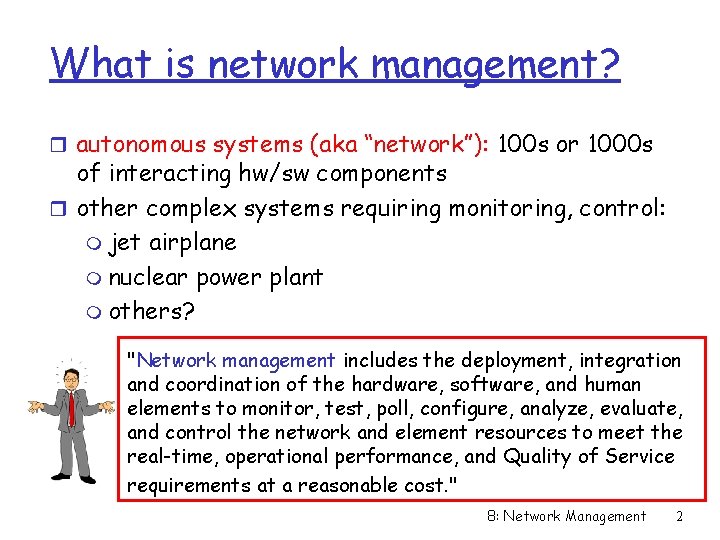
What is network management? r autonomous systems (aka “network”): 100 s or 1000 s of interacting hw/sw components r other complex systems requiring monitoring, control: m jet airplane m nuclear power plant m others? "Network management includes the deployment, integration and coordination of the hardware, software, and human elements to monitor, test, poll, configure, analyze, evaluate, and control the network and element resources to meet the real-time, operational performance, and Quality of Service requirements at a reasonable cost. " 8: Network Management 2
What would we like NM to do? r Detecting failures: NICs, routers, links r Monitor operations: m abnormal host behaviors m routing instabilities r Monitor traffic: supply stats for planning and resource allocation r Monitor performance contracts r Intrusion detection 8: Network Management 3
ISO NM model r Performance management r Fault management r Configuration management r Accounting management r Security management 8: Network Management 4
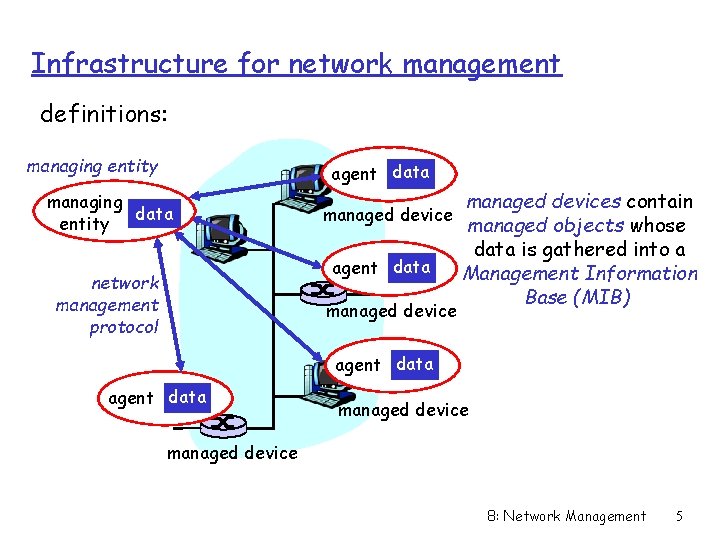
Infrastructure for network management definitions: managing entity agent data managing data entity network management protocol managed devices contain managed device managed objects whose data is gathered into a agent data Management Information Base (MIB) managed device agent data managed device 8: Network Management 5
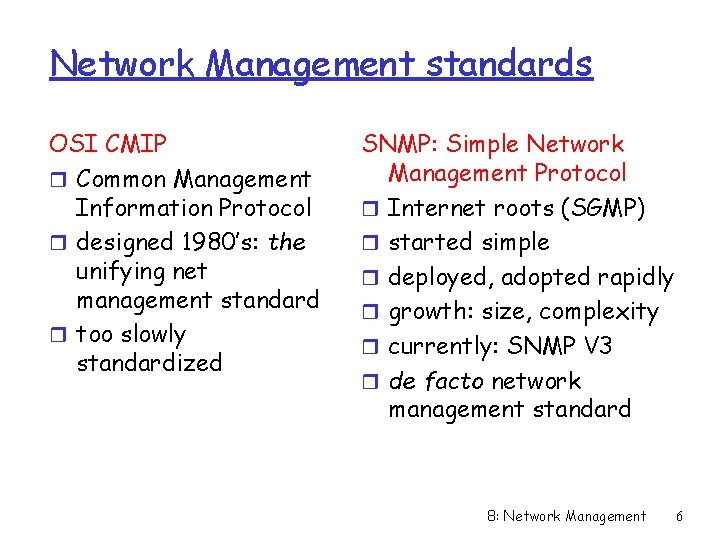
Network Management standards OSI CMIP r Common Management Information Protocol r designed 1980’s: the unifying net management standard r too slowly standardized SNMP: Simple Network Management Protocol r Internet roots (SGMP) r started simple r deployed, adopted rapidly r growth: size, complexity r currently: SNMP V 3 r de facto network management standard 8: Network Management 6
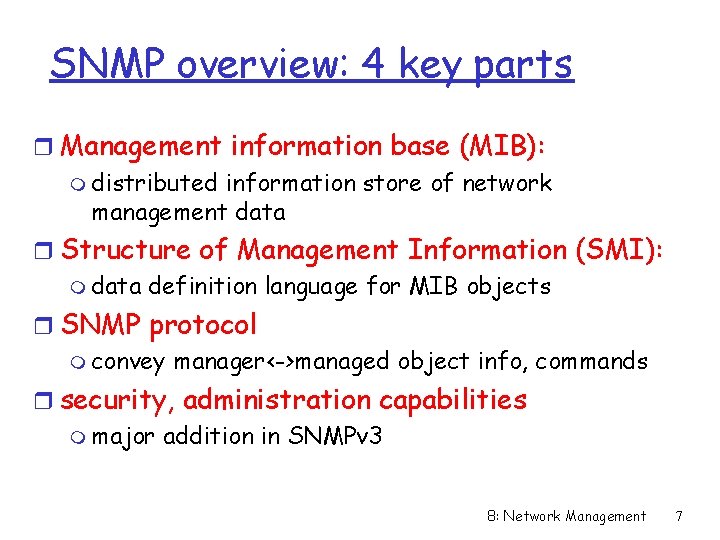
SNMP overview: 4 key parts r Management information base (MIB): m distributed information store of network management data r Structure of Management Information (SMI): m data definition language for MIB objects r SNMP protocol m convey manager<->managed object info, commands r security, administration capabilities m major addition in SNMPv 3 8: Network Management 7
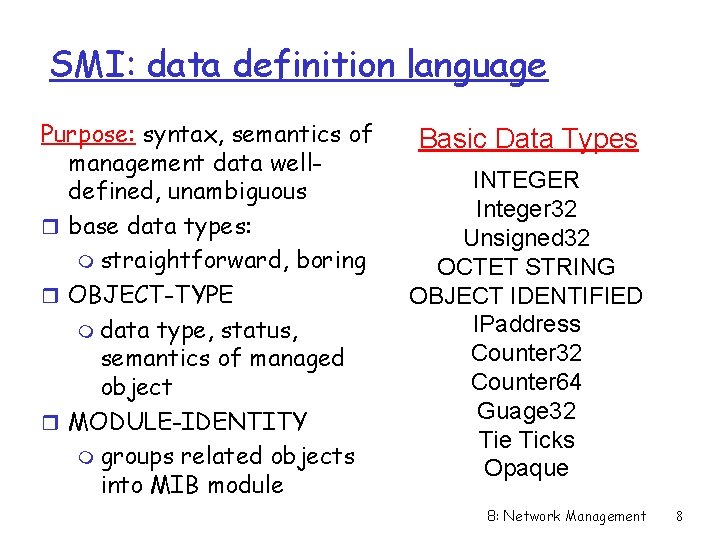
SMI: data definition language Purpose: syntax, semantics of management data welldefined, unambiguous r base data types: m straightforward, boring r OBJECT-TYPE m data type, status, semantics of managed object r MODULE-IDENTITY m groups related objects into MIB module Basic Data Types INTEGER Integer 32 Unsigned 32 OCTET STRING OBJECT IDENTIFIED IPaddress Counter 32 Counter 64 Guage 32 Tie Ticks Opaque 8: Network Management 8
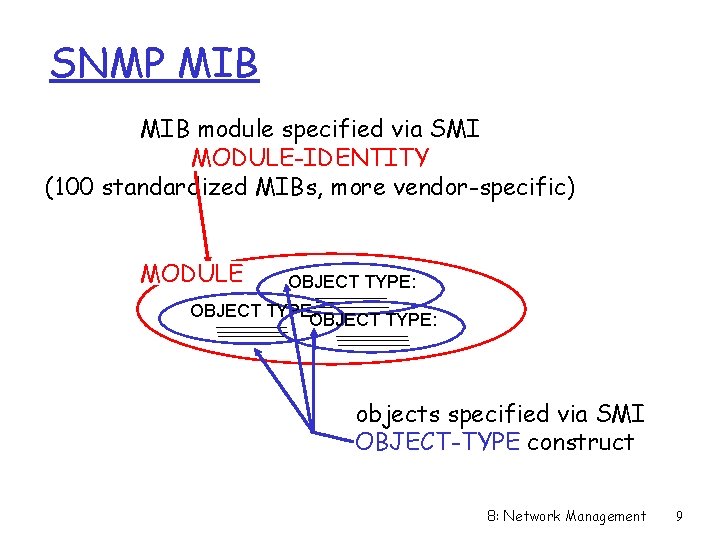
SNMP MIB module specified via SMI MODULE-IDENTITY (100 standardized MIBs, more vendor-specific) MODULE OBJECT TYPE: objects specified via SMI OBJECT-TYPE construct 8: Network Management 9
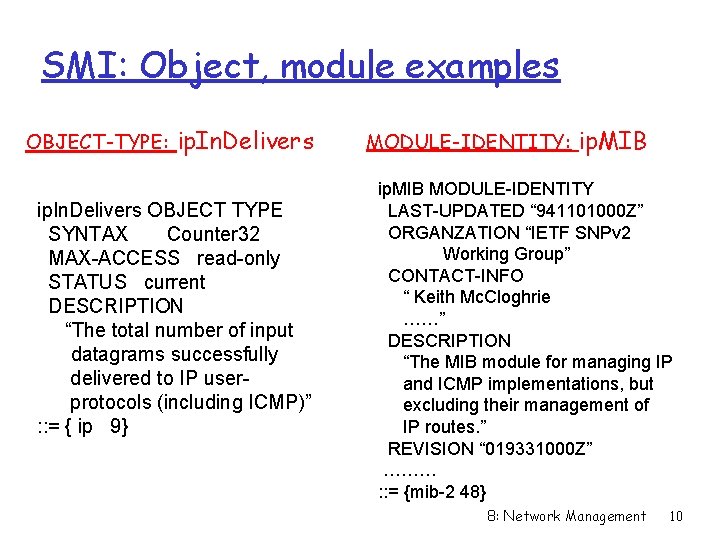
SMI: Object, module examples OBJECT-TYPE: ip. In. Delivers OBJECT TYPE SYNTAX Counter 32 MAX-ACCESS read-only STATUS current DESCRIPTION “The total number of input datagrams successfully delivered to IP userprotocols (including ICMP)” : : = { ip 9} MODULE-IDENTITY: ip. MIB MODULE-IDENTITY LAST-UPDATED “ 941101000 Z” ORGANZATION “IETF SNPv 2 Working Group” CONTACT-INFO “ Keith Mc. Cloghrie ……” DESCRIPTION “The MIB module for managing IP and ICMP implementations, but excluding their management of IP routes. ” REVISION “ 019331000 Z” ……… : : = {mib-2 48} 8: Network Management 10
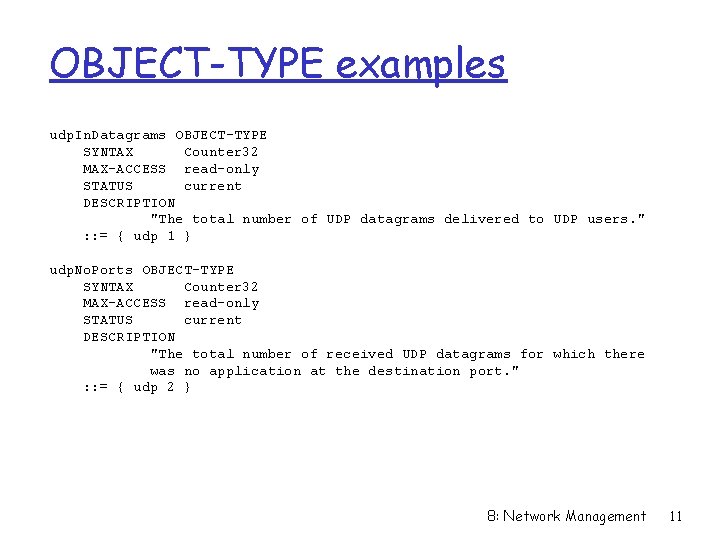
OBJECT-TYPE examples udp. In. Datagrams OBJECT-TYPE SYNTAX Counter 32 MAX-ACCESS read-only STATUS current DESCRIPTION "The total number of UDP datagrams delivered to UDP users. " : : = { udp 1 } udp. No. Ports OBJECT-TYPE SYNTAX Counter 32 MAX-ACCESS read-only STATUS current DESCRIPTION "The total number of received UDP datagrams for which there was no application at the destination port. " : : = { udp 2 } 8: Network Management 11
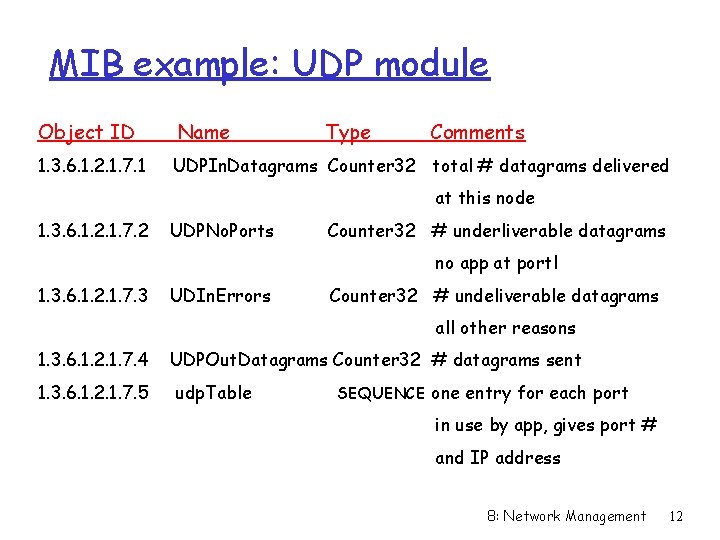
MIB example: UDP module Object ID Name Type Comments 1. 3. 6. 1. 2. 1. 7. 1 UDPIn. Datagrams Counter 32 total # datagrams delivered at this node 1. 3. 6. 1. 2. 1. 7. 2 UDPNo. Ports Counter 32 # underliverable datagrams no app at portl 1. 3. 6. 1. 2. 1. 7. 3 UDIn. Errors Counter 32 # undeliverable datagrams all other reasons 1. 3. 6. 1. 2. 1. 7. 4 UDPOut. Datagrams Counter 32 # datagrams sent 1. 3. 6. 1. 2. 1. 7. 5 udp. Table SEQUENCE one entry for each port in use by app, gives port # and IP address 8: Network Management 12
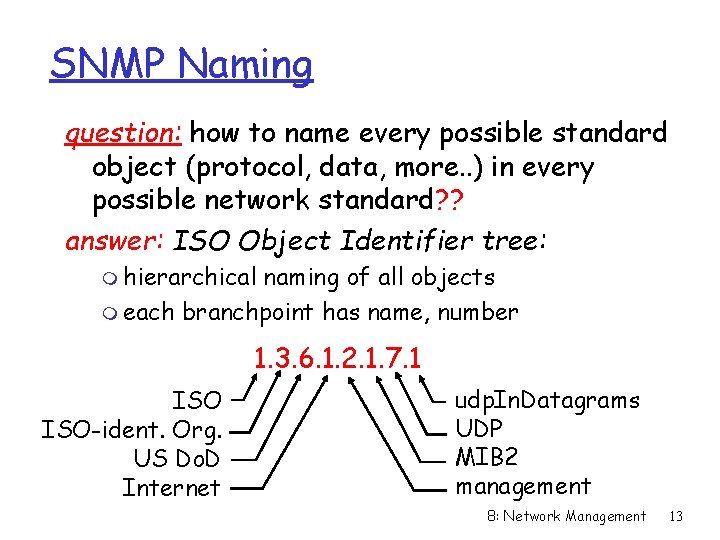
SNMP Naming question: how to name every possible standard object (protocol, data, more. . ) in every possible network standard? ? answer: ISO Object Identifier tree: m hierarchical naming of all objects m each branchpoint has name, number 1. 3. 6. 1. 2. 1. 7. 1 ISO-ident. Org. US Do. D Internet udp. In. Datagrams UDP MIB 2 management 8: Network Management 13
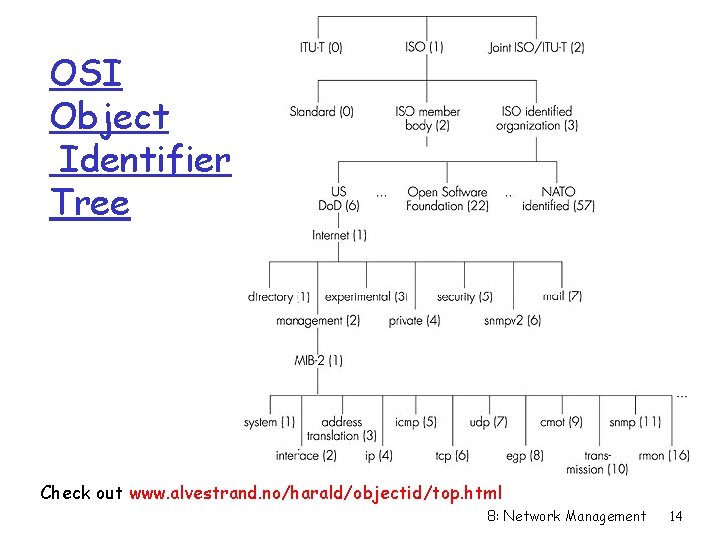
OSI Object Identifier Tree Check out www. alvestrand. no/harald/objectid/top. html 8: Network Management 14
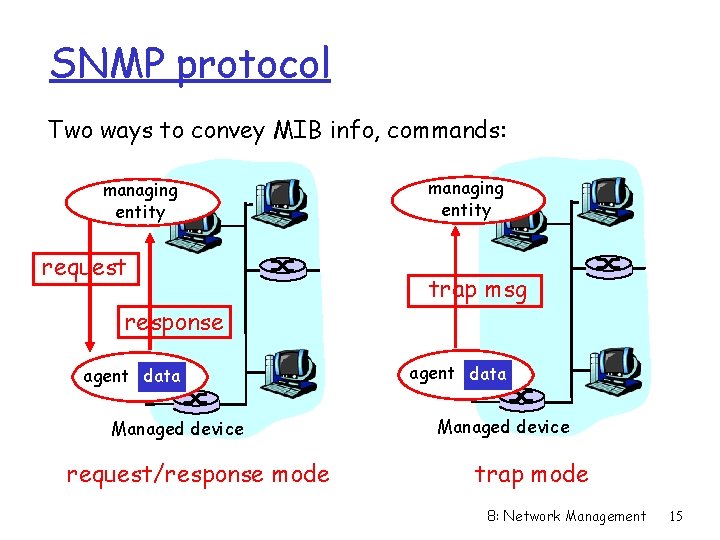
SNMP protocol Two ways to convey MIB info, commands: managing entity request response agent data Managed device request/response mode managing entity trap msg agent data Managed device trap mode 8: Network Management 15
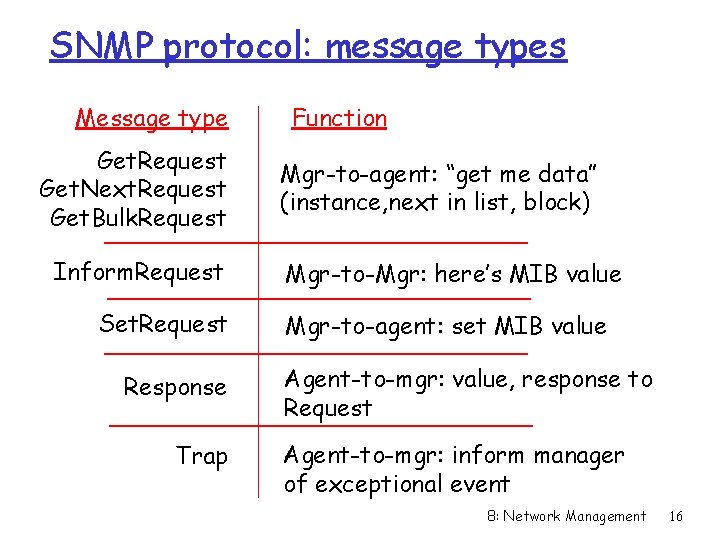
SNMP protocol: message types Message type Get. Request Get. Next. Request Get. Bulk. Request Inform. Request Set. Request Response Trap Function Mgr-to-agent: “get me data” (instance, next in list, block) Mgr-to-Mgr: here’s MIB value Mgr-to-agent: set MIB value Agent-to-mgr: value, response to Request Agent-to-mgr: inform manager of exceptional event 8: Network Management 16
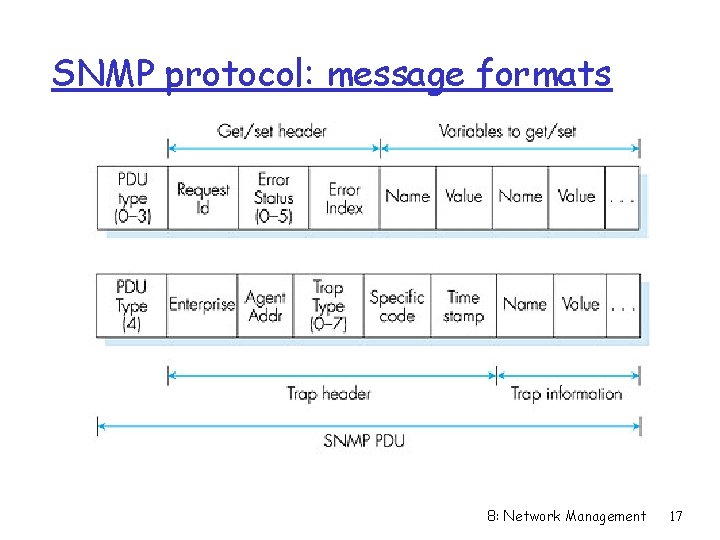
SNMP protocol: message formats 8: Network Management 17
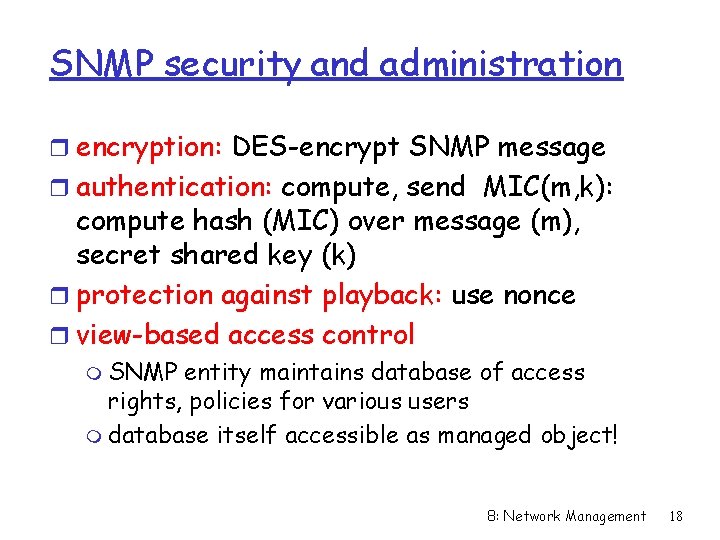
SNMP security and administration r encryption: DES-encrypt SNMP message r authentication: compute, send MIC(m, k): compute hash (MIC) over message (m), secret shared key (k) r protection against playback: use nonce r view-based access control m SNMP entity maintains database of access rights, policies for various users m database itself accessible as managed object! 8: Network Management 18
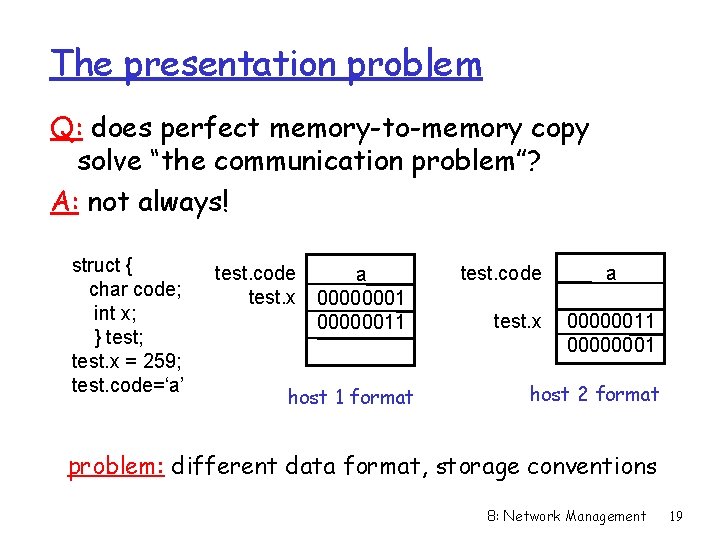
The presentation problem Q: does perfect memory-to-memory copy solve “the communication problem”? A: not always! struct { char code; int x; } test; test. x = 259; test. code=‘a’ test. code test. x a 000000011 host 1 format test. code test. x a 00000011 00000001 host 2 format problem: different data format, storage conventions 8: Network Management 19
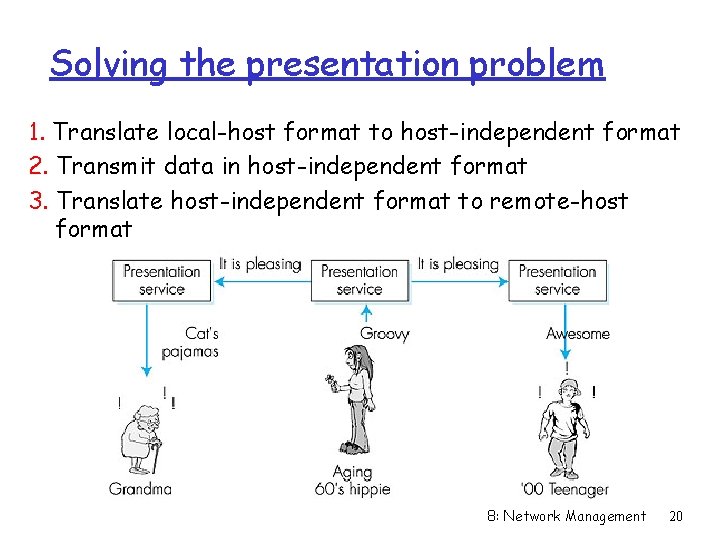
Solving the presentation problem 1. Translate local-host format to host-independent format 2. Transmit data in host-independent format 3. Translate host-independent format to remote-host format 8: Network Management 20
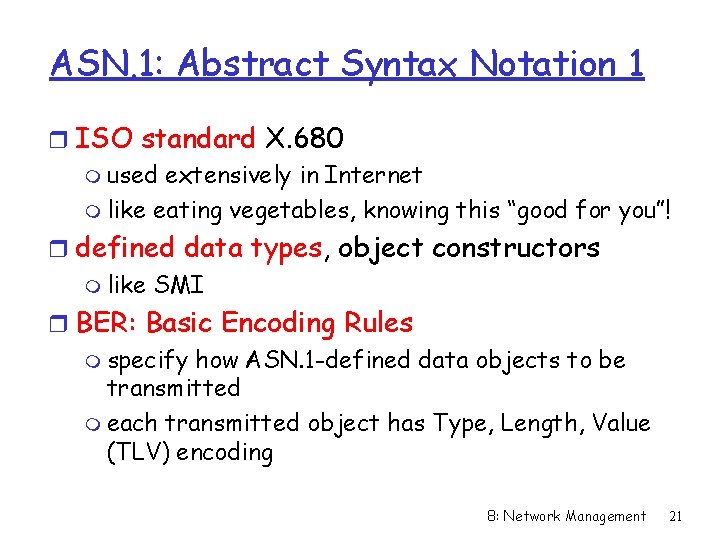
ASN. 1: Abstract Syntax Notation 1 r ISO standard X. 680 m used extensively in Internet m like eating vegetables, knowing this “good for you”! r defined data types, object constructors m like SMI r BER: Basic Encoding Rules m specify how ASN. 1 -defined data objects to be transmitted m each transmitted object has Type, Length, Value (TLV) encoding 8: Network Management 21
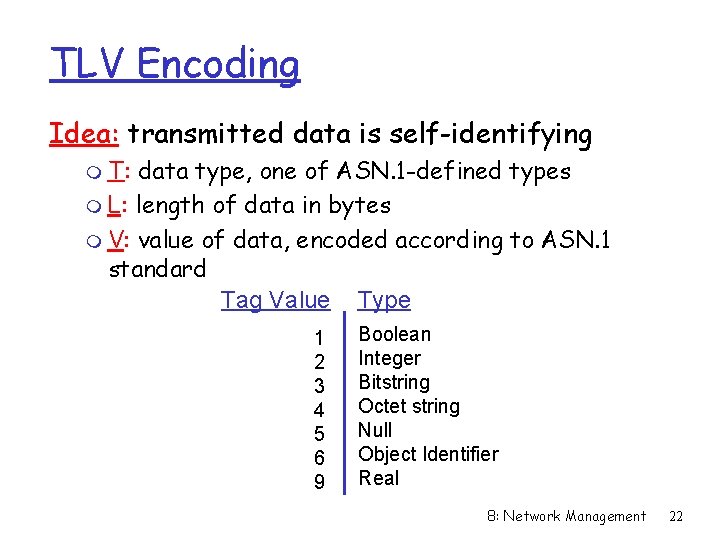
TLV Encoding Idea: transmitted data is self-identifying m T: data type, one of ASN. 1 -defined types m L: length of data in bytes m V: value of data, encoded according to ASN. 1 standard Tag Value Type 1 2 3 4 5 6 9 Boolean Integer Bitstring Octet string Null Object Identifier Real 8: Network Management 22
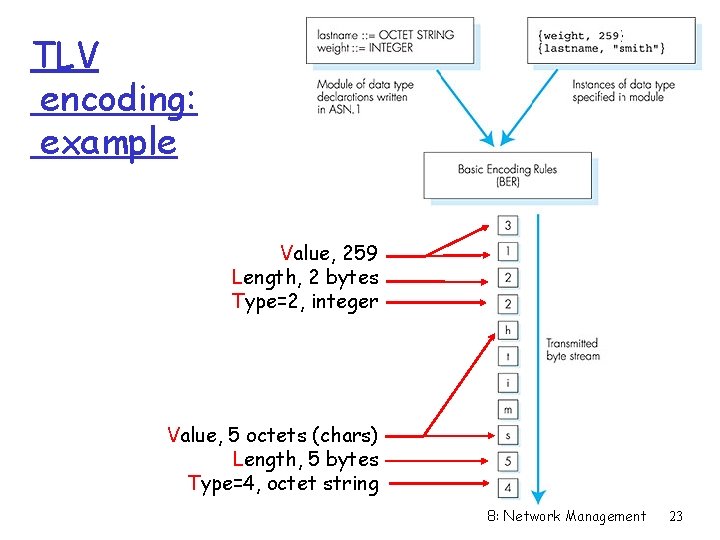
TLV encoding: example Value, 259 Length, 2 bytes Type=2, integer Value, 5 octets (chars) Length, 5 bytes Type=4, octet string 8: Network Management 23
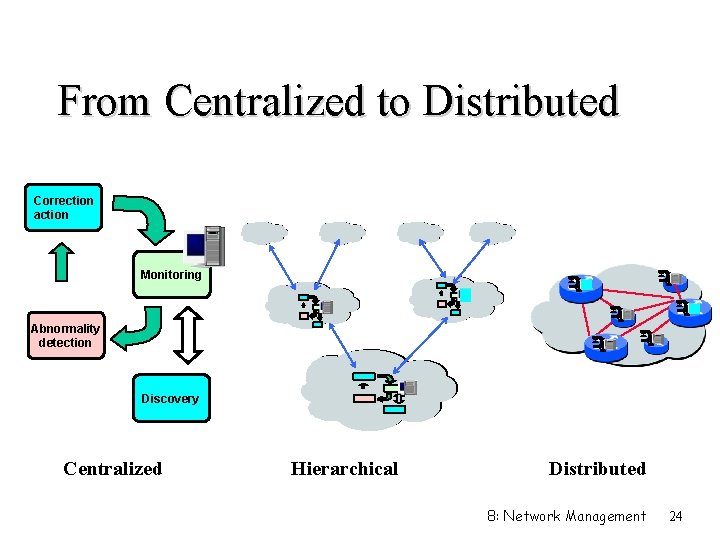
From Centralized to Distributed Correction action Monitoring Abnormality detection Discovery Centralized Hierarchical Distributed 8: Network Management 24
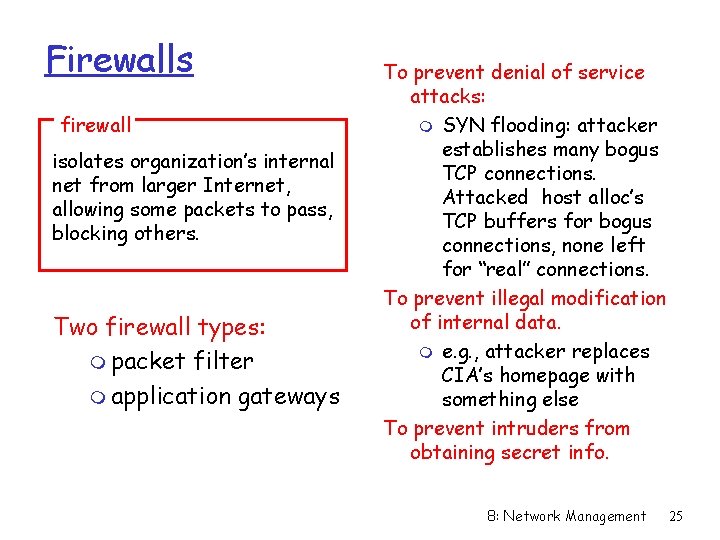
Firewalls firewall isolates organization’s internal net from larger Internet, allowing some packets to pass, blocking others. Two firewall types: m packet filter m application gateways To prevent denial of service attacks: m SYN flooding: attacker establishes many bogus TCP connections. Attacked host alloc’s TCP buffers for bogus connections, none left for “real” connections. To prevent illegal modification of internal data. m e. g. , attacker replaces CIA’s homepage with something else To prevent intruders from obtaining secret info. 8: Network Management 25
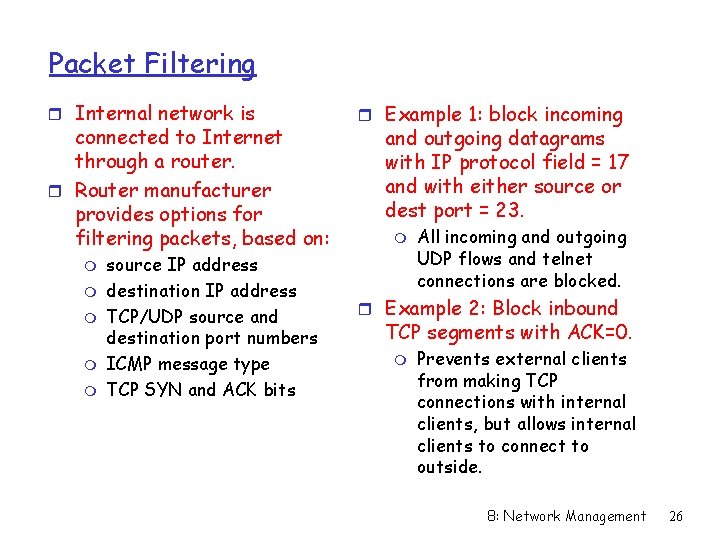
Packet Filtering r Internal network is connected to Internet through a router. r Router manufacturer provides options for filtering packets, based on: m m m source IP address destination IP address TCP/UDP source and destination port numbers ICMP message type TCP SYN and ACK bits r Example 1: block incoming and outgoing datagrams with IP protocol field = 17 and with either source or dest port = 23. m All incoming and outgoing UDP flows and telnet connections are blocked. r Example 2: Block inbound TCP segments with ACK=0. m Prevents external clients from making TCP connections with internal clients, but allows internal clients to connect to outside. 8: Network Management 26
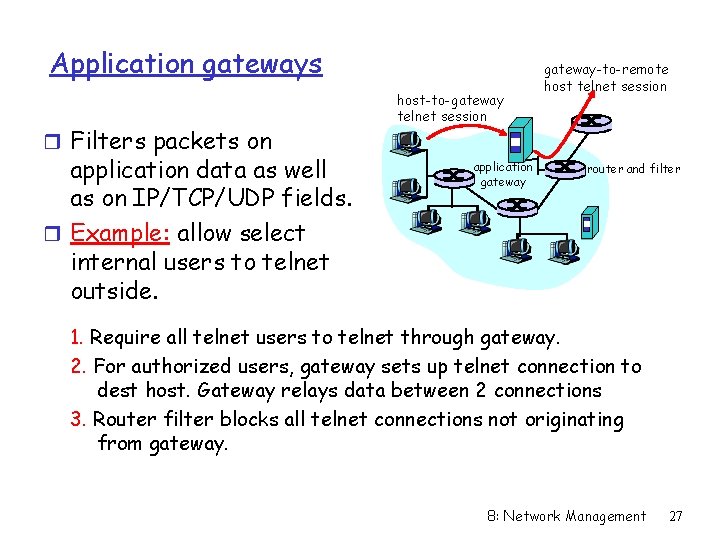
Application gateways r Filters packets on application data as well as on IP/TCP/UDP fields. r Example: allow select internal users to telnet outside. host-to-gateway telnet session application gateway-to-remote host telnet session router and filter 1. Require all telnet users to telnet through gateway. 2. For authorized users, gateway sets up telnet connection to dest host. Gateway relays data between 2 connections 3. Router filter blocks all telnet connections not originating from gateway. 8: Network Management 27
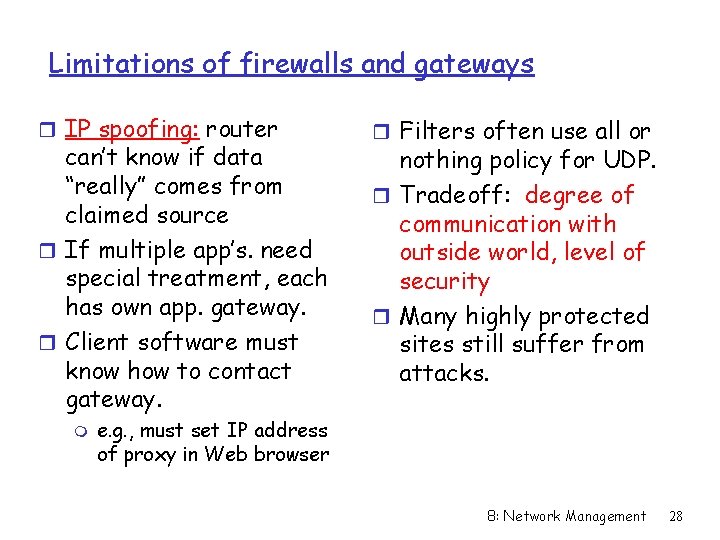
Limitations of firewalls and gateways r IP spoofing: router can’t know if data “really” comes from claimed source r If multiple app’s. need special treatment, each has own app. gateway. r Client software must know how to contact gateway. m r Filters often use all or nothing policy for UDP. r Tradeoff: degree of communication with outside world, level of security r Many highly protected sites still suffer from attacks. e. g. , must set IP address of proxy in Web browser 8: Network Management 28