
Network Management Intro 2019 Decide Act Monitor tasks


- Slides: 34
Network Management Intro 2019
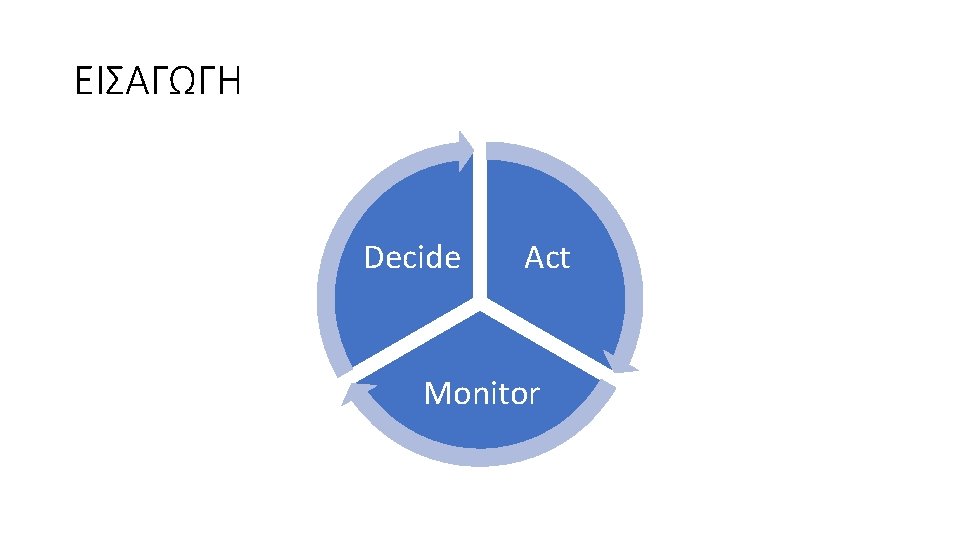
ΕΙΣΑΓΩΓΗ Decide Act Monitor
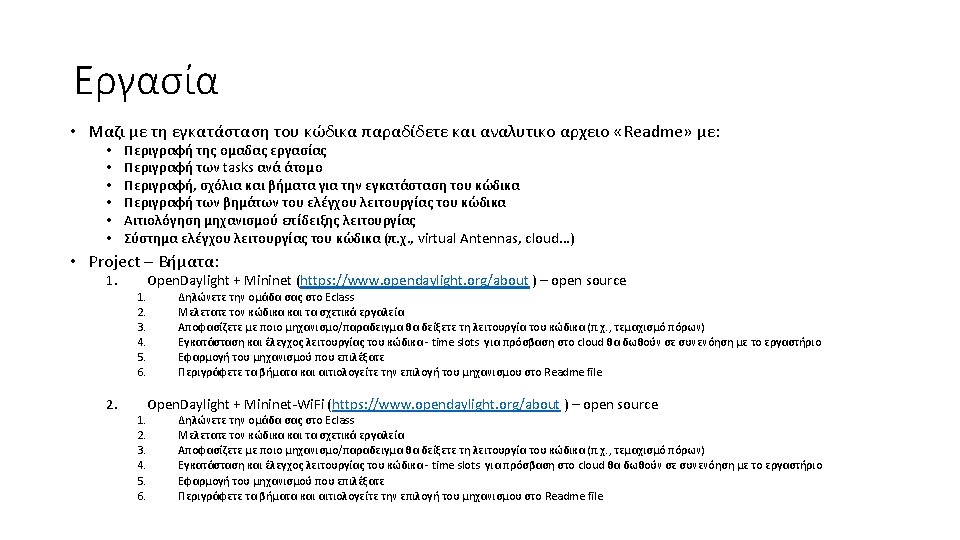
Εργασία • Δημιουργείτε ομάδες και δουλεύετε με ανάθεση tasks ανά άτομο. Επιλέγετε να δουλέψετε σε ένα απο τα 3 project • Τελική παράδοση 15/6/2019 • Project: 1. Open. Daylight - SDN (https: //www. opendaylight. org/about ) (ομάδες 4 -6 ατόμων) 1. 2. 3. Basic functionality Applications (Northbound) – 2 applications MININET 2. Open. Daylight - SDN (https: //www. opendaylight. org/about ) (ομάδες 4 -6 ατόμων) 1. 2. 3. Basic functionality Applications (Northbound) – 2 applications MININET-WIFI
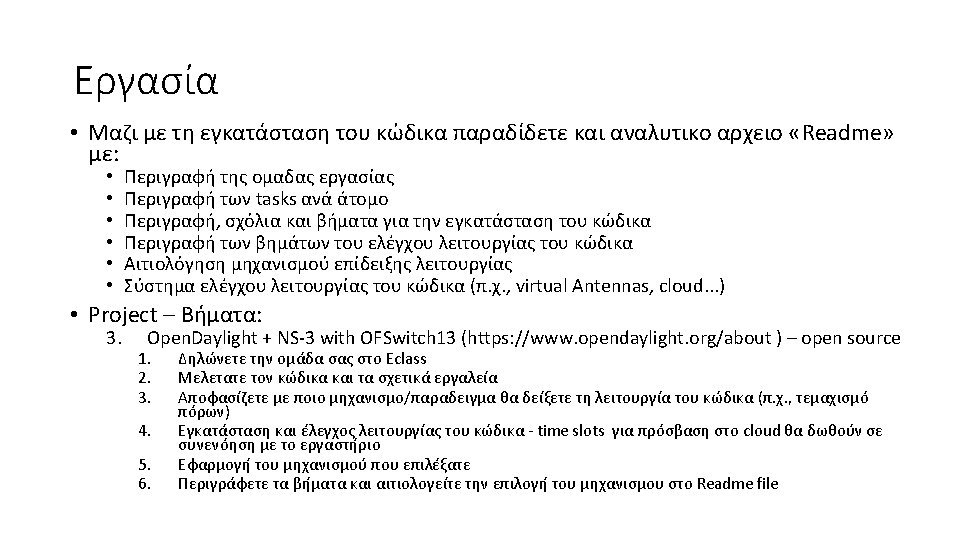
Εργασία • Δημιουργείτε ομάδες και δουλεύετε με ανάθεση tasks ανά άτομο. Επιλέγετε να δουλέψετε σε ένα απο τα 2 project • Τελική παράδοση 15/6/2019 • Project: 3. Open. Daylight - SDN (https: //www. opendaylight. org/about ) (ομάδες 4 -6 ατόμων) 1. 2. 3. Basic functionality Applications (Northbound) – 1 application NS-3 with OFSwitch 13
Where did SDN come from? • ~2004: Research on new management paradigms –RCP, 4 D [Princeton, CMU, . . ] –SANE, Ethane [Stanford/Berkeley] –Industrial efforts with similar flavor (not published) • 2008: Software-Defined Networking (SDN) –NOX Network Operating System [Nicira] –Open. Flow switch interface [Stanford/Nicira] • 2011: Open Networking Foundation –Board: Google, Yahoo, Verizon, DT, Msft, Fbook, NTT, GS–Members: Cisco, Juniper, HP, Dell, Broadcom, IBM, . . .
Status of SDN • SDN widely accepted as “future of networking” –More than 100 members in ONF (almost “everyone”) –Commercialized, in production use (few places) � • E. g. , controls Google’s WAN; AT&T adopted it, NTT moving to deploy …. . • An insane level of SDN hype, and backlash. . . –SDN doesn’t work miracles, merely makes things easier • But the real question is: why the rapid adoption?
What is Network Management? • Recall the two “planes” • Data plane: forwarding packets –Based on local forwarding state • Control plane: computing that forwarding state –Involves coordination with rest of system • Broad definition of “network management”: –Everything having to do with the control plane
Original goals for the control plane • Basic connectivity: route packets to destination –Local state computed by routing protocols –Globally distributed algorithms • Interdomain policy: find policy-compliant paths –Done by fully distributed BGP • For long time, these were the only relevant goals! –What other goals are there in running a network?
Isolation • L 2 bcast protocols often used for discovery –Useful, unscalable, invasive • Want multiple logical LANs on a physical network –Retain usefulness, cope with scaling, provide isolation • Use VLANs (virtual LANs) tags in L 2 headers –Controls where broadcast packets go –Gives support for logical L 2 networks –Routers connect these logical L 2 networks • No universal method for setting VLAN state
Access Control • Operators want to limit access to various hosts –Don’t let laptops access backend database machines • This can be imposed by routers using ACLs –ACL: Access control list • Example entry in ACL: <header template; drop> –If not port 80, drop – If source address = X, drop
Traffic Engineering • Want to avoid persistent overloads on links • Choose routes to spread traffic load across links • Two main methods: –Setting up MPLS tunnels –Adjusting weights in OSPF • Often done with centralized computation –Take snapshot of topology and load –Compute appropriate MPLS/OSPF state –Send to network
Network management has many goals • Achieving these goals is job of the control plane. . . • . . . which currently involves many mechanisms • Globally distributed: routing algorithms • Manual/scripted configuration: ACLs, VLANs • Centralized computation: Traffic engineering
Bottom Line • Many different control plane mechanisms • Each designed from scratch for their intended goal • Encompassing a wide variety of implementations • Distributed, manual, centralized, . . . • Network control plane is a complicated mess!
How Did We Get Into This Mess? How Have We Managed To Survive? • Net. admins miraculously master this complexity • Understand all aspects of networks • Must keep myriad details in mind • This ability to master complexity is both a blessing –. . . and a curse! • Still focused on mastering complexity –Networking “experts” are those that know all the details
Making Network Operators Cry. . . • We are really good at mastering complexity –And it has worked for us for decades, why change? • Step 1: Large datacenters • 100, 000 s machines; 10, 000 s switches • This is pushing the limits of what we can handle. . • Step 2: Multiple tenancy • Large datacenters can host many customers • Each customer gets their own logical network >Customer should be able to set policies on this network >ACLs (access control list), VLANs, etc. • If there are 1000 customers, that adds 3 oom (Where oom = orders of magnitude) • This goes way beyond what we can handle
Network Operators Are Now Weeping. . . • They have been beaten by complexity • The era of ad hoc control mechanisms is over • We need a simpler, more systematic design • So how do you “extract simplicity”?
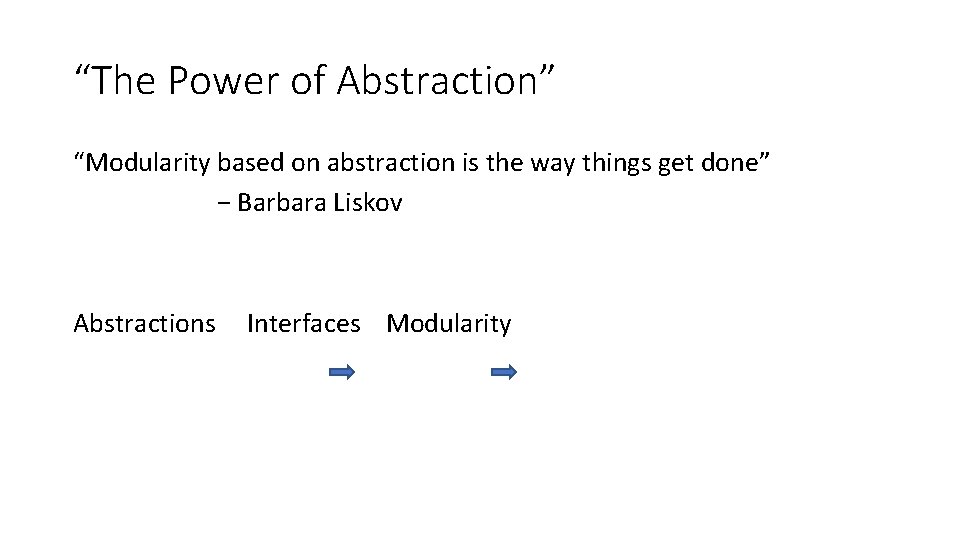
“The Power of Abstraction” “Modularity based on abstraction is the way things get done” − Barbara Liskov Abstractions Interfaces Modularity
What About Networking Abstractions? • Consider the data and control planes separately • Different tasks, so naturally different abstractions
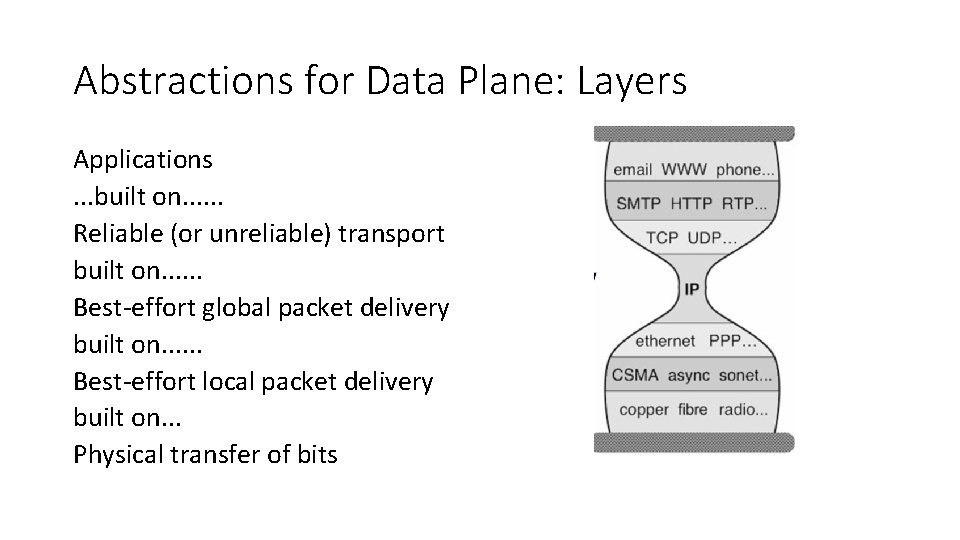
Abstractions for Data Plane: Layers Applications. . . built on. . . Reliable (or unreliable) transport built on. . . Best-effort global packet delivery built on. . . Best-effort local packet delivery built on. . . Physical transfer of bits
The Importance of Layering • Decomposed delivery into basic components • Independent, compatible innovation at each layer –Clean “separation of concerns” –Leaving each layer to solve a tractable problem • Responsible for the success of the Internet! –Rich ecosystem of independent innovation
Control Plane Abstractions? • (Too) Many Control Plane Mechanisms • Variety of goals, no modularity: • Routing: distributed routing algorithms • Isolation: ACLs, VLANs, Firewalls, . . . • Traffic engineering: adjusting weights, MPLS, . . . • Control Plane: mechanism without abstraction • Too many mechanisms, not enough functionality
Separate Concerns with Abstractions • Be compatible with low-level hardware/software • Need an abstraction for general forwarding model • Make decisions based on entire network • Need an abstraction for network state • Compute configuration of each physical device • Need an abstraction that simplifies configuration
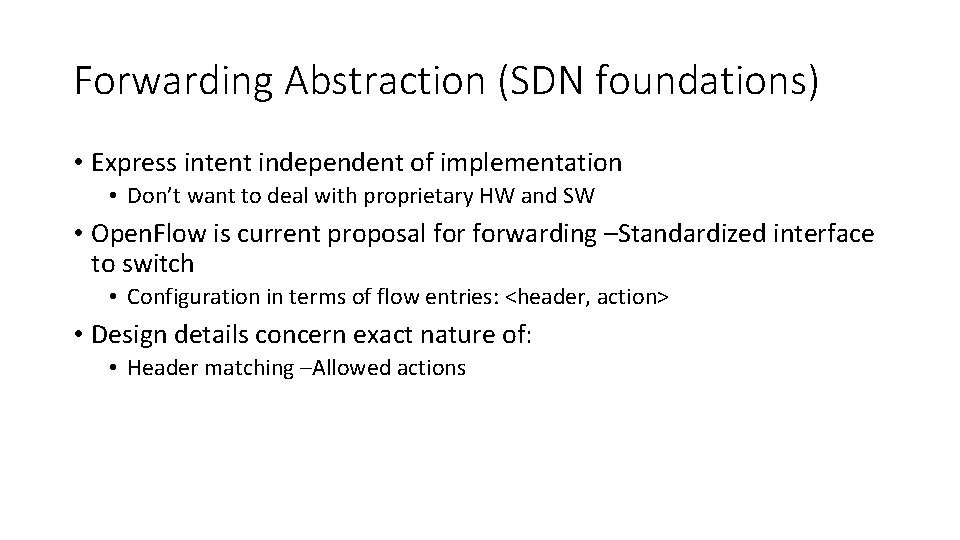
Forwarding Abstraction (SDN foundations) • Express intent independent of implementation • Don’t want to deal with proprietary HW and SW • Open. Flow is current proposal forwarding –Standardized interface to switch • Configuration in terms of flow entries: <header, action> • Design details concern exact nature of: • Header matching –Allowed actions
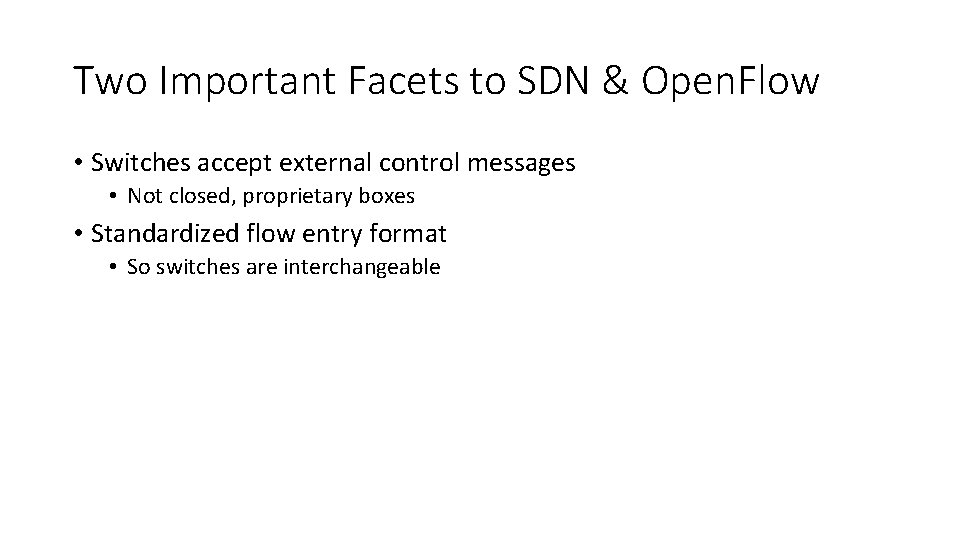
Two Important Facets to SDN & Open. Flow • Switches accept external control messages • Not closed, proprietary boxes • Standardized flow entry format • So switches are interchangeable
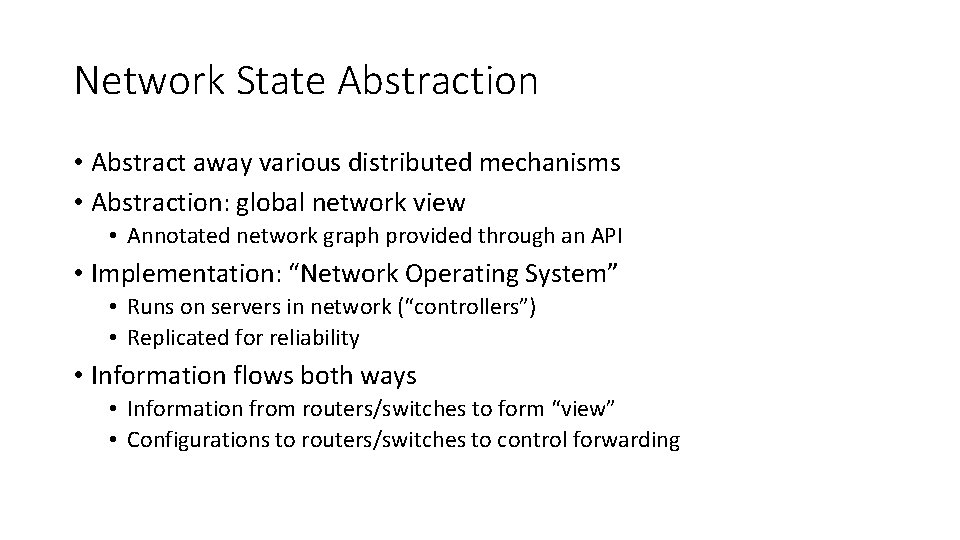
Network State Abstraction • Abstract away various distributed mechanisms • Abstraction: global network view • Annotated network graph provided through an API • Implementation: “Network Operating System” • Runs on servers in network (“controllers”) • Replicated for reliability • Information flows both ways • Information from routers/switches to form “view” • Configurations to routers/switches to control forwarding
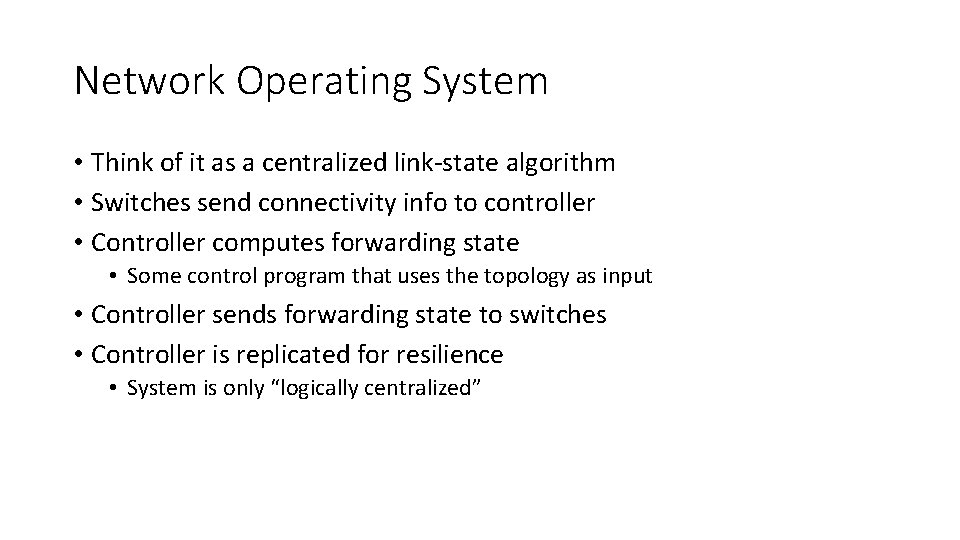
Network Operating System • Think of it as a centralized link-state algorithm • Switches send connectivity info to controller • Controller computes forwarding state • Some control program that uses the topology as input • Controller sends forwarding state to switches • Controller is replicated for resilience • System is only “logically centralized”
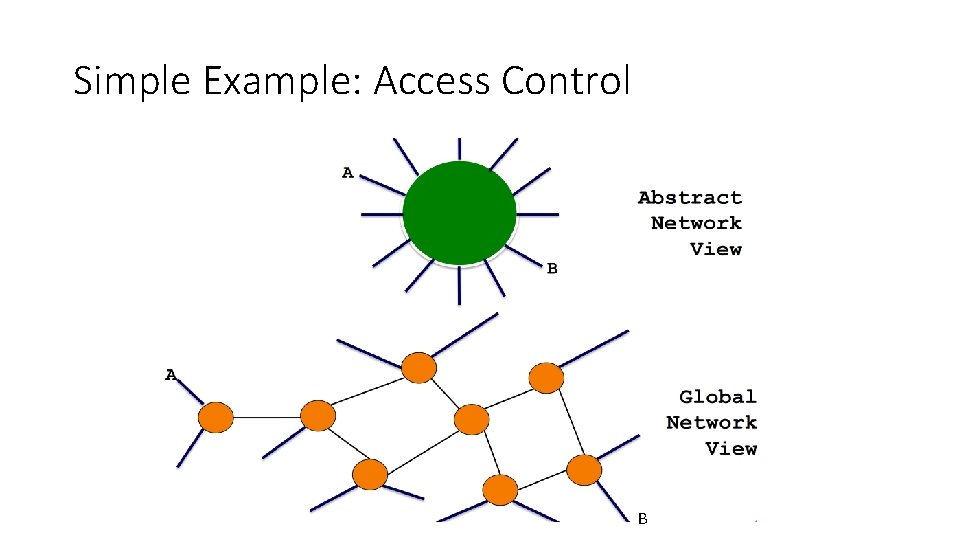
Specification Abstraction • Control mechanism expresses desired behavior • Whether it be isolation, access control, or Qo. S • It should not be responsible for implementing that behavior on physical network infrastructure • Requires configuring the forwarding tables in each switch • Proposed abstraction: abstract view of network • Abstract view models only enough detail to specify goals • Will depend on task semantics
Simple Example: Access Control B
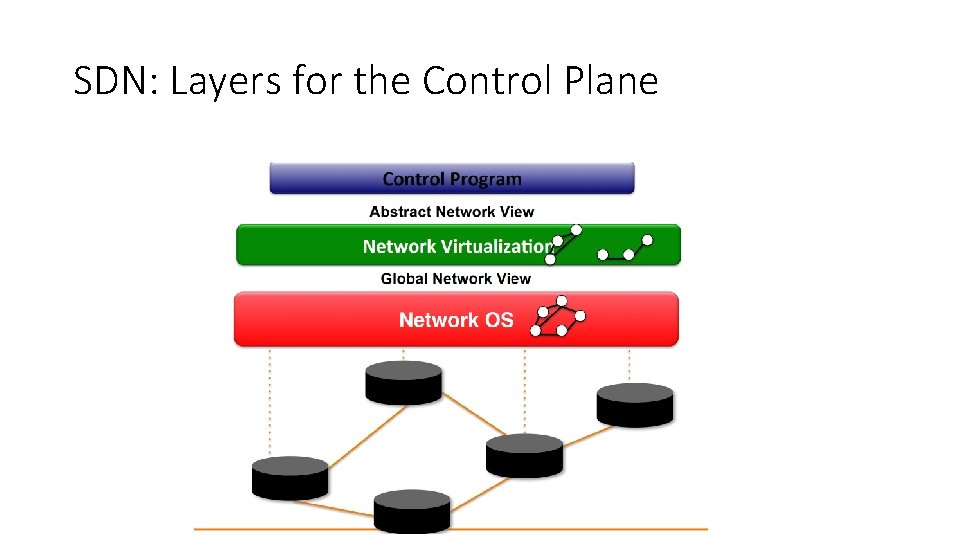
SDN: Layers for the Control Plane
Clean Separation of Concerns • Control program: express goals on abstract view –Driven by Operator Requirements • Virtualization. Layer: abstract view - global view • Driven by Specification Abstraction for particular task • NOS: global view - physical switches • API: driven by Network State Abstraction • Switch interface: driven by Forwarding Abstraction