
Network Load Balancing for Scalability l Network Load
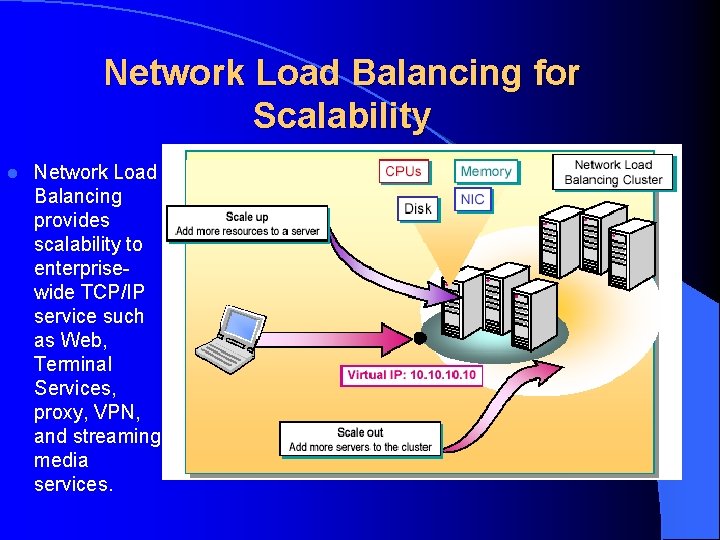
Network Load Balancing for Scalability l Network Load Balancing provides scalability to enterprisewide TCP/IP service such as Web, Terminal Services, proxy, VPN, and streaming media services.

Network Load Balancing provides scalability to enterprise wide TCP/IP services such as Web, Terminal Services, proxy, Virtual Private Network (VPN), and streaming media services. Network Load Balancing cluster hosts intercommunicate to provide one of the key benefits, scalability. l Network Load Balancing scales the performance of a server-based program, such as a Web server, by distributing its client requests across multiple identical servers within the cluster; you can add more servers to the cluster as traffic increases. Up to 32 servers are possible in any one cluster. l You can improve the performance of each individual host in a cluster by adding more or faster CPUs, network adapters and disks, and in some cases by adding more memory. These additions to the Network Load Balancing cluster is termed scaling up, but requires more intervention and careful planning than scaling out. Limitations of applications or the operating system configuration could mean that scaling up by adding more memory may not be l

You can handle additional IP traffic by simply adding computers to the Network Load Balancing cluster as necessary. Load balancing, in conjunction with the use of server farms, is part of a scaling approach referred to as scaling out. The greater the number of computers involved in the loadbalancing scenario, the higher the throughput of the overall server farm. l Tip: On a system where kernel resources, such as page table entries, non-paged pool, and paged pool, are limited and tuning is not effective, it is more appropriate to scale out than to scale up. l
- Slides: 3