
Network Hardware and Software ECE 544 Computer Networks
![Performance Requirements Rate [Mbps] Overhead Peak packet rate [Kpps] Time per packet [µs] small](https://slidetodoc.com/presentation_image_h2/b2afad3870ef58ae280017dbfdb94ba8/image-20.jpg "Performance Requirements Rate [Mbps] Overhead Peak packet rate [Kpps] Time per packet [µs] small")
- Slides: 57
Network Hardware and Software ECE 544: Computer Networks II Spring 2016
Network Hardware Basics
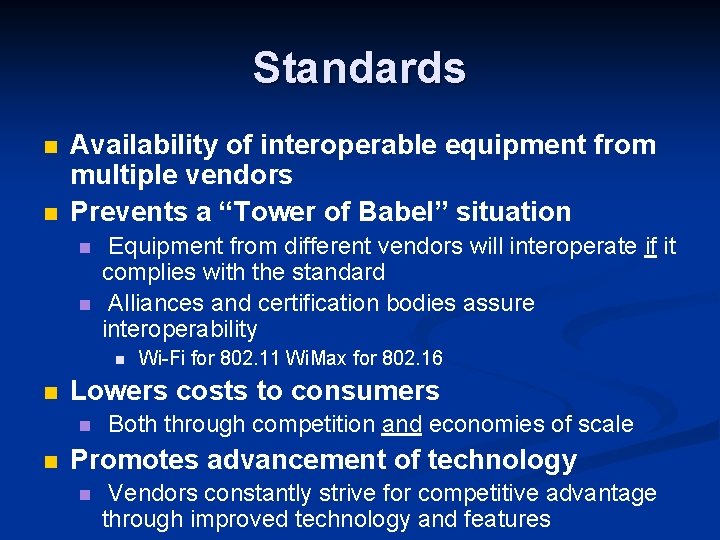
Standards n n Availability of interoperable equipment from multiple vendors Prevents a “Tower of Babel” situation n n Equipment from different vendors will interoperate if it complies with the standard Alliances and certification bodies assure interoperability n n Lowers costs to consumers n n Wi-Fi for 802. 11 Wi. Max for 802. 16 Both through competition and economies of scale Promotes advancement of technology n Vendors constantly strive for competitive advantage through improved technology and features
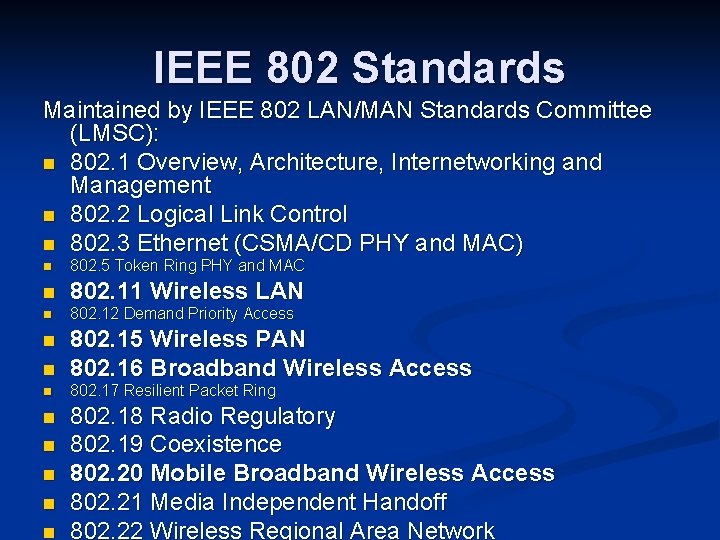
IEEE 802 Standards Maintained by IEEE 802 LAN/MAN Standards Committee (LMSC): n 802. 1 Overview, Architecture, Internetworking and Management n 802. 2 Logical Link Control n 802. 3 Ethernet (CSMA/CD PHY and MAC) n 802. 5 Token Ring PHY and MAC n 802. 11 Wireless LAN n 802. 12 Demand Priority Access n 802. 15 Wireless PAN 802. 16 Broadband Wireless Access n 802. 17 Resilient Packet Ring n n n 802. 18 Radio Regulatory 802. 19 Coexistence 802. 20 Mobile Broadband Wireless Access 802. 21 Media Independent Handoff 802. 22 Wireless Regional Area Network
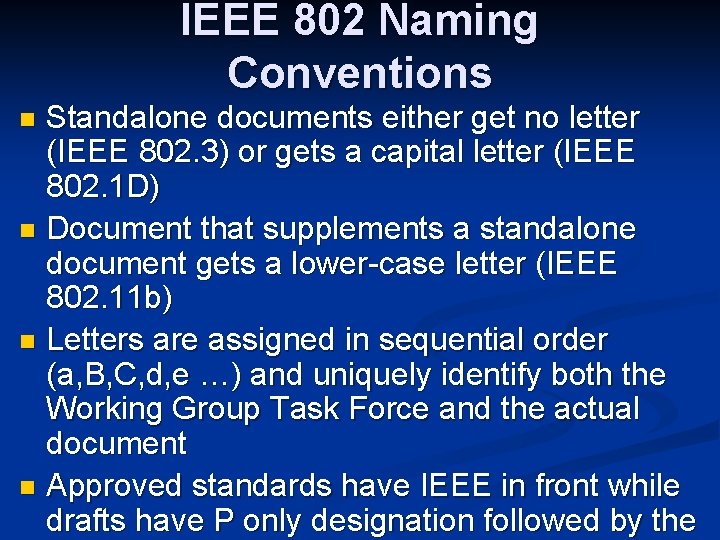
IEEE 802 Naming Conventions Standalone documents either get no letter (IEEE 802. 3) or gets a capital letter (IEEE 802. 1 D) n Document that supplements a standalone document gets a lower-case letter (IEEE 802. 11 b) n Letters are assigned in sequential order (a, B, C, d, e …) and uniquely identify both the Working Group Task Force and the actual document n Approved standards have IEEE in front while drafts have P only designation followed by the n
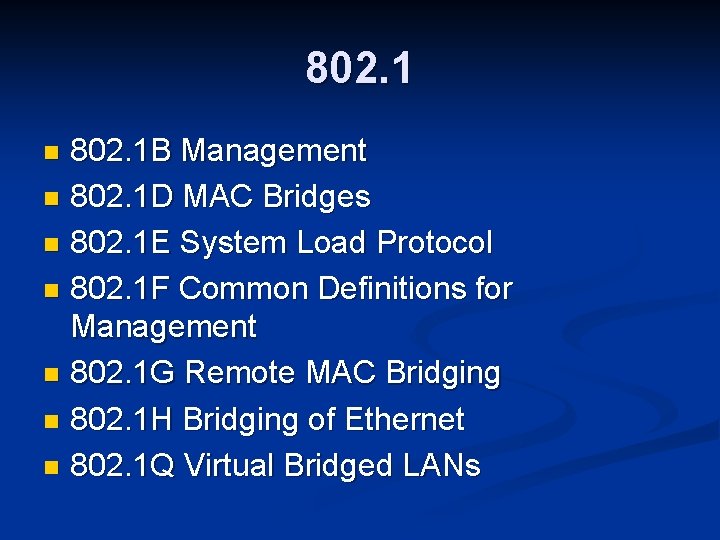
802. 1 B Management n 802. 1 D MAC Bridges n 802. 1 E System Load Protocol n 802. 1 F Common Definitions for Management n 802. 1 G Remote MAC Bridging n 802. 1 H Bridging of Ethernet n 802. 1 Q Virtual Bridged LANs n
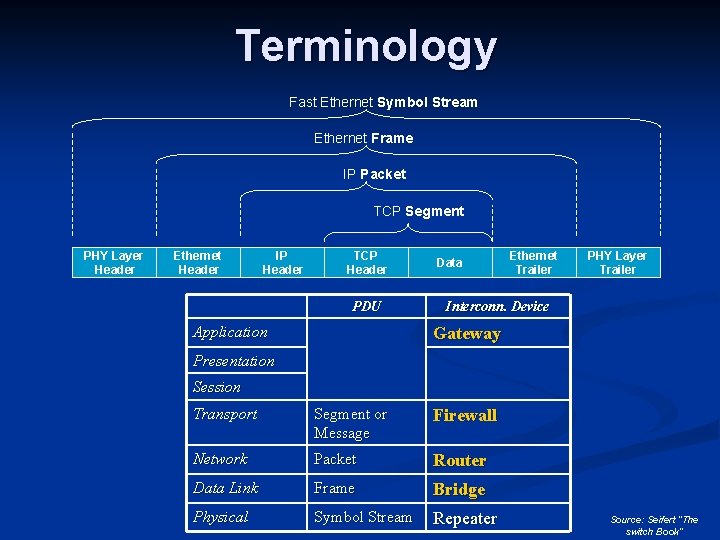
Terminology Fast Ethernet Symbol Stream Ethernet Frame IP Packet TCP Segment PHY Layer Header Ethernet Header IP Header TCP Header PDU Application Data Ethernet Trailer PHY Layer Trailer Interconn. Device Gateway Presentation Session Transport Segment or Message Firewall Network Packet Router Data Link Frame Bridge Physical Symbol Stream Repeater Source: Seifert “The switch Book”
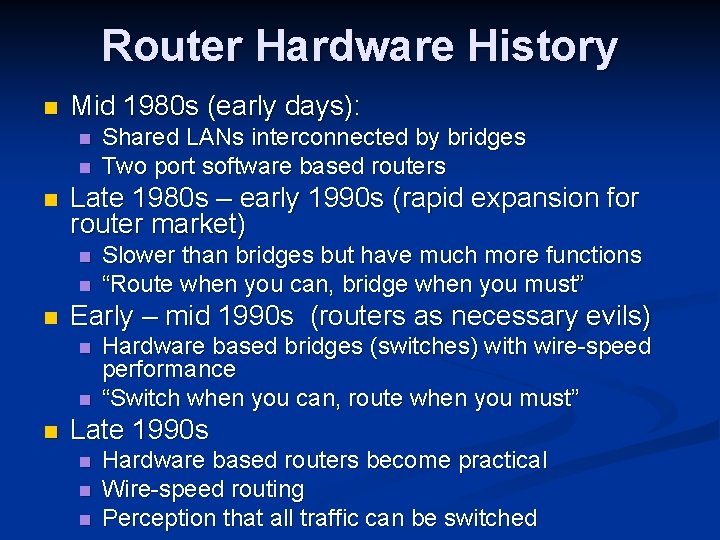
Router Hardware History n Mid 1980 s (early days): n n n Late 1980 s – early 1990 s (rapid expansion for router market) n n n Slower than bridges but have much more functions “Route when you can, bridge when you must” Early – mid 1990 s (routers as necessary evils) n n n Shared LANs interconnected by bridges Two port software based routers Hardware based bridges (switches) with wire-speed performance “Switch when you can, route when you must” Late 1990 s n n n Hardware based routers become practical Wire-speed routing Perception that all traffic can be switched
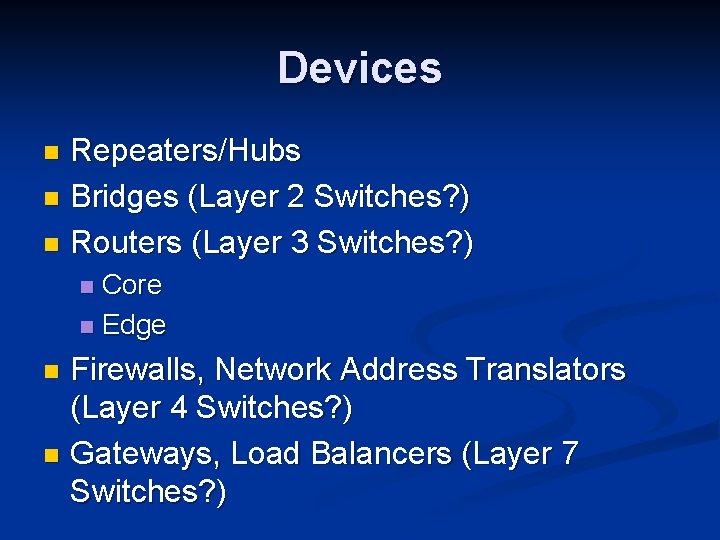
Devices Repeaters/Hubs n Bridges (Layer 2 Switches? ) n Routers (Layer 3 Switches? ) n Core n Edge n Firewalls, Network Address Translators (Layer 4 Switches? ) n Gateways, Load Balancers (Layer 7 Switches? ) n
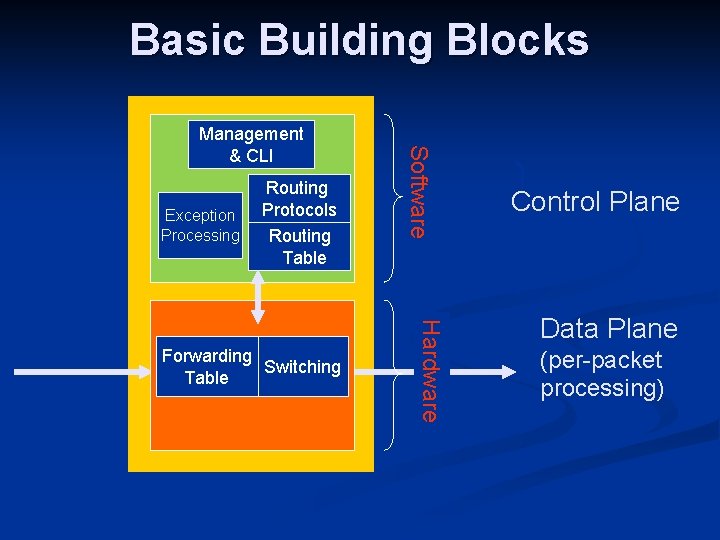
Basic Building Blocks Exception Processing Routing Protocols Routing Table Hardware Forwarding Switching Table Software Management & CLI Control Plane Data Plane (per-packet processing)
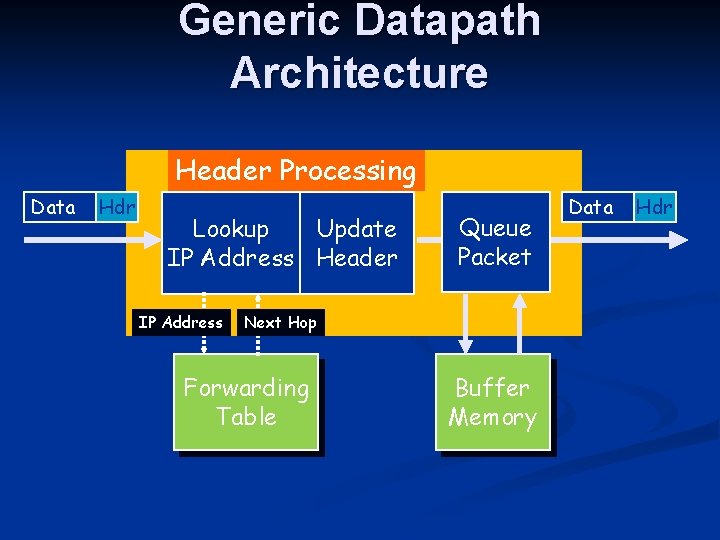
Generic Datapath Architecture Header Processing Data Hdr Lookup Update IP Address Header IP Address Queue Packet Next Hop Forwarding Table Buffer Memory Data Hdr
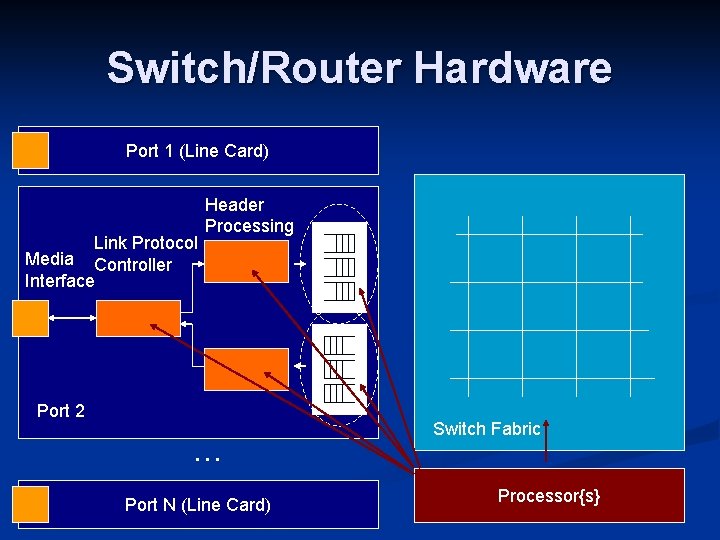
Switch/Router Hardware Port 1 (Line Card) Link Protocol Media Controller Interface Header Processing Port 2 … Port N (Line Card) Switch Fabric Processor{s}
Requirements n Distributed Data Plane n n Packet Processing: Examine L 2 -L 7 protocol information (Determine Qo. S, VPN ID, policy, etc. ) Packet Forwarding: Make appropriate routing, switching, and queuing decisions Performance: At least sum of external BW Distributed Control Plane n n Up to 106 entries in various tables (forwarding addresses, routing information etc. ) Performance: on the order of 100 MIPS
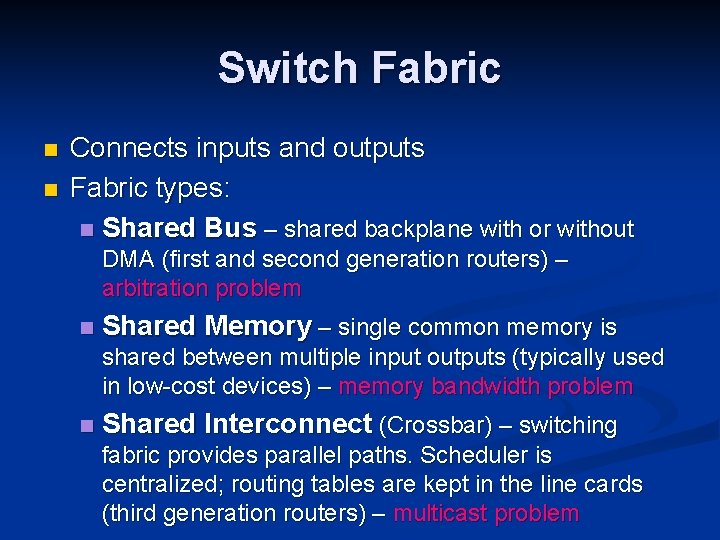
Switch Fabric n n Connects inputs and outputs Fabric types: n Shared Bus – shared backplane with or without DMA (first and second generation routers) – arbitration problem n Shared Memory – single common memory is shared between multiple input outputs (typically used in low-cost devices) – memory bandwidth problem n Shared Interconnect (Crossbar) – switching fabric provides parallel paths. Scheduler is centralized; routing tables are kept in the line cards (third generation routers) – multicast problem
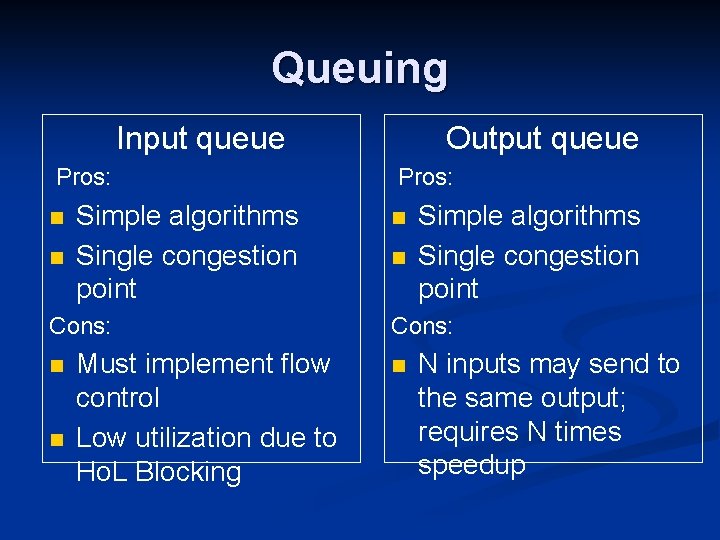
Queuing Input queue Pros: n n Simple algorithms Single congestion point Cons: n n Must implement flow control Low utilization due to Ho. L Blocking Output queue Pros: n n Simple algorithms Single congestion point Cons: n N inputs may send to the same output; requires N times speedup
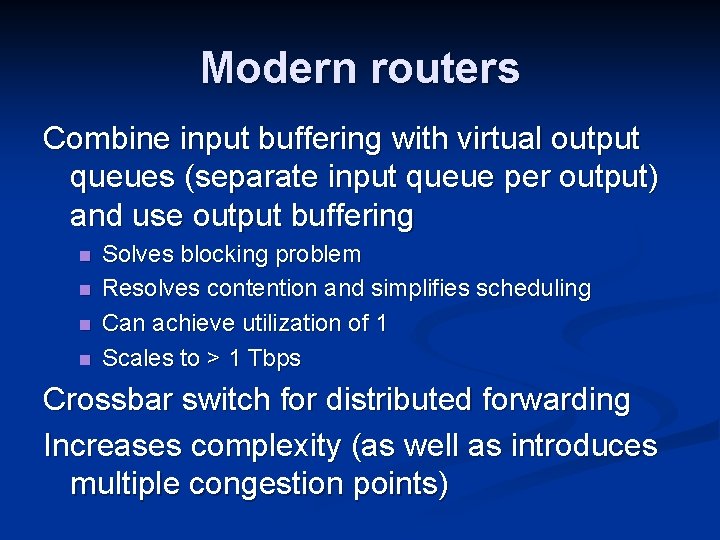
Modern routers Combine input buffering with virtual output queues (separate input queue per output) and use output buffering n n Solves blocking problem Resolves contention and simplifies scheduling Can achieve utilization of 1 Scales to > 1 Tbps Crossbar switch for distributed forwarding Increases complexity (as well as introduces multiple congestion points)
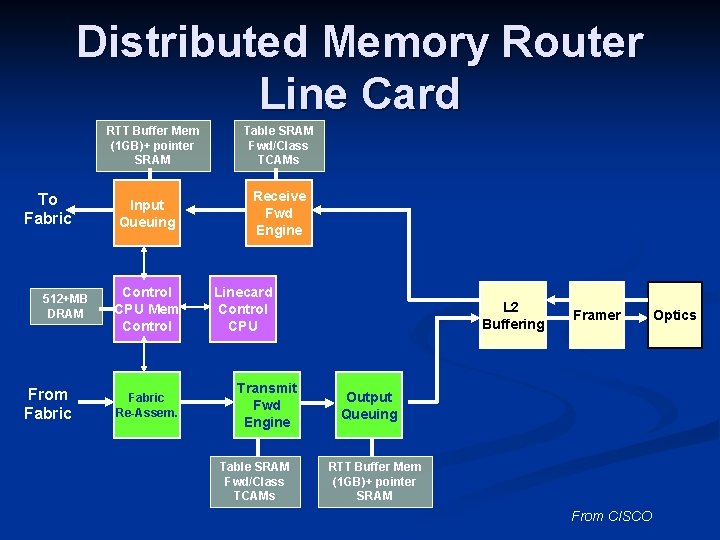
Distributed Memory Router Line Card RTT Buffer Mem (1 GB)+ pointer SRAM To Fabric 512+MB DRAM From Fabric Input Queuing Control CPU Mem Control Fabric Re-Assem. Table SRAM Fwd/Class TCAMs Receive Fwd Engine Linecard Control CPU Transmit Fwd Engine Table SRAM Fwd/Class TCAMs L 2 Buffering Framer Output Queuing RTT Buffer Mem (1 GB)+ pointer SRAM From CISCO Optics
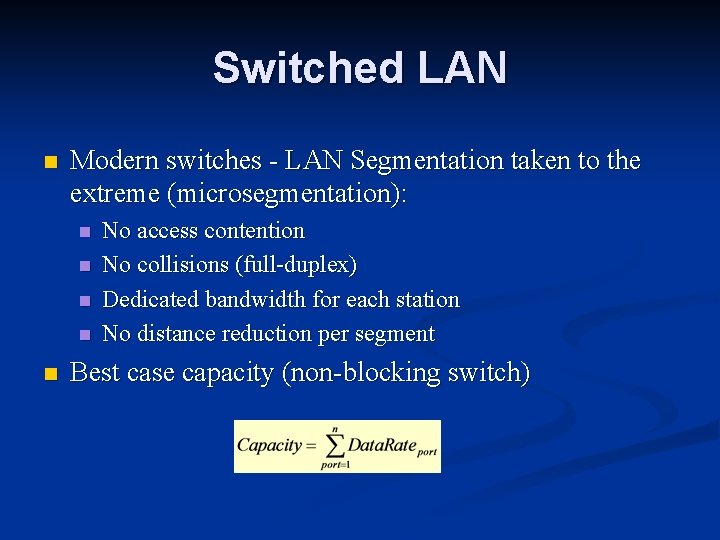
Switched LAN n Modern switches - LAN Segmentation taken to the extreme (microsegmentation): n n n No access contention No collisions (full-duplex) Dedicated bandwidth for each station No distance reduction per segment Best case capacity (non-blocking switch)
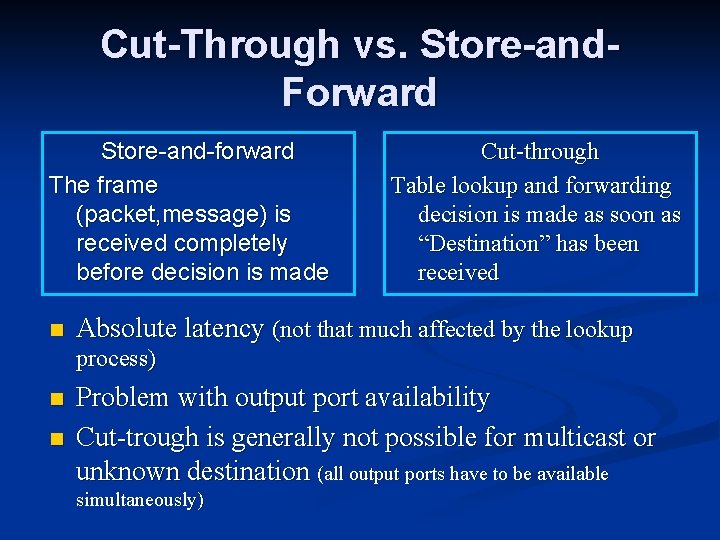
Cut-Through vs. Store-and. Forward Store-and-forward The frame (packet, message) is received completely before decision is made n Cut-through Table lookup and forwarding decision is made as soon as “Destination” has been received Absolute latency (not that much affected by the lookup process) n n Problem with output port availability Cut-trough is generally not possible for multicast or unknown destination (all output ports have to be available simultaneously)
Performance Requirements Rate [Mbps] Overhead Peak packet rate [Kpps] Time per packet [µs] small large 10 Base-T 10. 00 38 [Bytes] 19. 5 51. 20 1214. 40 100 Base-T 100. 00 38 [Bytes] 195. 3 5. 12 121. 44 OC-3 155. 52 6. 912 [Mbps] 303. 8 3. 29 78. 09 OC-12 622. 08 20. 736 [Mbps] 1214. 8 0. 82 19. 52 1000 Base-T 1000. 00 38 [Bytes] 1953. 1 0. 51 12. 14 OC-48 (2. 5 G) 2488. 32 82. 944 [Mbps] 4860. 0 0. 21 4. 88 OC-192 (10 G) 9953. 28 331. 776 [Mbps] 19440. 05 1. 22 OC-768 (40 G) 39, 813. 12 1327. 104 [Mbps] 77760. 01 0. 31 (Optical Carrier (OC-1) is SONET line with payload of 50. 112 Mbps and overhead of 1, 728 Mbps) • In general header inspection and packet forwarding require complex look-ups on a per packet basis resulting in up to 500 instructions per packet • At 40 Gbps processing requirements are > 100 MPPS
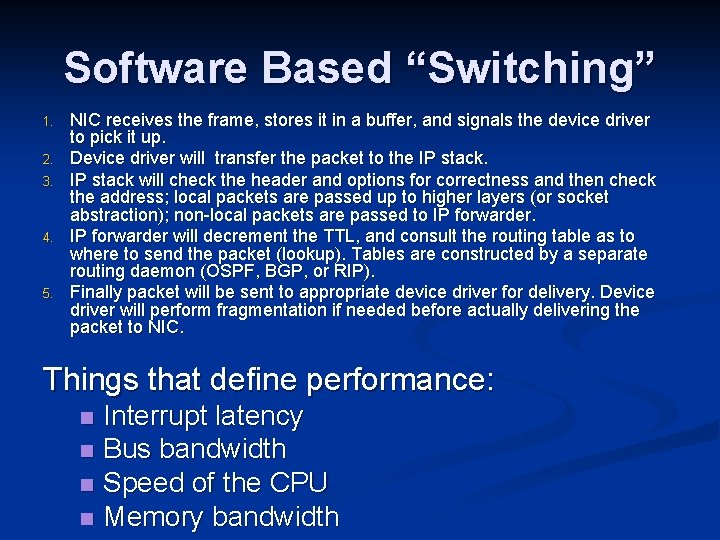
Software Based “Switching” 1. 2. 3. 4. 5. NIC receives the frame, stores it in a buffer, and signals the device driver to pick it up. Device driver will transfer the packet to the IP stack will check the header and options for correctness and then check the address; local packets are passed up to higher layers (or socket abstraction); non-local packets are passed to IP forwarder will decrement the TTL, and consult the routing table as to where to send the packet (lookup). Tables are constructed by a separate routing daemon (OSPF, BGP, or RIP). Finally packet will be sent to appropriate device driver for delivery. Device driver will perform fragmentation if needed before actually delivering the packet to NIC. Things that define performance: Interrupt latency n Bus bandwidth n Speed of the CPU n Memory bandwidth n
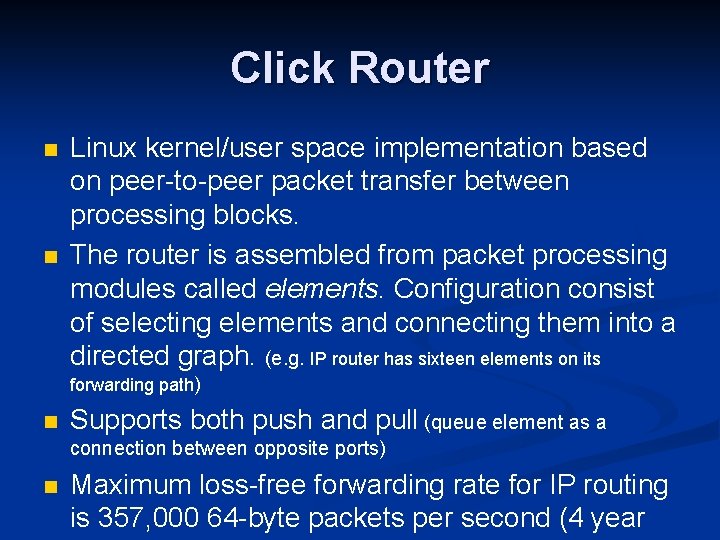
Click Router n n Linux kernel/user space implementation based on peer-to-peer packet transfer between processing blocks. The router is assembled from packet processing modules called elements. Configuration consist of selecting elements and connecting them into a directed graph. (e. g. IP router has sixteen elements on its forwarding path) n Supports both push and pull (queue element as a connection between opposite ports) n Maximum loss-free forwarding rate for IP routing is 357, 000 64 -byte packets per second (4 year
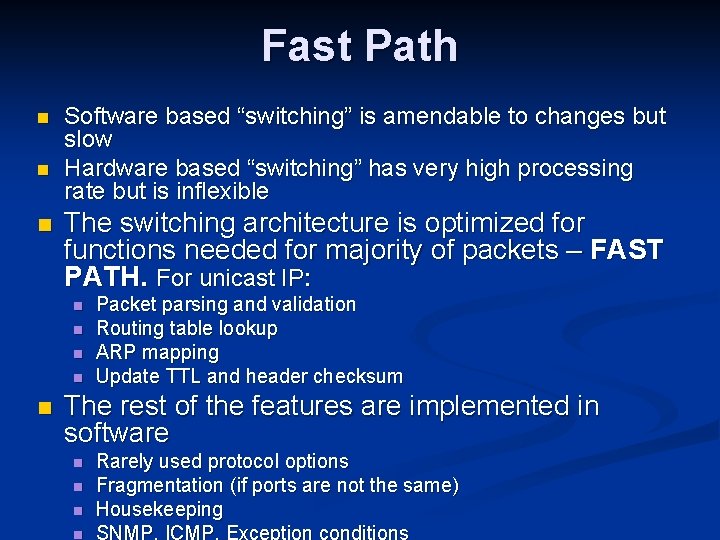
Fast Path n n n Software based “switching” is amendable to changes but slow Hardware based “switching” has very high processing rate but is inflexible The switching architecture is optimized for functions needed for majority of packets – FAST PATH. For unicast IP: n n n Packet parsing and validation Routing table lookup ARP mapping Update TTL and header checksum The rest of the features are implemented in software n n Rarely used protocol options Fragmentation (if ports are not the same) Housekeeping SNMP, ICMP, Exception conditions
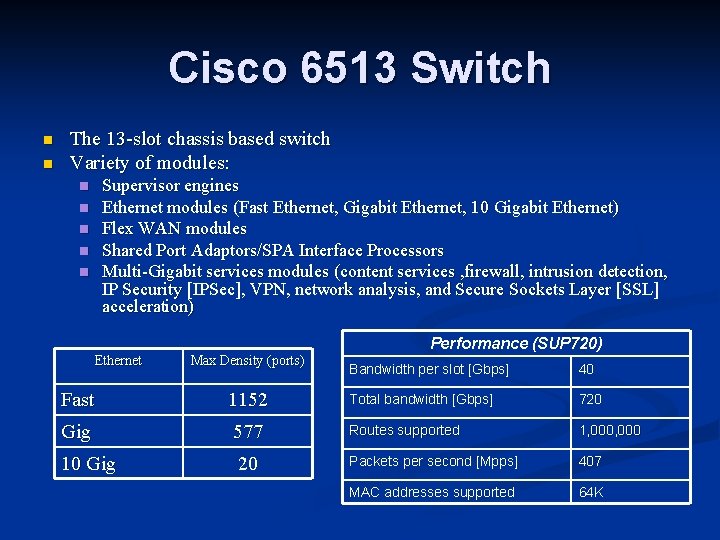
Cisco 6513 Switch n n The 13 -slot chassis based switch Variety of modules: Supervisor engines Ethernet modules (Fast Ethernet, Gigabit Ethernet, 10 Gigabit Ethernet) Flex WAN modules Shared Port Adaptors/SPA Interface Processors Multi-Gigabit services modules (content services , firewall, intrusion detection, IP Security [IPSec], VPN, network analysis, and Secure Sockets Layer [SSL] acceleration) n n n Performance (SUP 720) Ethernet Max Density (ports) Fast 1152 Gig 577 10 Gig 20 Bandwidth per slot [Gbps] 40 Total bandwidth [Gbps] 720 Routes supported 1, 000 Packets per second [Mpps] 407 MAC addresses supported 64 K
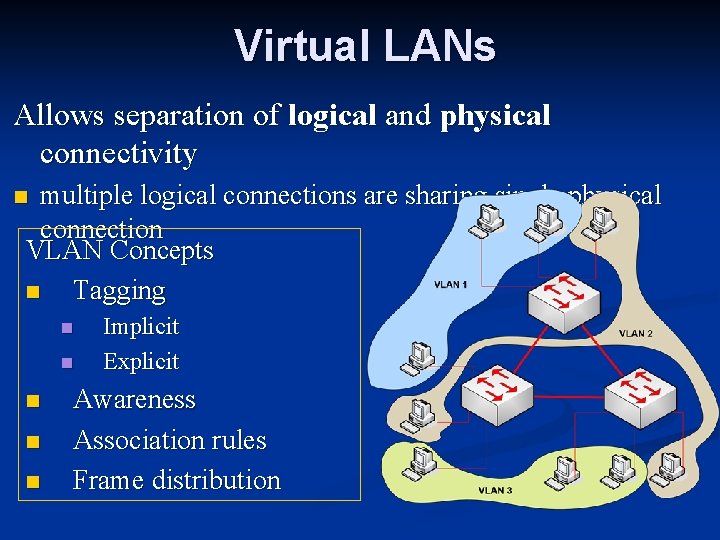
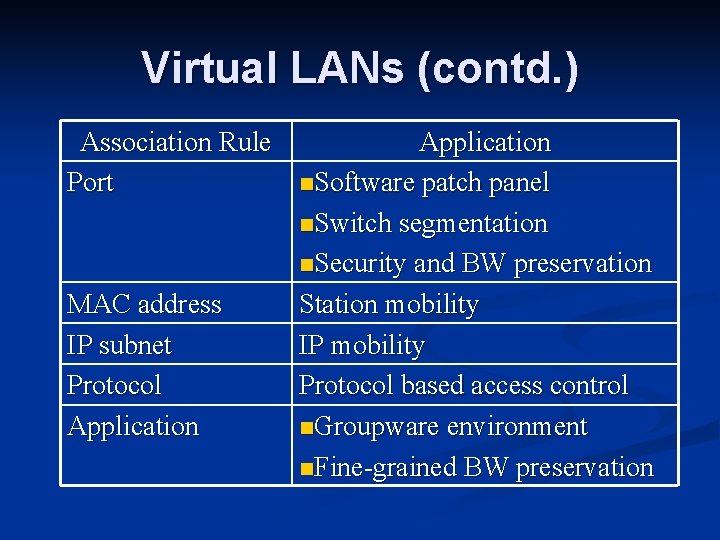
Virtual LANs Allows separation of logical and physical connectivity multiple logical connections are sharing single physical connection VLAN Concepts n Tagging n n n Implicit Explicit Awareness Association rules Frame distribution
Virtual LANs (contd. ) Association Rule Port MAC address IP subnet Protocol Application n. Software patch panel n. Switch segmentation n. Security and BW preservation Station mobility IP mobility Protocol based access control n. Groupware environment n. Fine-grained BW preservation
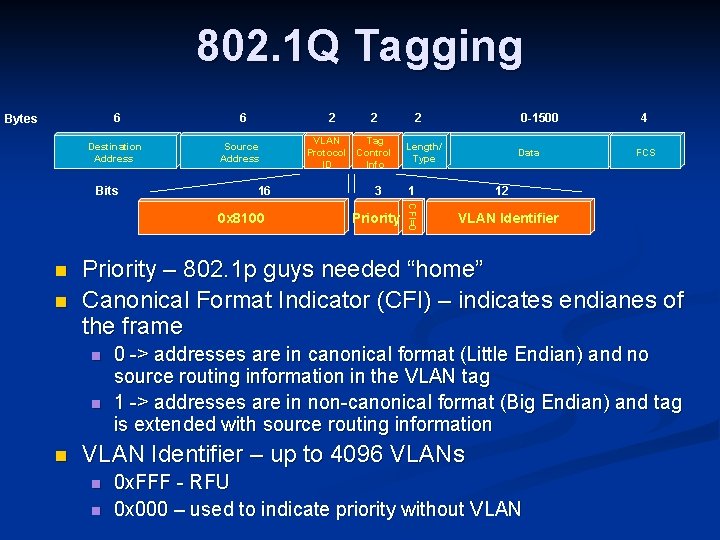
802. 1 Q Tagging 6 Bytes Destination Address 2 Source Address 16 0 x 8100 n n VLAN Tag Protocol Control ID Info 2 0 -1500 Length/ Type 3 1 Priority Data 4 FCS 12 VLAN Identifier Priority – 802. 1 p guys needed “home” Canonical Format Indicator (CFI) – indicates endianes of the frame n n n 2 CFI=0 Bits 6 0 -> addresses are in canonical format (Little Endian) and no source routing information in the VLAN tag 1 -> addresses are in non-canonical format (Big Endian) and tag is extended with source routing information VLAN Identifier – up to 4096 VLANs n n 0 x. FFF - RFU 0 x 000 – used to indicate priority without VLAN
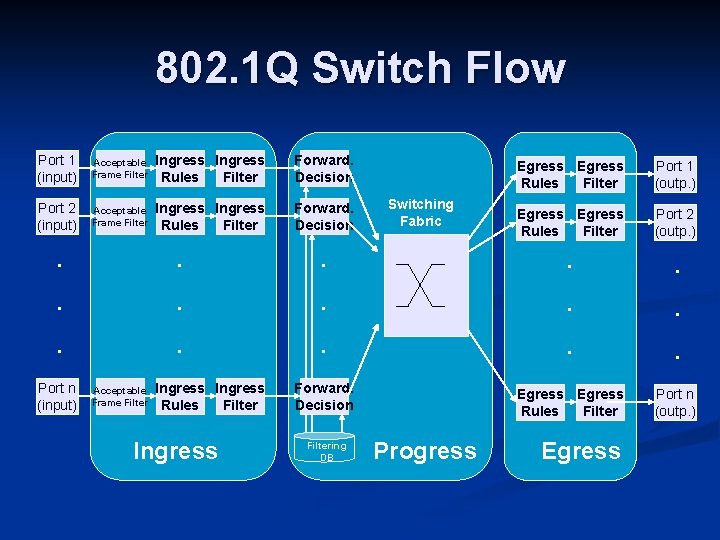
802. 1 Q Switch Flow Port 1 (input) Acceptable Frame Filter Ingress Rules Filter Forward. Decision Port 2 (input) Acceptable Frame Filter Ingress Rules Filter Forward. Decision . . . Port n (input) . . . Acceptable Frame Filter Ingress Rules Filter Ingress Switching Fabric . . . Port 1 (outp. ) Egress Rules Filter Port 2 (outp. ) . . . Forward. Decision Filtering DB Egress Rules Filter Progress Egress . . . Port n (outp. )
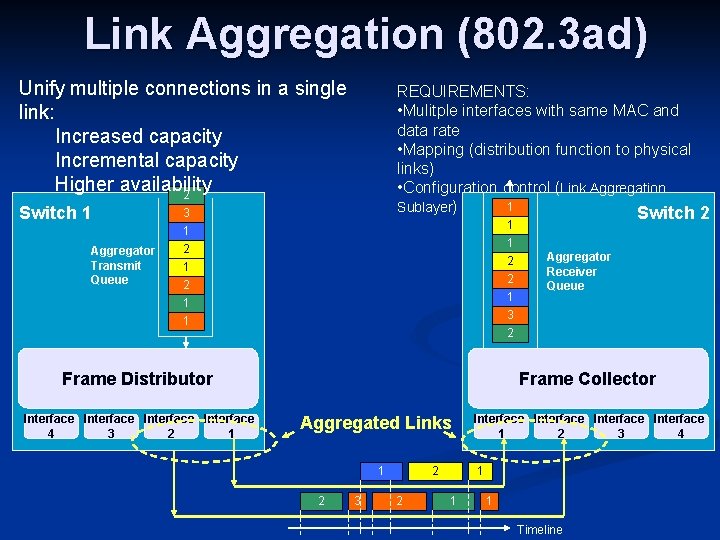
Link Aggregation (802. 3 ad) Unify multiple connections in a single link: Increased capacity Incremental capacity Higher availability 2 Switch 1 Aggregator Transmit Queue REQUIREMENTS: • Mulitple interfaces with same MAC and data rate • Mapping (distribution function to physical links) • Configuration control (Link Aggregation 1 Sublayer) Switch 2 3 1 2 1 1 2 2 1 3 2 1 1 Frame Distributor Interface 4 3 2 1 Aggregator Receiver Queue Frame Collector Aggregated Links 1 2 3 2 2 Interface 1 2 3 4 1 1 1 Timeline
802. 3 ad Applies only to Ethernet n Burden is on Distributor rather than Collector n Link Aggregation Control Protocol (LACP) n Concept of Actor and Partner n Port modes: n n Active mode – port emits messages on a periodic basis (fast rate = 1 sec, slow rate – 30 sec) n Passive mode – port will not speak unless spoken to
Network Management and Monitoring
Simple Network Management Protocol n SNMP – introduced in 1988 as a protocol for management of IP devices RFC 1157 - Simple Network Management Protocol (SNMP) n RFC 1213 - The Management Information Base II (MIB II) n RFC 1902 - The Structure for Management Information (SMI) n n A simple set of operations and information that enables operator to set/get state of a device
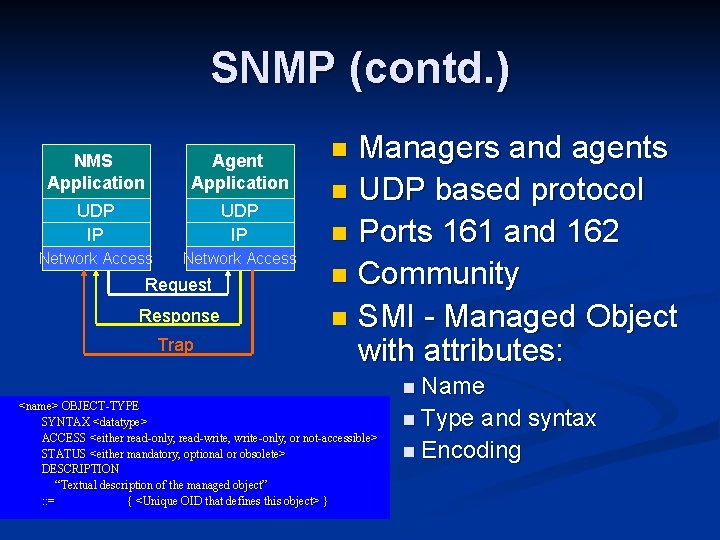
SNMP (contd. ) NMS Application Agent Application UDP IP Network Access Request Response Trap Managers and agents n UDP based protocol n Ports 161 and 162 n Community n SMI - Managed Object with attributes: n <name> OBJECT-TYPE SYNTAX <datatype> ACCESS <either read-only, read-write, write-only, or not-accessible> STATUS <either mandatory, optional or obsolete> DESCRIPTION “Textual description of the managed object” : : = { <Unique OID that defines this object> } n Name n Type and syntax n Encoding
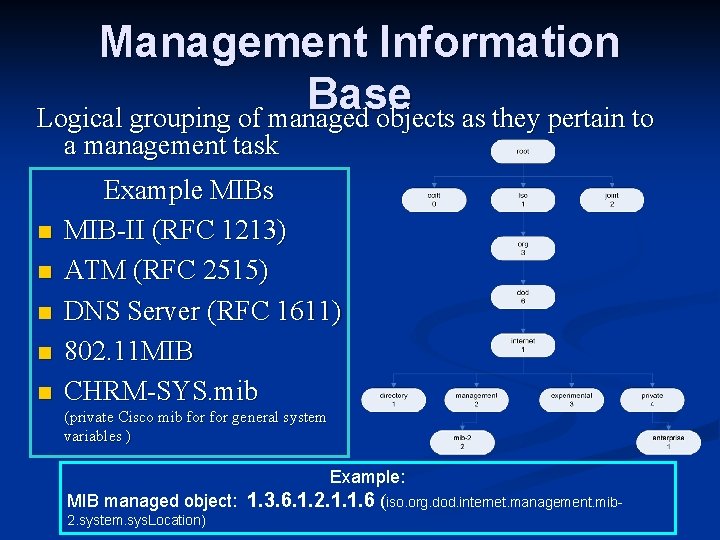
Management Information Base Logical grouping of managed objects as they pertain to a management task n n n Example MIBs MIB-II (RFC 1213) ATM (RFC 2515) DNS Server (RFC 1611) 802. 11 MIB CHRM-SYS. mib (private Cisco mib for general system variables ) Example: MIB managed object: 1. 3. 6. 1. 2. 1. 1. 6 (iso. org. dod. internet. management. mib 2. system. sys. Location)
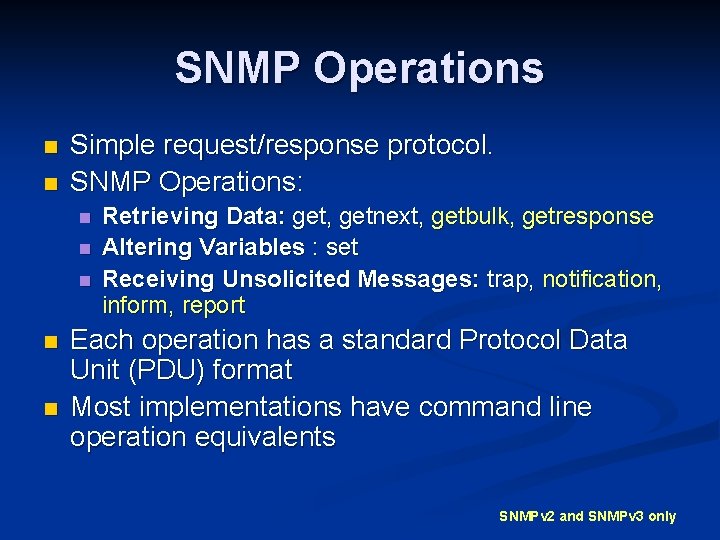
SNMP Operations n n Simple request/response protocol. SNMP Operations: n n n Retrieving Data: get, getnext, getbulk, getresponse Altering Variables : set Receiving Unsolicited Messages: trap, notification, inform, report Each operation has a standard Protocol Data Unit (PDU) format Most implementations have command line operation equivalents SNMPv 2 and SNMPv 3 only
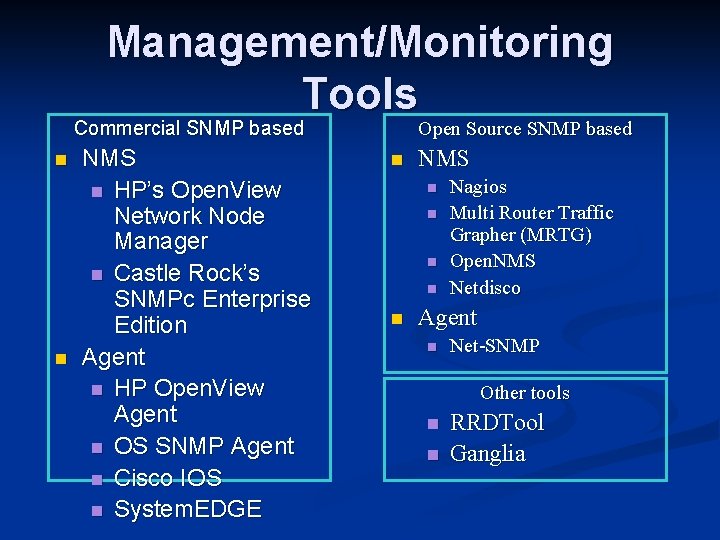
Management/Monitoring Tools Commercial SNMP based n n NMS n HP’s Open. View Network Node Manager n Castle Rock’s SNMPc Enterprise Edition Agent n HP Open. View Agent n OS SNMP Agent n Cisco IOS n System. EDGE Open Source SNMP based n NMS n n n Nagios Multi Router Traffic Grapher (MRTG) Open. NMS Netdisco Agent n Net-SNMP Other tools n n RRDTool Ganglia
Open. Flow
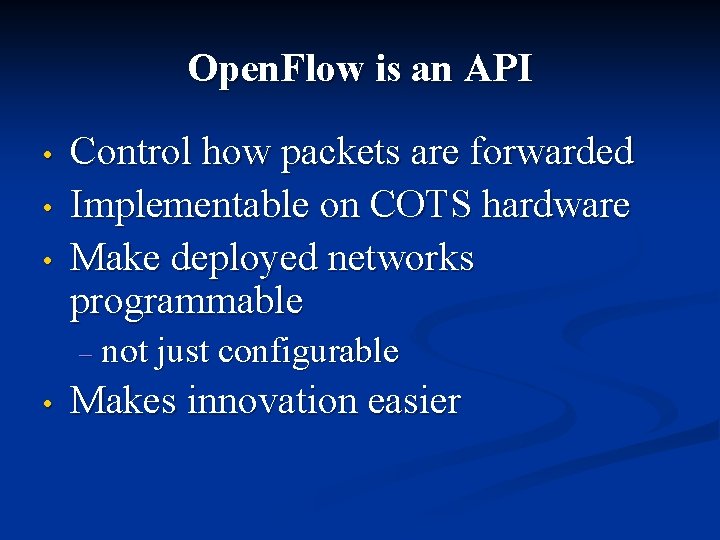
Open. Flow is an API • • • Control how packets are forwarded Implementable on COTS hardware Make deployed networks programmable – • not just configurable Makes innovation easier
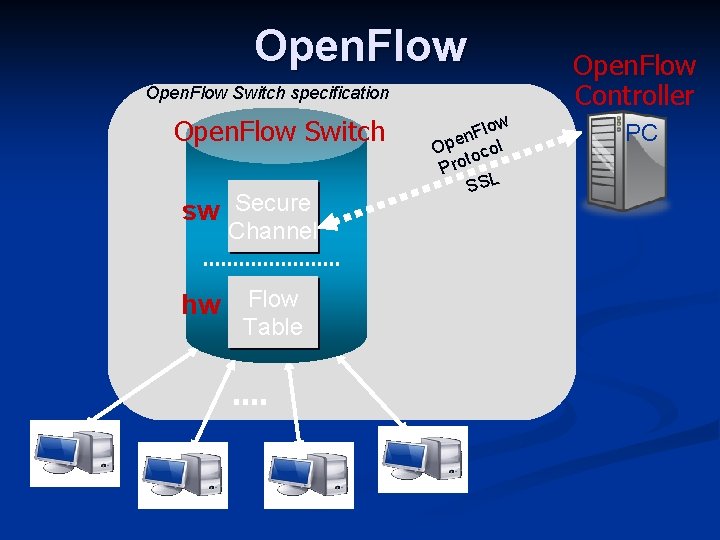
Open. Flow Switch specification Open. Flow Switch sw Secure Channel hw Flow Table low F n Ope ocol t Pro SSL Open. Flow Controller PC
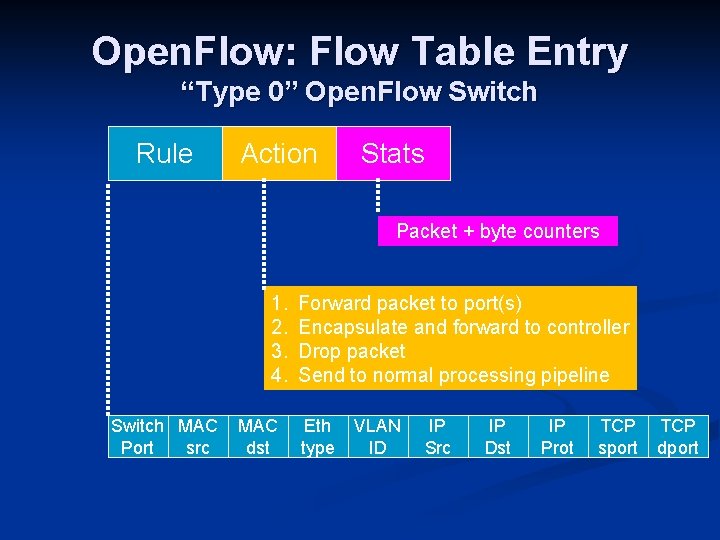
Open. Flow: Flow Table Entry “Type 0” Open. Flow Switch Rule Action Stats Packet + byte counters 1. 2. 3. 4. Switch MAC Port src MAC dst Forward packet to port(s) Encapsulate and forward to controller Drop packet Send to normal processing pipeline Eth type VLAN ID IP Src IP Dst IP Prot TCP sport TCP dport
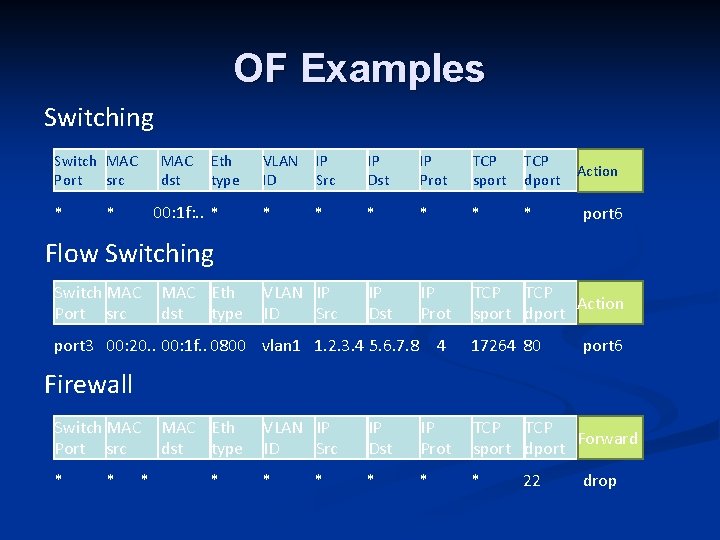
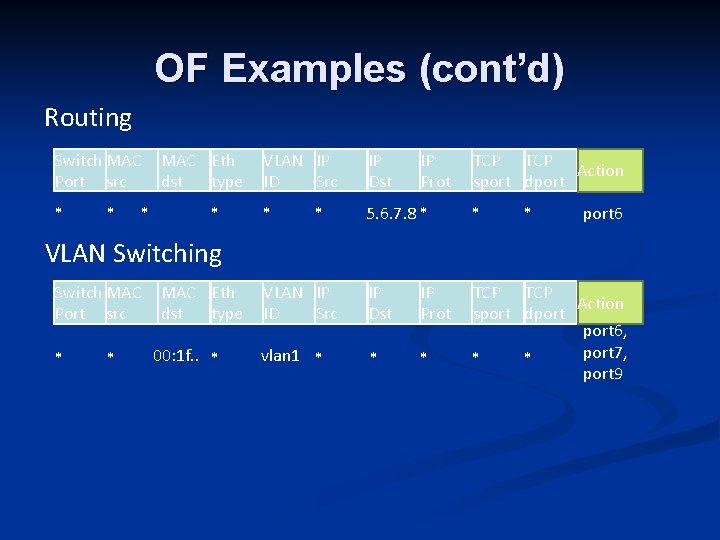
OF Examples Switching Switch MAC Port src * MAC dst Eth type 00: 1 f: . . * * VLAN ID IP Src IP Dst IP Prot TCP sport TCP dport * * * IP Dst IP Prot TCP Action sport dport Action port 6 Flow Switching Switch MAC Port src MAC Eth dst type VLAN IP ID Src port 3 00: 20. . 00: 1 f. . 0800 vlan 1 1. 2. 3. 4 5. 6. 7. 8 4 17264 80 port 6 Firewall Switch MAC Port src * * * MAC Eth dst type * VLAN IP ID Src IP Dst IP Prot TCP Forward sport dport * * * 22 drop
OF Examples (cont’d) Routing Switch MAC Port src * * * MAC Eth dst type * VLAN IP ID Src IP Dst * 5. 6. 7. 8 * * VLAN IP ID Src IP Dst IP Prot vlan 1 * * * TCP Action sport dport 6, port 7, * * port 9 * IP Prot TCP Action sport dport * port 6 VLAN Switching Switch MAC Port src * * MAC Eth dst type 00: 1 f. . *
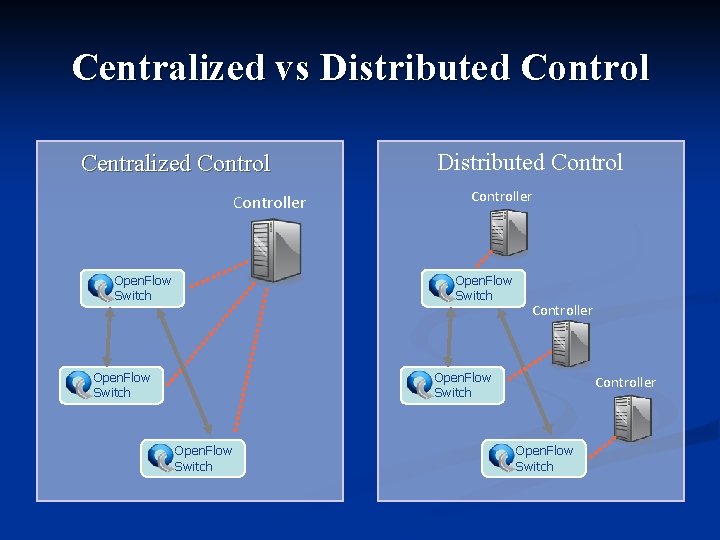
Centralized vs Distributed Control Centralized Controller Open. Flow Switch Distributed Controller Open. Flow Switch Controller Open. Flow Switch
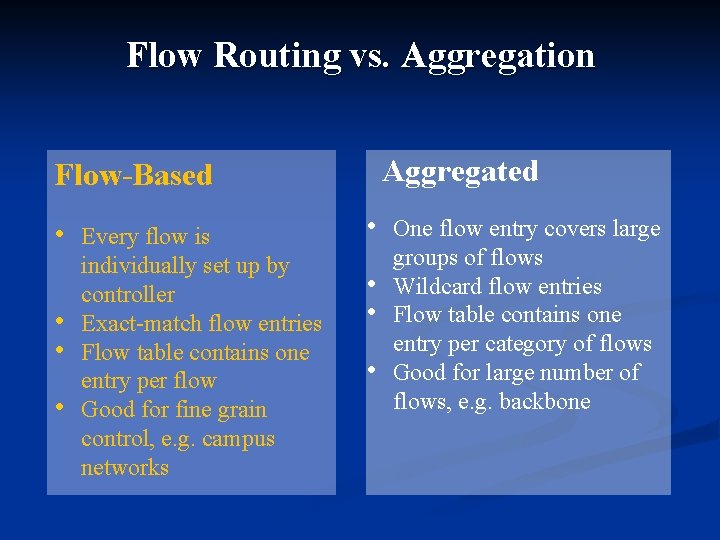
Flow Routing vs. Aggregation Aggregated Flow-Based • • Every flow is individually set up by controller Exact-match flow entries Flow table contains one entry per flow Good for fine grain control, e. g. campus networks • • One flow entry covers large groups of flows Wildcard flow entries Flow table contains one entry per category of flows Good for large number of flows, e. g. backbone
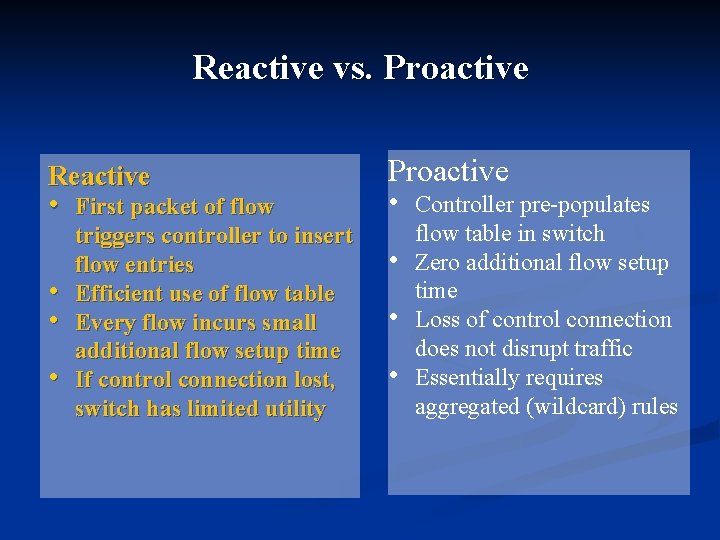
Reactive vs. Proactive Reactive • • First packet of flow triggers controller to insert flow entries Efficient use of flow table Every flow incurs small additional flow setup time If control connection lost, switch has limited utility Proactive • Controller pre-populates • • • flow table in switch Zero additional flow setup time Loss of control connection does not disrupt traffic Essentially requires aggregated (wildcard) rules
Network Programming
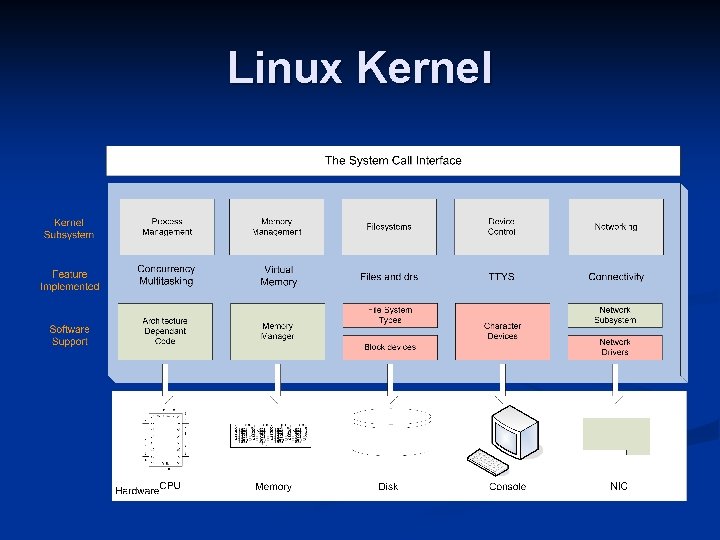
Linux Kernel
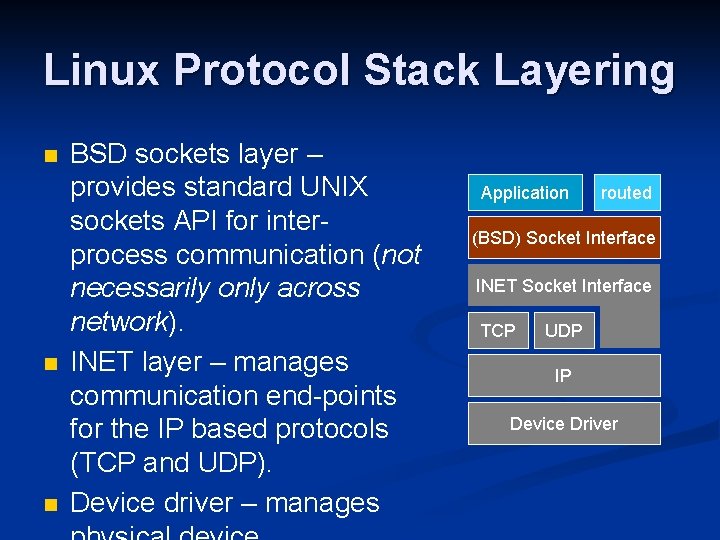
Linux Protocol Stack Layering n n n BSD sockets layer – provides standard UNIX sockets API for interprocess communication (not necessarily only across network). INET layer – manages communication end-points for the IP based protocols (TCP and UDP). Device driver – manages Application routed (BSD) Socket Interface INET Socket Interface TCP UDP IP Device Driver
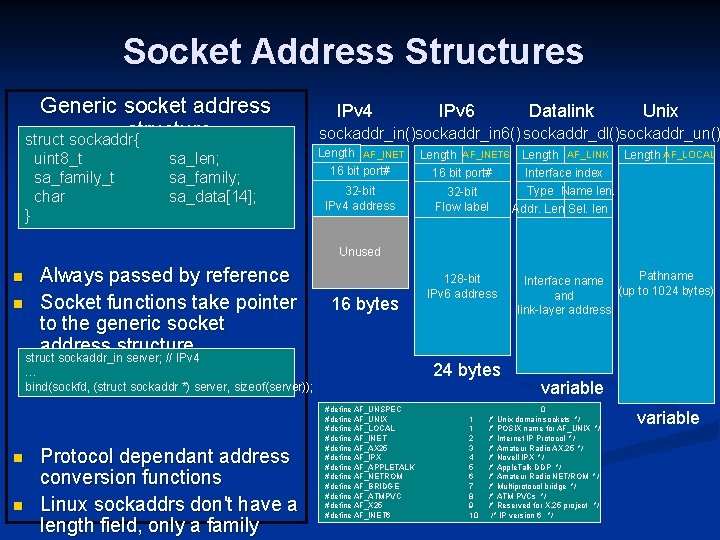
Socket Address Structures Generic socket address structure struct sockaddr{ uint 8_t sa_family_t char sa_len; sa_family; sa_data[14]; } IPv 4 IPv 6 Datalink Unix sockaddr_in()sockaddr_in 6() sockaddr_dl()sockaddr_un() Length AF_INET 16 bit port# Length AF_INET 6 16 bit port# 32 -bit IPv 4 address 32 -bit Flow label Length AF_LINK Length AF_LOCAL Interface index Type Name len. Addr. Len. Sel. len Unused Always passed by reference n Socket functions take pointer to the generic socket address structure struct sockaddr_in server; // IPv 4 n 16 bytes 24 bytes … bind(sockfd, (struct sockaddr *) server, sizeof(server)); n n Protocol dependant address conversion functions Linux sockaddrs don't have a length field, only a family 128 -bit IPv 6 address #define AF_UNSPEC #define AF_UNIX #define AF_LOCAL #define AF_INET #define AF_AX 25 #define AF_IPX #define AF_APPLETALK #define AF_NETROM #define AF_BRIDGE #define AF_ATMPVC #define AF_X 25 #define AF_INET 6 1 1 2 3 4 5 6 7 8 9 10 Pathname Interface name (up to 1024 bytes) and link-layer address variable 0 /* Unix domain sockets */ /* POSIX name for AF_UNIX */ /* Internet IP Protocol */ /* Amateur Radio AX. 25 */ /* Novell IPX */ /* Apple. Talk DDP */ /* Amateur Radio NET/ROM */ /* Multiprotocol bridge */ /* ATM PVCs */ /* Reserved for X. 25 project */ /* IP version 6 */ variable
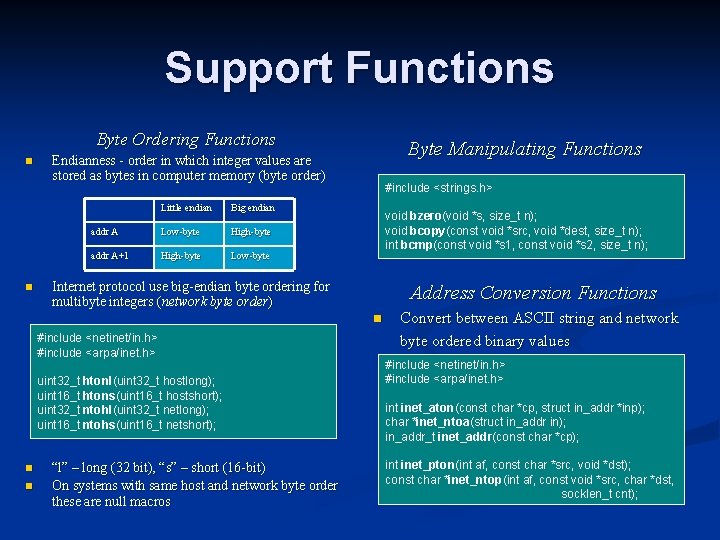
Support Functions Byte Ordering Functions n n Byte Manipulating Functions Endianness - order in which integer values are stored as bytes in computer memory (byte order) Little endian Big endian addr A Low-byte High-byte addr A+1 High-byte Low-byte #include <strings. h> void bzero(void *s, size_t n); void bcopy(const void *src, void *dest, size_t n); int bcmp(const void *s 1, const void *s 2, size_t n); Internet protocol use big-endian byte ordering for multibyte integers (network byte order) Address Conversion Functions n #include <netinet/in. h> #include <arpa/inet. h> uint 32_t htonl(uint 32_t hostlong); uint 16_t htons(uint 16_t hostshort); uint 32_t ntohl(uint 32_t netlong); uint 16_t ntohs(uint 16_t netshort); n n “l” – long (32 bit), “s” – short (16 -bit) On systems with same host and network byte order these are null macros Convert between ASCII string and network byte ordered binary values #include <netinet/in. h> #include <arpa/inet. h> int inet_aton(const char *cp, struct in_addr *inp); char *inet_ntoa(struct in_addr in); in_addr_t inet_addr(const char *cp); int inet_pton(int af, const char *src, void *dst); const char *inet_ntop(int af, const void *src, char *dst, socklen_t cnt);
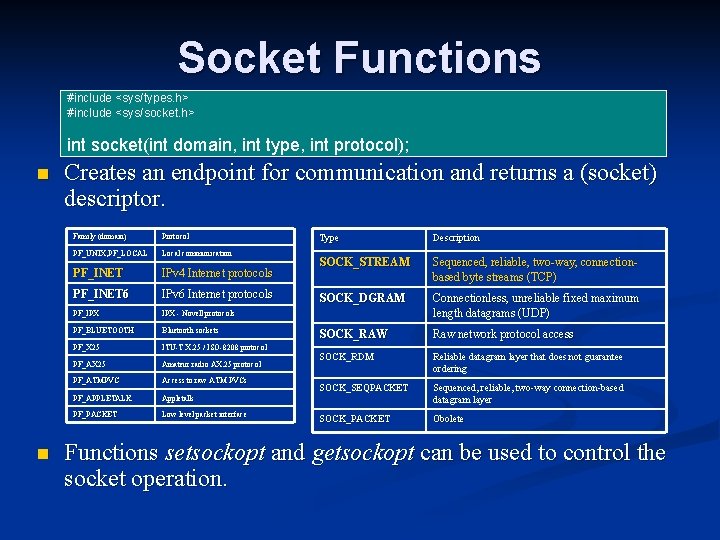
Socket Functions #include <sys/types. h> #include <sys/socket. h> int socket(int domain, int type, int protocol); n n Creates an endpoint for communication and returns a (socket) descriptor. Family (domain) Protocol PF_UNIX, PF_LOCAL Local communication PF_INET IPv 4 Internet protocols PF_INET 6 IPv 6 Internet protocols PF_IPX - Novell protocols PF_BLUETOOTH Bluetooth sockets PF_X 25 ITU-T X. 25 / ISO-8208 protocol PF_AX 25 Amateur radio AX. 25 protocol PF_ATMPVC Access to raw ATM PVCs PF_APPLETALK Appletalk PF_PACKET Low level packet interface Type Description SOCK_STREAM Sequenced, reliable, two-way, connectionbased byte streams (TCP) SOCK_DGRAM Connectionless, unreliable fixed maximum length datagrams (UDP) SOCK_RAW Raw network protocol access SOCK_RDM Reliable datagram layer that does not guarantee ordering SOCK_SEQPACKET Sequenced, reliable, two-way connection-based datagram layer SOCK_PACKET Obolete Functions setsockopt and getsockopt can be used to control the socket operation.
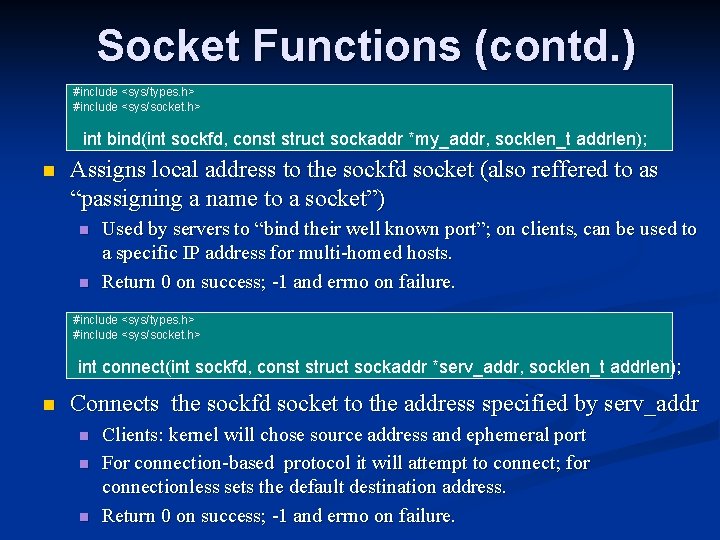
Socket Functions (contd. ) #include <sys/types. h> #include <sys/socket. h> int bind(int sockfd, const struct sockaddr *my_addr, socklen_t addrlen); n Assigns local address to the sockfd socket (also reffered to as “passigning a name to a socket”) n n Used by servers to “bind their well known port”; on clients, can be used to a specific IP address for multi-homed hosts. Return 0 on success; -1 and errno on failure. #include <sys/types. h> #include <sys/socket. h> int connect(int sockfd, const struct sockaddr *serv_addr, socklen_t addrlen); n Connects the sockfd socket to the address specified by serv_addr n n n Clients: kernel will chose source address and ephemeral port For connection-based protocol it will attempt to connect; for connectionless sets the default destination address. Return 0 on success; -1 and errno on failure.
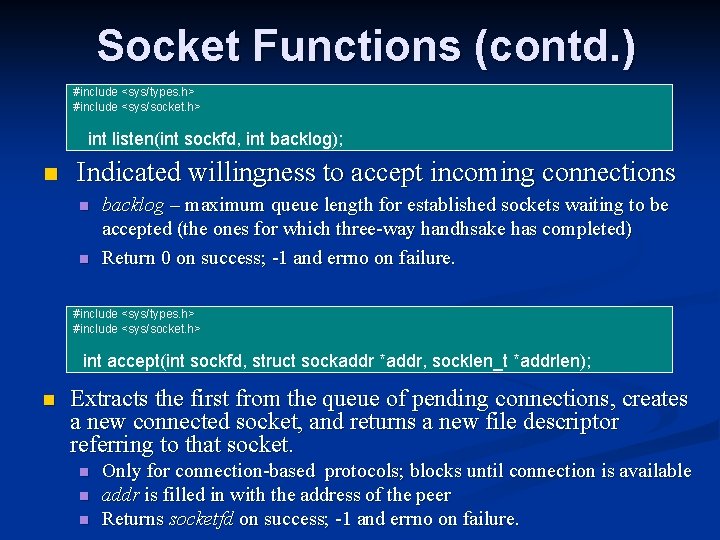
Socket Functions (contd. ) #include <sys/types. h> #include <sys/socket. h> int listen(int sockfd, int backlog); n Indicated willingness to accept incoming connections n n backlog – maximum queue length for established sockets waiting to be accepted (the ones for which three-way handhsake has completed) Return 0 on success; -1 and errno on failure. #include <sys/types. h> #include <sys/socket. h> int accept(int sockfd, struct sockaddr *addr, socklen_t *addrlen); n Extracts the first from the queue of pending connections, creates a new connected socket, and returns a new file descriptor referring to that socket. n n n Only for connection-based protocols; blocks until connection is available addr is filled in with the address of the peer Returns socketfd on success; -1 and errno on failure.
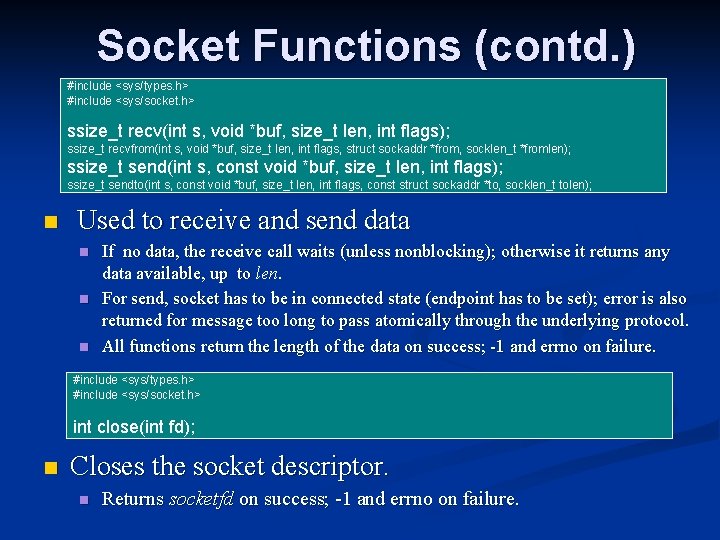
Socket Functions (contd. ) #include <sys/types. h> #include <sys/socket. h> ssize_t recv(int s, void *buf, size_t len, int flags); ssize_t recvfrom(int s, void *buf, size_t len, int flags, struct sockaddr *from, socklen_t *fromlen); ssize_t send(int s, const void *buf, size_t len, int flags); ssize_t sendto(int s, const void *buf, size_t len, int flags, const struct sockaddr *to, socklen_t tolen); n Used to receive and send data n n n If no data, the receive call waits (unless nonblocking); otherwise it returns any data available, up to len. For send, socket has to be in connected state (endpoint has to be set); error is also returned for message too long to pass atomically through the underlying protocol. All functions return the length of the data on success; -1 and errno on failure. #include <sys/types. h> #include <sys/socket. h> int close(int fd); n Closes the socket descriptor. n Returns socketfd on success; -1 and errno on failure.
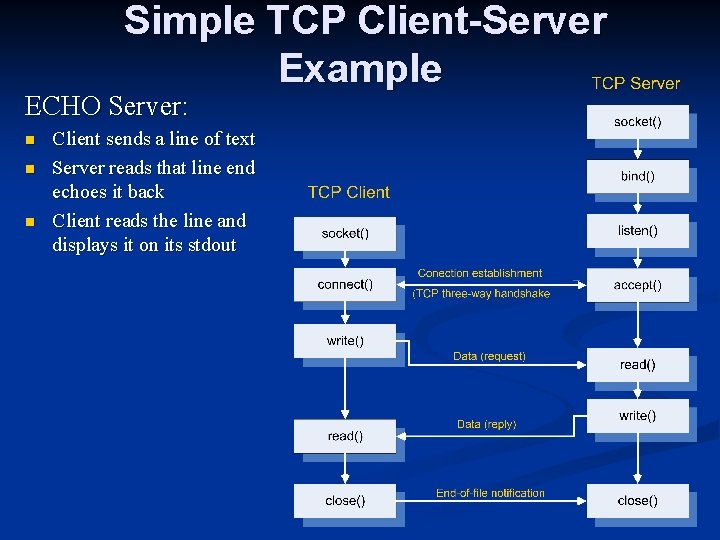
Simple TCP Client-Server Example ECHO Server: n n n Client sends a line of text Server reads that line end echoes it back Client reads the line and displays it on its stdout
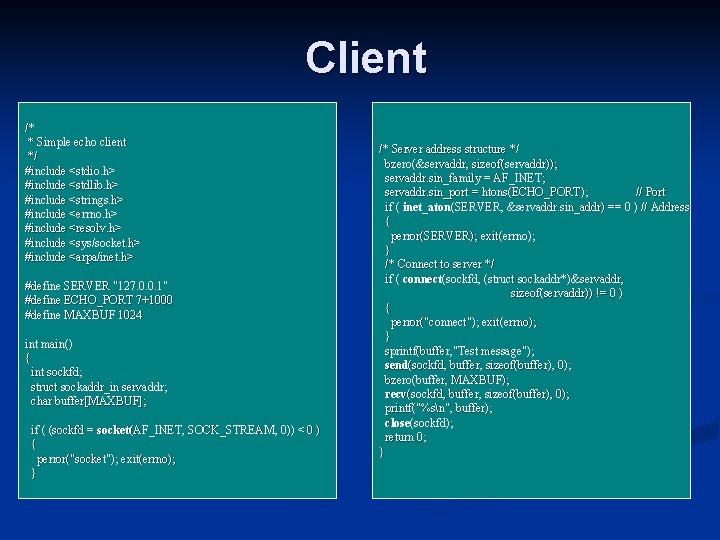
Client /* * Simple echo client */ #include <stdio. h> #include <stdlib. h> #include <strings. h> #include <errno. h> #include <resolv. h> #include <sys/socket. h> #include <arpa/inet. h> #define SERVER "127. 0. 0. 1" #define ECHO_PORT 7+1000 #define MAXBUF 1024 int main() { int sockfd; struct sockaddr_in servaddr; char buffer[MAXBUF]; if ( (sockfd = socket(AF_INET, SOCK_STREAM, 0)) < 0 ) { perror("socket"); exit(errno); } /* Server address structure */ bzero(&servaddr, sizeof(servaddr)); servaddr. sin_family = AF_INET; servaddr. sin_port = htons(ECHO_PORT); // Port if ( inet_aton(SERVER, &servaddr. sin_addr) == 0 ) // Address { perror(SERVER); exit(errno); } /* Connect to server */ if ( connect(sockfd, (struct sockaddr*)&servaddr, sizeof(servaddr)) != 0 ) { perror("connect"); exit(errno); } sprintf(buffer, "Test message"); send(sockfd, buffer, sizeof(buffer), 0); bzero(buffer, MAXBUF); recv(sockfd, buffer, sizeof(buffer), 0); printf("%sn", buffer); close(sockfd); return 0; }
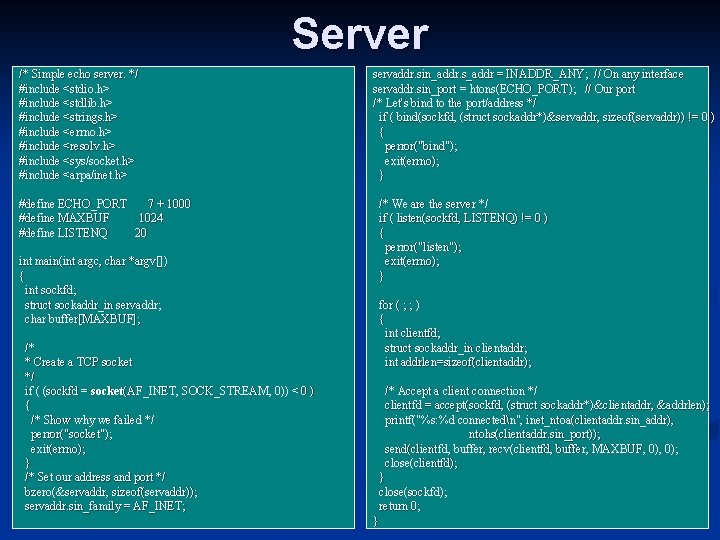
Server /* Simple echo server. */ #include <stdio. h> #include <stdlib. h> #include <strings. h> #include <errno. h> #include <resolv. h> #include <sys/socket. h> #include <arpa/inet. h> #define ECHO_PORT 7 + 1000 #define MAXBUF 1024 #define LISTENQ 20 int main(int argc, char *argv[]) { int sockfd; struct sockaddr_in servaddr; char buffer[MAXBUF]; /* * Create a TCP socket */ if ( (sockfd = socket(AF_INET, SOCK_STREAM, 0)) < 0 ) { /* Show why we failed */ perror("socket"); exit(errno); } /* Set our address and port */ bzero(&servaddr, sizeof(servaddr)); servaddr. sin_family = AF_INET; servaddr. sin_addr. s_addr = INADDR_ANY; // On any interface servaddr. sin_port = htons(ECHO_PORT); // Our port /* Let's bind to the port/address */ if ( bind(sockfd, (struct sockaddr*)&servaddr, sizeof(servaddr)) != 0 ) { perror("bind"); exit(errno); } /* We are the server */ if ( listen(sockfd, LISTENQ) != 0 ) { perror("listen"); exit(errno); } for ( ; ; ) { int clientfd; struct sockaddr_in clientaddr; int addrlen=sizeof(clientaddr); /* Accept a client connection */ clientfd = accept(sockfd, (struct sockaddr*)&clientaddr, &addrlen); printf("%s: %d connectedn", inet_ntoa(clientaddr. sin_addr), ntohs(clientaddr. sin_port)); send(clientfd, buffer, recv(clientfd, buffer, MAXBUF, 0); close(clientfd); } close(sockfd); return 0; }