
Network Flows Based on the book Introduction to
Network Flows Based on the book: Introduction to Management Science. Hillier & Hillier. Mc. Graw-Hill
Minimum Cost Flow Distribution Unlimited Co. Problem p The Distribution Unlimited Co. has two factories producing a product that needs to be shipped to two warehouses Factory 1 produces 80 units. n Factory 2 produces 70 units. n Warehouse 1 needs 60 units. n Warehouse 2 needs 90 units. n p There are rail links directly from Factory 1 to Warehouse 1 and Factory 2 to Warehouse 2. p Independent truckers are available to ship up to 50 units from each factory to the distribution center, and then 50 units from the distribution center to each warehouse. Question: How many units (truckloads) should be shipped along each shipping lane? Network Flow Problems Ardavan Asef-Vaziri Jan. 2014 2
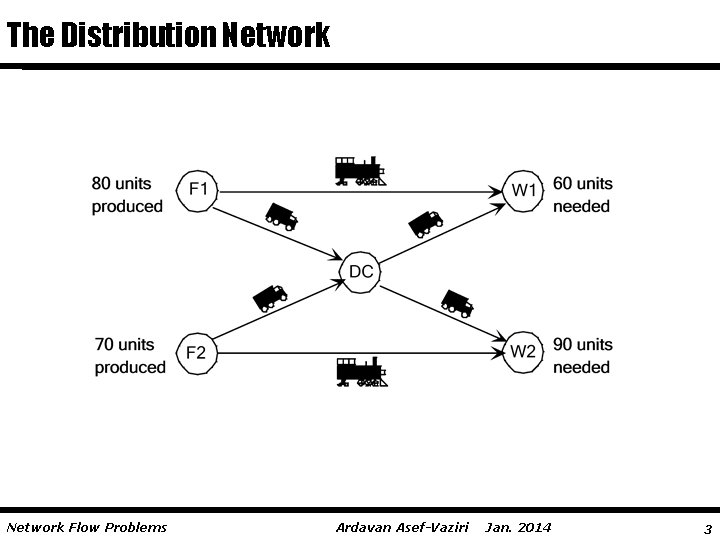
The Distribution Network Flow Problems Ardavan Asef-Vaziri Jan. 2014 3
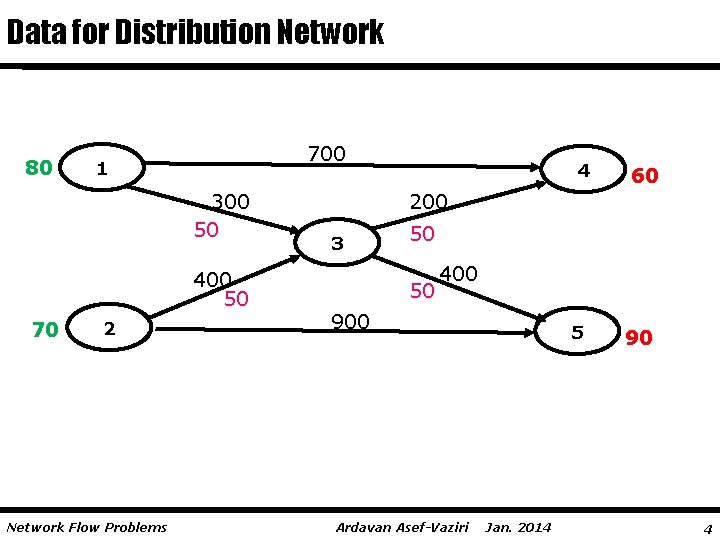
Data for Distribution Network 80 700 1 300 50 400 50 70 2 Network Flow Problems 4 60 200 3 50 50 400 900 Ardavan Asef-Vaziri 5 Jan. 2014 90 4
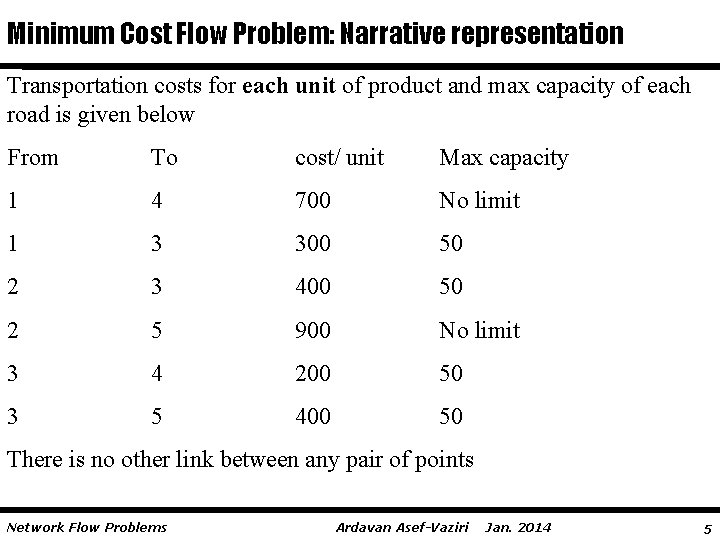
Minimum Cost Flow Problem: Narrative representation Transportation costs for each unit of product and max capacity of each road is given below From To cost/ unit Max capacity 1 4 700 No limit 1 3 300 50 2 3 400 50 2 5 900 No limit 3 4 200 50 3 5 400 50 There is no other link between any pair of points Network Flow Problems Ardavan Asef-Vaziri Jan. 2014 5

Minimum Cost Flow Problem: decision variables x 14 = Volume of product sent from point 1 to 4 x 13 = Volume of product sent from point 1 to 3 x 23 = Volume of product sent from point 2 to 3 x 25 = Volume of product sent from point 2 to 5 x 34 = Volume of product sent from point 3 to 4 x 35 = Volume of product sent from point 3 to 5 We want to minimize Z = 700 x 14 +300 x 13 + 400 x 23 + 900 x 25 +200 x 34 + 400 x 35 Network Flow Problems Ardavan Asef-Vaziri Jan. 2014 6
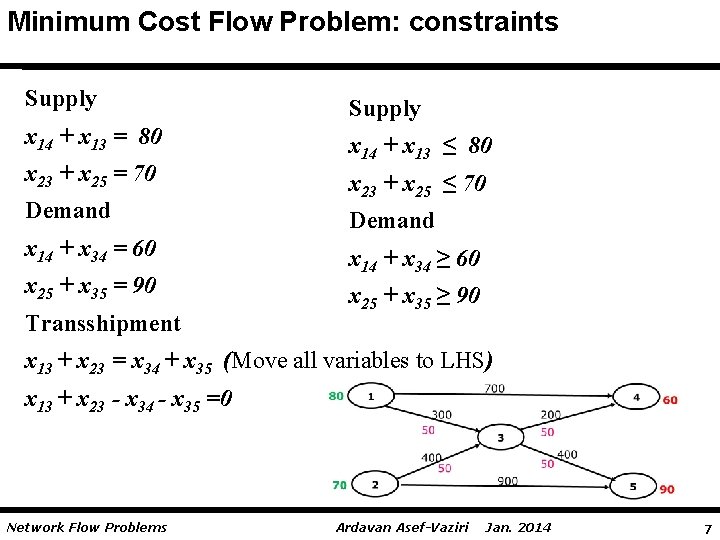
Minimum Cost Flow Problem: constraints Supply x 14 + x 13 = 80 x 14 + x 13 ≤ 80 x 23 + x 25 = 70 Demand x 14 + x 34 = 60 x 25 + x 35 = 90 Transshipment x 23 + x 25 ≤ 70 Demand x 14 + x 34 ≥ 60 x 25 + x 35 ≥ 90 x 13 + x 23 = x 34 + x 35 (Move all variables to LHS) x 13 + x 23 - x 34 - x 35 =0 Network Flow Problems Ardavan Asef-Vaziri Jan. 2014 7
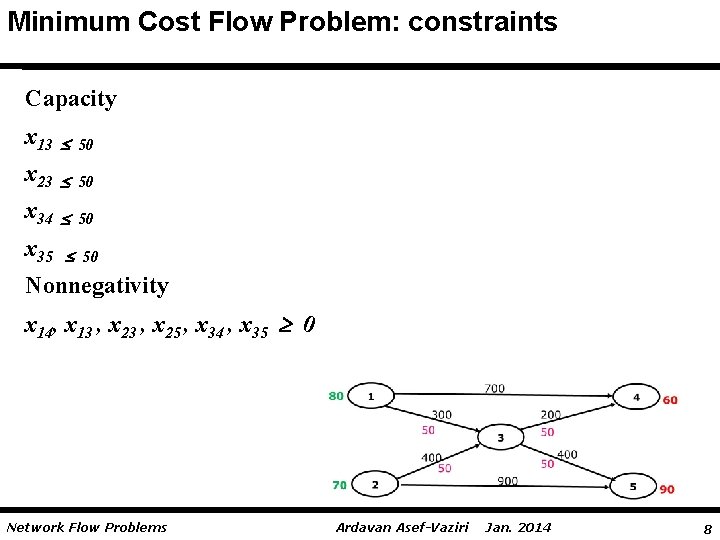
Minimum Cost Flow Problem: constraints Capacity x 13 50 x 23 50 x 34 50 x 35 50 Nonnegativity x 14, x 13 , x 25 , x 34 , x 35 0 Network Flow Problems Ardavan Asef-Vaziri Jan. 2014 8
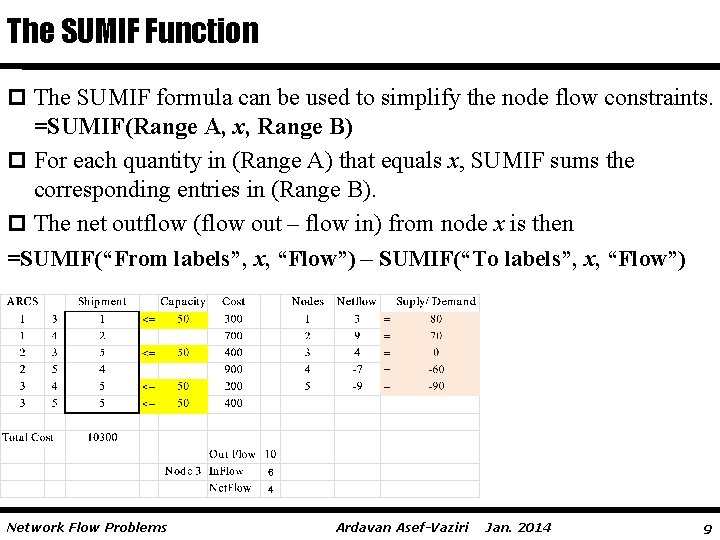
The SUMIF Function p The SUMIF formula can be used to simplify the node flow constraints. =SUMIF(Range A, x, Range B) p For each quantity in (Range A) that equals x, SUMIF sums the corresponding entries in (Range B). p The net outflow (flow out – flow in) from node x is then =SUMIF(“From labels”, x, “Flow”) – SUMIF(“To labels”, x, “Flow”) Network Flow Problems Ardavan Asef-Vaziri Jan. 2014 9
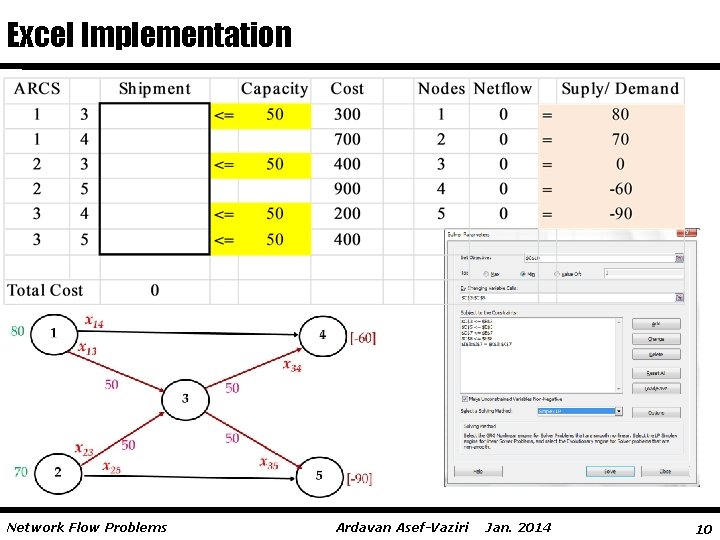
Excel Implementation Network Flow Problems Ardavan Asef-Vaziri Jan. 2014 10
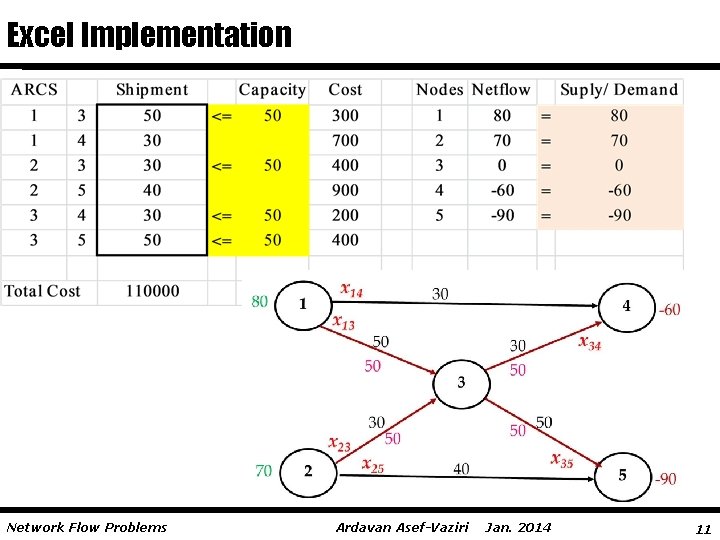
Excel Implementation Network Flow Problems Ardavan Asef-Vaziri Jan. 2014 11
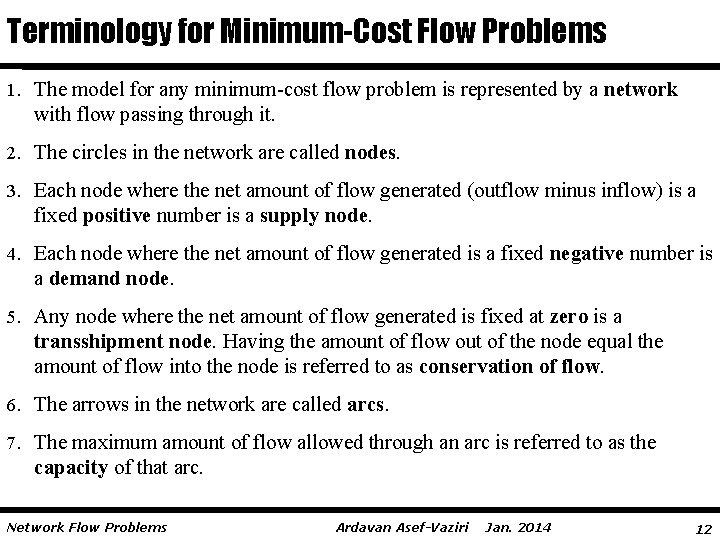
Terminology for Minimum-Cost Flow Problems 1. The model for any minimum-cost flow problem is represented by a network with flow passing through it. 2. The circles in the network are called nodes. 3. Each node where the net amount of flow generated (outflow minus inflow) is a fixed positive number is a supply node. 4. Each node where the net amount of flow generated is a fixed negative number is a demand node. 5. Any node where the net amount of flow generated is fixed at zero is a transshipment node. Having the amount of flow out of the node equal the amount of flow into the node is referred to as conservation of flow. 6. The arrows in the network are called arcs. 7. The maximum amount of flow allowed through an arc is referred to as the capacity of that arc. Network Flow Problems Ardavan Asef-Vaziri Jan. 2014 12
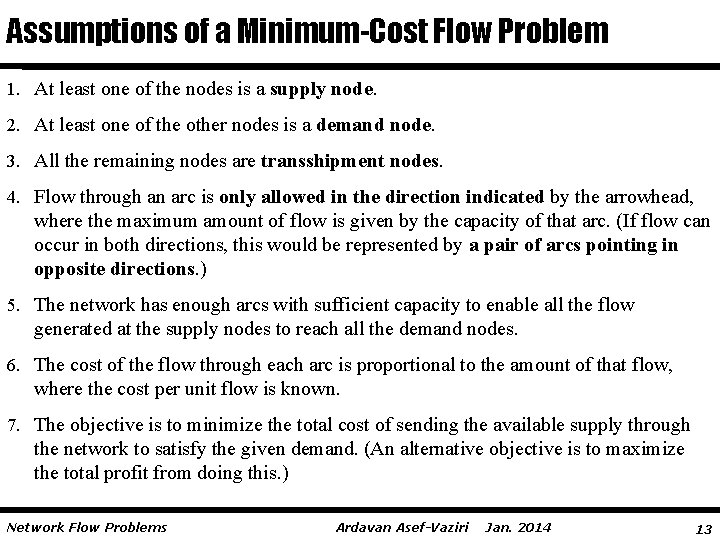
Assumptions of a Minimum-Cost Flow Problem 1. At least one of the nodes is a supply node. 2. At least one of the other nodes is a demand node. 3. All the remaining nodes are transshipment nodes. 4. Flow through an arc is only allowed in the direction indicated by the arrowhead, where the maximum amount of flow is given by the capacity of that arc. (If flow can occur in both directions, this would be represented by a pair of arcs pointing in opposite directions. ) 5. The network has enough arcs with sufficient capacity to enable all the flow generated at the supply nodes to reach all the demand nodes. 6. The cost of the flow through each arc is proportional to the amount of that flow, where the cost per unit flow is known. 7. The objective is to minimize the total cost of sending the available supply through the network to satisfy the given demand. (An alternative objective is to maximize the total profit from doing this. ) Network Flow Problems Ardavan Asef-Vaziri Jan. 2014 13
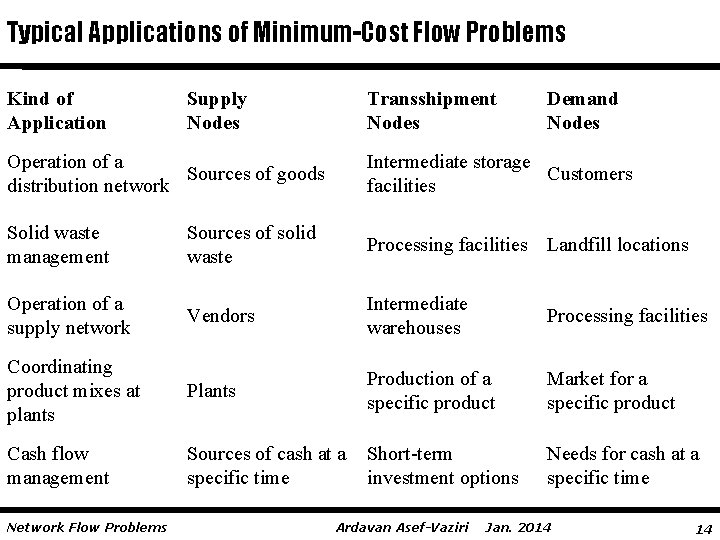
Typical Applications of Minimum-Cost Flow Problems Kind of Application Supply Nodes Transshipment Nodes Demand Nodes Operation of a Sources of goods distribution network Intermediate storage Customers facilities Solid waste management Sources of solid waste Processing facilities Landfill locations Operation of a supply network Vendors Intermediate warehouses Processing facilities Coordinating product mixes at plants Production of a specific product Market for a specific product Cash flow management Sources of cash at a specific time Short-term investment options Needs for cash at a specific time Network Flow Problems Ardavan Asef-Vaziri Jan. 2014 14
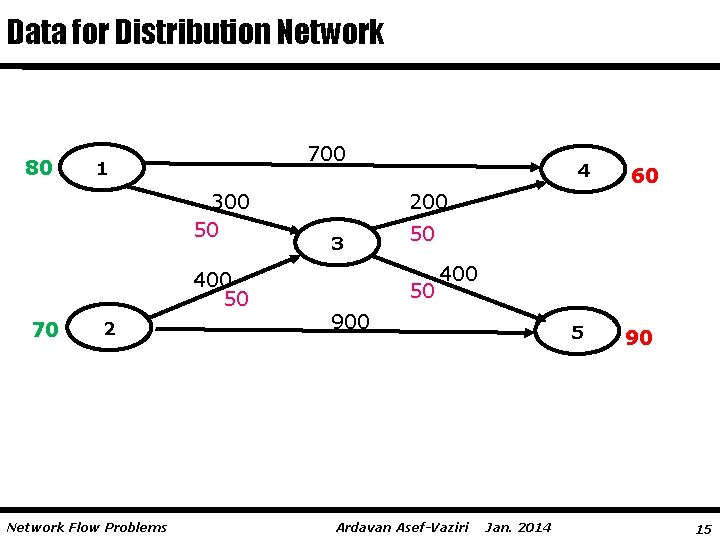
Data for Distribution Network 80 700 1 300 50 400 50 70 2 Network Flow Problems 4 60 200 3 50 50 400 900 Ardavan Asef-Vaziri 5 Jan. 2014 90 15
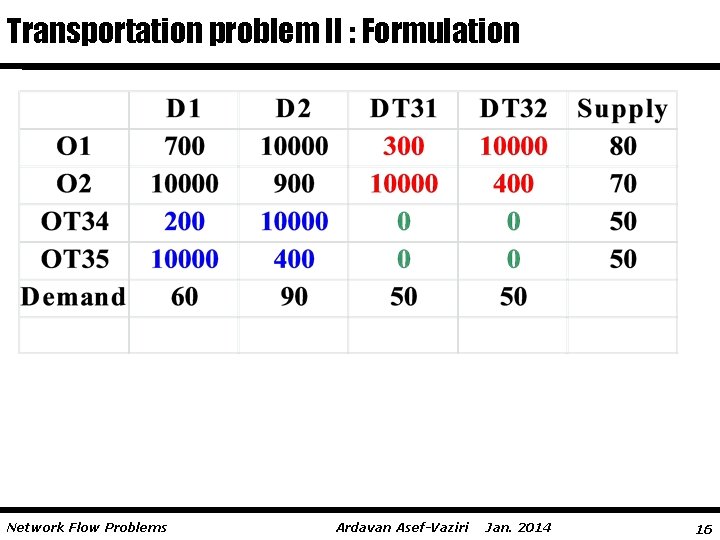
Transportation problem II : Formulation Network Flow Problems Ardavan Asef-Vaziri Jan. 2014 16
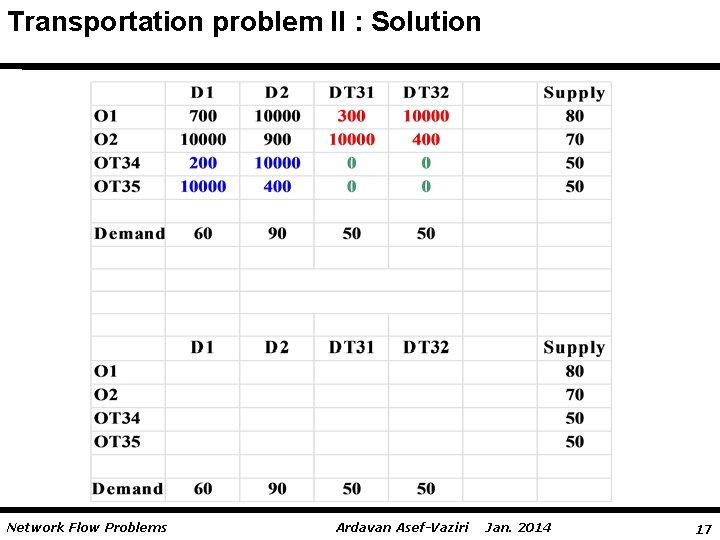
Transportation problem II : Solution Network Flow Problems Ardavan Asef-Vaziri Jan. 2014 17
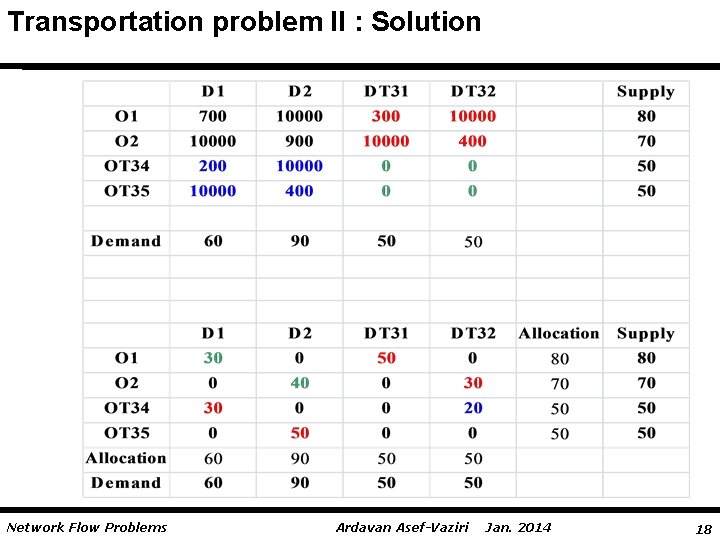
Transportation problem II : Solution Network Flow Problems Ardavan Asef-Vaziri Jan. 2014 18
- Slides: 18