
Network Economics Optimization Lab summary Shared by Prof
Network Economics & Optimization Lab summary Shared by Prof. Lingjie Duan @ SUTD Research interests: economics meets info engineering Cognitive radio enabled 5 G spectrum trading & sharing Optimization of energy-efficient communications & wireless power transfer Mobile crowdsourcing and sharing for Internet of Things Economic viability of emerging technologies & market competition Wireless operators not only make technological decisions, but economically Choices and timings of technology adoptions (e. g. , 4 G LTE or Wi. MAX). Resources (spectrum) to invest and costs (energy and infrastructure) to manage. Service pricing to control traffic congestion and make profit under competition. Highlight of research results Explain why competitive operators choose different times for their 4 G adoption [1]. Cost efficiency (combining spectrum- and energy-efficiency) is greatly improved via cross-layer optimization [2]. Propose time-dependent dynamic pricing to reshape traffic load and balance between different systems (e. g. , cellular and Wi. Fi/femtocell) [3] [4]. 1
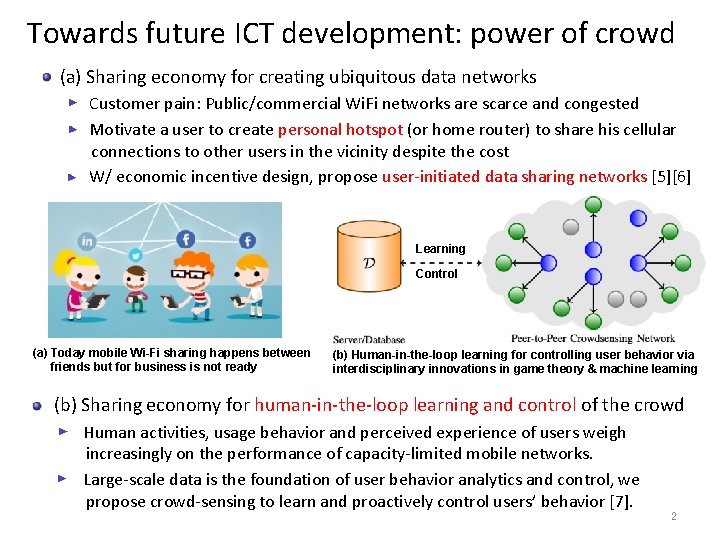
Towards future ICT development: power of crowd (a) Sharing economy for creating ubiquitous data networks Customer pain: Public/commercial Wi. Fi networks are scarce and congested Motivate a user to create personal hotspot (or home router) to share his cellular connections to other users in the vicinity despite the cost W/ economic incentive design, propose user-initiated data sharing networks [5][6] Learning Control (a) Today mobile Wi-Fi sharing happens between friends but for business is not ready (b) Human-in-the-loop learning for controlling user behavior via interdisciplinary innovations in game theory & machine learning (b) Sharing economy for human-in-the-loop learning and control of the crowd Human activities, usage behavior and perceived experience of users weigh increasingly on the performance of capacity-limited mobile networks. Large-scale data is the foundation of user behavior analytics and control, we propose crowd-sensing to learn and proactively control users’ behavior [7]. 2
![Reference • • [1] L. Duan, J. Huang, and J. Walrand, “Economic analysis of](http://slidetodoc.com/presentation_image_h2/ab461c128786ebc1361a2196e6a843df/image-3.jpg "Reference • • [1] L. Duan, J. Huang, and J. Walrand, “Economic analysis of")
Reference • • [1] L. Duan, J. Huang, and J. Walrand, “Economic analysis of 4 G upgrade timing, ” IEEE Transactions on Mobile Computing, vol. 14, no. 5, pp. 975 -989, 2015. [2] X. Jie, L. Duan, and R. Zhang, “Cost-aware green cellular networks with energy and communication cooperation, ” IEEE Communications Magazine, vol. 53, no. 5, pp. 257 -263, 2015. [3] L. Duan, J. Huang, and B. Shou, “Economics of femtocell service provision, ” IEEE Transactions on Mobile Computing, vol. 12, no. 11, pp. 2261 -2273, 2013. [4] L. Duan, B. Shou, and J. Huang, “Capacity allocation and pricing strategies for new wireless services, ” Production and Operations Management, vol. 25, no. 5, pp. 866 -882, 2016. [5] X. Wang, L. Duan, and R. Zhang, “User-initiated data plan trading via a personal hotspot market, ” IEEE Transactions on Wireless Communications, vol. 15, no. 11, pp. 7785 -7898, 2016. [6] F. Wang, L. Duan, and J. Niu, “Optimal pricing of user-initiated data-plan sharing in a roaming market, ” IEEE Transactions on Wireless Communications, vol. 17, no. 9, pp. 5929 -5944, 2018. [7] Y. Li, C. Courcoubetis, and L. Duan, “Dynamic routing for social information sharing, ” IEEE Journal on Selected Areas in Communications, vol. 35, no. 3, pp. 571585, 2017. 3
- Slides: 3