
Network Driver in Linux 2 42 6 CCU




















- Slides: 56
Network Driver in Linux 2. 4/2. 6 潘仁義 CCU COMM
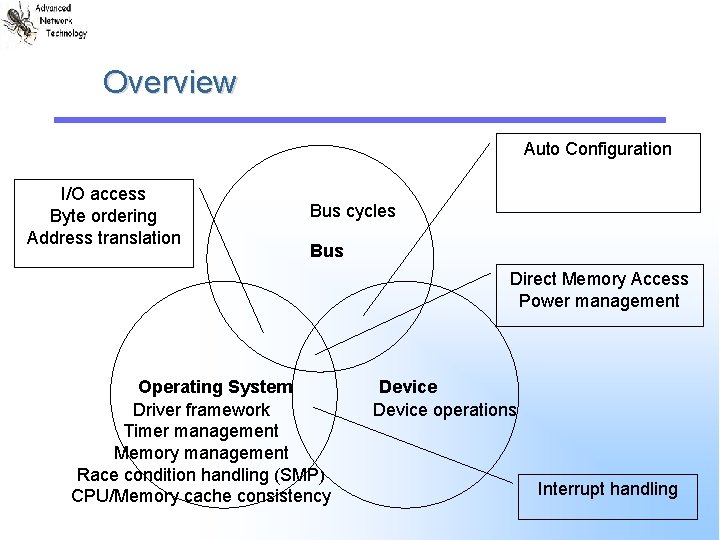
Overview Auto Configuration I/O access Byte ordering Address translation Bus cycles Bus Direct Memory Access Power management Operating System Driver framework Timer management Memory management Race condition handling (SMP) CPU/Memory cache consistency Device operations Interrupt handling
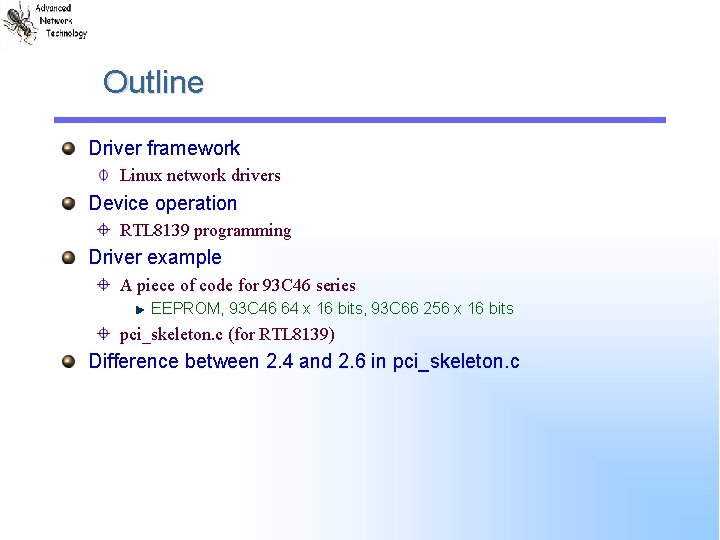
Outline Driver framework Linux network drivers Device operation RTL 8139 programming Driver example A piece of code for 93 C 46 series EEPROM, 93 C 46 64 x 16 bits, 93 C 66 256 x 16 bits pci_skeleton. c (for RTL 8139) Difference between 2. 4 and 2. 6 in pci_skeleton. c
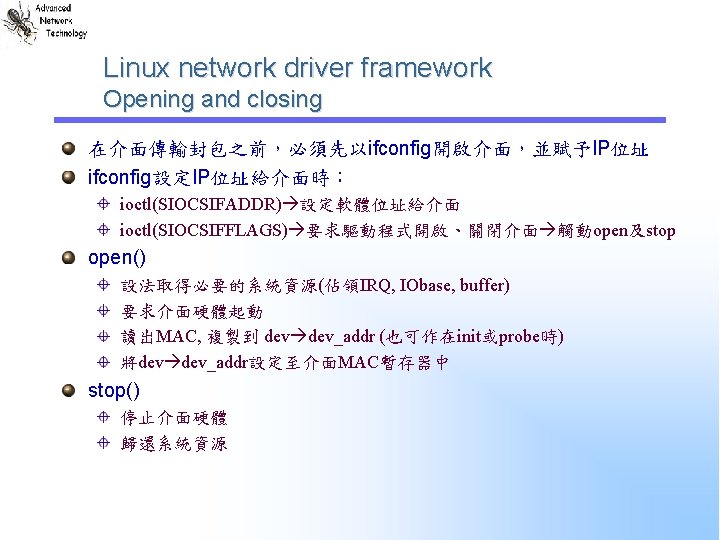
Linux network driver framework Connecting to the Kernel (1/2) Module_loading struct net_device snull_dev = { init : snull_init, }; //初始化函式 if((result = register_netdev(snull_dev)))) printk(“error”); 呼叫前, 先設定name 為“eth%d”, 以便其配置 “eth. X” 函式內部會呼叫 dev init() snull_init( ) Probe function Called when register_netdev() Usually avoid registering I/O and IRQ, delay until dev open() time To fill in the “dev” strcuture ether_setup(dev), 會將正確的ARP相關作業方法設定好 設定私有資料結構 “priv”; 網路介面生命期與系統一樣長, 可放統計資料 Module_unloading kfree(priv); unregister_netdev (snull_dev);
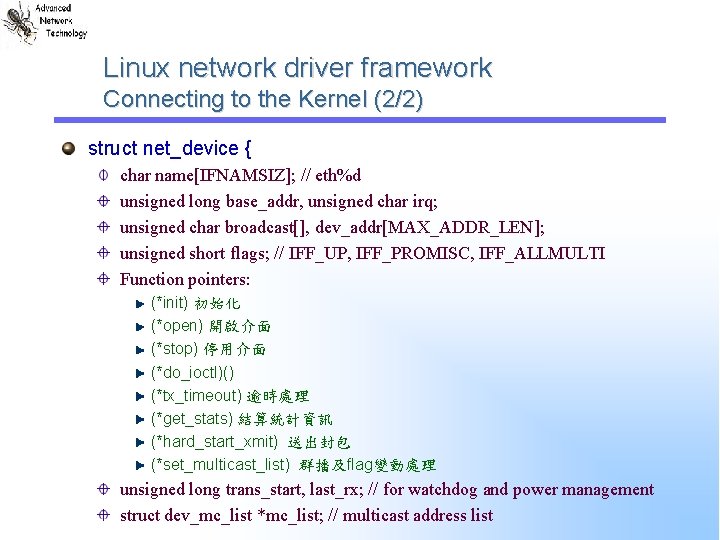
Linux network driver framework Connecting to the Kernel (2/2) struct net_device { char name[IFNAMSIZ]; // eth%d unsigned long base_addr, unsigned char irq; unsigned char broadcast[], dev_addr[MAX_ADDR_LEN]; unsigned short flags; // IFF_UP, IFF_PROMISC, IFF_ALLMULTI Function pointers: (*init) 初始化 (*open) 開啟介面 (*stop) 停用介面 (*do_ioctl)() (*tx_timeout) 逾時處理 (*get_stats) 結算統計資訊 (*hard_start_xmit) 送出封包 (*set_multicast_list) 群播及flag變動處理 unsigned long trans_start, last_rx; // for watchdog and power management struct dev_mc_list *mc_list; // multicast address list
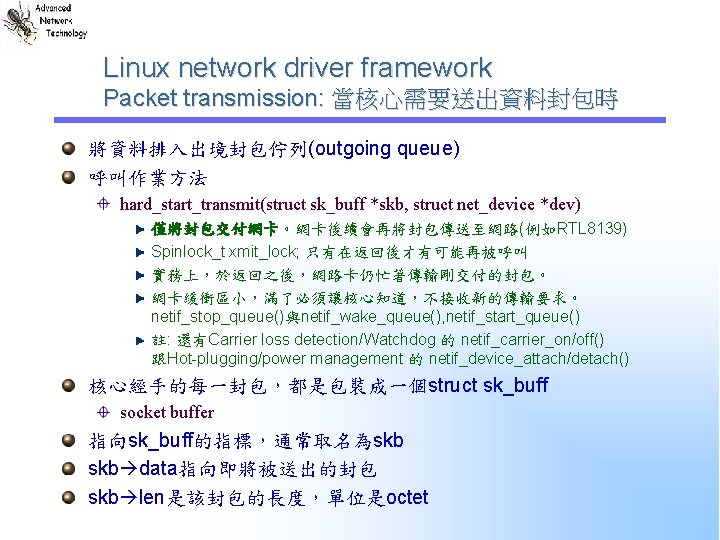
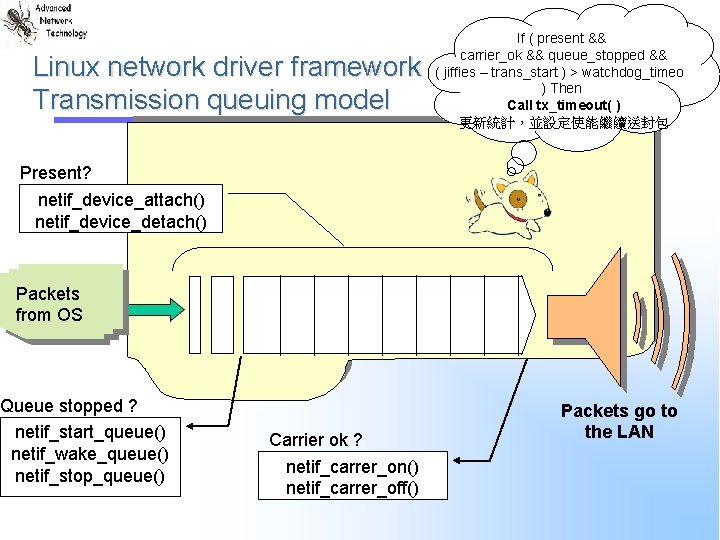
Linux network driver framework Packet transmission: 當核心需要送出資料封包時 將資料排入出境封包佇列(outgoing queue) 呼叫作業方法 hard_start_transmit(struct sk_buff *skb, struct net_device *dev) 僅將封包交付網卡。網卡後續會再將封包傳送至網路(例如RTL 8139) Spinlock_t xmit_lock; 只有在返回後才有可能再被呼叫 實務上,於返回之後,網路卡仍忙著傳輸剛交付的封包。 網卡緩衝區小,滿了必須讓核心知道,不接收新的傳輸要求。 netif_stop_queue()與netif_wake_queue(), netif_start_queue() 註: 還有Carrier loss detection/Watchdog 的 netif_carrier_on/off() 跟Hot-plugging/power management 的 netif_device_attach/detach() 核心經手的每一封包,都是包裝成一個struct sk_buff socket buffer 指向sk_buff的指標,通常取名為skb data指向即將被送出的封包 skb len是該封包的長度,單位是octet
Linux network driver framework Transmission queuing model If ( present && carrier_ok && queue_stopped && ( jiffies – trans_start ) > watchdog_timeo ) Then Call tx_timeout( ) 更新統計,並設定使能繼續送封包 Present? netif_device_attach() netif_device_detach() Packets from OS Queue stopped ? netif_start_queue() netif_wake_queue() netif_stop_queue() Carrier ok ? netif_carrer_on() netif_carrer_off() Packets go to the LAN
Linux network driver framework Packet reception 封包接收事件通常是從網路硬體觸發中斷開始 多半寫在interrupt handler 配置一個sk_buff,並交給核心內部的網路子系統 Interrupt-based 較 polling方式有效率 Example: snull_rx() skb = dev_alloc_skb(len+2); // 採用GFP_ATOMIC, 可在ISR中用 skb_reserve(skb, 2); // 16 byte align the IP field memcpy(skb_put(skb, len), receive_packet, len); //skb_put()參考sk_buff 填寫相關資訊 skb dev = dev; skb protocol = eth_type_trans(skb, dev); skb ip_summed = CHECKSUM_UNNECESSARY; /* 不必檢查 */ CHECKSUM_HW(硬體算了)/NONE(待算, 預設)/UNNECESSARY(不算 )
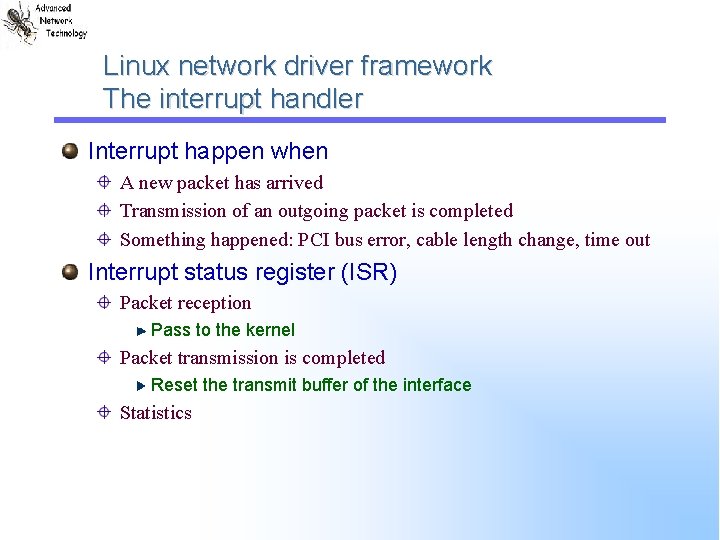
Linux network driver framework The interrupt handler Interrupt happen when A new packet has arrived Transmission of an outgoing packet is completed Something happened: PCI bus error, cable length change, time out Interrupt status register (ISR) Packet reception Pass to the kernel Packet transmission is completed Reset the transmit buffer of the interface Statistics
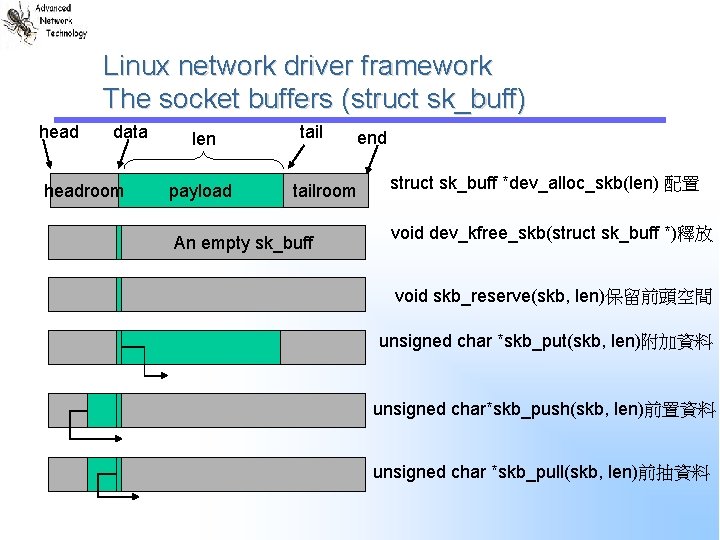
Linux network driver framework The socket buffers (struct sk_buff) head data headroom len payload tail end tailroom An empty sk_buff struct sk_buff *dev_alloc_skb(len) 配置 void dev_kfree_skb(struct sk_buff *)釋放 void skb_reserve(skb, len)保留前頭空間 unsigned char *skb_put(skb, len)附加資料 unsigned char*skb_push(skb, len)前置資料 unsigned char *skb_pull(skb, len)前抽資料
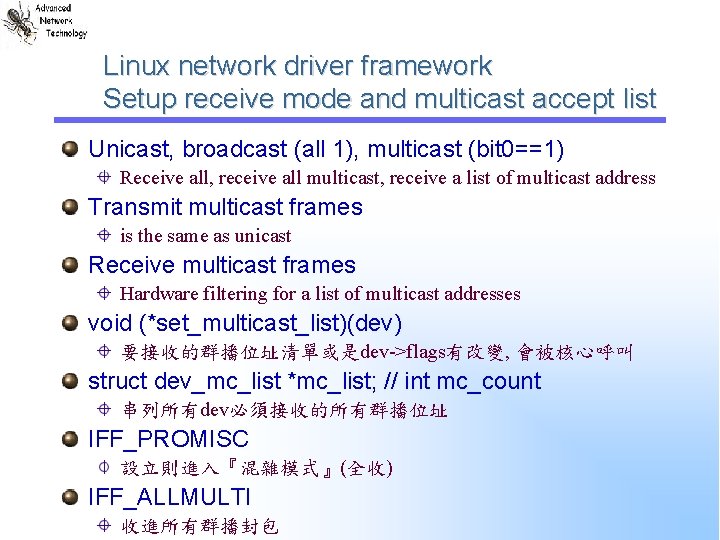
Linux network driver framework Setup receive mode and multicast accept list Unicast, broadcast (all 1), multicast (bit 0==1) Receive all, receive all multicast, receive a list of multicast address Transmit multicast frames is the same as unicast Receive multicast frames Hardware filtering for a list of multicast addresses void (*set_multicast_list)(dev) 要接收的群播位址清單或是dev->flags有改變, 會被核心呼叫 struct dev_mc_list *mc_list; // int mc_count 串列所有dev必須接收的所有群播位址 IFF_PROMISC 設立則進入『混雜模式』(全收) IFF_ALLMULTI 收進所有群播封包
Outline Driver framework Linux network drivers Device operation RTL 8139 programming Driver example A piece of code for 93 C 46 series EEPROM, 93 C 46 64 x 16 bits, 93 C 66 256 x 16 bits pci_skeleton. c (for RTL 8139)
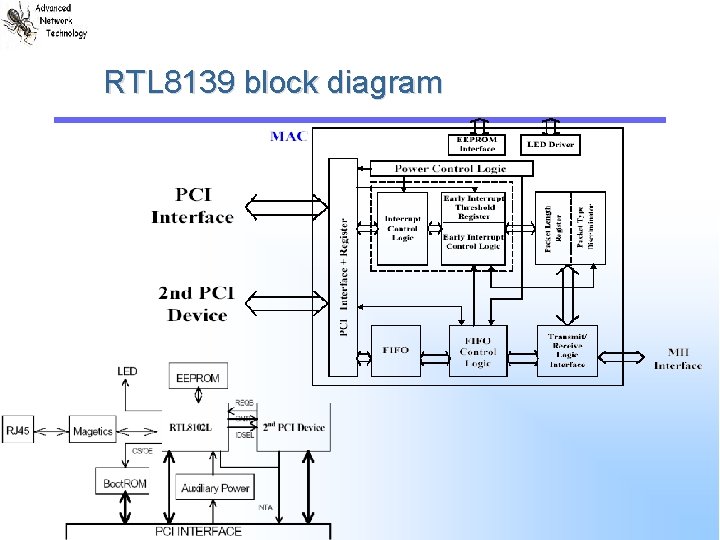
RTL 8139 block diagram
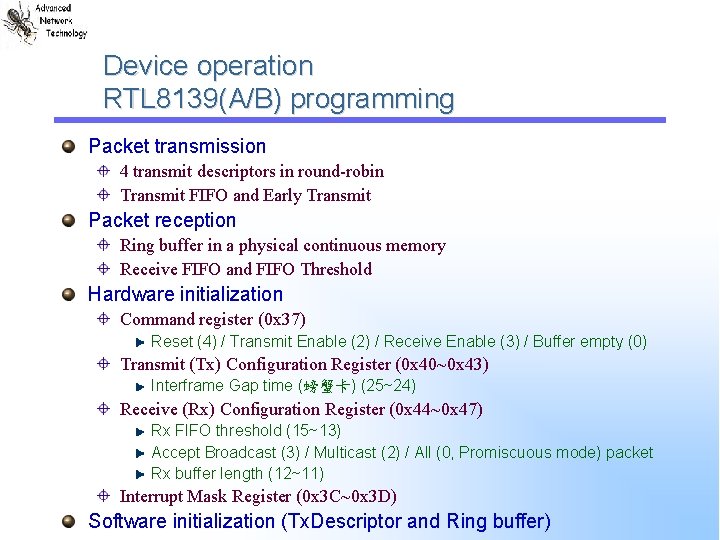
Device operation RTL 8139(A/B) programming Packet transmission 4 transmit descriptors in round-robin Transmit FIFO and Early Transmit Packet reception Ring buffer in a physical continuous memory Receive FIFO and FIFO Threshold Hardware initialization Command register (0 x 37) Reset (4) / Transmit Enable (2) / Receive Enable (3) / Buffer empty (0) Transmit (Tx) Configuration Register (0 x 40~0 x 43) Interframe Gap time (螃蟹卡) (25~24) Receive (Rx) Configuration Register (0 x 44~0 x 47) Rx FIFO threshold (15~13) Accept Broadcast (3) / Multicast (2) / All (0, Promiscuous mode) packet Rx buffer length (12~11) Interrupt Mask Register (0 x 3 C~0 x 3 D) Software initialization (Tx. Descriptor and Ring buffer)
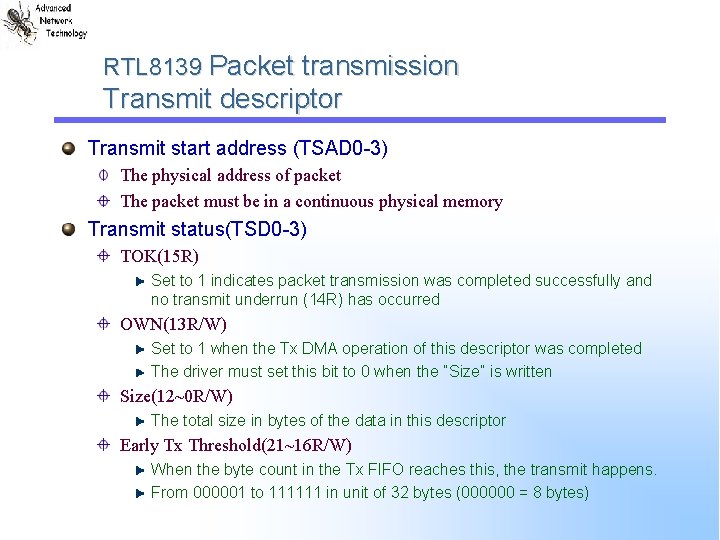
RTL 8139 Packet transmission Transmit descriptor Transmit start address (TSAD 0 -3) The physical address of packet The packet must be in a continuous physical memory Transmit status(TSD 0 -3) TOK(15 R) Set to 1 indicates packet transmission was completed successfully and no transmit underrun (14 R) has occurred OWN(13 R/W) Set to 1 when the Tx DMA operation of this descriptor was completed The driver must set this bit to 0 when the “Size” is written Size(12~0 R/W) The total size in bytes of the data in this descriptor Early Tx Threshold(21~16 R/W) When the byte count in the Tx FIFO reaches this, the transmit happens. From 000001 to 111111 in unit of 32 bytes (000000 = 8 bytes)
RTL 8139 Packet transmission Process of transmitting a packet 1. copy the packet to a physically continuous buffer in memory 2. Write the functioning descriptor Address, Size, Early transmit threshold, Clear OWN bit (this starts PCI operation) 3. 4. 5. 6. 7. As Tx. FIFO meet threshold, the chip start to move from FIFO to line When the whole packet is moved to FIFO, the OWN bit is set to 1 When the whole packet is moved to line, the TOK(TSD) is set to 1 If TOK(IMR) is set, then TOK(ISR) is set and a interrupt is triggered Interrupt service routine called, driver should clear TOK(ISR)
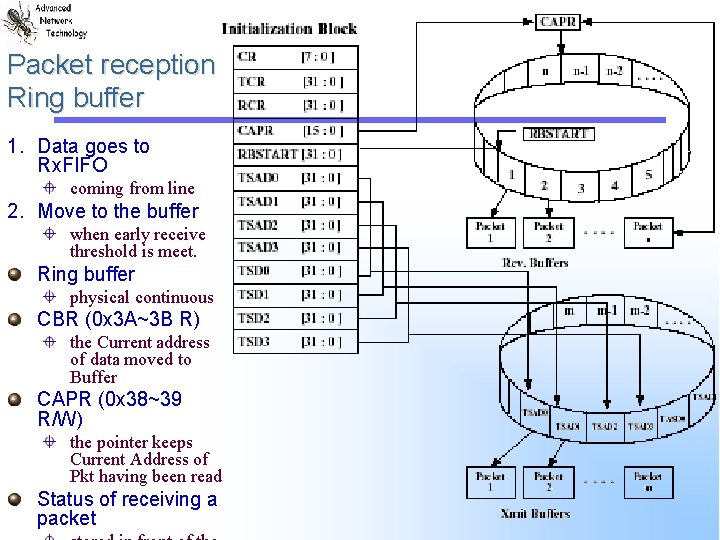
Packet reception Ring buffer 1. Data goes to Rx. FIFO coming from line 2. Move to the buffer when early receive threshold is meet. Ring buffer physical continuous CBR (0 x 3 A~3 B R) the Current address of data moved to Buffer CAPR (0 x 38~39 R/W) the pointer keeps Current Address of Pkt having been read Status of receiving a packet
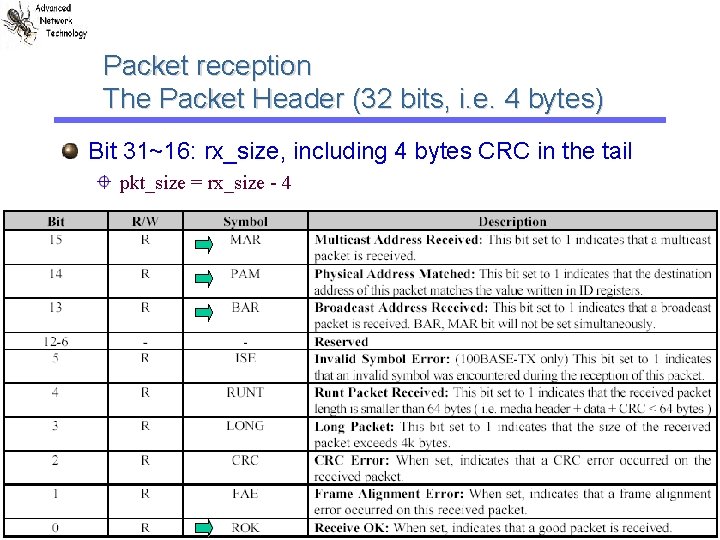
Packet reception The Packet Header (32 bits, i. e. 4 bytes) Bit 31~16: rx_size, including 4 bytes CRC in the tail pkt_size = rx_size - 4
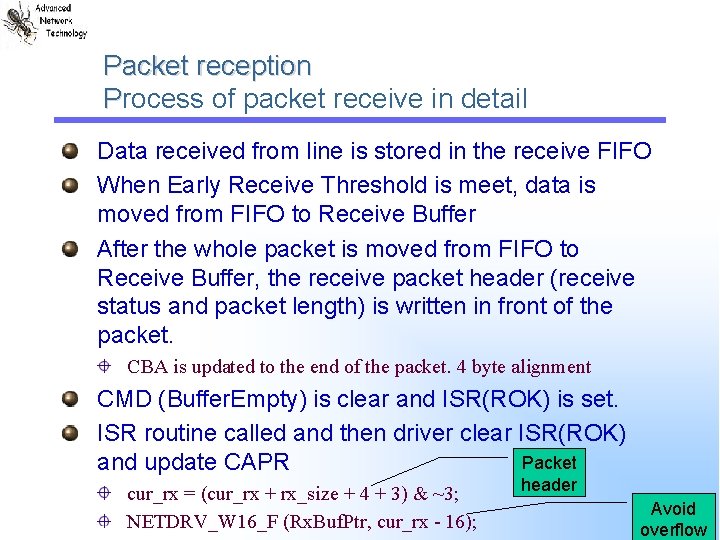
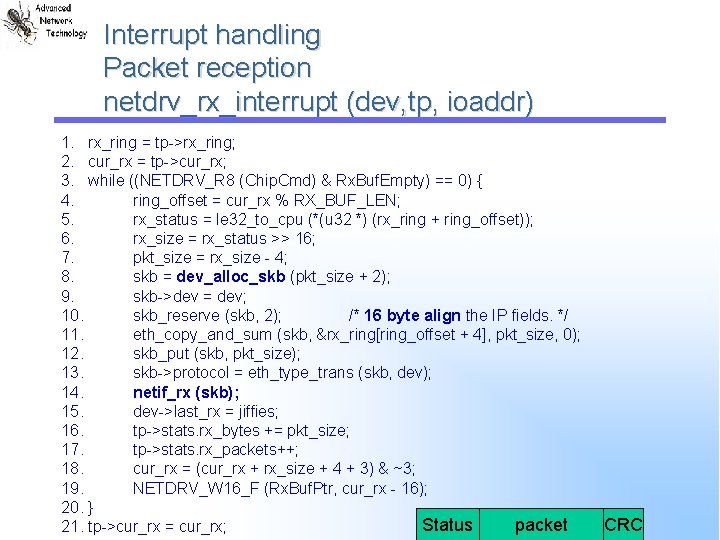
Packet reception Process of packet receive in detail Data received from line is stored in the receive FIFO When Early Receive Threshold is meet, data is moved from FIFO to Receive Buffer After the whole packet is moved from FIFO to Receive Buffer, the receive packet header (receive status and packet length) is written in front of the packet. CBA is updated to the end of the packet. 4 byte alignment CMD (Buffer. Empty) is clear and ISR(ROK) is set. ISR routine called and then driver clear ISR(ROK) Packet and update CAPR cur_rx = (cur_rx + rx_size + 4 + 3) & ~3; NETDRV_W 16_F (Rx. Buf. Ptr, cur_rx - 16); header Avoid overflow
Outline Driver framework Linux network drivers Device operation RTL 8139 programming Driver example A piece of code for 93 C 46 series EEPROM, 93 C 46 64 x 16 bits, 93 C 66 256 x 16 bits pci_skeleton. c (for RTL 8139)
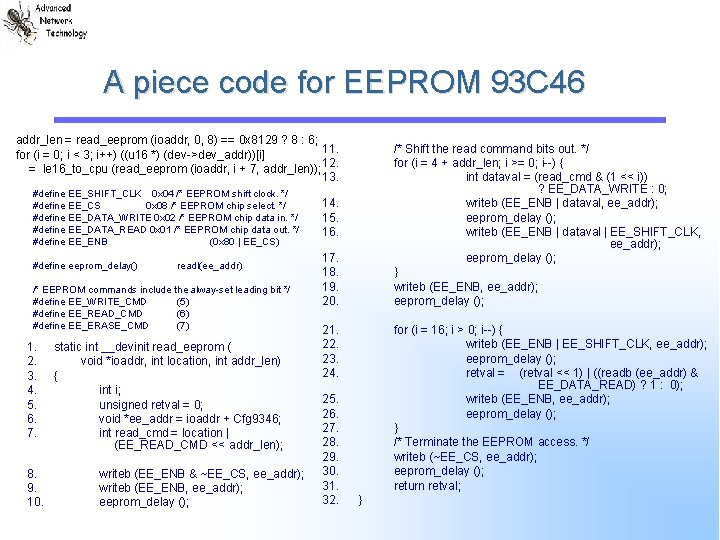
EEPROM 93 C 46 operations 93 C 46 Command Register (0 x 50 R/W)
A piece code for EEPROM 93 C 46 addr_len = read_eeprom (ioaddr, 0, 8) == 0 x 8129 ? 8 : 6; 11. for (i = 0; i < 3; i++) ((u 16 *) (dev->dev_addr))[i] = le 16_to_cpu (read_eeprom (ioaddr, i + 7, addr_len)); 12. 13. #define EE_SHIFT_CLK 0 x 04 /* EEPROM shift clock. */ #define EE_CS 0 x 08 /* EEPROM chip select. */ #define EE_DATA_WRITE 0 x 02 /* EEPROM chip data in. */ #define EE_DATA_READ 0 x 01 /* EEPROM chip data out. */ #define EE_ENB (0 x 80 | EE_CS) #define eeprom_delay() readl(ee_addr) /* EEPROM commands include the alway-set leading bit */ #define EE_WRITE_CMD (5) #define EE_READ_CMD (6) #define EE_ERASE_CMD (7) 1. 2. 3. 4. 5. 6. 7. 8. 9. 10. static int __devinit read_eeprom ( void *ioaddr, int location, int addr_len) { int i; unsigned retval = 0; void *ee_addr = ioaddr + Cfg 9346; int read_cmd = location | (EE_READ_CMD << addr_len); writeb (EE_ENB & ~EE_CS, ee_addr); writeb (EE_ENB, ee_addr); eeprom_delay (); /* Shift the read command bits out. */ for (i = 4 + addr_len; i >= 0; i--) { int dataval = (read_cmd & (1 << i)) ? EE_DATA_WRITE : 0; writeb (EE_ENB | dataval, ee_addr); eeprom_delay (); writeb (EE_ENB | dataval | EE_SHIFT_CLK, ee_addr); eeprom_delay (); } writeb (EE_ENB, ee_addr); eeprom_delay (); 14. 15. 16. 17. 18. 19. 20. 21. 22. 23. 24. 25. 26. 27. 28. 29. 30. 31. 32. for (i = 16; i > 0; i--) { writeb (EE_ENB | EE_SHIFT_CLK, ee_addr); eeprom_delay (); retval = (retval << 1) | ((readb (ee_addr) & EE_DATA_READ) ? 1 : 0); writeb (EE_ENB, ee_addr); eeprom_delay (); } /* Terminate the EEPROM access. */ writeb (~EE_CS, ee_addr); eeprom_delay (); return retval; }
Outline Driver framework Linux network drivers Device operation RTL 8139 programming Driver example A piece of code for 93 C 46 series EEPROM, 93 C 46 64 x 16 bits, 93 C 66 256 x 16 bits pci_skeleton. c (for RTL 8139)
#include<> of the RTL 8139 module_init() Definitions of I/O port read/write and ioremap() spinlock. h config. h MOD_* MODULE_*( ) Operating System module. h init. h module_exit( ) kernel. h barrier() printk() byteorder. h delay. h PCI BUS udelay() definition asm/io. h pci-skeleton. c crc 32. h pci. h skbuff. h PCI defines and prototypes Network Device pci_alloc_consistent() pci_resource_*() pci_request_regions() mii. h etherdevice. h netdevice. h pci_set_master() pci_read_config_word()(err ) Definitions for Ethernet Definitions for MII_ADVERTISE, MII_LPA eth_type_trans() ADVERTISE_FULL, LPA_100 FULL… alloc_ethdev() 給multicast算 ether_crc() 被間接引入 sched. h (irq, jiffies, capable) slab. h time. h spinlock. h asm/atomic. h Definitions for struct net_device register_netdev() netif_*() skbuff. h
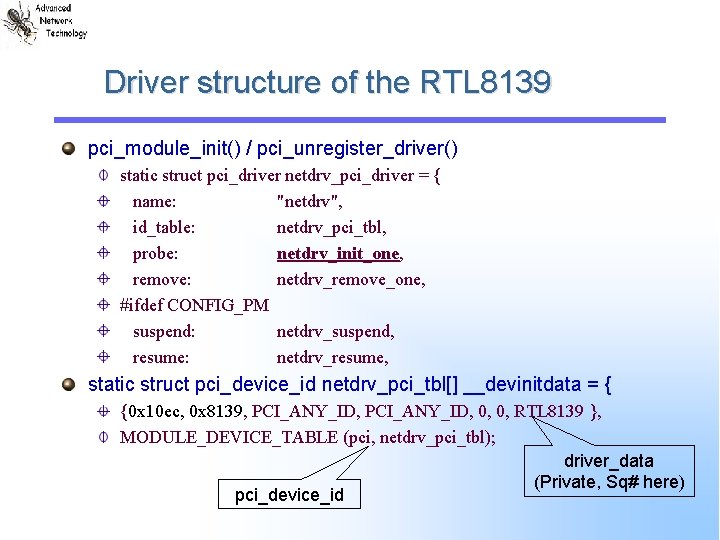
Driver structure of the RTL 8139 pci_module_init() / pci_unregister_driver() static struct pci_driver netdrv_pci_driver = { name: "netdrv", id_table: netdrv_pci_tbl, probe: netdrv_init_one, remove: netdrv_remove_one, #ifdef CONFIG_PM suspend: netdrv_suspend, resume: netdrv_resume, static struct pci_device_id netdrv_pci_tbl[] __devinitdata = { {0 x 10 ec, 0 x 8139, PCI_ANY_ID, 0, 0, RTL 8139 }, MODULE_DEVICE_TABLE (pci, netdrv_pci_tbl); driver_data (Private, Sq# here) pci_device_id
PCI device probe function netdrv_init_one() Linux invoke when probing netdrv_init_one() struct pci_dev *pdev, struct pci_device_id *ent call netdrv_init_board() to get net_device dev, void *ioaddr dev = alloc_etherdev(sizeof()) Initial net_device dev Set up dev_addr[], irq, base_addr Set up method: dev->open, dev->hard_start_transmit, dev->stop, dev->get_stats, dev->set_multicast_list, dev->do_ioctl, dev->tx_timeout 登記I/O port and memory pci_enable_device (pdev); pci_request_regions (pdev, “pci-sk"); pci_set_master (pdev); mmio_start = pci_resource_start (pdev, 1); ioaddr = ioremap (mmio_start, len); Soft reset the chip. NETDRV_W 8 (Chip. Cmd, (NETDRV_R 8 (Chip. Cmd) & Chip. Cmd. Clear) | Cmd. Reset); identify chip attached to board register_netdev (dev); // eth. X
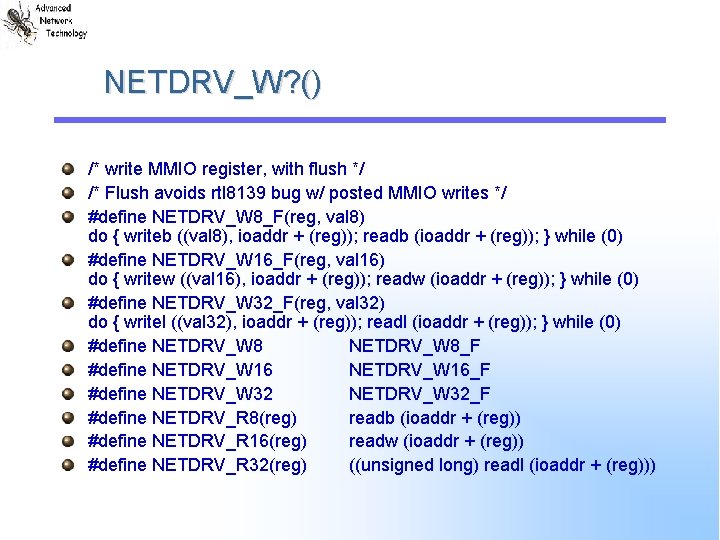
NETDRV_W? () /* write MMIO register, with flush */ /* Flush avoids rtl 8139 bug w/ posted MMIO writes */ #define NETDRV_W 8_F(reg, val 8) do { writeb ((val 8), ioaddr + (reg)); readb (ioaddr + (reg)); } while (0) #define NETDRV_W 16_F(reg, val 16) do { writew ((val 16), ioaddr + (reg)); readw (ioaddr + (reg)); } while (0) #define NETDRV_W 32_F(reg, val 32) do { writel ((val 32), ioaddr + (reg)); readl (ioaddr + (reg)); } while (0) #define NETDRV_W 8_F #define NETDRV_W 16_F #define NETDRV_W 32_F #define NETDRV_R 8(reg) readb (ioaddr + (reg)) #define NETDRV_R 16(reg) readw (ioaddr + (reg)) #define NETDRV_R 32(reg) ((unsigned long) readl (ioaddr + (reg)))
Device methods dev->open int netdrv_open (struct net_device *dev); dev->hard_start_transmit int netdrv_start_xmit (struct sk_buff *skb, struct net_device *dev); dev->stop int netdrv_close (…); dev->get_stats struct net_device_stats * netdrv_get_stats (struct net_device *); dev->set_multicast_list void netdrv_set_rx_mode (…); dev->do_ioctl int netdrv_ioctl (struct net_device *dev, struct ifreq *rq, int cmd); dev->tx_timeout void netdrv_tx_timeout (struct net_device *dev);
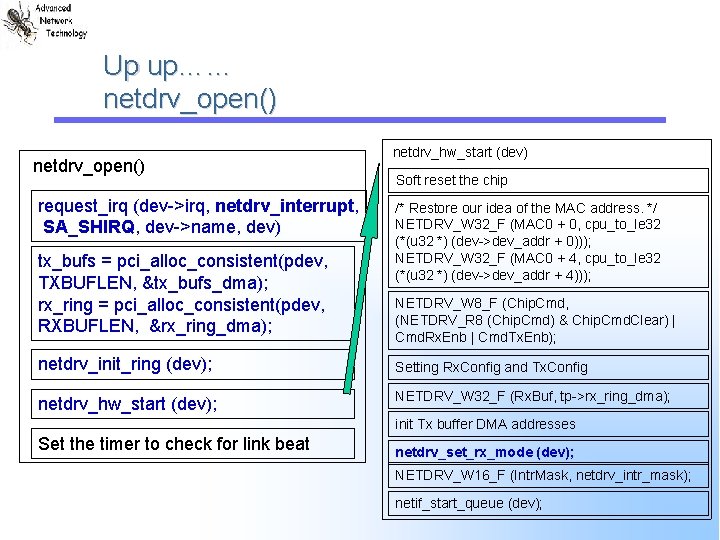
Up up…… netdrv_open() request_irq (dev->irq, netdrv_interrupt, SA_SHIRQ, dev->name, dev) tx_bufs = pci_alloc_consistent(pdev, TXBUFLEN, &tx_bufs_dma); rx_ring = pci_alloc_consistent(pdev, RXBUFLEN, &rx_ring_dma); netdrv_hw_start (dev) Soft reset the chip /* Restore our idea of the MAC address. */ NETDRV_W 32_F (MAC 0 + 0, cpu_to_le 32 (*(u 32 *) (dev->dev_addr + 0))); NETDRV_W 32_F (MAC 0 + 4, cpu_to_le 32 (*(u 32 *) (dev->dev_addr + 4))); NETDRV_W 8_F (Chip. Cmd, (NETDRV_R 8 (Chip. Cmd) & Chip. Cmd. Clear) | Cmd. Rx. Enb | Cmd. Tx. Enb); netdrv_init_ring (dev); Setting Rx. Config and Tx. Config netdrv_hw_start (dev); NETDRV_W 32_F (Rx. Buf, tp->rx_ring_dma); init Tx buffer DMA addresses Set the timer to check for link beat netdrv_set_rx_mode (dev); NETDRV_W 16_F (Intr. Mask, netdrv_intr_mask); netif_start_queue (dev);
Setup receive mode and multicast hashtable (*set_multicast_list)() netdrv_set_rx_mode() if (flags & IFF_PROMISC) Accept. Broadcast | Accept. Multicast | Accept. My. Phys | Accept. All. Phy mc_filter[1] = mc_filter[0] = 0 xffff else if ((mc_count > multicast_filter_limit) || (flags & IFF_ALLMULTI)) Accept. Broadcast | Accept. Multicast | Accept. My. Phys mc_filter[1] = mc_filter[0] = 0 xffff else Accept. Broadcast | Accept. Multicast | Accept. My. Phys mclist[0]. dmi_addr mclist[1]. dmi_addr ether_crc() 31 30 29 28 27 26 25. . . 0 mclist[2]. dmi_addr 63 62 1 0
Transmit a packet netdrv_start_xmit() if (skb->len < ETH_ZLEN) skb = skb_padto(skb, ETH_ZLEN); entry = atomic_read (&cur_tx) % NUM_TX_DESC; tx_info[entry]. skb = skb; memcpy (tx_buf[entry], skb->data, skb->len); NETDRV_W 32 (Tx. Status[entry], tx_flag | skb->len); dev->trans_start = jiffies; atomic_inc (&cur_tx); if ((atomic_read (&cur_tx) - atomic_read (&dirty_tx)) >= NUM_TX_DESC) netif_stop_queue (dev); 0 1 2 dirty_tx 3 0 1 2 cur_tx
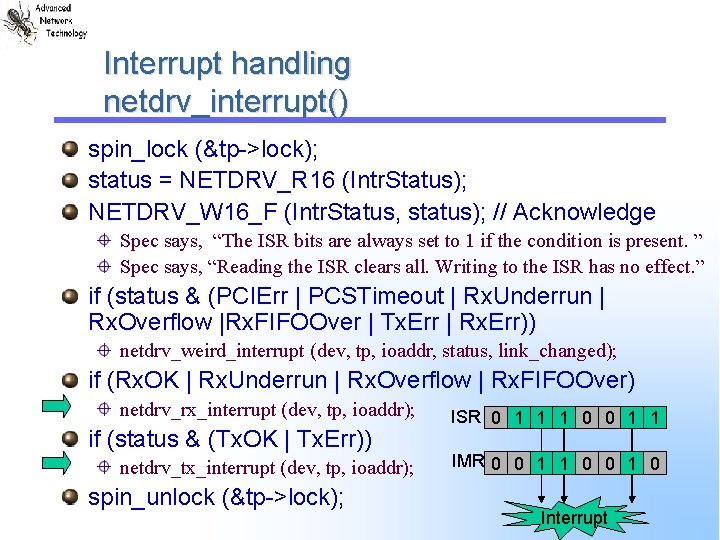
Interrupt handling netdrv_interrupt() spin_lock (&tp->lock); status = NETDRV_R 16 (Intr. Status); NETDRV_W 16_F (Intr. Status, status); // Acknowledge Spec says, “The ISR bits are always set to 1 if the condition is present. ” Spec says, “Reading the ISR clears all. Writing to the ISR has no effect. ” if (status & (PCIErr | PCSTimeout | Rx. Underrun | Rx. Overflow |Rx. FIFOOver | Tx. Err | Rx. Err)) netdrv_weird_interrupt (dev, tp, ioaddr, status, link_changed); if (Rx. OK | Rx. Underrun | Rx. Overflow | Rx. FIFOOver) netdrv_rx_interrupt (dev, tp, ioaddr); if (status & (Tx. OK | Tx. Err)) netdrv_tx_interrupt (dev, tp, ioaddr); spin_unlock (&tp->lock); ISR 0 1 1 1 0 0 1 1 IMR 0 0 1 1 0 0 1 0 Interrupt
Interrupt handling netdrv_tx_interrupt(dev, tp, ioaddr) 1. 2. 3. 4. 5. 6. 7. 8. 9. 10. 11. 12. 13. 14. 15. 16. 17. 18. 19. 20. 21. 22. 23. 24. dirty_tx = atomic_read (&tp->dirty_tx); cur_tx = atomic_read (&tp->cur_tx); tx_left = cur_tx - dirty_tx; while (tx_left > 0) { int entry = dirty_tx % NUM_TX_DESC; int txstatus = NETDRV_R 32 (Tx. Status[entry]); if (!(txstatus & (Tx. Stat. OK | Tx. Underrun | Tx. Aborted))) break; /* It still hasn't been Txed */ if (txstatus & (Tx. Out. Of. Window | Tx. Aborted)) { /* There was an major error, log it. */ tp->stats. tx_errors++; } else { if (txstatus & Tx. Underrun) /* Add 64 to the Tx FIFO threshold. */ tp->tx_flag += 0 x 00020000; tp->stats. tx_bytes += txstatus & 0 x 7 ff; tp->stats. tx_packets++; } dev_kfree_skb_irq (tp->tx_info[entry]. skb); tp->tx_info[entry]. skb = NULL; dirty_tx++; if (netif_queue_stopped (dev)) netif_wake_queue (dev); cur_tx = atomic_read (&tp->cur_tx); tx_left = cur_tx - dirty_tx; } atomic_set (&tp->dirty_tx, dirty_tx);
Interrupt handling Packet reception netdrv_rx_interrupt (dev, tp, ioaddr) 1. rx_ring = tp->rx_ring; 2. cur_rx = tp->cur_rx; 3. while ((NETDRV_R 8 (Chip. Cmd) & Rx. Buf. Empty) == 0) { 4. ring_offset = cur_rx % RX_BUF_LEN; 5. rx_status = le 32_to_cpu (*(u 32 *) (rx_ring + ring_offset)); 6. rx_size = rx_status >> 16; 7. pkt_size = rx_size - 4; 8. skb = dev_alloc_skb (pkt_size + 2); 9. skb->dev = dev; 10. skb_reserve (skb, 2); /* 16 byte align the IP fields. */ 11. eth_copy_and_sum (skb, &rx_ring[ring_offset + 4], pkt_size, 0); 12. skb_put (skb, pkt_size); 13. skb->protocol = eth_type_trans (skb, dev); 14. netif_rx (skb); 15. dev->last_rx = jiffies; 16. tp->stats. rx_bytes += pkt_size; 17. tp->stats. rx_packets++; 18. cur_rx = (cur_rx + rx_size + 4 + 3) & ~3; 19. NETDRV_W 16_F (Rx. Buf. Ptr, cur_rx - 16); 20. } Status packet 21. tp->cur_rx = cur_rx; CRC
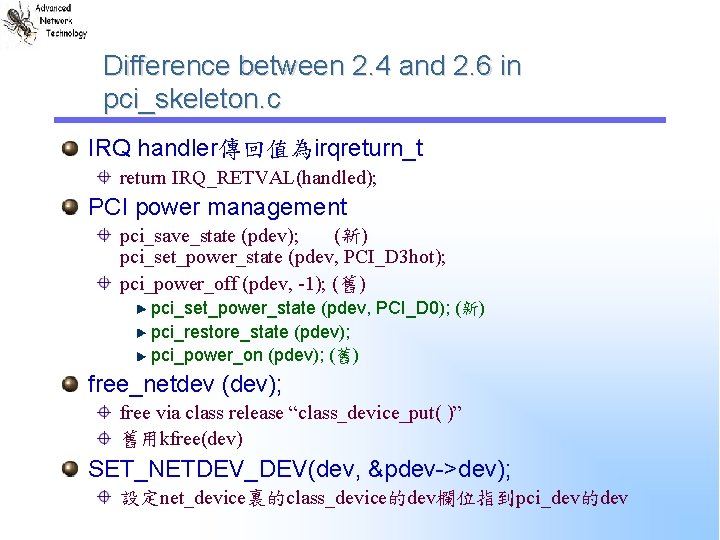
Difference between 2. 4 and 2. 6 in pci_skeleton. c IRQ handler傳回值為irqreturn_t return IRQ_RETVAL(handled); PCI power management pci_save_state (pdev); (新) pci_set_power_state (pdev, PCI_D 3 hot); pci_power_off (pdev, -1); (舊) pci_set_power_state (pdev, PCI_D 0); (新) pci_restore_state (pdev); pci_power_on (pdev); (舊) free_netdev (dev); free via class release “class_device_put( )” 舊用kfree(dev) SET_NETDEV_DEV(dev, &pdev->dev); 設定net_device裏的class_device的dev欄位指到pci_dev的dev
Backup slide
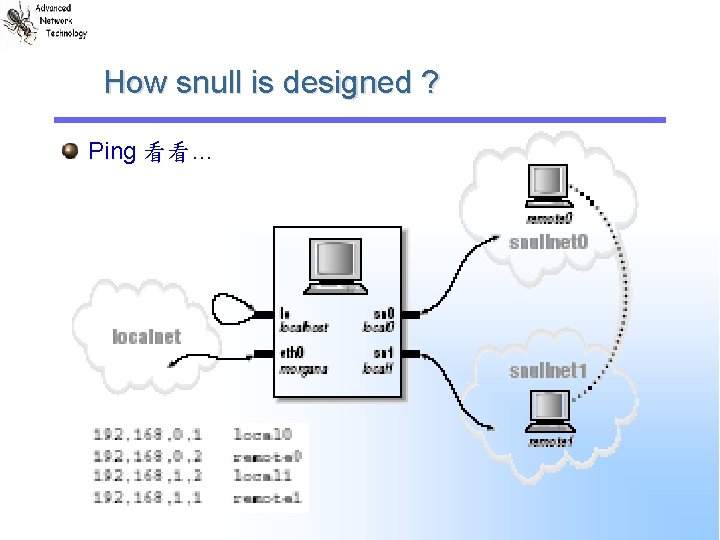
How snull is designed ? Ping 看看…
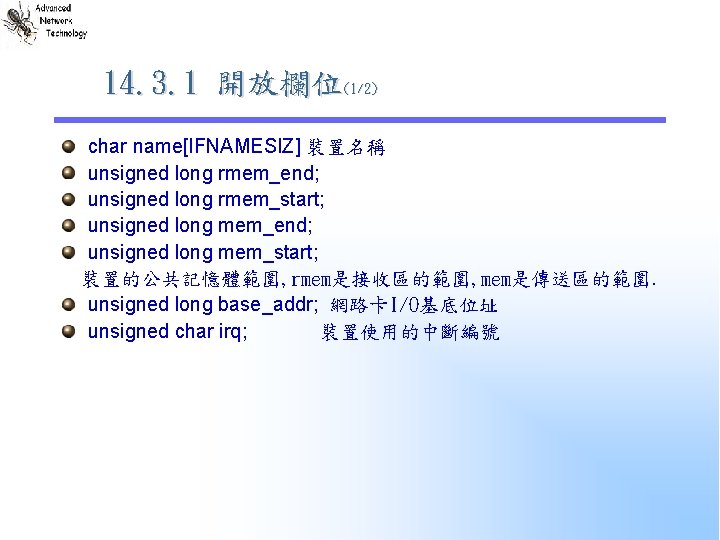
14. 3. 1 開放欄位(1/2) char name[IFNAMESIZ] 裝置名稱 unsigned long rmem_end; unsigned long rmem_start; unsigned long mem_end; unsigned long mem_start; 裝置的公共記憶體範圍, rmem是接收區的範圍, mem是傳送區的範圍. unsigned long base_addr; 網路卡I/O基底位址 unsigned char irq; 裝置使用的中斷編號
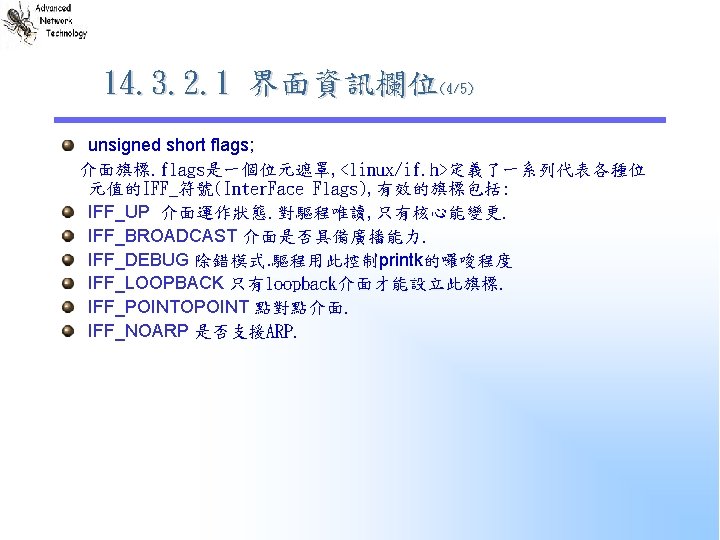
14. 3. 2. 1 界面資訊欄位(1/5) 設定網路介面的資訊性欄位 (driver/net_init. c) void ether_setup(struct net_device *dev); void fddi_setup(struct net_device *dev); void hippi_setup(struct net_device *dev); void ltalk_setup(struct net_device *dev); void tr_setup(struct net_device *dev); void fc_setup(struct net_device *dev); 這六類已經涵括所有能夠找到的網路技術, 若有更新奇的玩意兒, 就只好 老老實實自己填寫下面的欄位了.
14. 3. 2. 1 界面資訊欄位(2/5) unsigned short hard_header_len; 硬體標頭長度, 計算單位是octet. 對於Ethernet值為 14 unsigned mtu; 傳輸單位上限. 對於Ethernet值為 1500 octets unsigned long tx_queue_len; 傳輸佇列可容納的訊框長度上限. ether_setup()設為 100 unsigned short type; 介面硬體型態. 提供ARP判斷介面支援何種硬體位址
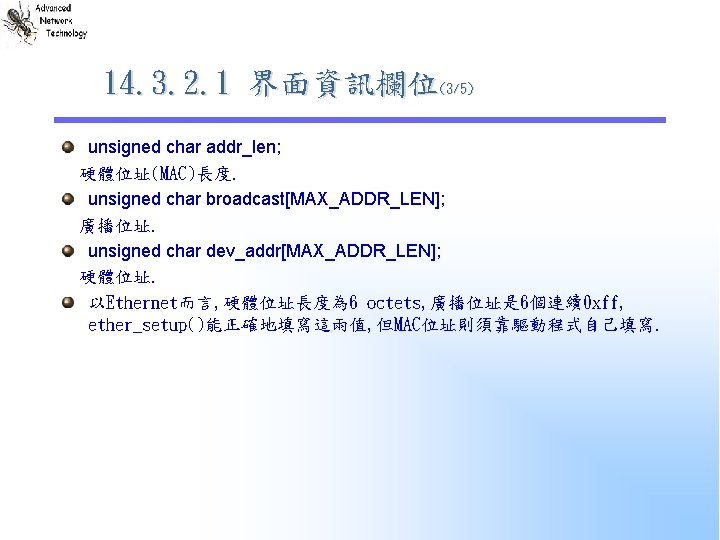
14. 3. 2. 1 界面資訊欄位(3/5) unsigned char addr_len; 硬體位址(MAC)長度. unsigned char broadcast[MAX_ADDR_LEN]; 廣播位址. unsigned char dev_addr[MAX_ADDR_LEN]; 硬體位址. 以Ethernet而言, 硬體位址長度為 6 octets, 廣播位址是 6個連續0 xff, ether_setup()能正確地填寫這兩值, 但MAC位址則須靠驅動程式自己填寫.
14. 3. 2. 2 網路介面的作業方法(1/4) 大致可分成基本與額外兩組, 你的驅程必須提供基本作業方法, 網路介面 才有用. 額外作業方法是屬於比較高階的功能, 並不嚴格要求一定要具備. 以下為基本作業方法: int (*open)(struct net_device *dev); 開啟介面 int (*stop)(struct net_device *dev); 停用介面 int (*hard_start_xmit) (struct sk_buff *skb, struct net_device *dev); 要 求硬體開始送出一個封包 int (*hard_header) (struct sk_buff *skb, struct net_device *dev, unsigned short type, void *daddr, void *saddr, unsigned len); 負責建構 硬體標頭
14. 3. 2. 2 網路介面的作業方法(2/4) int (*rebuild_header)(struct sk_buff *skb); 負責在傳輸封包之前重建硬體標頭. 2. 4改用hard_header void (*tx_timeout)(struct net_device *dev); 若無法在一段合理時間內完成封包傳輸, 則會呼叫此作業方法. struct net_device_stats *(*get_stats)(struct net_device *dev); 每當應用程式需介面統計資訊時, 就會觸動此作業方法. int (*set_config)(struct net_device *dev, struct ifmap *map); 更改介面的硬體組態.
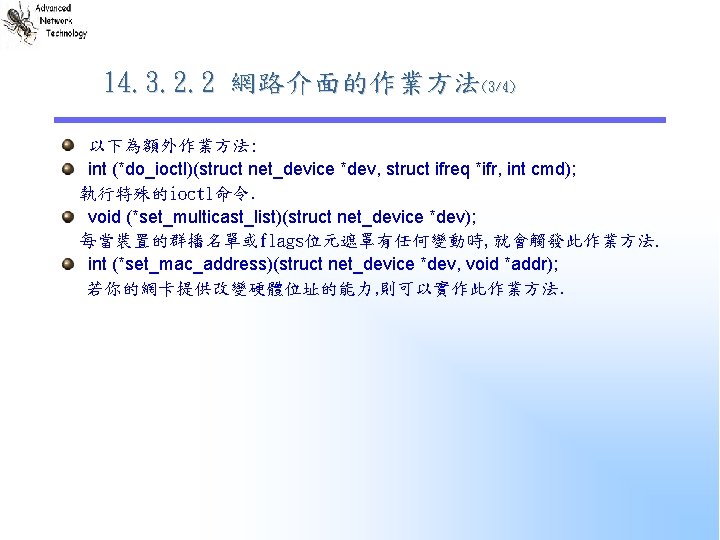
14. 3. 2. 2 網路介面的作業方法(3/4) 以下為額外作業方法: int (*do_ioctl)(struct net_device *dev, struct ifreq *ifr, int cmd); 執行特殊的ioctl命令. void (*set_multicast_list)(struct net_device *dev); 每當裝置的群播名單或flags位元遮罩有任何變動時, 就會觸發此作業方法. int (*set_mac_address)(struct net_device *dev, void *addr); 若你的網卡提供改變硬體位址的能力, 則可以實作此作業方法.
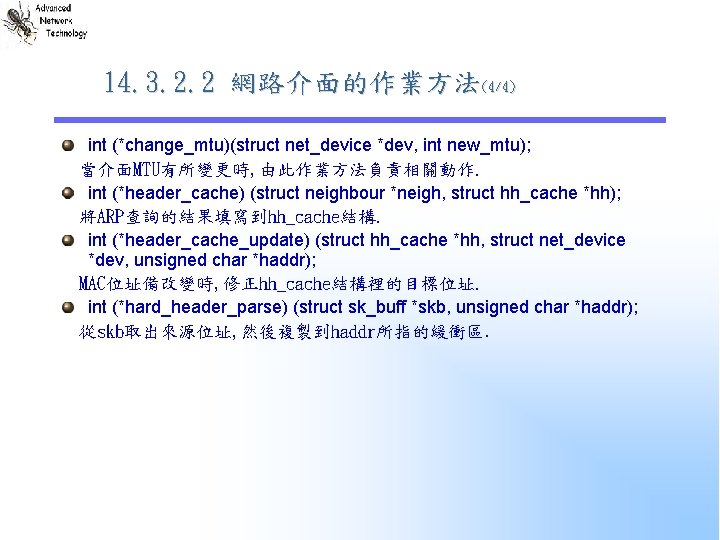
14. 3. 2. 2 網路介面的作業方法(4/4) int (*change_mtu)(struct net_device *dev, int new_mtu); 當介面MTU有所變更時, 由此作業方法負責相關動作. int (*header_cache) (struct neighbour *neigh, struct hh_cache *hh); 將ARP查詢的結果填寫到hh_cache結構. int (*header_cache_update) (struct hh_cache *hh, struct net_device *dev, unsigned char *haddr); MAC位址備改變時, 修正hh_cache結構裡的目標位址. int (*hard_header_parse) (struct sk_buff *skb, unsigned char *haddr); 從skb取出來源位址, 然後複製到haddr所指的緩衝區.
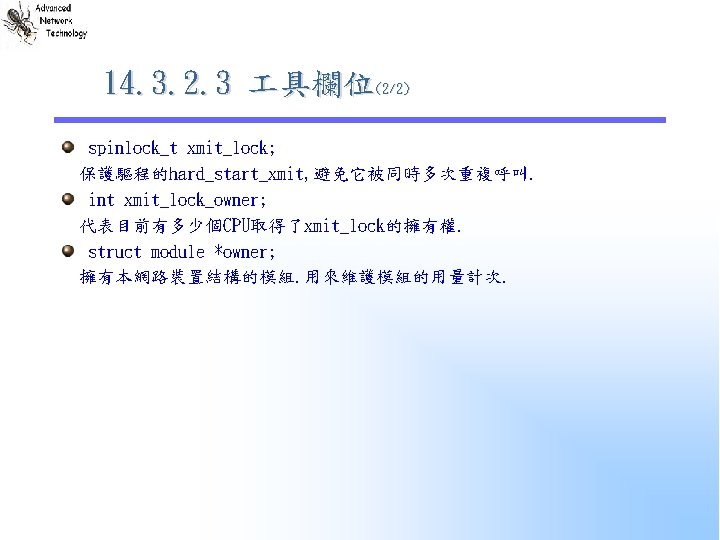
14. 3. 2. 3 具欄位(1/2) unsigned long trans_start; 開始傳輸的系統時刻. unsigned long last_rx; 最近一次收到完整封包的系統時刻. int watchdog_timeo; 網路子系統斷定傳輸逾期的最短時間間隔. void *priv; 地位相當於filp->private_data. struct dev_mc_list *mc_list; int mc_count; 這兩個欄位用來處理群播傳輸. mc_count是mc_list的節點個數.
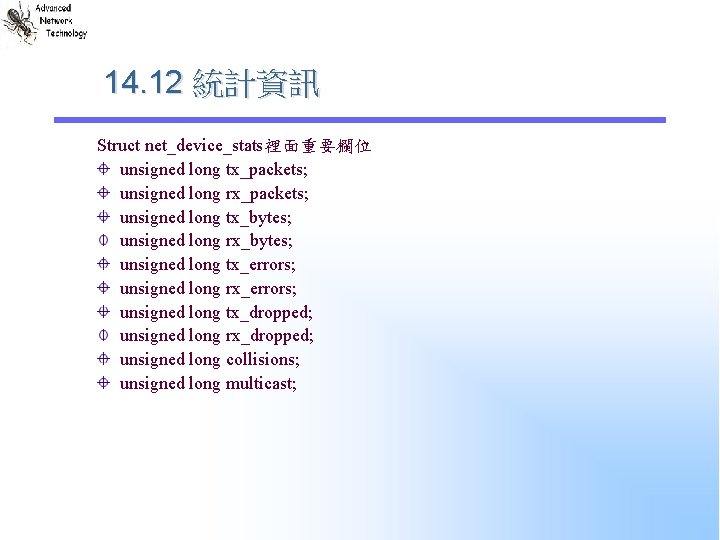
14. 12 統計資訊 Struct net_device_stats裡面重要欄位 unsigned long tx_packets; unsigned long rx_packets; unsigned long tx_bytes; unsigned long rx_bytes; unsigned long tx_errors; unsigned long rx_errors; unsigned long tx_dropped; unsigned long rx_dropped; unsigned long collisions; unsigned long multicast;
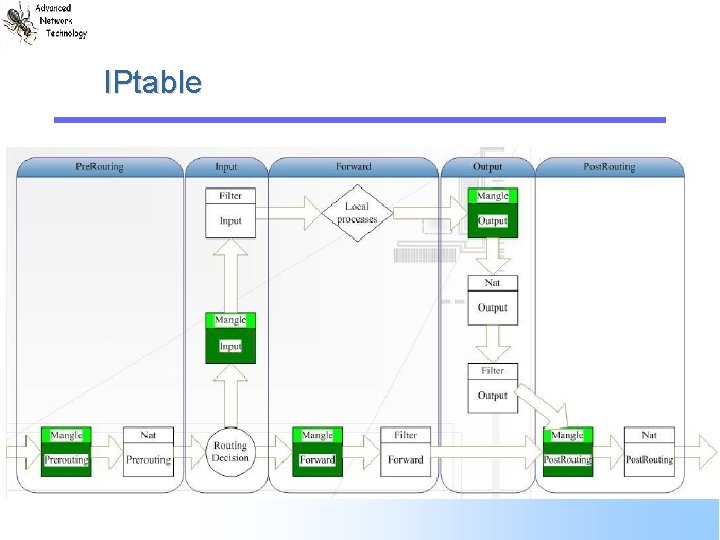
IPtable