
Network Data Plane Part 3 Miscellaneous topics related
- Slides: 47
Network Data Plane Part 3 Miscellaneous topics related to network layer (IP) data plane (and VLAN) • Link/Path MTU and IPv 4 Fragmentation and Reassembly • NAT (network address translation) • IPv 6 and IPv 6 Transition • Virtual Circuit and MPLS • VLAN Readings: Textbook: Chapter 4, Sections 4. 3. 1 -4. 3. 2, 4. 3. 4 -4. 3. 5; Chapter 5: Section 5. 6; Chapter 6: Sections 6. 4. 4 & Section 6. 5; Section 6. 7 CSci 4211: Network Data Plane Part 3 1
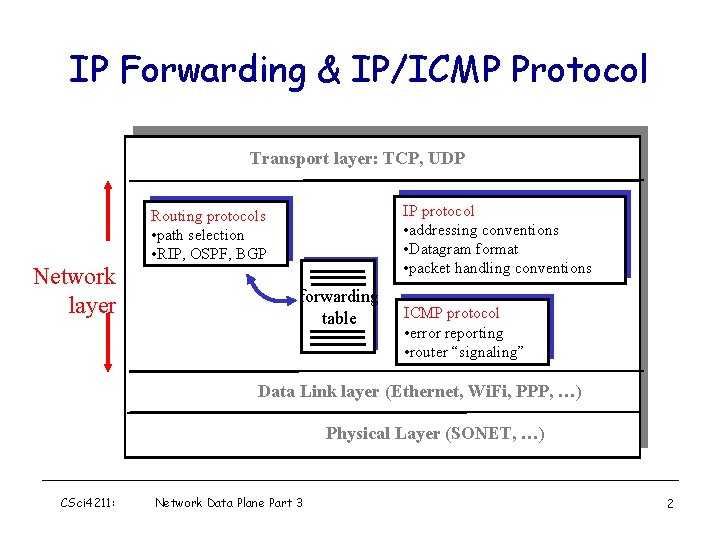
IP Forwarding & IP/ICMP Protocol Transport layer: TCP, UDP Network layer IP protocol • addressing conventions • Datagram format • packet handling conventions Routing protocols • path selection • RIP, OSPF, BGP forwarding table ICMP protocol • error reporting • router “signaling” Data Link layer (Ethernet, Wi. Fi, PPP, …) Physical Layer (SONET, …) CSci 4211: Network Data Plane Part 3 2
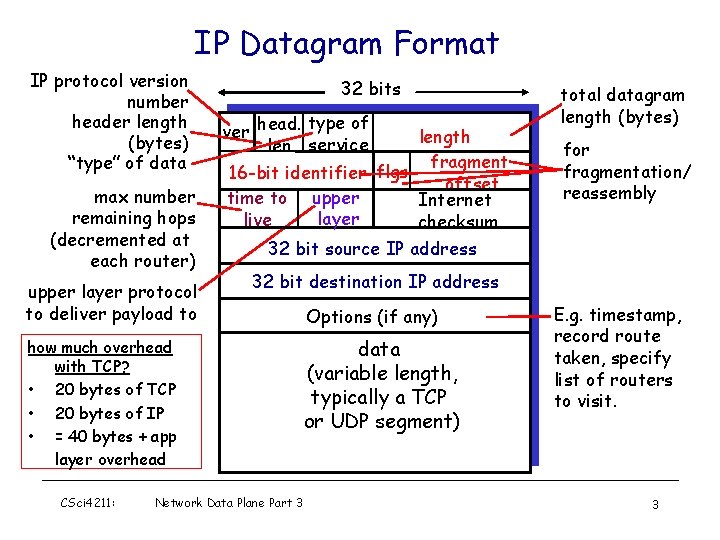
IP Datagram Format IP protocol version number header length (bytes) “type” of data max number remaining hops (decremented at each router) upper layer protocol to deliver payload to 32 bits ver head. type of len service length fragment 16 -bit identifier flgs offset upper time to Internet layer live checksum for fragmentation/ reassembly 32 bit source IP address 32 bit destination IP address how much overhead with TCP? • 20 bytes of TCP • 20 bytes of IP • = 40 bytes + app layer overhead CSci 4211: total datagram length (bytes) Network Data Plane Part 3 Options (if any) data (variable length, typically a TCP or UDP segment) E. g. timestamp, record route taken, specify list of routers to visit. 3
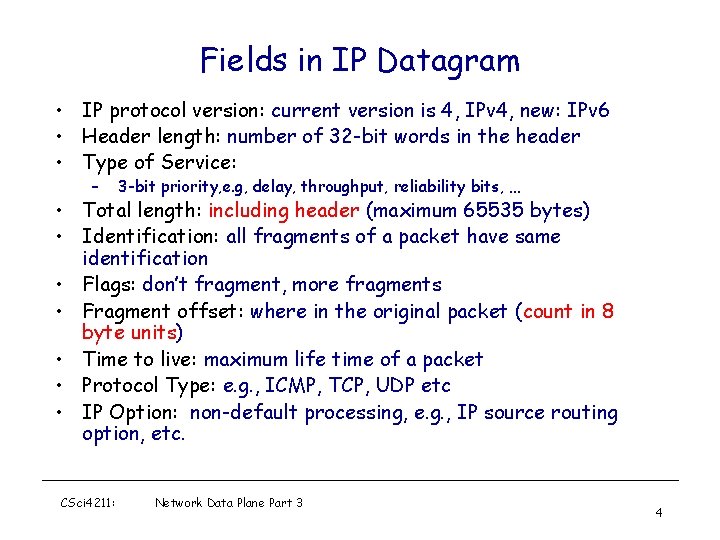
Fields in IP Datagram • IP protocol version: current version is 4, IPv 4, new: IPv 6 • Header length: number of 32 -bit words in the header • Type of Service: – 3 -bit priority, e. g, delay, throughput, reliability bits, … • Total length: including header (maximum 65535 bytes) • Identification: all fragments of a packet have same identification • Flags: don’t fragment, more fragments • Fragment offset: where in the original packet (count in 8 byte units) • Time to live: maximum life time of a packet • Protocol Type: e. g. , ICMP, TCP, UDP etc • IP Option: non-default processing, e. g. , IP source routing option, etc. CSci 4211: Network Data Plane Part 3 4
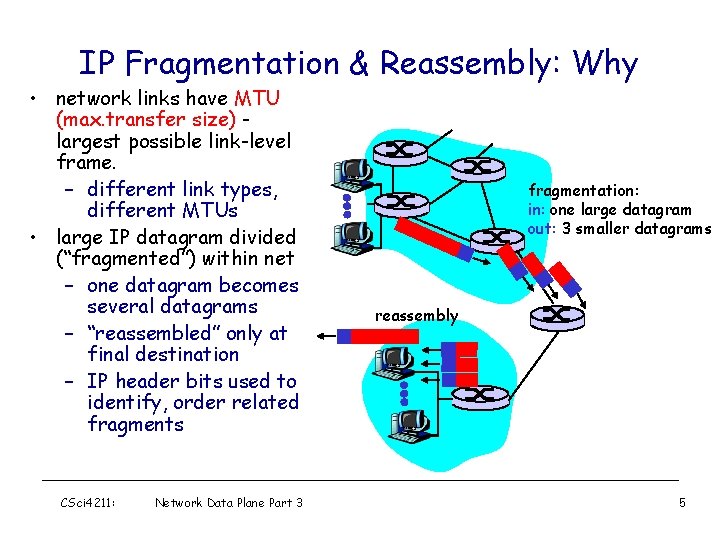
IP Fragmentation & Reassembly: Why • network links have MTU (max. transfer size) largest possible link-level frame. – different link types, different MTUs • large IP datagram divided (“fragmented”) within net – one datagram becomes several datagrams – “reassembled” only at final destination – IP header bits used to identify, order related fragments CSci 4211: Network Data Plane Part 3 fragmentation: in: one large datagram out: 3 smaller datagrams reassembly 5
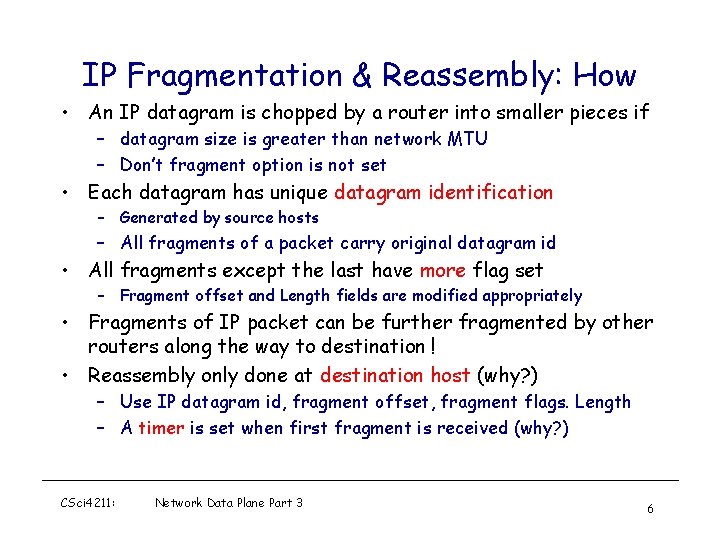
IP Fragmentation & Reassembly: How • An IP datagram is chopped by a router into smaller pieces if – datagram size is greater than network MTU – Don’t fragment option is not set • Each datagram has unique datagram identification – Generated by source hosts – All fragments of a packet carry original datagram id • All fragments except the last have more flag set – Fragment offset and Length fields are modified appropriately • Fragments of IP packet can be further fragmented by other routers along the way to destination ! • Reassembly only done at destination host (why? ) – Use IP datagram id, fragment offset, fragment flags. Length – A timer is set when first fragment is received (why? ) CSci 4211: Network Data Plane Part 3 6
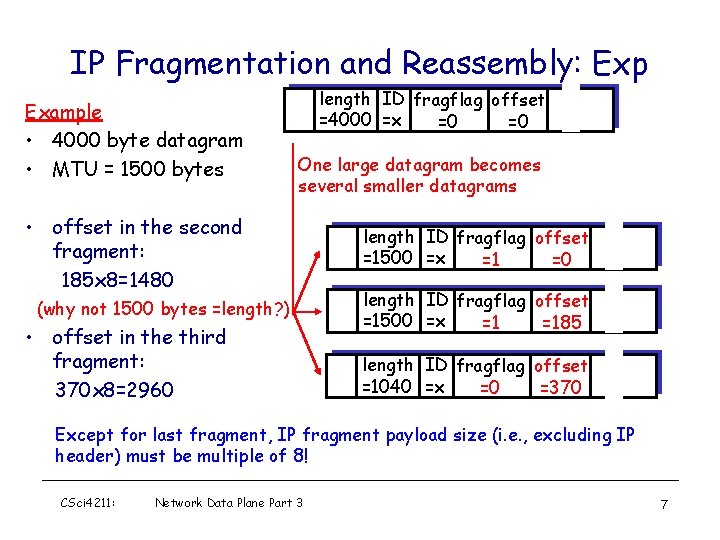
IP Fragmentation and Reassembly: Exp Example • 4000 byte datagram • MTU = 1500 bytes length ID fragflag offset =4000 =x =0 =0 One large datagram becomes several smaller datagrams • offset in the second fragment: 185 x 8=1480 (why not 1500 bytes =length? ) • offset in the third fragment: 370 x 8=2960 length ID fragflag offset =1500 =x =1 =185 length ID fragflag offset =1040 =x =0 =370 Except for last fragment, IP fragment payload size (i. e. , excluding IP header) must be multiple of 8! CSci 4211: Network Data Plane Part 3 7
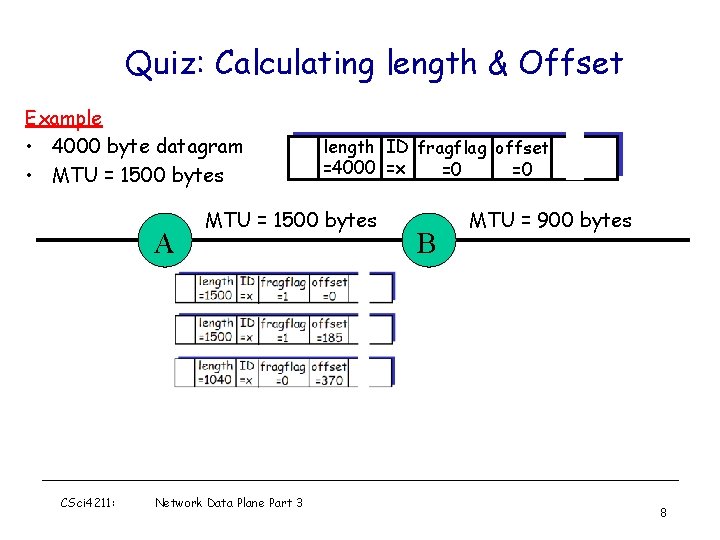
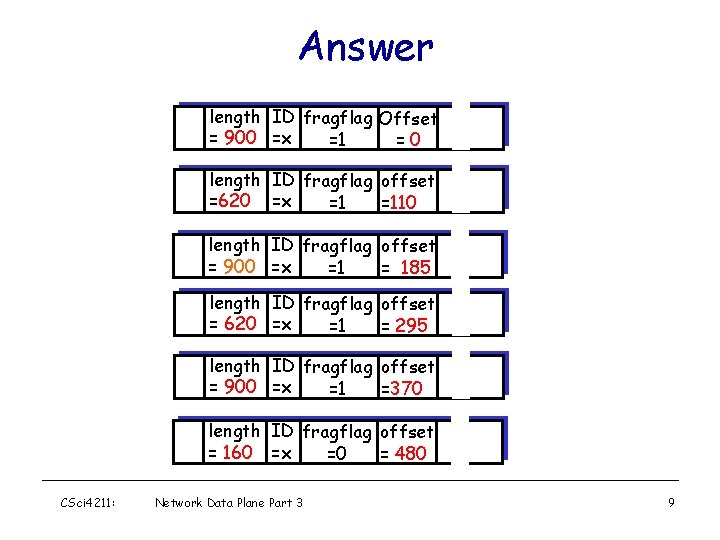
Quiz: Calculating length & Offset Example • 4000 byte datagram • MTU = 1500 bytes A CSci 4211: length ID fragflag offset =4000 =x =0 =0 MTU = 1500 bytes Network Data Plane Part 3 B MTU = 900 bytes 8
Answer length ID fragflag Offset = 900 =x =1 =0 length ID fragflag offset =620 =x =1 =110 length ID fragflag offset = 900 =x =1 = 185 length ID fragflag offset = 620 =x =1 = 295 length ID fragflag offset = 900 =x =1 =370 length ID fragflag offset = 160 =x =0 = 480 CSci 4211: Network Data Plane Part 3 9
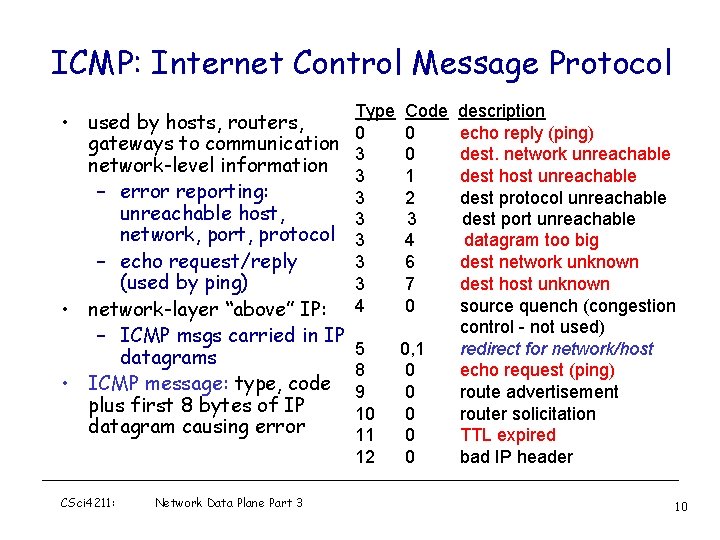
ICMP: Internet Control Message Protocol • used by hosts, routers, gateways to communication network-level information – error reporting: unreachable host, network, port, protocol – echo request/reply (used by ping) • network-layer “above” IP: – ICMP msgs carried in IP datagrams • ICMP message: type, code plus first 8 bytes of IP datagram causing error CSci 4211: Network Data Plane Part 3 Type 0 3 3 3 3 4 Code 0 0 1 2 3 4 6 7 0 5 8 9 10 11 12 0, 1 0 0 0 description echo reply (ping) dest. network unreachable dest host unreachable dest protocol unreachable dest port unreachable datagram too big dest network unknown dest host unknown source quench (congestion control - not used) redirect for network/host echo request (ping) route advertisement router solicitation TTL expired bad IP header 10
ICMP Message Transport & Usage • ICMP messages carried in IP datagrams • Treated like any other datagrams – But no error message sent if ICMP message causes error • Message sent to the source – 8 bytes of the original header included • ICMP Usage (non-error, informational): Examples – Testing reachability: ICMP echo request/reply • ping – Tracing route to a destination: Time-to-live field • traceroute – Path MTU discovery (see next slide for more details) • Don’t fragment bit – CSci 4211: IP redirect (for hosts only): inform hosts of better routes Network Data Plane Part 3 11
ICMP and Path MTU (RFC 1191) When a router is unable to forward a datagram, because it exceeds the MTU of the next-hop network and its “Don't Fragment” bit is set, the router is required to • return an ICMP “Destination Unreachable” message (type 3) to the source of the datagram, with code 4, indicating ”Fragmentation required and DF flag set". To support Path MTU Discovery, the router MUST • include the MTU of that next-hop network in the loworder 16 bits of the ICMP header field that is labelled "unused" in the ICMP specification. • The high-order 16 bits remain unused, and MUST be set to zero. CSci 4211: Network Data Plane Part 3 12
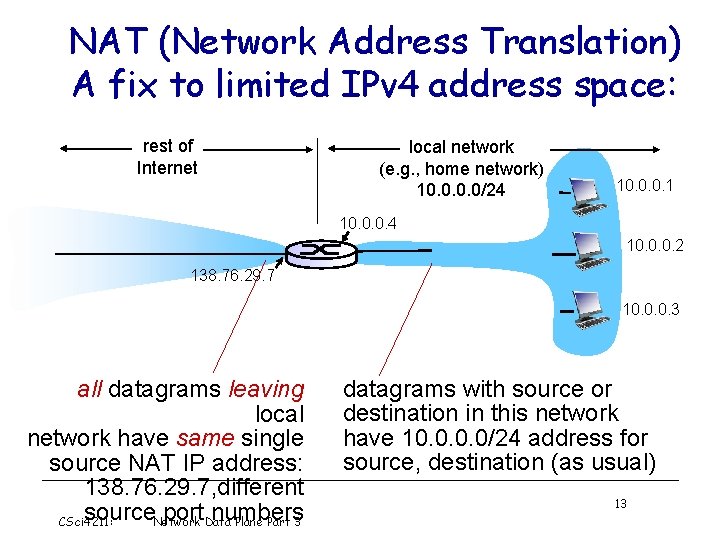
NAT (Network Address Translation) A fix to limited IPv 4 address space: rest of Internet local network (e. g. , home network) 10. 0/24 10. 0. 0. 1 10. 0. 0. 4 10. 0. 0. 2 138. 76. 29. 7 10. 0. 0. 3 all datagrams leaving local network have same single source NAT IP address: 138. 76. 29. 7, different source. Network port. Data numbers CSci 4211: Plane Part 3 datagrams with source or destination in this network have 10. 0/24 address for source, destination (as usual) 13
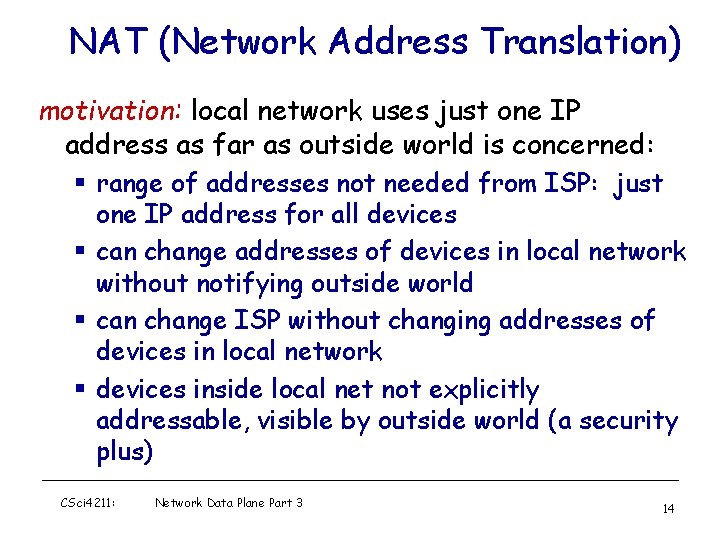
NAT (Network Address Translation) motivation: local network uses just one IP address as far as outside world is concerned: § range of addresses not needed from ISP: just one IP address for all devices § can change addresses of devices in local network without notifying outside world § can change ISP without changing addresses of devices in local network § devices inside local net not explicitly addressable, visible by outside world (a security plus) CSci 4211: Network Data Plane Part 3 14
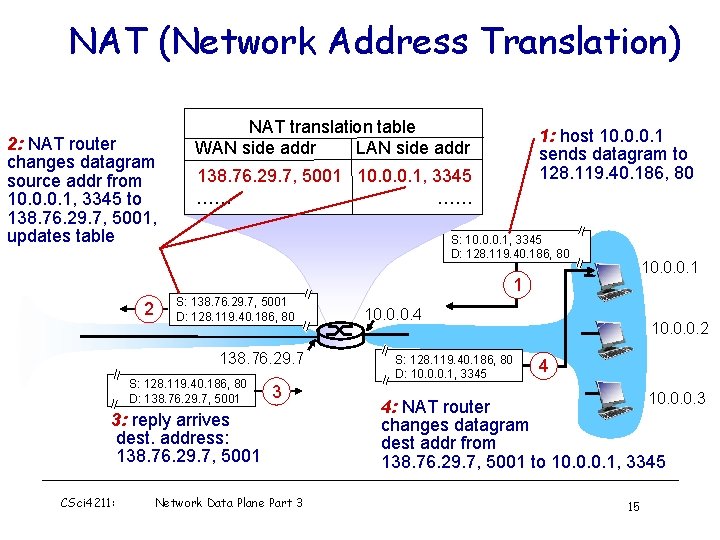
NAT (Network Address Translation) 2: NAT router changes datagram source addr from 10. 0. 0. 1, 3345 to 138. 76. 29. 7, 5001, updates table NAT translation table WAN side addr LAN side addr 1: host 10. 0. 0. 1 sends datagram to 128. 119. 40. 186, 80 138. 76. 29. 7, 5001 10. 0. 0. 1, 3345 …… …… S: 10. 0. 0. 1, 3345 D: 128. 119. 40. 186, 80 10. 0. 0. 1 1 2 S: 138. 76. 29. 7, 5001 D: 128. 119. 40. 186, 80 138. 76. 29. 7 S: 128. 119. 40. 186, 80 D: 138. 76. 29. 7, 5001 3 3: reply arrives dest. address: 138. 76. 29. 7, 5001 CSci 4211: Network Data Plane Part 3 10. 0. 0. 4 S: 128. 119. 40. 186, 80 D: 10. 0. 0. 1, 3345 10. 0. 0. 2 4 10. 0. 0. 3 4: NAT router changes datagram dest addr from 138. 76. 29. 7, 5001 to 10. 0. 0. 1, 3345 15
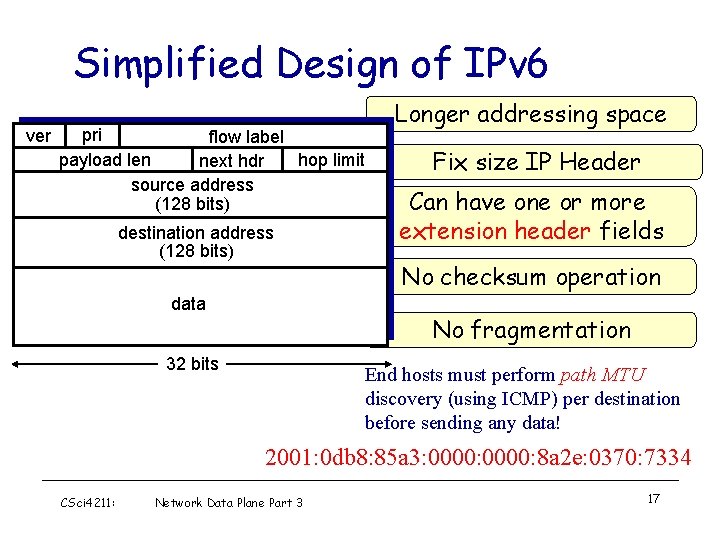
IPv 6: Motivation • initial motivation: 32 -bit address space soon to be completely allocated. • additional motivation: – header format helps speed processing/forwarding – header changes to facilitate Qo. S IPv 6 datagram format: – fixed-length 40 byte header – no fragmentation allowed --- hosts must perform path MTU discovery to learn about path MTU! CSci 4211: Network Data Plane Part 3 16
Simplified Design of IPv 6 ver pri flow label hop limit payload len next hdr source address (128 bits) destination address (128 bits) data Longer addressing space Fix size IP Header Can have one or more extension header fields No checksum operation No fragmentation 32 bits End hosts must perform path MTU discovery (using ICMP) per destination before sending any data! 2001: 0 db 8: 85 a 3: 0000: 8 a 2 e: 0370: 7334 CSci 4211: Network Data Plane Part 3 17
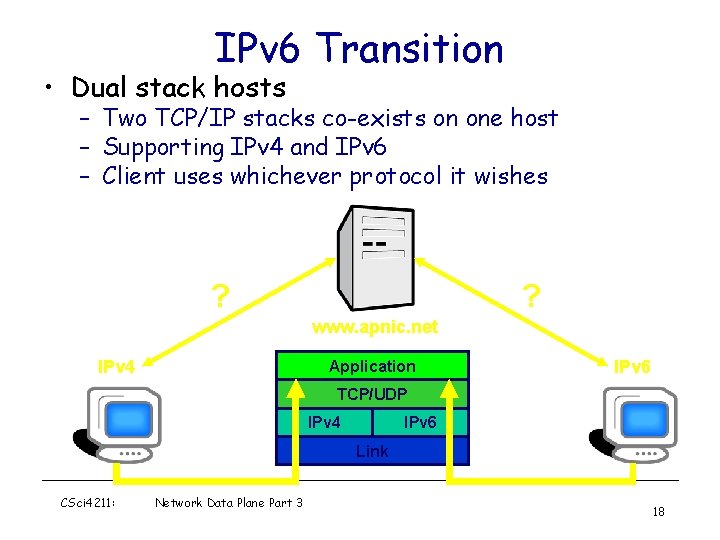
IPv 6 Transition • Dual stack hosts – Two TCP/IP stacks co-exists on one host – Supporting IPv 4 and IPv 6 – Client uses whichever protocol it wishes ? ? www. apnic. net IPv 4 Application IPv 6 TCP/UDP IPv 4 IPv 6 Link CSci 4211: Network Data Plane Part 3 18
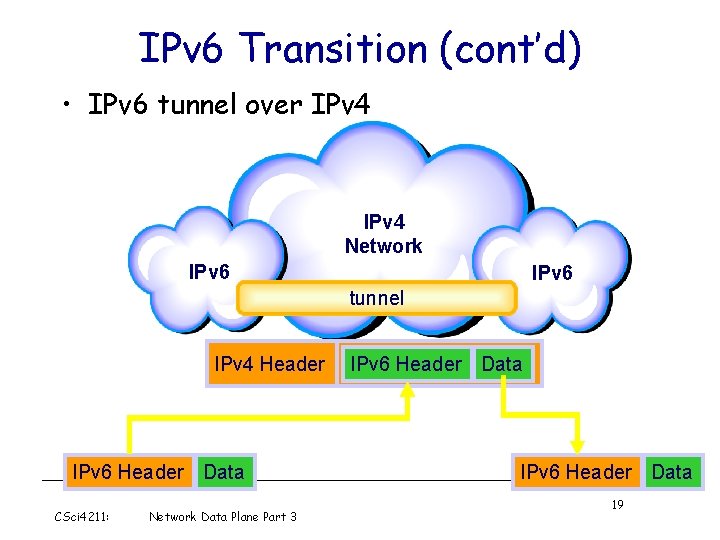
IPv 6 Transition (cont’d) • IPv 6 tunnel over IPv 4 Network IPv 6 tunnel IPv 4 Header IPv 6 Header Data CSci 4211: Network Data Plane Part 3 IPv 6 Header Data 19
Tunnels and “Network Virtualization” Techniques • IPv 6 tunnels over IPv 4 provides an example of the general way that one type of networks can be used to support another type of networks to, e. g. , support incremental deployment of a new protocol, accommodate the co-existence of multiple (heterogeneous) networks, or implement “network virtualization” (e. g. , a “private network” running on top of a public Internet) • IP-in-IP tunnels – IPv 6 -in-IPv 4 tunnels or IPv 4 -in-IPv 6 tunnels – IPv 4 -in=IPv 4 tunnels, e. g. , virtual private network (VPN) • Virtual Circuits as tunnels in IP networks – e. g. , MPLS (multiple protocol label switching) is often used to form virtual IP “links” (across multiple IP routers) • VLAN (layer-2 virtual LAN); Vx. LAN (virtual LANs over UDP/IP) • GRE, L 2 TP, and other tunnels; application-layer gateways; …. . . Note: impact on MTU ! CSci 4211: Network Data Plane Part 3 20
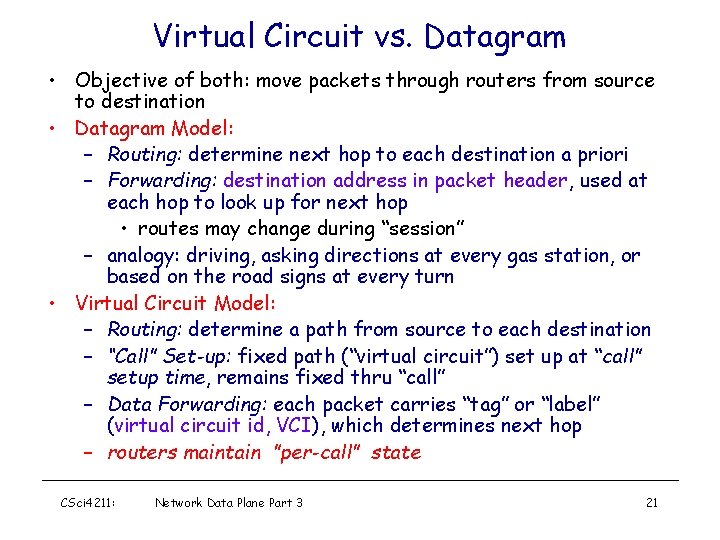
Virtual Circuit vs. Datagram • Objective of both: move packets through routers from source to destination • Datagram Model: – Routing: determine next hop to each destination a priori – Forwarding: destination address in packet header, used at each hop to look up for next hop • routes may change during “session” – analogy: driving, asking directions at every gas station, or based on the road signs at every turn • Virtual Circuit Model: – Routing: determine a path from source to each destination – “Call” Set-up: fixed path (“virtual circuit”) set up at “call” setup time, remains fixed thru “call” – Data Forwarding: each packet carries “tag” or “label” (virtual circuit id, VCI), which determines next hop – routers maintain ”per-call” state CSci 4211: Network Data Plane Part 3 21
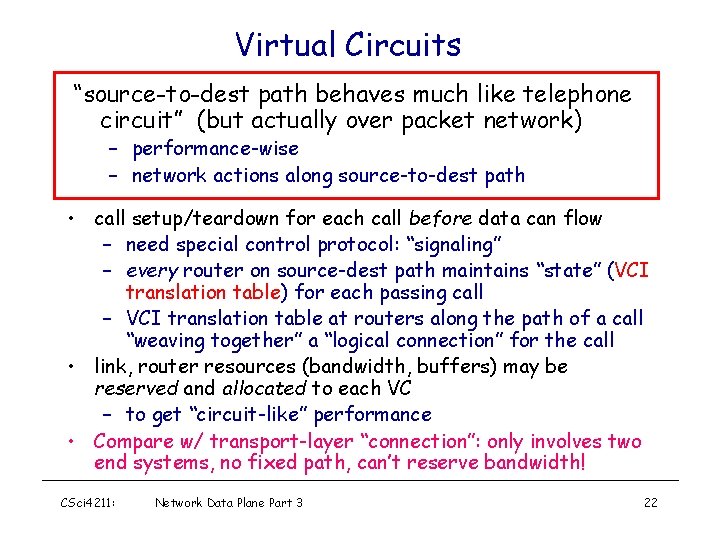
Virtual Circuits “source-to-dest path behaves much like telephone circuit” (but actually over packet network) – performance-wise – network actions along source-to-dest path • call setup/teardown for each call before data can flow – need special control protocol: “signaling” – every router on source-dest path maintains “state” (VCI translation table) for each passing call – VCI translation table at routers along the path of a call “weaving together” a “logical connection” for the call • link, router resources (bandwidth, buffers) may be reserved and allocated to each VC – to get “circuit-like” performance • Compare w/ transport-layer “connection”: only involves two end systems, no fixed path, can’t reserve bandwidth! CSci 4211: Network Data Plane Part 3 22
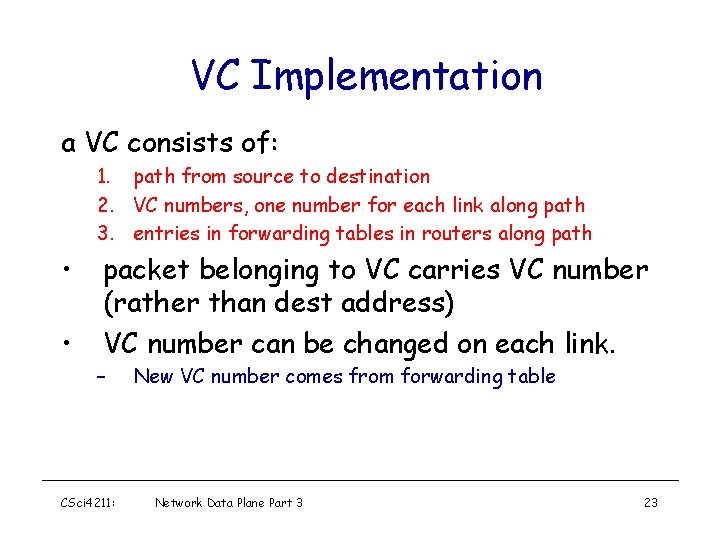
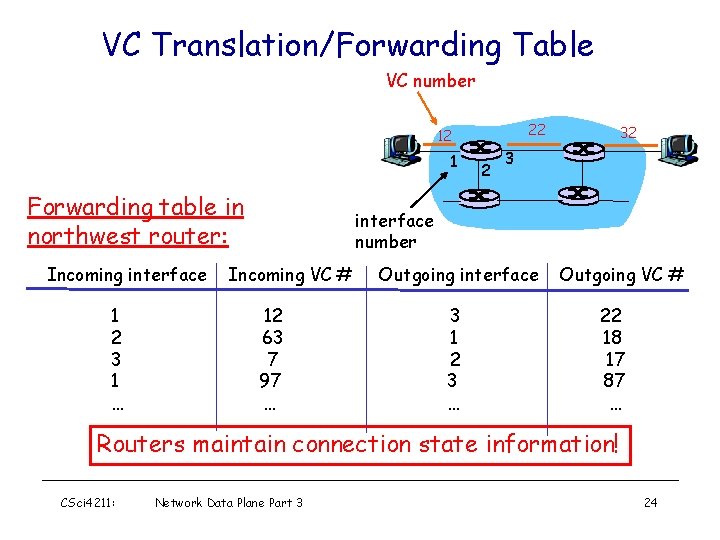
VC Implementation a VC consists of: 1. path from source to destination 2. VC numbers, one number for each link along path 3. entries in forwarding tables in routers along path • • packet belonging to VC carries VC number (rather than dest address) VC number can be changed on each link. – CSci 4211: New VC number comes from forwarding table Network Data Plane Part 3 23
VC Translation/Forwarding Table VC number 22 12 1 Forwarding table in northwest router: Incoming interface 1 2 3 1 … 2 32 3 interface number Incoming VC # 12 63 7 97 … Outgoing interface 3 1 2 3 … Outgoing VC # 22 18 17 87 … Routers maintain connection state information! CSci 4211: Network Data Plane Part 3 24
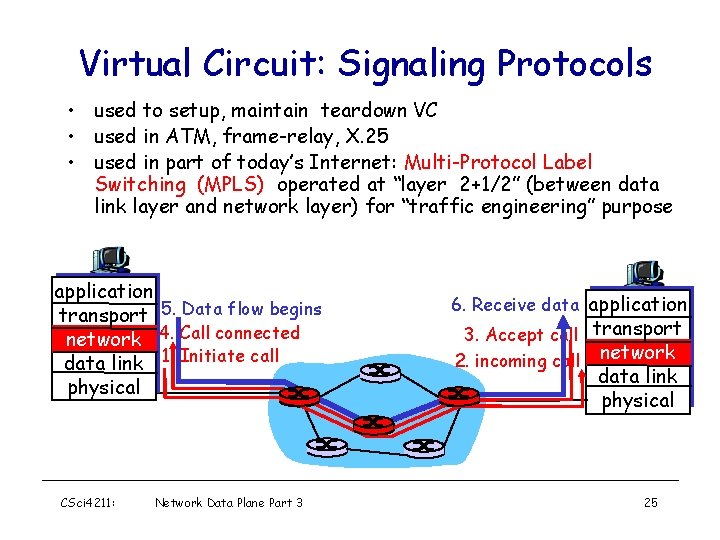
Virtual Circuit: Signaling Protocols • used to setup, maintain teardown VC • used in ATM, frame-relay, X. 25 • used in part of today’s Internet: Multi-Protocol Label Switching (MPLS) operated at “layer 2+1/2” (between data link layer and network layer) for “traffic engineering” purpose application transport 5. Data flow begins network 4. Call connected data link 1. Initiate call physical CSci 4211: Network Data Plane Part 3 6. Receive data application 3. Accept call transport 2. incoming call network data link physical 25
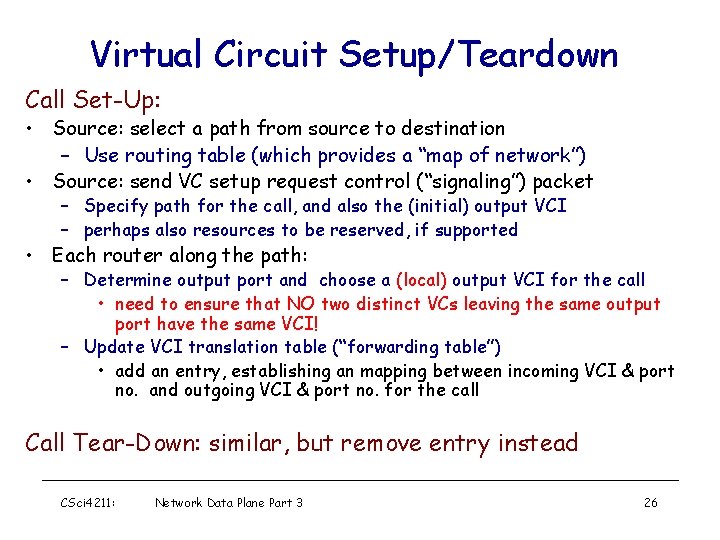
Virtual Circuit Setup/Teardown Call Set-Up: • Source: select a path from source to destination – Use routing table (which provides a “map of network”) • Source: send VC setup request control (“signaling”) packet – Specify path for the call, and also the (initial) output VCI – perhaps also resources to be reserved, if supported • Each router along the path: – Determine output port and choose a (local) output VCI for the call • need to ensure that NO two distinct VCs leaving the same output port have the same VCI! – Update VCI translation table (“forwarding table”) • add an entry, establishing an mapping between incoming VCI & port no. and outgoing VCI & port no. for the call Call Tear-Down: similar, but remove entry instead CSci 4211: Network Data Plane Part 3 26
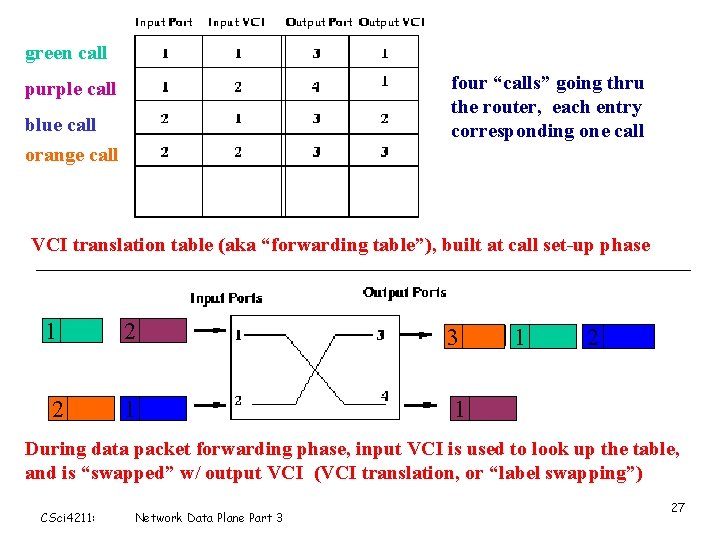
green call four “calls” going thru the router, each entry corresponding one call purple call blue call orange call VCI translation table (aka “forwarding table”), built at call set-up phase 1 2 3 2 1 1 1 2 During data packet forwarding phase, input VCI is used to look up the table, and is “swapped” w/ output VCI (VCI translation, or “label swapping”) CSci 4211: Network Data Plane Part 3 27
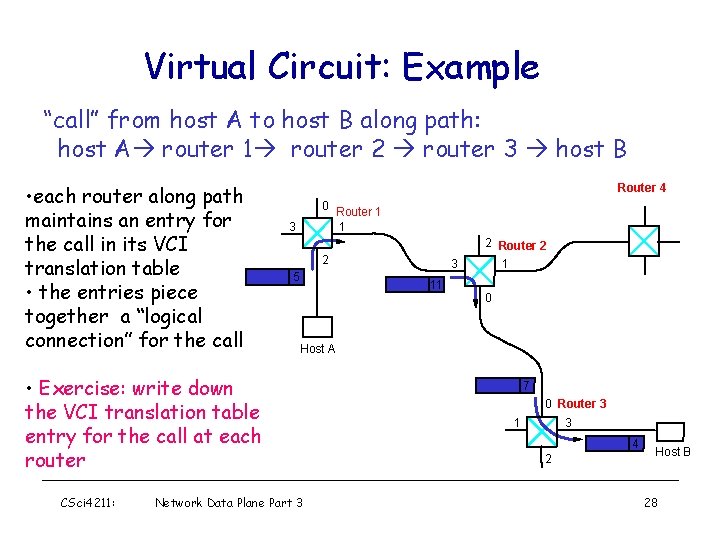
Virtual Circuit: Example “call” from host A to host B along path: host A router 1 router 2 router 3 host B • each router along path maintains an entry for the call in its VCI translation table • the entries piece together a “logical connection” for the call Router 4 0 Router 1 1 3 2 Router 2 2 5 11 1 0 Host A • Exercise: write down the VCI translation table entry for the call at each router CSci 4211: 3 Network Data Plane Part 3 7 0 Router 3 1 3 4 2 Host B 28
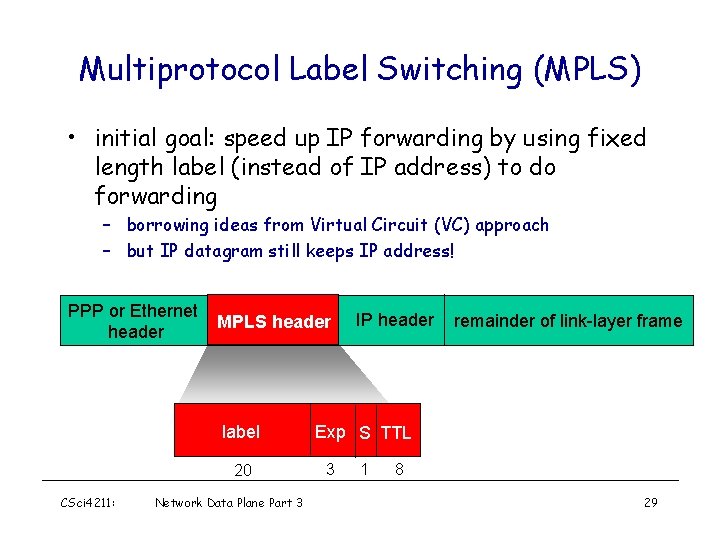
Multiprotocol Label Switching (MPLS) • initial goal: speed up IP forwarding by using fixed length label (instead of IP address) to do forwarding – borrowing ideas from Virtual Circuit (VC) approach – but IP datagram still keeps IP address! PPP or Ethernet header MPLS header label 20 CSci 4211: Network Data Plane Part 3 IP header remainder of link-layer frame Exp S TTL 3 1 8 29
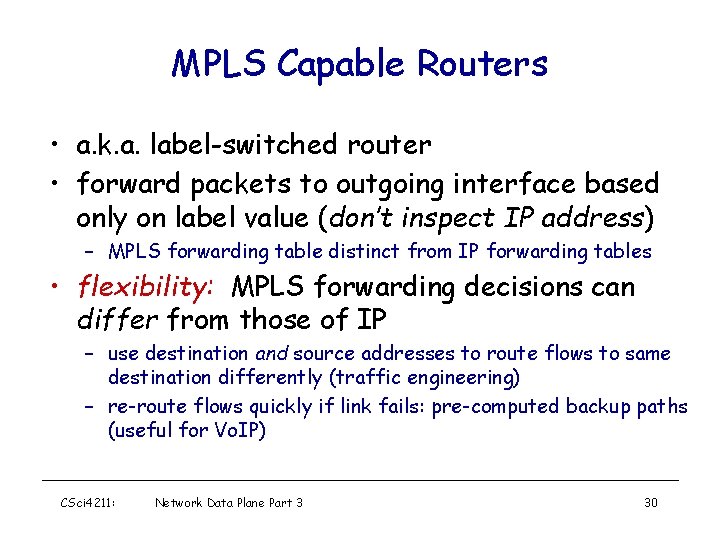
MPLS Capable Routers • a. k. a. label-switched router • forward packets to outgoing interface based only on label value (don’t inspect IP address) – MPLS forwarding table distinct from IP forwarding tables • flexibility: MPLS forwarding decisions can differ from those of IP – use destination and source addresses to route flows to same destination differently (traffic engineering) – re-route flows quickly if link fails: pre-computed backup paths (useful for Vo. IP) CSci 4211: Network Data Plane Part 3 30
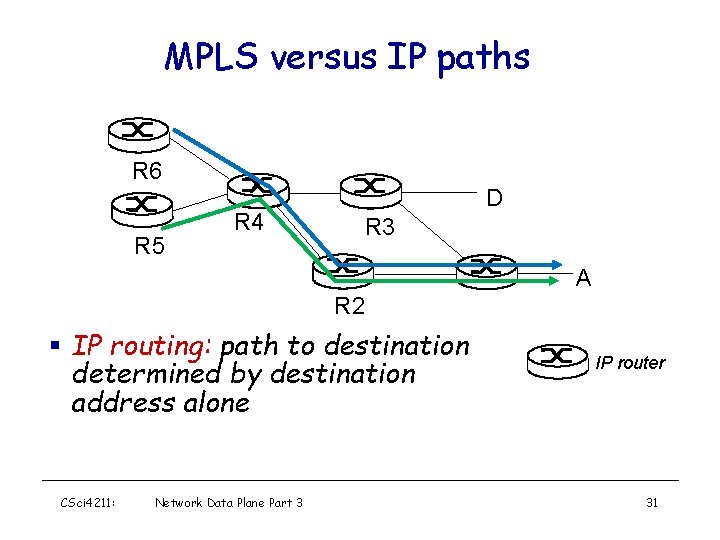
MPLS versus IP paths R 6 R 5 R 4 D R 3 A R 2 § IP routing: path to destination determined by destination address alone CSci 4211: Network Data Plane Part 3 IP router 31
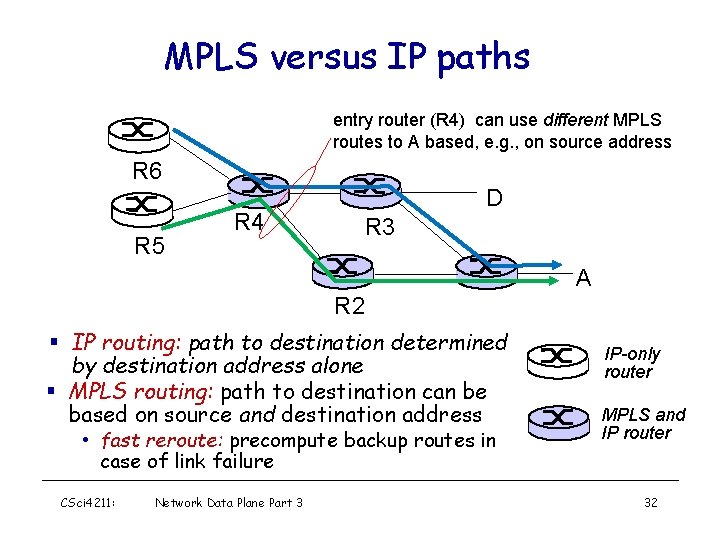
MPLS versus IP paths entry router (R 4) can use different MPLS routes to A based, e. g. , on source address R 6 R 5 R 4 D R 3 A R 2 § IP routing: path to destination determined by destination address alone § MPLS routing: path to destination can be based on source and destination address • fast reroute: precompute backup routes in case of link failure CSci 4211: Network Data Plane Part 3 IP-only router MPLS and IP router 32
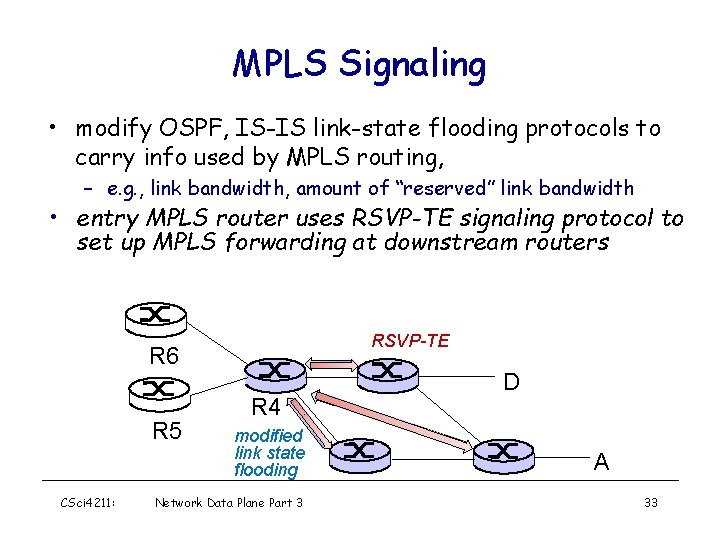
MPLS Signaling • modify OSPF, IS-IS link-state flooding protocols to carry info used by MPLS routing, – e. g. , link bandwidth, amount of “reserved” link bandwidth • entry MPLS router uses RSVP-TE signaling protocol to set up MPLS forwarding at downstream routers RSVP-TE R 6 R 5 CSci 4211: R 4 modified link state flooding Network Data Plane Part 3 D A 33
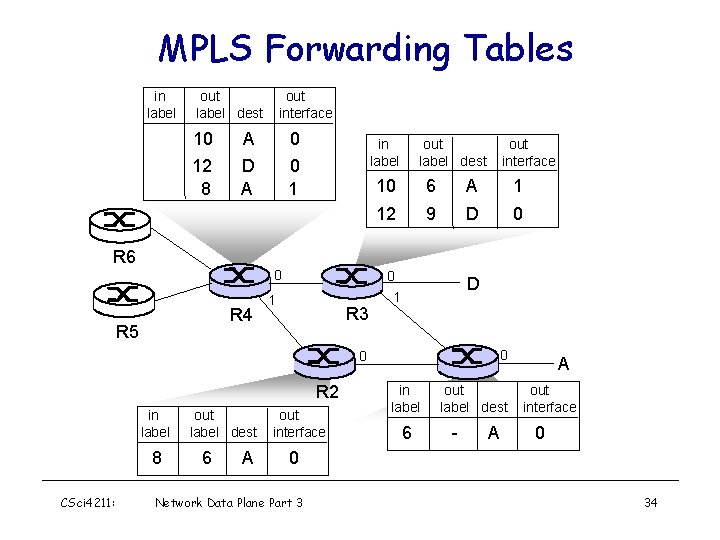
MPLS Forwarding Tables in label out label dest 10 12 8 out interface A D A R 6 0 0 1 in label 0 R 4 R 5 out label dest 10 6 A 1 12 9 D 0 0 1 R 3 out interface D 1 0 0 R 2 in label 8 CSci 4211: out label dest 6 A out interface in label 6 out. R 1 label dest - A A out interface 0 0 Network Data Plane Part 3 34
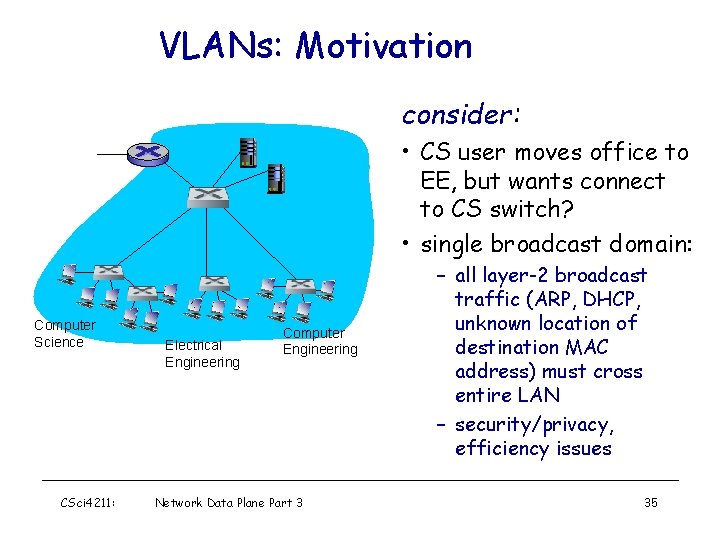
VLANs: Motivation consider: • CS user moves office to EE, but wants connect to CS switch? • single broadcast domain: Computer Science CSci 4211: Electrical Engineering Computer Engineering Network Data Plane Part 3 – all layer-2 broadcast traffic (ARP, DHCP, unknown location of destination MAC address) must cross entire LAN – security/privacy, efficiency issues 35
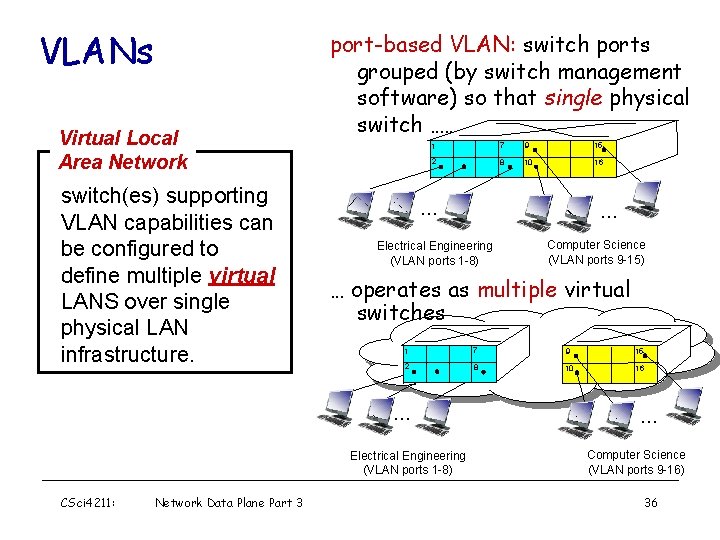
VLANs Virtual Local Area Network switch(es) supporting VLAN capabilities can be configured to define multiple virtual LANS over single physical LAN infrastructure. port-based VLAN: switch ports grouped (by switch management software) so that single physical switch …… 1 7 9 15 2 8 10 16 … Electrical Engineering (VLAN ports 1 -8) 1 7 9 15 2 8 10 16 Electrical Engineering (VLAN ports 1 -8) Network Data Plane Part 3 Computer Science (VLAN ports 9 -15) … operates as multiple virtual switches … CSci 4211: … … Computer Science (VLAN ports 9 -16) 36
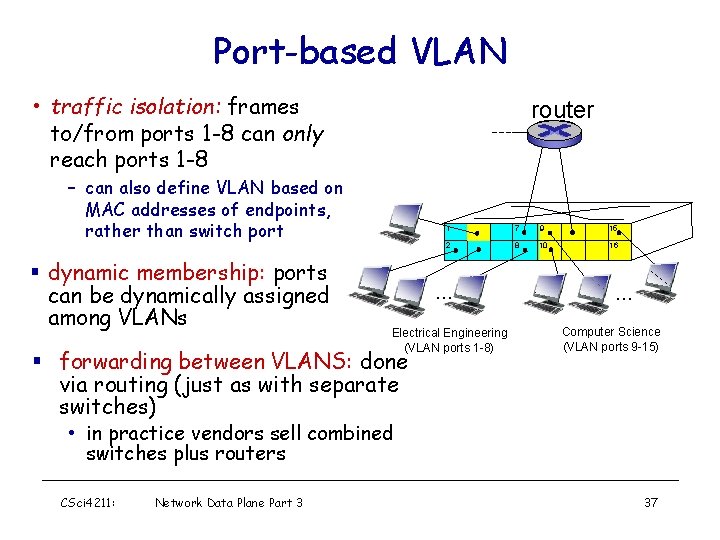
Port-based VLAN • traffic isolation: frames to/from ports 1 -8 can only reach ports 1 -8 router – can also define VLAN based on MAC addresses of endpoints, rather than switch port § dynamic membership: ports can be dynamically assigned among VLANs 1 7 9 15 2 8 10 16 … Electrical Engineering (VLAN ports 1 -8) § forwarding between VLANS: done via routing (just as with separate switches) … Computer Science (VLAN ports 9 -15) • in practice vendors sell combined switches plus routers CSci 4211: Network Data Plane Part 3 37
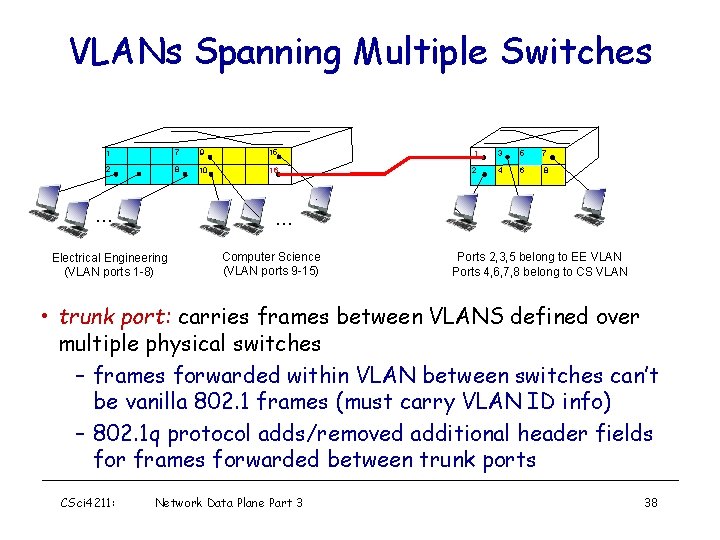
VLANs Spanning Multiple Switches 1 7 9 15 1 3 5 7 2 8 10 16 2 4 6 8 … … Electrical Engineering (VLAN ports 1 -8) Computer Science (VLAN ports 9 -15) Ports 2, 3, 5 belong to EE VLAN Ports 4, 6, 7, 8 belong to CS VLAN • trunk port: carries frames between VLANS defined over multiple physical switches – frames forwarded within VLAN between switches can’t be vanilla 802. 1 frames (must carry VLAN ID info) – 802. 1 q protocol adds/removed additional header fields for frames forwarded between trunk ports CSci 4211: Network Data Plane Part 3 38
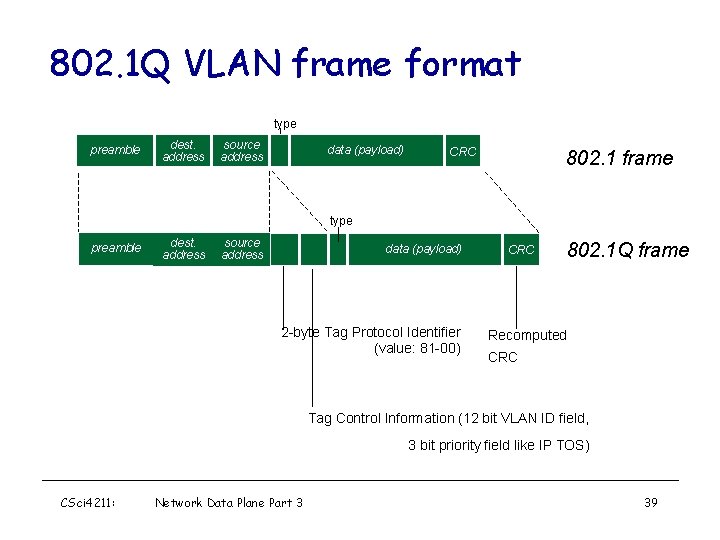
802. 1 Q VLAN frame format type preamble dest. address source address data (payload) CRC 802. 1 frame type preamble dest. address source address data (payload) 2 -byte Tag Protocol Identifier (value: 81 -00) CRC 802. 1 Q frame Recomputed CRC Tag Control Information (12 bit VLAN ID field, 3 bit priority field like IP TOS) CSci 4211: Network Data Plane Part 3 39
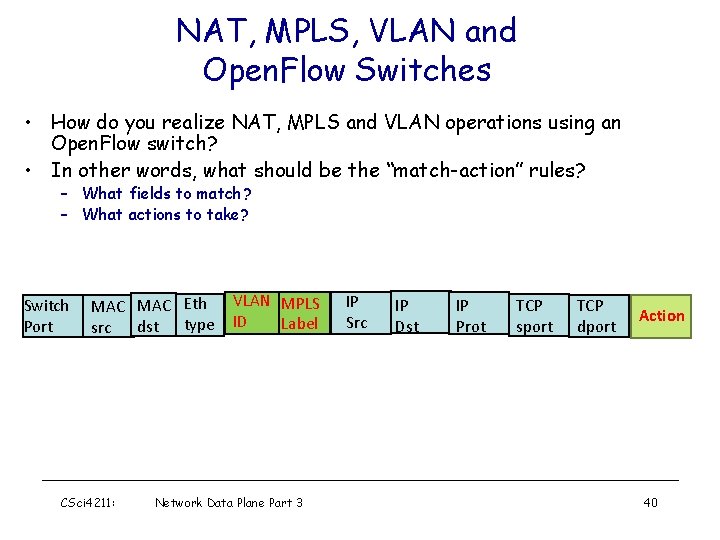
NAT, MPLS, VLAN and Open. Flow Switches • How do you realize NAT, MPLS and VLAN operations using an Open. Flow switch? • In other words, what should be the “match-action” rules? – What fields to match? – What actions to take? Switch Port MAC Eth dst type src CSci 4211: VLAN MPLS ID Label Network Data Plane Part 3 IP Src IP Dst IP Prot TCP sport TCP dport Action 40
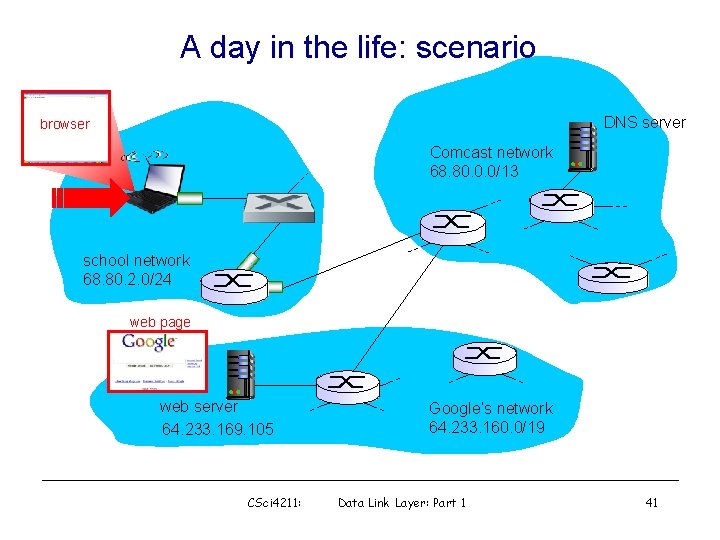
A day in the life: scenario DNS server browser Comcast network 68. 80. 0. 0/13 school network 68. 80. 2. 0/24 web page web server 64. 233. 169. 105 CSci 4211: Google’s network 64. 233. 160. 0/19 Data Link Layer: Part 1 41
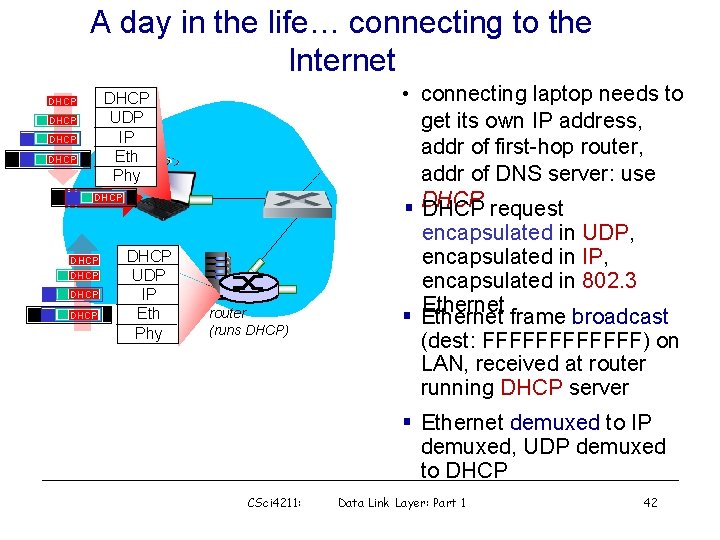
A day in the life… connecting to the Internet DHCP UDP IP Eth Phy DHCP DHCP DHCP UDP IP Eth Phy router (runs DHCP) • connecting laptop needs to get its own IP address, addr of first-hop router, addr of DNS server: use § DHCP request encapsulated in UDP, encapsulated in IP, encapsulated in 802. 3 Ethernet § Ethernet frame broadcast (dest: FFFFFF) on LAN, received at router running DHCP server § Ethernet demuxed to IP demuxed, UDP demuxed to DHCP CSci 4211: Data Link Layer: Part 1 42
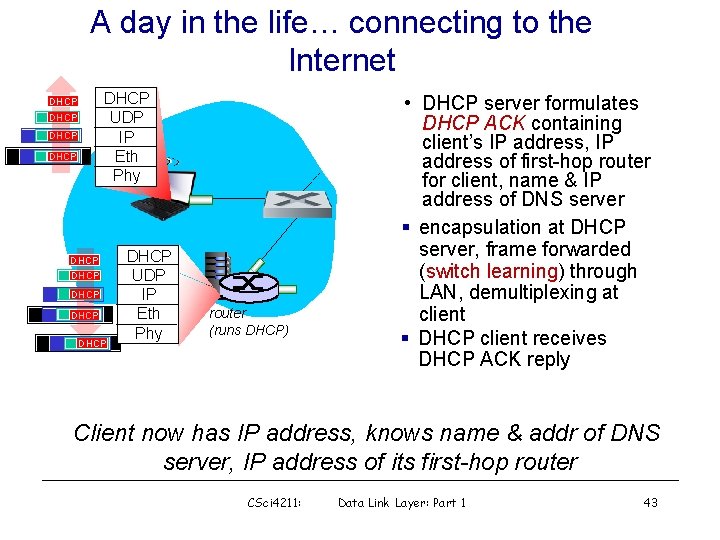
A day in the life… connecting to the Internet DHCP UDP IP Eth Phy DHCP DHCP DHCP UDP IP Eth Phy router (runs DHCP) • DHCP server formulates DHCP ACK containing client’s IP address, IP address of first-hop router for client, name & IP address of DNS server § encapsulation at DHCP server, frame forwarded (switch learning) through LAN, demultiplexing at client § DHCP client receives DHCP ACK reply Client now has IP address, knows name & addr of DNS server, IP address of its first-hop router CSci 4211: Data Link Layer: Part 1 43
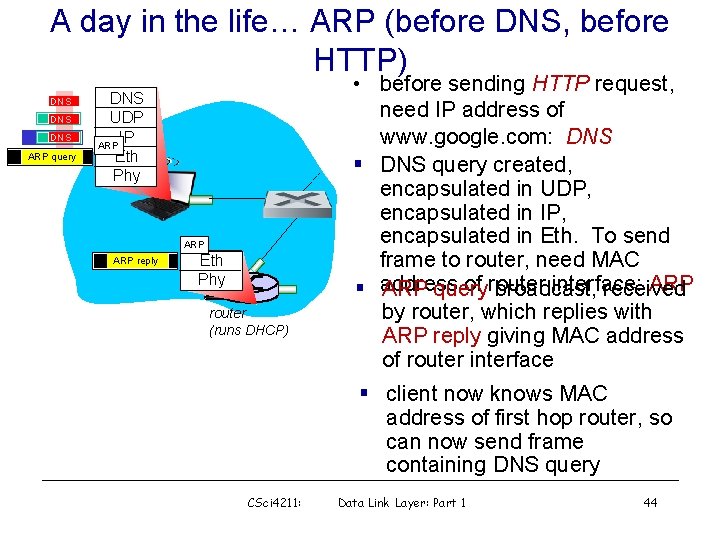
A day in the life… ARP (before DNS, before HTTP) DNS DNS ARP query DNS UDP IP ARP Eth Phy ARP reply Eth Phy router (runs DHCP) • before sending HTTP request, need IP address of www. google. com: DNS § DNS query created, encapsulated in UDP, encapsulated in IP, encapsulated in Eth. To send frame to router, need MAC of router interface: ARP § address ARP query broadcast, received by router, which replies with ARP reply giving MAC address of router interface § client now knows MAC address of first hop router, so can now send frame containing DNS query CSci 4211: Data Link Layer: Part 1 44
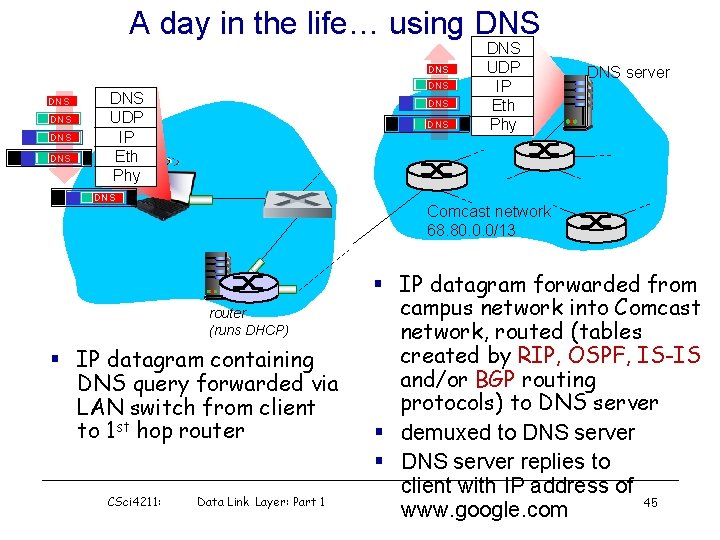
A day in the life… using DNS DNS UDP IP Eth Phy DNS DNS server Comcast network 68. 80. 0. 0/13 router (runs DHCP) § IP datagram containing DNS query forwarded via LAN switch from client to 1 st hop router CSci 4211: DNS UDP IP Eth Phy Data Link Layer: Part 1 § IP datagram forwarded from campus network into Comcast network, routed (tables created by RIP, OSPF, IS-IS and/or BGP routing protocols) to DNS server § demuxed to DNS server § DNS server replies to client with IP address of 45 www. google. com
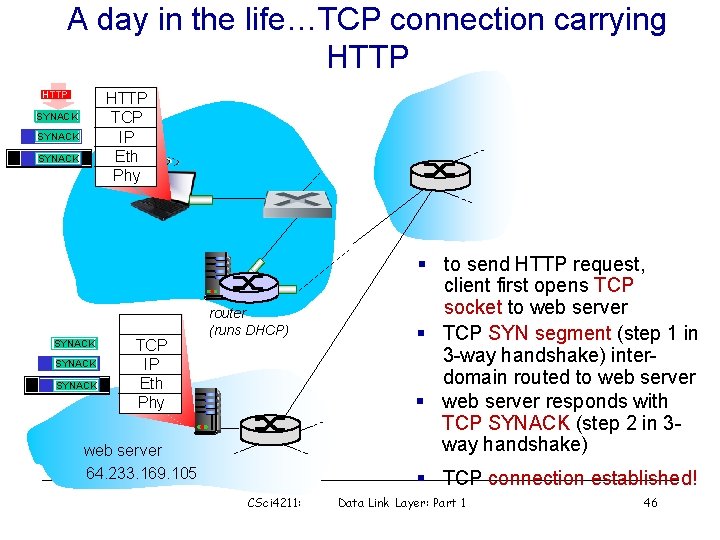
A day in the life…TCP connection carrying HTTP TCP IP Eth Phy SYNACK SYN SYNACK SYN TCP IP Eth Phy router (runs DHCP) web server 64. 233. 169. 105 § to send HTTP request, client first opens TCP socket to web server § TCP SYN segment (step 1 in 3 -way handshake) interdomain routed to web server § web server responds with TCP SYNACK (step 2 in 3 way handshake) § TCP connection established! CSci 4211: Data Link Layer: Part 1 46
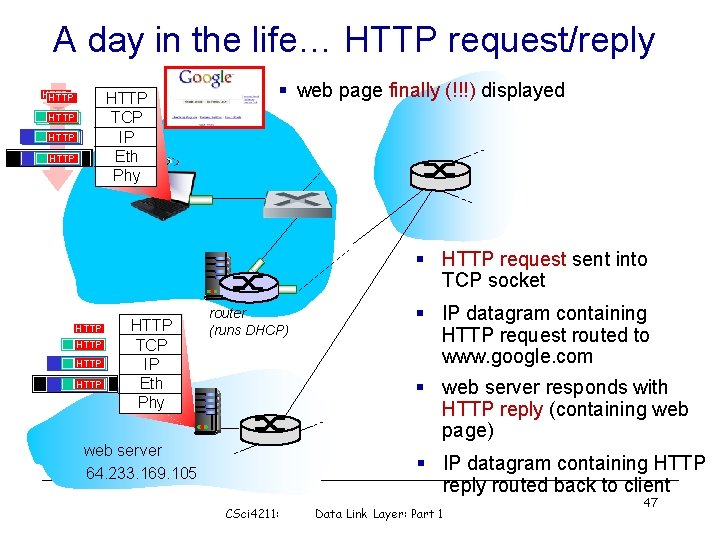
A day in the life… HTTP request/reply HTTP TCP IP Eth Phy HTTP HTTP § web page finally (!!!) displayed § HTTP request sent into TCP socket HTTP HTTP TCP IP Eth Phy router (runs DHCP) web server 64. 233. 169. 105 § IP datagram containing HTTP request routed to www. google. com § web server responds with HTTP reply (containing web page) § IP datagram containing HTTP reply routed back to client CSci 4211: Data Link Layer: Part 1 47