
Network Coding Overview Motivation Some bounds Examples Case
Network Coding
Overview • Motivation • Some bounds • Examples • Case Study: Data Gathering – Self-coding – Excursion: Shallow Light Tree – Foreign coding – Multi-coding
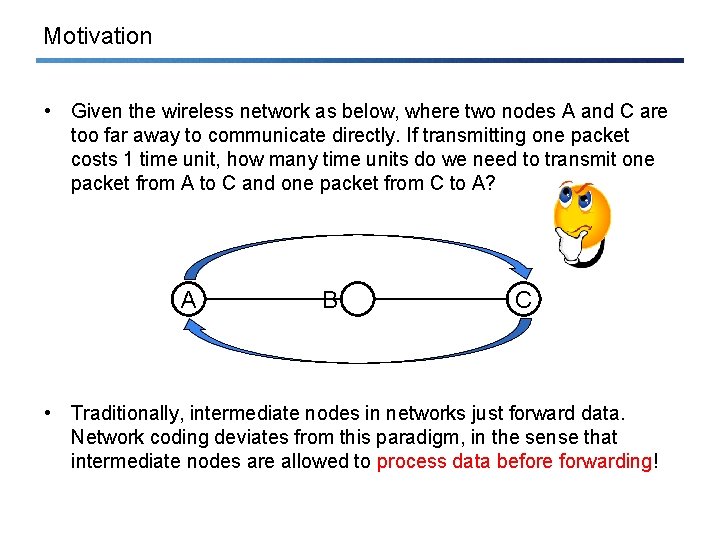
Motivation • Given the wireless network as below, where two nodes A and C are too far away to communicate directly. If transmitting one packet costs 1 time unit, how many time units do we need to transmit one packet from A to C and one packet from C to A? A B C • Traditionally, intermediate nodes in networks just forward data. Network coding deviates from this paradigm, in the sense that intermediate nodes are allowed to process data before forwarding!
![Network Coding Saves Transmissions [Christina Fragouli, EPFL]](http://slidetodoc.com/presentation_image_h2/a8c41775b8ba3aacb052a0b393e593b5/image-4.jpg "Network Coding Saves Transmissions [Christina Fragouli, EPFL]")
Network Coding Saves Transmissions [Christina Fragouli, EPFL]
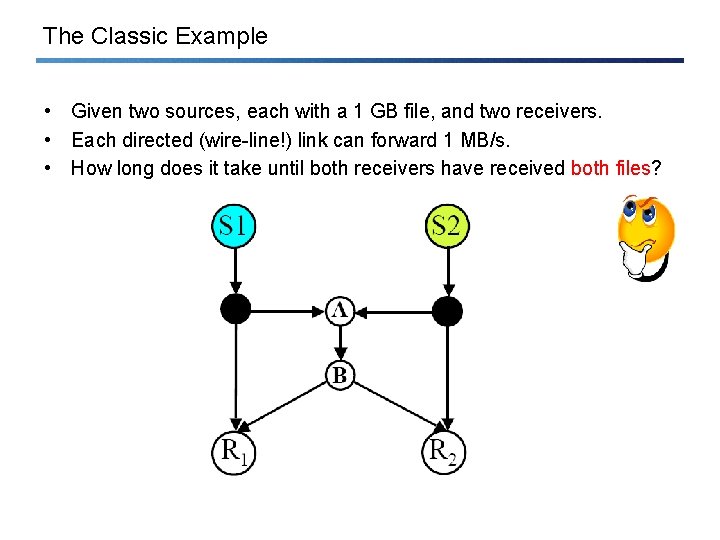
The Classic Example • Given two sources, each with a 1 GB file, and two receivers. • Each directed (wire-line!) link can forward 1 MB/s. • How long does it take until both receivers have received both files?

Without Network Coding? • Well, the naïve solution would first deliver the first file to both receivers, then the second. The total time needed is 2000 s. Can we do better (without network coding)? • First it seems that there is a better “forwarding-only” solution. The picture shows that we can deliver a total of 3 MB/s. However, this is not true. Indeed “crossing” traffic must go through the bottleneck link A-B; to deliver the 2 GB information through this 1 MB/s link, we need 2000 s… • What about with network coding? [Christina Fragouli, EPFL]
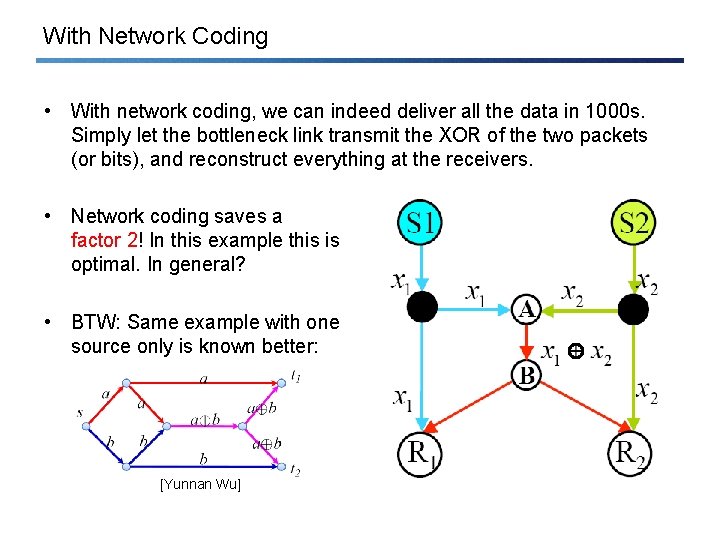
With Network Coding • With network coding, we can indeed deliver all the data in 1000 s. Simply let the bottleneck link transmit the XOR of the two packets (or bits), and reconstruct everything at the receivers. • Network coding saves a factor 2! In this example this is optimal. In general? • BTW: Same example with one source only is known better: [Yunnan Wu]
![Max-Flow Min-Cut Theorem [Ford-Fulkerson] We can transmit a flow at rate r from source](http://slidetodoc.com/presentation_image_h2/a8c41775b8ba3aacb052a0b393e593b5/image-8.jpg "Max-Flow Min-Cut Theorem [Ford-Fulkerson] We can transmit a flow at rate r from source")
Max-Flow Min-Cut Theorem [Ford-Fulkerson] We can transmit a flow at rate r from source s to receiver t Between source s and receiver t, the minimum cut is r • Assumes splittable flows • Can we achieve the max-flow min-cut rate even when multicasting? !
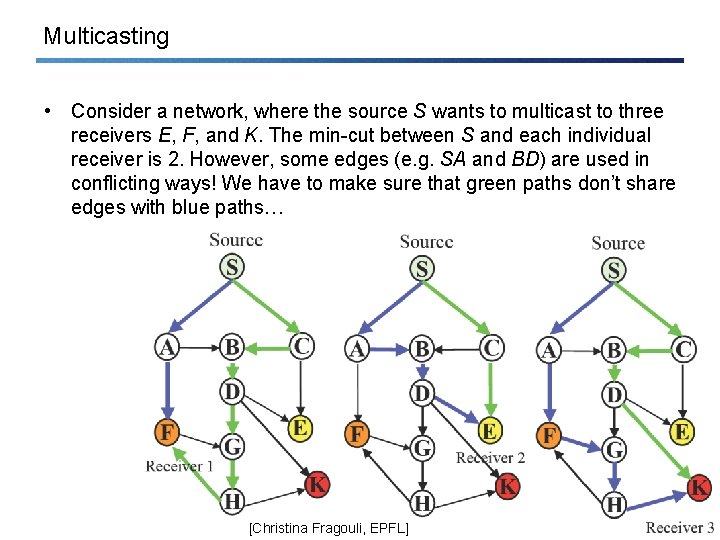
Multicasting • Consider a network, where the source S wants to multicast to three receivers E, F, and K. The min-cut between S and each individual receiver is 2. However, some edges (e. g. SA and BD) are used in conflicting ways! We have to make sure that green paths don’t share edges with blue paths… [Christina Fragouli, EPFL]
Steiner Tree Packing • To optimize multicasting (without network coding), we need to solve the Steiner tree packing problem (How can you connect source and all destinations by edge-disjoint Steiner trees? ). This is known to be notoriously difficult (NP-complete, there approximations). • Even if we could solve this, we might end up with a solution which is inferior to the best solution using network coding. – Indeed, all previous examples showed that the best Steiner tree packing is a factor 2 worse than the min-cut.
![Multicasting w/ Network Coding [Ahlswede, Cai, Li, Yeung] We can transmit a flow at](http://slidetodoc.com/presentation_image_h2/a8c41775b8ba3aacb052a0b393e593b5/image-11.jpg "Multicasting w/ Network Coding [Ahlswede, Cai, Li, Yeung] We can transmit a flow at")
Multicasting w/ Network Coding [Ahlswede, Cai, Li, Yeung] We can transmit a flow at rate r from source s to each receiver ti • This works with various coding schemes • Indeed, the factor 2 was no coincidence. For undirected networks, it can be shown that network coding can at most improve multicasting by a factor 2. [Christina Fragouli, EPFL] Between source s and each receiver ti, the minimum cut is r
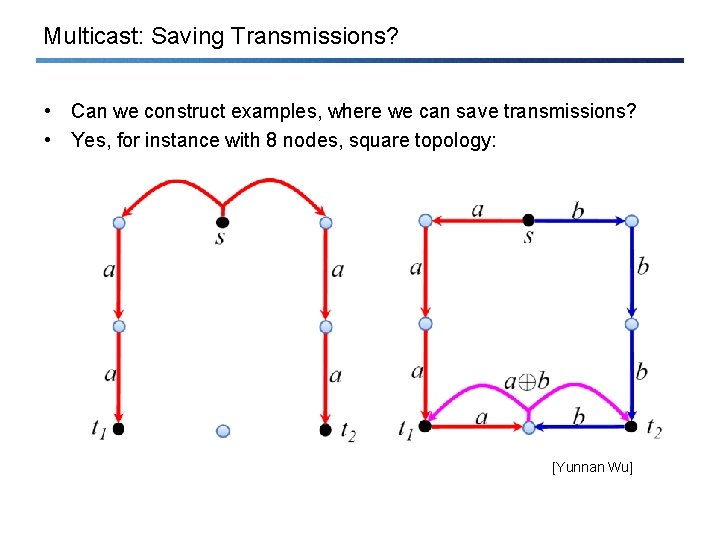
Multicast: Saving Transmissions? • Can we construct examples, where we can save transmissions? • Yes, for instance with 8 nodes, square topology: [Yunnan Wu]
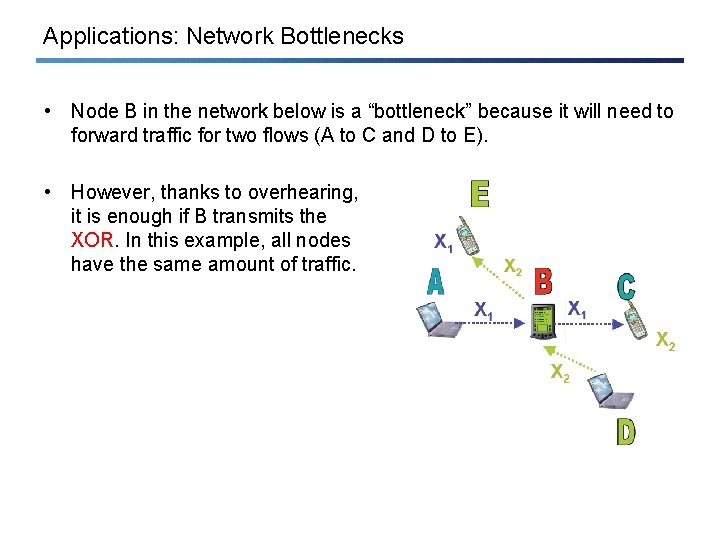
Applications: Network Bottlenecks • Node B in the network below is a “bottleneck” because it will need to forward traffic for two flows (A to C and D to E). • However, thanks to overhearing, it is enough if B transmits the XOR. In this example, all nodes have the same amount of traffic.
![Applications: Security [Christina Fragouli, EPFL] • Without network coding, an eavesdropper may get half](http://slidetodoc.com/presentation_image_h2/a8c41775b8ba3aacb052a0b393e593b5/image-14.jpg "Applications: Security [Christina Fragouli, EPFL] • Without network coding, an eavesdropper may get half")
Applications: Security [Christina Fragouli, EPFL] • Without network coding, an eavesdropper may get half of the information. • With network coding, getting useful information is harder.
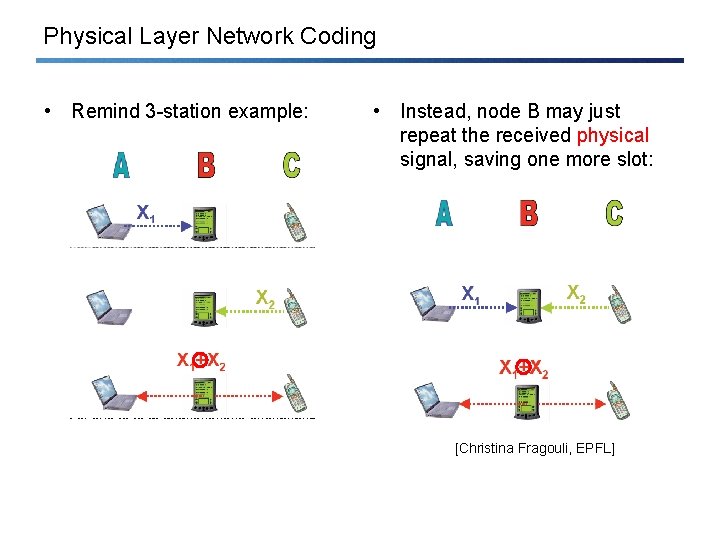
Physical Layer Network Coding • Remind 3 -station example: • Instead, node B may just repeat the received physical signal, saving one more slot: [Christina Fragouli, EPFL]
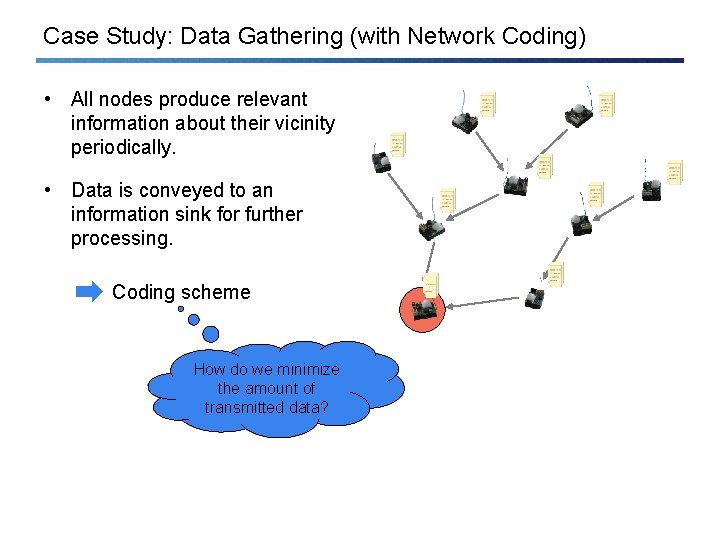
Case Study: Data Gathering (with Network Coding) • All nodes produce relevant information about their vicinity periodically. • Data is conveyed to an information sink for further processing. Coding scheme How do we minimize the amount of transmitted data?
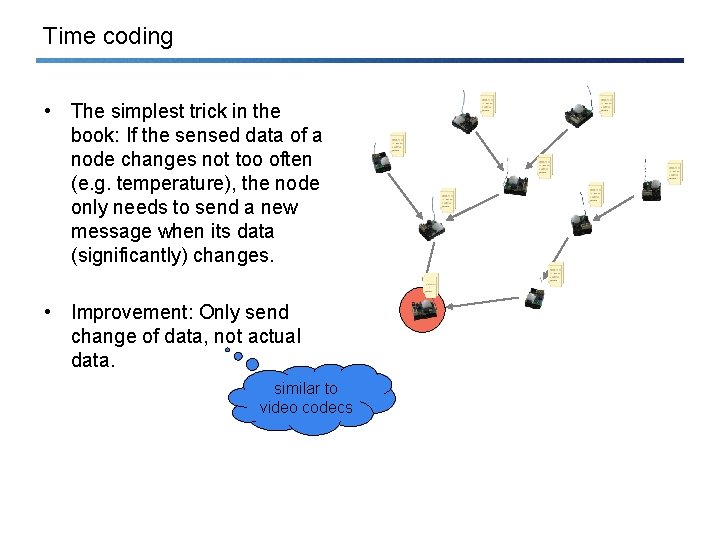
Time coding • The simplest trick in the book: If the sensed data of a node changes not too often (e. g. temperature), the node only needs to send a new message when its data (significantly) changes. • Improvement: Only send change of data, not actual data. similar to video codecs
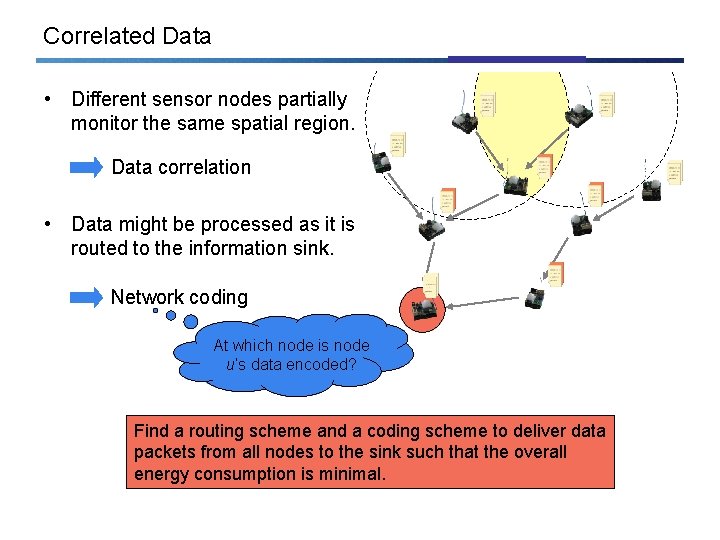
Correlated Data • Different sensor nodes partially monitor the same spatial region. Data correlation • Data might be processed as it is routed to the information sink. Network coding At which node is node u’s data encoded? Find a routing scheme and a coding scheme to deliver data packets from all nodes to the sink such that the overall energy consumption is minimal.
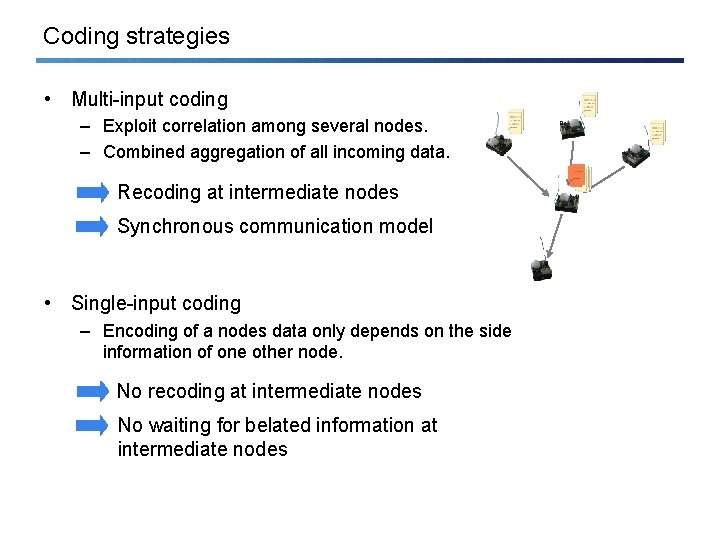
Coding strategies • Multi-input coding – Exploit correlation among several nodes. – Combined aggregation of all incoming data. Recoding at intermediate nodes Synchronous communication model • Single-input coding – Encoding of a nodes data only depends on the side information of one other node. No recoding at intermediate nodes No waiting for belated information at intermediate nodes
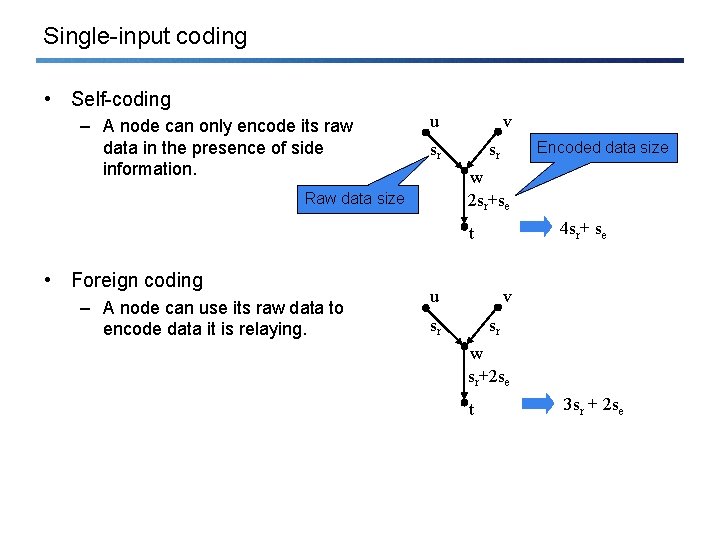
Single-input coding • Self-coding – A node can only encode its raw data in the presence of side information. u v sr Encoded data size sr w 2 sr+se Raw data size 4 sr+ se t • Foreign coding – A node can use its raw data to encode data it is relaying. u v sr sr w sr+2 se t 3 sr + 2 se
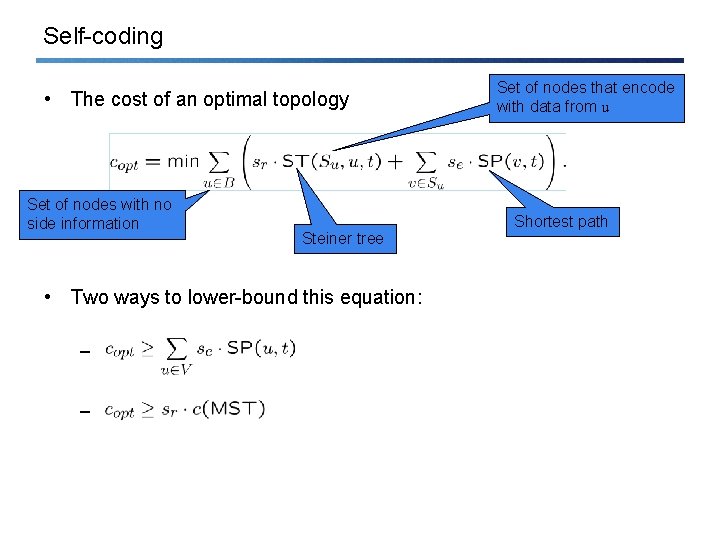
Self-coding • The cost of an optimal topology Set of nodes with no side information Steiner tree • Two ways to lower-bound this equation: – – Set of nodes that encode with data from u Shortest path
MST vs. SPT • Is a good SPT not automatically a good MST (or vice versa)? MST SPT SLT
![Excursion: Shallow-Light Tree (SLT) • Introduced by [Awerbuch, Baratz, Peleg, PODC 1990] • Improved](http://slidetodoc.com/presentation_image_h2/a8c41775b8ba3aacb052a0b393e593b5/image-23.jpg "Excursion: Shallow-Light Tree (SLT) • Introduced by [Awerbuch, Baratz, Peleg, PODC 1990] • Improved")
Excursion: Shallow-Light Tree (SLT) • Introduced by [Awerbuch, Baratz, Peleg, PODC 1990] • Improved by [Khuller, Raghavachari, Young, SODA 1993] – new name: Light-Approximate-Shortest-Path-Tree (LAST) • Idea: Construct a spanning tree for a given root r that is both a MSTapproximation as well as a SPT-approximation for the root r. In particular, for any > 0 – – • Remember: – MST: Easily computable with e. g. Prim’s greedy edge picking algorithm – SPT: Easily computable with e. g. Dijkstra’s shortest path algorithm
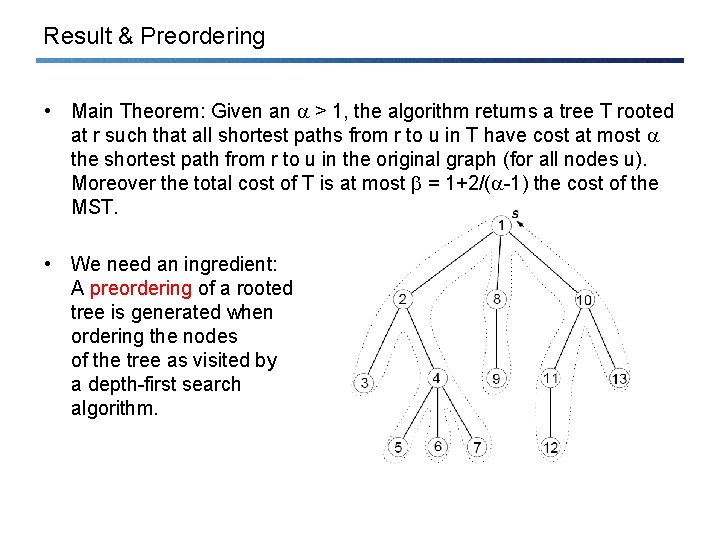
Result & Preordering • Main Theorem: Given an > 1, the algorithm returns a tree T rooted at r such that all shortest paths from r to u in T have cost at most the shortest path from r to u in the original graph (for all nodes u). Moreover the total cost of T is at most = 1+2/( -1) the cost of the MST. • We need an ingredient: A preordering of a rooted tree is generated when ordering the nodes of the tree as visited by a depth-first search algorithm.
The SLT Algorithm 1. 2. 3. 4. Compute MST H of Graph G; Compute all shortest paths (SPT) from the root r. Compute preordering of MST with root r. For all nodes v in order of their preordering do • • Compute shortest path from r to v in H. If the cost of this shortest path in H is more than a factor more than the cost of the shortest path in G, then just add the shortest path in G to H. Formally: IF d. H(r, zi) > d. G(r, zi) THEN H : = H + d. G(r, zi) ENDIF. 5. Now simply compute the SPT with root r in H. • Sounds crazy… but it works!
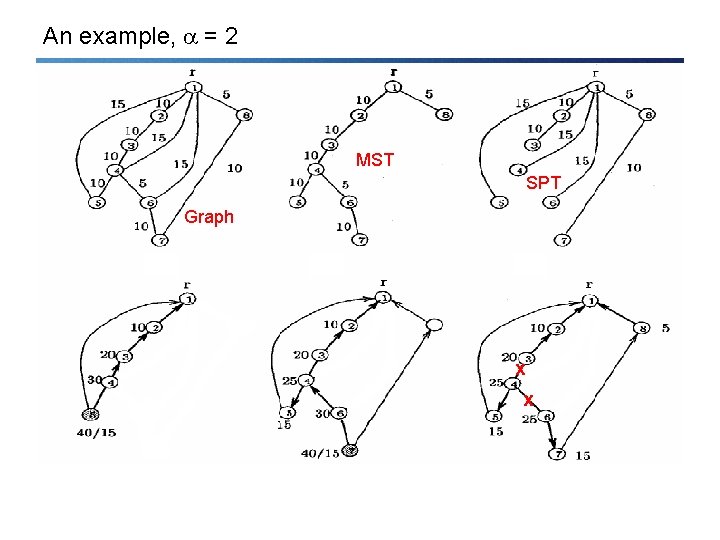
An example, = 2 MST SPT Graph x x
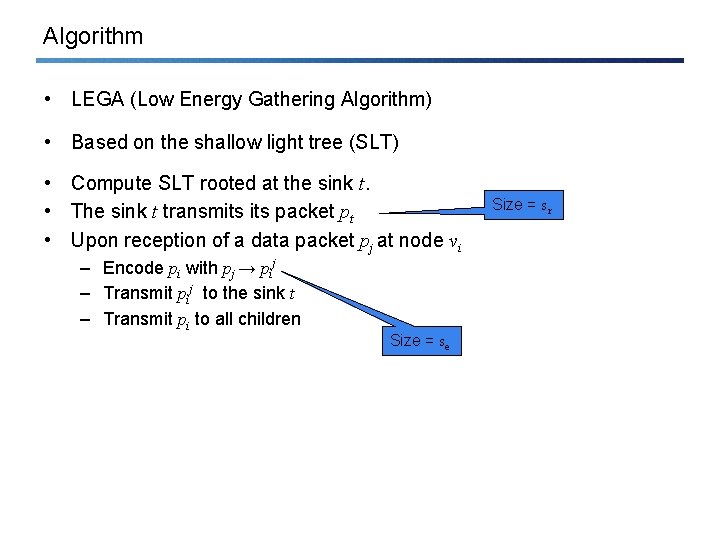
Algorithm • LEGA (Low Energy Gathering Algorithm) • Based on the shallow light tree (SLT) • Compute SLT rooted at the sink t. • The sink t transmits packet pt • Upon reception of a data packet pj at node vi – Encode pi with pj → pij – Transmit pij to the sink t – Transmit pi to all children Size = se Size = sr
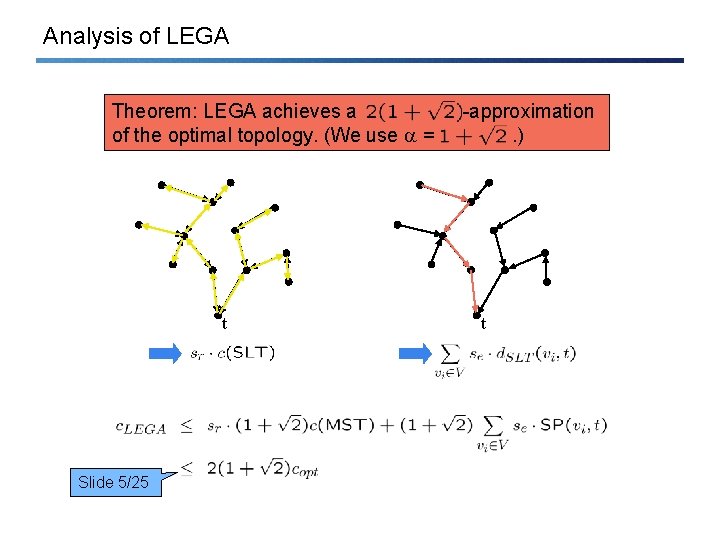
Analysis of LEGA Theorem: LEGA achieves a of the optimal topology. (We use = t Slide 5/25 -approximation. ) t
Open problem • Future applications incorporating network coding may not try to optimize network throughput but utilize other side effects. In peer-to-peer networks for example, network coding is used to increase the longevity of a file inside the network. – Concretely, so far peers store pieces of a file. If all peers storing a certain piece leave the network, the file cannot be reconstructed anymore. Instead, if peers store combinations of pieces, the file will be more available. • Goal: Find a new application that exploits the reliability aspect of network coding.
- Slides: 29