
Network Architecture Standards Unit 2 Chapter 3 4


- Slides: 30
Network Architecture & Standards Unit 2, Chapter 3 & 4 Why Standards?
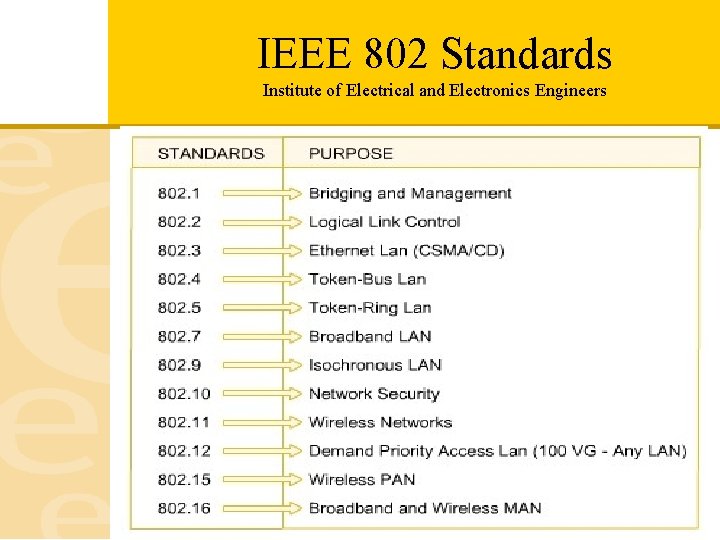
Objectives Explain the importance of network architecture. Identify 802. x LAN standards as described by IEEE. Match the seven layers of the OSI model to network equipment and their role in crossplatform interoperability Describe the function of a network access PDU. Differentiate between connectionless and connection-oriented protocols. Describe selected basic functions of a protocol.
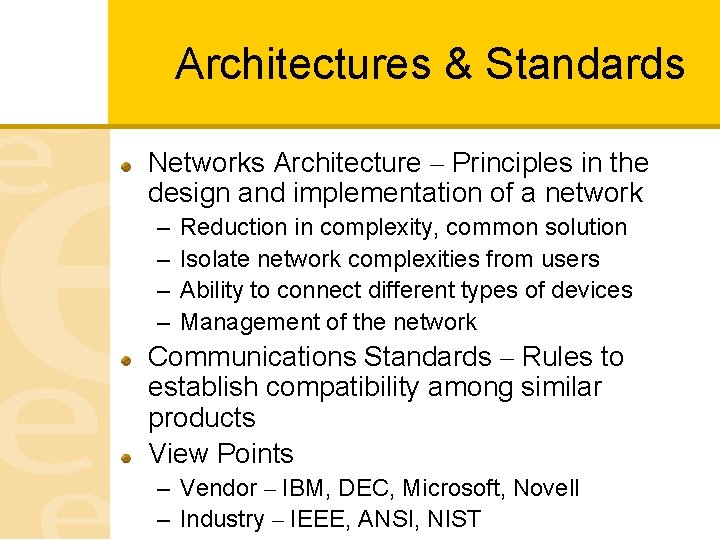
Architectures & Standards Networks Architecture – Principles in the design and implementation of a network – – Reduction in complexity, common solution Isolate network complexities from users Ability to connect different types of devices Management of the network Communications Standards – Rules to establish compatibility among similar products View Points – Vendor – IBM, DEC, Microsoft, Novell – Industry – IEEE, ANSI, NIST
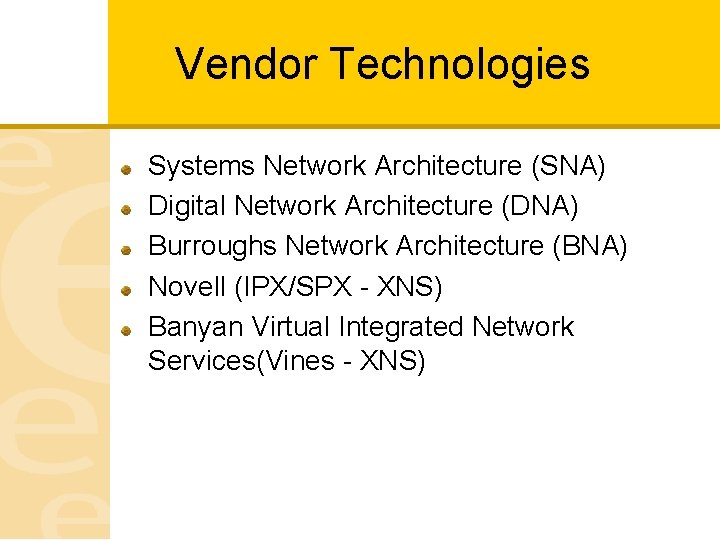
Vendor Technologies Systems Network Architecture (SNA) Digital Network Architecture (DNA) Burroughs Network Architecture (BNA) Novell (IPX/SPX - XNS) Banyan Virtual Integrated Network Services(Vines - XNS)
IEEE 802 Standards Institute of Electrical and Electronics Engineers
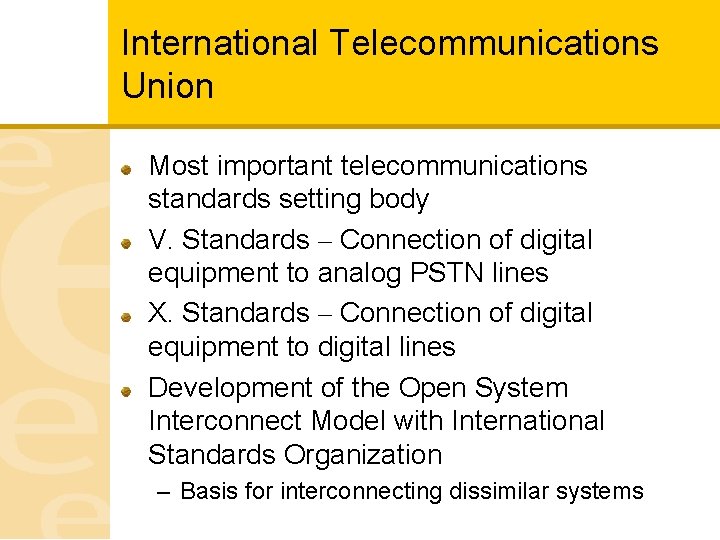
International Telecommunications Union Most important telecommunications standards setting body V. Standards – Connection of digital equipment to analog PSTN lines X. Standards – Connection of digital equipment to digital lines Development of the Open System Interconnect Model with International Standards Organization – Basis for interconnecting dissimilar systems
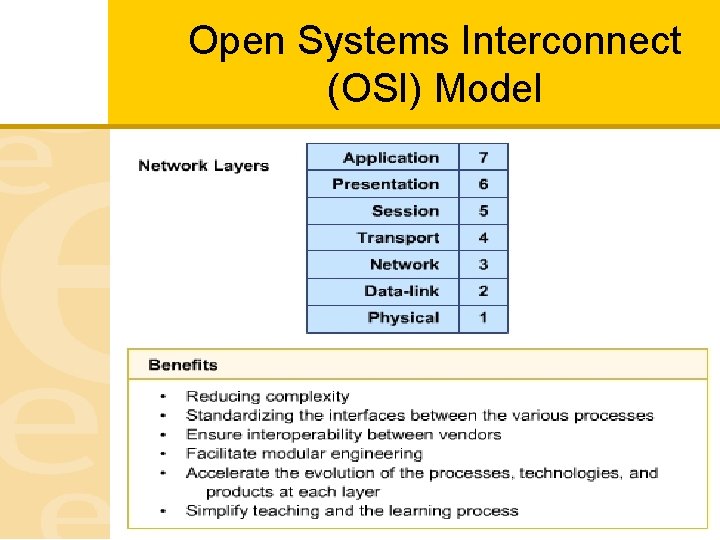
Open Systems Interconnect (OSI) Model
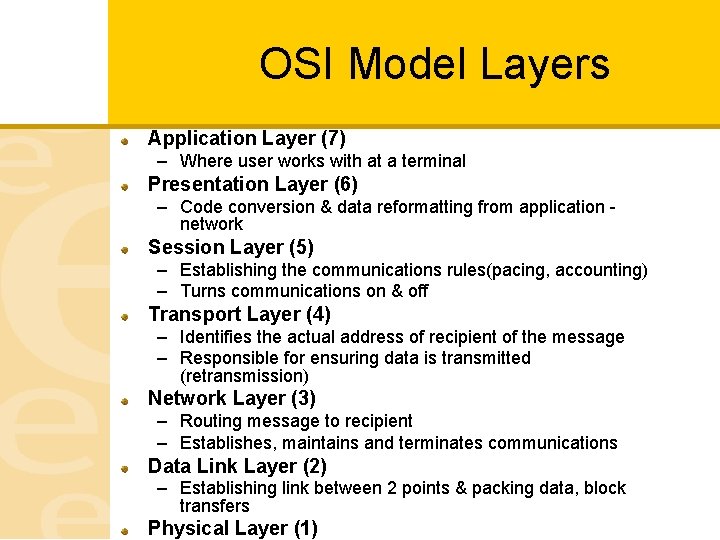
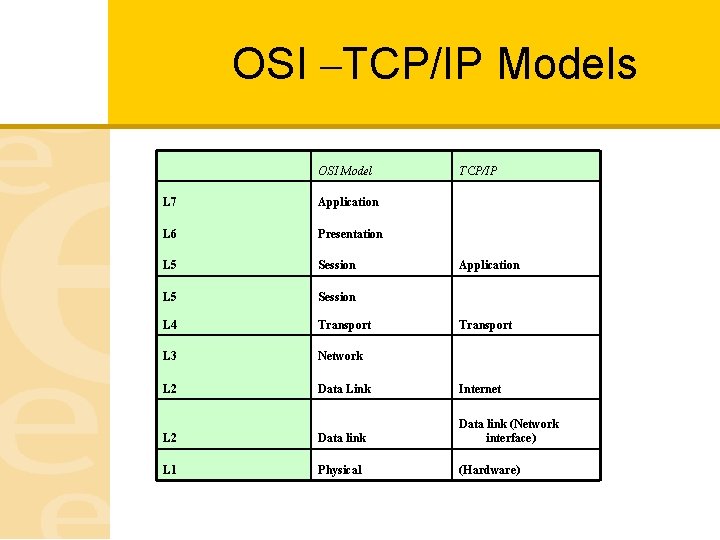
OSI Model Layers Application Layer (7) – Where user works with at a terminal Presentation Layer (6) – Code conversion & data reformatting from application network Session Layer (5) – Establishing the communications rules(pacing, accounting) – Turns communications on & off Transport Layer (4) – Identifies the actual address of recipient of the message – Responsible for ensuring data is transmitted (retransmission) Network Layer (3) – Routing message to recipient – Establishes, maintains and terminates communications Data Link Layer (2) – Establishing link between 2 points & packing data, block transfers Physical Layer (1)
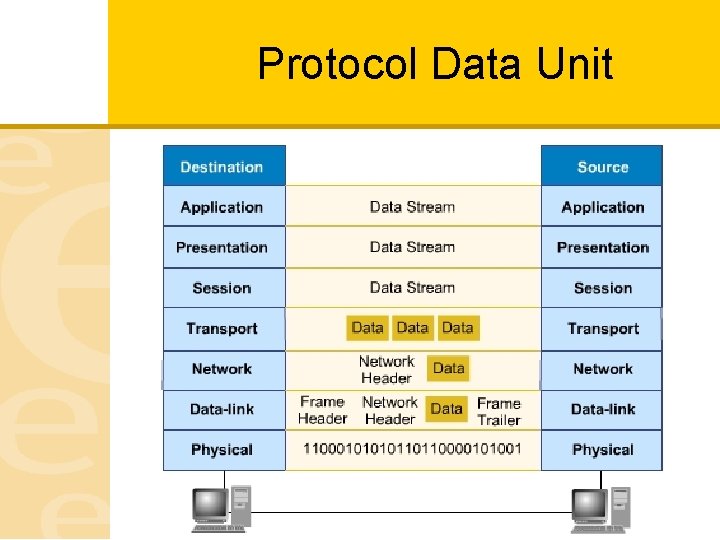
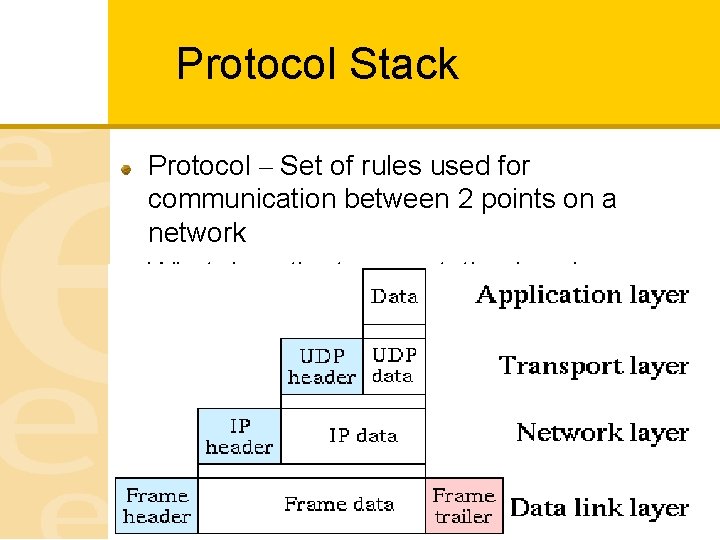
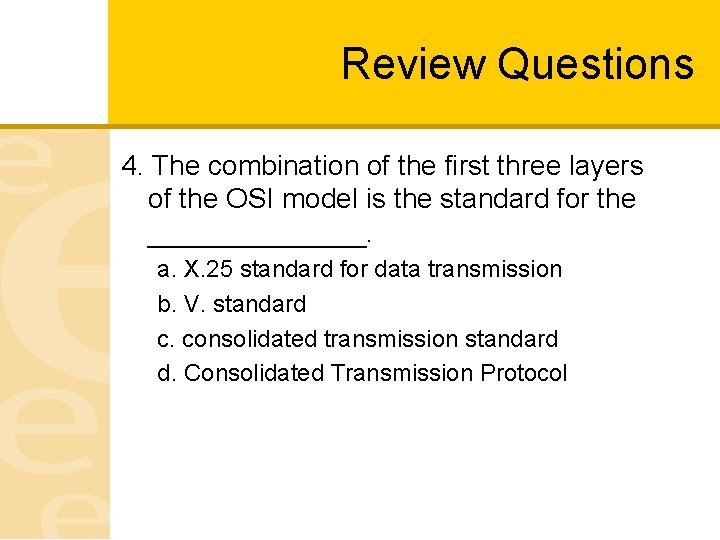
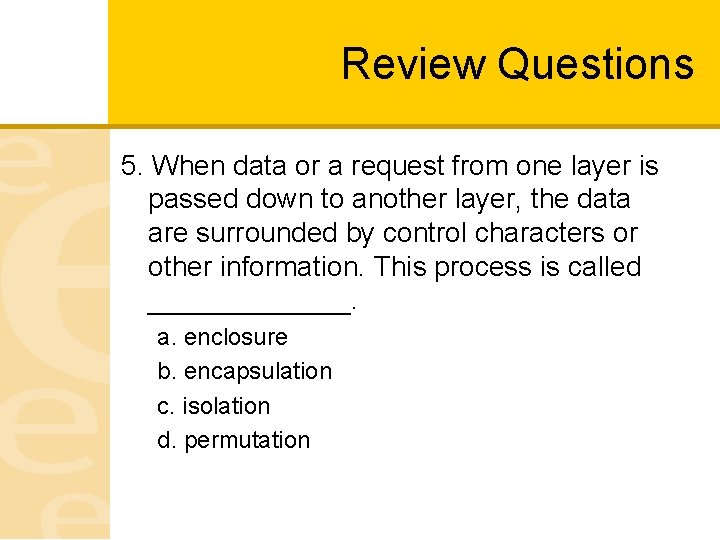
More OSI X. 25 standard for data transmission – Used in packet switching networks – 1 st 3 OSI layers (physical, data link, network) Encapsulation: process that surrounds the original data or requests with control characters for routing and error checking
Protocol Data Unit
Internet Architecture Principles Multiplexing – Multiple Independent data streams on one physical communication line Survivability – Message gets through no matter what Service Generality – Useful for multiple purposes Diverse Network Technologies – Accommodate previous network technologies (Arpanet, Satellite-based networks…. )
TCP/IP Transmission Control Protocol / Internet Protocol Advanced Research Project Agency (ARPA) – Arpanet TCP/IP = 4 or 5 layers of OSI Model
OSI –TCP/IP Models OSI Model TCP/IP L 7 Application L 6 Presentation L 5 Session L 4 Transport L 3 Network L 2 Data Link Application Transport Internet L 2 Data link (Network interface) L 1 Physical (Hardware)
Protocol Stack Protocol – Set of rules used for communication between 2 points on a network What does the transportation header contain? Pg 76
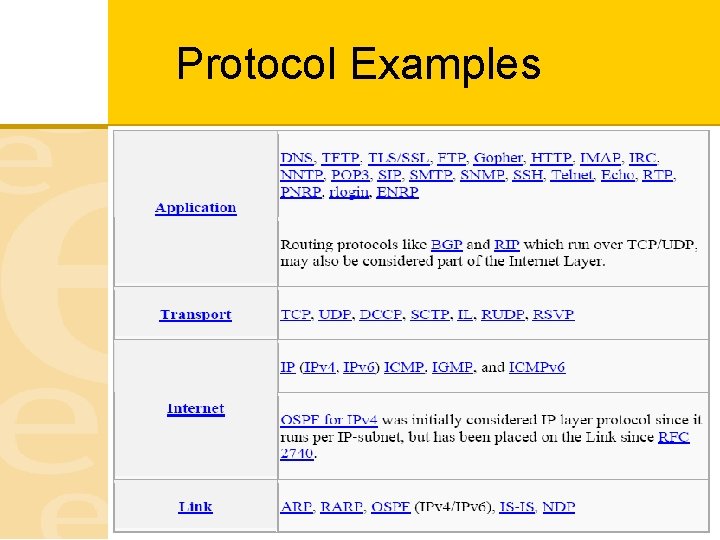
Protocol Examples
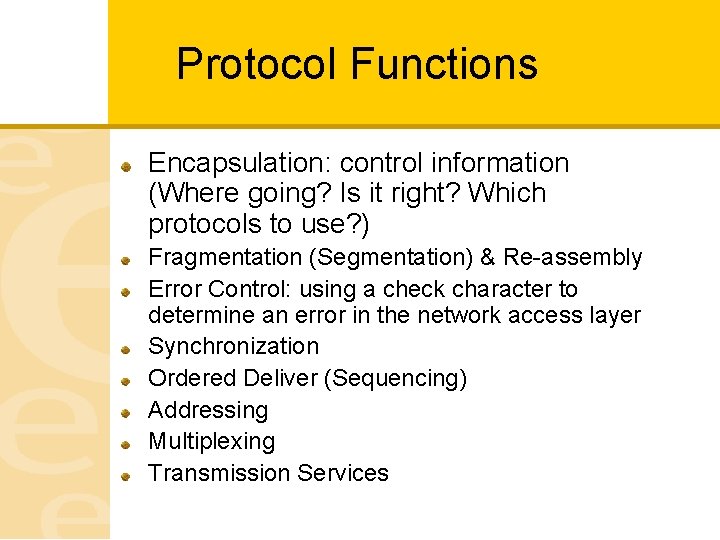
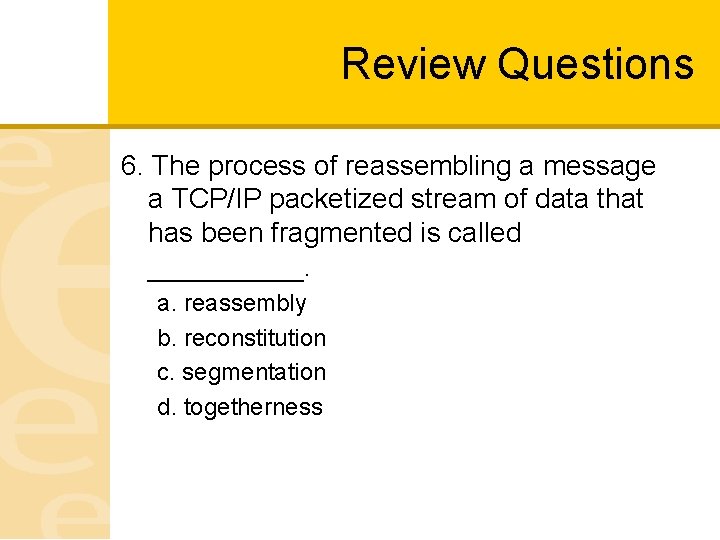
Protocol Functions Encapsulation: control information (Where going? Is it right? Which protocols to use? ) Fragmentation (Segmentation) & Re-assembly Error Control: using a check character to determine an error in the network access layer Synchronization Ordered Deliver (Sequencing) Addressing Multiplexing Transmission Services
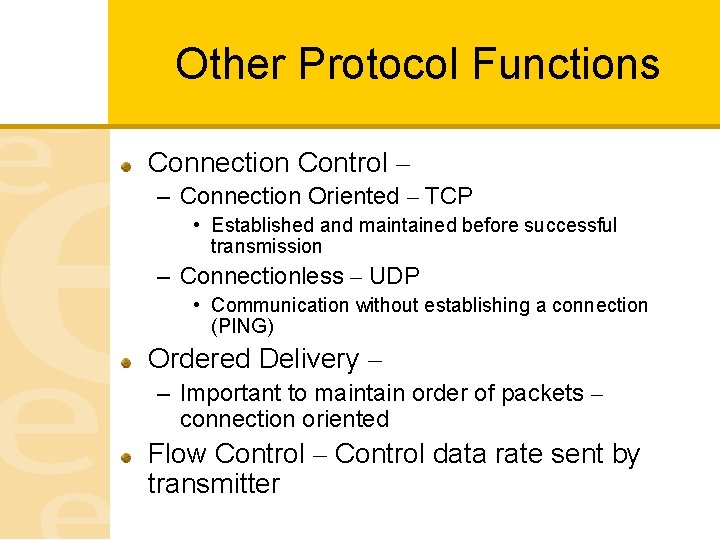
Other Protocol Functions Connection Control – – Connection Oriented – TCP • Established and maintained before successful transmission – Connectionless – UDP • Communication without establishing a connection (PING) Ordered Delivery – – Important to maintain order of packets – connection oriented Flow Control – Control data rate sent by transmitter
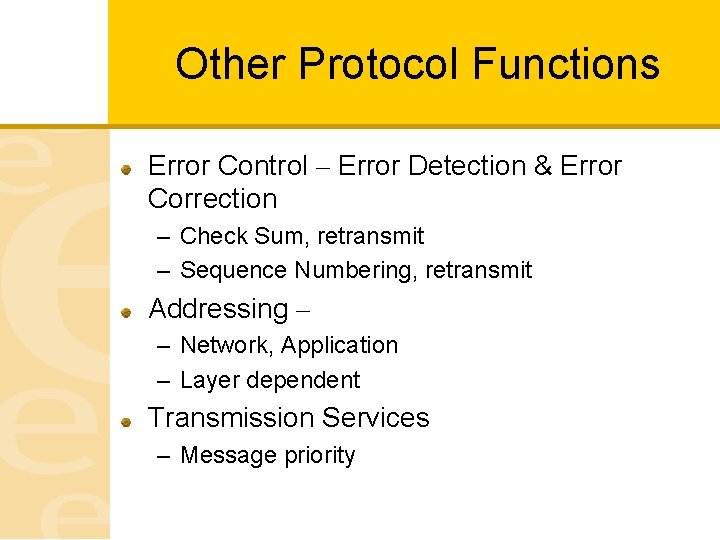
Other Protocol Functions Error Control – Error Detection & Error Correction – Check Sum, retransmit – Sequence Numbering, retransmit Addressing – – Network, Application – Layer dependent Transmission Services – Message priority
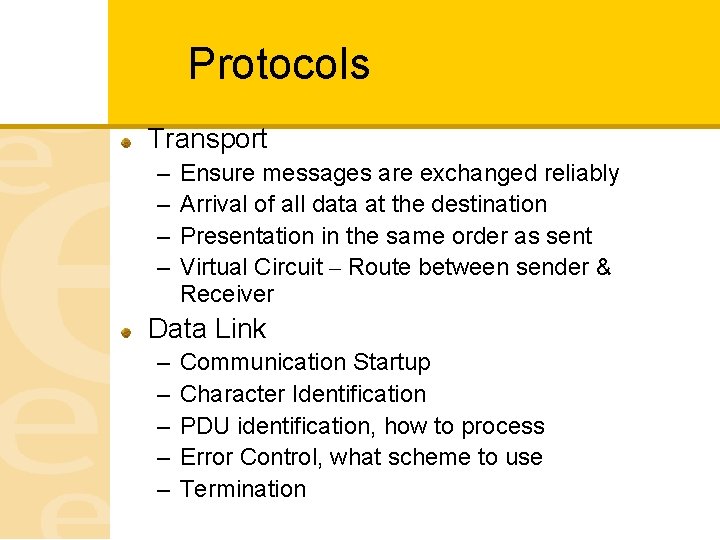
Protocols Transport – – Ensure messages are exchanged reliably Arrival of all data at the destination Presentation in the same order as sent Virtual Circuit – Route between sender & Receiver Data Link – – – Communication Startup Character Identification PDU identification, how to process Error Control, what scheme to use Termination
Review Questions 1. Communications standards define what needs to be done but not how to do it. a. True b. False
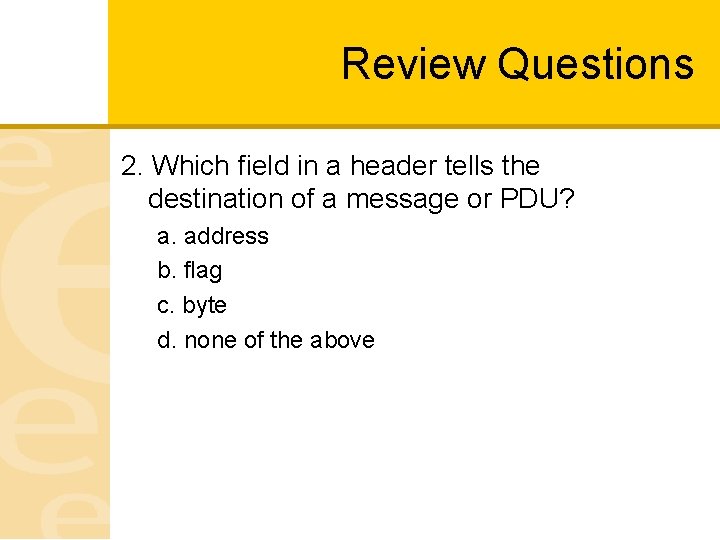
Review Questions 2. Which field in a header tells the destination of a message or PDU? a. address b. flag c. byte d. none of the above
Review Questions 3. It is more difficult for a machine to process a code if all of the bits are of the same duration. a. True b. False
Review Questions 4. The combination of the first three layers of the OSI model is the standard for the _______. a. X. 25 standard for data transmission b. V. standard c. consolidated transmission standard d. Consolidated Transmission Protocol
Review Questions 5. When data or a request from one layer is passed down to another layer, the data are surrounded by control characters or other information. This process is called _______. a. enclosure b. encapsulation c. isolation d. permutation
Review Questions 6. The process of reassembling a message a TCP/IP packetized stream of data that has been fragmented is called _____. a. reassembly b. reconstitution c. segmentation d. togetherness
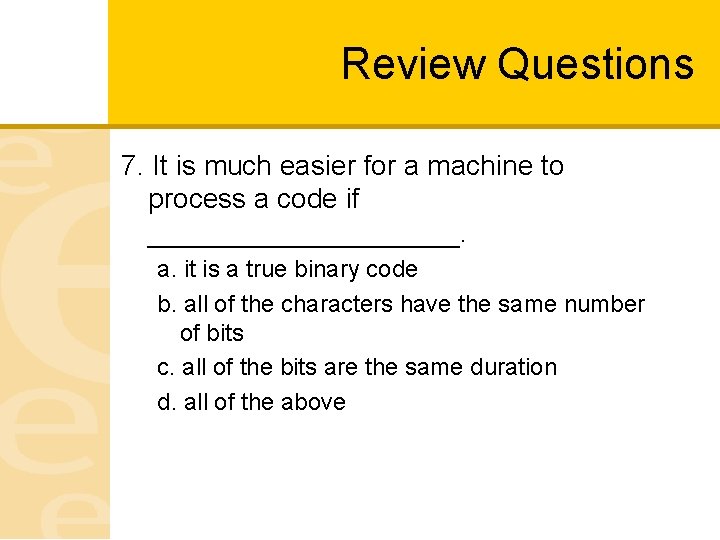
Review Questions 7. It is much easier for a machine to process a code if __________. a. it is a true binary code b. all of the characters have the same number of bits c. all of the bits are the same duration d. all of the above
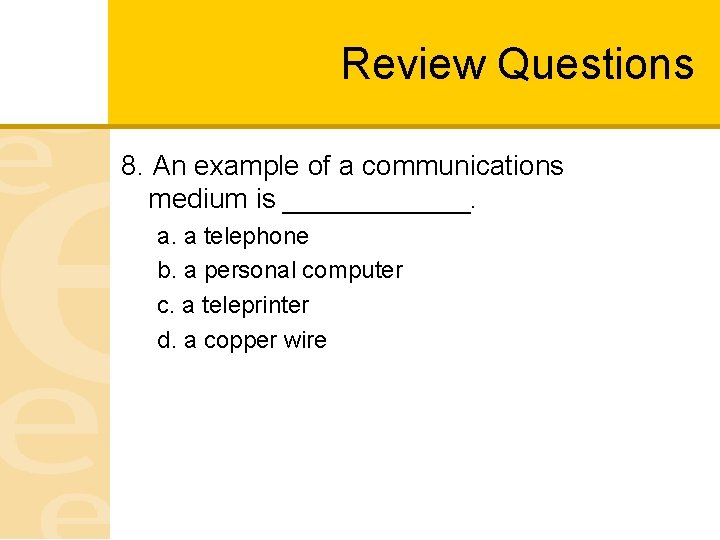
Review Questions 8. An example of a communications medium is ______. a. a telephone b. a personal computer c. a teleprinter d. a copper wire
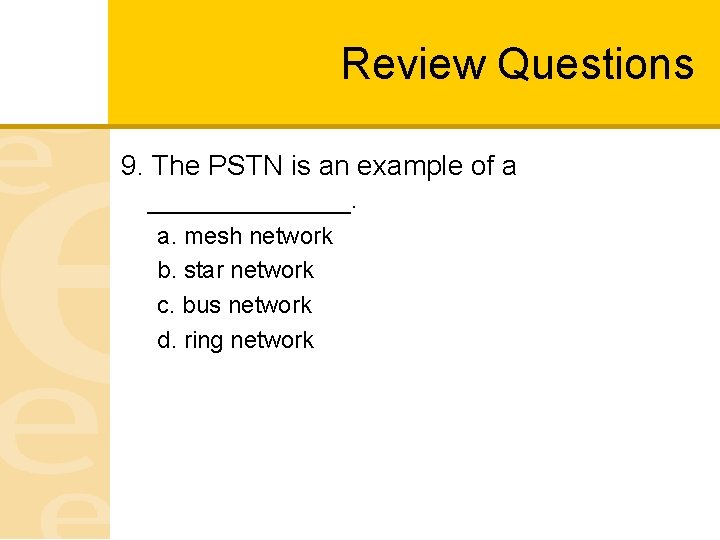
Review Questions 9. The PSTN is an example of a _______. a. mesh network b. star network c. bus network d. ring network
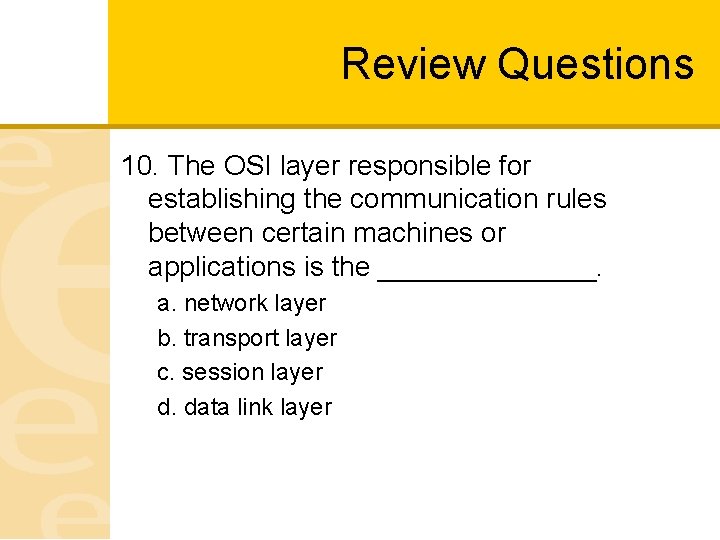
Review Questions 10. The OSI layer responsible for establishing the communication rules between certain machines or applications is the _______. a. network layer b. transport layer c. session layer d. data link layer
Homework Assignment: Due Next Week – Review: • • – Chapter 3, pp. 48 -66 Chapter 4, pp. 72 -82 Read: • • – Chapter 5, pp. 90 -101 Chapter 14, pp. 376 -411 Complete: • • • Assignment 2. 1: Chapter 3 & 4 Multiple Choice Questions Assignment 2. 2: Binary Exercise Assignment 2. 3: Draw OSI Model (pg 57) by Hand