
Network Architecture and Design Chaper5 Requirements definition Slides

- Slides: 30
Network Architecture and Design Chaper-5
Requirements definition Slides Prepared By: Kaif Jamal Gilani (Course Coordinator) Kaif Jamal Gilani (Course Teacher) Department of CNET Faculty of CS&IS Jazan University
�User Outline Requirements �Items to be inventoried �Requirement categories �Traffic sizing �Traffic characteristics �Time and Delay consideration �Network Delay elements �Connectivity types �Availability and Reliability �Service Aspects �Budget constraints
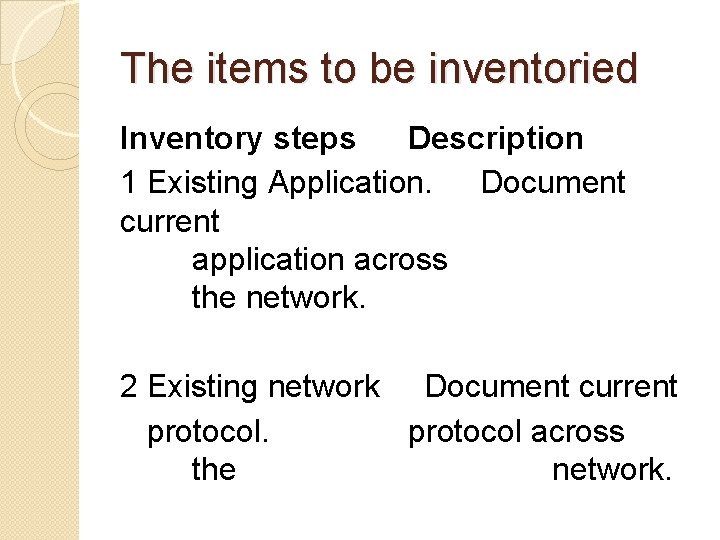
User requirements �There are two basic steps that is to be fulfilled by the designer, that is Performance and Documentation of an inventory of current network and requirements & documentation of the expectation of new network. �Cisco recommends 12 items is to be inventoried in the customers current network but we are taking only 7 items
The items to be inventoried Inventory steps Description 1 Existing Application. Document current application across the network. 2 Existing network Document current protocol across the network.
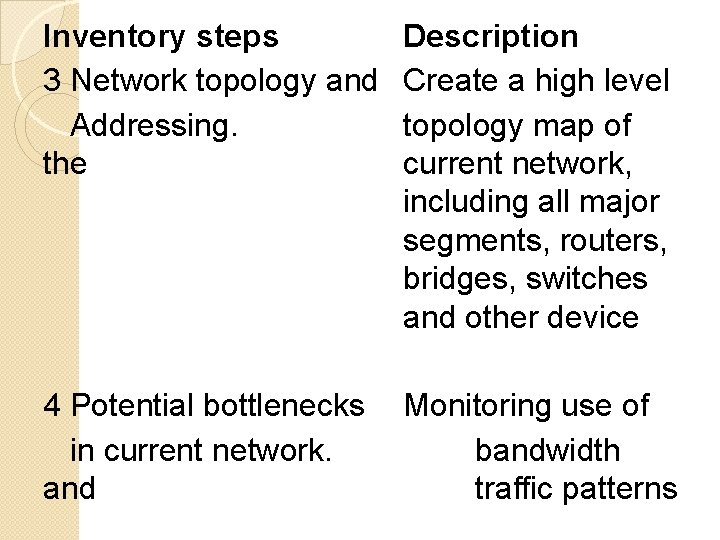
Inventory steps 3 Network topology and Addressing. the Description Create a high level topology map of current network, including all major segments, routers, bridges, switches and other device 4 Potential bottlenecks in current network. and Monitoring use of bandwidth traffic patterns
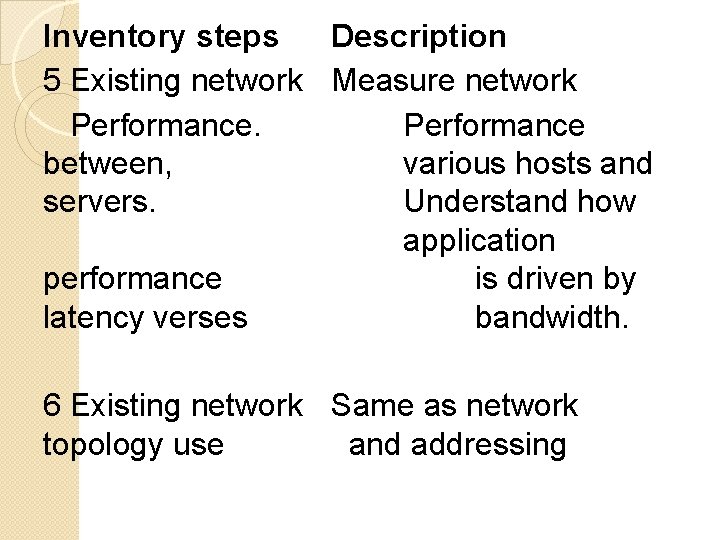
Inventory steps Description 5 Existing network Measure network Performance between, various hosts and servers. Understand how application performance is driven by latency verses bandwidth. 6 Existing network Same as network topology use and addressing
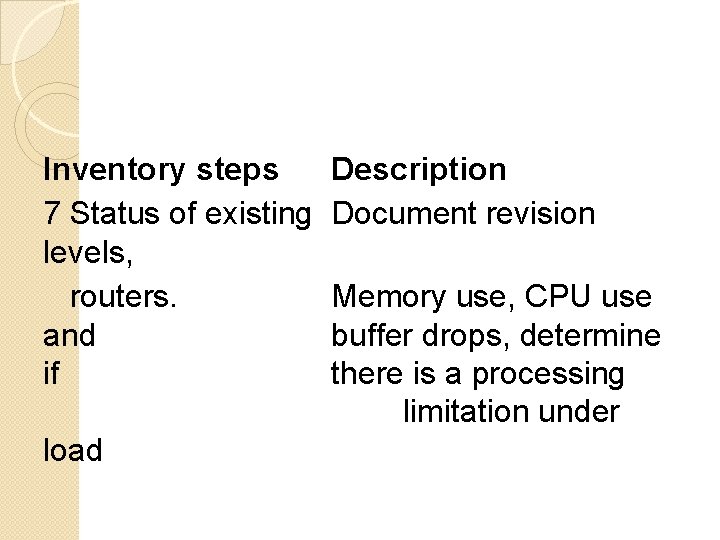
Inventory steps 7 Status of existing levels, routers. and if load Description Document revision Memory use, CPU use buffer drops, determine there is a processing limitation under
Requirement categories �Requirement are classified into three different categories, they are as follows �Business Requirements �Security Requirements �Manageability Requirements
Business Requirements Business requirements includes the following items. �Timeline �Staffing �Training �Budgets and �Project approval
Security Requirements Security requirements are very critical to most business, it includes the following. �Who can access the network? �Each resource. �What can be accessed and when? �Determine the appropriate security level for the resources and network you are trying to protect.
Manageability Requirements �Manageability Requirements can vary across the board from simple PING program documentation that each device in the network is alive to full blown network management system.
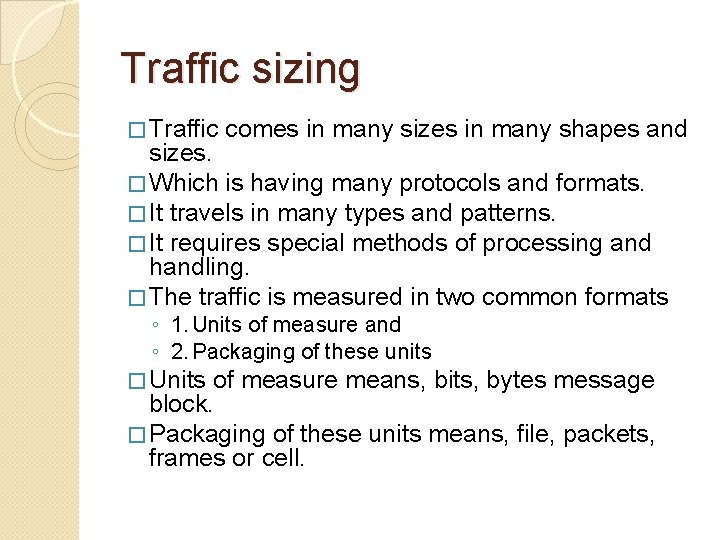
Traffic sizing � Traffic comes in many sizes in many shapes and sizes. � Which is having many protocols and formats. � It travels in many types and patterns. � It requires special methods of processing and handling. � The traffic is measured in two common formats ◦ 1. Units of measure and ◦ 2. Packaging of these units � Units of measure means, bits, bytes message block. � Packaging of these units means, file, packets, frames or cell.
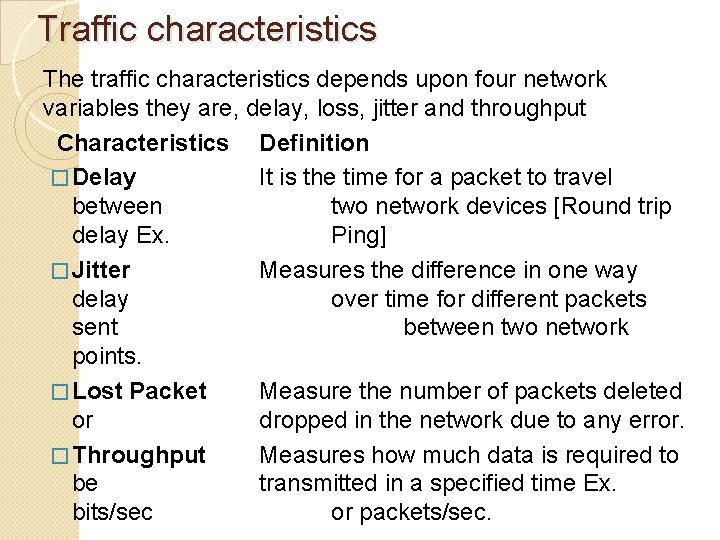
Traffic characteristics The traffic characteristics depends upon four network variables they are, delay, loss, jitter and throughput Characteristics Definition � Delay It is the time for a packet to travel between two network devices [Round trip delay Ex. Ping] � Jitter Measures the difference in one way delay over time for different packets sent between two network points. � Lost Packet Measure the number of packets deleted or dropped in the network due to any error. � Throughput Measures how much data is required to be transmitted in a specified time Ex. bits/sec or packets/sec.
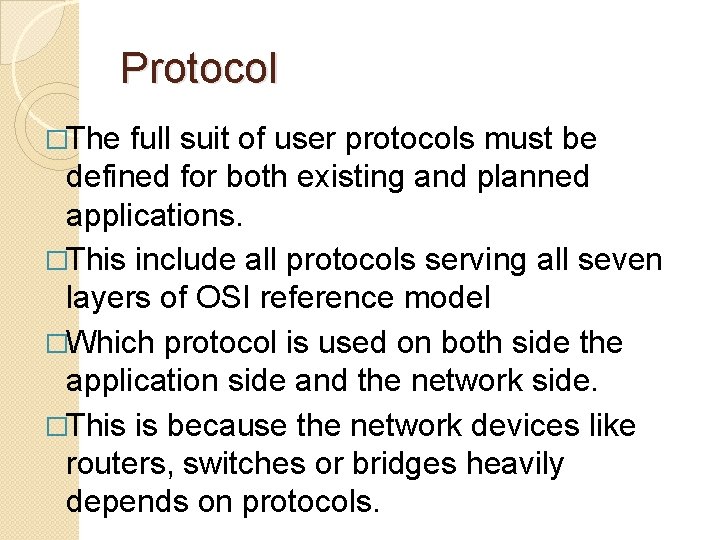
Protocol �The full suit of user protocols must be defined for both existing and planned applications. �This include all protocols serving all seven layers of OSI reference model �Which protocol is used on both side the application side and the network side. �This is because the network devices like routers, switches or bridges heavily depends on protocols.
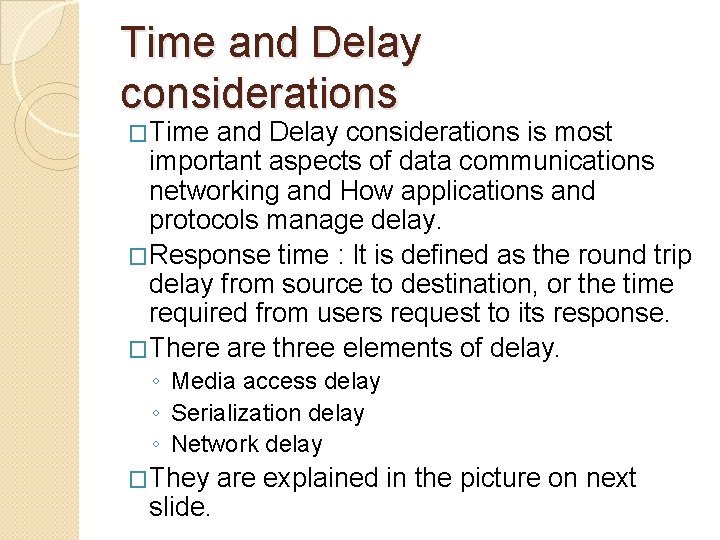
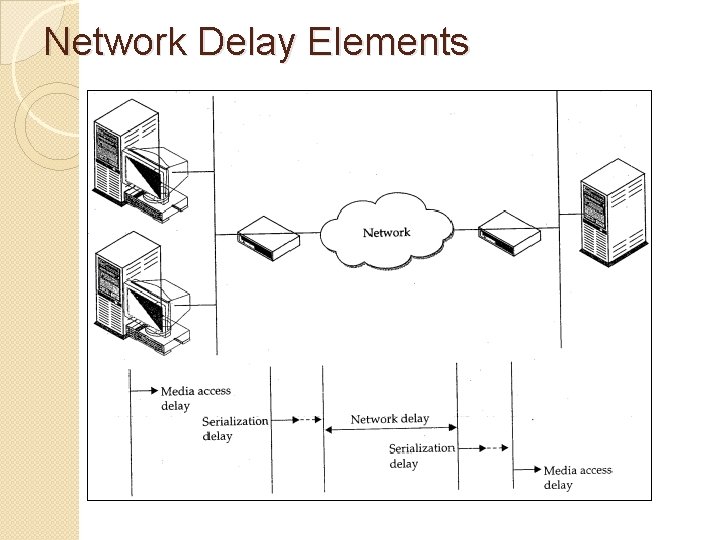
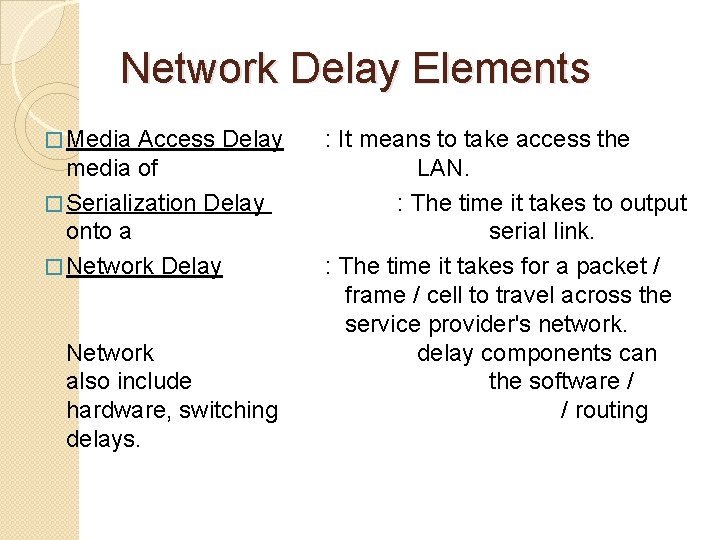
Time and Delay considerations �Time and Delay considerations is most important aspects of data communications networking and How applications and protocols manage delay. �Response time : It is defined as the round trip delay from source to destination, or the time required from users request to its response. �There are three elements of delay. ◦ Media access delay ◦ Serialization delay ◦ Network delay �They slide. are explained in the picture on next
Network Delay Elements
Network Delay Elements � Media Access Delay media of � Serialization Delay onto a � Network Delay Network also include hardware, switching delays. : It means to take access the LAN. : The time it takes to output serial link. : The time it takes for a packet / frame / cell to travel across the service provider's network. delay components can the software / / routing
Connectivity �Connectivity is with respect to user connectivity requirements. �User connectivity can be defines as existing or available connectivity methods. �Like Dial up connectivity, DSL connectivity or cable access. �Now we will see user to network and network to network connectivity.
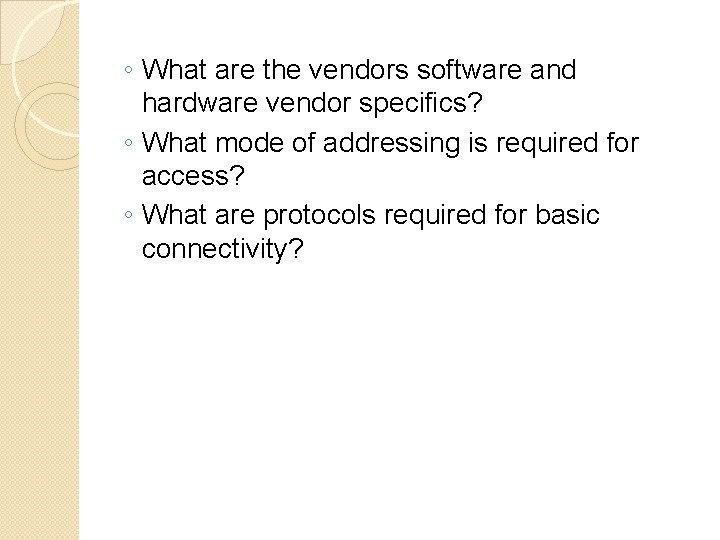
User-to-network �The following points are to be examined for user-to- network connectivity. ◦ What is minimum speed required for connectivity? ◦ What types of devices will be connected? ◦ What type of data rates can they transmit? ◦ What is distance involved between user equipment and data communication equipment?
◦ What are the vendors software and hardware vendor specifics? ◦ What mode of addressing is required for access? ◦ What are protocols required for basic connectivity?
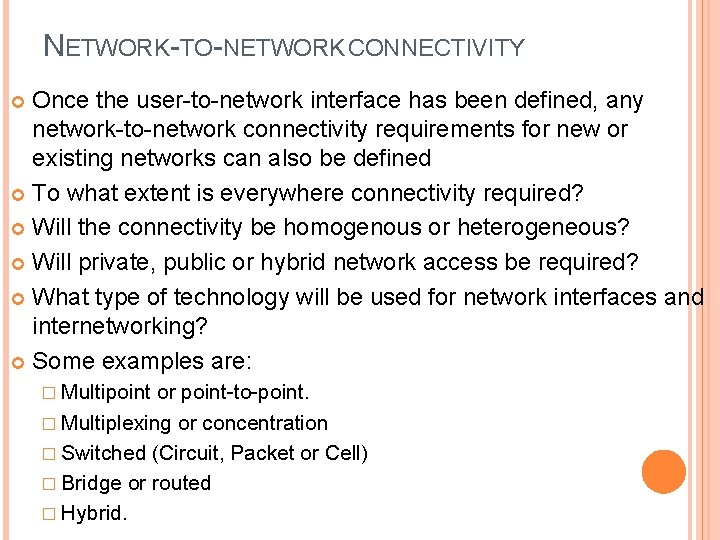
NETWORK-TO-NETWORK CONNECTIVITY Once the user-to-network interface has been defined, any network-to-network connectivity requirements for new or existing networks can also be defined To what extent is everywhere connectivity required? Will the connectivity be homogenous or heterogeneous? Will private, public or hybrid network access be required? What type of technology will be used for network interfaces and internetworking? Some examples are: � Multipoint or point-to-point. � Multiplexing or concentration � Switched (Circuit, Packet or Cell) � Bridge or routed � Hybrid.
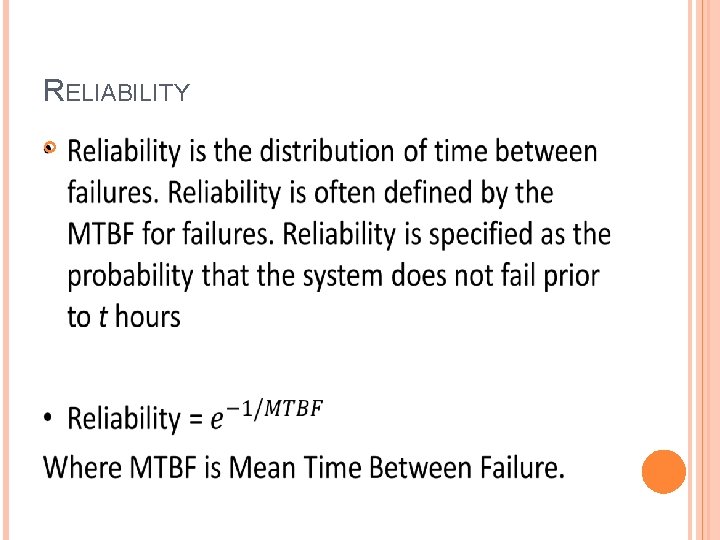
AVAILABILITY AND RELIABILITY Two quality measures of hardware and software must be known by the network designer that is availability and reliability. These two measures are depend on MTBF (Mean Time Between Failure) and MTTR (Mean Time To Repair) this is given by the vendor.
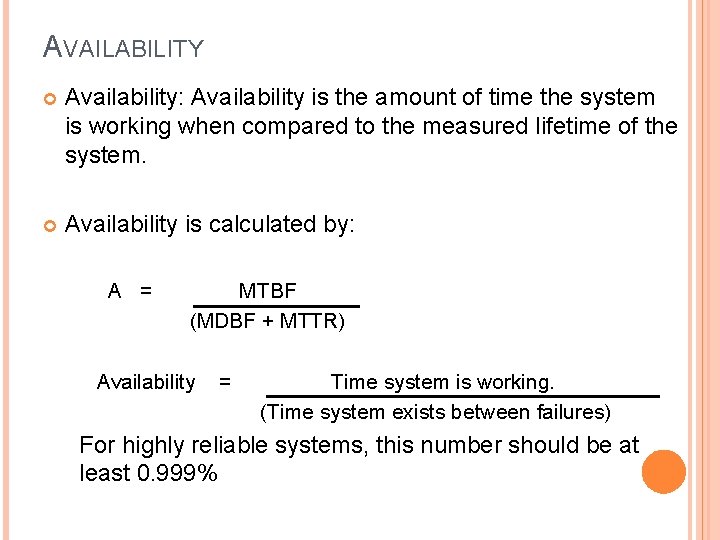
AVAILABILITY Availability: Availability is the amount of time the system is working when compared to the measured lifetime of the system. Availability is calculated by: A = MTBF (MDBF + MTTR) Availability = Time system is working. (Time system exists between failures) For highly reliable systems, this number should be at least 0. 999%
RELIABILITY
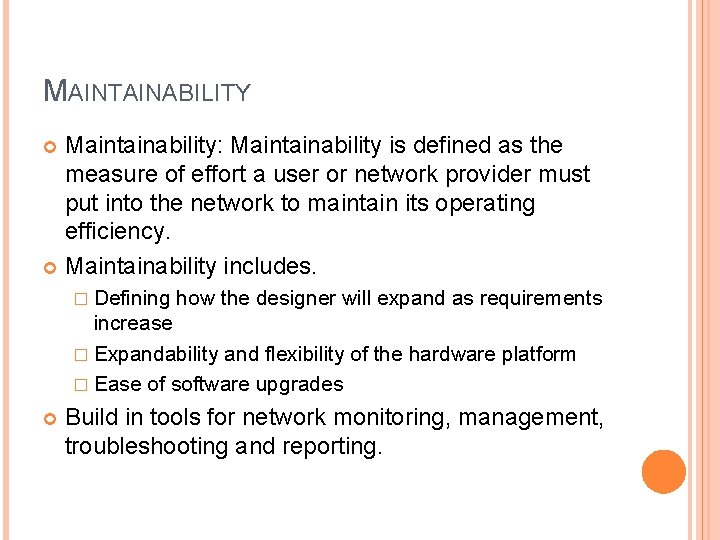
MAINTAINABILITY Maintainability: Maintainability is defined as the measure of effort a user or network provider must put into the network to maintain its operating efficiency. Maintainability includes. � Defining how the designer will expand as requirements increase � Expandability and flexibility of the hardware platform � Ease of software upgrades Build in tools for network monitoring, management, troubleshooting and reporting.
SERVICE ASPECTS Service aspects such as network management, billing, security, user support and disaster recovery are important topic with range of standard and proprietary solutions. Network designer must understand the capabilities offered by each technology and protocol.
BUDGET CONSTRAINTS It means the limitations of budget: The designer must design the network within a given budget, accommodating the largest number of users and applications within the available budget. This becomes a balance between cost, capabilities and connectivity. A network becomes cost justified if it improves operating efficiency, helps users meet corporate objectives. There are two things who controls the network budget, the network manager and the users, but most often it is the network manager. When user have budgetary control the question is, what is placed on the network? When network manager has control and the user is a customer, the user tries to place everything possible over the network.
VIDEOS https: //www. youtube. com/watch? v=qp. Kg. VTCm 06 c
THANK YOU