
Network and Grid Computing Modeling Algorithms and Software

- Slides: 19
Network and Grid Computing –Modeling, Algorithms, and Software Mo Mu Joint work with Xiao Hong Zhu, Falcon Siu
Trend in High Performance and Supercomputing • • Parallel Computing Distributed Computing Network Computing Grid Computing
Applied Math and Scientific Computing • • • Single model applications Multi-scale problems Multi-domain problems Multi-media problems Multi-modeling problems
Multi-modeling Problems • • • Inviscid-viscous flows Compressible-incompressible flows Turbulent-laminar flows Interface stability with different media Composite materials Complex systems
Formulation • Different models in local regions • Interface coupling conditions • Complexity across the interfaces – Physical • Discontinuity • Boundary layer – Geometrical • Topology • Moving interfaces
Applications • Originated from a underlying problem where a global model approximation might not be applicable – physically or mathematically • Reduced from a underlying global model – Computational efficiency – Approximation accuracy – Stiffness – Domain decomposition
Characteristics • Modeling complex physical systems • Sharp resolution of interface structures • Local solvers with mature methods and codes • Software integration • Grid computing • More accurate and efficient in some cases
Research Issues • Modeling • Algorithms • Software
Case Study: Inviscid-Viscous Flow • Hybrid hyperbolic and parabolic problem • Example: Euler/N-S coupling – Characteristics • Nonlinear • System of equations • 2 D or 3 D – Existing work (Q, Cai, etc. ) • Linear • Scalar equation • 2 D
Simplest Case • 1 D • Scalar equation • Linear
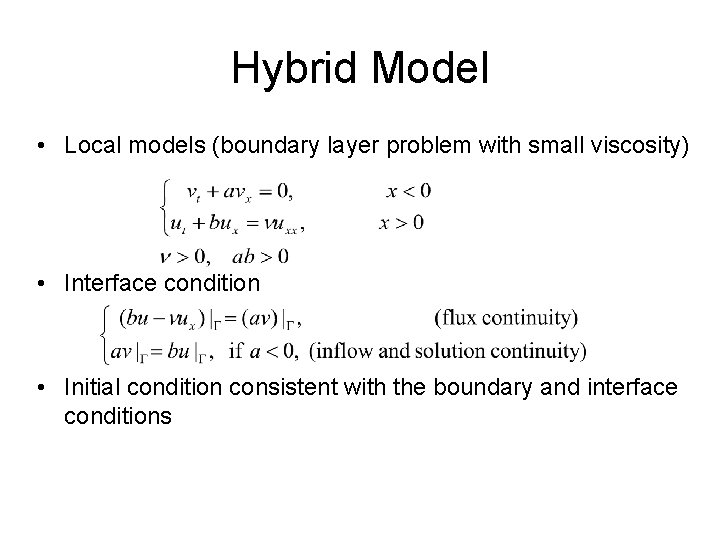
Hybrid Model • Local models (boundary layer problem with small viscosity) • Interface condition • Initial condition consistent with the boundary and interface conditions
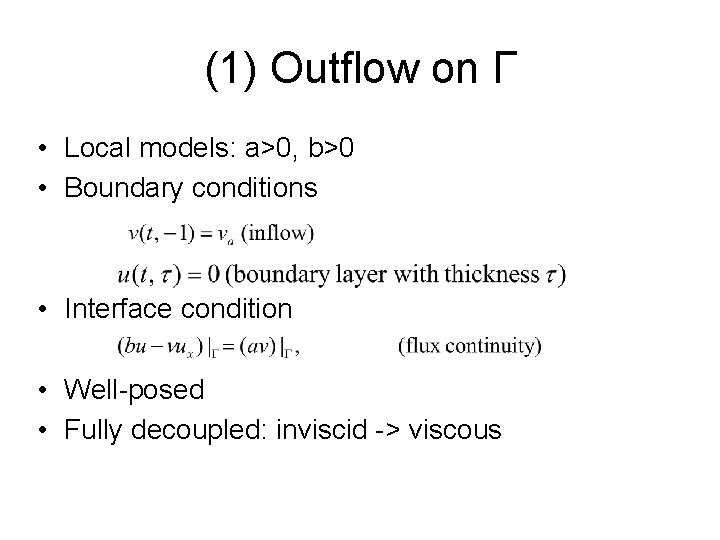
(1) Outflow on Γ • Local models: a>0, b>0 • Boundary conditions • Interface condition • Well-posed • Fully decoupled: inviscid -> viscous
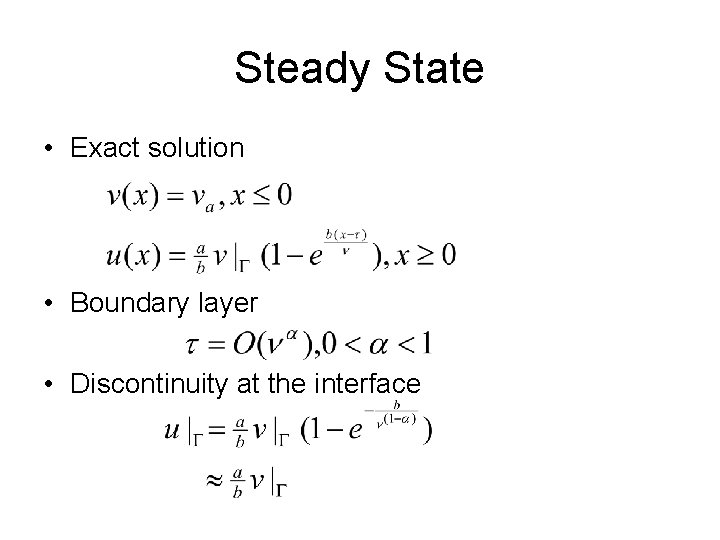
Steady State • Exact solution • Boundary layer • Discontinuity at the interface
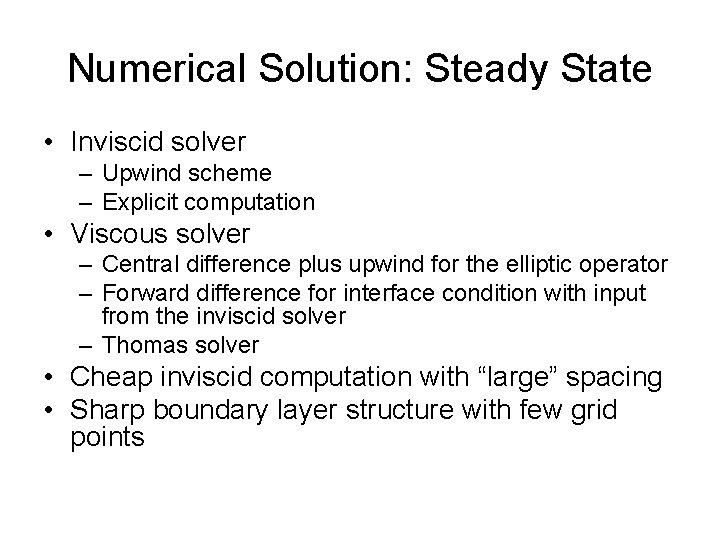
Numerical Solution: Steady State • Inviscid solver – Upwind scheme – Explicit computation • Viscous solver – Central difference plus upwind for the elliptic operator – Forward difference for interface condition with input from the inviscid solver – Thomas solver • Cheap inviscid computation with “large” spacing • Sharp boundary layer structure with few grid points
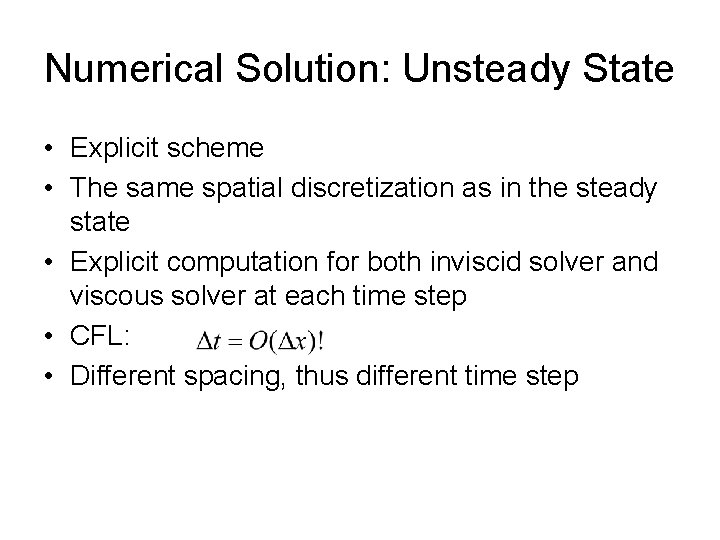
Numerical Solution: Unsteady State • Explicit scheme • The same spatial discretization as in the steady state • Explicit computation for both inviscid solver and viscous solver at each time step • CFL: • Different spacing, thus different time step
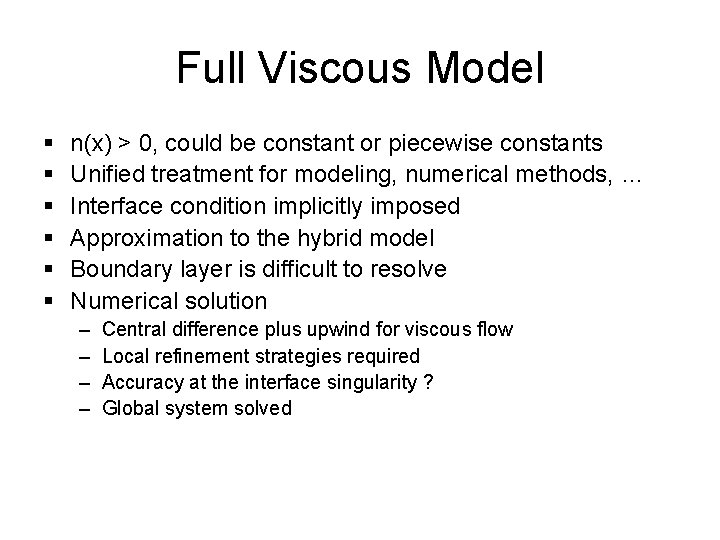
Full Viscous Model § § § n(x) > 0, could be constant or piecewise constants Unified treatment for modeling, numerical methods, … Interface condition implicitly imposed Approximation to the hybrid model Boundary layer is difficult to resolve Numerical solution – – Central difference plus upwind for viscous flow Local refinement strategies required Accuracy at the interface singularity ? Global system solved
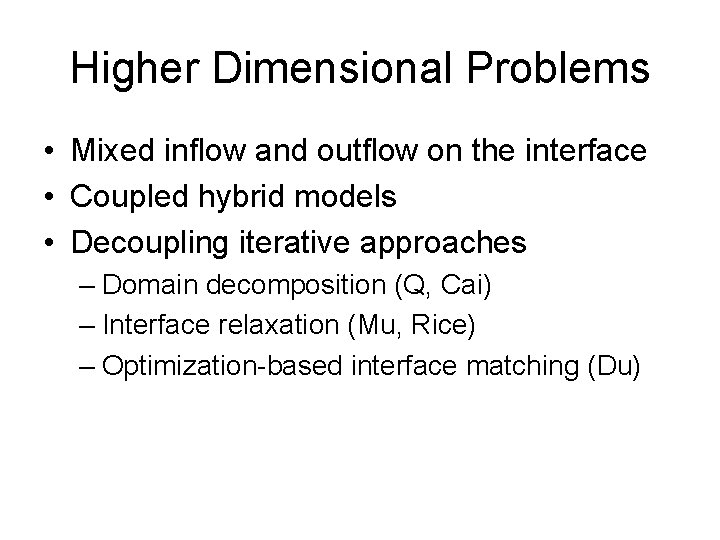
Higher Dimensional Problems • Mixed inflow and outflow on the interface • Coupled hybrid models • Decoupling iterative approaches – Domain decomposition (Q, Cai) – Interface relaxation (Mu, Rice) – Optimization-based interface matching (Du)
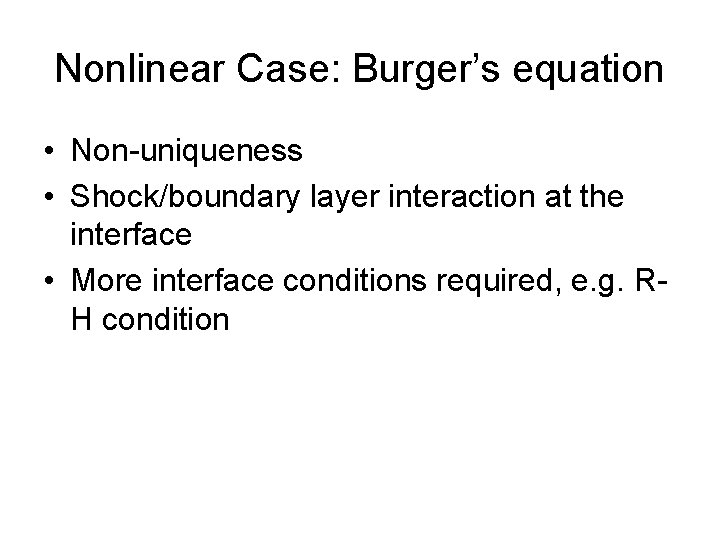
Nonlinear Case: Burger’s equation • Non-uniqueness • Shock/boundary layer interaction at the interface • More interface conditions required, e. g. RH condition
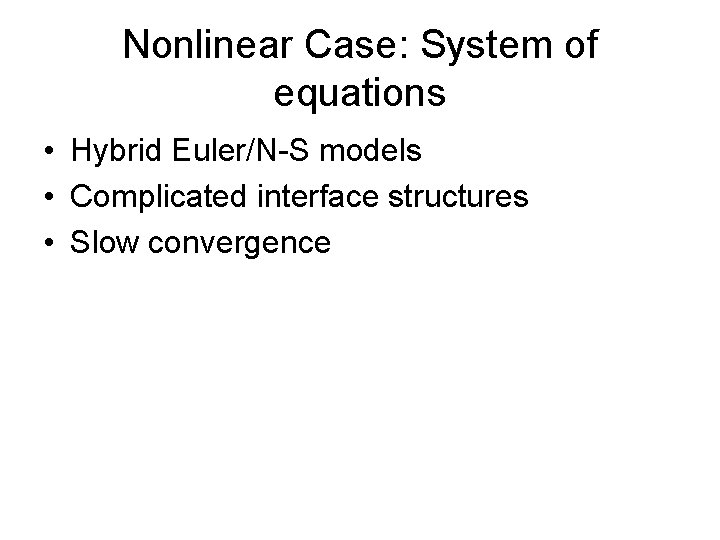
Nonlinear Case: System of equations • Hybrid Euler/N-S models • Complicated interface structures • Slow convergence