
Network Analysis by Barry Wellman Three Ways to
Network Analysis by Barry Wellman
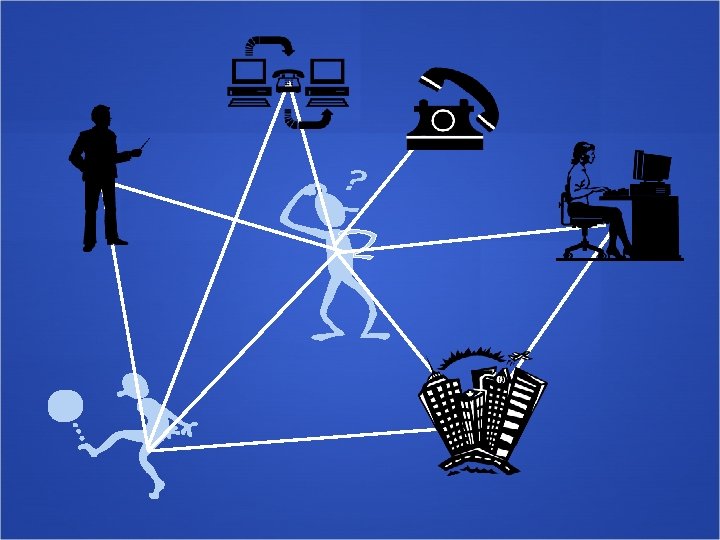
Three Ways to Look at Reality Categories All Possess One or More Properties as an Aggregate of Individuals Examples: Men, Developed Countries Groups (Almost) All Densely-Knit Within Tight Boundary Thought of as a Solitary Unit (Really a Special Network) Family, Workgroup, Community Networks Set of Connected Units: People, Organizations, Networks Can Belong to Multiple Networks Examples: Friendship, Organizational, Inter-, World-System, Internet
Nodes, Relationships & Ties Nodes: A Unit That Possibly is Connected Individuals, Households, Groups, Organizations, States Relationships (A Specific Type of Connection) Gives Emotional Support Sends Money To Attacks Ties (One or More Relationships) Friendship (with possibly many relationships)
A Network is More Than The Sum of Its Ties A Network Consists of One or More Nodes Could be Persons, Organizations, Groups, Nations Connected by One or More Ties Could be One or More Relationships That Form Distinct, Analyzable Patterns Can Study Patterns of Relationships OR Ties 5
Overview - Journals Wellman founded, Connections, 1977 Informal journal: “Useful” articles, news, gossip, grants, abstracts, book summaries Bill Richards, Tom Valente edit now Lin Freeman founded, Social Networks, 1978 Formal journal: Refereed articles Ronald Breiger now co-editor David Krackhardt founded, J of Social Structure, 2000 Online, Refereed Lots of visuals Articles Appear Occasionally when their time has come 6
Overview – Key Books 1) 2) 3) 4) 5) 6) 7) 8) 9) 10) 11) 12) 13) Elizabeth Bott, Family & Social Network, 1957 J. Clyde Mitchell, Networks, Norms & Institutions, 1973 Holland & Leinhardt, Perspectives on Social Network Research, 1979 S. D. Berkowitz, An Introduction to Structural Analysis, 1982 Knoke & Kuklinski, Network Analysis, 1983 Charles Tilly, Big Structures, Large Processes, Huge Comparisons, 1984 David Knoke, Political Networks, 1990 John Scott, Social Network Analysis, 1991 Ron Burt, Structural Holes, 1992 Manuel Castells, The Rise of Network Society, 1996, 2000 Wasserman & Faust, Social Network Analysis, 1992 Nan Lin, Social Capital (monograph & reader), 2001 Monge & Contractor, Theories of Communication Networks, 2003
Overview – Software 1) UCINet – Whole Network Analysis 2) Multi. Net – Whole Network Analysis 3) P*Star – Dyadic Analysis 4) Krackplot – Network Visualization 5) Pajek – Network Visualization 6) Personal Network Analysis 1) SPSS/SAS – See Wellman, et al. “How To…” papers
The Social Network Approach The world is composed of networks - not densely-knit, tightly-bounded groups Networks provide flexible means of social organization and of thinking about social organization Networks have emergent properties of structure and composition Networks are a major source of social capital mobilizable in themselves and from their contents Networks are self-shaping and reflexive Networks scale up to networks of networks 9
Networked Individualism Moving from a society bound up in little boxes to a multiple network – and networking – society Networks are a flexible means of social organization Networks are a major source of social capital: mobilizable in themselves & from their contents Networks link: Persons Within organizations Between organizations and institutions 10
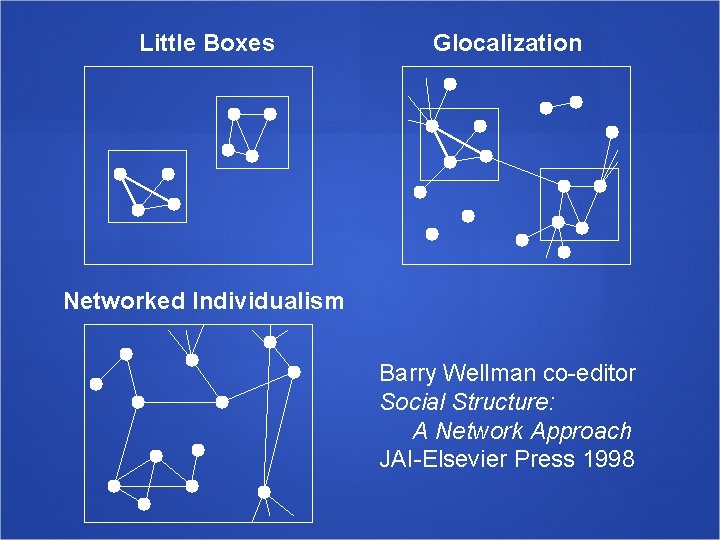
Little Boxes Glocalization Networked Individualism Barry Wellman co-editor Social Structure: A Network Approach JAI-Elsevier Press 1998
Ways of Looking at Networks Whole Networks & Personal Networks Focus on the System or on the Set of Individuals Graphs & Matrices We dream in graphs We analyze in matrices 12
Whole Social Networks Comprehensive Set of Role Relationships in a Full System Analyze Each Role Relationship – Can Combine Composition: % Women; Heterogeneity; % Weak Ties Structure: Pattern of Ties Village, Organization, Kinship, Enclaves, World-System Typical Methods: Cliques, Blocks, Centrality, Flows (1) What is the Real Structure of an Organization? (2) How Does Information Flow Through a Village? 13
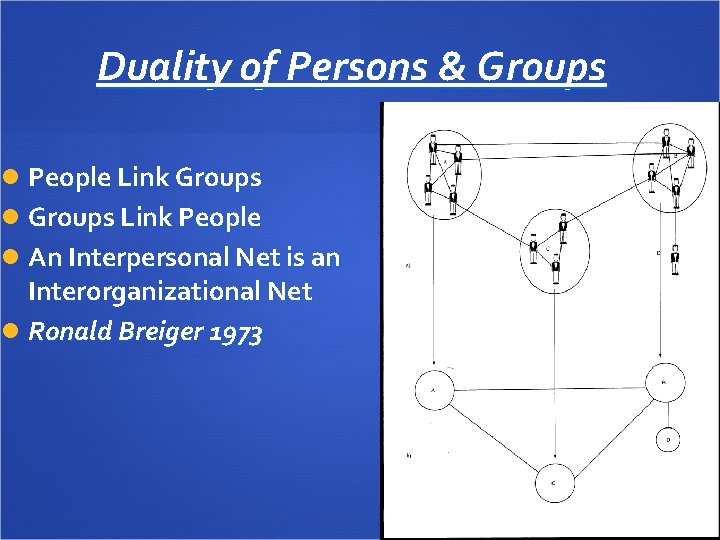
Duality of Persons & Groups People Link Groups Link People An Interpersonal Net is an Interorganizational Net Ronald Breiger 1973 14
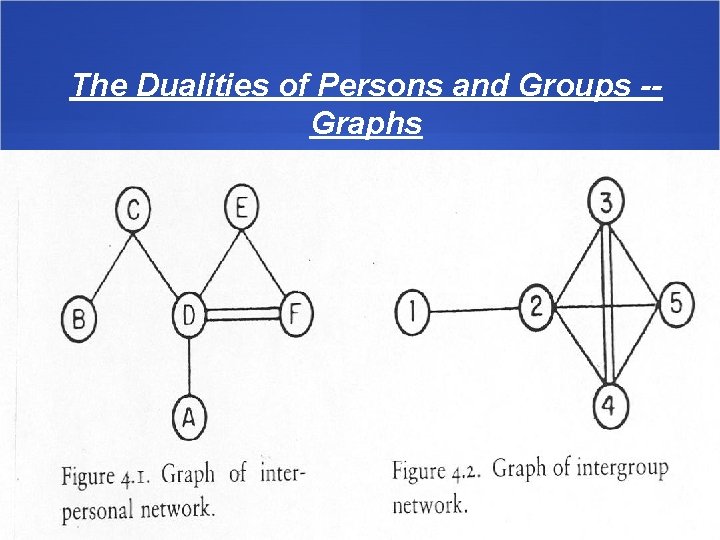
The Dualities of Persons and Groups -Graphs 15
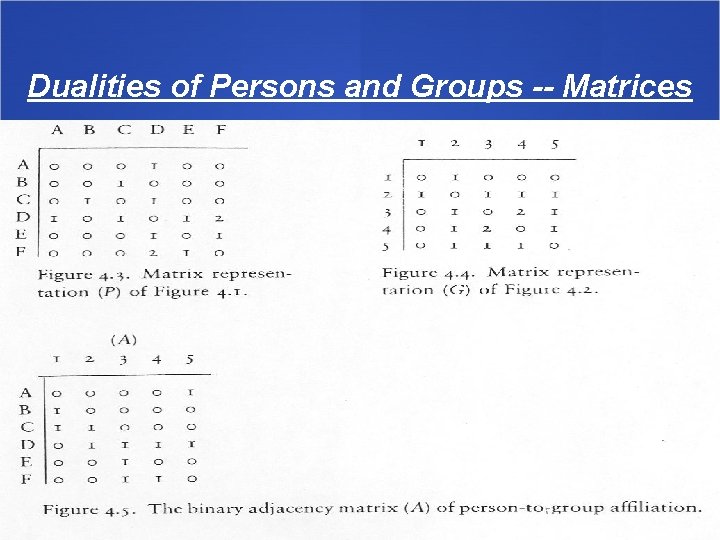
Dualities of Persons and Groups -- Matrices 16
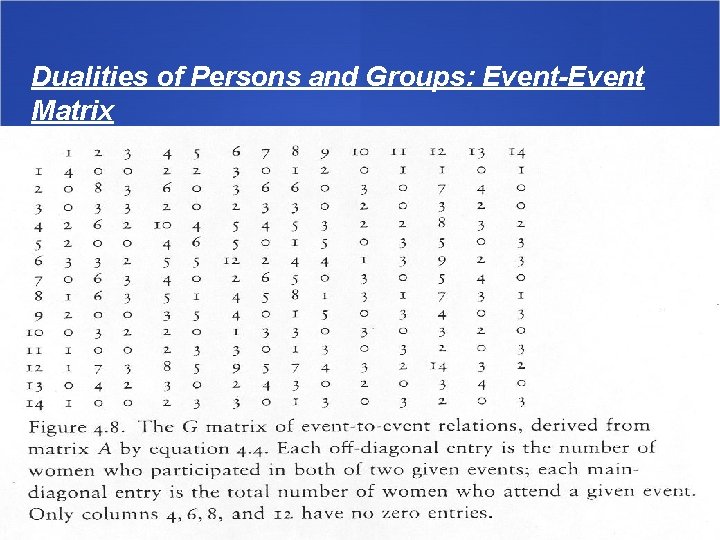
Dualities of Persons and Groups: Event-Event Matrix 17
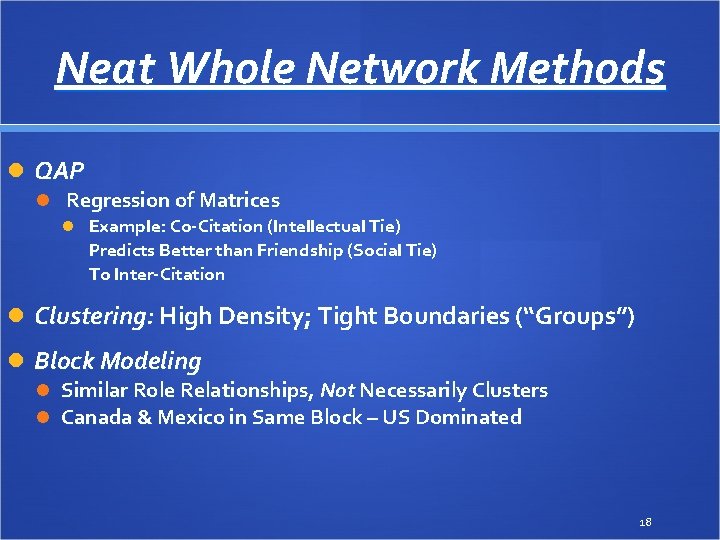
Neat Whole Network Methods QAP Regression of Matrices Example: Co-Citation (Intellectual Tie) Predicts Better than Friendship (Social Tie) To Inter-Citation Clustering: High Density; Tight Boundaries (“Groups”) Block Modeling Similar Role Relationships, Not Necessarily Clusters Canada & Mexico in Same Block – US Dominated 18
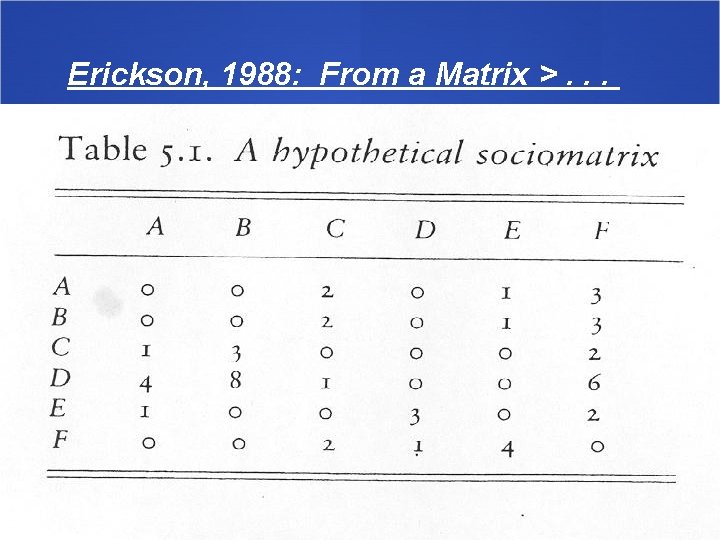
Erickson, 1988: From a Matrix >. . . 19
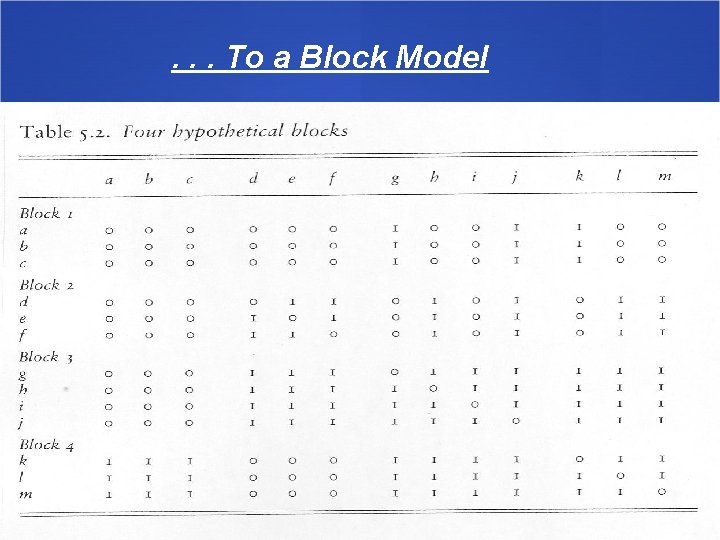
. . . To a Block Model 20
Costs of Whole Network Analysis Requires a Roster of Entire Population Requires (Imposition of) a Social Boundary This May Assume What You Want to Find Hard to Handle Missing Data Needs Special Analytic Packages Becoming Easier to Use 21
Personal Social Networks Ptolemaic Ego-Centered View Good for Unbounded Networks Often Uses Survey Research Example: (1) Do Densely-Knit Networks Provide More Support? (structure) (2) Do More Central People Get More Support? (network) (2) Do Women Provide More Support? (composition) (3) Do Face-to-Face Ties Provide More Support Than Internet Ties? (relational) (4) Are People More Isolated Now? (ego) 22
- Slides: 22