
NETW 1010 IOT Technologies IEEE 802 15 4
- Slides: 32
NETW 1010 IOT Technologies: IEEE 802. 15. 4 Dr. Eng. Tallal Elshabrawy Based on Sensor Networks and Configuration - Fundamentals, Standards, Platforms, and Applications Springer 2007, Chapter 16: Zig. Bee and Their Applications Meng-Shiuan Pan, Yu-Chee Tseng Spring 2019
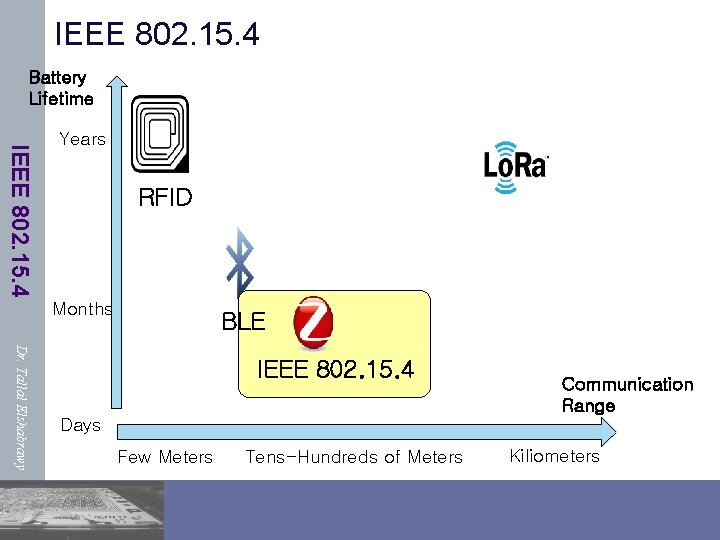
IEEE 802. 15. 4 Battery Lifetime IEEE 802. 15. 4 Years RFID Months BLE Dr. Tallal Elshabrawy IEEE 802. 15. 4 Communication Range Days Few Meters Tens-Hundreds of Meters Kiliometers
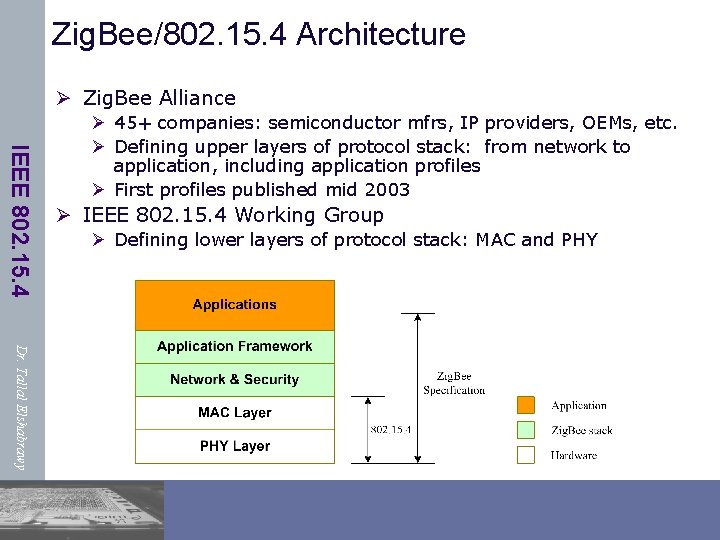
Zig. Bee/802. 15. 4 Architecture Ø Zig. Bee Alliance IEEE 802. 15. 4 Ø 45+ companies: semiconductor mfrs, IP providers, OEMs, etc. Ø Defining upper layers of protocol stack: from network to application, including application profiles Ø First profiles published mid 2003 Ø IEEE 802. 15. 4 Working Group Ø Defining lower layers of protocol stack: MAC and PHY Dr. Tallal Elshabrawy
How is Zig. Bee related to IEEE 802. 15. 4? IEEE 802. 15. 4 Ø Zig. Bee takes full advantage of a powerful physical radio specified by IEEE 802. 15. 4 Ø Zig. Bee adds logical network, security and application software Dr. Tallal Elshabrawy Ø Zig. Bee continues to work closely with the IEEE to ensure an integrated and complete solution for the market
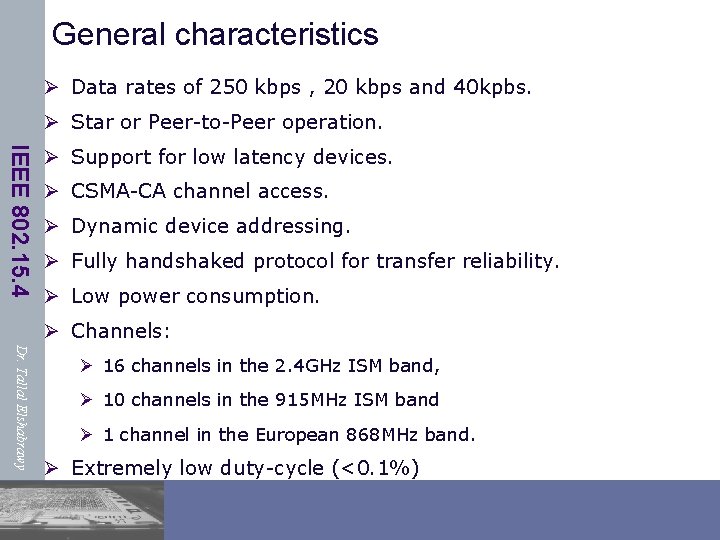
General characteristics Ø Data rates of 250 kbps , 20 kbps and 40 kpbs. Ø Star or Peer-to-Peer operation. IEEE 802. 15. 4 Ø Support for low latency devices. Ø CSMA-CA channel access. Ø Dynamic device addressing. Ø Fully handshaked protocol for transfer reliability. Ø Low power consumption. Ø Channels: Dr. Tallal Elshabrawy Ø 16 channels in the 2. 4 GHz ISM band, Ø 10 channels in the 915 MHz ISM band Ø 1 channel in the European 868 MHz band. Ø Extremely low duty-cycle (<0. 1%)
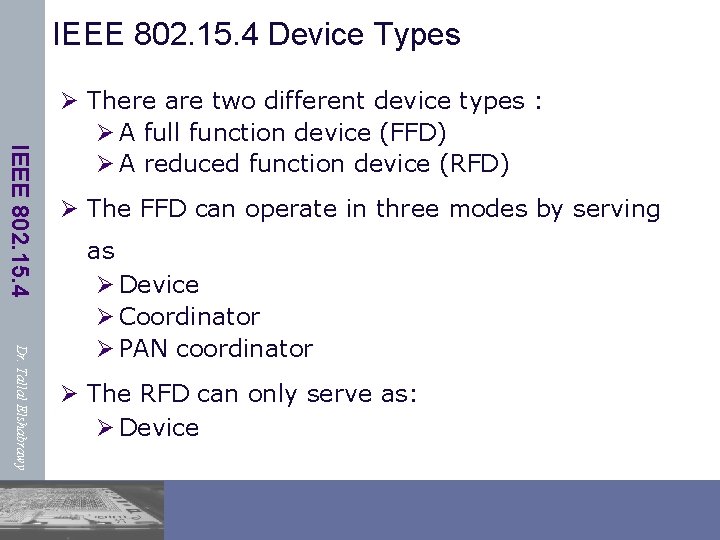
IEEE 802. 15. 4 Device Types IEEE 802. 15. 4 Ø There are two different device types : Ø A full function device (FFD) Ø A reduced function device (RFD) Ø The FFD can operate in three modes by serving Dr. Tallal Elshabrawy as Ø Device Ø Coordinator Ø PAN coordinator Ø The RFD can only serve as: Ø Device
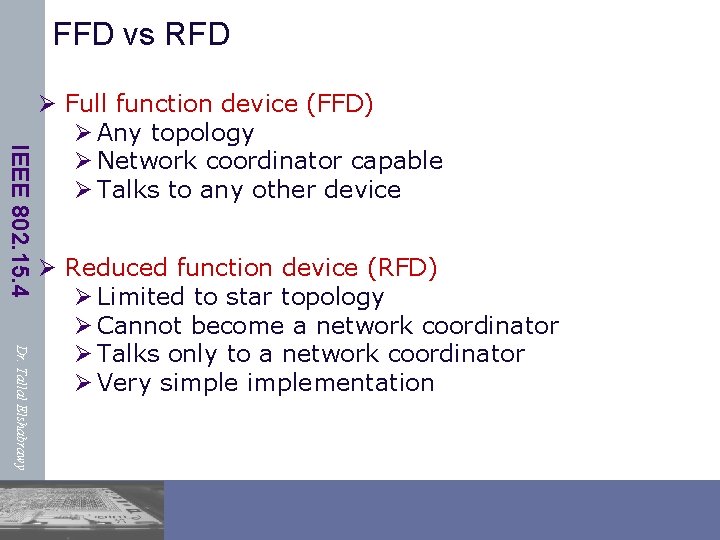
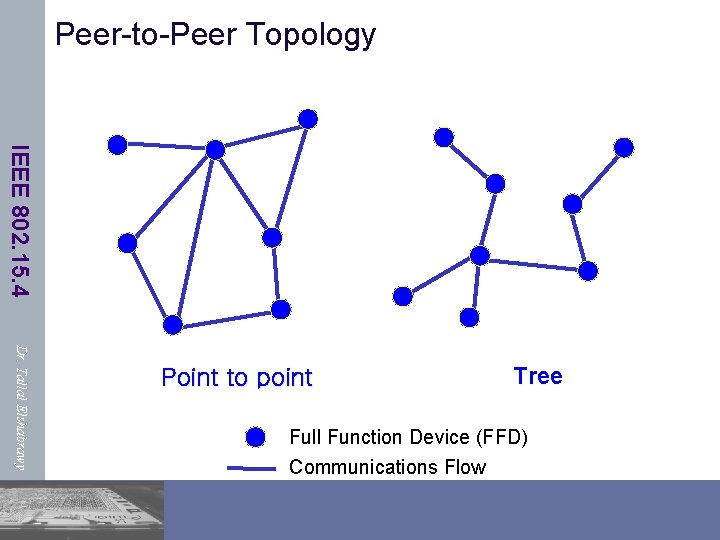
FFD vs RFD IEEE 802. 15. 4 Ø Full function device (FFD) Ø Any topology Ø Network coordinator capable Ø Talks to any other device Dr. Tallal Elshabrawy Ø Reduced function device (RFD) Ø Limited to star topology Ø Cannot become a network coordinator Ø Talks only to a network coordinator Ø Very simplementation
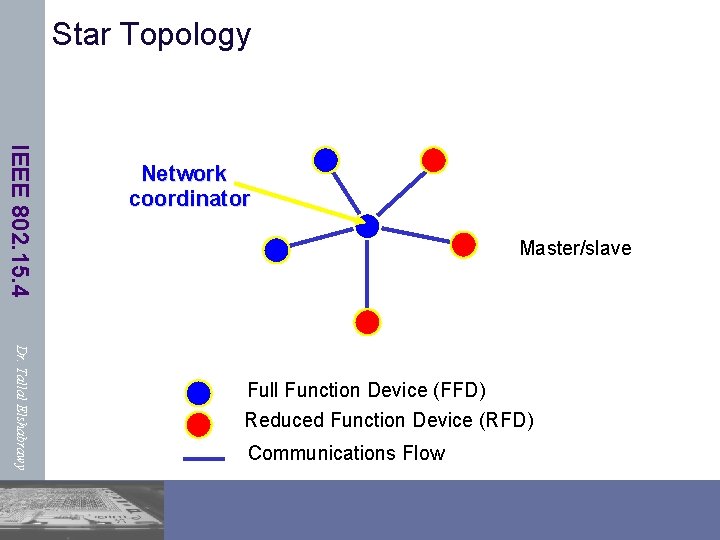
Star Topology IEEE 802. 15. 4 Network coordinator Master/slave Dr. Tallal Elshabrawy Full Function Device (FFD) Reduced Function Device (RFD) Communications Flow
Peer-to-Peer Topology IEEE 802. 15. 4 Dr. Tallal Elshabrawy Point to point Tree Full Function Device (FFD) Communications Flow
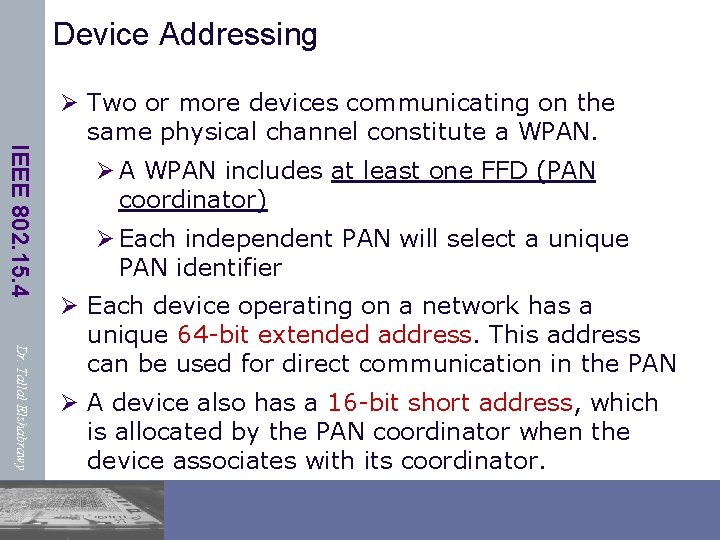
Device Addressing IEEE 802. 15. 4 Ø Two or more devices communicating on the same physical channel constitute a WPAN. Ø A WPAN includes at least one FFD (PAN coordinator) Ø Each independent PAN will select a unique PAN identifier Dr. Tallal Elshabrawy Ø Each device operating on a network has a unique 64 -bit extended address. This address can be used for direct communication in the PAN Ø A device also has a 16 -bit short address, which is allocated by the PAN coordinator when the device associates with its coordinator.
IEEE 802. 15. 4 PHY Overview IEEE 802. 15. 4 Dr. Tallal Elshabrawy Ø PHY functionalities: Ø Activation and deactivation of the radio transceiver Ø Energy detection within the current channel Ø Link quality indication for received packets Ø Clear channel assessment for CSMA-CA Ø Channel frequency selection Ø Data transmission and reception
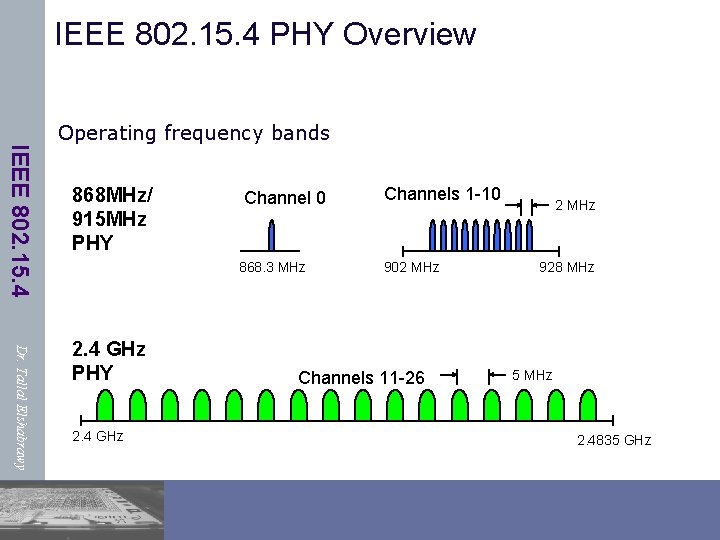
IEEE 802. 15. 4 PHY Overview IEEE 802. 15. 4 Operating frequency bands 868 MHz/ 915 MHz PHY Channel 0 868. 3 MHz Dr. Tallal Elshabrawy 2. 4 GHz PHY 2. 4 GHz Channels 1 -10 902 MHz Channels 11 -26 2 MHz 928 MHz 5 MHz 2. 4835 GHz
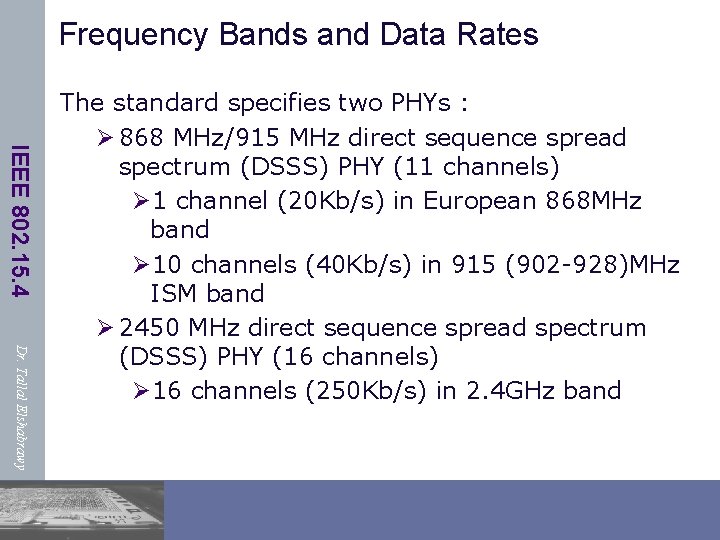
Frequency Bands and Data Rates IEEE 802. 15. 4 Dr. Tallal Elshabrawy The standard specifies two PHYs : Ø 868 MHz/915 MHz direct sequence spread spectrum (DSSS) PHY (11 channels) Ø 1 channel (20 Kb/s) in European 868 MHz band Ø 10 channels (40 Kb/s) in 915 (902 -928)MHz ISM band Ø 2450 MHz direct sequence spread spectrum (DSSS) PHY (16 channels) Ø 16 channels (250 Kb/s) in 2. 4 GHz band
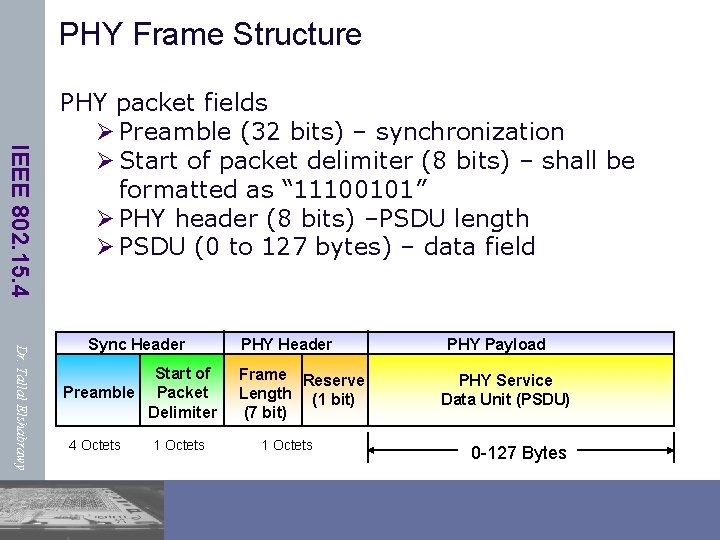
PHY Frame Structure IEEE 802. 15. 4 PHY packet fields Ø Preamble (32 bits) – synchronization Ø Start of packet delimiter (8 bits) – shall be formatted as “ 11100101” Ø PHY header (8 bits) –PSDU length Ø PSDU (0 to 127 bytes) – data field Dr. Tallal Elshabrawy Sync Header Start of Preamble Packet Delimiter 4 Octets 1 Octets PHY Header Frame Reserve Length (1 bit) (7 bit) 1 Octets PHY Payload PHY Service Data Unit (PSDU) 0 -127 Bytes
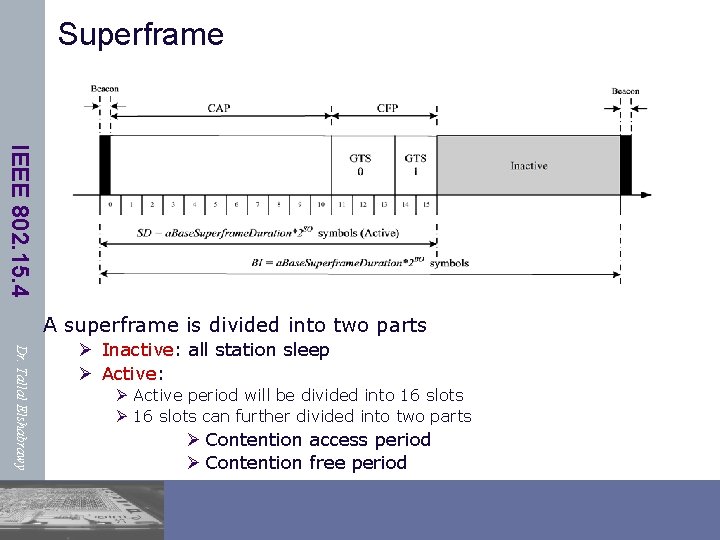
Superframe IEEE 802. 15. 4 A superframe is divided into two parts Dr. Tallal Elshabrawy Ø Inactive: all station sleep Ø Active: Ø Active period will be divided into 16 slots Ø 16 slots can further divided into two parts Ø Contention access period Ø Contention free period
Superframe IEEE 802. 15. 4 Dr. Tallal Elshabrawy Ø Beacons are used for Ø starting superframes Ø synchronizing with other devices Ø announcing the existence of a PAN Ø informing pending data in coordinators Ø In a “beacon-enabled” network, Ø Devices use the slotted CAMA/CA mechanism to contend for the usage of channels Ø FFDs which require fixed rates of transmissions can ask for guarantee time slots (GTS) from the coordinator
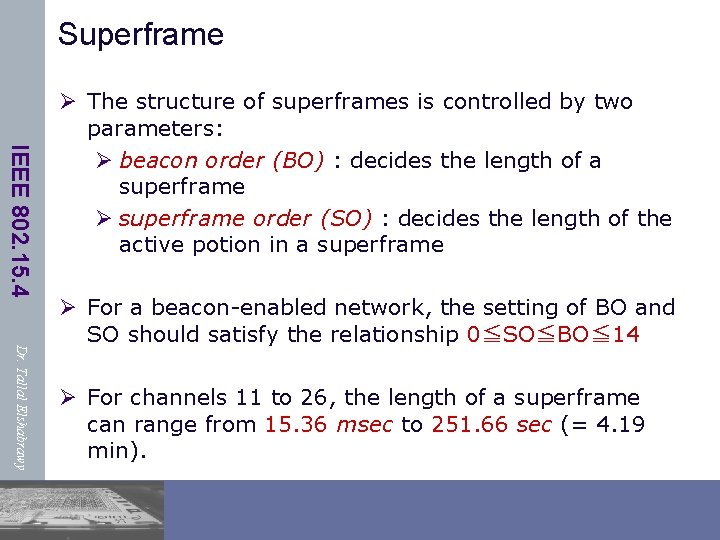
Superframe IEEE 802. 15. 4 Ø The structure of superframes is controlled by two parameters: Ø beacon order (BO) : decides the length of a superframe Ø superframe order (SO) : decides the length of the active potion in a superframe Dr. Tallal Elshabrawy Ø For a beacon-enabled network, the setting of BO and SO should satisfy the relationship 0≦SO≦BO≦ 14 Ø For channels 11 to 26, the length of a superframe can range from 15. 36 msec to 251. 66 sec (= 4. 19 min).
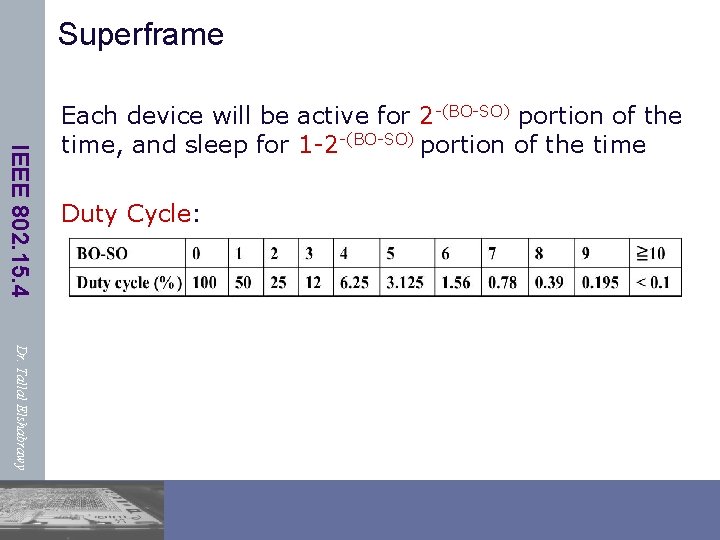
Superframe IEEE 802. 15. 4 Each device will be active for 2 -(BO-SO) portion of the time, and sleep for 1 -2 -(BO-SO) portion of the time Duty Cycle: Dr. Tallal Elshabrawy
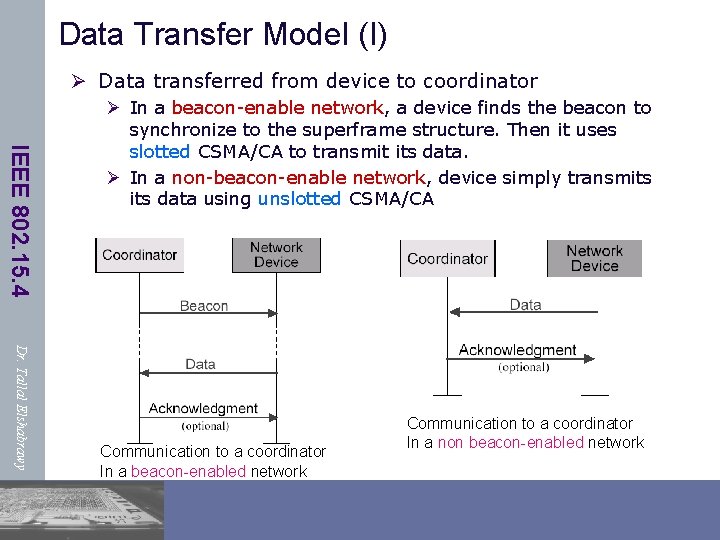
Data Transfer Model (I) Ø Data transferred from device to coordinator IEEE 802. 15. 4 Ø In a beacon-enable network, a device finds the beacon to synchronize to the superframe structure. Then it uses slotted CSMA/CA to transmit its data. Ø In a non-beacon-enable network, device simply transmits data using unslotted CSMA/CA Dr. Tallal Elshabrawy Communication to a coordinator In a beacon-enabled network Communication to a coordinator In a non beacon-enabled network
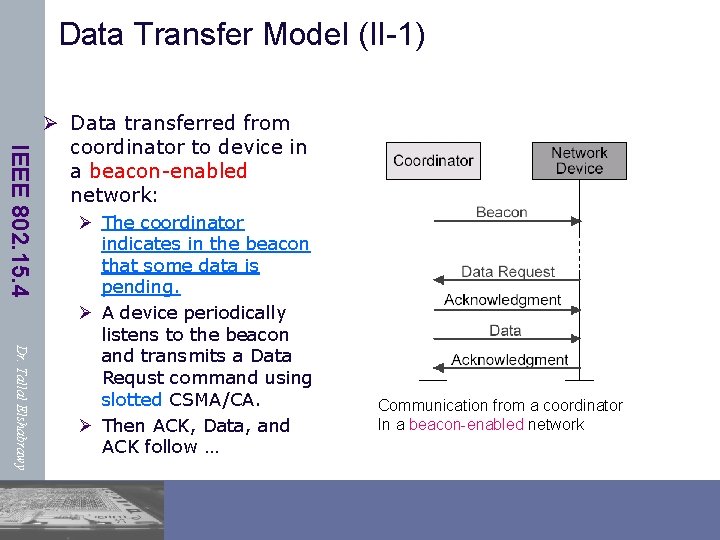
Data Transfer Model (II-1) IEEE 802. 15. 4 Ø Data transferred from coordinator to device in a beacon-enabled network: Dr. Tallal Elshabrawy Ø The coordinator indicates in the beacon that some data is pending. Ø A device periodically listens to the beacon and transmits a Data Requst command using slotted CSMA/CA. Ø Then ACK, Data, and ACK follow … Communication from a coordinator In a beacon-enabled network
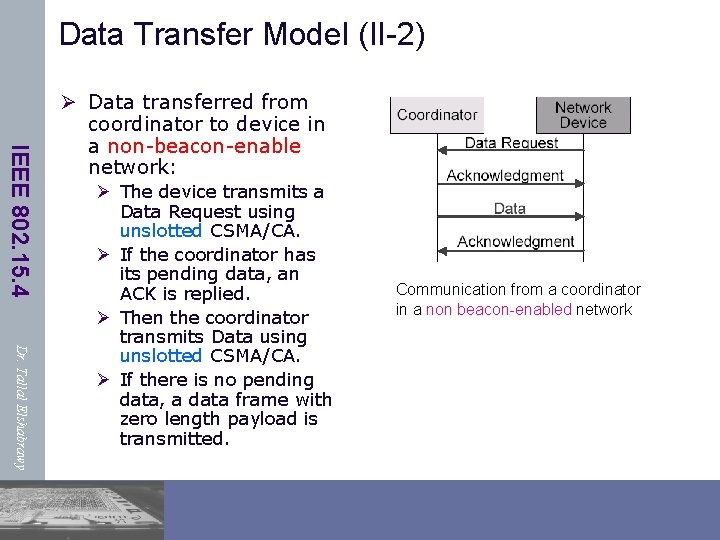
Data Transfer Model (II-2) IEEE 802. 15. 4 Ø Data transferred from coordinator to device in a non-beacon-enable network: Dr. Tallal Elshabrawy Ø The device transmits a Data Request using unslotted CSMA/CA. Ø If the coordinator has its pending data, an ACK is replied. Ø Then the coordinator transmits Data using unslotted CSMA/CA. Ø If there is no pending data, a data frame with zero length payload is transmitted. Communication from a coordinator in a non beacon-enabled network
Channel Access Mechanism IEEE 802. 15. 4 Two type channel access mechanism: Ø beacon-enabled networks slotted CSMA/CA channel access mechanism Ø non-beacon-enabled networks unslotted CSMA/CA channel access mechanism Dr. Tallal Elshabrawy
Slotted CSMA/CA Algorithm IEEE 802. 15. 4 Dr. Tallal Elshabrawy Ø In slotted CSMA/CA Ø The backoff period boundaries of every device in the PAN shall be aligned with the superframe slot boundaries of the PAN coordinator Øi. e. the start of first backoff period of each device is aligned with the start of the beacon transmission Ø The MAC sublayer shall ensure that the PHY layer commences all of its transmissions on the boundary of a backoff period
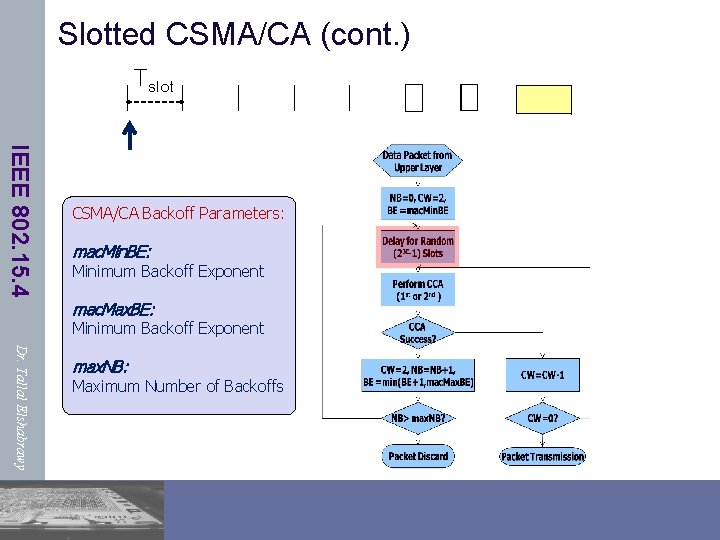
Slotted CSMA/CA Algorithm (cont. ) IEEE 802. 15. 4 Dr. Tallal Elshabrawy Ø Each device maintains 3 variables for each transmission attempt Ø NB: number of times that backoff has been taken in this attempt (if exceeding mac. Max. CSMABackoff, the attempt fails) Ø BE: the backoff exponent which is determined by NB Ø CW: contention window length, the number of clear slots that must be seen after each backoff Ø always set to 2 and count down to 0 if the channel is sensed to be clear Ø The design is for some PHY parameters, which require 2 CCA for efficient channel usage. Ø Battery Life Extension: Ø designed for very low-power operation, where a node only contends in the first 6 slots
Slotted CSMA/CA (cont. ) Tslot IEEE 802. 15. 4 CSMA/CA Backoff Parameters: mac. Min. BE: Minimum Backoff Exponent mac. Max. BE: Minimum Backoff Exponent Dr. Tallal Elshabrawy max. NB: Maximum Number of Backoffs
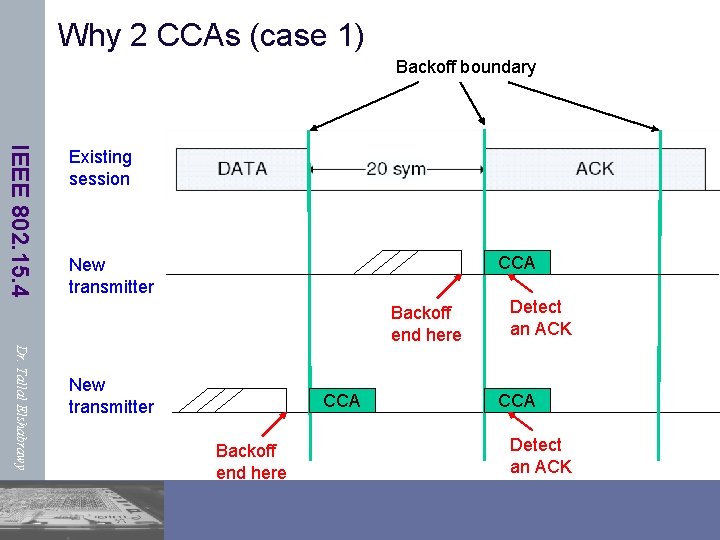
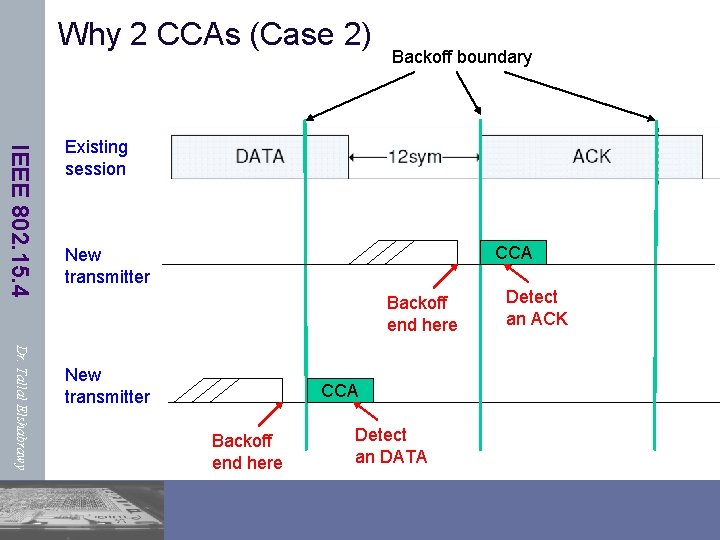
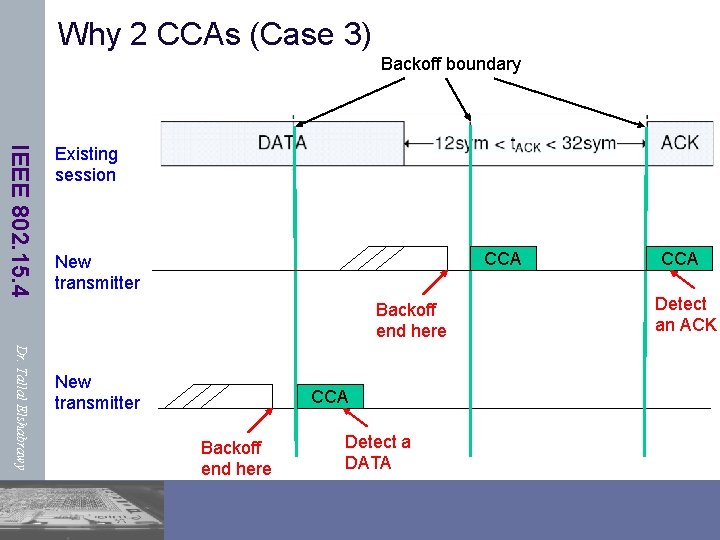
Why 2 CCAs to Ensure Collision-Free IEEE 802. 15. 4 Dr. Tallal Elshabrawy Ø Each CCA occurs at the boundary of a backoff slot (= 20 symbols), and each CCA time = 8 symbols. Ø The standard species that a transmitter node performs the CCA twice in order to protect acknowledgment (ACK). Ø When an ACK packet is expected, the receiver shall send it after a t. ACK time on the backoff boundary Øt. ACK varies from 12 to 31 symbols Ø One-time CCA of a transmitter may potentially cause a collision between a newly-transmitted packet and an ACK packet. Ø (See examples below)
Why 2 CCAs (case 1) Backoff boundary IEEE 802. 15. 4 Existing session CCA New transmitter Dr. Tallal Elshabrawy Backoff end here New transmitter CCA Backoff end here Detect an ACK CCA Detect an ACK
Why 2 CCAs (Case 2) Backoff boundary IEEE 802. 15. 4 Existing session CCA New transmitter Backoff end here Dr. Tallal Elshabrawy New transmitter CCA Backoff end here Detect an DATA Detect an ACK
Why 2 CCAs (Case 3) Backoff boundary IEEE 802. 15. 4 Existing session CCA New transmitter Backoff end here Dr. Tallal Elshabrawy New transmitter CCA Backoff end here Detect a DATA CCA Detect an ACK
GTS Concepts (I) IEEE 802. 15. 4 Dr. Tallal Elshabrawy Ø A guaranteed time slot (GTS) allows a device to operate on the channel within a portion of the superframe Ø A GTS shall only be allocated by the PAN coordinator Ø The PAN coordinator can allocated up to 7 GTSs at the same time Ø The PAN coordinator decides whether to allocate GTS based on: Ø Requirements of the GTS request Ø The current available capacity in the superframe
GTS Concepts (II) IEEE 802. 15. 4 Dr. Tallal Elshabrawy Ø A GTS can be deallocated Ø At any time at the discretion of the PAN coordinator or Ø By the device that originally requested the GTS Ø A device that has been allocated a GTS may also operate in the CAP Ø A data frame transmitted in an allocated GTS shall use only short addressing
GTS Concepts (III) IEEE 802. 15. 4 Dr. Tallal Elshabrawy Ø Before GTS starts, the GTS direction shall be specified as either transmit or receive Ø Each device may request one transmit GTS and/or one receive GTS Ø A device shall only attempt to allocate and use a GTS if it is currently tracking the beacon Ø If a device loses synchronization with the PAN coordinator, all its GTS allocations shall be lost Ø The use of GTSs by an RFD is optional