
NetCentric 2016 The Path Computation Element as a

- Slides: 24
Net-Centric 2016 The Path Computation Element as a Centralized Controller in advanced SDN Operations Adrian Farrel : Old Dog Consulting adrian@olddog. co. uk www. isocore. com/2016
Net-Centric 2016 Agenda • • • Remember - What is a PCE? What does SDN look like? The role of PCE in SDN The implications of putting PCE at the centre What could we do with a “PCE-Based Centralized Controller” • What would it take? • Why would we do it? • Who is doing it? 2
Net-Centric 2016 PCE Refresher • Well, do we really need a PCE refresher? • History • Origins • A mechanism to provide inter-domain paths • A tool to offload path computation in MPLS systems • Rapid developments • Path computation for all connection oriented systems • MPLS-TE, GMPLS, MPLS-TP, … • Server functionality • Receives path computation requests • Sends responses 3
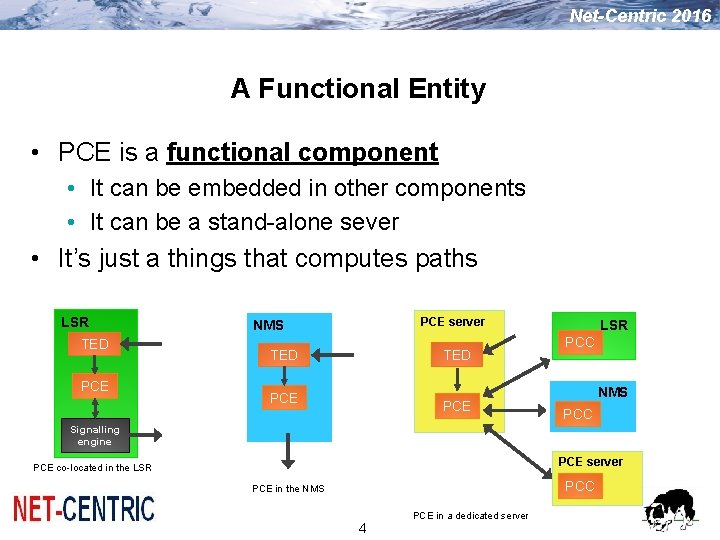
Net-Centric 2016 A Functional Entity • PCE is a functional component • It can be embedded in other components • It can be a stand-alone sever • It’s just a things that computes paths LSR TED PCE server NMS TED PCE LSR PCC NMS PCC Signalling engine PCE server PCE co-located in the LSR PCC PCE in the NMS 4 PCE in a dedicated server
Net-Centric 2016 Developments Over Time • It was a request/response server • “Please compute a path” / “Here is your answer” • Stateful PCE is valuable • Coordinate with other LSPs in the system • Delegated control • PCE sends “suggested” updates when the network changes • PCE-Initiated LSPs • PCE sends unsolicited LSP setup “requests” • All these features become important for SDN 5
Net-Centric 2016 What is Software Defined Networking? • Let’s not re-open this debate (please!) • Centralized control • Especially of end-to-end services • Network convergence • Converged services and infrastructure • Network “abstraction” • Partitioning of resources • Network automation • Application-to-network relationship • Provides access to the forwarding plane of network devices • Momentum being driven for commercial benefits • Rapidly provide cool services at lower prices • Reduce OPEX and simplify network operations • Enable better monitoring and diagnostics 6
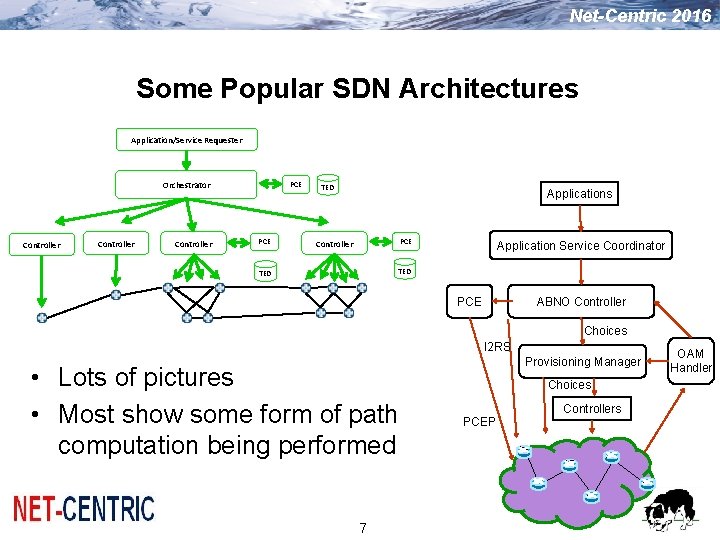
Net-Centric 2016 Some Popular SDN Architectures Application/Service Requester PCE Orchestrator Controller PCE TED Applications PCE Controller Application Service Coordinator TED PCE ABNO Controller Choices I 2 RS • Lots of pictures • Most show some form of path computation being performed 7 Provisioning Manager Choices PCEP Controllers OAM Handler
Net-Centric 2016 Why is PCE at the Centre? • This is really simple • Its all about coordination of network resources • Centralization avoid contention • And its all about traffic engineering • Centralization aids planning and optimization • And it uses complex and intensive algorithms • May be best to offload from the “dumb” network • And it can benefit from large databases • Network capabilities • Traffic demands and intentions • Telemetrics 8
Net-Centric 2016 What Does it Mean To Be At the Centre? PCE-Based Centralized Control • PCE is there in all the pictures • That means PCE is central to the decision-making processes • From there on it is a labelling function • • • Controllers/Orchestrators/OSS use PCE-enabled Controllers/Orchestrators/OSS PCE-based Central Controller PCE as a Central Controller • This is mainly semantics • A lot of it is about how you build software and how you market product 9
Net-Centric 2016 Some Useful Functions • • • Answer computation enquiries (already supported) Modify an LSP that is already in place (stateful PCE) Cause an LSP to be set up (PCE-initiated LSPs) Say what an LSP is for Apply to other technologies • • • Deterministic networking Time-sliced channel hopping (IEEE 802. 15. 4 e) Segment Routing Service Function Chaining PCEP as an SDN Southbound Interface – Static LSPs LSP stitching as a hybrid use case 10
Net-Centric 2016 Traffic Classification – What is The LSP For? • When a TE-LSP is set up, the head end needs to know how to use it • • • What traffic to send on the LSP Whether it is a virtual link Whether to advertise it in the IGP What bits of this information to signal to the tail end What to do with traffic received on an LSP • PCEP allows an Active PCE to set up or modify LSPs • But we have no way to tell the head end how to use the LSP • This is because of history • It used to be the LER that made the request of the PCE, so it knew why it wanted the LSP • This function is presumably necessary • But it is currently missing 11
Net-Centric 2016 But LSPs Are Used Today – How? • There are several possibilities • No-one uses Active PCE • The problem doesn’t arise • Active PCE is used only in controlled environments • Head end always knows what the LSP is for • Active PCE is used in conjunction with configuration • The LSP is set up using PCEP • Some other mechanism tells the head end what to do • Active PCE is used in conjunction with BGP Flowspec • Possibly not what BGP Flowspec was designed for • But it works • Note that the last two of these seem a waste • Why separate the functions? • Could use one protocol for everything 12
Net-Centric 2016 What Features for “LSP Purposing”? • Describe: • How to use the LSP • What traffic to place on the LSP • We already have ways of describing traffic flows • e. g. , BGP Flowspec • How to advertise the LSP • Does it appear as a link in a topology? • Which instance, what metric, what bandwidth? • Compare with RFC 6107 • Extra signalling information • Other stuff gets signalled to coordinate LSP end points • Features of “LSP usage” 13
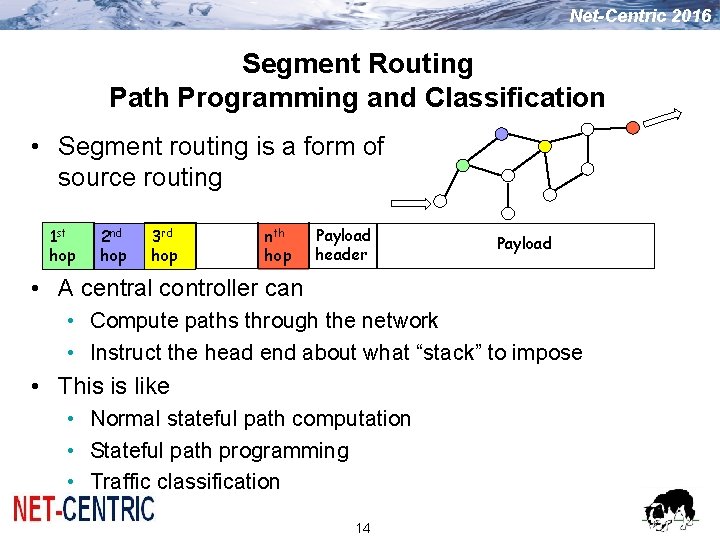
Net-Centric 2016 Segment Routing Path Programming and Classification • Segment routing is a form of source routing 1 st hop 2 nd hop 3 rd hop nth hop Payload header Payload • A central controller can • Compute paths through the network • Instruct the head end about what “stack” to impose • This is like • Normal stateful path computation • Stateful path programming • Traffic classification 14
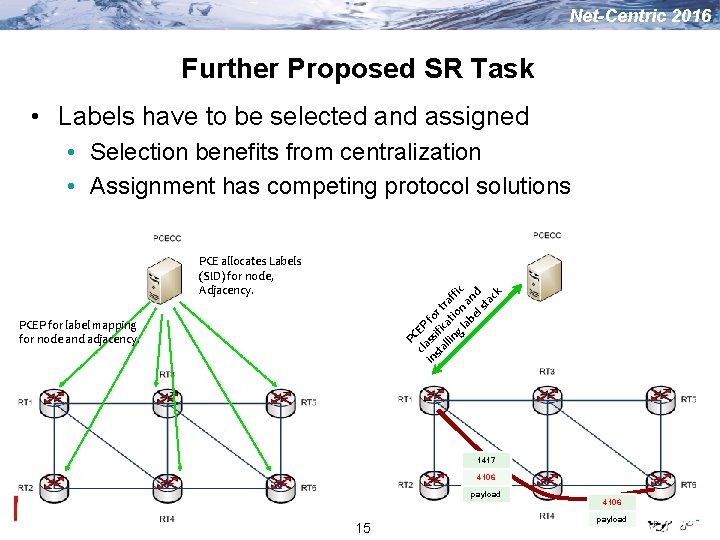
Net-Centric 2016 Further Proposed SR Task • Labels have to be selected and assigned • Selection benefits from centralization • Assignment has competing protocol solutions P cla CEP in ss fo st ifi r t al ca ra lin ti ff g on ic la a be nd ls ta ck PCE allocates Labels (SID) for node, Adjacency. PCEP for label mapping for node and adjacency. 1417 4106 payload 15 4106 payload
Net-Centric 2016 Static LSPs • A TE-LSP is a series of “cross connects” and “resource reservations” • Familiar in “legacy” transport networks • Popular with “MPLS-TP” • MPLS-TE without a control plane • Order of programming is not important • Can program in parallel Incoming interface/label Outgoing interface/label 16
Net-Centric 2016 Static LSPs – PCEP as an SDN SBI • PCEP allows an active PCE to install LSPs to be signalled in a TE network • The “cross-connects” are indicated by the ERO • An ERO can include label information (GMPLS) • Incoming label and outgoing label • LSPs can be short • A single hop ERO can be just one “cross-connect” • PCEP is already an SBI for static LSPs 17
Net-Centric 2016 SBI Thoughts • The ERO approach is a little ugly • It might trigger the signalling component to attempt to do work • We haven’t worked much on “upstream interface for head-end LER” in GMPLS or PCEP • We could add to PCEP specifically for this function • Not a lot of work 18
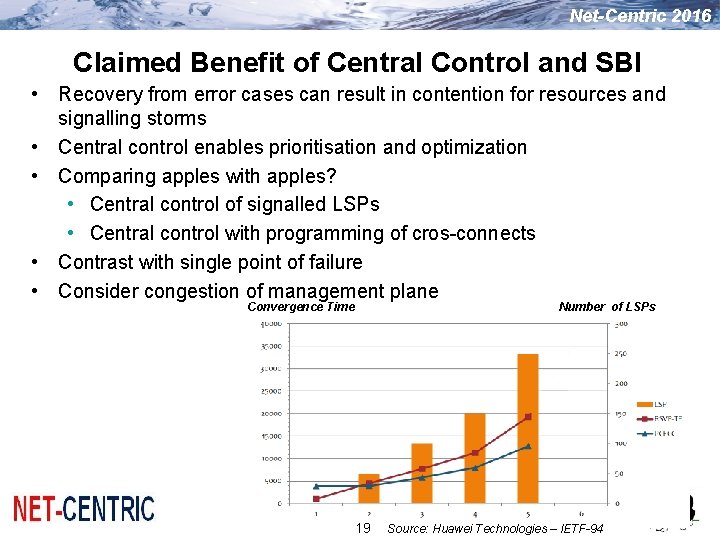
Net-Centric 2016 Claimed Benefit of Central Control and SBI • Recovery from error cases can result in contention for resources and signalling storms • Central control enables prioritisation and optimization • Comparing apples with apples? • Central control of signalled LSPs • Central control with programming of cros-connects • Contrast with single point of failure • Consider congestion of management plane Convergence Time Number of LSPs 19 Source: Huawei Technologies – IETF-94
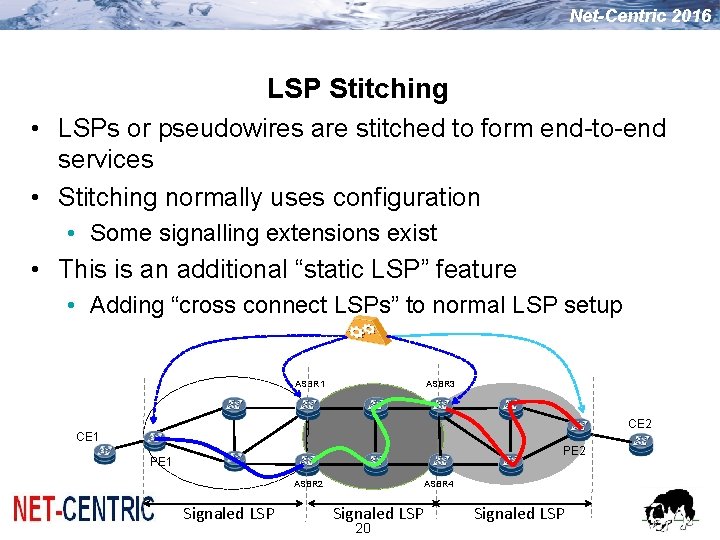
Net-Centric 2016 LSP Stitching • LSPs or pseudowires are stitched to form end-to-end services • Stitching normally uses configuration • Some signalling extensions exist • This is an additional “static LSP” feature • Adding “cross connect LSPs” to normal LSP setup ASBR 3 ASBR 1 CE 2 CE 1 PE 2 PE 1 ASBR 2 Signaled LSP ASBR 4 Signaled LSP 20 Signaled LSP
Net-Centric 2016 Modifications to PCE and PCEP • Adding traffic classification to an LSP message is “just another Object” • We already have experience with BGP Flowspec • Segment Routing paths are just hop-by-hop paths • Each hop TLV needs to encode a SID • Static LSPs are just very short LSPs with no signalling • Should be possible to use existing messages and objects • Could add specialist messages • Bottom line • Only tweaking PCEP not making radical changes 21
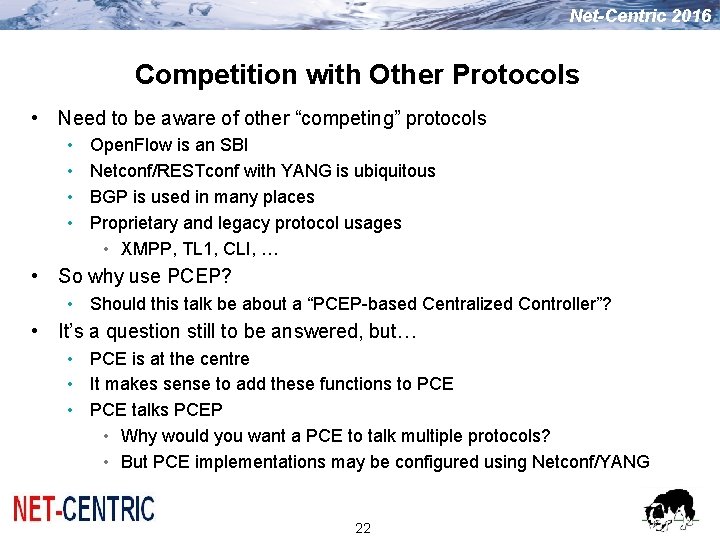
Net-Centric 2016 Competition with Other Protocols • Need to be aware of other “competing” protocols • • Open. Flow is an SBI Netconf/RESTconf with YANG is ubiquitous BGP is used in many places Proprietary and legacy protocol usages • XMPP, TL 1, CLI, … • So why use PCEP? • Should this talk be about a “PCEP-based Centralized Controller”? • It’s a question still to be answered, but… • PCE is at the centre • It makes sense to add these functions to PCE • PCE talks PCEP • Why would you want a PCE to talk multiple protocols? • But PCE implementations may be configured using Netconf/YANG 22
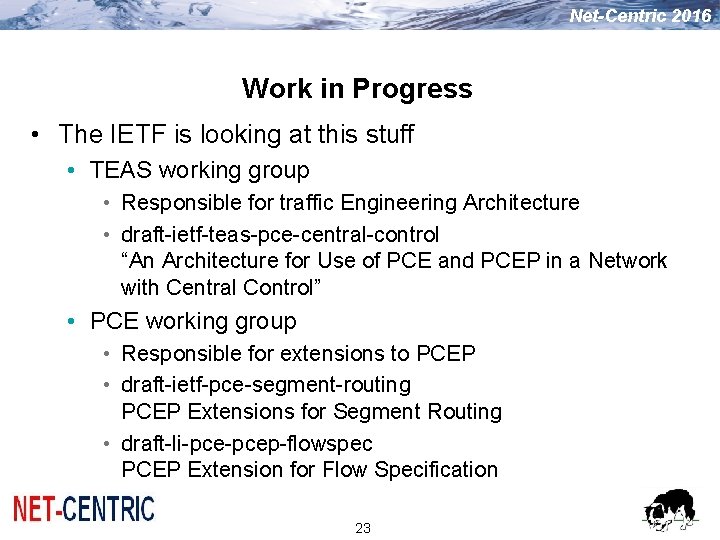
Net-Centric 2016 Work in Progress • The IETF is looking at this stuff • TEAS working group • Responsible for traffic Engineering Architecture • draft-ietf-teas-pce-central-control “An Architecture for Use of PCE and PCEP in a Network with Central Control” • PCE working group • Responsible for extensions to PCEP • draft-ietf-pce-segment-routing PCEP Extensions for Segment Routing • draft-li-pcep-flowspec PCEP Extension for Flow Specification 23
Net-Centric 2016 Questions adrian@olddog. co. uk 24