
NET METERING FEED IN TARIFF REVIEW IURC Technical
- Slides: 26
NET METERING & FEED IN TARIFF REVIEW IURC Technical Conference Cause No. 43922 September 21, 2010 1
Agenda 1. High Level Overview of NIPSCO Proposal and Interaction Between Net Metering and Feed-In Tariff • Example Customer “Decision Tree” to Demonstrate 2. Net Metering Proposal (generally following proposed tariff language) • • • Overview Discussion of Questions re Net Metering Proposal (e. g. eligible technologies, facility size, facility ownership, meter aggregation, system cap) Interaction and Consistency with Draft Commission Rule 3. Feed-In Tariff Proposal (generally following proposed tariff language) • • Overview Discussion of Questions/Issues re Feed-In Tariff Proposal (e. g. eligible technologies, facility size, facility ownership, pricing, system cap) 4. Any Other Related Matters (e. g. interconnection, etc. ) 5. Next Steps 2
Policy Overview • Feed-in Tariff – Renewable initiative – Increasing customer interest – Technological advancements (both application and cost) and federal initiatives through tax credits – Gather information about how and when customers use these programs • Experimental rates under a three pilot program – This effort is consistent with the Hoosier Homegrown Energy Policy • Net Metering – Permanent change that is supportive of the renewable initiative – Complimentary to the feed in tariff – No sunset on the effectiveness of expansion to net metering • Part of NIPSCO’s Mission to invest in clean, modern and affordable energy solutions 3
Policy Overview (cont. ) • Encourage job and economic growth • Increase diversity of energy supply system • NIPSCO filed a request to enhance the current Net Metering tariff and provide a Feed-in tariff for its customers on July 16, 2010 • Based on customer requests – Higher project limits and expansion of availability beyond residential and K-12 customer for Net Metering – Adding Feed-in tariff for larger projects • Feed-in tariffs can be implemented alongside net metering • IPL has the only Feed-in tariff in Indiana at this point 4
Customer Feedback • Approached by a customer looking to install a solar farm in Porter County – Told by the solar project developer that a long term contract is essential – Limited window due to the expiration of a federal tax credit • A developer responding to school’s request to install wind power in Elkhart County – Indicated that fixed-price and long-term contract are desirable – Use of feed-in tariff affords multiple locations for project • Approached by a large agricultural business for pricing to support a bio-gas to electricity project 5
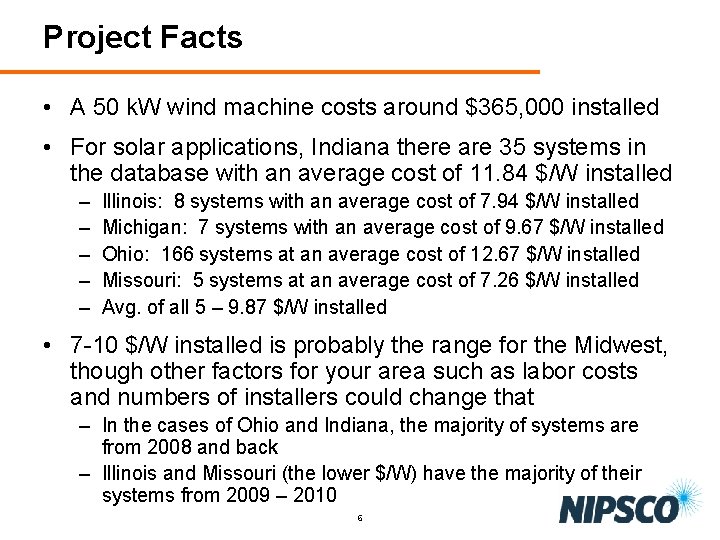
Project Facts • A 50 k. W wind machine costs around $365, 000 installed • For solar applications, Indiana there are 35 systems in the database with an average cost of 11. 84 $/W installed – – – Illinois: 8 systems with an average cost of 7. 94 $/W installed Michigan: 7 systems with an average cost of 9. 67 $/W installed Ohio: 166 systems at an average cost of 12. 67 $/W installed Missouri: 5 systems at an average cost of 7. 26 $/W installed Avg. of all 5 – 9. 87 $/W installed • 7 -10 $/W installed is probably the range for the Midwest, though other factors for your area such as labor costs and numbers of installers could change that – In the cases of Ohio and Indiana, the majority of systems are from 2008 and back – Illinois and Missouri (the lower $/W) have the majority of their systems from 2009 – 2010 6
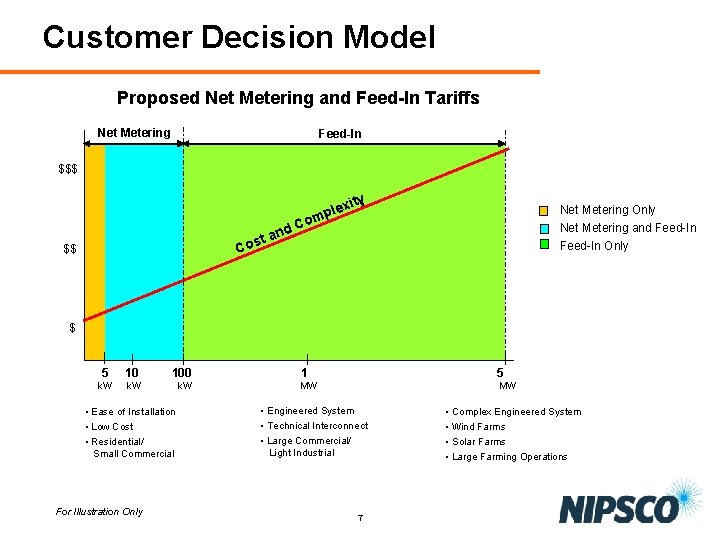
Customer Decision Model Proposed Net Metering and Feed-In Tariffs Net Metering Feed-In $$$ ta Co s $$ nd Co le mp x i ty Net Metering Only Net Metering and Feed-In Only $ 5 10 100 k. W • Ease of Installation • Low Cost • Residential/ Small Commercial For Illustration Only 1 5 MW MW • Engineered System • Technical Interconnect • Large Commercial/ Light Industrial 7 • Complex Engineered System • Wind Farms • Solar Farms • Large Farming Operations
NET METERING PROPOSAL 8
Net Metering • Customers owning qualifying renewable generators are billed only for their net energy consumption over a given billing period • Obtain a credit for future billing periods if production exceeds consumption • Provides a direct, inexpensive, and easily administered mechanism for encouraging the customer installation of small scale renewable energy facilities on their buildings 9
NIPSCO Proposal Highlights • All Customers eligible • Participation level increased to 100 k. W (from 10 k. W) • Wind, Solar and Hydroelectricity generation qualify – The state proposal • A renewable energy resource as defined in IC 8 -1 -8. 8 -10 • Hydrogen • Other emerging renewable energy technologies the commission determines appropriate • No changes to interconnection policy 10
NIPSCO Proposal Highlights (cont. ) • Aggregate amount increased to 6 MW (was 1 MW previously) – State proposes an optional limit of (1%) of the most recent summer peak load of the utility, with at least fifty percent (50%) of the capacity reserved solely for participation by residential customers • Metering requirements remain unchanged • Allows all customers to roll over credits from month to month – State proposes to limit customers with capacity up to 200 k. W rollover credits from month to month 11
Customer Benefits • Expanded to all customer groups • Allows for the customer to “spin the meter backward” and be credited for feed back at retail value • Fits in with the “Green” Building movement • Supports the growth of the renewable energy equipment sales and service industry • Moves the renewable energy option for our customers beyond the test period and allows for mainstream use • Gives our customers another option for conserving energy 12
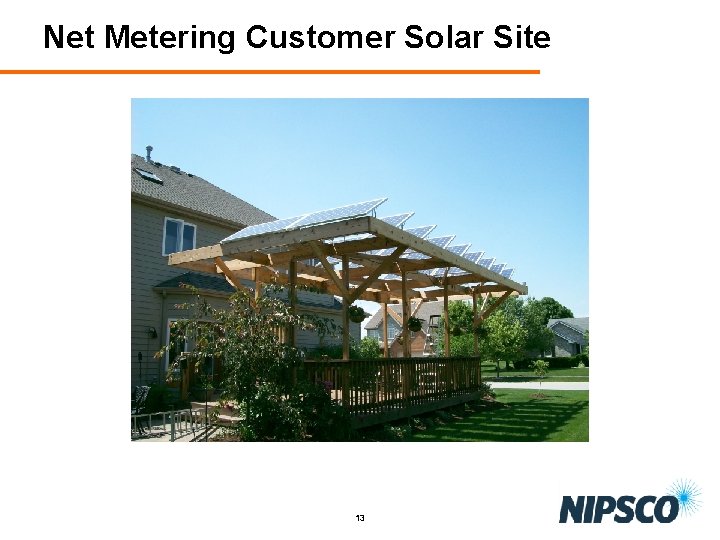
Net Metering Customer Solar Site 13
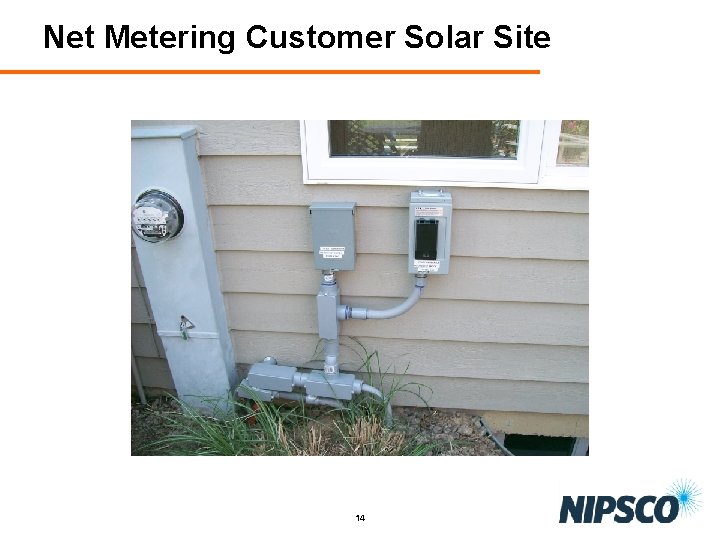
Net Metering Customer Solar Site 14
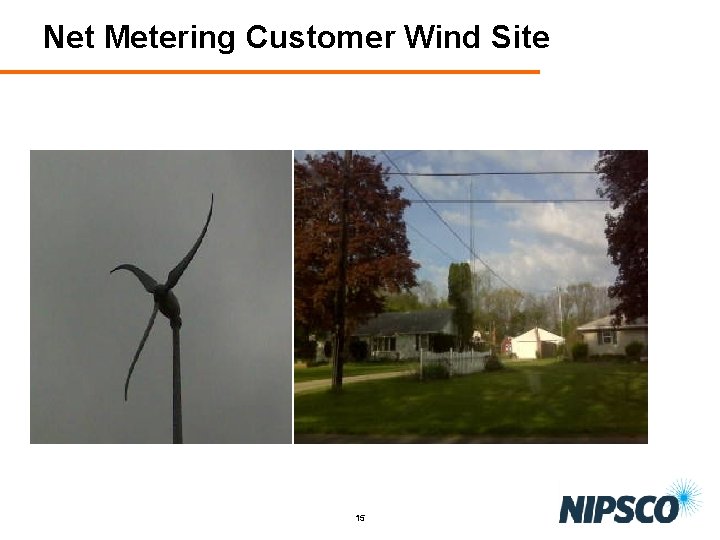
Net Metering Customer Wind Site 15
Overview of NIPSCO Proposal and Interaction Between Net Metering and Feed-In Tariff 16
Interaction and Consistency with Draft Commission Rule • Eligible facilities • System Wide Cap (. 2% vs. 1%) • Unit Cap (100 k. W vs. 1 MW) • 50% Reserve for Residential Customers 17
FEED-IN TARIFF PROPOSAL 18
Feed-in Tariff • Encourages new renewable energy development – Long term financial incentive to customers who generate renewable electricity – Standardized and streamlined process to do so, easing the entry of new systems • Contract term up to 10 years obligates NIPSCO to purchase eligibility renewable energy • NIPSCO’s feed-in tariff is its first comprehensive purchase rate schedule for renewable electricity production • It offers stable prices under long-term contracts for energy generated from renewable sources, including: – Biomass – Biogas – Landfill gas 19
Feed-in Tariff (cont. ) • Attributes – Rates developed using a standard Discounted Cash flow model – Capped at 1% of project peak system demand – 30 MW – No Single technology can exceed 50% of the 30 MW cap – Could use up to 100 k. W of renewable generation against own energy load – NIPSCO will retain all environmental attributes • Contracts subject to IURC approval • One year from contract signing to put project into service 20
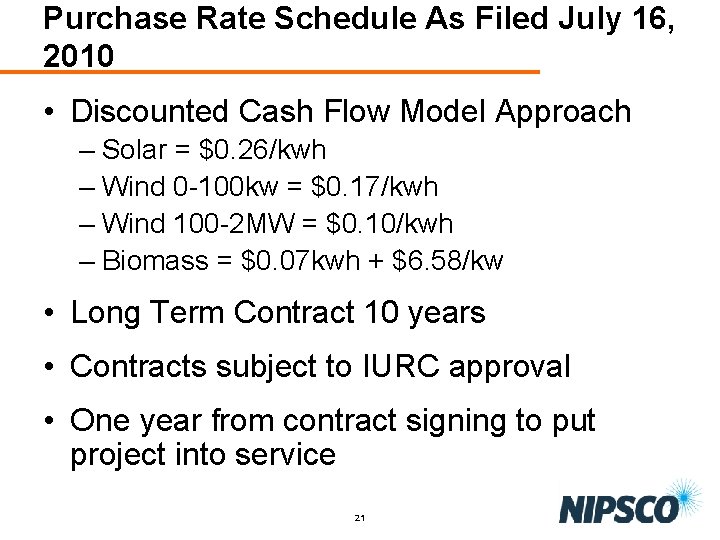
Purchase Rate Schedule As Filed July 16, 2010 • Discounted Cash Flow Model Approach – Solar = $0. 26/kwh – Wind 0 -100 kw = $0. 17/kwh – Wind 100 -2 MW = $0. 10/kwh – Biomass = $0. 07 kwh + $6. 58/kw • Long Term Contract 10 years • Contracts subject to IURC approval • One year from contract signing to put project into service 21
FEED-IN TARIFF PROPOSAL Discounted Cash Flow Modeling 22
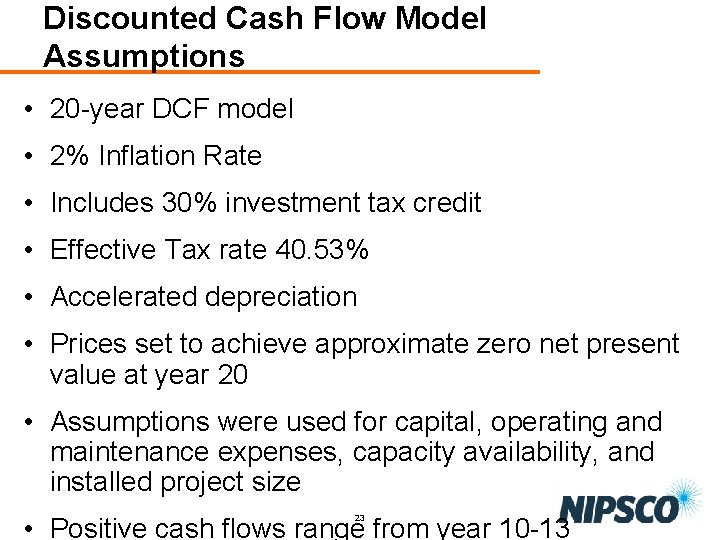
Discounted Cash Flow Model Assumptions • 20 -year DCF model • 2% Inflation Rate • Includes 30% investment tax credit • Effective Tax rate 40. 53% • Accelerated depreciation • Prices set to achieve approximate zero net present value at year 20 • Assumptions were used for capital, operating and maintenance expenses, capacity availability, and installed project size • Positive cash flows range from year 10 -13 23
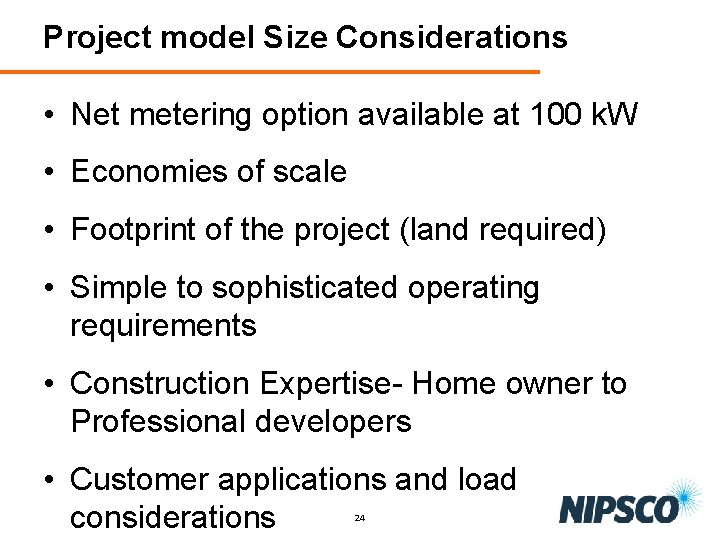
Project model Size Considerations • Net metering option available at 100 k. W • Economies of scale • Footprint of the project (land required) • Simple to sophisticated operating requirements • Construction Expertise- Home owner to Professional developers • Customer applications and load considerations 24
FEED-IN TARIFF PROPOSAL Discounted Cash Flow Modeling Review of Spreadsheets 25
Other Related Matters and Next Steps 26