
Net Flow FlowLike Data and Their Many Uses
- Slides: 35
Net. Flow, Flow-Like Data, and Their Many Uses Avi Freedman avi@kentik. com CHI-NOG 06 5/12/2016
What is Net. Flow? Net. Flow is… A 20 -year old technology now supported in some variant by most network devices. Mostly works fine now. s. Flow came later, and is packet sampling and the first bytes of the packet (including the header). … and is simpler and more accurate in real-time IPFIX and Netflow v 9 are extensible via templates, and allow sending more than just ‘basic flow’ data via those templates. 2
‘Basic’ Flow Basic flow records contain byte and packet counters, TCP Flags, AS, next-hop, and other data. Aggregated by (usually) the ‘ 5 tuple’ of (protocol, srcip, dstip, srcport, dstport). Most devices support a fixed sampling rate. Despite the simplicity of data, there are many use cases for basic flow data for monitoring availability, efficiency, and security of networks, hosts, and applications. 3
State of Device Export Mostly works! s. Flow is more common at the switch layer, and Net. Flow/IPFIX is more common in routers, but many devices support both protocols. Still possible to negatively impact packet forwarding by enabling flow export, but accuracy and stability is generally fine w/ correct software versions. Much, much better situation than 5+ years ago. 4
State of Flow Tools All have some suck. Most suck more and some suck less. No perfect eng+perf+BI+ops tool: • • • OSS tools don’t cluster, but popular. DIY mostly Spark, Streaming, Elastic. Most downloadable commercial sw has scale. Appliances usually limits and single-purpose. Newer vendors mostly big-data and cloudy in arch. Extensibility + openness key for augmented flow use cases. 5
Classic Flow Use Cases Flow from routers and switches can and is being used today for: • • Congestion analysis for providers and/or customers Peering analytics Trending, planning and forecasting (d)Do. S detection (primarily volumetric) Basic forensic/historic (who did an IP talk to) Modeling of TE, what-if analysis Customer cost analysis (Flow + BGP communities) 6
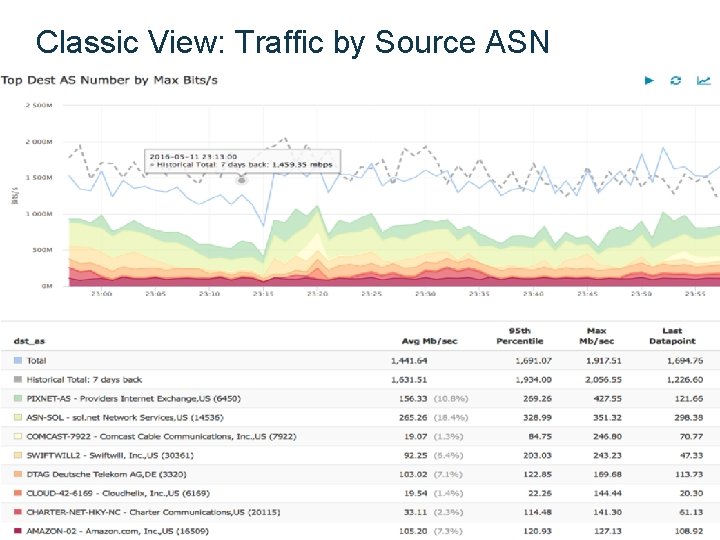
Classic View: Traffic by Source ASN
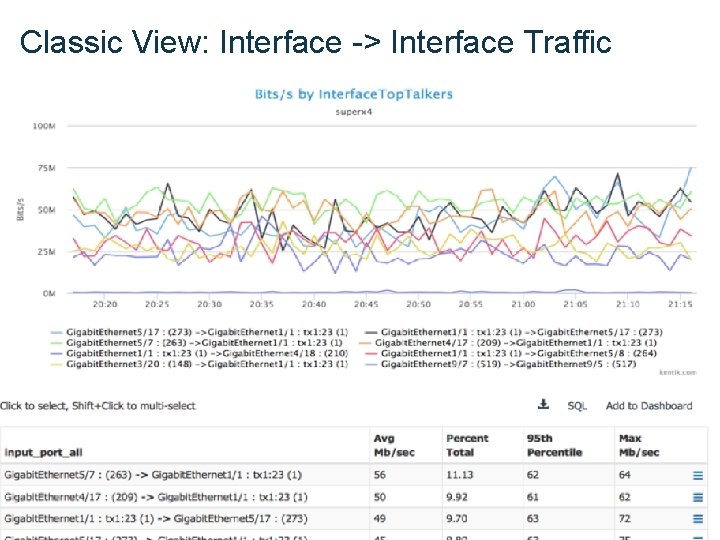
Classic View: Interface -> Interface Traffic
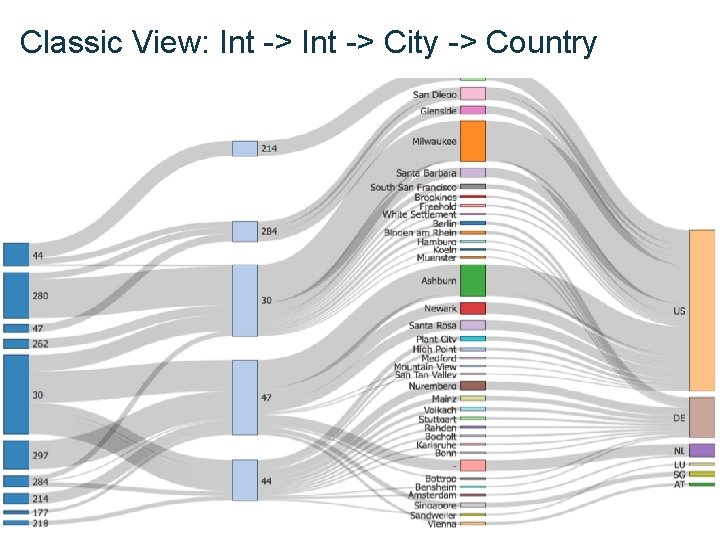
Classic View: Int -> City -> Country
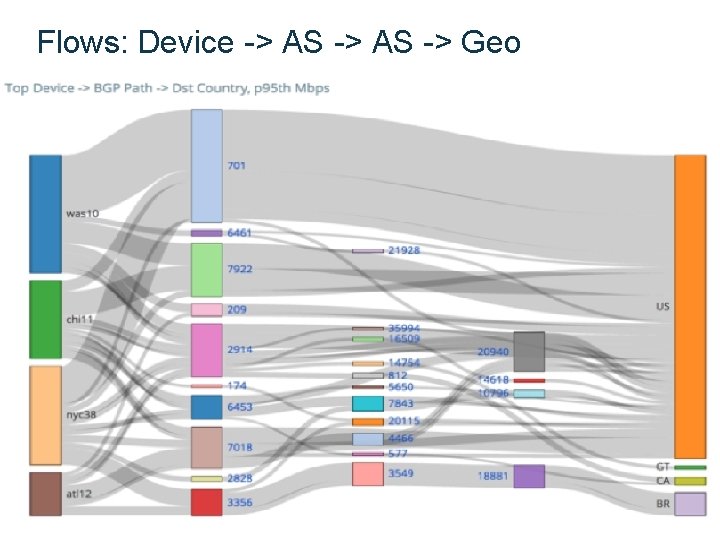
Flows: Device -> AS -> Geo
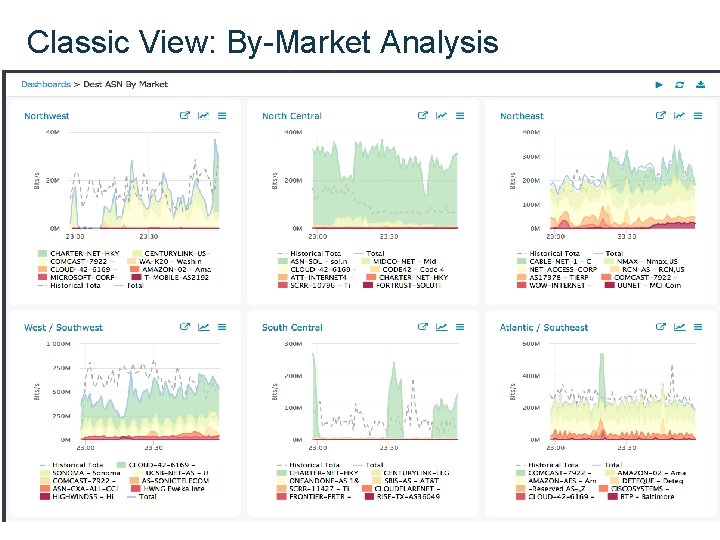
Classic View: By-Market Analysis
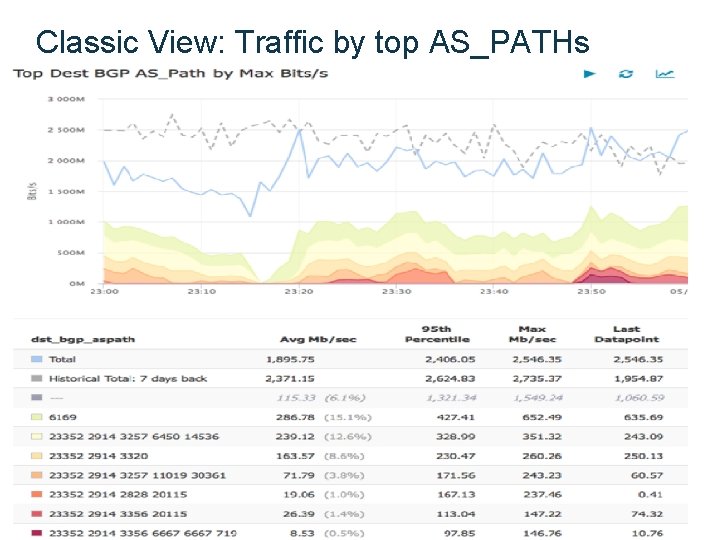
Classic View: Traffic by top AS_PATHs
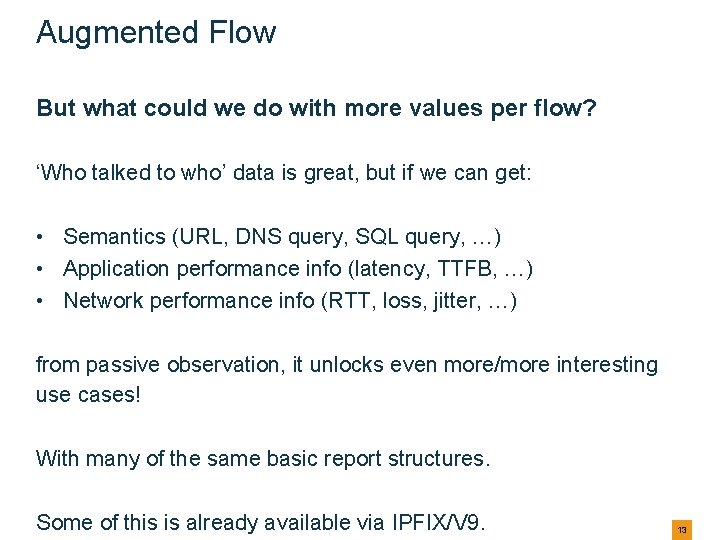
Augmented Flow But what could we do with more values per flow? ‘Who talked to who’ data is great, but if we can get: • Semantics (URL, DNS query, SQL query, …) • Application performance info (latency, TTFB, …) • Network performance info (RTT, loss, jitter, …) from passive observation, it unlocks even more/more interesting use cases! With many of the same basic report structures. Some of this is already available via IPFIX/V 9. 13
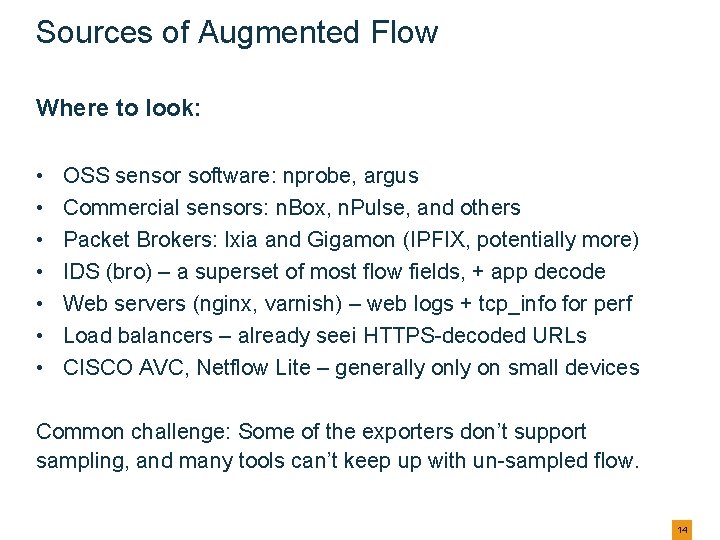
Sources of Augmented Flow Where to look: • • OSS sensor software: nprobe, argus Commercial sensors: n. Box, n. Pulse, and others Packet Brokers: Ixia and Gigamon (IPFIX, potentially more) IDS (bro) – a superset of most flow fields, + app decode Web servers (nginx, varnish) – web logs + tcp_info for perf Load balancers – already seei HTTPS-decoded URLs CISCO AVC, Netflow Lite – generally on small devices Common challenge: Some of the exporters don’t support sampling, and many tools can’t keep up with un-sampled flow. 14
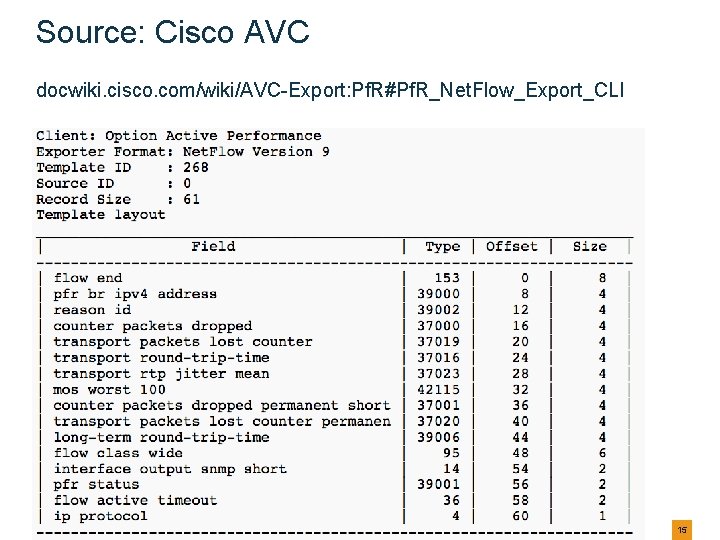
Source: Cisco AVC docwiki. cisco. com/wiki/AVC-Export: Pf. R#Pf. R_Net. Flow_Export_CLI 15
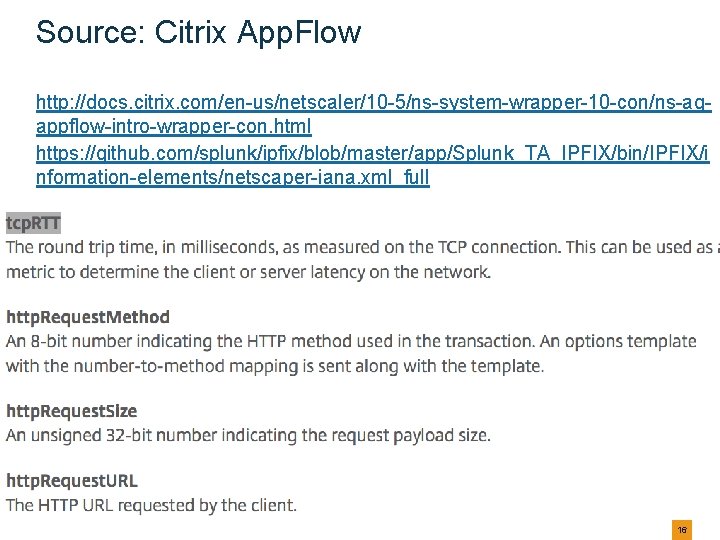
Source: Citrix App. Flow http: //docs. citrix. com/en-us/netscaler/10 -5/ns-system-wrapper-10 -con/ns-agappflow-intro-wrapper-con. html https: //github. com/splunk/ipfix/blob/master/app/Splunk_TA_IPFIX/bin/IPFIX/i nformation-elements/netscaper-iana. xml_full 16
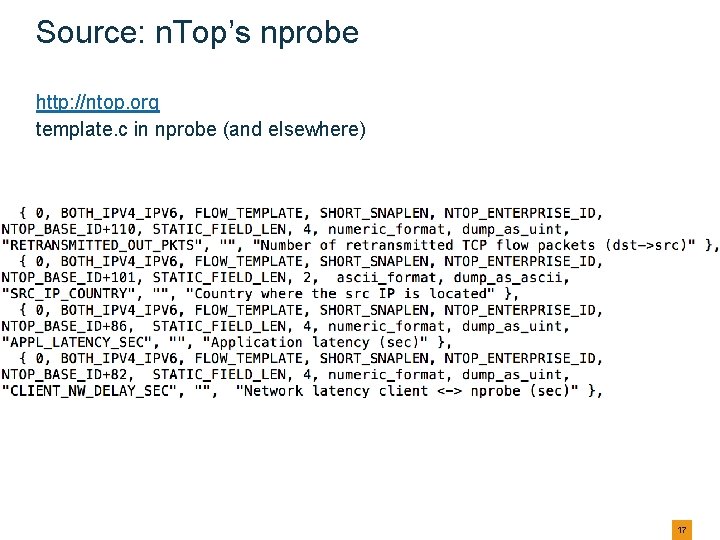
Source: n. Top’s nprobe http: //ntop. org template. c in nprobe (and elsewhere) 17
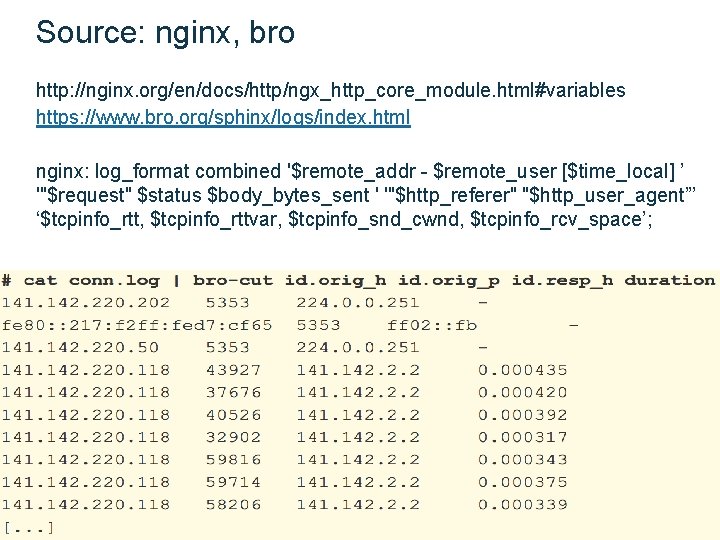
Source: nginx, bro http: //nginx. org/en/docs/http/ngx_http_core_module. html#variables https: //www. bro. org/sphinx/logs/index. html nginx: log_format combined '$remote_addr - $remote_user [$time_local] ’ '"$request" $status $body_bytes_sent ' '"$http_referer" "$http_user_agent”’ ‘$tcpinfo_rtt, $tcpinfo_rttvar, $tcpinfo_snd_cwnd, $tcpinfo_rcv_space’; 18
Use Case: Storing + Using Aug. Flow Back-end needs to store/make accessible. Often requires integration (for OSS/big data tools) or vendor support. And if the tools aren’t ‘open’ via API, SQL, or CLI, data can be trapped and not as useful. Many first use cases are ad-hoc to prove effectiveness, then drive to UI reports/dashboards. Holy grail: end user app perf + net flow + host perf + app internals insturmentation. 19
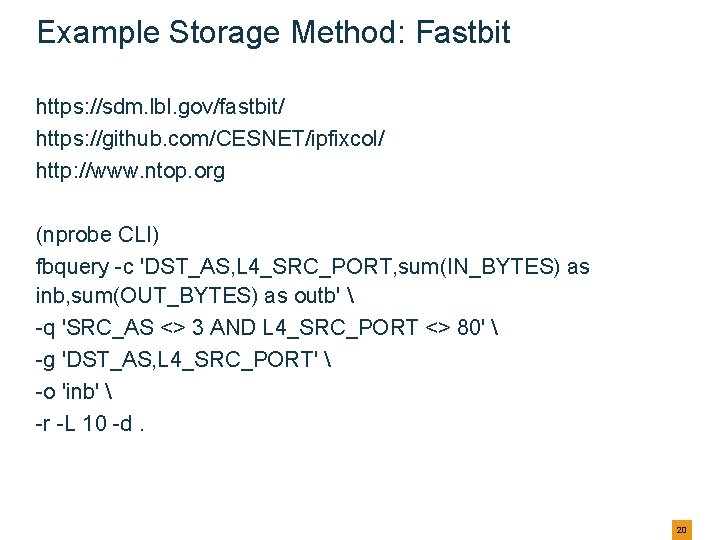
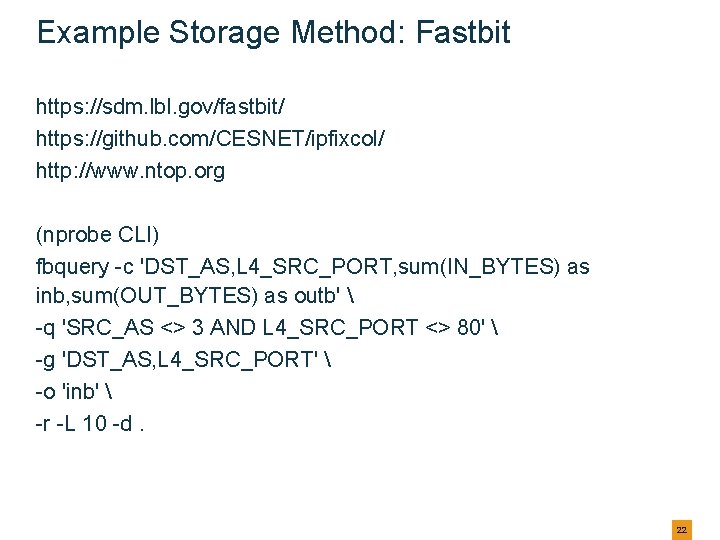
Example Storage Method: Fastbit https: //sdm. lbl. gov/fastbit/ https: //github. com/CESNET/ipfixcol/ http: //www. ntop. org (nprobe CLI) fbquery -c 'DST_AS, L 4_SRC_PORT, sum(IN_BYTES) as inb, sum(OUT_BYTES) as outb' -q 'SRC_AS <> 3 AND L 4_SRC_PORT <> 80' -g 'DST_AS, L 4_SRC_PORT' -o 'inb' -r -L 10 -d. 20
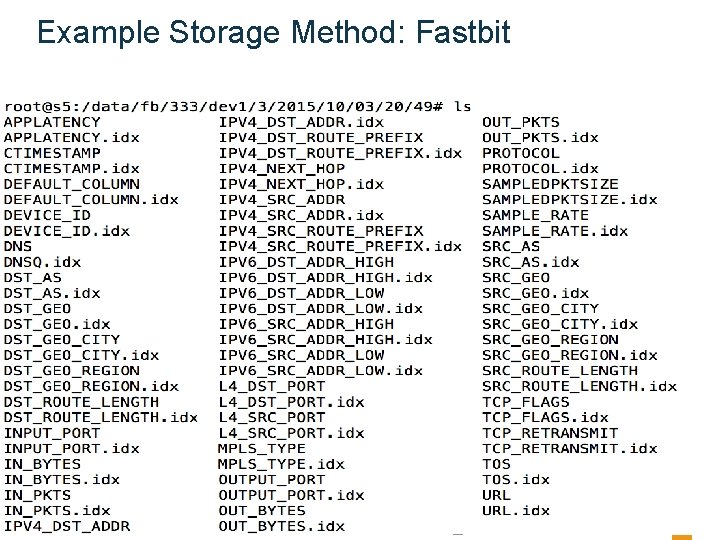
Example Storage Method: Fastbit 21
Example Storage Method: Fastbit https: //sdm. lbl. gov/fastbit/ https: //github. com/CESNET/ipfixcol/ http: //www. ntop. org (nprobe CLI) fbquery -c 'DST_AS, L 4_SRC_PORT, sum(IN_BYTES) as inb, sum(OUT_BYTES) as outb' -q 'SRC_AS <> 3 AND L 4_SRC_PORT <> 80' -g 'DST_AS, L 4_SRC_PORT' -o 'inb' -r -L 10 -d. 22
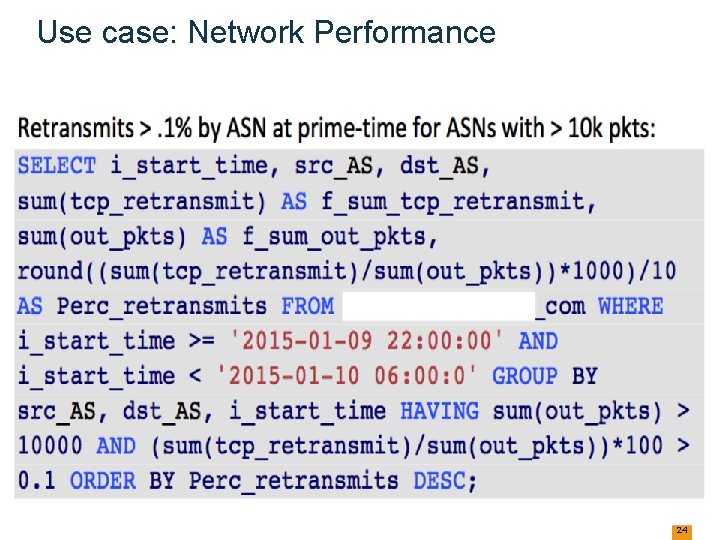
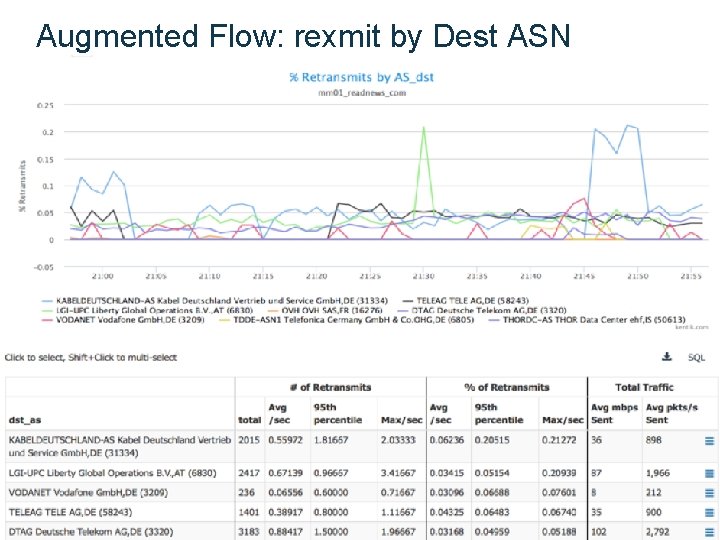
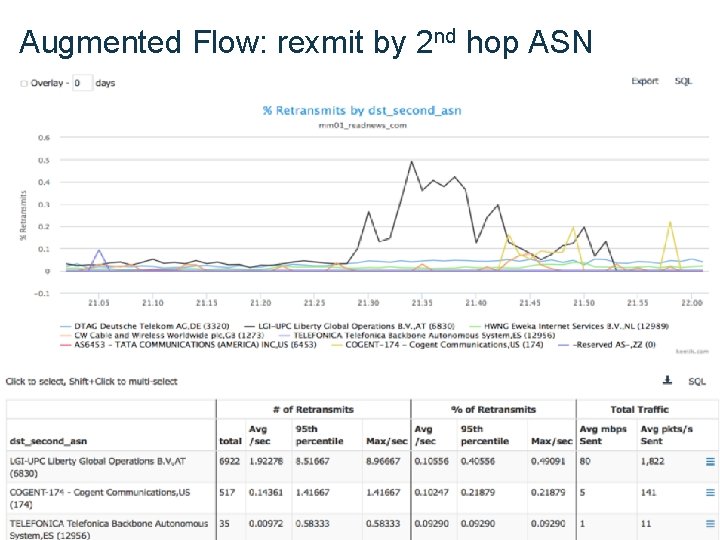
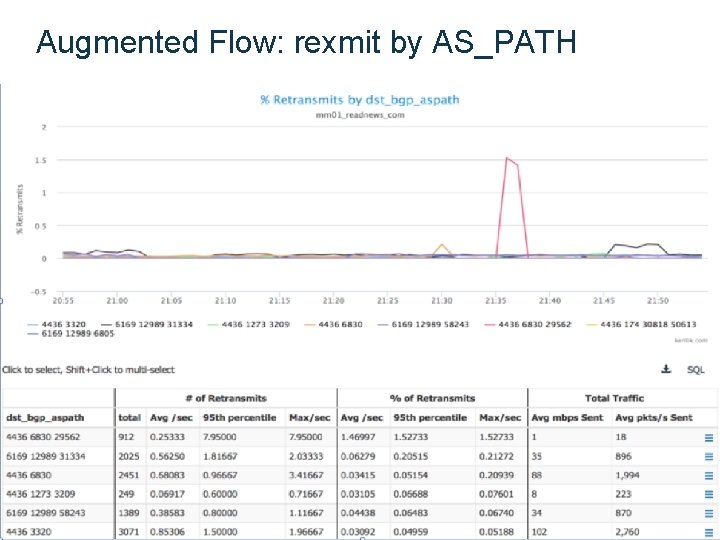
Use Case: Network Performance If the flow system can aggregate by arbitrary dimensions by AS, AS_PATH, Geo, Prefix, etc. Then looking at raw network performance from passive sources can be very useful. Ex: TCP rexmit by AS_PATH (i. e. from nprobe for a server or, via span/tap, a sensor). So… Is it data center, intranet, Internet, etc? Important to weight absolute relevance (not just % loss if a few 3 pkt flows). 23
Use case: Network Performance 24
Augmented Flow: rexmit by Dest ASN
Augmented Flow: rexmit by 2 nd hop ASN
Augmented Flow: rexmit by AS_PATH
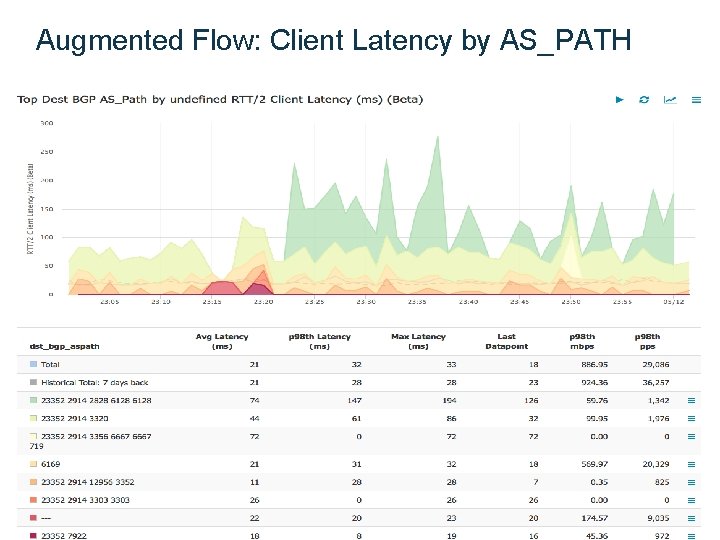
Augmented Flow: Client Latency by AS_PATH
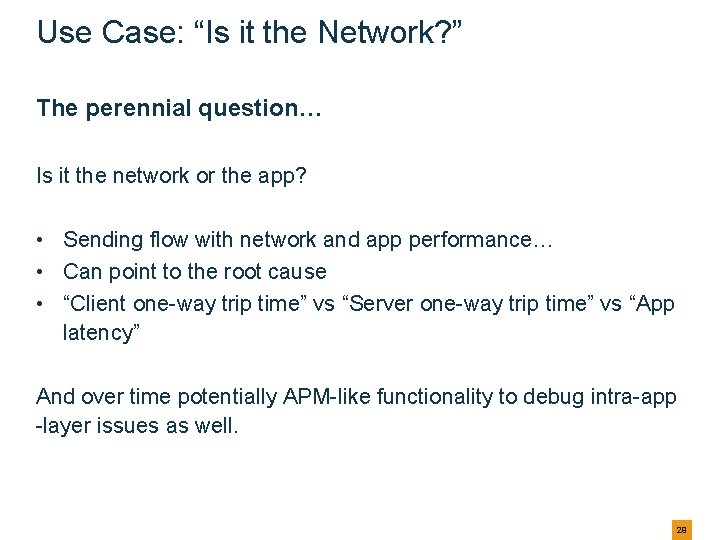
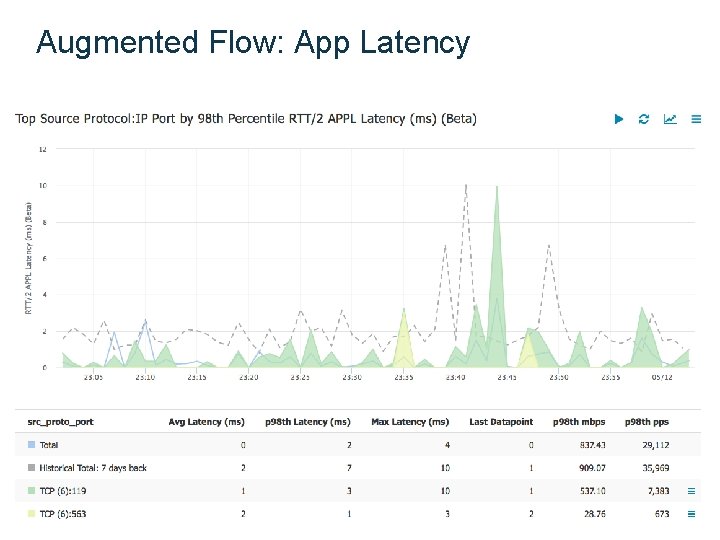
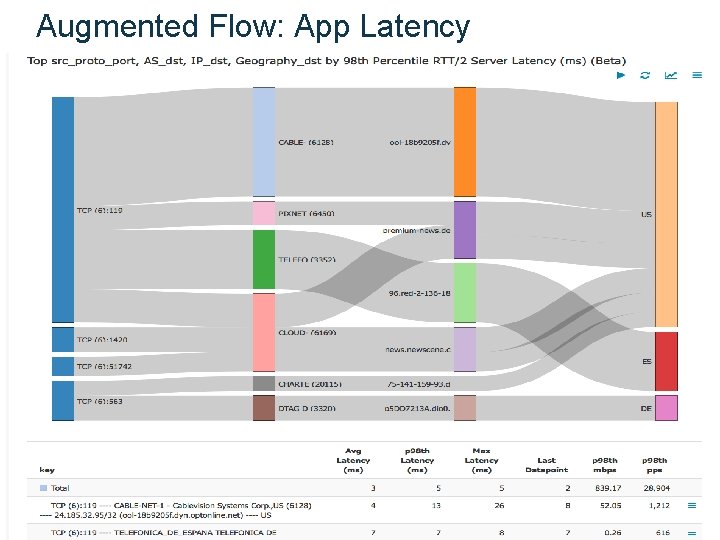
Use Case: “Is it the Network? ” The perennial question… Is it the network or the app? • Sending flow with network and app performance… • Can point to the root cause • “Client one-way trip time” vs “Server one-way trip time” vs “App latency” And over time potentially APM-like functionality to debug intra-app -layer issues as well. 29
Augmented Flow: App Latency
Augmented Flow: App Latency
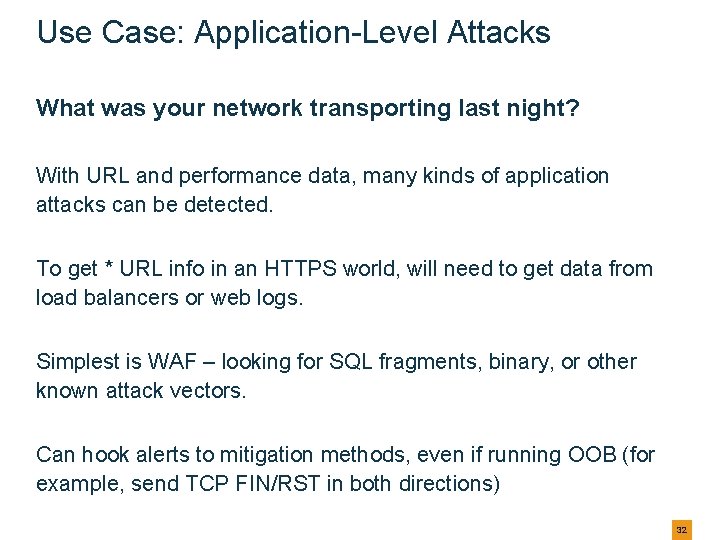
Use Case: Application-Level Attacks What was your network transporting last night? With URL and performance data, many kinds of application attacks can be detected. To get * URL info in an HTTPS world, will need to get data from load balancers or web logs. Simplest is WAF – looking for SQL fragments, binary, or other known attack vectors. Can hook alerts to mitigation methods, even if running OOB (for example, send TCP FIN/RST in both directions) 32
Use Case: Bot Detection Is that flow human or bot? With performance information combined with URL, basic ecommerce bot detection is possible. Many attacks are advanced so may require a packet approach to get complete visibility, but basic visibility can often demonstrate a problem. Can sometimes be done with syslog analytics, but flow tools often aggregate in interesting ways (geo, AS) that syslog analytics don’t, at least out of the box. 33
Use Case: Bot Detection Is that flow human or bot? With performance information combined with URL, basic ecommerce bot detection is possible. Many attacks are advanced so may require a packet approach to get complete visibility, but basic visibility can often demonstrate a problem. Can sometimes be done with syslog analytics, but flow tools often aggregate in interesting ways (geo, AS) that syslog analytics don’t, at least out of the box. 34
Questions? Avi Freedman avi@kentik. com CHI-NOG 06 5/12/2016