
Nestorian Order First some vocabulary What does argument
Nestorian Order
First, some vocabulary… What does “argument” mean when referring to persuasive writing? A disagreement made up of three partsviewpoint, support, and opposing viewpoint.
Directions: § You will be given six strips of paper. § With a partner, put the strips of paper in the order that each element should appear in your persuasive essay.
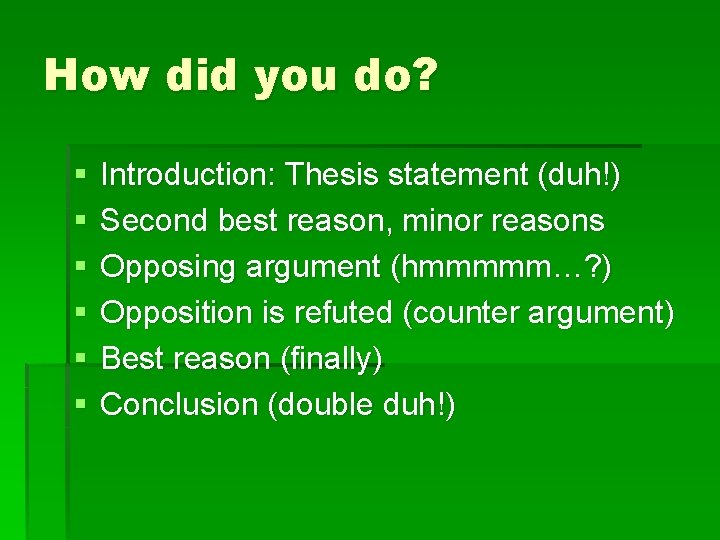
How did you do? § § § Introduction: Thesis statement (duh!) Second best reason, minor reasons Opposing argument (hmmmmm…? ) Opposition is refuted (counter argument) Best reason (finally) Conclusion (double duh!)
§ Why do we need to include the opposing viewpoint? Addressing the opposing viewpoint shows that you are familiar with your audience. It also shows that you are fair, which makes it more likely the audience will respect your viewpoint. Besides, if you didn’t address it, you could not refute it or prove that it is wrong.
More Vocabulary § Issue § Position § Bias § Evidence § Opinion § Appeal § Refute § Call to Action
Three Types of Appeals Your Persuasive Appeals Pyramid will help you remember to use at least one of the three types of appeals in your persuasive writing. Take appropriate notes for each of the three sections…
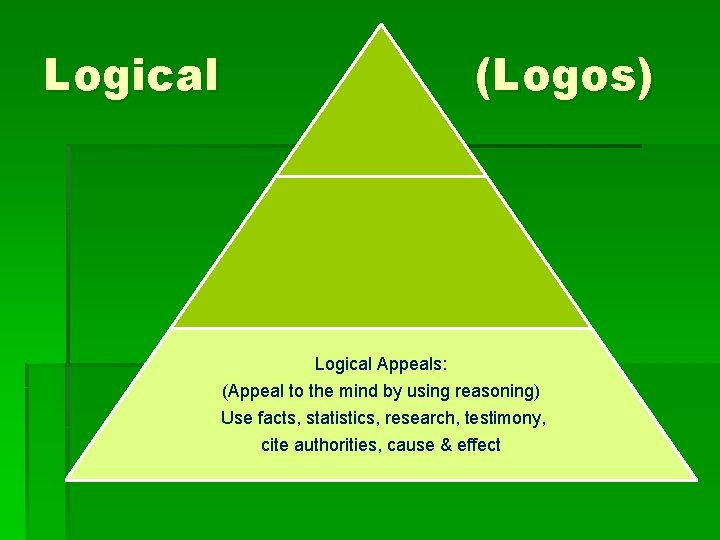
Logical (Logos) Logical Appeals: (Appeal to the mind by using reasoning) Use facts, statistics, research, testimony, cite authorities, cause & effect
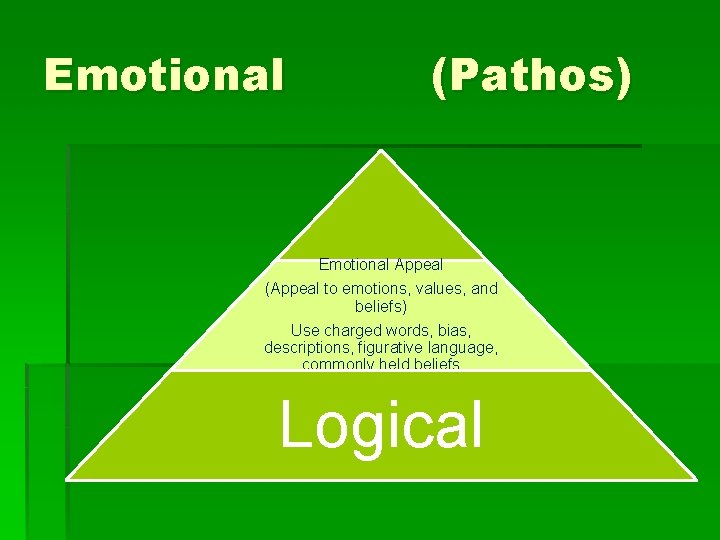
Emotional (Pathos) Emotional Appeal (Appeal to emotions, values, and beliefs) Use charged words, bias, descriptions, figurative language, commonly held beliefs Logical
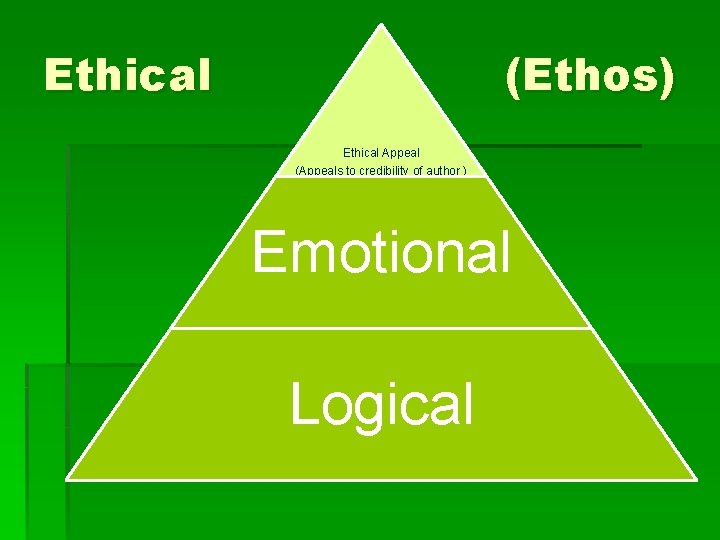
Ethical (Ethos) Ethical Appeal (Appeals to credibility of author ) Must show trustworthiness, reliability, and a true concern for the audience. Emotional Logical
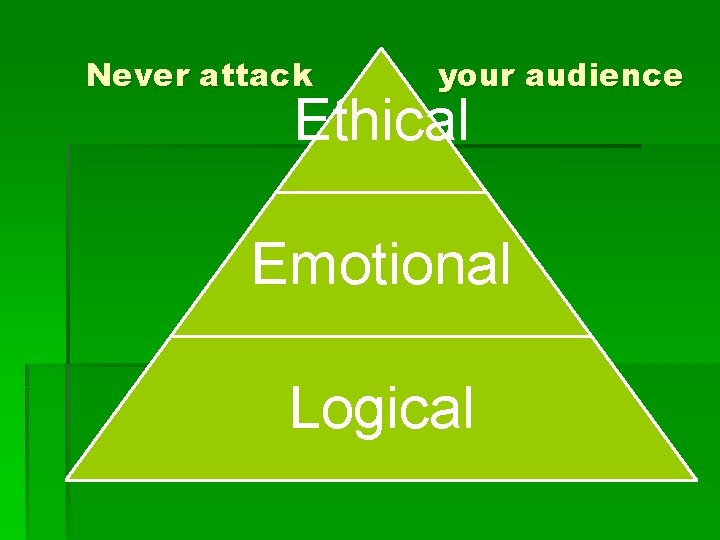
Never attack your audience Ethical Emotional Logical
What is a “Thesis Statement”? A declarative sentence that usually appears in the first or last sentence of the introductory paragraph stating the controlling idea of your paper.
Never use the phrase “My paper Is about…” Never express thesis as a question.
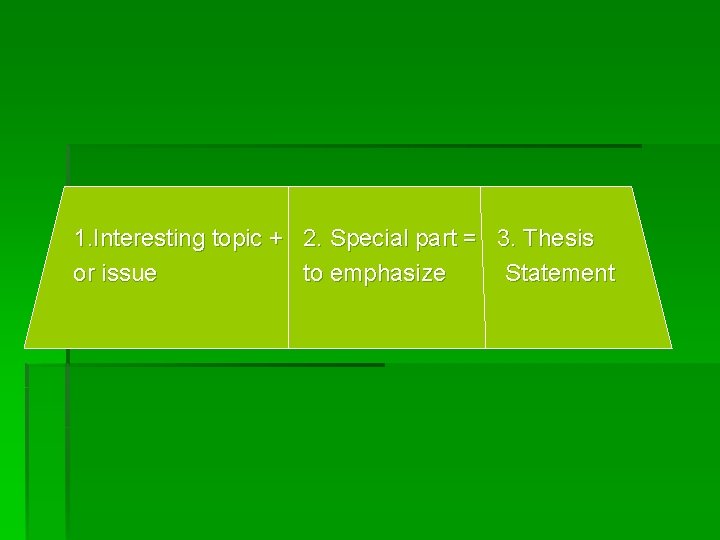
1. Interesting topic + 2. Special part = 3. Thesis or issue to emphasize Statement
- Slides: 15