
Nested Designs and Repeated Measures with Treatment and

- Slides: 12
Nested Designs and Repeated Measures with Treatment and Time Effects KNNL – Sections 26. 1 -26. 5, 27. 3
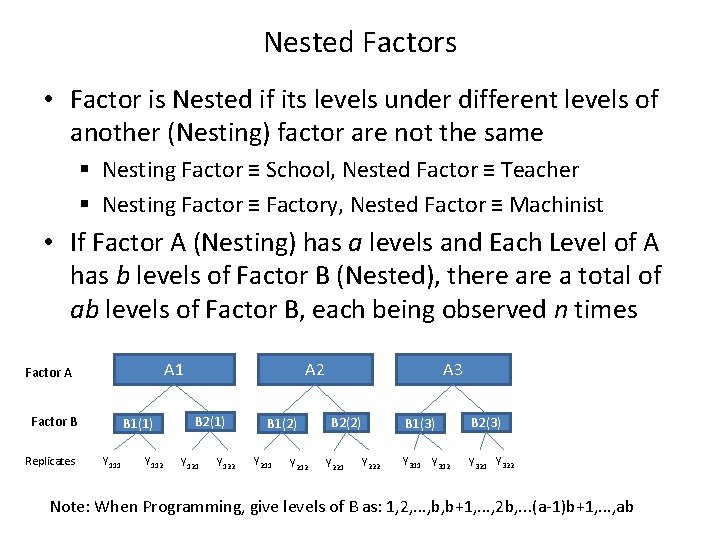
Nested Factors • Factor is Nested if its levels under different levels of another (Nesting) factor are not the same § Nesting Factor ≡ School, Nested Factor ≡ Teacher § Nesting Factor ≡ Factory, Nested Factor ≡ Machinist • If Factor A (Nesting) has a levels and Each Level of A has b levels of Factor B (Nested), there a total of ab levels of Factor B, each being observed n times A 1 Factor A Factor B Replicates B 1(1) Y 111 Y 112 A 2 B 2(1) Y 121 Y 122 B 1(2) Y 211 Y 212 A 3 B 2(2) Y 221 Y 222 B 1(3) B 2(3) Y 311 Y 312 Y 321 Y 322 Note: When Programming, give levels of B as: 1, 2, . . . , b, b+1, . . . , 2 b, . . . (a-1)b+1, . . . , ab
2 -Factor Nested Model – Balanced Case
Estimators, Analysis of Variance, F-tests
Fixed Effects Model (A and B Fixed)
Mixed Effects Model (A Fixed and B Random)
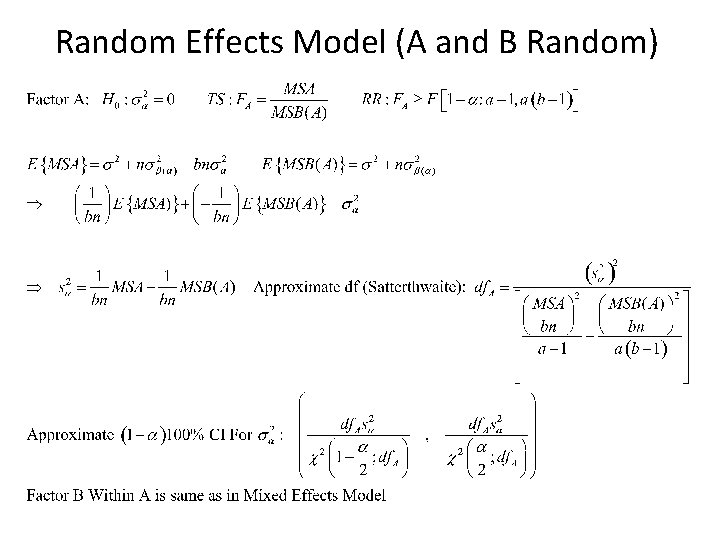
Random Effects Model (A and B Random)
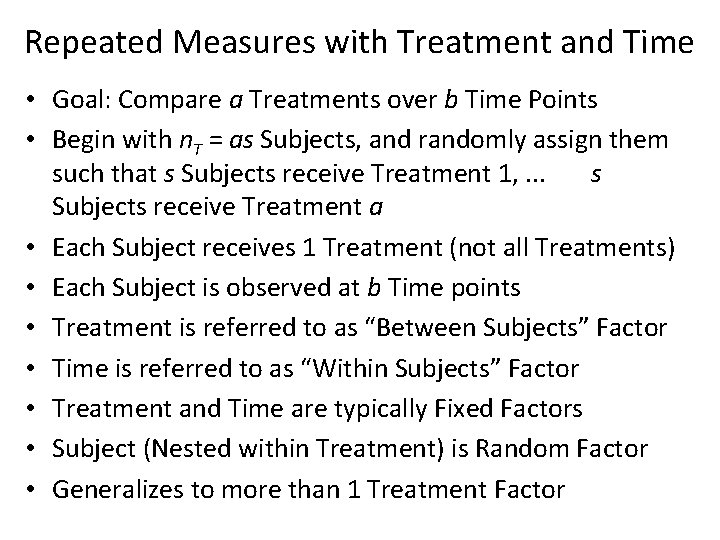
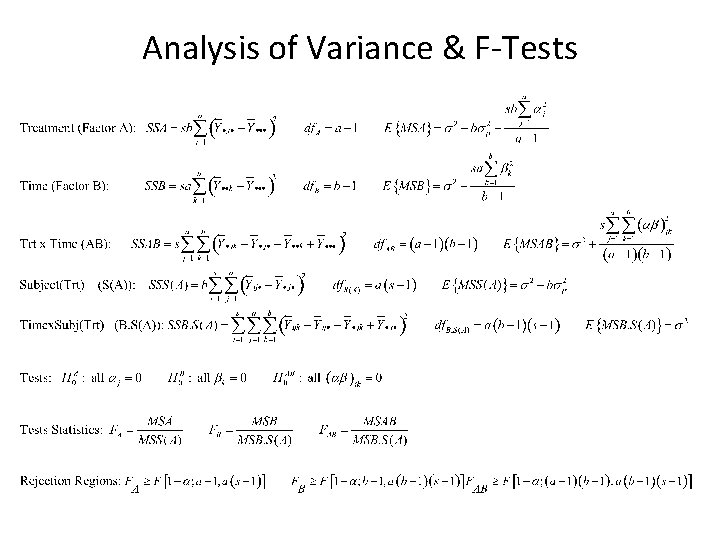
Repeated Measures with Treatment and Time • Goal: Compare a Treatments over b Time Points • Begin with n. T = as Subjects, and randomly assign them such that s Subjects receive Treatment 1, . . . s Subjects receive Treatment a • Each Subject receives 1 Treatment (not all Treatments) • Each Subject is observed at b Time points • Treatment is referred to as “Between Subjects” Factor • Time is referred to as “Within Subjects” Factor • Treatment and Time are typically Fixed Factors • Subject (Nested within Treatment) is Random Factor • Generalizes to more than 1 Treatment Factor
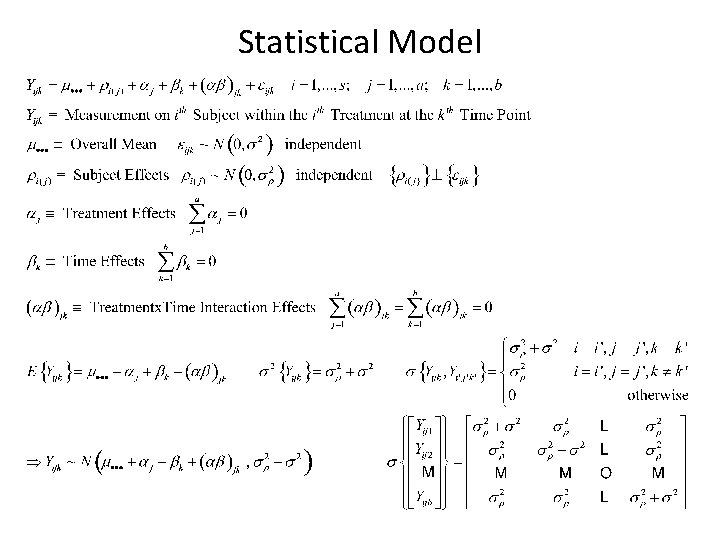
Statistical Model
Analysis of Variance & F-Tests
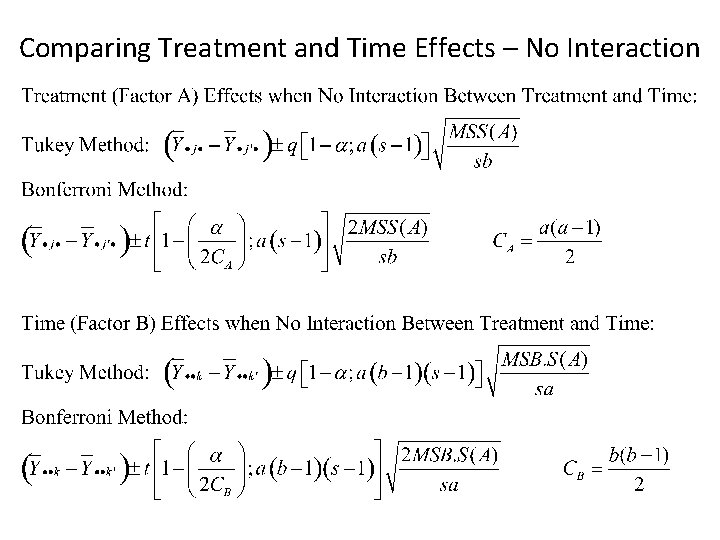
Comparing Treatment and Time Effects – No Interaction
Comparing Trt Levels w/in Time Periods