
Nervous System Suzanne DAnna 1 Nervous System master
- Slides: 73
Nervous System Suzanne D'Anna 1
Nervous System master control system master communicating center l nerve tissue develops from embryonic ectoderm Suzanne D'Anna 2
Role of the Nervous System monitors changes - (sensory function) l processes and interprets information - (integrative) l elicits responses - (motor) l Suzanne D'Anna 3
Nervous System Organization anatomical organization - central nervous system (CNS) - peripheral nervous system (PNS) l functional organization - sensory - integrative - motor l Suzanne D'Anna 4
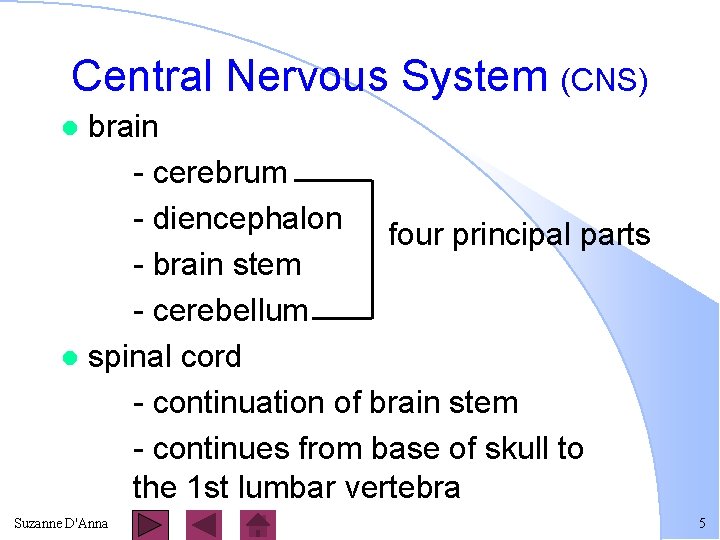
Central Nervous System (CNS) brain - cerebrum - diencephalon four principal parts - brain stem - cerebellum l spinal cord - continuation of brain stem - continues from base of skull to the 1 st lumbar vertebra l Suzanne D'Anna 5
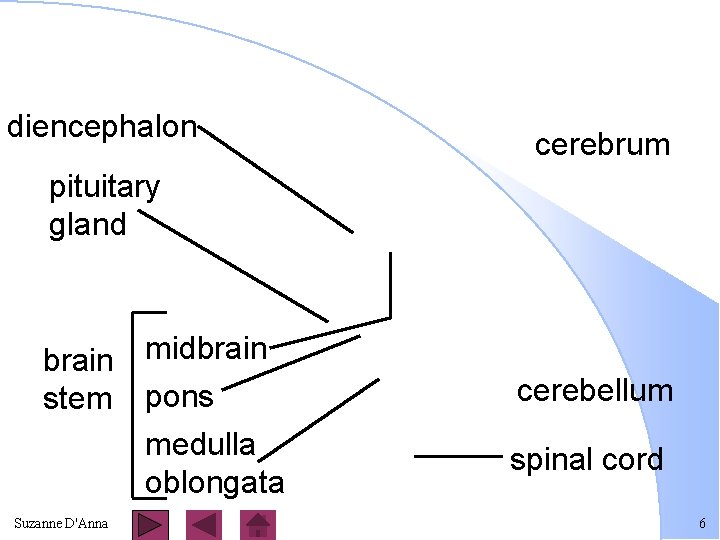
diencephalon cerebrum pituitary gland brain midbrain stem pons medulla oblongata Suzanne D'Anna cerebellum spinal cord 6
Peripheral Nervous System (PNS) cranial nerves - 12 pairs - emerge from the brain l spinal nerves - 31 pairs - emerge from the spinal cord l Suzanne D'Anna 7
Functional Organization sensory - gathers information that occurs within internal and external environment l integrative - analyzes sensory information - decides necessary responses l motor - carries instructions (nerve impulses) to muscles and glands (effectors) l Suzanne D'Anna 8
Basic Types of Functional Neurons Suzanne D'Anna 9
Sensory Neurons l afferent neurons - carry information from various body parts to the brain or spinal cord (input) Motor Neurons l efferent neurons - carry instructions from the CNS to muscles and glands (output) Suzanne D'Anna 10
Interneurons or Connecting Neurons analyze information l determine appropriate response l located in the CNS l Suzanne D'Anna 11
Peripheral Nervous System (subdivisions) somatic nervous system (soma = body) - voluntary - sensations are consciously perceived l autonomic nervous system (auto = self) - involuntary and automatic - sensations are usually not consciously perceived l Suzanne D'Anna 12
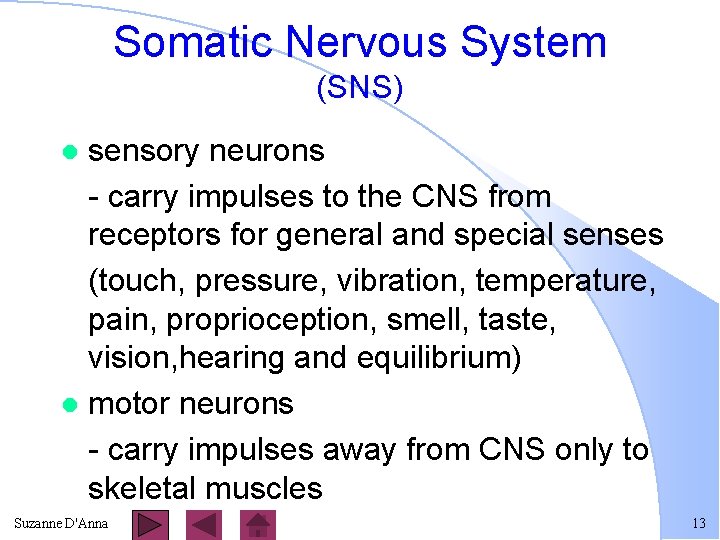
Somatic Nervous System (SNS) sensory neurons - carry impulses to the CNS from receptors for general and special senses (touch, pressure, vibration, temperature, pain, proprioception, smell, taste, vision, hearing and equilibrium) l motor neurons - carry impulses away from CNS only to skeletal muscles l Suzanne D'Anna 13
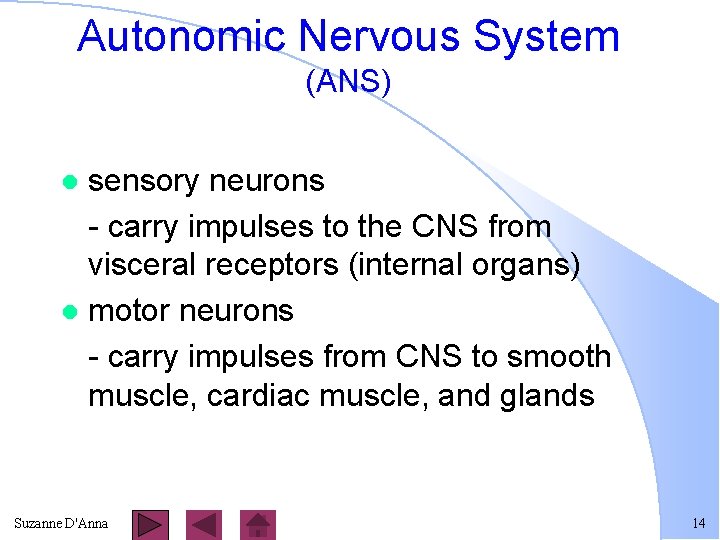
Autonomic Nervous System (ANS) sensory neurons - carry impulses to the CNS from visceral receptors (internal organs) l motor neurons - carry impulses from CNS to smooth muscle, cardiac muscle, and glands l Suzanne D'Anna 14
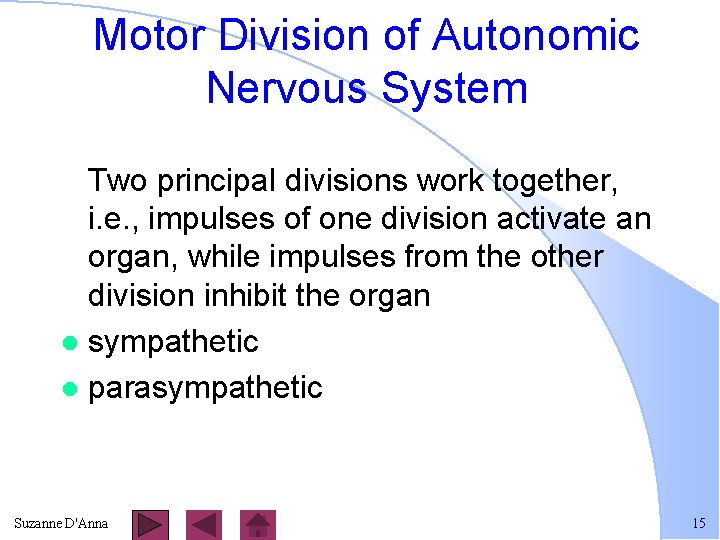
Motor Division of Autonomic Nervous System Two principal divisions work together, i. e. , impulses of one division activate an organ, while impulses from the other division inhibit the organ l sympathetic l parasympathetic Suzanne D'Anna 15
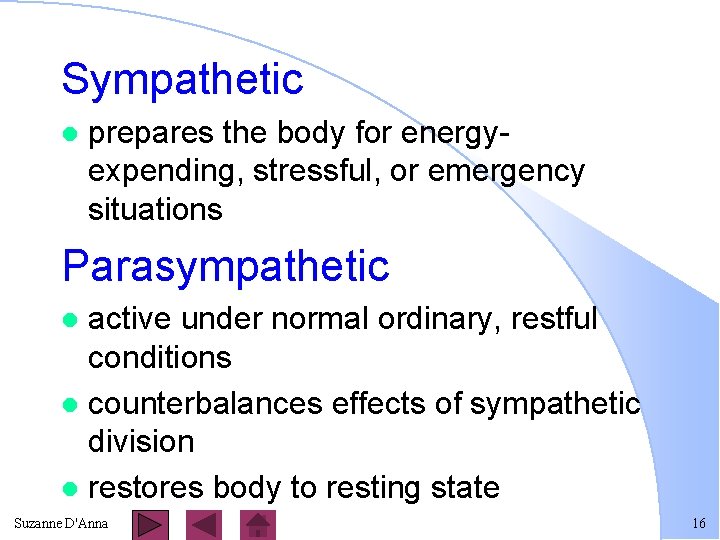
Sympathetic l prepares the body for energyexpending, stressful, or emergency situations Parasympathetic active under normal ordinary, restful conditions l counterbalances effects of sympathetic division l restores body to resting state l Suzanne D'Anna 16
Protection and Coverings of the Brain bones of cranium l cerebrospinal fluid l connective tissue membranes called meninges l vertebral column l Suzanne D'Anna 17
Cranium frontal l sphenoid l ethmoid l occipital l parietal l temporal l Suzanne D'Anna 18
Cerebrospinal Fluid (CSF) formed by filtration and secretion from networks of capillaries - choroid plexuses located in the (4) ventricles of the brain form blood-brain barrier l clear, colorless liquid l contains glucose, proteins, lactic acid, urea, cations, and lymphocytes l Suzanne D'Anna 19
Cerebrospinal Fluid (cont. ) acts as shock-absorbing medium l protects brain from banging against inner walls of cranium l is a medium for exchange of nutrients and waste products between blood and nervous tissue l Suzanne D'Anna 20
Cerebrospinal Fluid (cont. ) significant changes in composition can indicate disease conditions - meningitis - tumors - multiple sclerosis l if drainage of CSF is obstructed, excessive pressure on the brain will cause hydrocephalus l Suzanne D'Anna 21
Blood-Brain Barrier permits certain substances to enter the fluid but prohibits others l protects the brain from harmful substances l formed by tightly adherent cell connections l Suzanne D'Anna 22
Meninges protective membranes l delicate l envelop brain and spinal cord l Three connective tissue membranes: - dura mater - arachnoid - pia mater l Suzanne D'Anna 23
Dura Mater outermost layer l leathery l next to bony inner surface of cranium l separated from arachnoid by subdural space which is fluid filled l Suzanne D'Anna 24
Arachnoid middle layer l looks like a cobweb l Two components: - layer next to the subdural space - system of supporting fibers (trabeculae) forming web-like structure between arachnoid and pia mater l Suzanne D'Anna 25
Arachnoid (cont. ) in some areas, arachnoid material perforates dura mater forming protrusions called arachnoid villa l Functions: - reabsorption of CSF into blood l Suzanne D'Anna 26
Pia Mater innermost l thin layer of loose connective tissue l transparent l contains many blood vessels l between pia mater and nerve tissue is a thin layer of neuroglial processes firmly attached to pia mater l Suzanne D'Anna 27
Meningitis inflammation of meninges l serious threat to brain l bacterial and viral meningitis can spread to nervous tissue of CNS l Suzanne D'Anna 28
Regions of the Brain cerebrum (cerebral hemisphere ) l diencephalon l brain stem l cerebellum l Suzanne D'Anna 29
Cerebrum (cerebral hemisphere) largest, obscures most of brain stem l looks like mushroom cap l made up of 2 deeply grooved hemispheres - left and right l Surface is covered by: - grooves - fissures or sulci - ridges - gyri or convolutions which serve as landmarks l Suzanne D'Anna 30
Cerebrum (con’t) l concerned with higher brain functions l Contains centers for: - interpreting sensory impulses - initiating voluntary muscular movements l stores information of memory l utilizes information in reasoning processes l functions in determining a person’s intelligence and personality Suzanne D'Anna 31
Left Hemisphere l More important for: - right-hand control - spoken and written language - numerical and scientific skills - reasoning Suzanne D'Anna 32
Right Hemisphere l More important for: - left-hand control - musical and artistic awareness - space and pattern perception - insight and imagination Suzanne D'Anna 33
Lobes each hemisphere is subdivided into 4 lobes l named for cranial bone that covers them l more precisely defined by surface landmarks, i. e. , sulci and fissures l Suzanne D'Anna 34
Lobes (cont. ) parietal lobe l occipital lobe l temporal lobe l frontal lobe l Suzanne D'Anna 35
White Matter underlying the cortex l whitish appearance is due to fatty component of myelin l consists of myelinated axons extending in three principal directions - association fibers - commissural fibers - projection fibers l Suzanne D'Anna 36
Association Fibers l connect and transmit impulses between gyri in the same hemispheres Suzanne D'Anna 37
Commissural Fibers l transmit impulses from the gyri in one cerebral hemisphere to corresponding in the opposite hemisphere Suzanne D'Anna gyri 38
Three Important Commissural Fibers corpus callosum (corpus = mass or body) - great commissure of the brain between the cerebral hemispheres l anterior commissure l posterior commissure l Suzanne D'Anna 39
Projection Fibers form descending and ascending tracts l tracts transmit impulses from cerebrum and other parts of brain to spinal cord l tracts transmit impulses from spinal cord to brain l Suzanne D'Anna 40
Gray Matter made primarily of densely packed neuron cell bodies l basal ganglia - paired masses of gray matter - found in cerebral hemispheres l cerebral cortex - layer of gray matter approx. 3 mm thick - has 6 distinct layers - divided into 3 areas based on function l Suzanne D'Anna 41
Cerebral Hemisphere l outer layer of gray matter is cerebral cortex - made up of lobes composed of dendrites and cell body neurons - interior is composed of white matter (nerve fibers arranged in bundles called tracts) Suzanne D'Anna 42
Functions of Cerebral Cortex l divided into three main areas based on function - sensory area - motor area - association area Suzanne D'Anna 43
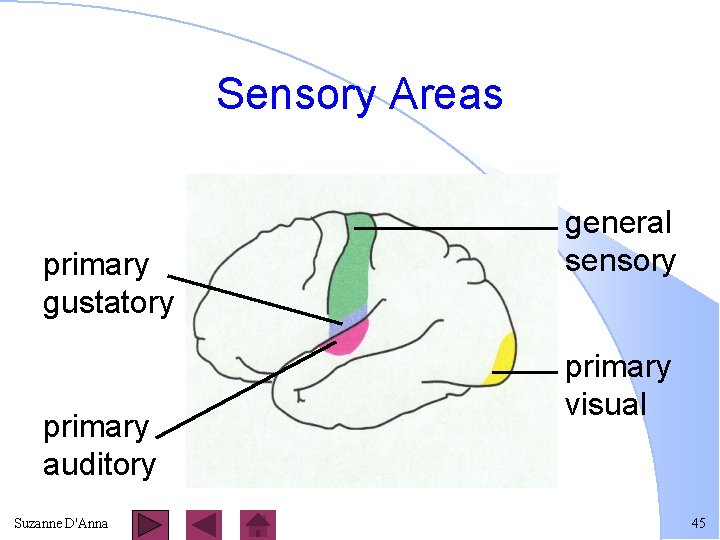
Sensory Areas l Function in interpreting impulses, located in several lobes of cerebrum - general sensory area - primary visual area - primary auditory area - primary gustatory area - primary olfactory area Suzanne D'Anna 44
Sensory Areas primary gustatory primary auditory Suzanne D'Anna general sensory primary visual 45
General Sensory Area Receives impulses from: - the skin - muscles - internal organs l localizes precisely where sensations originate l located on the postcentral gryus on the occipital lobe l Suzanne D'Anna 46
Primary Visual Area receives input from the eyes l Interprets: - shape - color - movement l located on the occipital lobes l Suzanne D'Anna 47
Primary Auditory Area (cont. ) receives input from internal ear (cochlea) l Interprets: - pitch - rhythm l located on the temporal lobes l Suzanne D'Anna 48
Primary Gustatory Area receives input from taste buds l Interprets: - sensations related to taste (sweet, sour, salty, bitter) l located at base of postcentral gryus on parietal lobes l Suzanne D'Anna 49
Primary Olfactory Area receives input from olfactory bulbs l Interprets: - sensations related to smell l located on temporal lobes l Suzanne D'Anna 50
Motor Areas All located on frontal lobes, control actions of specific muscles or groups of muscles - primary motor area - motor speech area Suzanne D'Anna 51
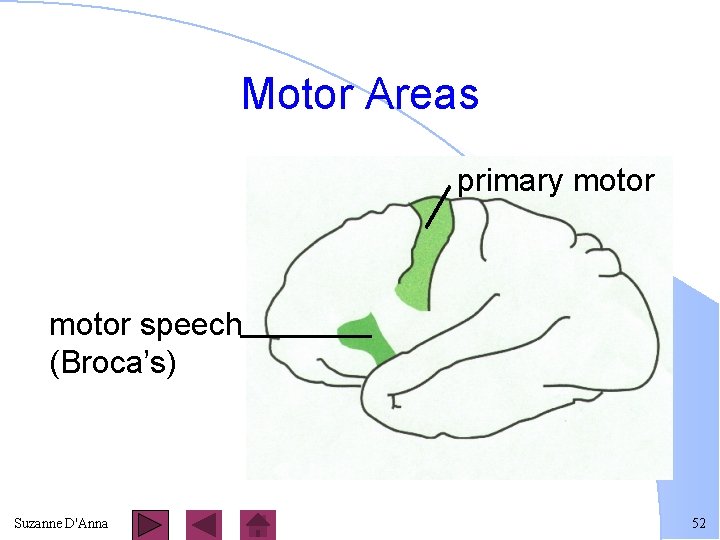
Motor Areas primary motor speech (Broca’s) Suzanne D'Anna 52
Primary Motor Area controls muscles in specific parts of body l located on precentral gyrus of frontal lobe l The translation of thoughts into speech involves the motor speech area l Suzanne D'Anna 53
Motor Speech Area (Broca’s Area) Coordinates complex muscular actions of the: - mouth - tongue - larynx l located at junction of temporal, parietal, and occipital lobes in only one cerebral hemisphere (usually left) l Suzanne D'Anna 54
Association Areas l Concerned with: - personality - intelligence - emotions - reasoning - problem solving - creativity judgment Suzanne D'Anna 55
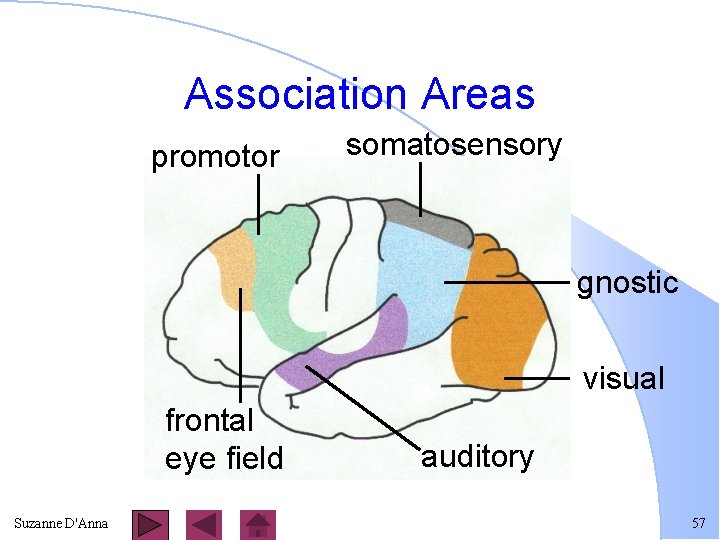
Association Areas (cont. ) somatosensory association area l visual association area l auditory associations area (Wernick’s area) l gnostic area l premotor area l frontal eye field l Suzanne D'Anna 56
Association Areas promotor somatosensory gnostic visual frontal eye field Suzanne D'Anna auditory 57
Somatosensory Association Area integrates and interprets sensations l Determines: - shape and texture of an object - orientation of one object to another as they are felt - sense relation of one body part to another l stores memories, so present sensations can be compared to previous experiences l Suzanne D'Anna 58
Visual Association Area relates present to past visual experiences by recognizing and evaluating what is seen l located in occipital lobe l Suzanne D'Anna 59
Auditory Associations Area (Wernick’s area) interprets meaning of speech l determines type of sound - speech, music, and noise l also interprets meaning of speech by translating words into thoughts l located inferior to primary auditory area in temporal lobe l Suzanne D'Anna 60
Gnostic Area (gnosis = knowledge) l (NOS-tik) integrates sensory interpretations from the association areas and impulses from other areas so that a common thought can be formed - sends signals to other parts of the brain to cause appropriate response Suzanne D'Anna 61
Premotor Area anterior to primary motor area l neurons from this area communicate with primary motor cortex, sensory associations areas in the parietal lobe, the basal ganglia, and the thalamus l concerned with learned motor activities of complex and sequential nature such as writing or playing the piano l Suzanne D'Anna 62
Frontal Eye Field in frontal cortex l controls voluntary scanning movements of the eyes such as searching for a word on a page of text or dictionary l Suzanne D'Anna 63
Diencephalon consists primarily of the thalamus and the hypothalamus l sits on top of brain stem l Suzanne D'Anna 64
Thalamus oval structure l consists of paired masses of gray matter (1 inch long) organized into nuclei l form lateral walls of third ventricle l right and left halves are joined by bridge of gray matter called intermediate mass l principal relay station l allows crude recognition of sensations; pain, temperature, or pressure l Suzanne D'Anna 65
Hypothalamus under thalamus l single most important region of brain for maintaining homeostasis l Regulates: - temperature, hunger, thirst, smell, fear, rage, sexual behavior, endocrine rhythms, and posterior and anterior pituitary secretions l Suzanne D'Anna 66
Brain Stem Three parts: - midbrain - pons - medulla oblongata l three inches long l Suzanne D'Anna 67
Midbrain mesencephalon (meso = middle, enkephalos = brain) l extends from pons to diencephalon l about one inch l involved with visual and auditory stimuli l Suzanne D'Anna 68
Pons (pons = bridge) directly above medulla l anterior to cerebellum l about one inch long l consists of white matter with regions of gray matter (nuclei) scattered throughout l bridge connecting spinal cord with brain via transverse and longitudinal fibers l helps to control respiration l Suzanne D'Anna 69
Medulla Oblongata merges with spinal cord l contains all ascending and descending tracts that connect spinal cord and various parts of brain l contains centers that control heart rate, blood pressure, breathing, swallowing and vomiting l Suzanne D'Anna 70
Cerebellum looks like a cauliflower l located behind the pons and below occipital lobes of cerebrum l controls subconscious skeletal muscle contractions required for smooth, coordinated movements and equilibrium “automatic pilot” l second largest part of brain l Suzanne D'Anna 71
Spinal Cord continuation of brain stem l extends from large opening in base of cranium (foramen magnum) down to upper region of the lower back (1 st lumbar vertebra) l cylindrically shaped l approximately 17 inches long l 1 inch in diameter l Suzanne D'Anna 72
Spinal Cord (cont. ) Surrounded and protected by: - meninges - cerebrospinal fluid - a layer of fatty tissue - the vertebra l no possibility of spinal cord injury below L 4; ideal site for removal of cerebral spinal fluid l Suzanne D'Anna 73