
Nervous System I I The nervous system is

- Slides: 12
Nervous System I I. The nervous system is a network of specialized cells known as neurons or nerve cells. The neuron is the functional unit of the nervous system.
II. Nerve cells carry “messages” throughout the organism, these messages are called impulses. An impulse is an electrochemical charge. a. Impulses are fast and do not attenuate (die out). b. Impulses are also known as the way “neurons talk to each other. ” III. An impulse is initiated (started) by a stimulus. A stimulus is a change in the external or internal environment. Example: hand touches fire
IV. There are specialized structures especially found in our skin to help us detect certain stimuli called receptors. Examples: pain, touch, temperature receptors a. Receptors are very specific and are found in greater numbers in regions used for exploring the environment. Examples: mouth, finger tips, sense organs V. Structures that allow organisms to respond to a stimulus are called effectors. In most cases effectors are either muscles or glands.
VI. The final reaction to a stimulus is called a response and it is generated by either muscle (movement) or gland tissue (secretion). VII. Putting it all together – A receptor detects a stimulus and the stimulus generates an impulse along the neuron (or neurons). The impulse finally reaches an effector that allows the organism to make a response to the initial stimulus.
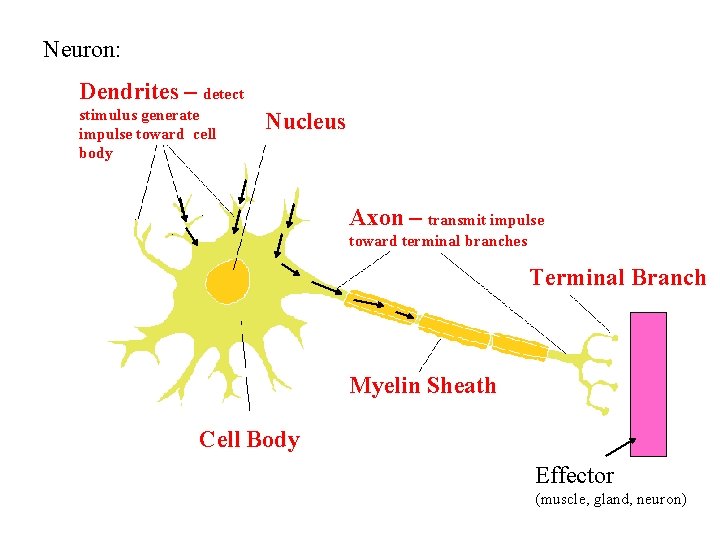
VIII. The only cell in your body capable of responding to a stimulus is a neuron. A neuron is a cell specially adapted for the transmission of impulses. It is composed of regional specializations.
Neuron: Dendrites – detect stimulus generate impulse toward cell body Nucleus Axon – transmit impulse toward terminal branches Terminal Branch Myelin Sheath Cell Body Effector (muscle, gland, neuron)
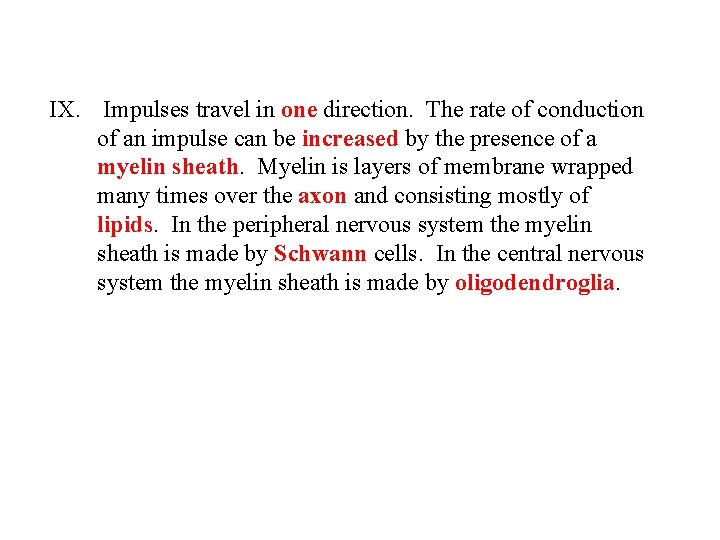
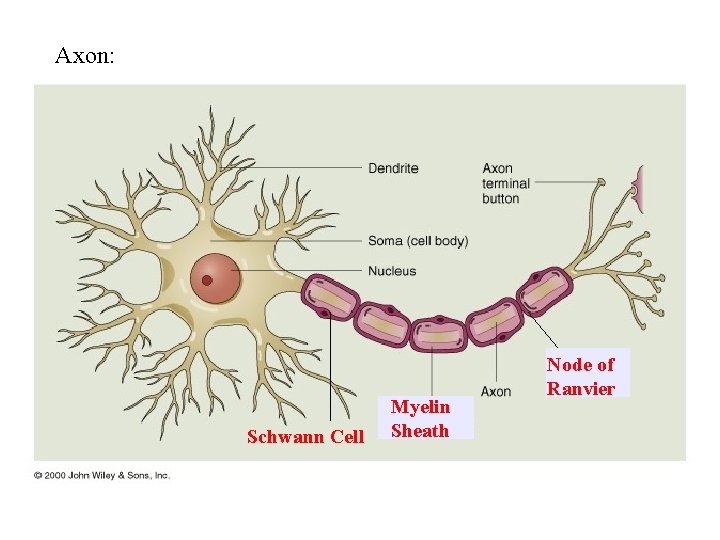
IX. Impulses travel in one direction. The rate of conduction of an impulse can be increased by the presence of a myelin sheath. Myelin is layers of membrane wrapped many times over the axon and consisting mostly of lipids. In the peripheral nervous system the myelin sheath is made by Schwann cells. In the central nervous system the myelin sheath is made by oligodendroglia.
Axon: Schwann Cell Myelin Sheath Node of Ranvier
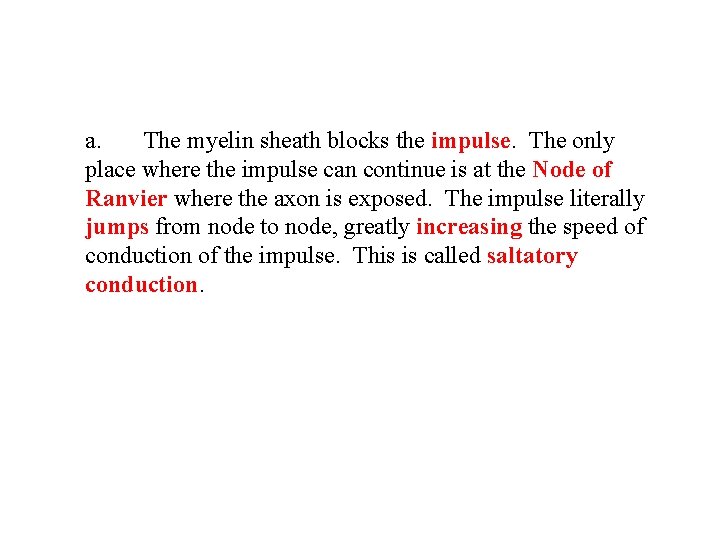
a. The myelin sheath blocks the impulse. The only place where the impulse can continue is at the Node of Ranvier where the axon is exposed. The impulse literally jumps from node to node, greatly increasing the speed of conduction of the impulse. This is called saltatory conduction.
X. How does the impulse travel from one neuron to the next cell in the chain? The next cell in the chain can be another neuron, muscle, or gland. There are specializations at the terminal branch that allow the impulse to travel from one cell to the next without attenuation.
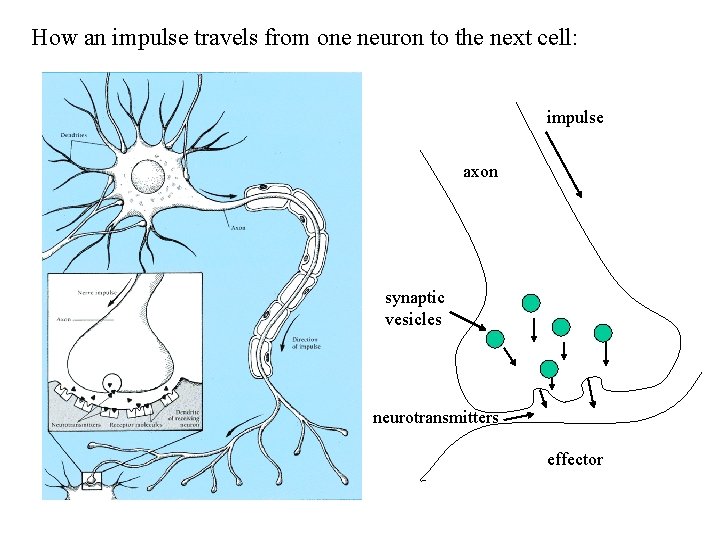
How an impulse travels from one neuron to the next cell: impulse axon synaptic vesicles neurotransmitters effector
When an impulse arrives at the terminal branch, membranes of synaptic vesicles fuse with the cell membrane of the terminal branch. The contents of the synaptic vesicles which are neurotransmitters are expelled into the synapse (gap). Neurotransmitters travel across the gap and stimulate the next cell (neuron, muscle, or gland) in the chain. The result of this stimulation is that an impulse is generated. Examples of neurotransmitters include: acetylcholine, noradrenaline, dopamine, and serotonin