
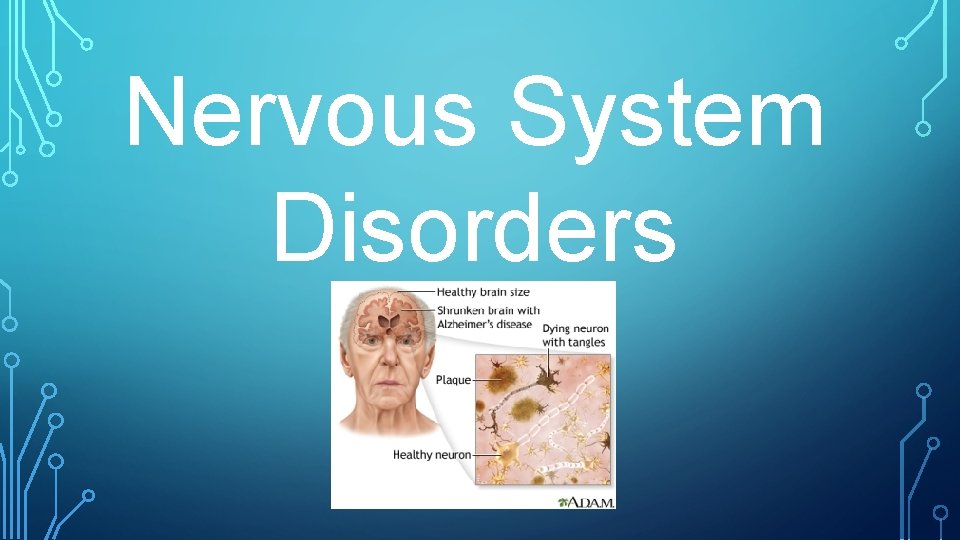
Nervous System Disorders ALZHEIMERS DISEASEDEMENTIA Progressive degenerative disease

- Slides: 17
Nervous System Disorders
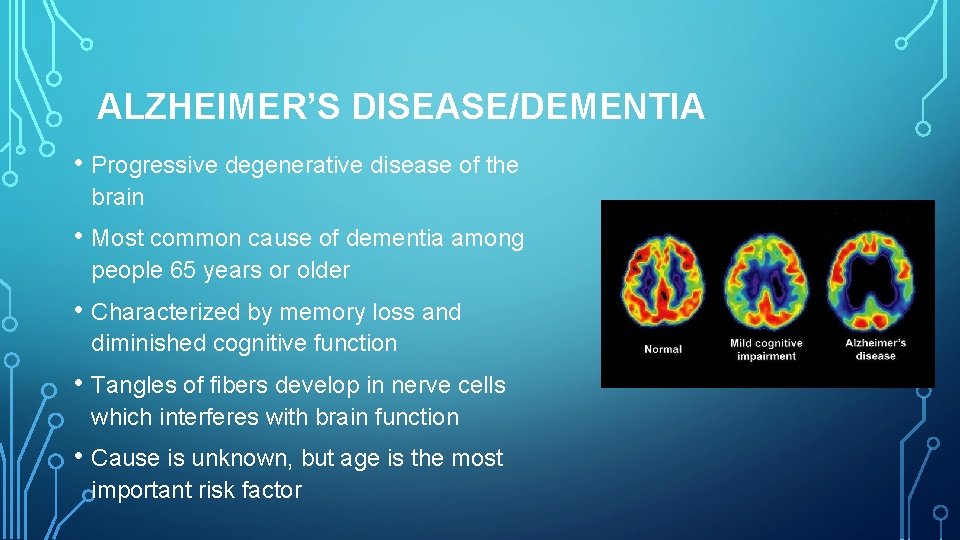
ALZHEIMER’S DISEASE/DEMENTIA • Progressive degenerative disease of the brain • Most common cause of dementia among people 65 years or older • Characterized by memory loss and diminished cognitive function • Tangles of fibers develop in nerve cells which interferes with brain function • Cause is unknown, but age is the most important risk factor
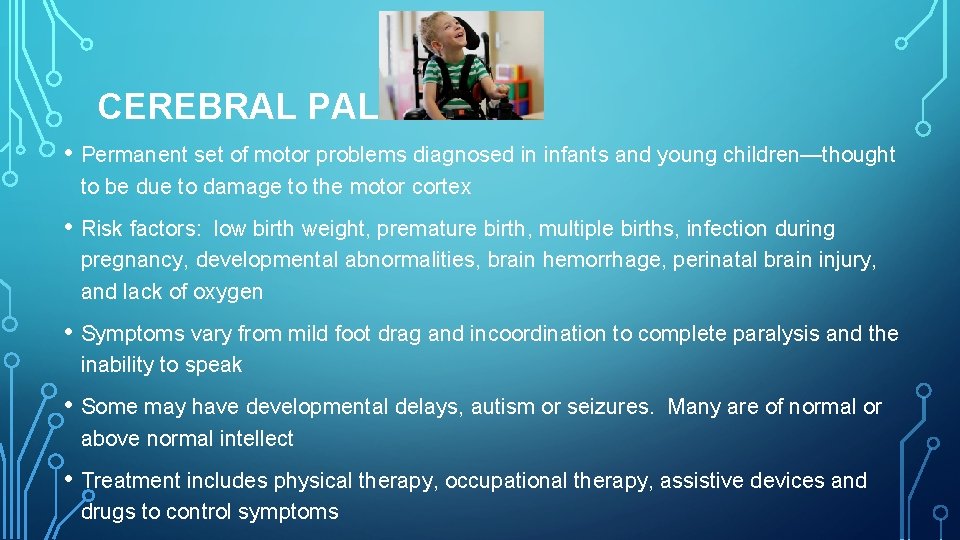
CEREBRAL PALSY • Permanent set of motor problems diagnosed in infants and young children—thought to be due to damage to the motor cortex • Risk factors: low birth weight, premature birth, multiple births, infection during pregnancy, developmental abnormalities, brain hemorrhage, perinatal brain injury, and lack of oxygen • Symptoms vary from mild foot drag and incoordination to complete paralysis and the inability to speak • Some may have developmental delays, autism or seizures. Many are of normal or above normal intellect • Treatment includes physical therapy, occupational therapy, assistive devices and drugs to control symptoms
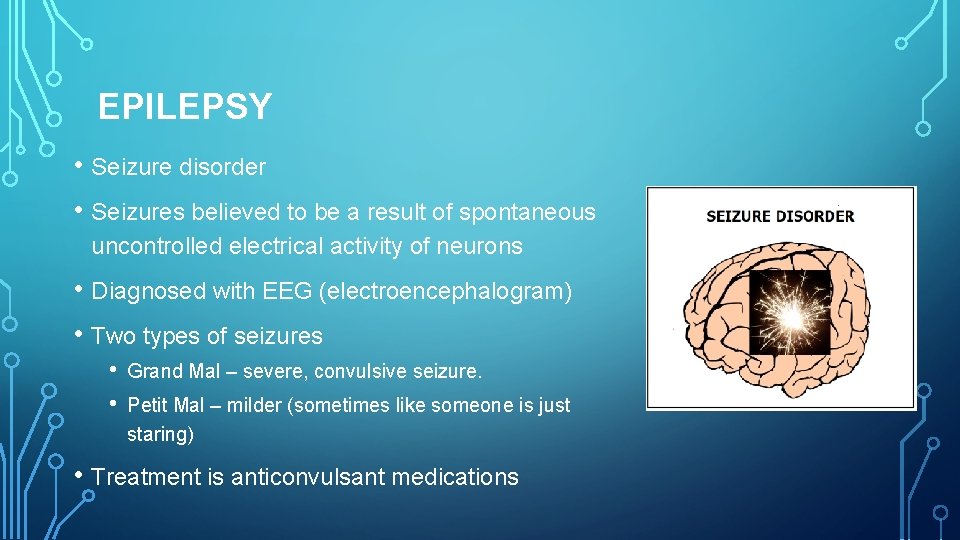
EPILEPSY • Seizure disorder • Seizures believed to be a result of spontaneous uncontrolled electrical activity of neurons • Diagnosed with EEG (electroencephalogram) • Two types of seizures • • Grand Mal – severe, convulsive seizure. Petit Mal – milder (sometimes like someone is just staring) • Treatment is anticonvulsant medications
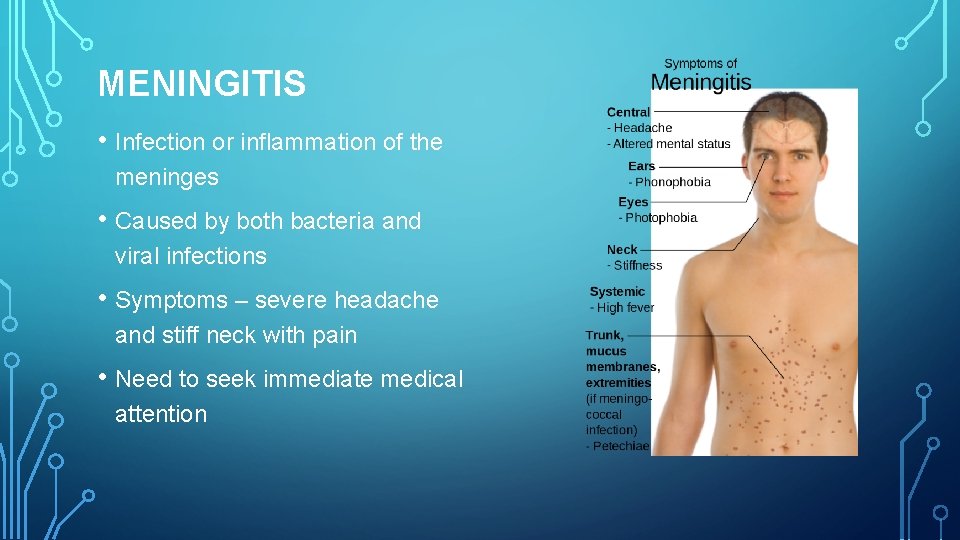
MENINGITIS • Infection or inflammation of the meninges • Caused by both bacteria and viral infections • Symptoms – severe headache and stiff neck with pain • Need to seek immediate medical attention
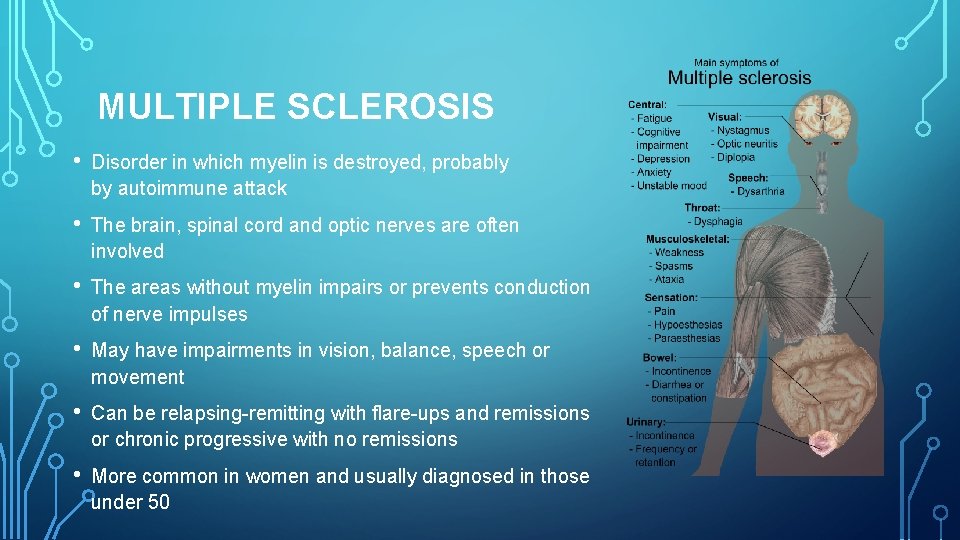
MULTIPLE SCLEROSIS • Disorder in which myelin is destroyed, probably by autoimmune attack • The brain, spinal cord and optic nerves are often involved • The areas without myelin impairs or prevents conduction of nerve impulses • May have impairments in vision, balance, speech or movement • Can be relapsing-remitting with flare-ups and remissions or chronic progressive with no remissions • More common in women and usually diagnosed in those under 50
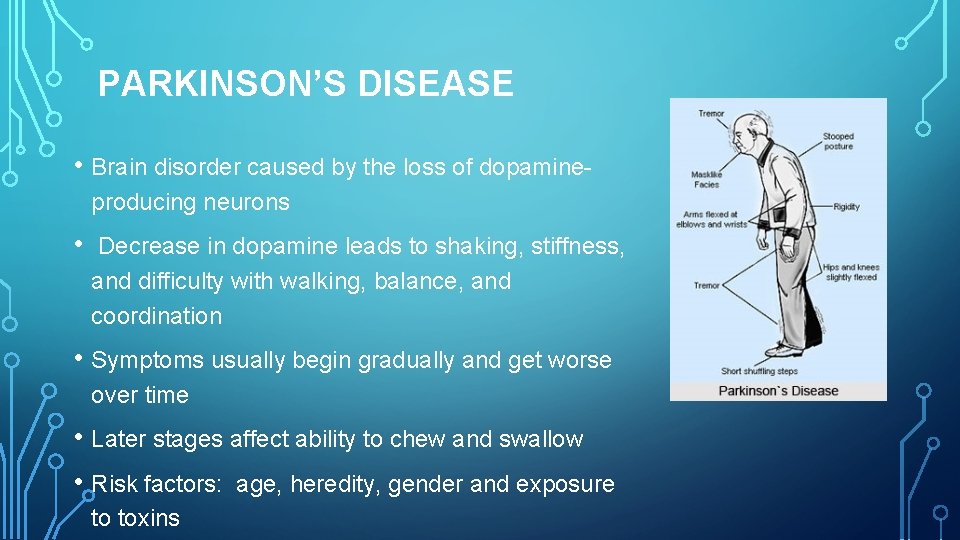
PARKINSON’S DISEASE • Brain disorder caused by the loss of dopamineproducing neurons • Decrease in dopamine leads to shaking, stiffness, and difficulty with walking, balance, and coordination • Symptoms usually begin gradually and get worse over time • Later stages affect ability to chew and swallow • Risk factors: age, heredity, gender and exposure to toxins
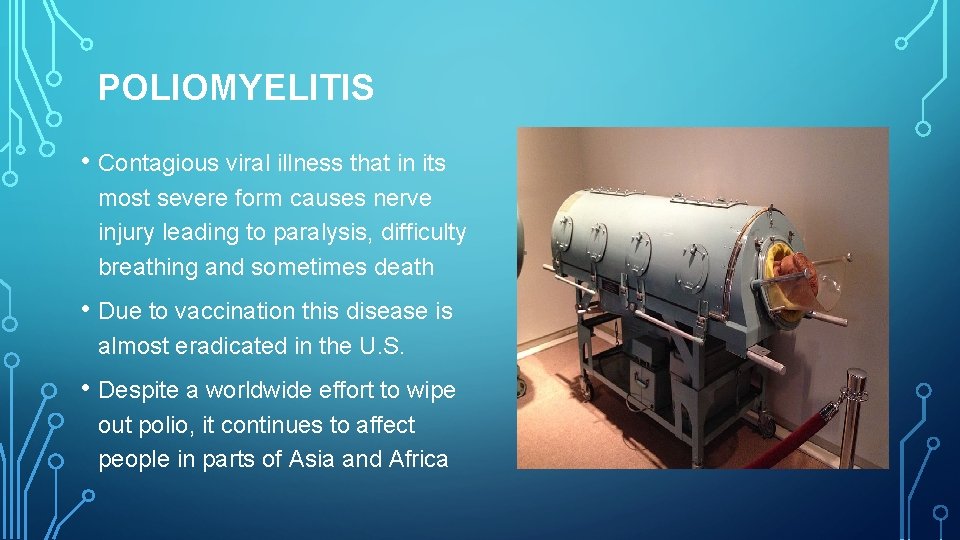
POLIOMYELITIS • Contagious viral illness that in its most severe form causes nerve injury leading to paralysis, difficulty breathing and sometimes death • Due to vaccination this disease is almost eradicated in the U. S. • Despite a worldwide effort to wipe out polio, it continues to affect people in parts of Asia and Africa
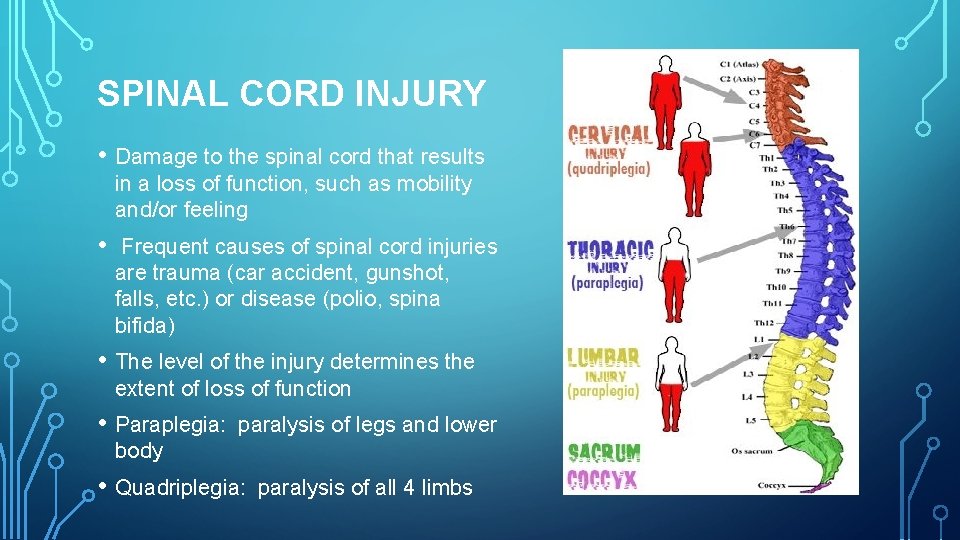
SPINAL CORD INJURY • Damage to the spinal cord that results in a loss of function, such as mobility and/or feeling • Frequent causes of spinal cord injuries are trauma (car accident, gunshot, falls, etc. ) or disease (polio, spina bifida) • The level of the injury determines the extent of loss of function • Paraplegia: paralysis of legs and lower body • Quadriplegia: paralysis of all 4 limbs
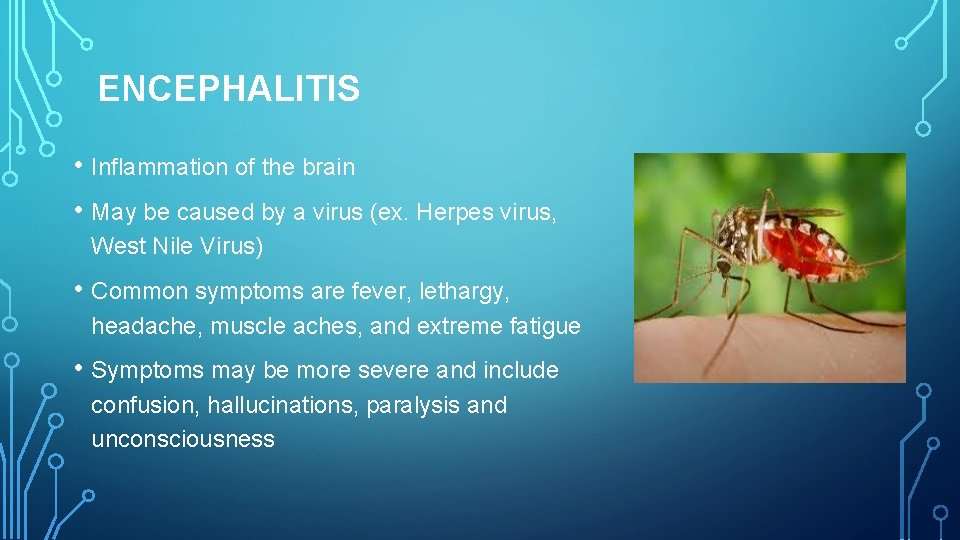
ENCEPHALITIS • Inflammation of the brain • May be caused by a virus (ex. Herpes virus, West Nile Virus) • Common symptoms are fever, lethargy, headache, muscle aches, and extreme fatigue • Symptoms may be more severe and include confusion, hallucinations, paralysis and unconsciousness
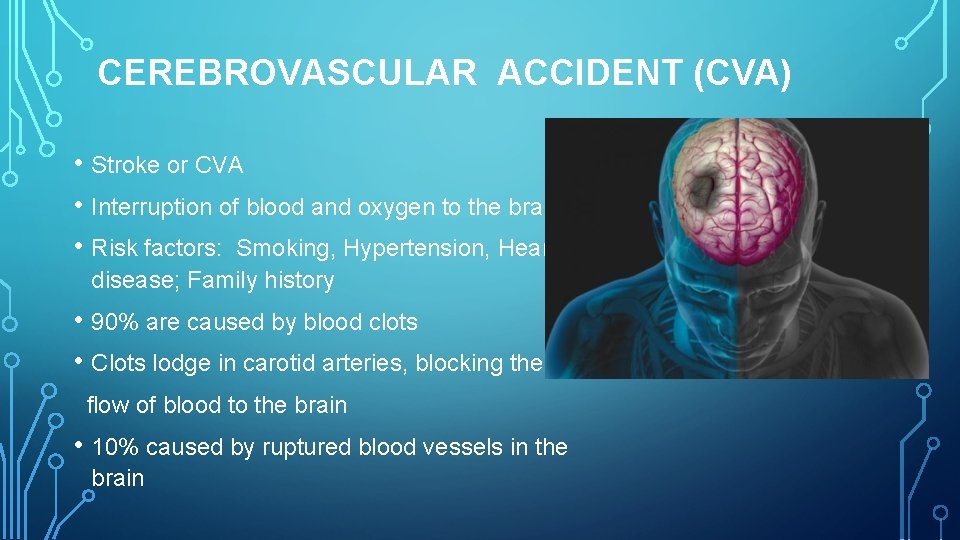
CEREBROVASCULAR ACCIDENT (CVA) • Stroke or CVA • Interruption of blood and oxygen to the brain • Risk factors: Smoking, Hypertension, Heart disease; Family history • 90% are caused by blood clots • Clots lodge in carotid arteries, blocking the flow of blood to the brain • 10% caused by ruptured blood vessels in the brain
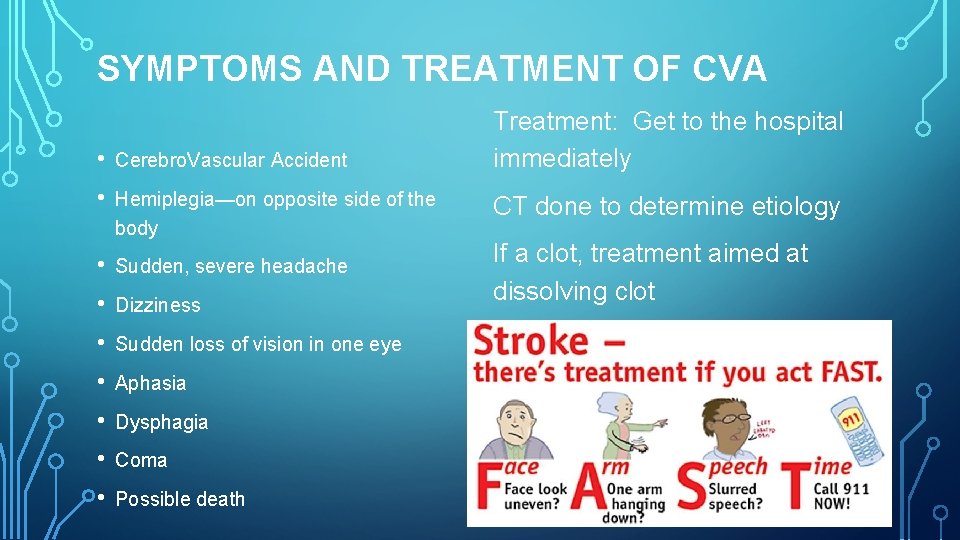
SYMPTOMS AND TREATMENT OF CVA • Cerebro. Vascular Accident • Hemiplegia—on opposite side of the body • Sudden, severe headache • Dizziness • Sudden loss of vision in one eye • Aphasia • Dysphagia • Coma • Possible death Treatment: Get to the hospital immediately CT done to determine etiology If a clot, treatment aimed at dissolving clot
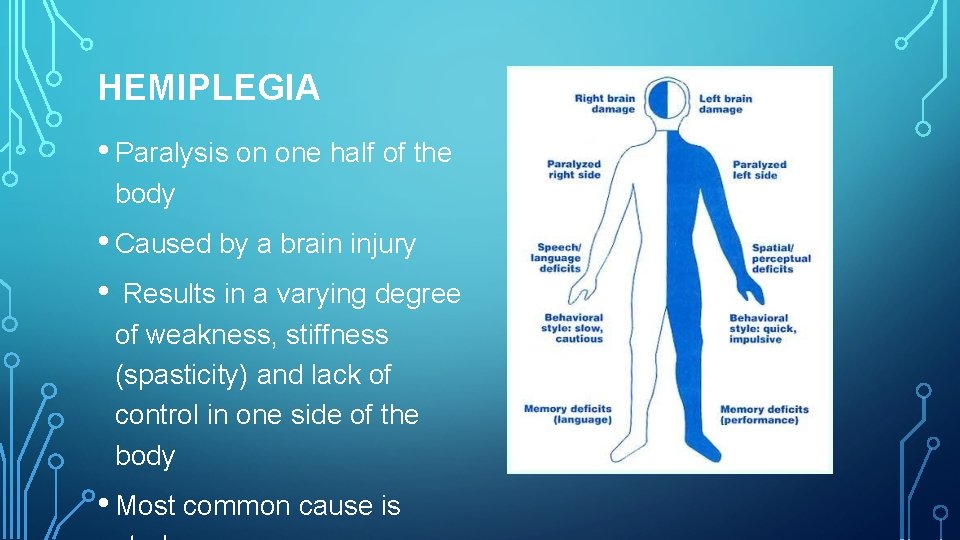
HEMIPLEGIA • Paralysis on one half of the body • Caused by a brain injury • Results in a varying degree of weakness, stiffness (spasticity) and lack of control in one side of the body • Most common cause is
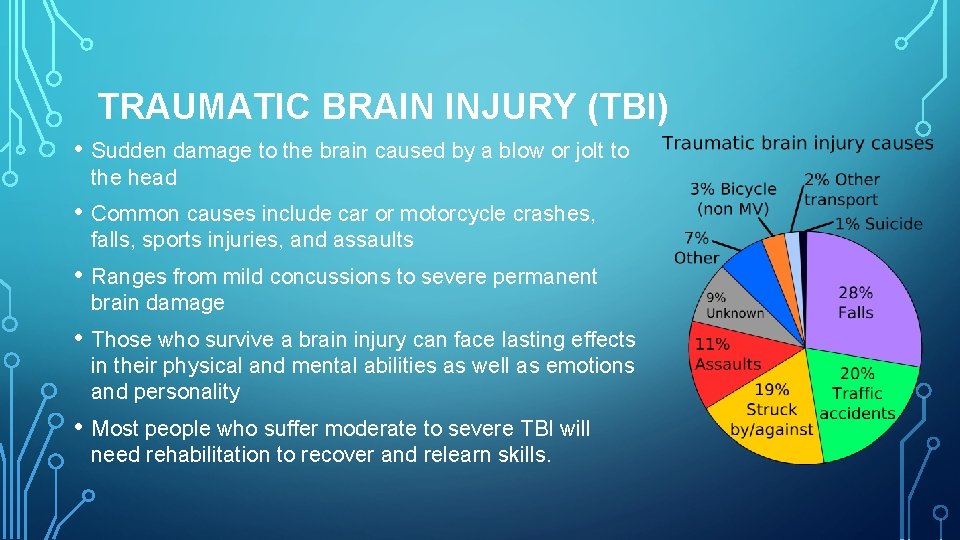
TRAUMATIC BRAIN INJURY (TBI) • Sudden damage to the brain caused by a blow or jolt to the head • Common causes include car or motorcycle crashes, falls, sports injuries, and assaults • Ranges from mild concussions to severe permanent brain damage • Those who survive a brain injury can face lasting effects in their physical and mental abilities as well as emotions and personality • Most people who suffer moderate to severe TBI will need rehabilitation to recover and relearn skills.
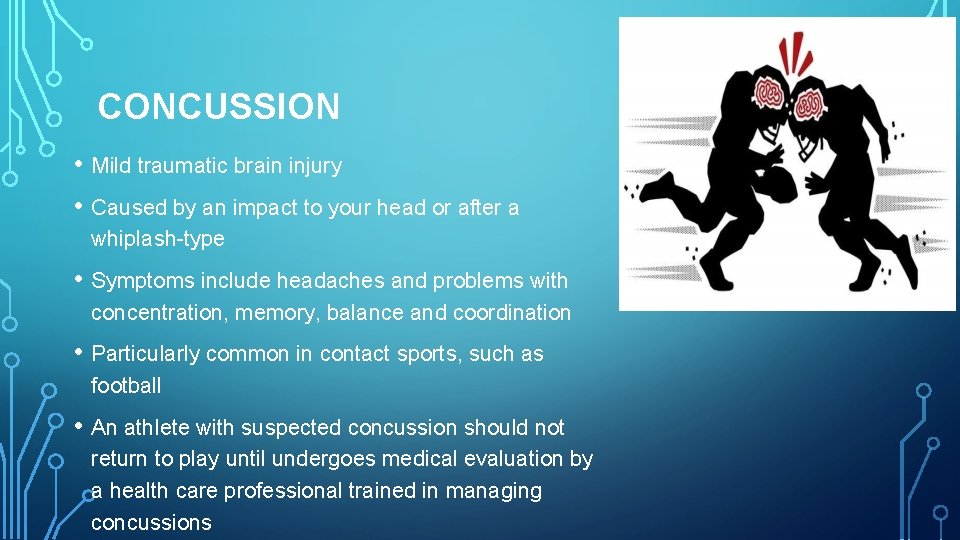
CONCUSSION • Mild traumatic brain injury • Caused by an impact to your head or after a whiplash-type • Symptoms include headaches and problems with concentration, memory, balance and coordination • Particularly common in contact sports, such as football • An athlete with suspected concussion should not return to play until undergoes medical evaluation by a health care professional trained in managing concussions
RESOURCES File: 1201 Overview of Nervous System. jpg. (2020, April 4). Wikimedia Commons, the free media repository. Retrieved 01: 11, May 30, 2020 from https: //commons. wikimedia. org/w/index. php? title=File: 1201_Overview_of_Nervous_System. jpg&oldid=409160754. File: Neuron. svg. (2020, April 23). Wikimedia Commons, the free media repository. Retrieved 01: 16, May 30, 2020 from https: //commons. wikimedia. org/w/index. php? title=File: Neuron. svg&oldid=414384599 File: Reuptake both. png. (2014, March 12). Wikimedia Commons, the free media repository. Retrieved 01: 19, May 30, 2020 from https: //commons. wikimedia. org/w/index. php? title=File: Reuptake_both. png&oldid=118920316 File: NSdiagram. png. (2018, September 5). Wikimedia Commons, the free media repository. Retrieved 01: 28, May 30, 2020 from https: //commons. wikimedia. org/w/index. php? title=File: NSdiagram. png&oldid=318642382. File: Diagram showing the lobes of the brain CRUK 308. svg. (2018, February 1). Wikimedia Commons, the free media repository. Retrieved 01: 37, May 30, 2020 from https: //commons. wikimedia. org/w/index. php? title=File: Diagram_showing_the_lobes_of_the_brain_CRUK_308. svg&oldid=284464699. File: Blausen 0111 Brain. Lobes. png. (2020, May 9). Wikimedia Commons, the free media repository. Retrieved 01: 41, May 30, 2020 from https: //commons. wikimedia. org/w/index. php? title=File: Blausen_0111_Brain. Lobes. png&oldid=418238619. https: //www. pinterest. com/pin/70016969180855904/, Retrieved May 29, 2020 File: Blausen 0115 Brain. Structures. png. (2020, May 9). Wikimedia Commons, the free media repository. Retrieved 02: 02, May 30, 2020 from https: //commons. wikimedia. org/w/index. php? title=File: Blausen_0115_Brain. Structures. png&oldid=418238377. File: Blausen 0614 Limbic. System. png. (2020, May 9). Wikimedia Commons, the free media repository. Retrieved 02: 04, May 30, 2020 from https: //commons. wikimedia. org/w/index. php? title=File: Blausen_0614_Limbic. System. png&oldid=418238630. File: 1311 Brain Stem. jpg. (2019, December 26). Wikimedia Commons, the free media repository. Retrieved 02: 10, May 30, 2020 from https: //commons. wikimedia. org/w/index. php? title=File: 1311_Brain_Stem. jpg&oldid=383280056 File: 3 D Medical Illustration Meninges Details. jpg. (2020, February 20). Wikimedia Commons, the free media repository. Retrieved 02: 15, May 30, 2020 from https: //commons. wikimedia. org/w/index. php? title=File: 3 D_Medical_Illustration_Meninges_Details. jpg&oldid=396418850. File: Blausen 0216 Cerebrospinal. System. png. (2020, May 9). Wikimedia Commons, the free media repository. Retrieved 02: 20, May 30, 2020 from https: //commons. wikimedia. org/w/index. php? title=File: Blausen_0216_Cerebrospinal. System. png&oldid=418238622.
ADDITIONAL RESOURCES File: Diagram of the spinal cord CRUK 046. svg. (2018, November 22). Wikimedia Commons, the free media repository. Retrieved 02: 24, May 30, 2020 from https: //commons. wikimedia. org/w/index. php? title=File: Diagram_of_the_spinal_cord_CRUK_046. svg&oldid=328860538. https: //www. pinterest. com/pin/753649318873303456/, Retrieved May 29, 2020 File: Symptoms of Meningitis. png. (2015, April 20). Wikimedia Commons, the free media repository. Retrieved 02: 52, May 30, 2020 from https: //commons. wikimedia. org/w/index. php? title=File: Symptoms_of_Meningitis. png&oldid=157887240. File: Symptoms of multiple sclerosis. png. (2019, June 19). Wikimedia Commons, the free media repository. Retrieved 02: 54, May 30, 2020 from https: //commons. wikimedia. org/w/index. php? title=File: Symptoms_of_multiple_sclerosis. png&oldid=355399738. File: Iron Lung at Fort Sam 2. jpg. (2019, September 1). Wikimedia Commons, the free media repository. Retrieved 02: 59, May 30, 2020 from https: //commons. wikimedia. org/w/index. php? title=File: Iron_Lung_at_Fort_Sam_2. jpg&oldid=364115948. https: //www. pinterest. com/pin/588564245027087714/, Retrieved May 29, 2020 File: TBI causes chart. svg. (2019, July 28). Wikimedia Commons, the free media repository. Retrieved 03: 17, May 30, 2020 from https: //commons. wikimedia. org/w/index. php? title=File: TBI_causes_chart. svg&oldid=359761270. “Other images taken from Creative Commons with CCO license. No attribution required. ” https: //www. livescience. com/22665 -nervous-system. html https: //www. news-medical. net/health/What-is-the-Nervous-System. aspx https: //www. visiblebody. com/learn/nervous/system-overview https: //www. innerbody. com/image/nervov. html