
Nervous System Anatomy 2012 Pearson Education Inc 2012
- Slides: 66
Nervous System Anatomy © 2012 Pearson Education, Inc.
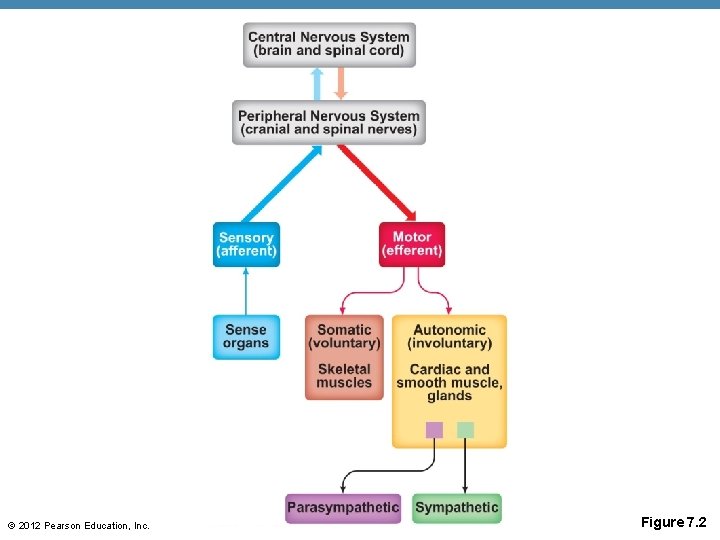
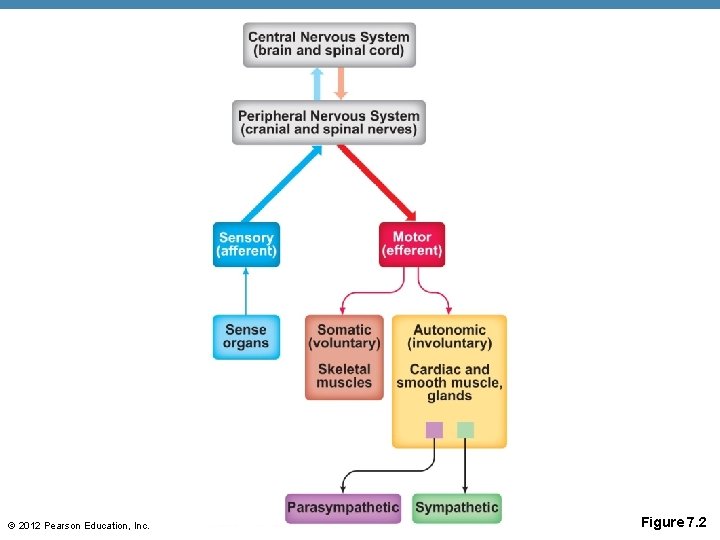
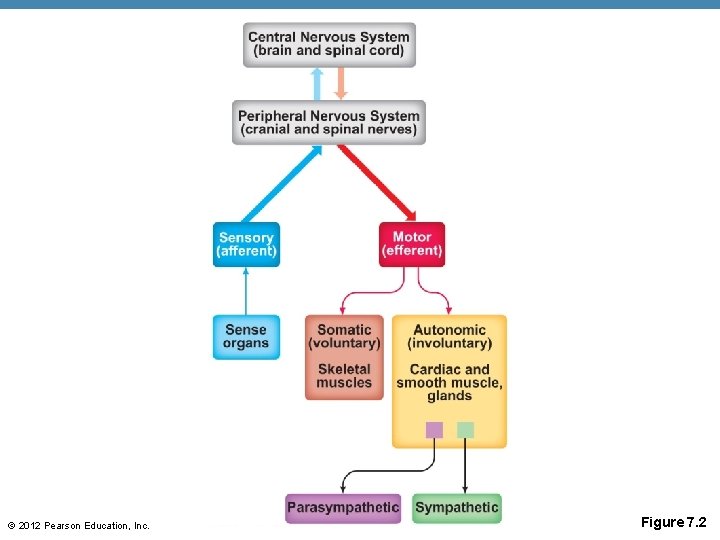
© 2012 Pearson Education, Inc. Figure 7. 2
Central Nervous System (CNS) • CNS develops from the embryonic neural tube • The neural tube becomes the brain and spinal cord • The opening of the neural tube becomes the ventricles • Four chambers within the brain • Filled with cerebrospinal fluid © 2012 Pearson Education, Inc.
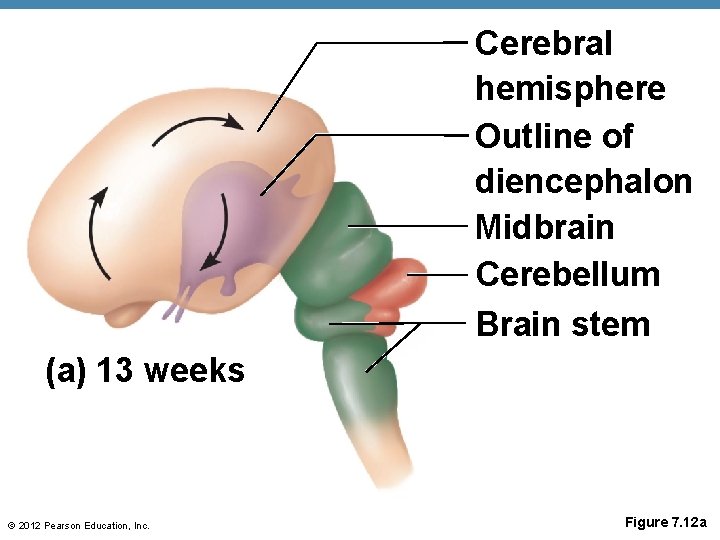
Cerebral hemisphere Outline of diencephalon Midbrain Cerebellum Brain stem (a) 13 weeks © 2012 Pearson Education, Inc. Figure 7. 12 a
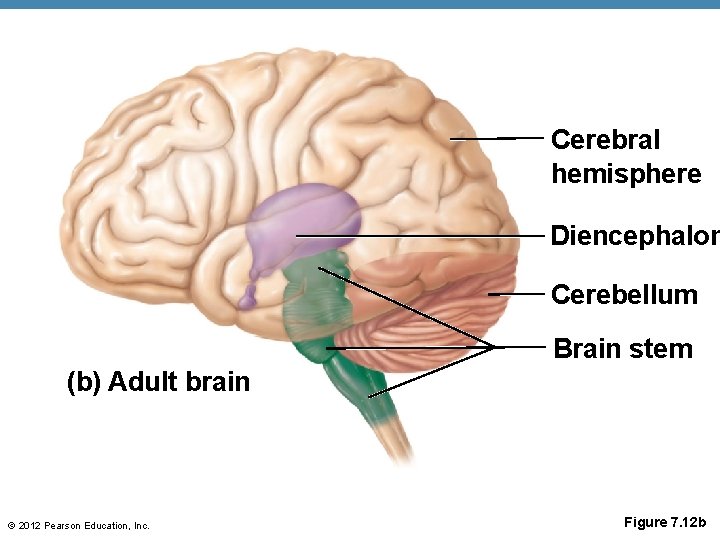
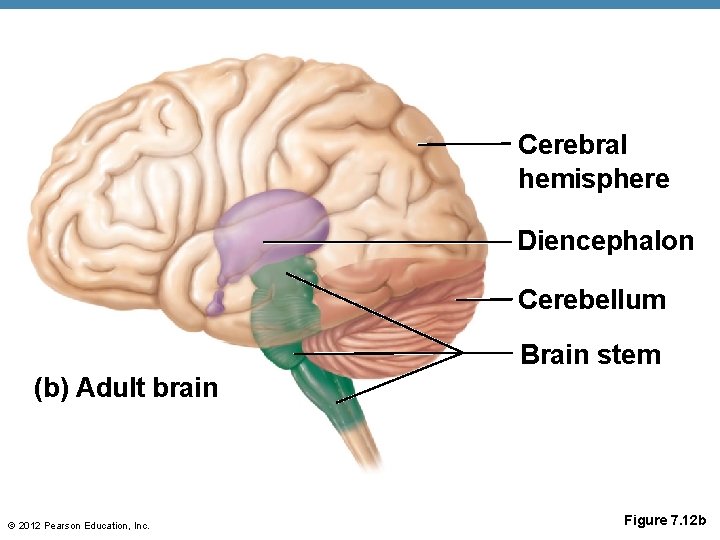
Regions of the Brain • Cerebral hemispheres (cerebrum) • Diencephalon • Brain stem • Cerebellum © 2012 Pearson Education, Inc.
Cerebral hemisphere Diencephalon Cerebellum Brain stem (b) Adult brain © 2012 Pearson Education, Inc. Figure 7. 12 b
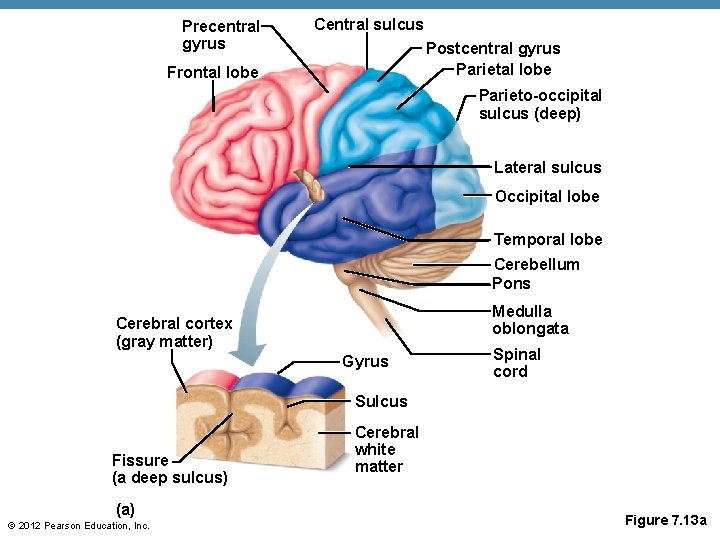
Regions of the Brain: Cerebrum • Cerebral Hemispheres (Cerebrum) • Paired (left and right) superior parts of the brain • Includes more than half of the brain mass • The surface is made of ridges (gyri) and grooves (sulci) © 2012 Pearson Education, Inc.
Precentral gyrus Central sulcus Postcentral gyrus Parietal lobe Frontal lobe Parieto-occipital sulcus (deep) Lateral sulcus Occipital lobe Temporal lobe Cerebellum Pons Medulla oblongata Cerebral cortex (gray matter) Gyrus Spinal cord Sulcus Fissure (a deep sulcus) (a) © 2012 Pearson Education, Inc. Cerebral white matter Figure 7. 13 a
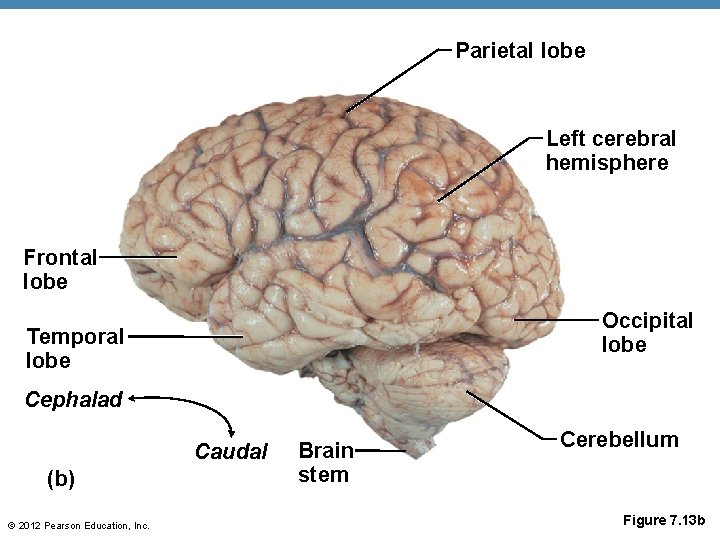
Regions of the Brain: Cerebrum • Lobes of the cerebrum • Fissures (deep grooves) divide the cerebrum into lobes • Surface lobes of the cerebrum • Frontal lobe • Parietal lobe • Occipital lobe • Temporal lobe © 2012 Pearson Education, Inc.
Parietal lobe Left cerebral hemisphere Frontal lobe Occipital lobe Temporal lobe Cephalad Caudal (b) © 2012 Pearson Education, Inc. Brain stem Cerebellum Figure 7. 13 b
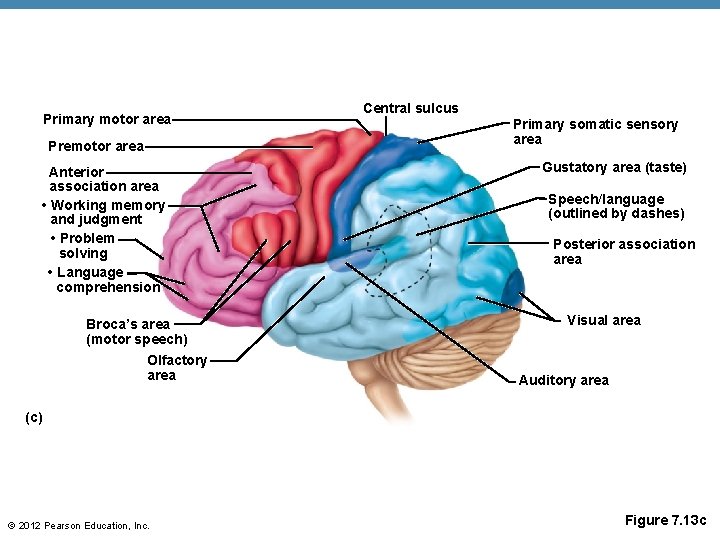
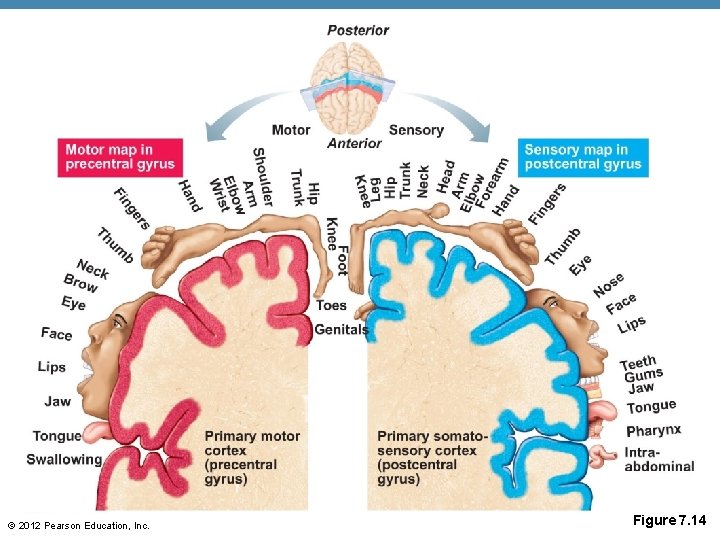
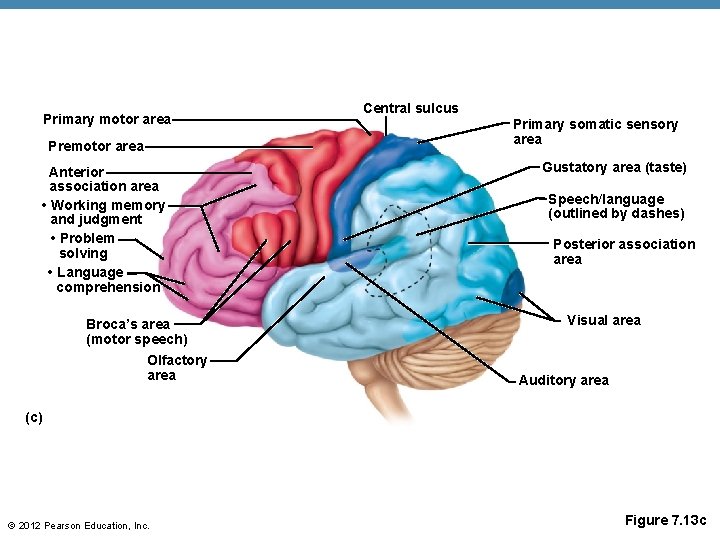
Regions of the Brain: Cerebrum • Specialized areas of the cerebrum • Primary somatic sensory area • Receives impulses from the body’s sensory receptors • Located in parietal lobe • Primary motor area • Sends impulses to skeletal muscles • Located in frontal lobe • Broca’s area • Involved in our ability to speak © 2012 Pearson Education, Inc.
Primary motor area Premotor area Anterior association area • Working memory and judgment • Problem solving • Language comprehension Broca’s area (motor speech) Olfactory area Central sulcus Primary somatic sensory area Gustatory area (taste) Speech/language (outlined by dashes) Posterior association area Visual area Auditory area (c) © 2012 Pearson Education, Inc. Figure 7. 13 c
© 2012 Pearson Education, Inc. Figure 7. 14
Regions of the Brain: Cerebrum • Cerebral areas involved in special senses • Gustatory area (taste) • Visual area • Auditory area • Olfactory area © 2012 Pearson Education, Inc.
Regions of the Brain: Cerebrum • Interpretation areas of the cerebrum • Speech/language region • Language comprehension region • General interpretation area © 2012 Pearson Education, Inc.
Primary motor area Premotor area Anterior association area • Working memory and judgment • Problem solving • Language comprehension Broca’s area (motor speech) Olfactory area Central sulcus Primary somatic sensory area Gustatory area (taste) Speech/language (outlined by dashes) Posterior association area Visual area Auditory area (c) © 2012 Pearson Education, Inc. Figure 7. 13 c
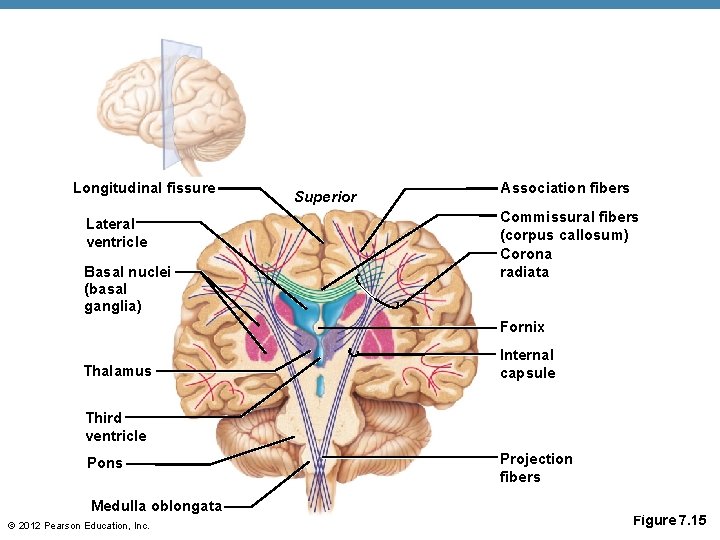
Regions of the Brain: Cerebrum • Layers of the cerebrum • Gray matter—outer layer in the cerebral cortex composed mostly of neuron cell bodies • White matter—fiber tracts deep to the gray matter, carry impulses to, from, and within the cortex © 2012 Pearson Education, Inc.
Longitudinal fissure Lateral ventricle Basal nuclei (basal ganglia) Superior Association fibers Commissural fibers (corpus callosum) Corona radiata Fornix Thalamus Internal capsule Third ventricle Pons Medulla oblongata © 2012 Pearson Education, Inc. Projection fibers Figure 7. 15
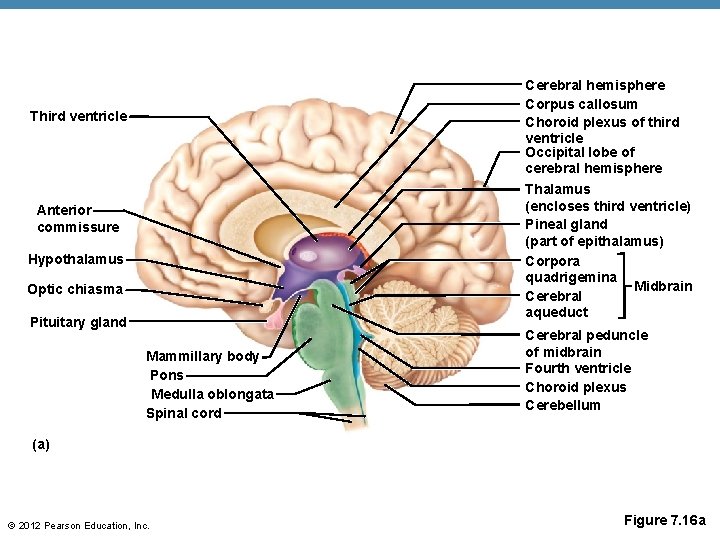
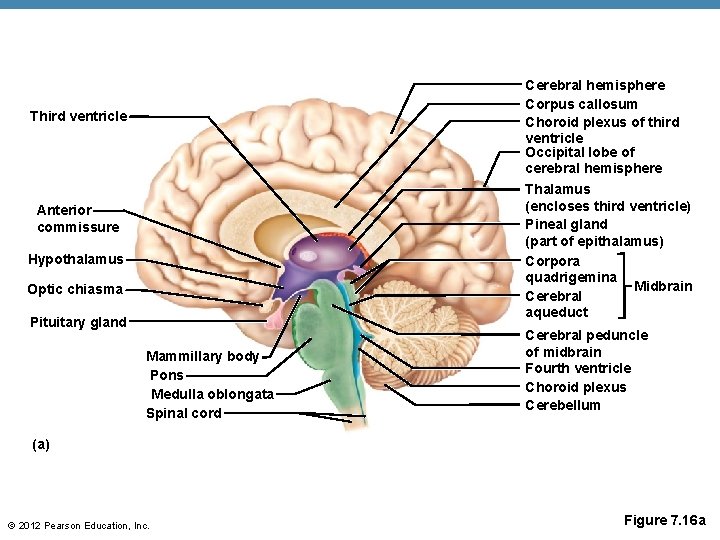
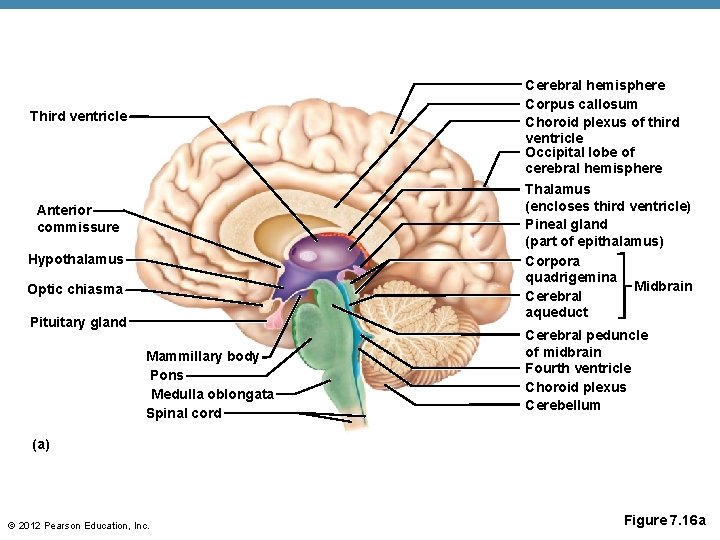
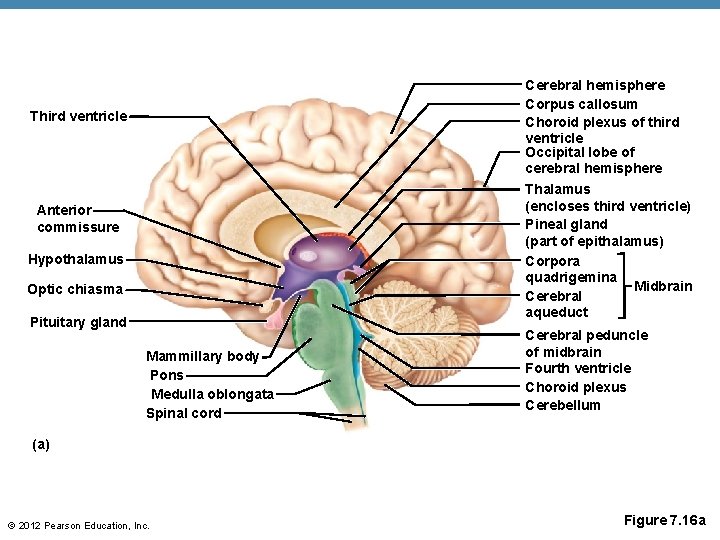
Cerebral hemisphere Corpus callosum Choroid plexus of third ventricle Occipital lobe of cerebral hemisphere Thalamus (encloses third ventricle) Pineal gland (part of epithalamus) Corpora quadrigemina Midbrain Cerebral aqueduct Third ventricle Anterior commissure Hypothalamus Optic chiasma Pituitary gland Mammillary body Pons Medulla oblongata Spinal cord Cerebral peduncle of midbrain Fourth ventricle Choroid plexus Cerebellum (a) © 2012 Pearson Education, Inc. Figure 7. 16 a
Regions of the Brain: Diencephalon • Sits on top of the brain stem • Enclosed by the cerebral hemispheres • Made of three parts • Thalamus • Hypothalamus • Epithalamus © 2012 Pearson Education, Inc.
Cerebral hemisphere Diencephalon Cerebellum Brain stem (b) Adult brain © 2012 Pearson Education, Inc. Figure 7. 12 b
Cerebral hemisphere Corpus callosum Choroid plexus of third ventricle Occipital lobe of cerebral hemisphere Thalamus (encloses third ventricle) Pineal gland (part of epithalamus) Corpora quadrigemina Midbrain Cerebral aqueduct Third ventricle Anterior commissure Hypothalamus Optic chiasma Pituitary gland Mammillary body Pons Medulla oblongata Spinal cord Cerebral peduncle of midbrain Fourth ventricle Choroid plexus Cerebellum (a) © 2012 Pearson Education, Inc. Figure 7. 16 a
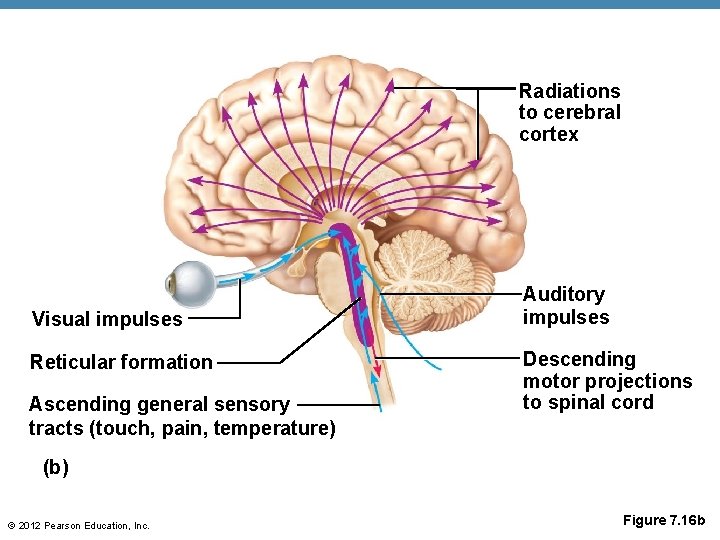
Regions of the Brain: Diencephalon • Thalamus • The relay station for sensory impulses • Transfers impulses to the correct part of the cortex for localization and interpretation © 2012 Pearson Education, Inc.
Radiations to cerebral cortex Visual impulses Reticular formation Ascending general sensory tracts (touch, pain, temperature) Auditory impulses Descending motor projections to spinal cord (b) © 2012 Pearson Education, Inc. Figure 7. 16 b
Regions of the Brain: Diencephalon • Hypothalamus • Under the thalamus • Important autonomic nervous system center • Helps regulate body temperature • Controls water balance • Regulates metabolism • Houses the limbic center for emotions • Regulates the nearby pituitary gland © 2012 Pearson Education, Inc.
Regions of the Brain: Diencephalon • Epithalamus • Houses the pineal body (an endocrine gland) • Includes the choroid plexus • The choroid plexus forms cerebrospinal fluid • What is cerebrospinal fluid? More on this later. © 2012 Pearson Education, Inc.
Regions of the Brain: Brain Stem • Attaches to the spinal cord • Parts of the brain stem • Midbrain • Pons • Medulla oblongata © 2012 Pearson Education, Inc.
Cerebral hemisphere Corpus callosum Choroid plexus of third ventricle Occipital lobe of cerebral hemisphere Thalamus (encloses third ventricle) Pineal gland (part of epithalamus) Corpora quadrigemina Midbrain Cerebral aqueduct Third ventricle Anterior commissure Hypothalamus Optic chiasma Pituitary gland Mammillary body Pons Medulla oblongata Spinal cord Cerebral peduncle of midbrain Fourth ventricle Choroid plexus Cerebellum (a) © 2012 Pearson Education, Inc. Figure 7. 16 a
Regions of the Brain: Brain Stem • Midbrain • Mostly composed of tracts of nerve fibers • Reflex centers for vision and hearing © 2012 Pearson Education, Inc.
Regions of the Brain: Brain Stem • Pons • The bulging center part of the brain stem • Includes nuclei involved in the control of breathing © 2012 Pearson Education, Inc.
Regions of the Brain: Brain Stem • Medulla oblongata • The lowest part of the brain stem • Merges into the spinal cord • Contains important control centers • Heart rate control • Blood pressure regulation • Breathing • Swallowing • Vomiting © 2012 Pearson Education, Inc.
Regions of the Brain: Cerebellum • Two hemispheres with convoluted surfaces • Provides involuntary coordination of body movements © 2012 Pearson Education, Inc.
Cerebral hemisphere Corpus callosum Choroid plexus of third ventricle Occipital lobe of cerebral hemisphere Thalamus (encloses third ventricle) Pineal gland (part of epithalamus) Corpora quadrigemina Midbrain Cerebral aqueduct Third ventricle Anterior commissure Hypothalamus Optic chiasma Pituitary gland Mammillary body Pons Medulla oblongata Spinal cord Cerebral peduncle of midbrain Fourth ventricle Choroid plexus Cerebellum (a) © 2012 Pearson Education, Inc. Figure 7. 16 a
Protection of the Central Nervous System • Scalp and skin • Skull and vertebral column • Meninges • Cerebrospinal fluid (CSF) • Blood-brain barrier © 2012 Pearson Education, Inc.
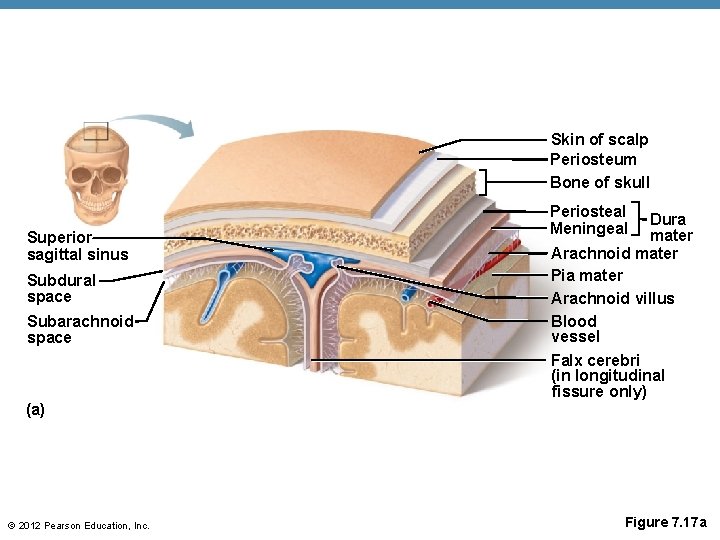
Skin of scalp Periosteum Bone of skull Superior sagittal sinus Subdural space Subarachnoid space Periosteal Meningeal Dura mater Arachnoid mater Pia mater Arachnoid villus Blood vessel Falx cerebri (in longitudinal fissure only) (a) © 2012 Pearson Education, Inc. Figure 7. 17 a
Meninges • Dura mater • Tough outermost layer © 2012 Pearson Education, Inc.
Meninges • Arachnoid layer • Middle layer • Web-like extensions span the subarachnoid space • Subarachnoid space is filled with CSF • Pia mater • Internal layer • Clings to the surface of the brain and spinal cord © 2012 Pearson Education, Inc.
Meninges • Pia mater • Internal layer • Clings to the surface of the brain and spinal cord © 2012 Pearson Education, Inc.
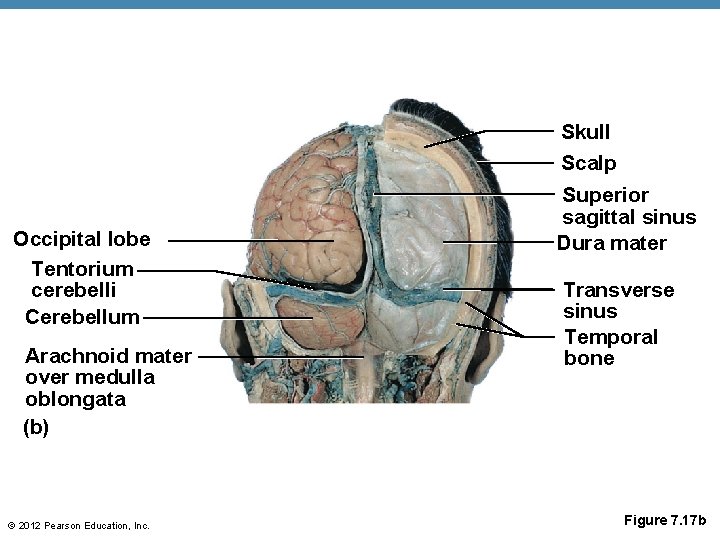
Skull Scalp Occipital lobe Tentorium cerebelli Cerebellum Arachnoid mater over medulla oblongata (b) © 2012 Pearson Education, Inc. Superior sagittal sinus Dura mater Transverse sinus Temporal bone Figure 7. 17 b
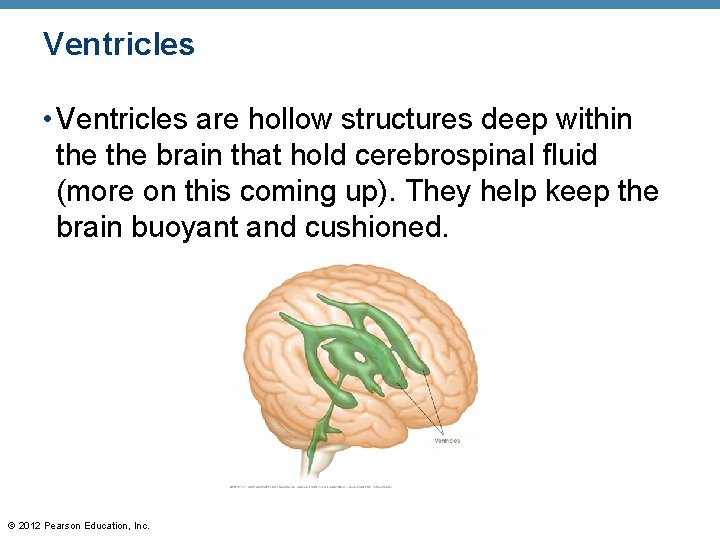
Ventricles • Ventricles are hollow structures deep within the brain that hold cerebrospinal fluid (more on this coming up). They help keep the brain buoyant and cushioned. © 2012 Pearson Education, Inc.
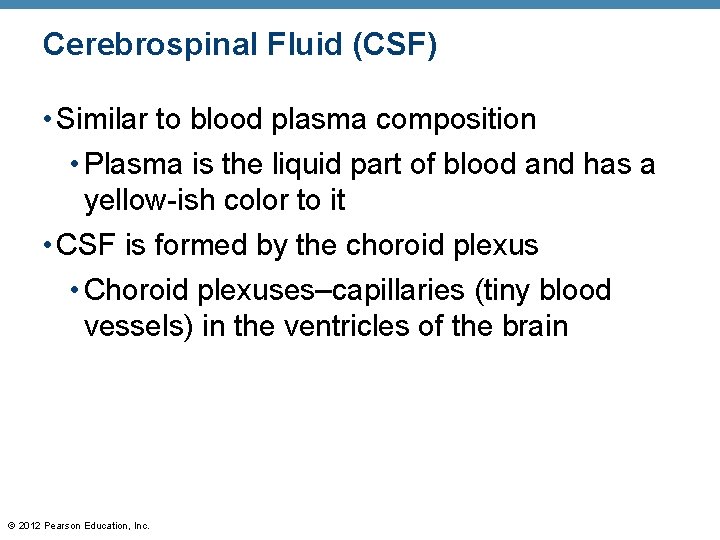
Cerebrospinal Fluid (CSF) • Similar to blood plasma composition • Plasma is the liquid part of blood and has a yellow-ish color to it • CSF is formed by the choroid plexus • Choroid plexuses–capillaries (tiny blood vessels) in the ventricles of the brain © 2012 Pearson Education, Inc.
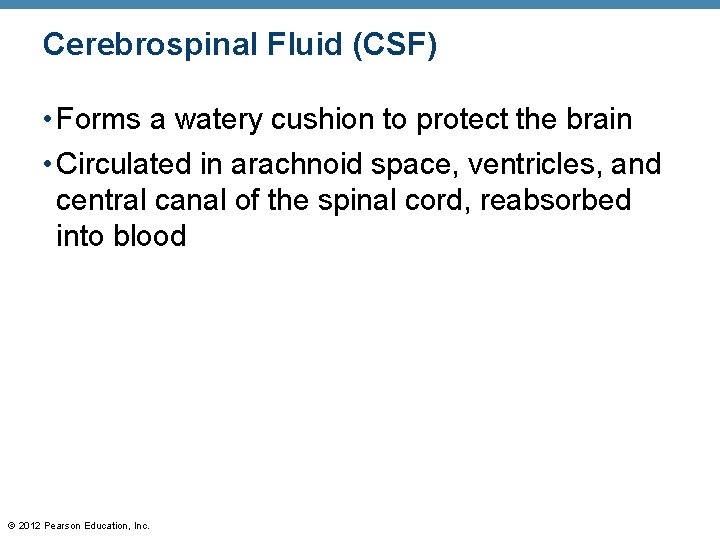
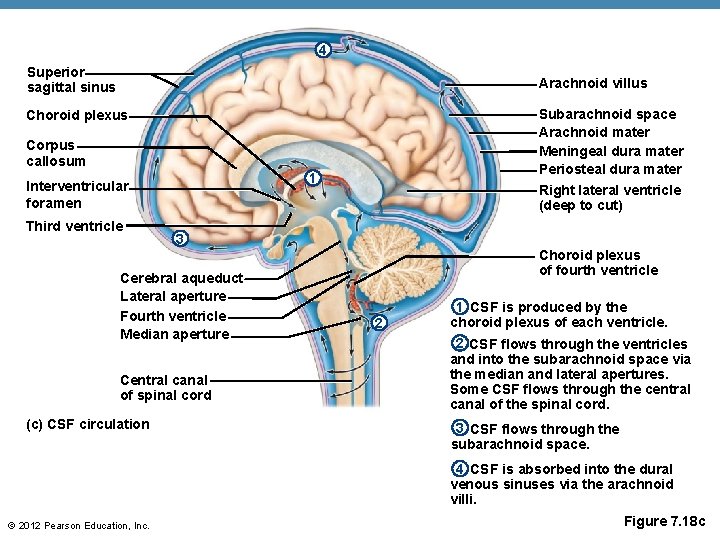
Cerebrospinal Fluid (CSF) • Forms a watery cushion to protect the brain • Circulated in arachnoid space, ventricles, and central canal of the spinal cord, reabsorbed into blood © 2012 Pearson Education, Inc.
4 Superior sagittal sinus Arachnoid villus Subarachnoid space Arachnoid mater Meningeal dura mater Periosteal dura mater Right lateral ventricle (deep to cut) Choroid plexus Corpus callosum 1 Interventricular foramen Third ventricle 3 Cerebral aqueduct Lateral aperture Fourth ventricle Median aperture Central canal of spinal cord (c) CSF circulation Choroid plexus of fourth ventricle 2 1 CSF is produced by the choroid plexus of each ventricle. 2 CSF flows through the ventricles and into the subarachnoid space via the median and lateral apertures. Some CSF flows through the central canal of the spinal cord. 3 CSF flows through the subarachnoid space. 4 CSF is absorbed into the dural venous sinuses via the arachnoid villi. © 2012 Pearson Education, Inc. Figure 7. 18 c
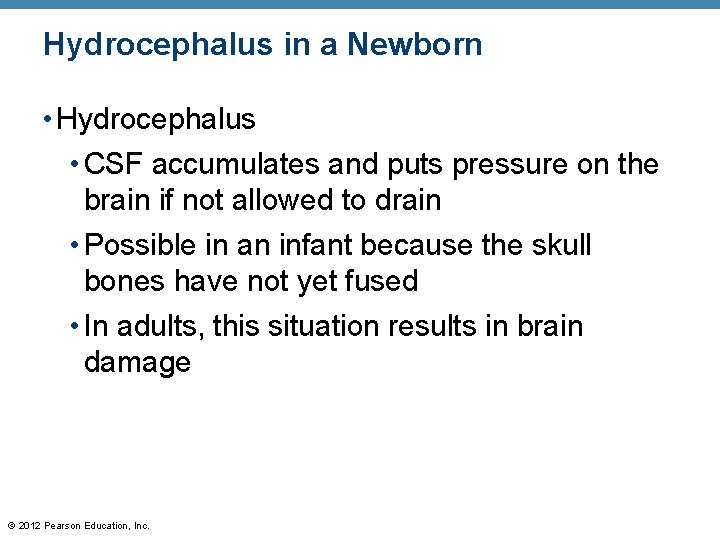
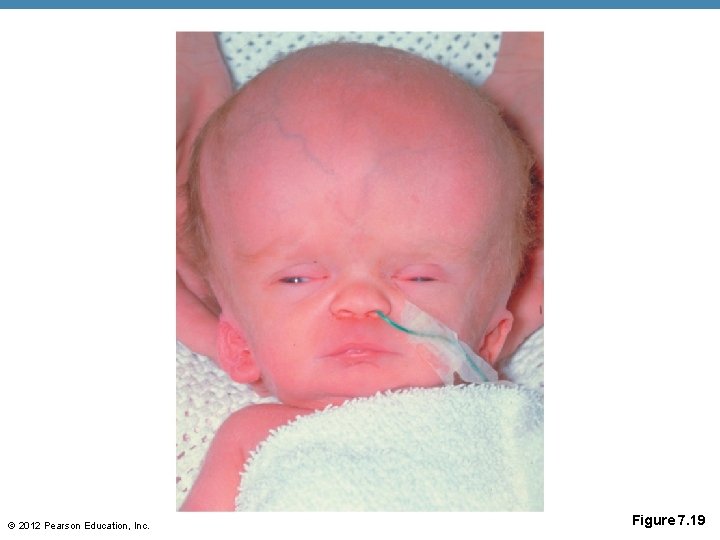
Hydrocephalus in a Newborn • Hydrocephalus • CSF accumulates and puts pressure on the brain if not allowed to drain • Possible in an infant because the skull bones have not yet fused • In adults, this situation results in brain damage © 2012 Pearson Education, Inc.
© 2012 Pearson Education, Inc. Figure 7. 19
Blood-Brain Barrier • Includes the least permeable capillaries of the body • Protects the brain from many potentially harmful substances © 2012 Pearson Education, Inc.
Blood-Brain Barrier • There are some substances that can cross the blood-brain barrier: • Fats and fat soluble molecules • Respiratory gases • Alcohol • Nicotine • Anesthesia © 2012 Pearson Education, Inc.
Traumatic Brain Injuries • Concussion • Slight brain injury, no permanent brain damage • Contusion • Nervous tissue destruction occurs • Nervous tissue does not regenerate • Cerebral edema • Swelling from the inflammatory response • May compress and kill brain tissue © 2012 Pearson Education, Inc.
Cerebrovascular Accident (CVA) or Stroke • Results from a ruptured blood vessel that supplies a particular region of the brain with blood • Brain tissue supplied with oxygen from that blood source dies • Loss of some functions or death may result. Examples: • Hemiplegia–One-sided paralysis • Aphasis–Damage to speech center in left hemisphere © 2012 Pearson Education, Inc.
Alzheimer’s Disease • Progressive degenerative brain disease • Mostly seen in the elderly, but may begin in middle age • Structural changes in the brain include abnormal protein deposits and twisted fibers within neurons • Victims experience memory loss, irritability, confusion, and ultimately, hallucinations and death © 2012 Pearson Education, Inc.
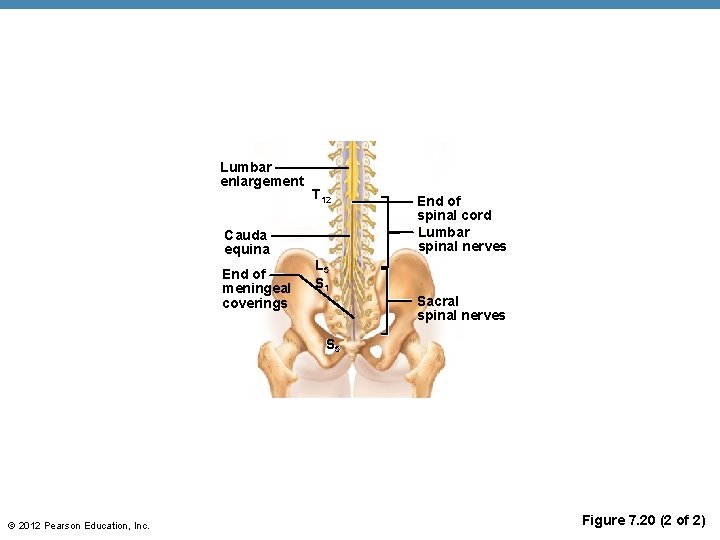
Spinal Cord • Extends from the foramen magnum of the skull to the first or second lumbar vertebra • Provides a two-way pathway to and from the brain © 2012 Pearson Education, Inc.
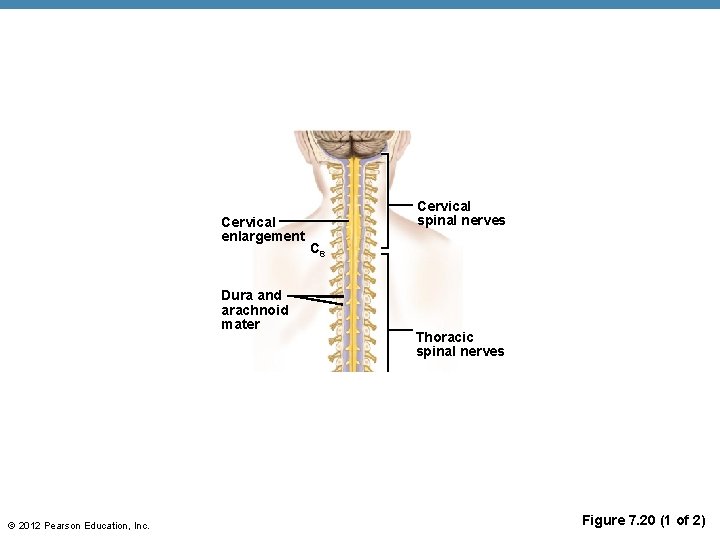
Cervical enlargement Dura and arachnoid mater © 2012 Pearson Education, Inc. Cervical spinal nerves C 8 Thoracic spinal nerves Figure 7. 20 (1 of 2)
Lumbar enlargement T 12 Cauda equina End of meningeal coverings End of spinal cord Lumbar spinal nerves L 5 S 1 Sacral spinal nerves S 5 © 2012 Pearson Education, Inc. Figure 7. 20 (2 of 2)
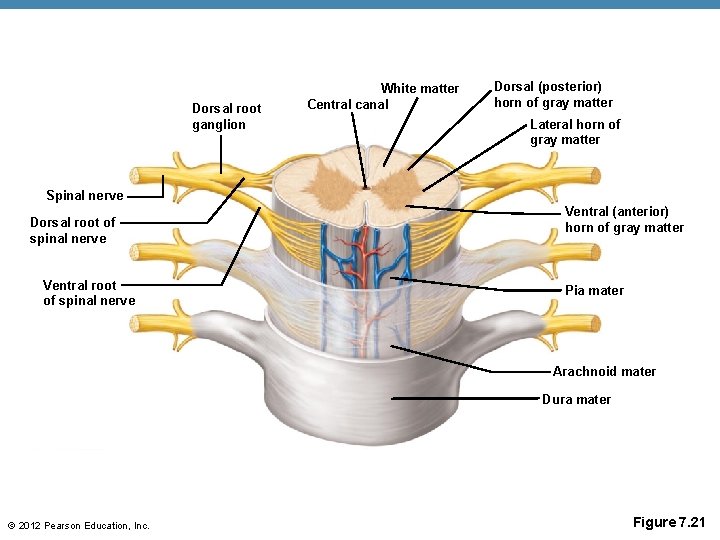
Spinal Cord Anatomy • Internal gray matter is mostly cell bodies • Gray matter surrounds the central canal • Central canal is filled with cerebrospinal fluid • Exterior white mater—conduction tracts © 2012 Pearson Education, Inc.
Dorsal root ganglion White matter Central canal Dorsal (posterior) horn of gray matter Lateral horn of gray matter Spinal nerve Dorsal root of spinal nerve Ventral (anterior) horn of gray matter Pia mater Arachnoid mater Dura mater © 2012 Pearson Education, Inc. Figure 7. 21
Spinal Cord Anatomy • Meninges cover the spinal cord • Spinal nerves leave at the level of each vertebrae © 2012 Pearson Education, Inc.
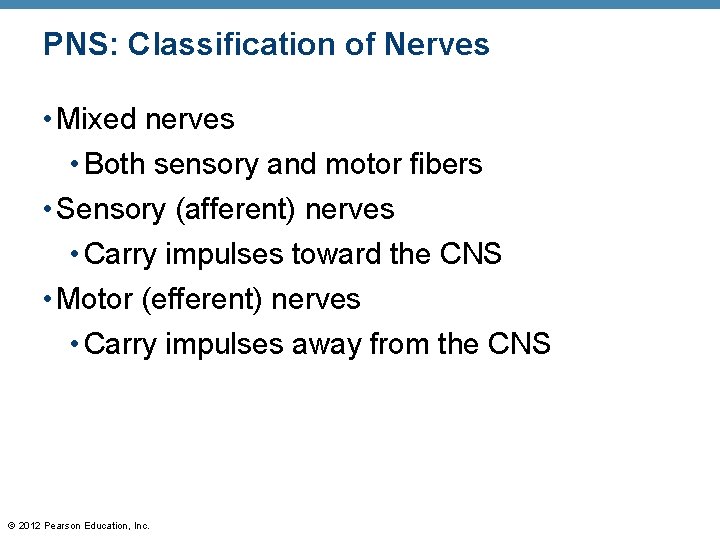
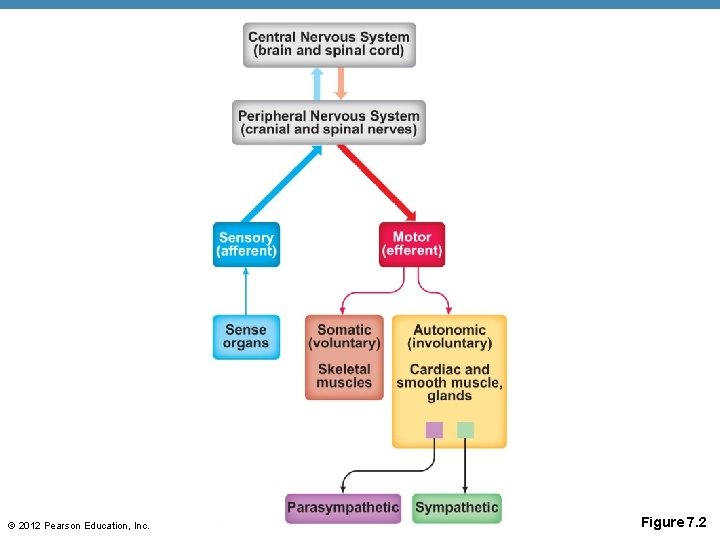
PNS: Classification of Nerves • Mixed nerves • Both sensory and motor fibers • Sensory (afferent) nerves • Carry impulses toward the CNS • Motor (efferent) nerves • Carry impulses away from the CNS © 2012 Pearson Education, Inc.
© 2012 Pearson Education, Inc. Figure 7. 2
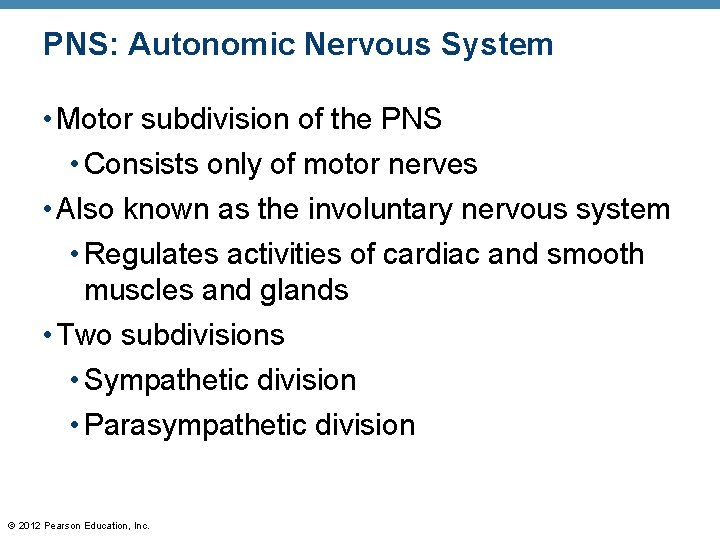
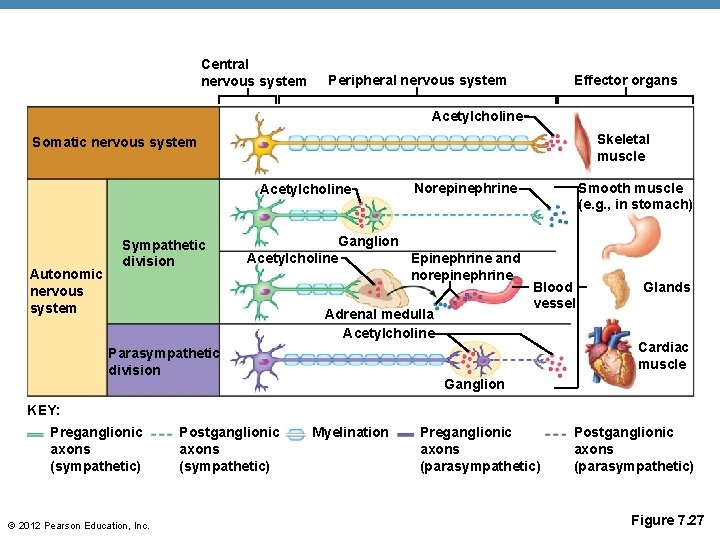
PNS: Autonomic Nervous System • Motor subdivision of the PNS • Consists only of motor nerves • Also known as the involuntary nervous system • Regulates activities of cardiac and smooth muscles and glands • Two subdivisions • Sympathetic division • Parasympathetic division © 2012 Pearson Education, Inc.
© 2012 Pearson Education, Inc. Figure 7. 2
Central nervous system Peripheral nervous system Effector organs Acetylcholine Skeletal muscle Somatic nervous system Acetylcholine Autonomic nervous system Sympathetic division Ganglion Epinephrine and Acetylcholine norepinephrine Adrenal medulla Acetylcholine Parasympathetic division Smooth muscle (e. g. , in stomach) Norepinephrine Blood vessel Glands Cardiac muscle Ganglion KEY: Preganglionic axons (sympathetic) © 2012 Pearson Education, Inc. Postganglionic axons (sympathetic) Myelination Preganglionic axons (parasympathetic) Postganglionic axons (parasympathetic) Figure 7. 27
PNS: Autonomic Functioning • Sympathetic—“fight or flight” • Response to unusual stimulus • Takes over to increase activities • Remember as the “E” division • Exercise, excitement, emergency, and embarrassment © 2012 Pearson Education, Inc.
PNS: Autonomic Functioning • Parasympathetic—“housekeeping” activities • Conserves energy • Maintains daily necessary body functions • Remember as the “D” division • digestion, defecation © 2012 Pearson Education, Inc.
© 2012 Pearson Education, Inc. Figure 7. 2
Developmental Aspects of the Nervous System • The nervous system is formed during the first month of embryonic development • Any maternal infection can have extremely harmful effects © 2012 Pearson Education, Inc.
Developmental Aspects of the Nervous System • No more neurons are formed after birth, but growth and maturation continues for several years • The brain reaches maximum weight as a young adult © 2012 Pearson Education, Inc.