
Nervous system An overview Functions of the Nervous
- Slides: 18
Nervous system An overview
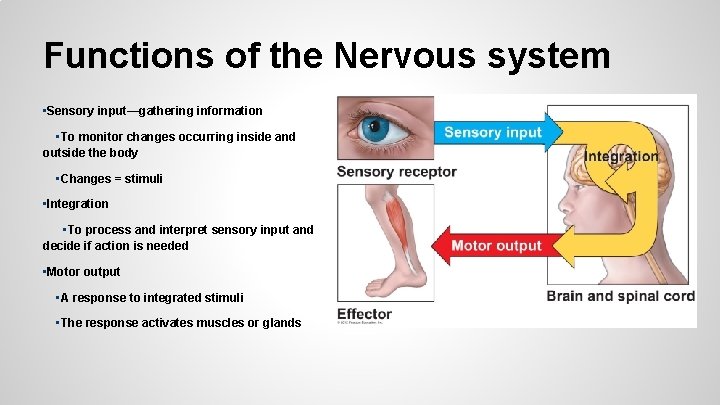
Functions of the Nervous system • Sensory input—gathering information • To monitor changes occurring inside and outside the body • Changes = stimuli • Integration • To process and interpret sensory input and decide if action is needed • Motor output • A response to integrated stimuli • The response activates muscles or glands
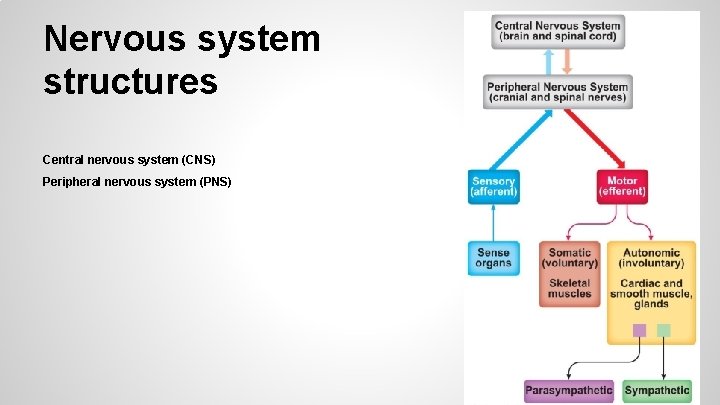
Nervous system structures Central nervous system (CNS) Peripheral nervous system (PNS)
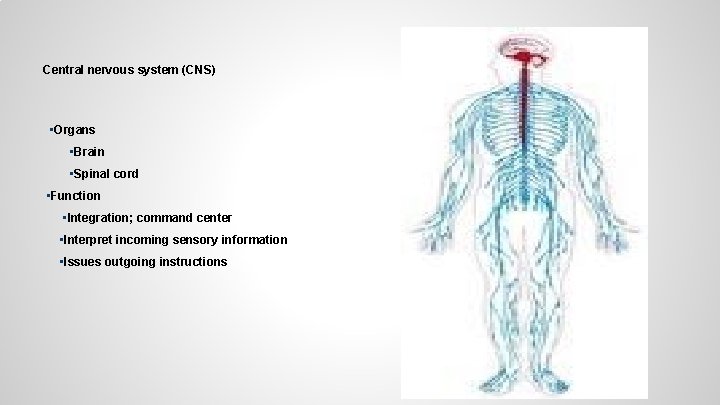
Central nervous system (CNS) • Organs • Brain • Spinal cord • Function • Integration; command center • Interpret incoming sensory information • Issues outgoing instructions
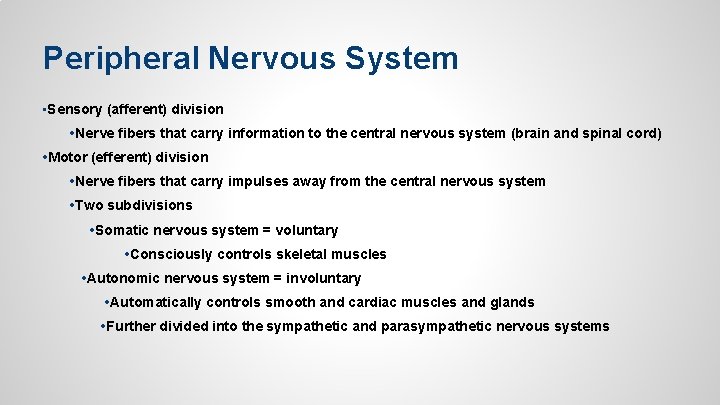
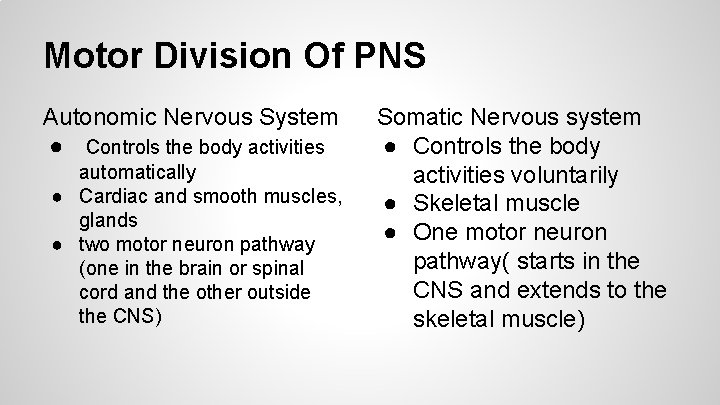
Peripheral Nervous System • Sensory (afferent) division • Nerve fibers that carry information to the central nervous system (brain and spinal cord) • Motor (efferent) division • Nerve fibers that carry impulses away from the central nervous system • Two subdivisions • Somatic nervous system = voluntary • Consciously controls skeletal muscles • Autonomic nervous system = involuntary • Automatically controls smooth and cardiac muscles and glands • Further divided into the sympathetic and parasympathetic nervous systems
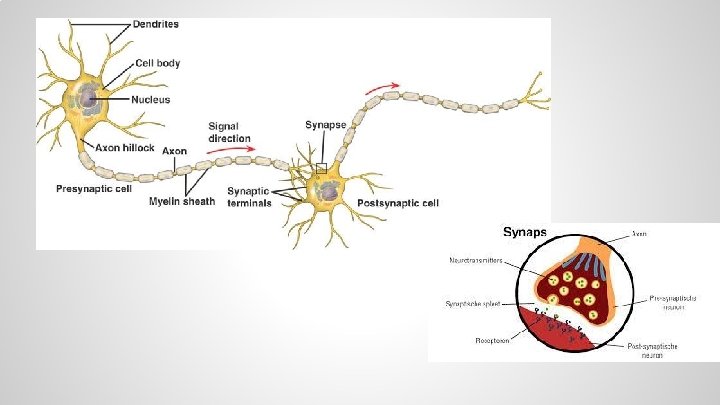
Nervous Tissue: Neurons • Neurons = nerve cells • Cells specialized to transmit messages • Major regions of neurons • Cell body—nucleus and metabolic center of the cell • Processes—fibers that extend from the cell body
Processes (outside the neuron cell body) • Dendrites—conduct impulses toward the cell body • Neurons may have hundreds of dendrites • Axons—conduct impulses away from the cell body • Neurons have only one axon arising from the cell body at the axon hillock • Axons • End in axon terminals • Axon terminals contain vesicles with neurotransmitters • Axon terminals are separated from the next neuron by a gap • Synaptic cleft—gap between adjacent neurons • Synapse—junction between nerves
Functional Classification of Neurons Sensory (afferent) neurons • Carry impulses from the sensory receptors to the CNS • Skin receptors are free nerve ending (detect pain and temperature) and Meissner’s corpuscle (touch receptors) • Proprioceptors—detect stretch or tension within skeletal muscle, joints and tendons • Motor (efferent) neurons • Carry impulses from the central nervous system to viscera, muscles, or glands
• Interneurons (association neurons) • originate or terminate in the brain or spinal cord • Connect sensory and motor neurons • Multipolar neurons—many extensions from the cell body • All motor and interneurons are multipolar • Most common structure
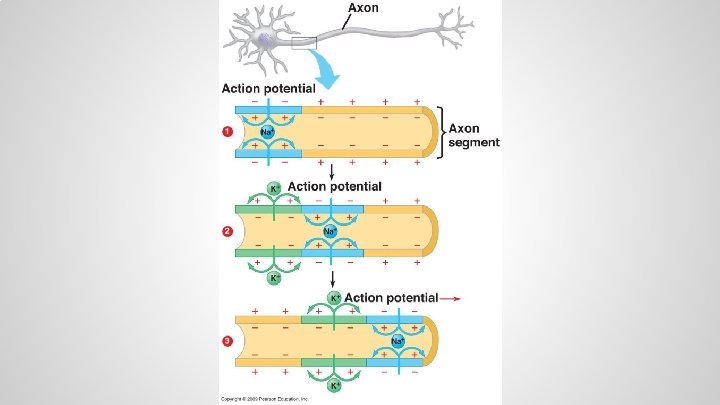
Nerve Impulses • Action potential • The movement of ions initiates an action potential in the neuron due to a stimulus • A graded potential (localized depolarization) exists where the inside of the membrane is more positive and the outside is less positive
• Movement of the action potential • If enough sodium enters the cell, the action potential (nerve impulse) starts and is moved down the entire axon • Impulses travel faster when fibers have a myelin sheath
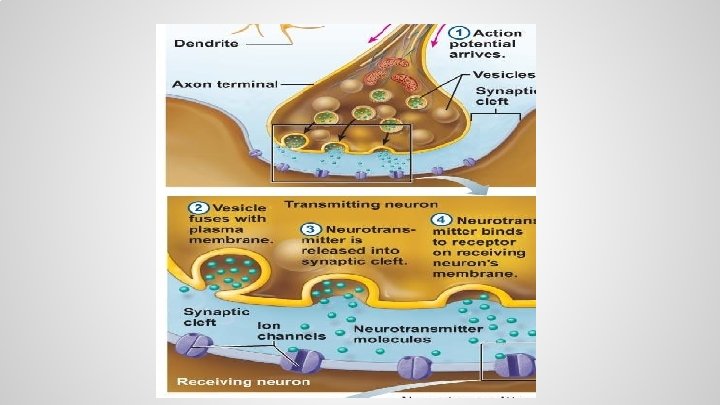
Transmission of a Signal at Synapses • When the action potential reaches the axon terminal, the electrical charge opens calcium channels • Calcium, in turn, causes the tiny vesicles containing the neurotransmitter chemical to fuse with the axonal membrane and release the neurotransmitter into the synapse cleft
• The neurotransmitter molecules diffuse across the synapse and bind to receptors on the membrane of the next neuron • If enough neurotransmitter is released, graded potential will be generated • Eventually an action potential (nerve impulse) will occur in the neuron beyond the synapse
Motor Division Of PNS Autonomic Nervous System ● Controls the body activities automatically ● Cardiac and smooth muscles, glands ● two motor neuron pathway (one in the brain or spinal cord and the other outside the CNS) Somatic Nervous system ● Controls the body activities voluntarily ● Skeletal muscle ● One motor neuron pathway( starts in the CNS and extends to the skeletal muscle)
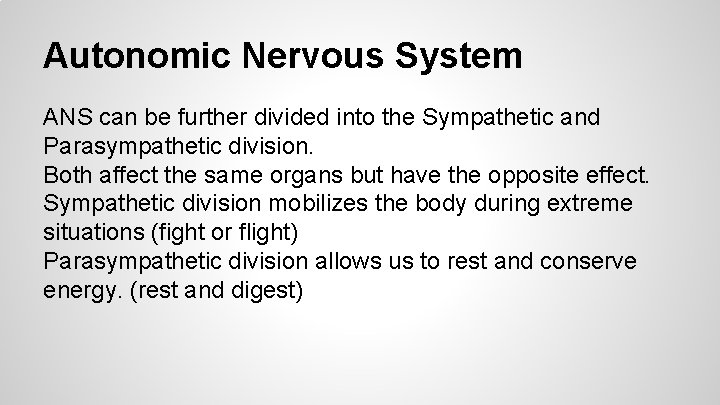
Autonomic Nervous System ANS can be further divided into the Sympathetic and Parasympathetic division. Both affect the same organs but have the opposite effect. Sympathetic division mobilizes the body during extreme situations (fight or flight) Parasympathetic division allows us to rest and conserve energy. (rest and digest)